
Schaeffler to Cut 3,460 Positions in Europe and Close Five Sites as Combustion Demand Weakens
Schaeffler AG, the German automotive and industrial supplier, said Nov. 3 it will cut a net 3,460 positions in Europe and close five sites, four of them in Germany, as weak demand for combustion-engine vehicles and a slower ramp-up of electric mobility strain its operations. The company, based in Herzogenaurach, Germany, disclosed the program on the same day it reported nine-month results and confirmed its 2026 outlook.
Key developments
- The program covers 16 European locations and about 2,660 of the 3,460 net position cuts fall in Germany. Roughly half of the positions are in production, 30% in research and development and 20% in other functions.
- Schaeffler plans to close sites in Dortmund, with about 430 employees; Morbach, with about 160; Berlin, with about 270; Schwalbach, with about 385; and Herstal, Belgium, with about 15.
- The company expects savings of about 300 million euros per year by 2030 and one-time expenses of about 480 million euros, most of them booked as restructuring provisions in 2026.
- A temporary, voluntary pay reduction, starting with the Board of Managing Directors and extending to all levels, is meant to limit job losses and one-time costs. Its details are still being worked out.
- Nine-month revenue was 17.48 billion euros, against 17.67 billion euros a year earlier, and earnings before interest and taxes before special items rose 6.5% to 794 million euros.
Background: A second round after the Vitesco merger
The new measures follow a restructuring Schaeffler announced in November 2024, shortly after it combined with powertrain specialist Vitesco Technologies, and about 1,800 partial-retirement agreements concluded in early October. Counting those earlier steps, the company said the reduction in its German core workforce reaches about 18% by 2028. That core workforce stood at 31,957 on Sept. 30.
Schaeffler set four goals: removing excess capacity, adjusting development capacity, lowering personnel costs and simplifying an organization it said has too many management levels. It also cited above-average costs per employee in Germany. CEO Klaus Rosenfeld said the company wants to show that competitive manufacturing in Germany remains possible and sensible despite the operating environment.
The closures reflect that reasoning unevenly. Dortmund and Morbach both belong to the Powertrain & Chassis division and make combustion-engine products, so their closure follows directly from falling volumes. Schwalbach is different: Schaeffler expects a large portion of its roughly 385 employees to transfer to its Frankfurt site, with about 190 positions affected in total.
Industry implications
The nine-month figures show why a supplier with improving margins is still cutting capacity. The group margin before special items rose to 4.5% from 4.2%, yet the gains were uneven across divisions. Powertrain & Chassis revenue fell 4.6% after currency adjustment to 6.30 billion euros, with its margin slipping to 10.8% from 11.5%.
E-Mobility moved the other way. Its revenue grew 4.6% on a currency-adjusted basis to 3.87 billion euros, but it lost 571 million euros before special items, a margin of negative 14.8%. Schaeffler also decided on measures in the division that produced about 240 million euros in impairments and provisions, tied to lower volumes on European carmakers' projects, especially in China. Most of the charges relate to production equipment, and about 220 million euros landed in the third quarter.
The combination is the central problem for many suppliers managing the transition: the profitable combustion business is shrinking, while the electric business that should replace it is growing but remains deep in losses. Vehicle Lifetime Solutions, at a 15.1% margin, and Bearings & Industrial Solutions, at 8.9%, are carrying more of the load.
Competitive and supply chain implications
Schaeffler's move lands during a wider reset among European auto companies. Volvo Cars said Oct. 23 it would cut about 2,500 jobs globally, and SKF is preparing to separate its automotive bearing business as SKF Vertevo, with a Nasdaq Stockholm listing expected Dec. 1. SKF is choosing separation, while Schaeffler keeps its automotive and industrial businesses under one roof.
For automakers, the immediate question is continuity of combustion-engine parts supply as Dortmund and Morbach wind down, which makes any transfer of work to other sites important. Schaeffler says structural measures fall mainly in 2027 and 2028.
The program also trims capabilities that sit behind the factory floor. Toolmaking at Höchstadt will end, and special machinery activities at Erlangen and Schweinfurt will be adjusted. Those changes could push some of that work to outside vendors or other Schaeffler sites. The 30% share of cuts in research and development points to a narrower engineering base as well.
Chief Operating Officer Jochen Schröder pointed to humanoid robotics and defense as promising fields that draw on existing technology, and the company said at least part of the job cuts will be offset by new roles in growth areas. Rosenfeld separately cited new customer wins in humanoid robotics during the reporting period.
Regional implications
Germany takes about 77% of the net cuts, with effects spread beyond the four closing sites. Schaeffler listed capacity changes at Herzogenaurach, Bühl, Höchstadt, Nürnberg and Regensburg, several of them in Bavaria, on top of closures in North Rhine-Westphalia, Rhineland-Palatinate, Berlin and Hesse.
Outside Germany, the company plans adjustments at Haguenau and Toulouse in France and at Skalica and Kysuce in Slovakia. Herstal in Belgium is the only closure outside Germany. Schaeffler said it will carry out the measures under its 2018 Future Accord and in dialogue with employee representatives, and Chief Human Resources Officer Astrid Fontaine stressed a socially responsible approach. Site-specific details will be presented at local staff meetings.
Credence Research analysis
The most telling element is the mix of the cuts, not their total. Half of the reductions fall outside production, which suggests Schaeffler sees its problem as overhead and engineering breadth as well as surplus plant capacity. The 2024 combination with Vitesco gave it a broader powertrain portfolio, and this program reads as an effort to pay for that breadth now that electric volumes have arrived later than planned. The E-Mobility charges, tied to projects with lower volumes, support that reading.
The solidarity contribution deserves close attention because Rosenfeld called it the program's most important element and because its terms remain open. A voluntary pay reduction across all levels could reduce job losses and ease the 2027 and 2028 income statements, but its value depends on participation. The financial balance also leaves little margin for delay: with leverage at 2.3 times before special items and nine-month free cash flow before M&A of negative 40 million euros, the 480 million euros in one-time costs come before savings that reach their full rate only by 2030. Third-quarter free cash flow of 260 million euros gives some room.
What comes next
- Local staff meetings will present site-specific details at affected locations.
- Management will discuss implementation with employee representatives and works councils under the Future Accord.
- Schaeffler must finalize the terms of the solidarity contribution, with relief expected in 2027 and 2028.
- Most of the 480 million euros in one-time expenses is expected to be booked as restructuring provisions in 2026.
- Structural measures are scheduled mainly for 2027 and 2028, with savings of about 300 million euros per year by 2030.
Sources
- Schaeffler: Schaeffler announces further performance improvement program
- EQS News: Schaeffler corporate news release on the program
- Schaeffler: Nine-month 2026 results release (German)
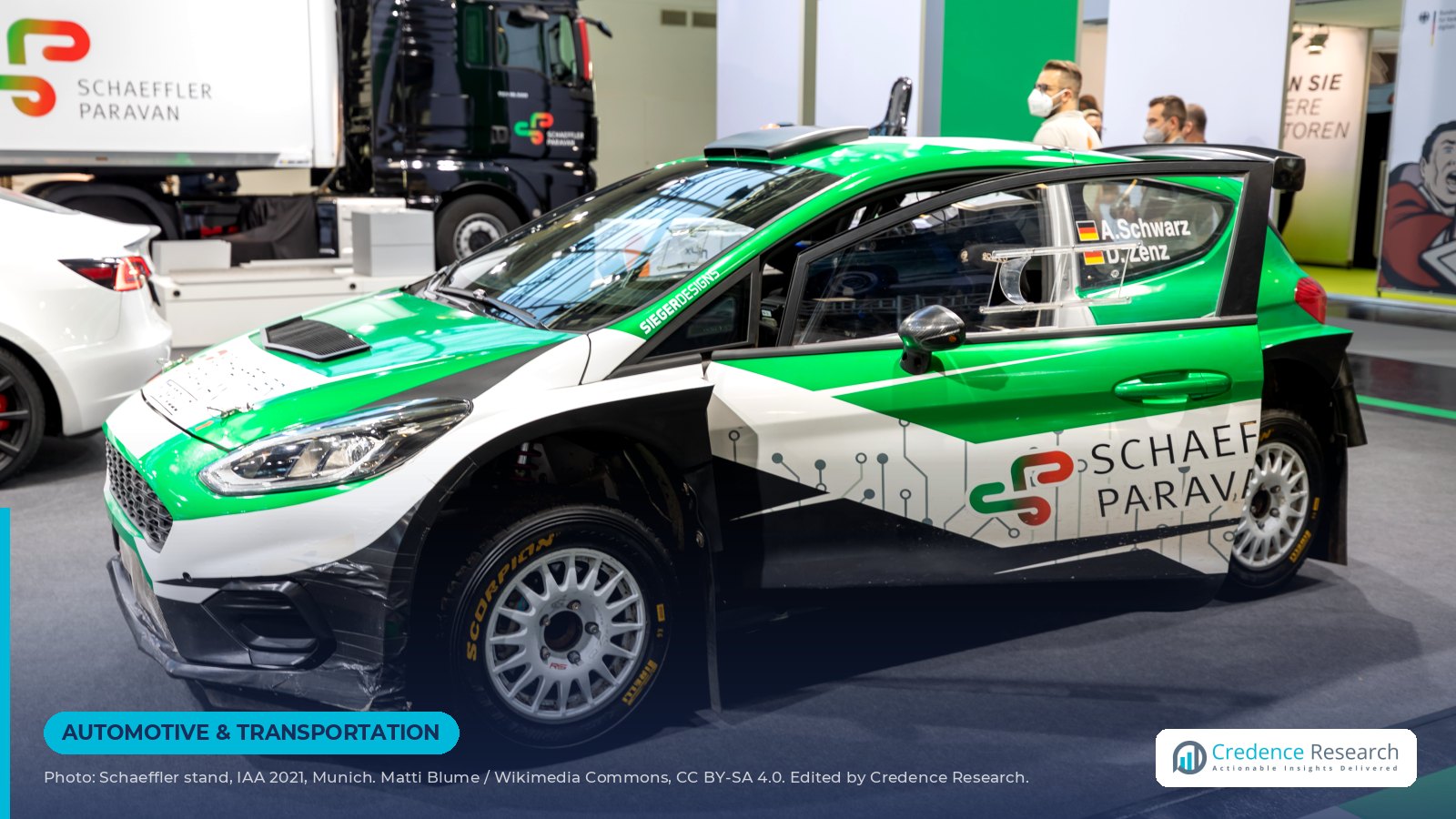
Image: A Schaeffler Paravan-branded rally car on display at IAA 2021 in Munich, by Matti Blume via Wikimedia Commons, CC BY-SA 4.0. Cropped and edited by Credence Research.

About the Author

Senior News Editor at Credence Research Inc