
Lockheed Martin to Invest $420 Million in Camden, Arkansas, Adding 650 Missile Production Jobs
Lockheed Martin plans to spend $420 million expanding its missile and rocket manufacturing operations in Camden, Arkansas, and expects to add 650 full-time jobs over five years, the Arkansas Economic Development Commission said Nov. 2, 2026. The added capacity is aimed at three programs in heavy demand: the PAC-3 and THAAD air defense interceptors and the Precision Strike Missile.
Key developments
- The $420 million is capital investment in Camden manufacturing operations at the Highland Industrial Park, according to the state's release.
- The 650 new full-time positions would come over five years, on top of about 1,100 people Lockheed Martin employs in Camden today.
- The expansion is meant to raise production capacity for PAC-3, Terminal High Altitude Area Defense (THAAD) and the Precision Strike Missile (PrSM).
- The site covers 2.2 million square feet on 2,427 acres and works on seven U.S. Department of War programs. The others are ATACMS, GMLRS, HIMARS and M270.
- The release gives no construction schedule, completion date or incentive amount for the new investment.
Why Camden matters to missile output
Lockheed Martin established its Camden operations in 1979 and says the site has delivered more than 700,000 missiles and rockets over four decades. The company's Grand Prairie, Texas, plant makes parts that feed final assembly at Camden and at Troy, Alabama, which makes Camden one of the places where growth in machined parts has to turn into finished rounds.
The Nov. 2 announcement follows three framework agreements Lockheed Martin signed with the Department of War this year. The January PAC-3 MSE agreement calls for annual output to rise from about 600 to about 2,000 interceptors over seven years. A second agreement, signed Jan. 29, targets THAAD output of 400 interceptors a year, up from 96, also over seven years. A third, announced March 25, is intended to quadruple PrSM production, and Lockheed Martin's summary describes a seven-year term and capacity of 550 missiles a year.
Camden has already drawn investment under those plans. On Jan. 29, Lockheed Martin broke ground there on a Munitions Acceleration Center to train workers to build THAAD, PAC-3 and other systems using advanced manufacturing, robotics and digital tools. The company has also said Camden has 115,500 square feet of PrSM production space and 400 employees assigned to that program.
Industry implications
The size of the commitment matters less than where it lands. Framework agreements set production ambitions, but those targets depend on physical capacity and trained workers at specific sites. A named capital figure and a jobs count at a final assembly location show the targets moving into plant-level spending. The state's release does not break the $420 million down by program, so it is not possible to say how much of the capacity increase each missile line will receive.
Labor may prove as hard as equipment. If all 650 positions are filled and existing employment holds, Camden's Lockheed Martin workforce would grow by nearly 60%. Missile assembly requires skilled technicians who handle energetic materials and work under strict quality and security requirements. Pairing the expansion with a dedicated training center suggests the company expects hiring and qualification to be a limiting factor, not an afterthought.
Funding remains a separate question. When Lockheed Martin announced the PAC-3 and THAAD frameworks in January, it said initial contract awards were expected to follow fiscal 2026 appropriations and, for THAAD, other funding sources. The company announced a first accelerated PAC-3 MSE contract in April. Long-term capacity decisions by contractors carry more risk if annual budgets do not keep pace with the volumes those frameworks describe.
Competitive and supply chain implications
Camden is part of a wider Lockheed Martin program. The company said Oct. 14 that it plans to invest $8 billion to $9 billion through 2030 to modernize or expand more than 20 U.S. facilities, and that it was putting $300 million into Grand Prairie. The Arkansas release does not say whether the $420 million falls within that total.
Rival RTX is on a similar path. Manufacturing Dive reported in October that its Raytheon unit received contracts worth up to $24.4 billion for SM-6 production and $6.3 billion for SM-3 Block IB work, tied to its own framework agreements with the Pentagon. Both companies now draw on many of the same supplier categories, including rocket motors, seekers, electronics and specialty materials, so their ramps could compete for the same constrained inputs.
Propulsion is a clear example. L3Harris opened a solid rocket motor plant in Camden in October, designed to double GMLRS motor capacity, and Lockheed Martin signed a motor agreement with Italy's Avio on Oct. 13. For smaller suppliers, longer production horizons under seven-year frameworks may offer a stronger basis for their own capacity spending, though they will still need firm orders to justify it.
Regional implications
The investment adds to Camden's concentration of defense manufacturing in south Arkansas. The state's economic development agency described the city as a recognized defense manufacturing hub, and Gov. Sarah Huckabee Sanders' statement linked its growth to rebuilding the defense industrial base. James Lee Silliman, executive director of the Ouachita Partnership for Economic Development, said the project would be a major lift for the Calhoun and Ouachita County economy.
A rural labor market will feel that demand directly. Hundreds of new positions at one employer, alongside hiring by other defense manufacturers in the same area, could put pressure on housing, training programs and wages for skilled trades. Regional colleges and workforce agencies are likely to become more important partners as the five-year hiring period advances, although the release does not announce specific programs with them.
Credence Research analysis
Lockheed Martin's Camden commitment is best read as the plant-level follow-through on national production targets set earlier this year. The three framework agreements describe large increases in annual output, and capital spending at final assembly sites is one of the first signs that those numbers are being turned into real capacity. The company's choice to name three programs, rather than the seven the site supports, signals where it sees the most urgent demand.
The evidence for delivery is still incomplete. The release offers no capacity figure tied to the investment, no construction timeline and no split by program, so the announcement cannot yet be measured against the framework targets. The more useful tests will be contract awards, hiring progress against the 650-job goal and annual delivery counts for PAC-3, THAAD and PrSM. Bottlenecks in motors, seekers and skilled labor could still limit output even after new floor space is ready.
What comes next
- Any disclosure of a construction schedule or completion date for the Camden expansion.
- Progress on the Munitions Acceleration Center and its first training groups.
- Lockheed Martin's hiring pace against the 650-job target over five years.
- Further contract awards and appropriations tied to the PAC-3, THAAD and PrSM framework agreements.
- Additional facility announcements under Lockheed Martin's plan covering more than 20 U.S. sites.
Sources
- Arkansas Economic Development Commission release on the Camden investment
- Lockheed Martin THAAD framework agreement and Munitions Acceleration Center
- Lockheed Martin PAC-3 MSE framework agreement
- Lockheed Martin PrSM production agreement
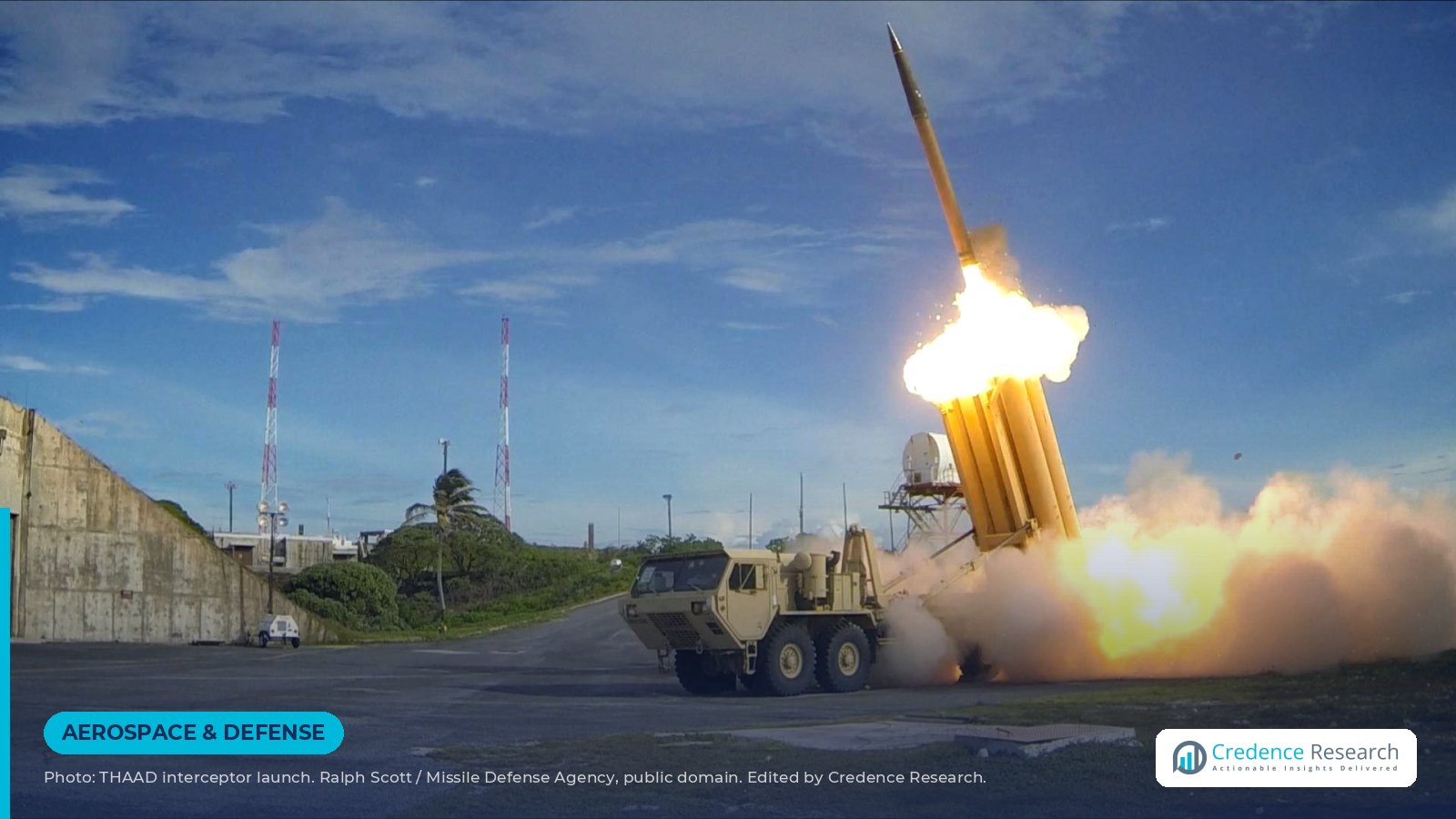
Image: THAAD interceptor launch during an intercept test, by Ralph Scott, Missile Defense Agency, via Wikimedia Commons, public domain. Cropped and edited by Credence Research.

About the Author

Senior News Editor at Credence Research Inc