
FDA Grants Priority Review to uniQure's Huntington's Gene Therapy, Sets May 1 Decision Date
The U.S. Food and Drug Administration has accepted uniQure's Biologics License Application for ifezuntirgene inilparvovec, also known as AMT-130, and granted it Priority Review, the company said Nov. 2 from Lexington, Massachusetts, and Amsterdam. The one-time gene therapy for Huntington's disease now carries a target action date of May 1, 2027, and could become the first treatment shown to slow the inherited brain disorder if regulators accept the evidence behind it.
Key developments
- The FDA accepted the application under its Accelerated Approval pathway and granted Priority Review, with a Prescription Drug User Fee Act target date of May 1, 2027.
- The acceptance letter said the agency is tentatively planning to discuss the application at an advisory committee meeting. No date has been set.
- The filing relies on 36-month Phase I/II data compared with a propensity score-matched external control drawn from the Enroll-HD natural history database.
- uniQure and the FDA have aligned on a confirmatory trial of about 200 patients, randomized 2:1 against standard of care, with U.S. screening planned by the end of 2026.
- The therapy also holds Breakthrough Therapy, Regenerative Medicine Advanced Therapy and Fast Track designations.
Disease and technology background
Huntington's disease is a rare, autosomal dominant neurodegenerative disorder caused by a CAG repeat expansion in the first exon of the huntingtin gene. It produces motor symptoms, behavioral changes and cognitive decline. uniQure estimates about 75,000 people have the disease across the United States, the European Union and the United Kingdom, with hundreds of thousands more at risk. The company says no approved therapy delays onset or slows progression.
AMT-130 is built on uniQure's miQURE gene-silencing platform and carries a microRNA designed to silence the huntingtin gene and its potentially toxic exon 1 protein fragment. Delivery is a single administration through MRI-guided, convection-enhanced stereotactic neurosurgery directly into the caudate and putamen, the two structures of the striatum. Across the Phase I/II cohorts, 51 patients have received the therapy.
The regulatory path has moved quickly since mid-year. uniQure said June 17 that the FDA considered the three-year analysis acceptable as the primary basis for an accelerated approval filing, provided the two sides agreed on a confirmatory study first. The company submitted the application Sept. 2 and filed a parallel marketing authorization application in the United Kingdom on the same data.
Industry implications
The review will test how far regulators will rely on external controls for a one-time neurological gene therapy. In the data cut behind the filing, 12 high-dose patients with 36 months of follow-up were compared with matched patients from Enroll-HD rather than with a concurrent randomized arm. The company reported 75% slowing on the composite Unified Huntington's Disease Rating Scale, or cUHDRS, and 60% slowing on Total Functional Capacity in that September 2025 analysis.
Later data complicate the picture. In a Sept. 29 update using a June 30, 2026, data cutoff and a revised control set, uniQure reported 80% slowing on cUHDRS at 36 months, with a nominal p-value of 0.005. At 48 months, with 12 high-dose patients, cUHDRS slowing was 44% with a nominal p-value of 0.144, while Total Functional Capacity slowing was 61% with a nominal p-value of 0.008. The company attributes the weaker cUHDRS result largely to missing data and survivor bias in the external control, where missingness reached 53% at month 48.
That debate is likely to shape any advisory committee discussion. Safety will also draw attention: across all cohorts, 20 of 51 patients had a serious adverse event and five had one the company judged drug related. One low-dose patient died by suicide about five years after treatment, which uniQure assessed as unrelated.
Competitive and supply chain implications
AMT-130 is ahead of rival Huntington's programs on the regulatory calendar, but it faces a different delivery proposition. Huntington's Disease News reported in July that Novartis began dosing in June in the Phase 3 INVEST-HD trial of oral votoplam, that Skyhawk Therapeutics is enrolling the global portion of its Phase 2/3 FALCON-HD study of SKY-0515, and that Prilenia has launched the Phase 3 PRECISE-HD trial of pridopidine. Those candidates are oral drugs rather than a neurosurgical procedure.
The delivery route also defines the supply chain question. A stereotactic, MRI-guided procedure depends on neurosurgical teams, imaging capacity and centers trained in the technique, in addition to vector supply. uniQure has not detailed a site network in the materials reviewed for this article. Its second-quarter release said resources are being used to fund the anticipated launch, and reported $810.3 million in cash, cash equivalents and current investment securities as of June 30, which it expects to fund operations into 2030.
The confirmatory trial is its own operational commitment. FDA draft guidance, as described by uniQure, says such a study should be well underway, and potentially fully enrolled, by the time of accelerated approval. The FDA suggested a standard-of-care control instead of a sham procedure, a design that spares control patients from surgery but removes blinding of participants to their treatment.
Regional implications
In the United States, the May 2027 date puts Huntington's patients, neurologists and payers on a defined timeline. U.S. screening for the confirmatory study is expected to begin before the end of this year, which means the trial and the review will run side by side.
In Britain, the Medicines and Healthcare products Regulatory Agency is reviewing the parallel application based on the same data, following a pre-submission meeting in March. A European Medicines Agency filing was not described in the company's recent releases, leaving the European Union's position open even though its patients are included in uniQure's population estimate and the company runs an open-label European study of 13 patients.
Credence Research analysis
The acceptance is a procedural step rather than a verdict on efficacy, yet it matters because it moves a contested evidence package into a formal review with a fixed date. Priority Review and the tentative advisory committee point in different directions: the first reflects the seriousness of the disease and the lack of options, while the second signals that the agency may want outside input on data that rest on a small high-dose group and a non-randomized comparison.
The central issue for developers beyond Huntington's disease is how regulators treat durability evidence that weakens on one endpoint as follow-up lengthens. The filing rests on 36-month data, but the 48-month results are now public, and uniQure's own risk language acknowledges that the FDA could find the data insufficient. A clear outcome either way would give sponsors of other one-time therapies for slowly progressing neurological diseases a practical reference point on external control design, missing data and the timing of confirmatory trials.
What comes next
- The FDA is expected to finalize the date and timelines of any advisory committee meeting and notify uniQure.
- U.S. screening for the roughly 200-patient confirmatory trial is planned to begin by the end of 2026, with Total Functional Capacity at 36 months as the primary endpoint.
- The FDA target action date is May 1, 2027.
- The UK review of the marketing authorization application continues in parallel.
- Rival oral programs continue enrolling, with cUHDRS as the primary endpoint in all three trials cited above.
Sources
- uniQure: FDA acceptance and Priority Review release, Nov. 2, 2026 (SEC exhibit)
- uniQure: AMT-130 program update, Sept. 29, 2026 (SEC exhibit)
- uniQure: Plan for BLA submission, June 17, 2026 (SEC exhibit)
- Huntington's Disease News: Oral therapies in ongoing trials, July 2026
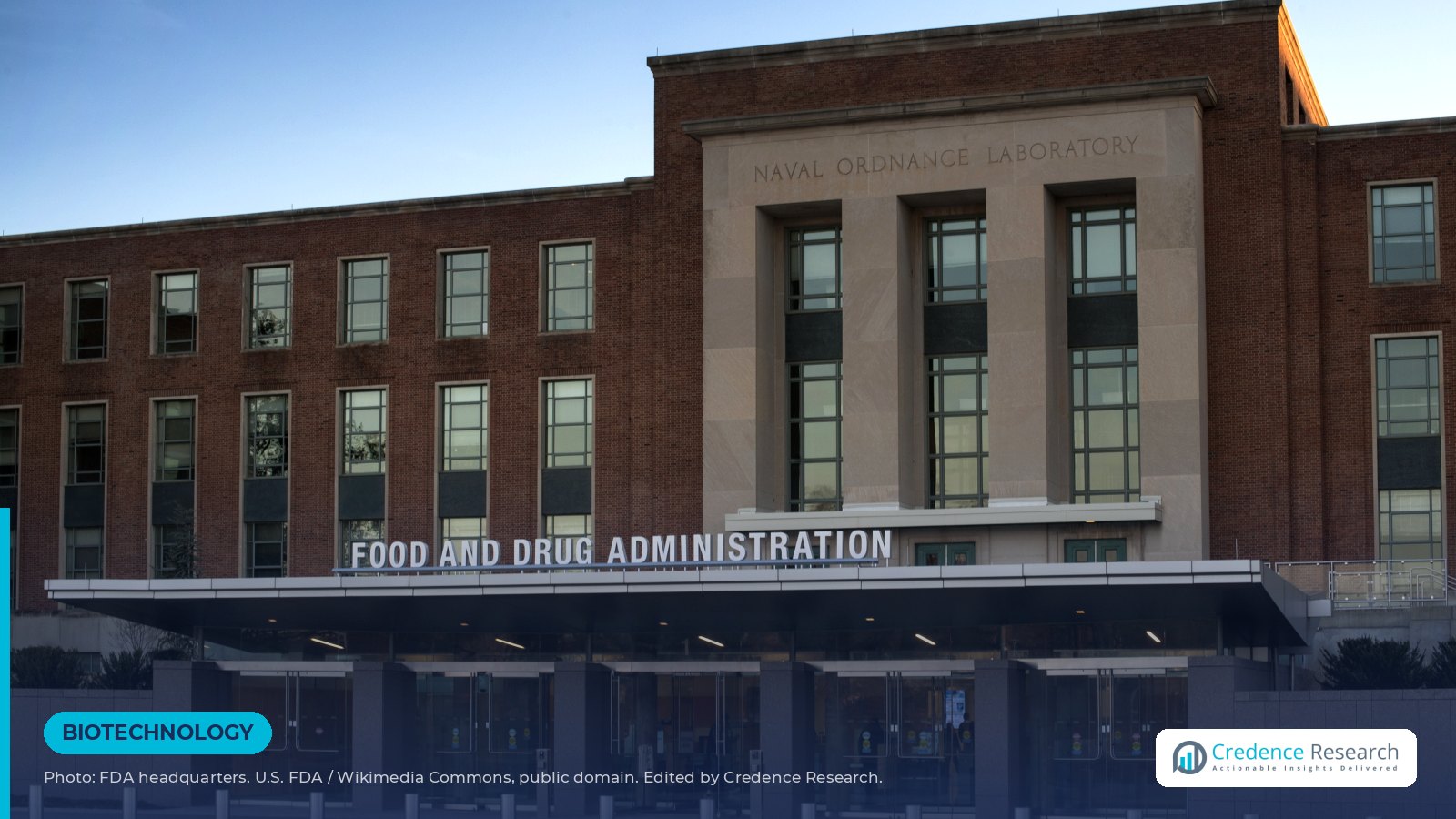
Image: Entrance to the U.S. Food and Drug Administration headquarters, by The U.S. Food and Drug Administration via Wikimedia Commons, public domain. Cropped and edited by Credence Research.

About the Author

Senior News Editor at Credence Research Inc