
CenterPoint Energy Raises 10-Year Capital Plan to $70.7 Billion as Houston Load Requests Surge
CenterPoint Energy raised its 10-year capital investment plan by $4 billion to $70.7 billion on Oct. 27, 2026, as the Houston-based utility moves to expand grid capacity for a surge of industrial, commercial and data center demand across Greater Houston. The company disclosed the increase with its third-quarter 2026 results and also pulled another $1.5 billion of spending into the first five years of the plan.
Key developments
- CenterPoint lifted its 10-year capital plan from $66.7 billion to $70.7 billion and accelerated $1.5 billion of investment into the first five years, according to its earnings release.
- The company kept its estimate of at least $10 billion in additional investment opportunities through 2035, tied to reliability, safety and economic development.
- CenterPoint said the added load on its Houston system should deliver about $5 billion in savings for Texas residential and commercial customers over the next decade.
- Executives told analysts they expect 14 GW of new demand to come online through 2030 and have submitted 17 GW of projects to ERCOT's large-load process, Utility Dive reported.
- Third-quarter GAAP net income was $331 million, or 50 cents per diluted share, with non-GAAP earnings of 53 cents per share.
Industry background
CenterPoint serves nearly 7 million metered electric and natural gas customers in Indiana, Minnesota and Texas. Its largest growth engine is Houston Electric, the transmission and distribution utility that delivers power across the Houston region inside the Electric Reliability Council of Texas grid. Because Texas separates wires companies from power generators in most of ERCOT, CenterPoint earns its return on poles, lines, substations and transformers rather than on power plants in that territory.
The utility has spent the past two years rebuilding its operational credibility. Hurricane Beryl in July 2024 left more than 2 million of its customers without power, triggering regulatory scrutiny and a push to harden the system. On the earnings call, executives said reliability has improved 40% since 2024 and that the company plans to file its next System Resiliency Plan by the end of 2027, according to Utility Dive.
The new plan arrives only three months after CenterPoint set the previous $66.7 billion figure in July. Of the revised total, about $51.5 billion is earmarked for electric operations and $19 billion for natural gas, with the remainder at the corporate level, Utility Dive reported.
Industry implications
The revision shows how quickly large-load requests are reshaping utility capital planning in Texas. Chairman, President and CEO Jason Wells said the region's speed-to-market advantage is creating a compelling pipeline of customer-driven investment, and that the $4 billion increase is meant to expand system capacity for that growth. Executives said the company received nearly 1 GW of distribution-level load requests in the past year and that industrial and commercial leasing in the Houston area is up more than 30% from a year earlier, according to Utility Dive.
ERCOT's batch study process for large loads now sets the pace for how much of that demand reaches the grid. CenterPoint said it expects 12 GW of its 17 GW submission to be eligible as base or studied load. Batch Zero is underway, and Batch One opens for applications in summer 2027, Utility Dive reported. The company's release lists ERCOT approval of the gigawatts to be connected, and any failure to win approval in Batch Zero or later batches, among its key risk factors.
The customer savings claim matters for regulators. CenterPoint argues that spreading fixed grid costs over a much larger volume of delivered electricity can lower bills for households and small businesses even as total spending climbs. That argument will be tested in rate proceedings before the Public Utility Commission of Texas.
Competitive and supply chain implications
A wires-heavy plan of this size places CenterPoint among the largest buyers of grid equipment in the country. Power transformers, high-voltage breakers, switchgear and conductor have faced long lead times since 2022, and a utility that accelerates $1.5 billion of work into the near term needs firm manufacturing slots, crews and substation sites. Equipment makers that have announced U.S. capacity expansions stand to benefit from steady Texas orders.
Transmission is a growing piece of the picture. CenterPoint's release refers to 765-kilovolt transmission projects and transmission planning studies, and executives said an internal study identified more than a dozen projects to add load-serving capacity, according to Utility Dive. Extra-high-voltage lines are new to ERCOT, and the first wave of projects will compete for the same specialized engineering, steel structures and construction contractors.
For data center developers, the plan signals that Houston intends to compete with Dallas-Fort Worth and West Texas for hyperscale and AI campuses. Utilities that can show credible capacity timelines tend to win site selection decisions, and CenterPoint is positioning its capital plan as proof that it can connect large customers quickly.
Regional implications
Texas carries most of the new spending. The Houston region's petrochemical complex, port activity, liquefied natural gas supply chain and emerging data center cluster all depend on Houston Electric's ability to add substations and feeders. A faster build-out could support industrial electrification projects along the Ship Channel that previously waited on grid capacity.
Indiana and Minnesota remain part of the story. CenterPoint said its additional opportunities of at least $10 billion include transmission, resiliency and large-load projects, including in Indiana, Utility Dive reported. Its natural gas utilities, which account for roughly $19 billion of the plan, continue pipeline replacement and safety work across its service territories.
Credence Research analysis
CenterPoint's update is a clear case of load growth turning into balance sheet commitments at a regulated utility. A $4 billion increase only one quarter after the prior plan suggests demand signals in Houston are moving faster than the company's own planning cycle. The key question is conversion: 17 GW of submitted requests is a pipeline, not signed load, and ERCOT's batch process will decide how much of it actually energizes this decade. Investors and regulators should watch the gap between studied load and contracted interconnections over the next 12 to 18 months.
The plan also concentrates execution risk. CenterPoint must deliver more equipment, more crews and more transmission at the same time it is still rebuilding public trust after Beryl. If equipment lead times stay long or storm season disrupts construction, accelerated spending could slip back. If it executes, Houston could gain a meaningful advantage in attracting energy-intensive industry and data centers, and CenterPoint's argument that growth lowers average customer costs would become a template for other fast-growing Texas utilities.
What comes next
- ERCOT's Batch Zero large-load study results will determine how much of CenterPoint's 17 GW submission moves toward connection.
- Batch One opens for large-load applications in summer 2027, according to Utility Dive.
- CenterPoint plans to file its next System Resiliency Plan with Texas regulators by the end of 2027.
- Transmission planning studies, including 765-kV projects, will shape the scope of future capital plan updates.
- Rate proceedings at the Public Utility Commission of Texas will test the company's projected $5 billion in customer savings.
Sources
- CenterPoint Energy third-quarter 2026 earnings release (Form 8-K, Exhibit 99.1)
- Utility Dive: CenterPoint expands 10-year capital plan by $4B to handle load growth
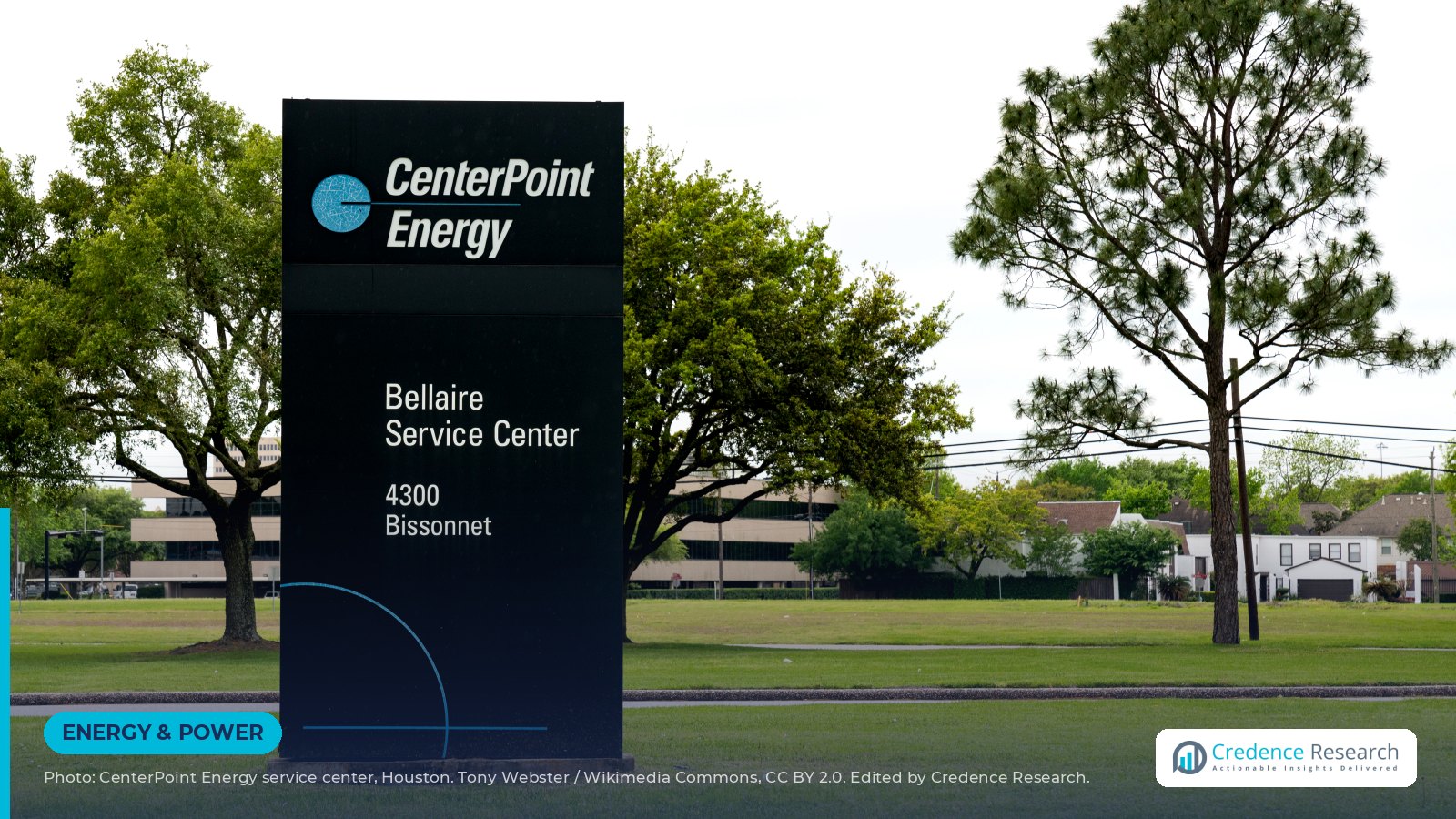
Image: CenterPoint Energy Bellaire Electric Service Center in Houston, by Tony Webster via Wikimedia Commons, CC BY 2.0. Cropped and edited by Credence Research.

About the Author

Senior News Editor at Credence Research Inc