
China Approves Bayer's Asundexian, the First Factor XIa Inhibitor, for Secondary Stroke Prevention
China's National Medical Products Administration has approved Bayer's asundexian, sold as Sunharbo, for adults who have had a non-cardioembolic ischemic stroke or a high-risk transient ischemic attack, the Berlin-based drugmaker said on Oct. 26, 2026. The once-daily 50 mg tablet is the first Factor XIa inhibitor to win marketing authorization anywhere in the world, according to Bayer, and the decision gives the company a commercial foothold for a drug class that much of the industry has pursued for nearly a decade as a way to prevent clots with less bleeding.
Key developments
- The NMPA granted marketing authorization for asundexian 50 mg to reduce the risk of stroke in adults after a non-cardioembolic ischemic stroke or high-risk transient ischemic attack, following a Priority Review designation from China's Center for Drug Evaluation.
- Bayer said the approval makes asundexian the first FXIa inhibitor approved worldwide.
- The approval rests on the Phase III OCEANIC-STROKE trial of 12,327 participants, in which asundexian added to single or dual antiplatelet therapy cut ischemic stroke by 26% versus antiplatelet therapy alone.
- The trial met its primary safety endpoint of ISTH major bleeding, and the incidence of all bleeding events was similar between groups, Bayer said.
- Applications are under review in additional markets. The U.S. Food and Drug Administration accepted Bayer's New Drug Application with Priority Review in May 2026.
How the drug works
Factor XIa is an enzyme in the intrinsic coagulation pathway. Researchers have targeted it because people born with a deficiency of Factor XI appear to have fewer thrombotic events without the severe spontaneous bleeding seen in other clotting disorders. The theory behind the class is that blocking Factor XIa can limit pathological clot growth while leaving the body's normal response to injury largely intact.
That distinction matters in secondary stroke prevention. Patients who survive a non-cardioembolic ischemic stroke typically receive aspirin, clopidogrel or a short course of both. Adding a conventional anticoagulant on top of that regimen has historically raised bleeding risk, including bleeding in the brain, which has limited how aggressively physicians can treat recurrence risk. Bayer said about one in 10 survivors of this stroke type has another stroke within a year, even with current prevention strategies.
OCEANIC-STROKE was a global, randomized, double-blind, placebo-controlled, event-driven study. Bayer said the treatment effect was consistent across age, sex, index event type, stroke subtype, stroke severity and planned antiplatelet regimen. Results were presented at the International Stroke Conference 2026 in New Orleans and published in The New England Journal of Medicine.
Industry implications
The approval is a validation point for a class that has had a difficult run. Bayer stopped its OCEANIC-AF trial in atrial fibrillation in November 2023 after asundexian showed inferior efficacy to apixaban, a setback that raised doubts about whether Factor XIa inhibition could deliver enough protection. The stroke program took a different approach, adding the drug to antiplatelet therapy rather than replacing an established anticoagulant, and that design produced a positive result.
For drug developers, the outcome suggests that the clinical setting may matter as much as the mechanism. A modest, well-tolerated antithrombotic effect layered on top of existing therapy appears to be a viable path, while head-to-head replacement of direct oral anticoagulants remains a harder test. That lesson is likely to shape trial design across the remaining Factor XI and XIa programs.
China's regulator also acted ahead of the FDA, which accepted the U.S. application under Priority Review in May. The sequence reflects Beijing's push to speed reviews of innovative medicines and gives multinational companies a reason to file in China early rather than treat it as a follow-on market.
Competitive and supply chain implications
The closest rival is milvexian, an oral Factor XIa inhibitor developed by Bristol Myers Squibb and Johnson & Johnson. The partners halted the Librexia ACS trial in acute coronary syndrome in November 2025 after an interim analysis found it was not on track to meet its primary efficacy goal, while the Librexia STROKE and Librexia AF studies continued. Pharmaphorum reported that milvexian has not yet been submitted for approval in any market and that its stroke readout, originally due later in 2026, could slip into 2027.
That gap gives Bayer a first-mover window in secondary stroke prevention, including time to build relationships with neurologists, stroke centers and hospital formularies before a second oral agent arrives. In China, access will also depend on hospital listing and reimbursement decisions. Bayer said it is working with stakeholders to support equitable and timely access for eligible patients, which points to pricing and reimbursement talks as the next commercial hurdle.
On the supply side, asundexian is a small-molecule tablet, which fits conventional oral solid dose manufacturing and distribution rather than the cold-chain logistics required by biologics. That should simplify scale-up across hospital and retail pharmacy channels if reimbursement follows.
Regional implications
China carries one of the world's heaviest stroke burdens. Bayer said stroke is the leading cause of death and disability in the country, and that ischemic stroke prevalence rose 10% between 2010 and 2021 to more than 20 million cases. An aging population and high rates of hypertension keep secondary prevention a public health priority.
In the United States, the FDA granted asundexian Fast Track designation in 2023 and accepted the New Drug Application with Priority Review in May 2026, so a U.S. decision is the next major regulatory event. Pharmaphorum reported that the European Medicines Agency has also begun its review. Approval in those markets would move the drug into stroke care pathways that differ from China's in reimbursement and in how antiplatelet therapy is prescribed after discharge.
Credence Research analysis
The Chinese approval matters less for its immediate scale than for what it establishes. Bayer now holds the first regulatory clearance for a Factor XIa inhibitor, based on a large outcomes trial that met both its efficacy and major bleeding endpoints. That evidence package will be the benchmark against which milvexian and other Factor XI programs are judged, and it shifts the debate over the class from whether it works to where it works best. After the atrial fibrillation failure in 2023, the answer so far appears to be as an add-on to antiplatelet therapy in patients whose main risk is arterial, non-cardioembolic stroke.
The commercial test is adoption. A 26% relative reduction in ischemic stroke without a significant rise in major bleeding is a clinically meaningful result, but uptake will depend on how guideline committees in China, the U.S. and Europe weigh it against low-cost generic antiplatelet regimens, and on the price Bayer negotiates in each system. Bayer also needs a durable pharmaceutical growth driver as older franchises lose exclusivity, which raises the stakes on a smooth U.S. review and a fast launch in China.
What comes next
- A U.S. FDA decision on the asundexian New Drug Application, which is under Priority Review.
- The European Medicines Agency's assessment of the application for secondary stroke prevention.
- Bayer's commercial launch in China and its talks on hospital access and reimbursement.
- Topline results from BMS and Johnson & Johnson's Librexia STROKE trial of milvexian, which could arrive late in 2026 or in 2027.
- Updates to stroke prevention guidelines that address Factor XIa inhibitors alongside antiplatelet therapy.
Sources
- Bayer: Asundexian first Factor XIa inhibitor approved in China for stroke risk reduction after priority review
- Bayer via Business Wire: Bayer granted Priority Review by U.S. FDA for asundexian
- Pharmaphorum: Bayer gets first approval for stroke drug asundexian
- Indian Pharma Post: Bristol Myers Squibb, Johnson & Johnson halt Librexia ACS trial
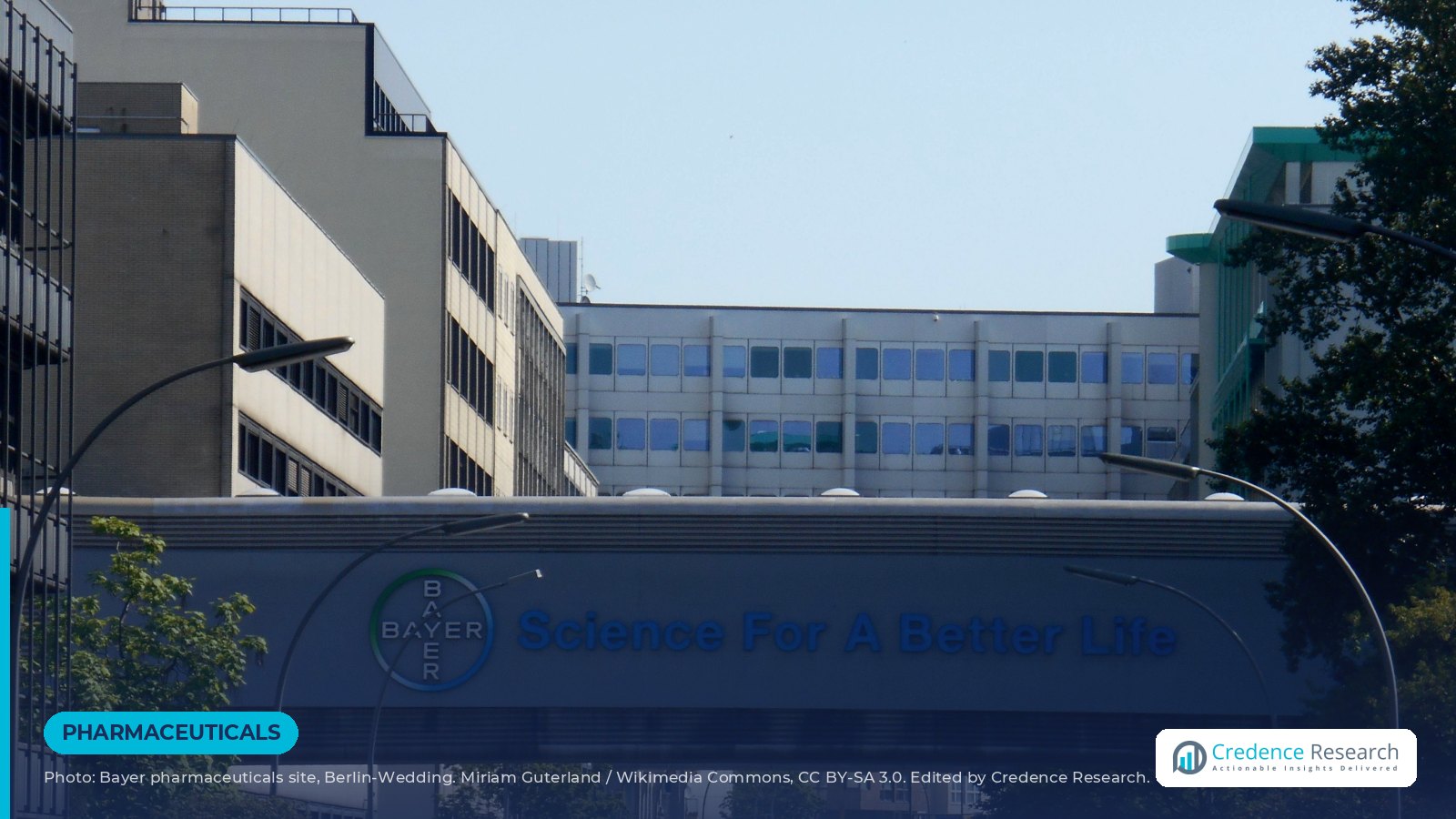
Image: Bayer pharmaceuticals site in Berlin-Wedding, by Miriam Guterland via Wikimedia Commons, CC BY-SA 3.0. Cropped and edited by Credence Research.

About the Author

Senior News Editor at Credence Research Inc