
FDA Tentatively Approves Dr. Reddy's Generic Lenacapavir, Clearing Path for $40-a-Year HIV Prevention Shot
The U.S. Food and Drug Administration has granted tentative approval to the first generic version of injectable lenacapavir for HIV prevention, a twice-a-year shot developed by Dr. Reddy's Laboratories of Hyderabad, India, Unitaid and its partners said from Geneva on Nov. 2. The product is priced at $40 per person per year for 120 low- and middle-income countries, and first supplies are expected to reach countries by the end of 2026.
Key developments
- The FDA tentative approval came about 16 months after the June 2025 approval of Gilead Sciences' originator product, Yeztugo. Unitaid said the process would typically take many years.
- Dr. Reddy's generic will cost $40 per person per year in the 120 countries covered by Gilead's voluntary license, under a September 2025 agreement with Unitaid, the Clinton Health Access Initiative (CHAI) and Wits RHI.
- Dr. Reddy's combined the drug's prevention and treatment indications in one application, which let it file through the FDA's 505(b)(2) pathway. The agency granted a priority review, which targets a decision within six months.
- First supplies are expected by the end of 2026, with broader availability in 2027.
- More than 125,000 people in 10 early adopter African countries have already started Gilead's lenacapavir, according to Unitaid.
How the drug and the approval work
Lenacapavir is a long-acting injectable given every six months. Gilead's label covers pre-exposure prophylaxis to reduce the risk of sexually acquired HIV-1 in adults and adolescents weighing at least 35 kilograms who test negative before starting. Business Standard reported the same intended use for the Dr. Reddy's product. In Gilead's pivotal trials, the PURPOSE 1 study recorded zero infections among 2,134 participants on the drug, and PURPOSE 2 recorded two infections among 2,179 participants.
Tentative approval is the FDA's standard designation for a generic while the originator remains under patent. It does not permit U.S. sales. The Associated Press reported that Yeztugo carries a U.S. list price of $28,218 a year. Dr. Reddy's said the decision was granted under the President's Emergency Plan for AIDS Relief, or PEPFAR, according to AFP, and Unitaid said tentative approval supports national regulatory approvals in other countries.
The commercial framework dates to October 2024, when Gilead signed royalty-free, non-exclusive licenses with six manufacturers: Dr. Reddy's, Emcure, Eva Pharma, Ferozsons Laboratories, Hetero and Mylan, a Viatris subsidiary. Gilead said technology transfers to all six were completed in December 2024. The AP reported that versions from the other licensees have not yet been approved by the FDA.
Industry implications
The decision shows how far a coordinated licensing and regulatory plan can compress the generic timeline for a new medicine. CHAI Chief Executive Officer Neil Buddy Shah said in the release that a generic typically arrives about a decade after the originator. Here, a voluntary license signed before prevention approval, early financing and a combined filing strategy cut that gap to just over a year. Unitaid Executive Director Philippe Duneton attributed the shorter timeline to early risk-taking by funders.
The filing route also deserves attention from other generic developers. Combining indications in a single 505(b)(2) application opened the way to a priority review, a useful precedent for manufacturers working on long-acting products where several indications share one molecule. Deepak Sapra, chief executive officer of API and services at Dr. Reddy's, said the decision validates the company's scientific, manufacturing and scale-up work.
The price is equally significant for program planners. At $40 a year, the injection costs about the same as daily oral prevention pills, according to the AP. CHAI's 2025 announcement also capped the oral starter course at $17.
Competitive and supply chain implications
Dr. Reddy's now holds a regulatory lead among the six licensees, but its advantage may be short-lived. Hetero has a separate agreement with the Gates Foundation, which provides upfront funding and volume guarantees aimed at a similar price of about $40 per patient per year. Two suppliers near that price would give procurers more than one source for a product that has so far come from a single company.
Gilead remains central during the transition. The company has been supplying lenacapavir at no profit, with the Global Fund and PEPFAR setting country priorities and handling delivery. Their commitment now totals 3 million people in high-incidence, resource-limited countries through 2028, and Gilead's own access page anticipates large-scale generic rollout in 2027. The generic cannot be sold in the United States while Gilead's patent stands, the AP reported.
Scale-up is the practical test. Buyers will watch whether Dr. Reddy's can meet its end-2026 delivery target and hold quality at volume for a sterile long-acting injectable. Business Standard reported that World Health Organization prequalification and national approvals are still needed before wider availability.
Regional implications
Sub-Saharan Africa is the first place the decision is likely to matter. Gilead lists lenacapavir availability in Eswatini, Lesotho, Zambia, Kenya, Zimbabwe, Nigeria, Mozambique, South Africa, Uganda and Malawi, with rollouts that began in late 2025. The company is prioritizing registrations in 18 countries that account for 70% of the HIV burden across the 120 licensed territories, and national registrations will shape how quickly generic supply can follow.
For India, the approval strengthens the country's long-standing role as a supplier of HIV medicines to public health programs. Both generic programs with announced pricing near $40, at Dr. Reddy's and Hetero, are Indian. Dr. Reddy's 2024 license also covers India itself, alongside the 120 other countries.
The United States sits outside the arrangement as a sales territory but remains central as regulator and funder. The State Department's Bureau of Global Health Security and Diplomacy is named among the partners working with Unitaid, CHAI and Wits RHI. UNAIDS has counted 1.3 million new HIV infections in 2024, well above its 2025 target of 370,000.
Credence Research analysis
The most consequential element of this approval is the timing, not the molecule. Gilead's trial results were established before its 2025 approval, and the open question since has been when competing low-cost supply would arrive. A 16-month interval from originator approval to a tentative generic approval changes the planning horizon for ministries of health and donors, who can now design programs around a stated price and a named supplier that has cleared FDA review.
The approval does not by itself deliver access, and the partners acknowledge that, calling it a milestone rather than the finish line. Wits RHI's Saiqa Mullick said an affordable drug alone is not enough without ready health systems, confident providers and engaged communities. Twice-yearly dosing still requires HIV testing and follow-up. The next signals to watch are operational: shipment dates, national registrations and whether a second generic clears the FDA in time to create real supply redundancy in 2027.
What comes next
- First Dr. Reddy's supplies are expected in countries by the end of 2026.
- National regulatory approvals must follow in countries where they are required, which may take longer.
- Broader availability of the generic is planned for 2027.
- Other licensed manufacturers, including Hetero, have yet to receive FDA approval for their versions.
- PEPFAR and Global Fund supply of Gilead's product continues under commitments that run through 2028.
Sources
- Unitaid: U.S. FDA approves first generic injectable lenacapavir for HIV prevention
- CHAI: Agreement with Dr. Reddy's on lenacapavir
- Gilead: Access strategy for lenacapavir for PrEP
- Gilead: Yeztugo FDA approval, June 2025
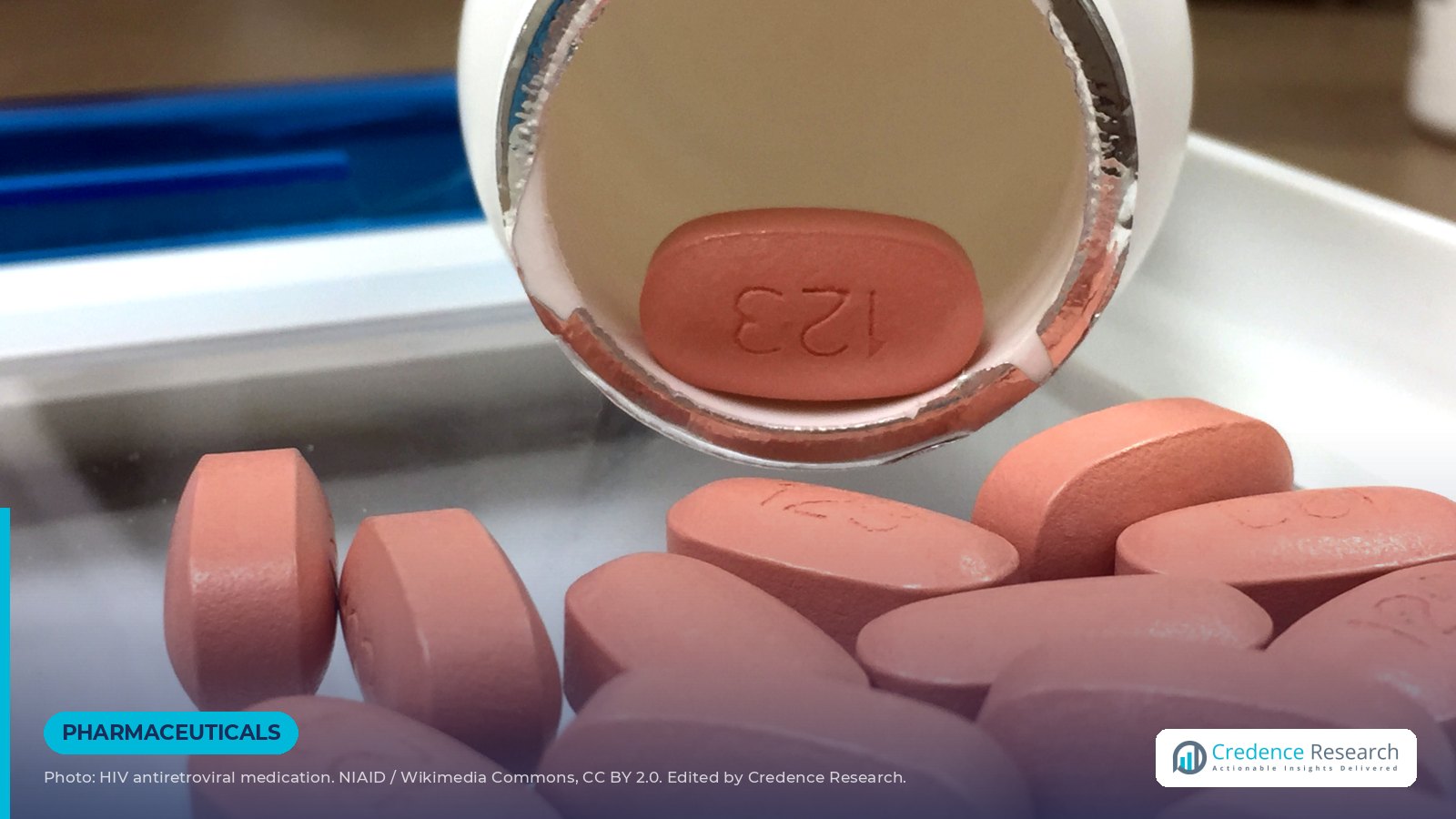
Image: HIV antiretroviral medication tablets, by NIAID via Wikimedia Commons, CC BY 2.0. Cropped and edited by Credence Research.

About the Author

Senior News Editor at Credence Research Inc