
Foxconn shows factory-built Nvidia AI pods at Hon Hai Tech Day, points to new OpenAI work
Foxconn used its Hon Hai Tech Day 2026 in Taipei, which ran Oct. 30-31 at the Taipei Nangang Exhibition Center, to show factory-built Nvidia Vera Rubin infrastructure in modular containers, and Chairman Young Liu told reporters that a new collaboration with OpenAI is in the works. The contract manufacturer framed the event around what it calls the token factory, its term for AI data center capacity assembled as an integrated system of compute, networking, power and cooling.
Key developments
- Foxconn showcased Nvidia DSX POD, a factory-built reference design that lets partners preintegrate Vera Rubin rack-scale systems in modular containers and connect them to site infrastructure after delivery.
- The seventh annual event featured a record 321 exhibits, with about a quarter of them in the Token Factory zone, according to the company.
- A simulated AI data hall demonstrated co-designed compute, networking, power and cooling, including Nvidia 800-volt direct current power distribution.
- Visionbay.ai, an Nvidia Cloud Partner linked to Foxconn's AI supercomputing and cloud operations business, is planning its facility design around Nvidia DSX MaxLPS principles.
- Liu said he met OpenAI CEO Sam Altman on Oct. 30 and that an announcement would follow once details are confirmed, Reuters reported. He gave no further details.
How the factory-built model works
Nvidia introduced DSX POD on Oct. 21 at its GTC Berlin conference. Under the design, partners complete rack-to-rack cabling, wiring, piping and functional validation inside modular containers before shipment. Nvidia said the approach can reduce deployment from six months to as little as 14 days at a prepared site, and it expects worldwide delivery of DSX POD AI factories in early 2027. The 14-day figure is a best case and depends on a site being ready to receive the units.
Foxconn is one of the named partners, through its Ingrasys unit. Its Taipei exhibits extended the idea further down the hardware stack. The company displayed a 20-meter wall of printed circuit boards carrying tens of thousands of micron-level components, along with what it described as a cable-free, hose-free and fanless compute tray design. It also showed co-packaged optics and power and cooling systems, and described its Vera Rubin work as running from rack-level system integration to sub-micron component manufacturing.
Liu summed up the direction in the company's release, saying Foxconn "is transforming into a technology manufacturing platform service provider." Onstage sessions brought together Nvidia, Google and Schneider Electric on AI infrastructure, while Honda R&D and Mitsubishi Electric Mobility discussed next-generation electromobility.
Industry implications
The display points to a shift in where AI data center work gets done. Cabling, piping and validation have traditionally been performed in the building where racks are installed. Moving those tasks to a factory transfers labor, testing and quality risk to the manufacturer, and it makes factory capacity and logistics more central to a project's schedule.
The shift would not remove the main constraints on site. A container still needs a prepared location with power, cooling connections and network access, which is why Nvidia's timeline carries that condition. For operators, the practical question is whether factory integration shortens the overall project or simply moves the bottleneck to grid connections and site preparation.
The move to 800-volt direct current distribution adds another layer. It affects equipment across the power chain, so suppliers and operators have a reason to settle designs early. That favors manufacturers able to test power, cooling and compute together before anything ships.
Competitive and supply chain implications
Foxconn does not have this model to itself. Nvidia's partner list for DSX POD also includes Dell Technologies, HPE, Lenovo, Quanta Cloud Technology, Pegatron, Wistron and GIGABYTE, along with infrastructure suppliers Delta, Eaton, Schneider Electric and Vertiv. A shared reference design narrows the room to compete on architecture and pushes rivals to compete on execution, including delivery speed, validation quality and access to components.
The OpenAI remark matters for a different reason. The two companies announced a collaboration on Nov. 20, 2025, covering co-development of multiple generations of data center racks, U.S. manufacturing readiness and domestic production of components such as cabling, networking, cooling and power systems. OpenAI said at the time that the initial agreement carried no purchase commitments or financial obligations, though it included early access to evaluate the systems and an option to buy them. A follow-on deal would show whether that design work is moving toward firm volume, but neither company has disclosed terms.
Foxconn is also extending automation into its own plants. Brand Cheng, chairman of Foxconn Industrial Internet, told Reuters that more than 10 humanoid robots have been deployed at the group's Texas facilities for internal use, with plans to expand beyond Texas.
Regional implications
Taiwan hosted the showcase for Foxconn's AI server business, while the U.S. is becoming a larger production base. Reuters reported that the company has six factory buildings in Houston making AI servers for Nvidia, and Liu said further expansion is needed. In its Aug. 12 second-quarter results announcement, Foxconn said it expects capital spending to keep rising in 2027, particularly in Taiwan, the U.S., Mexico and Vietnam.
Europe has a stake as well. Nvidia chose Berlin to launch DSX POD and pitched the design as a way to accelerate infrastructure deployment there. Factory-built units could appeal to European operators facing long construction timelines, although grid access and permitting would still set the pace at each site.
Credence Research analysis
The evidence supports a measured reading. Foxconn's release is a showcase rather than a contract: it discloses no customers, orders, capacity figures or plant locations tied to DSX POD, and the OpenAI collaboration remains unspecified. The stronger signal lies in the company's own disclosures. Reuters reported that cloud and networking products made up 51% of second-quarter revenue, the first time the segment exceeded half, and Foxconn said in August that it expected Vera Rubin racks to enter mass production in the third quarter.
Read together, these points suggest the competitive contest in AI hardware is moving from assembling servers to delivering validated systems on a predictable schedule. Liu's rejection of bubble concerns, reported by Reuters, came as AI-related stocks have fallen on worries about heavy spending and borrowing costs. That makes firm orders the test to watch. The value of factory integration will be proven by delivered units and shortened project timelines, and neither exists yet at scale for DSX POD, since Nvidia's delivery target is still months away.
What comes next
- Foxconn and OpenAI: an announcement on the scope of the new collaboration, which Liu said would follow once details are confirmed.
- Early 2027: Nvidia's target for worldwide delivery of DSX POD AI factories, the first real test of the 14-day claim.
- Houston: any detail on the further U.S. expansion Liu said is needed.
- Visionbay.ai: disclosure of location, size or timing for its planned facility, none of which appeared in the release.
- Humanoid robots: whether deployments extend beyond Foxconn's Texas sites, as the group plans.
Sources
- Foxconn: Foxconn Ecosystem Enabling Token Factory for AI in Spotlight at Hon Hai Tech Day 2026
- Nvidia: NVIDIA Introduces DSX POD AI Factories to Accelerate Europe's Infrastructure Deployment
- OpenAI: OpenAI and Foxconn collaborate
- Reuters via The Star: Foxconn working on a new tie-up with OpenAI, says there is no AI bubble
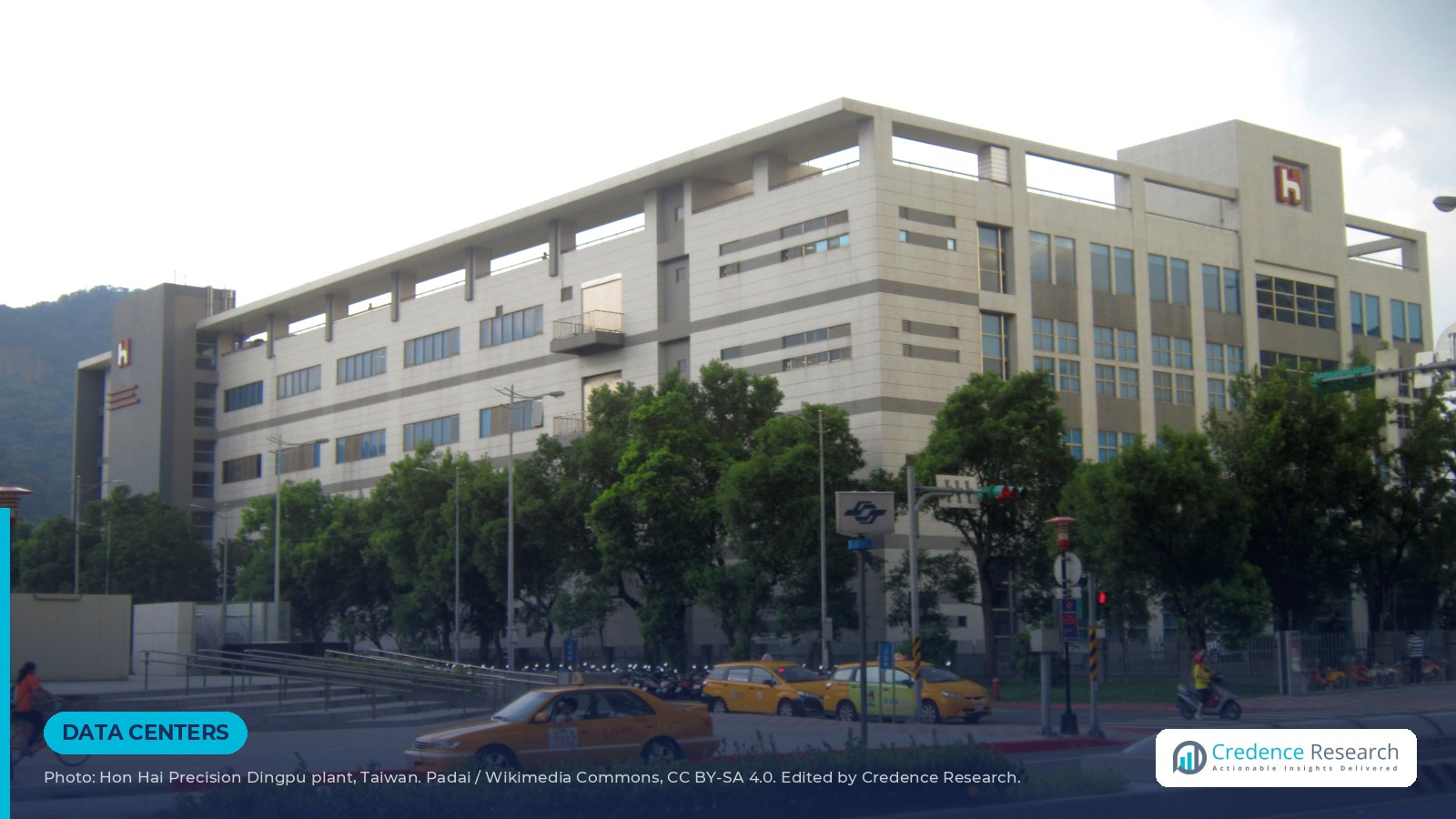
Image: Hon Hai Precision Dingpu plant in Taiwan, by Padai via Wikimedia Commons, CC BY-SA 4.0. Cropped and edited by Credence Research.

About the Author

Senior News Editor at Credence Research Inc