
Tata Motors Takes Control of Iveco With 89.42% Stake as Tender Offer Settles
Tata Motors took control of Iveco Group on Oct. 30, 2026, after settling the first stage of its cash tender offer at 14.40 euros a share and acquiring about 89.42% of the Italian truck and bus maker's common shares, net of treasury stock. The settlement makes the Euronext Milan-listed company part of the Indian truck maker and installs Tata Sons Chairman N. Chandrasekaran as Iveco's chairperson, while shareholders who have not yet tendered get a final five-day window that opened Monday.
Key developments
- TML CV Holdings B.V., an indirect wholly owned Tata Motors subsidiary, now holds 238,157,212 Iveco common shares, a tranche worth about 3.43 billion euros at the offer price.
- The acceptance period reopens Nov. 2 through Nov. 6, with settlement of those shares on Nov. 13.
- Iveco's new six-member board includes Chandrasekaran, CEO Olof Persson, Tata Motors executives P.B. Balaji and Girish Wagh, and independent directors Guenter Butschek and Charles Nichols.
- All outstanding special voting shares were repurchased for no consideration under terms authorized at an Oct. 16 extraordinary general meeting.
- Iveco moved its third-quarter results to Nov. 3 from Nov. 5.
Deal background
Tata Motors and Iveco announced the transaction on July 30, 2025, at 14.10 euros a share, or about 3.8 billion euros for the business excluding defense. The deal depended on Iveco first separating its defense unit. Iveco said on March 17, 2026, that all conditions for the sale of the IDV and ASTRA brands to Leonardo had been met, and trade publication Trans.info reported that the sale closed that month at an enterprise value of about 1.7 billion euros.
The timetable slipped past the companies' original expectation of a close in the second quarter of 2026. The offer document was published Sept. 4, and the offer ran until Oct. 26, according to Trans.info. In its final weeks, Tata Motors raised the price to 14.40 euros, a move Business Standard linked to pressure from activist investor Petrus Advisers, which argued the original price undervalued Iveco. Trans.info reported that Iveco's shareholder meeting also cut the minimum acceptance condition to 80% from 95% on Oct. 16.
The Iveco that Tata now controls has about 33,000 employees, 16 industrial sites and 22 research and development centers. Its brands are IVECO, FPT, IVECO BUS, HEULIEZ and IVECO CAPITAL. Business Standard reported 2025 revenue of 13.43 billion euros.
Industry implications
The transaction brings together two commercial vehicle groups of very different geographic profile. When the deal was announced, the companies said the combination would sell more than 540,000 vehicles a year and generate about 22 billion euros of revenue, split roughly 50% in Europe, 35% in India and 15% in the Americas. Chandrasekaran described the result at the time as a group with two strategic home markets, India and Europe.
That framing matters because truck makers now face expensive, parallel technology bets. Battery-electric and hydrogen drivetrains, connected services and advanced driver assistance all require heavy development spending, and the volumes in any single region may not carry those costs. EU rules adopted in 2024 call for new heavy-duty vehicle carbon dioxide emissions to fall 45% by 2030, 65% by 2035 and 90% by 2040 against 2019 levels, which keeps pressure on every manufacturer selling in Europe. Persson said in 2025 that the combination would speed innovation in zero-emission transport, and electrive reported that the companies plan to share supplier networks and industrial capabilities to scale electric mobility.
Competitive and supply chain implications
The deal adds an Indian parent to a European heavy-truck field that includes Daimler Truck, Volvo Group and Traton. Tata Motors and Iveco describe their product portfolios as complementary, with limited overlap in industrial and geographic footprints, which suggests less immediate pressure to consolidate plants than a merger of two European rivals would bring. The real competitive test will be whether Iveco gains access to lower-cost engineering and sourcing fast enough to improve its position against larger European peers.
Purchasing is the most visible near-term lever. Components such as axles, transmissions, electronics and battery systems could be sourced across a larger combined base, and FPT, Iveco's powertrain business, gains a route to wider volume through Tata's vehicle lines. Neither company has published integration targets in the settlement announcement, so suppliers will be watching for early signs of platform sharing or dual-sourcing decisions. Any such moves will need to work within the commitments made to protect Iveco's European footprint.
Regional implications
In Italy, the government conditionally cleared the sale on Oct. 31, 2025, according to a Reuters report carried by Just Auto. The companies committed in 2025 to keep the Turin headquarters, brands and factories, and electrive reported that non-financial commitments on jobs and investment run for two years after closing. Defense assets stayed in Italian hands through the Leonardo sale, which removed the most sensitive part of the business from the transaction.
For India, the takeover extends a Tata presence in European vehicle making that began with the group's 2008 purchase of Jaguar Land Rover, now part of a separate company. It gives Tata Motors, which took its current name on Oct. 29, 2025, after the separation of its commercial vehicle business, a direct manufacturing presence in Europe. The Americas accounted for about 15% of the combined revenue the companies cited in 2025, and Iveco's operations there widen Tata's reach beyond its Asian and African base.
Credence Research analysis
The Oct. 30 settlement shifts the story from deal certainty to execution. Tata Motors has control, but it does not yet have full ownership. The 89.42% stake sits below the 95% level that Trans.info identified as the threshold for a compulsory squeeze-out, and Tata said only that later steps may include a voluntary purchase procedure, a Dutch legal squeeze-out, or a post-offer demerger and liquidation. The result of this week's reopened window will determine which route is open, and how quickly Tata can integrate Iveco without minority holders in place.
The governance choices point to a light-touch start with close financial oversight. Persson stays as CEO, while Balaji, the Tata Motors group chief financial officer, sits on the audit and compensation committees, and Wagh chairs the ESG committee. That structure keeps operational continuity in Turin while giving the parent direct sight of capital allocation. With the two-year commitments limiting early footprint moves, value creation in the first phase is more likely to come from procurement, shared engineering and product access to new regions than from plant restructuring. The 14.40-euro price and the lowered acceptance condition also show that Tata was prepared to adjust terms to get control, which raises the bar for delivering returns.
What comes next
- Nov. 3: Iveco reports third-quarter results, its first since the change of control.
- Nov. 6: The reopened acceptance period ends at 5:30 p.m. CET.
- Nov. 13: Shares tendered in the reopened period settle.
- Later: Tata Motors is due to announce the post-offer route, which could lead to Iveco leaving Euronext Milan.
- Coming quarters: Watch for the first integration plan, including any joint sourcing, powertrain or zero-emission programs.
Sources
- Tata Motors and Iveco Group joint release, Oct. 30, 2026
- Iveco Group release on the defense business sale, March 17, 2026
- Trans.info report on the tender offer threshold, Oct. 27, 2026
- electrive report on the original deal terms, July 31, 2025
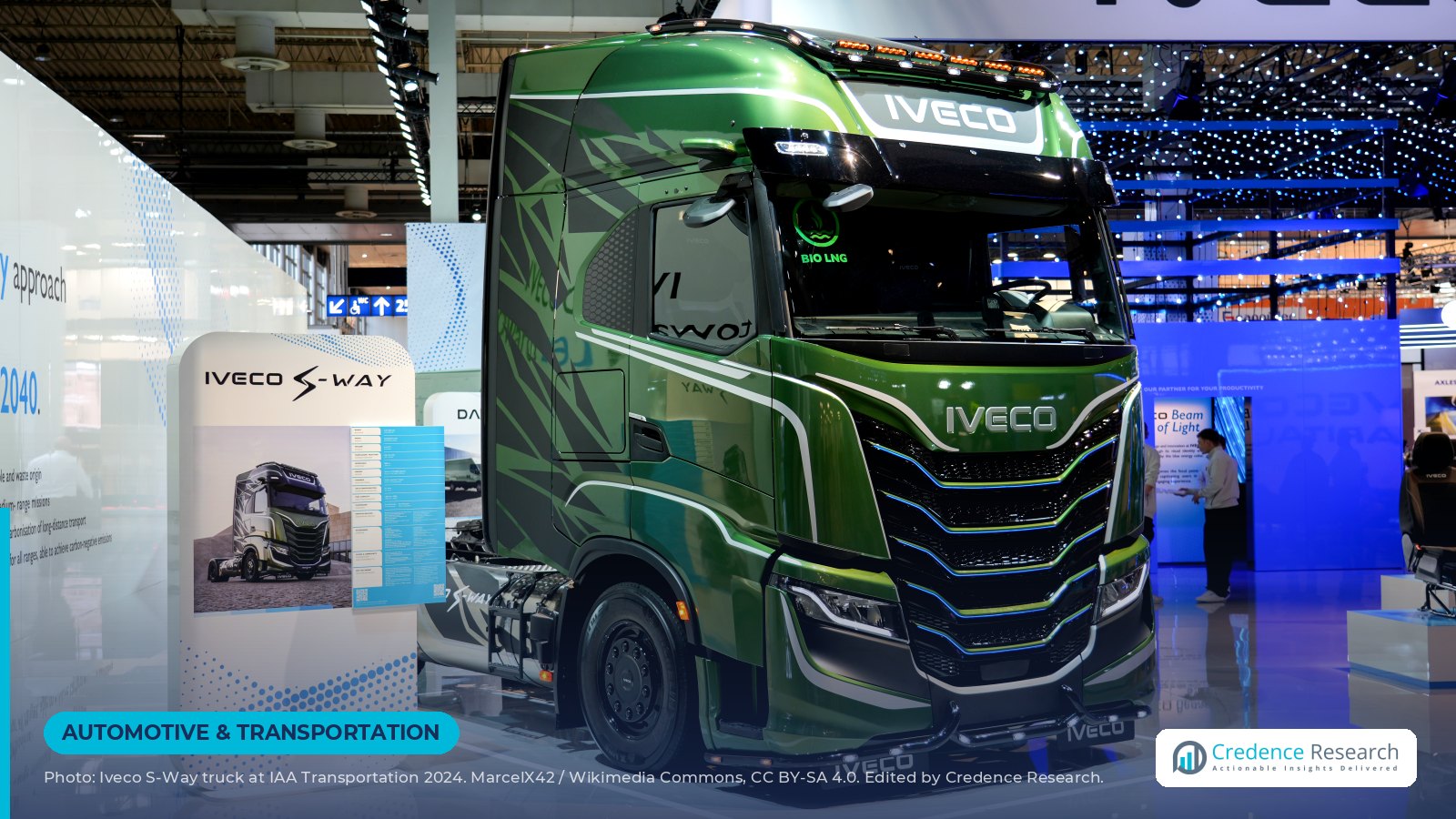
Image: Iveco S-Way 500 Bio-LNG truck at IAA Transportation 2024, by MarcelX42 via Wikimedia Commons, CC BY-SA 4.0. Cropped and edited by Credence Research.

About the Author

Senior News Editor at Credence Research Inc