
Fresenius Signs WuXi Biologics Deal for Up to 37 Biosimilar Candidates Over Next Decade
Fresenius SE & Co. KGaA on Monday, Nov. 2, 2026, said it signed an exclusive development agreement with China's WuXi Biologics that gives the German health care group option rights to up to 37 identified biosimilar candidates over the next decade. Announced from Bad Homburg, Germany, the deal could lift Fresenius' portfolio from 29 marketed and pipeline molecules to as many as 66. Fresenius described it as the largest development agreement announced in the biosimilars industry to date.
Key developments
- Fresenius holds exclusive option rights on up to 37 candidates and selects programs based on market attractiveness, development risk and expected returns.
- Fresenius keeps exclusive global commercialization rights, including marketing authorizations, and the full economics of each commercialized product.
- WuXi Biologics is paid on a fee-for-service basis for each selected candidate, so research and development spending scales only as programs advance.
- Initial development is expected to focus on polatuzumab vedotin, marketed as Polivy, and teprotumumab, marketed as Tepezza.
- The agreement is funded from operating cash flow and requires no new financing. Fresenius left its 2026 guidance unchanged.
Industry background
Biosimilars are highly similar versions of biologic medicines that have lost or are nearing the end of their exclusivity. Unlike small-molecule generics, they come from living cell systems, which makes process development, analytical characterization and manufacturing scale central to the business. Fresenius competes in this field through its Fresenius Kabi operating company and through mAbxience, the biosimilar developer and manufacturer it now fully controls.
That control is recent. Fresenius said on Oct. 1 that it had acquired the remaining 45% of mAbxience from Insud Pharma and Invim Corporativo for up to 750 million euros in cash, including a 50 million euro contingent payment tied to site approvals. The transaction was signed and completed on Sept. 30. Fresenius had held a 55% stake since August 2022. mAbxience has four products on the market, eight candidates in development and three multi-product drug substance facilities in Spain and Latin America.
The scientific scope of the new pipeline also moves beyond conventional antibodies. Fresenius said the candidates include monoclonal and bispecific antibodies, antibody-drug conjugates and fusion proteins, and that the broader portfolio is expected to span 13 therapeutic areas. Those include neurology, nephrology and cardiopulmonary medicine, alongside its existing work in oncology, immunology and gastroenterology.
Industry implications
The structure separates access from commitment. Rather than paying to develop every molecule, Fresenius buys the right to choose, then spends as each program clears its internal criteria. The company cautioned that whether, when and how many candidates are developed depends on future option exercises, and that no assurance exists that any or all will reach the market. The release does not state a total contract value.
The first two programs show the complexity Fresenius is targeting. Polivy, a Genentech product, is an antibody-drug conjugate that links a CD79b-targeting antibody to the agent MMAE and is used in diffuse large B-cell lymphoma. Tepezza, an Amgen product, is a human monoclonal antibody that inhibits the IGF-1R receptor and treats thyroid eye disease. Antibody-drug conjugates in particular require handling of a potent payload as well as the antibody itself, so a follow-on version is a harder build than a standard antibody biosimilar.
Regulation is moving in a direction that favors broader pipelines. The European Medicines Agency finalized a reflection paper on March 16, 2026, that allows comparative efficacy studies to be waived when specific criteria are met. The U.S. Food and Drug Administration issued draft guidance in October 2025 questioning the need for such studies for well-characterized products, followed by draft questions and answers on March 9, 2026, that could reduce the need for U.S. comparator studies. Lower clinical burdens would change the economics of working through a long candidate list, though complex modalities may still require more evidence.
Competitive and supply chain implications
Fresenius will determine the long-term manufacturing strategy for each candidate, which may include progressively transferring selected products to mAbxience. Development is expected to draw on WuXi Biologics' global network. The practical result is a two-stage supply model: a contract organization for speed in early work, and an owned platform as an option once a product proves commercially worthwhile. Chief Executive Michael Sen said full mAbxience ownership and the WuXi agreement together support Biopharma growth well beyond 2030.
For rival biosimilar developers, an exclusive claim on 37 identified candidates narrows what WuXi Biologics can offer others on those specific programs, though it does not stop competitors from developing the same molecules independently. Tepezza also faces new branded competition: the FDA approved Roche's Enspryng for thyroid eye disease on Oct. 16, 2026, a reminder that a biosimilar's commercial case can shift during the years of development.
Regional implications
The deal links a German buyer with a Chinese contract developer at a sensitive moment for U.S. biotech policy. The BIOSECURE Act, enacted as part of the fiscal 2026 defense authorization law, restricts federal procurement from designated biotechnology companies of concern and names none directly. WuXi Biologics is not on the Defense Department's Section 1260H list dated June 8, 2026, according to law firm Ropes & Gray, which said it is not a subsidiary, parent or successor of the listed WuXi AppTec. The Office of Management and Budget must publish its own list, which is expected around December 2026.
In Europe, the agreement strengthens a Germany-based group whose owned manufacturing sits in Spain and Latin America, giving those mAbxience sites a possible role in later-stage supply. Any U.S. launch would still require FDA approval, product by product.
Credence Research analysis
The most useful detail in this announcement is the payment mechanism, not the headline count. A fee-for-service option model turns a decade-long pipeline into a sequence of smaller capital decisions, and it keeps economic ownership with Fresenius rather than sharing it with a partner. Sen's description of potentially tripling the portfolio should be read alongside the release's own figures: 29 to 66 molecules is roughly 2.3 times the current count, and that is a ceiling, not a commitment. The number of exercised options will be the real measure of this deal.
The September purchase of mAbxience and the November agreement with WuXi Biologics read as one strategy executed in two steps: secure owned capacity, then secure a wider candidate funnel to feed it. The largest open risk sits in geopolitics rather than science. WuXi Biologics is not currently named in the U.S. framework, but the December OMB list will show how far designations reach, and Fresenius' flexibility to shift products to mAbxience gives it a hedge that a pure outsourcing arrangement would not.
What comes next
- Fresenius expects to raise its long-term Biopharma ambitions and has reaffirmed its 2030 ambition for the existing portfolio; updated targets would show how much weight it places on this pipeline.
- Fresenius and WuXi Biologics are expected to begin with polatuzumab vedotin and teprotumumab. The release gives no filing or launch dates.
- The Office of Management and Budget must publish its biotechnology companies of concern list, expected around December 2026, with implementing guidance due within 180 days after that.
- Fresenius will decide product by product whether to exercise options and whether to transfer manufacturing to mAbxience.
Sources
- Fresenius: Fresenius and WuXi Biologics enter exclusive development agreement
- Fresenius: Acquisition of the remaining 45% of mAbxience
- Ropes & Gray: Updated 1260H list and the BIOSECURE Act
- ICON: March 2026 FDA and EMA biosimilar changes
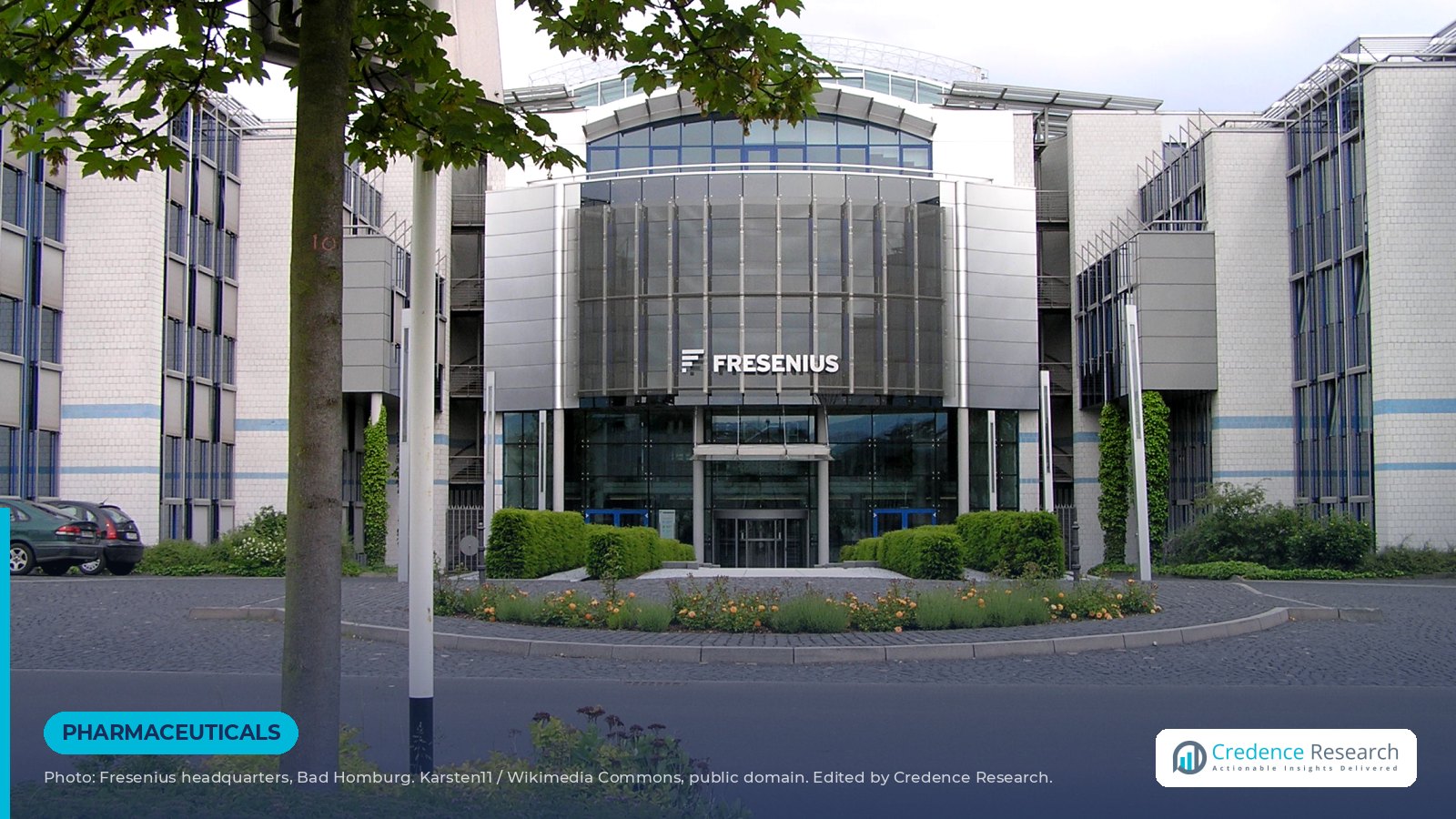
Image: Fresenius headquarters in Bad Homburg, Germany, by Karsten11 via Wikimedia Commons, public domain. Cropped and edited by Credence Research.

About the Author

Senior News Editor at Credence Research Inc