
Lonza to Buy Merck KGaA's U.S. CDMO Network, Adding Five Sites and About 1,100 Employees
Lonza Group AG said Tuesday, Nov. 3, 2026, it signed a definitive agreement to buy five U.S. contract manufacturing sites from Merck KGaA, Darmstadt, Germany, a deal that raises the Swiss company's U.S. contract development and manufacturing network from four sites to nine. About 1,100 employees would move to Lonza, which announced the cash transaction from Basel, Switzerland. Both companies expect it to close in mid-2027, subject to regulatory approvals and other customary conditions.
Key developments
- The sites are in St. Louis; Madison and Verona, Wisconsin; Carlsbad, California; and Indianapolis. Lonza's U.S. workforce would top 6,000.
- Lonza put the deal's enterprise value in the low- to mid-triple-digit millions of Swiss francs. Merck KGaA described the price as a mid-triple-digit million-euro amount.
- Lonza will pay from cash on hand and existing credit facilities, and said the transaction keeps its BBB+ credit rating.
- Merck KGaA keeps its BioReliance contract testing services and its Life Science consumables and technologies.
- Until closing, the businesses operate independently, and the companies said they will work on continuity for employees, customers and supply.
How the acquired network fits together
Contract development and manufacturing organizations, or CDMOs, make medicines and their components for drug companies that prefer not to own every process. The assets in this deal concentrate on modalities that are difficult to produce. Lonza said St. Louis handles bioconjugates, while Madison and Verona focus on high-potency payload-linkers, the toxic molecules and chemical connectors used in conjugated drugs. Carlsbad offers end-to-end viral vector work, including aseptic fill-finish. Indianapolis provides lipid nanoparticle, liposome and PEGylated protein services, also with aseptic fill-finish.
For Merck KGaA, which does business in the United States and Canada as MilliporeSigma in life science, the sale removes a services unit that Life Science CEO Jean-Charles Wirth said employees built over more than 35 years. Group CEO Kai Beckmann called the sale another step in the company's strategy of concentrating on innovation-driven businesses tied to its core capabilities. Wirth said a narrower Life Science portfolio lets Merck KGaA direct investment toward technologies where it holds scientific leadership.
The purchase extends a run of portfolio moves at Lonza. In March 2024, it agreed to pay $1.2 billion for Genentech's large-scale biologics site in Vacaville, California, which has about 330,000 liters of bioreactor capacity. In March 2026, it agreed to sell its Capsules and Health Ingredients business to Lone Star Funds at an enterprise value of 2.3 billion Swiss francs while keeping a 40% stake, a move Lonza said would complete its shift to a pure-play CDMO. In September, it announced a commercial spray-drying plant in Bend, Oregon, due for completion in 2029.
Industry implications
The transaction shows two large life science groups reaching opposite conclusions about the same assets. Merck KGaA sells tools and materials to the biopharma manufacturers that CDMOs serve, and it is choosing to stay on that side of the relationship while retaining testing services. Lonza is choosing scale in outsourced production, with Chief Executive Wolfgang Wienand saying customers want partners that pair deep science with enough scale for increasingly complex medicines.
The modalities involved carry their own operating demands. High-potency payload work requires containment, and viral vector and lipid nanoparticle production depend on specialized processes and sterile finishing. Those requirements take time and capital to replicate, which helps explain why an established network can be attractive to a buyer even at a price well below Lonza's Vacaville purchase. Wienand cited high demand for bioconjugates and viral vectors, though the two lines serve different customers and may not develop at the same pace.
Lonza was also candid about near-term economics. It expects the sites to run below its group margin in 2028, with an insignificant effect on the group, and to reach its future group margin level by the mid-2030s. That frames the purchase as a capability and footprint decision rather than a quick earnings contribution. Lonza confirmed its 2026 outlook and mid-term ambitions.
Competitive and supply chain implications
For drug developers, the most immediate question is continuity. Customers with programs at the five sites will move from a supplier inside a Life Science tools group to a dedicated CDMO, and contracts, quality agreements and technology roadmaps will need to carry across that change. Both companies have said continuity is a transition priority, but neither has named customers or described specific programs.
The deal also links steps that a conjugate developer often has to buy separately. St. Louis conjugation and Wisconsin payload-linker production would sit under the same owner as Lonza's existing network, which could reduce the number of handoffs in a supply chain where potent intermediates move between specialized facilities. Merck KGaA's position shifts in a different way. It stays a supplier of consumables and technologies to biopharma manufacturers, which can include companies that compete with Lonza, and it would no longer run a contract manufacturing business alongside those customers.
BofA Securities advised Lonza. Lonza's previously announced share buyback is unaffected and will proceed after the Capsules and Health Ingredients sale closes.
Regional implications
The largest effect falls on the United States, where Lonza more than doubles its CDMO site count with sites in Missouri, Wisconsin, California and Indiana. Wienand called the country a key market, and Lonza said the sites complement the readiness work at Vacaville and the Bend project. Lonza's stated reasoning centers on customer proximity and demand rather than trade policy, although the expanded footprint also gives it more U.S. production options.
For St. Louis, Madison, Verona, Carlsbad and Indianapolis, the deal changes the employer for about 1,100 workers. Neither company announced job cuts or site changes. In Europe, the transaction turns a Darmstadt-based group further toward its remaining businesses, while the Swiss buyer directs more of its footprint across the Atlantic.
Credence Research analysis
The structure of this deal is more revealing than its size. Lonza is paying what its own disclosure describes as a triple-digit million amount, far below the $1.2 billion it paid for Vacaville, and is accepting a margin drag that it does not expect to fully resolve until the mid-2030s. A buyer accepts those terms when it values the capabilities and customer relationships more than current profitability. The clearest signal is the pairing of payload-linkers and bioconjugation, where Lonza gains adjacent steps in a supply chain that drug developers often struggle to coordinate.
The main risk is uneven demand across a mixed portfolio. Bioconjugates and viral vectors are different businesses with different customers, and Lonza's confidence in both will be tested after closing. Merck KGaA, meanwhile, removes a potential conflict with its own tool customers and simplifies its Life Science story, though it gives up direct exposure to complex-modality manufacturing. How many customers stay through the handover will be the first practical measure of whether the sale works for both sides.
What comes next
- The companies must obtain regulatory approvals and meet other closing conditions, with completion targeted for mid-2027.
- Employees, customers and supply arrangements will move through a transition plan the companies have yet to detail publicly.
- Lonza's Vacaville readiness work and its Bend spray-drying plant, due in 2029, continue alongside the integration.
- Lonza's share buyback starts after its Capsules and Health Ingredients sale closes.
Sources
- Lonza: Agreement to acquire U.S. CDMO network from Merck KGaA
- Merck KGaA: To divest CDMO business to Lonza
- Lonza: Agreement to acquire Vacaville site from Roche
- Lonza: Agreement to divest Capsules and Health Ingredients
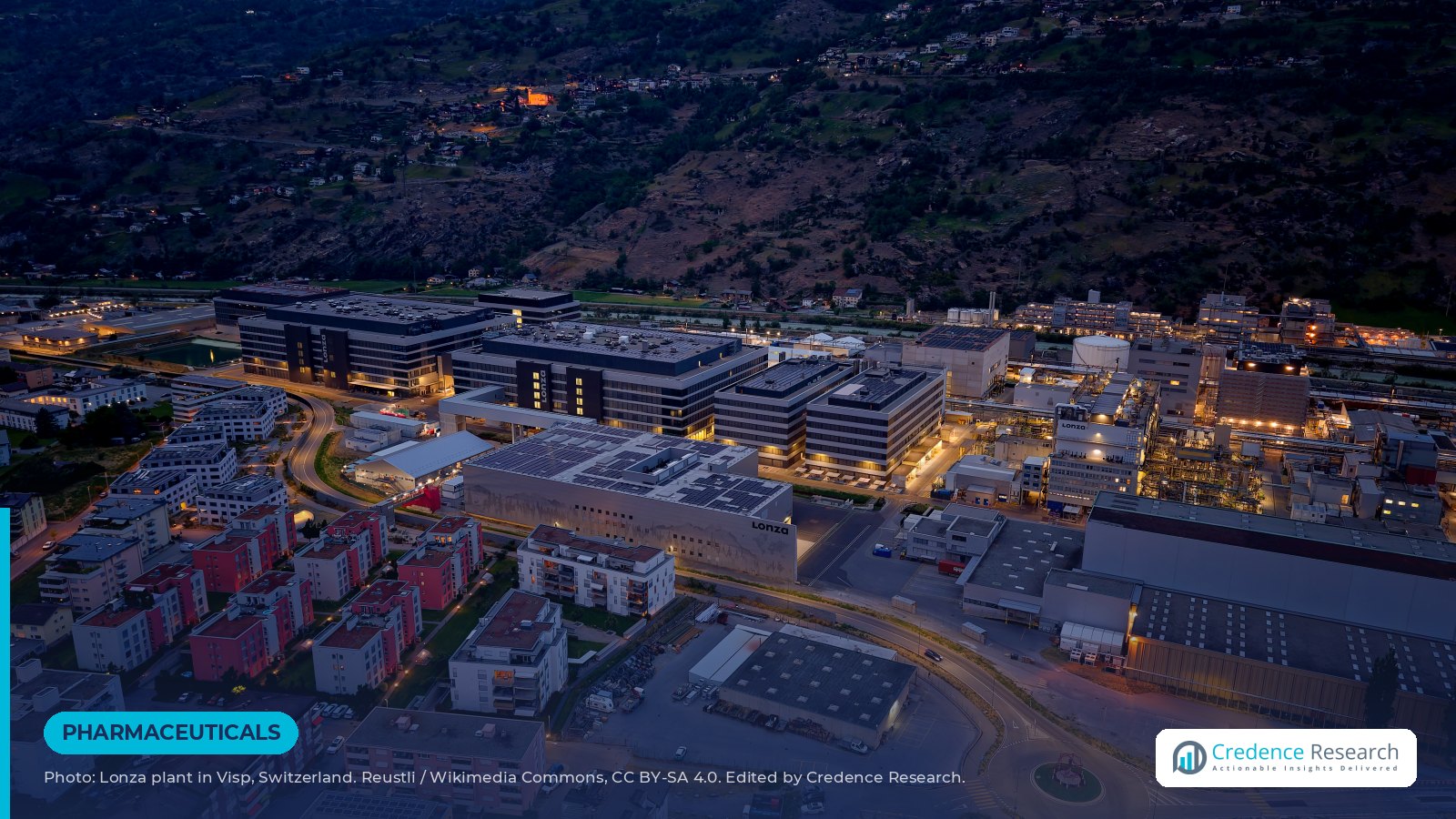
Image: Lonza plant in Visp, Switzerland, by Reustli via Wikimedia Commons, CC BY-SA 4.0. Cropped and edited by Credence Research.

About the Author

Senior News Editor at Credence Research Inc