
LG Energy Solution Targets 70 GWh of North American Storage Capacity by End-2027, Widens Cathode Supply
LG Energy Solution plans to lift its North American energy storage battery capacity to more than 70 gigawatt-hours by the end of 2027 and widen its pool of lithium iron phosphate cathode suppliers to at least four, the Seoul-based battery maker said in third-quarter results issued Nov. 2 in U.S. time and Nov. 3 in South Korea. The plan moves more of its U.S. factory base away from electric vehicle cells at a time when storage shipments are driving its earnings.
Key developments
- North American energy storage system (ESS) capacity will exceed 70 GWh by end-2027 through conversion of more EV pouch lines and new prismatic ESS lines.
- North American cylindrical capacity will exceed 20 GWh by end-2027, with U.S. 46-Series production due to start by the end of 2026.
- The company aims to have four or more North American LFP cathode suppliers that comply with U.S. prohibited foreign entity (PFE) rules.
- LG Energy Solution won its first direct-supply, behind-the-meter storage project for a big tech customer and did not name the customer.
- Third-quarter revenue reached 9.6 trillion won, up 27.6% from the prior quarter, with operating profit of 756 billion won.
Industry background
The new target extends a goal the company set earlier this year. In its first-quarter release on April 30, LG Energy Solution said it would secure more than 50 GWh of North American ESS capacity by the end of 2026, using three standalone plants in Holland, Michigan; Lansing, Michigan; and Windsor, Ontario, along with its Ultium Cells joint venture in Tennessee and its L-H Battery joint venture in Ohio. The latest figure adds at least 20 GWh to that goal over the following 12 months.
The Lansing site shows how the shift works in practice. When production started there in August, the company said the plant would make large-format LFP cells for storage and nickel-manganese-cobalt cells for EVs, with more than 35 GWh of annual output at full-scale operation. Toyota and DTE Energy are named customers.
LG Energy Solution posted an operating loss of 207.8 billion won on revenue of 6.6 trillion won in the first quarter. In the third quarter, it credited the rebound to higher ESS shipments, stronger sales of high-voltage mid-nickel pouch cells and steady cylindrical supply, along with better factory utilization in Europe and a lower fixed-cost burden as North American ESS lines stabilized.
Industry implications
For storage developers, the announcement points to more North American cell supply from a producer that is already qualifying products for data center use. The company said in September that its AC-coupled system qualified under Nvidia's DSX Ready program, and the new behind-the-meter contract is its first direct sale of that kind to a big tech customer. Behind-the-meter systems sit on the customer's side of the grid connection, so a direct deal moves LG Energy Solution closer to the end user.
For automakers, the message is more mixed. Converting pouch lines to storage reduces EV-oriented capacity that was built for a faster electric vehicle ramp, though the company is still adding EV-related work elsewhere. It extended supply periods and raised volumes on existing mid-nickel contracts in Europe, restarted its GM joint venture plant in North America and plans tabless 2170 lines for hybrid vehicles starting in 2027.
The results also show how much the U.S. production incentive still matters. The 416.9 billion won incentive, which the company includes in revenue, equals about 55% of reported third-quarter operating profit by Credence Research's calculation. Earnings remain tied to U.S. policy even as shipments improve.
Competitive and supply chain implications
The cathode goal may be the most consequential supply chain line in the release. Chinese companies have long dominated LFP cathode production, and U.S. rules on prohibited foreign entities have made non-Chinese material a commercial requirement for many storage buyers seeking tax credits. LG Energy Solution said it has diversified its LFP cathode suppliers for PFE compliance and secured long-term North American supplies of lithium concentrate and lithium carbonate. It did not name suppliers in the release.
South Korean media reported one such deal on the same day. Aju Press, citing a regulatory filing, reported that L&F signed a contract on Nov. 2 to supply LFP cathode material to LG Energy Solution worth about 1.035 trillion won, with deliveries from 2028 through 2031. The outlet said the amount reflects only minimum committed volumes and equals about 48% of L&F's 2025 revenue. It also reported that L&F plans new capacity for the order and already holds LFP contracts with Samsung SDI and SK On. Credence Research did not review the filing directly.
That activity suggests Korean battery makers are competing for the same limited pool of non-Chinese cathode output. The Asia Business Daily reported in September that SK On signed a roughly 1.1 trillion won LFP cathode deal with POSCO Future M. A target of four or more suppliers would give LG Energy Solution some pricing leverage and protection against a single plant delay, but most of this new cathode capacity has yet to prove it can run at volume and at competitive cost.
Regional implications
North America carries most of the near-term build. Beyond the capacity targets, the company completed a new link production line in Arizona and is expanding pack production in phases in Ohio. Those steps extend its U.S. footprint beyond cells into system-level assembly.
Europe gets a slower and narrower plan. The company said it wants local 46-Series cylindrical lines by 2029 and intends to localize key materials there, while utilization at its Poland plant has improved. In Asia, it plans to produce sodium-ion samples this year for proof-of-concept testing with a key ESS customer and to begin high-power LFP 2170 production next year at its Korean mother factory.
Credence Research analysis
The strongest signal is the pairing of the 70 GWh figure with the cathode plan. A storage line converted in Michigan or Tennessee delivers limited value to a U.S. buyer if its materials fail PFE tests. By setting capacity and supplier goals in the same release, LG Energy Solution is treating compliance as a production constraint rather than a paperwork exercise. The reported L&F deal fits that reading, although its 2028 start implies a gap between cell capacity arriving by 2027 and some contracted cathode volume arriving later.
The release also leaves key questions open. It gave no capital spending figure tied to the new targets, no value for the big tech project and no breakdown of how much capacity will come from conversions versus new prismatic lines. Conversions can be faster than new lines, but they reduce flexibility if EV demand recovers.
What comes next
- End of 2026: U.S. 46-Series production start, more than 50 GWh of North American ESS capacity under the earlier target, and sodium-ion samples.
- 2027: High-power LFP 2170 production begins, followed by tabless 2170 lines for hybrid vehicles.
- End of 2027: More than 70 GWh of North American ESS capacity and more than 20 GWh of cylindrical capacity.
- 2028: Reported start of L&F cathode deliveries, and first supply of a next-generation grid storage product that the company said in April would cut total cost by 15% from its current ESS LFP products.
- By 2029: Local 46-Series lines in Europe.
Sources
- LG Energy Solution: 2026 third-quarter financial results
- LG Energy Solution: 2026 first-quarter financial results
- LG Energy Solution: Start of production at Lansing battery plant
- Aju Press: L&F clinches LFP cathode deal with LG Energy Solution
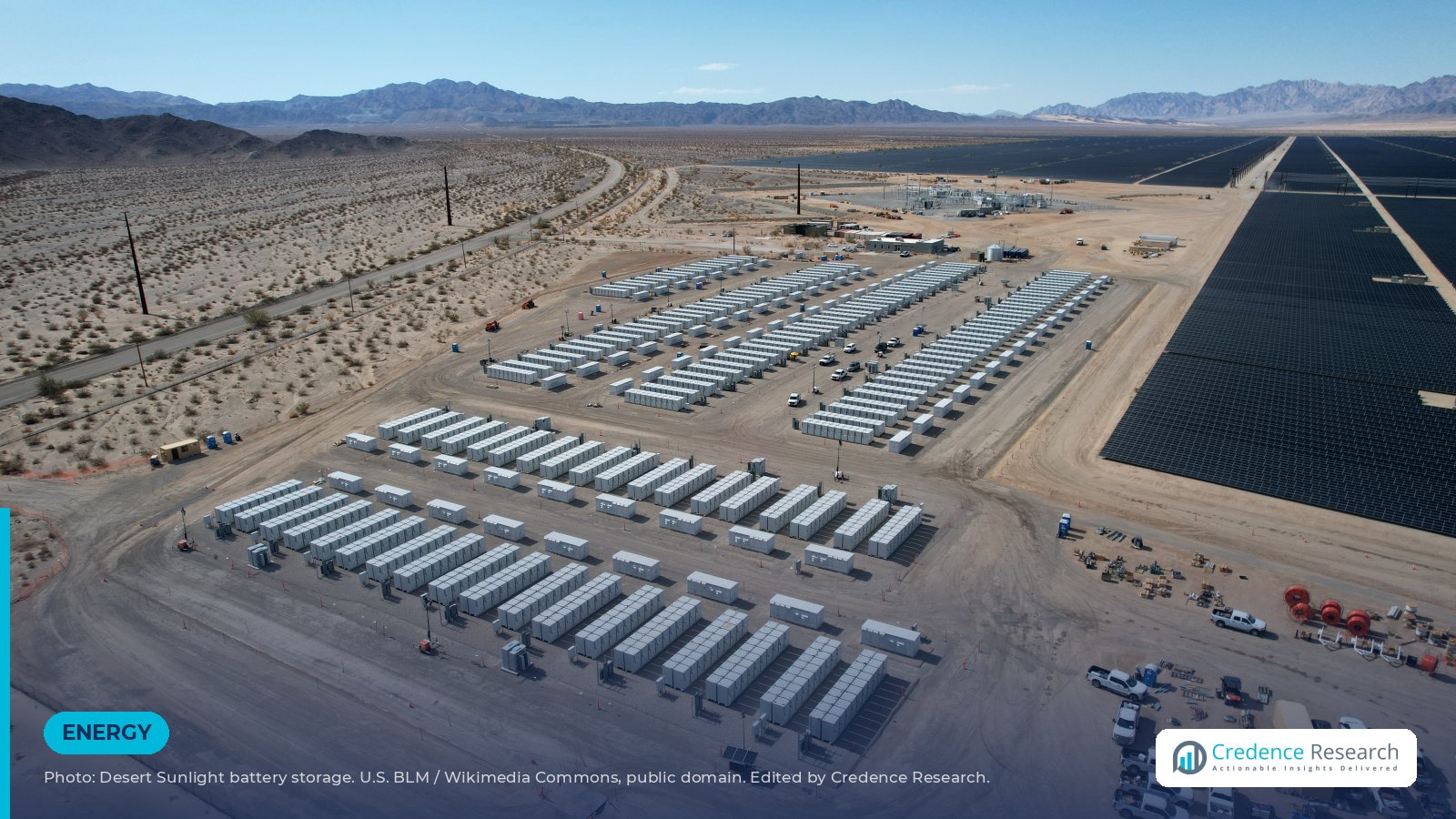
Image: Desert Sunlight battery energy storage system in California, not an LG Energy Solution site, by the U.S. Bureau of Land Management via Wikimedia Commons, public domain. Cropped and edited by Credence Research.

About the Author

Senior News Editor at Credence Research Inc