
Market Overview:
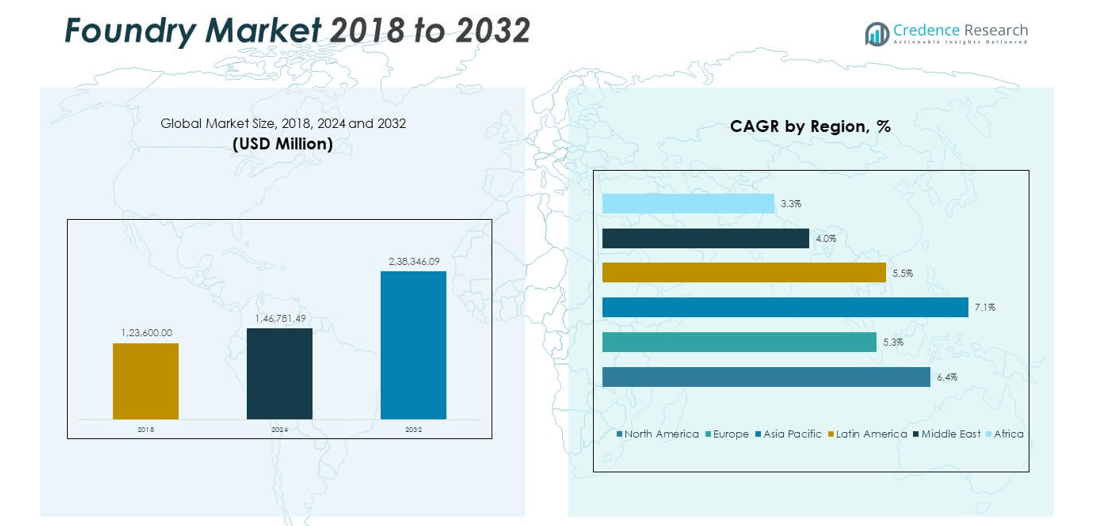
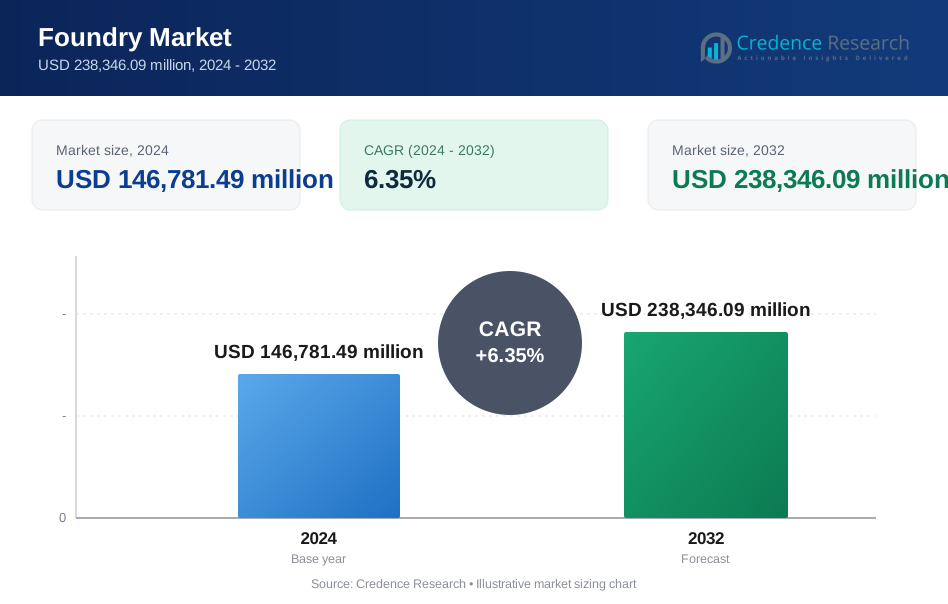
The Global Foundry Market size was valued at USD 123,600 million in 2018 to USD 146,781.49 million in 2024 and is anticipated to reach USD 238,346.09 million by 2032, at a CAGR of 6.35% during the forecast period.
| REPORT ATTRIBUTE | DETAILS |
|---|---|
| Historical Period | 2020-2023 |
| Base Year | 2024 |
| Forecast Period | 2025-2032 |
| Foundry Market Size 2024 | USD 146,781.49 million |
| Foundry Market, CAGR | 6.35% |
| Foundry Market Size 2032 | USD 238,346.09 million |
The Global Foundry Market grows due to strong demand for advanced semiconductor parts across key industries. Chipmakers expand capacity to support rising orders from automotive, telecom, and industrial electronics. Producers adopt new materials that improve durability and thermal performance. Firms invest in automation to raise output and reduce defects. Buyers shift toward customized designs to support next-generation electronics. Supply chain players support long-term contracts to maintain stable production networks.
Regional growth stays strong across major semiconductor hubs. Asia Pacific leads due to extensive fabrication clusters and steady government support. North America gains momentum through rising investments in advanced node technologies. Europe holds a solid position with strong automotive electronics demand. Emerging regions in Southeast Asia and India expand due to new production sites and growing engineering capability. Global players widen presence to secure resilient distribution and faster delivery cycles.
Market Insights:
- The Global Foundry Market expanded from USD 123,600 million in 2018 to USD 146,781.49 million in 2024 and is projected to reach USD 238,346.09 million by 2032, growing at a CAGR of 6.35%.
- Asia Pacific (45.63%), North America (24.42%), and Europe (18.38%) hold the largest regional shares due to strong manufacturing bases, mature automotive sectors, and advanced engineering ecosystems that support high-volume casting requirements.
- Asia Pacific remains the fastest-growing region, driven by large industrial clusters, expanding automotive and machinery production, and competitive supply networks supporting global export demand.
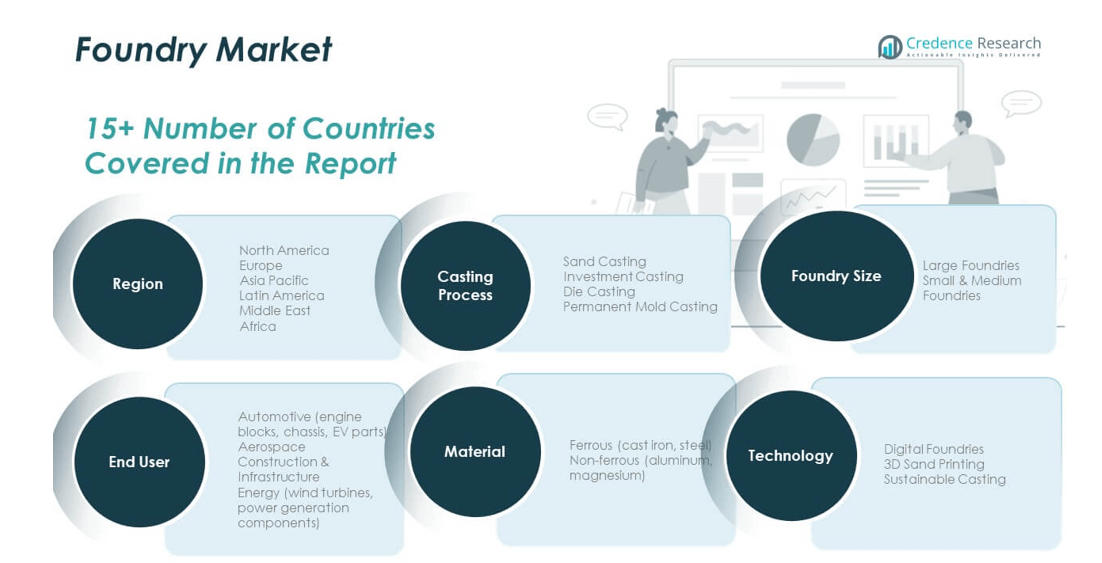
- Ferrous materials represent a smaller share across the timeline in the chart, accounting for roughly 35–40% of the total volume due to their use in heavy machinery and structural applications.
- Non-ferrous materials maintain the dominant share, at approximately 60–65%, supported by rising adoption in automotive lightweighting, aerospace components, and advanced industrial systems.
Market Drivers:
Rising Demand For Advanced Semiconductor Components Across Expanding Industrial Ecosystems
The Global Foundry Market gains strong momentum due to rising use of chips in smart devices. Manufacturers push higher volumes to meet growth in automotive electronics. Telecom firms support stable demand with 5G rollouts across major regions. Industrial firms adopt upgraded controllers that require precise fabrication standards. Consumer devices integrate more sensors that raise wafer orders. Procurement teams expand sourcing networks to secure steady supply. It supports wider adoption of foundry services across many applications. Strong interest in advanced materials strengthens development programs.
- For instance, global manufacturers shipped about 1 trillionsemiconductor units in 2024, representing a market that reached $627.6 billion in sales, including a growing, but comparatively small, number of high-value AI chips, underscoring the scale of demand for advanced logic and accelerators.
Growing Adoption Of Automation And Digital Production Systems Across Fabrication Sites
Automation raises output and reduces defect levels across many foundries. Digital twins support faster modelling of complex wafer structures. Robotics help maintain high purity standards and controlled environments. AI inspection tools detect irregular patterns in micro-features with higher accuracy. Global Foundry Market players invest in automated optical systems to manage tight timelines. Firms adopt predictive tools that stabilize equipment performance. It helps reduce downtime during large production runs. Rising use of smart systems supports continuous improvement cycles.
- For instance, GlobalFoundries (GF) reports conservation programs that saved an estimated 33 gigawatt-hours of electricity and approximately 224 thousand cubic meters of water annually through efficiency and process optimization, while cutting 100,000 metric tons of greenhouse-gas emissions (MTCO2e).
Rising Integration Of Specialized Chips Across Automotive, Healthcare, And Telecom Platforms
Automotive firms require high-temperature chips that support advanced driver systems. Healthcare devices employ compact sensors that need stable performance under pressure. Telecom networks depend on custom RF parts for better signal routing. Wearable devices include power-efficient modules that raise specialized orders. Industrial machinery embeds smart controllers for accurate field operations. Global Foundry Market suppliers expand lines that handle niche geometries. It builds strong diversification across many applications. Higher design complexity encourages deeper technical collaboration.
Strong Investments In Capacity Expansion Across Leading Global Semiconductor Hubs
Producers expand fabrication units to handle rising global demand. New clean rooms support wider production of advanced node technologies. Global Foundry Market leaders build multi-site networks to reduce supply risks. Government incentives encourage higher capital spending across critical regions. R&D programs focus on next-generation lithography capabilities. Material suppliers strengthen distribution networks for key inputs. It supports smoother operations during heavy production cycles. Consistent upgrades raise competitiveness across global markets.
Market Trends:
Shift Toward Smaller Geometry Nodes And High-Density Designs Across Core Electronics Segments
Producers move toward advanced nodes that enhance performance and efficiency. Demand rises for smaller transistors that support compact devices. High-density layouts improve speed across major computing platforms. AI workloads push interest in optimized logic units. IoT networks adopt miniature chips that enable wider device coverage. Global Foundry Market participants develop improved EUV processes for better output. It drives tighter control of pattern fidelity across complex layers. Strong focus on precision shapes long-term roadmap strategies.
- For instance, TSMC reports that advanced technologies at 7 nanometers and below generate 69% of its wafer revenue, with total shipments reaching 9 million 12-inch equivalent wafers in one recent year, underlining how quickly leading-edge nodes dominate mix and volume.
Growing Use Of Heterogeneous Integration And Advanced Packaging Technologies
Manufacturers combine multiple chiplets to raise performance levels in many systems. Advanced packaging boosts communication between components in compact layouts. High-bandwidth solutions support smoother AI model execution. 3D stacking improves space usage for dense computing workloads. Thermal control systems evolve to reduce heat in multi-layer structures. Global Foundry Market firms work closely with packaging suppliers for better reliability. It builds stronger compatibility between new product lines. Wider adoption strengthens advanced system architecture development.
- For instance, high-bandwidth memory devices that rely on 2.5D and 3D advanced packaging are projected to account for 1% of the global semiconductor market by 2028, highlighting how packaging-driven products carve out a distinct share of industry value.
Increasing Use Of Wide-Bandgap Materials Across Power Electronics And Industrial Systems
Wide-bandgap materials help manage high voltages with better efficiency. EV platforms prefer SiC solutions to support longer driving range. Industrial converters adopt GaN parts for higher power density. Telecom infrastructure gains better output with upgraded RF parts. Energy systems integrate durable components for stable long-term loads. Global Foundry Market manufacturers scale specialized lines to support these materials. It enables stronger performance under strict thermal conditions. Rising interest shapes new design standards.
Rising Demand For Custom Silicon And Application-Specific Designs Across Multiple Sectors
Application-specific chips gain traction in AI devices and robotics. Firms create tailored designs to optimize performance for defined tasks. Data centers adopt specialized accelerators for faster model deployment. Consumer electronics integrate custom modules to reduce energy loss. Industrial devices use domain-specific designs for stable operations. Global Foundry Market players expand design-service partnerships for better outcomes. It supports stronger product differentiation across brands. Higher customization attracts long-term development contracts.
Market Challenges Analysis:
High Production Costs, Supply Volatility, And Complexity Across Advanced Fabrication Processes
The Global Foundry Market faces cost pressure from expensive tools and materials. EUV systems raise capital needs for modern fabs. Price shifts in specialty chemicals disrupt planning for many producers. Skilled labor shortages reduce operational flexibility across regions. Process complexity increases risk of defects in advanced nodes. It forces firms to maintain strict monitoring routines. Long equipment cycles limit rapid adaptation to new designs. Competitive pricing becomes harder when margins tighten.
Rising Geopolitical Tensions, Export Controls, And Vulnerable Global Supply Links
Geopolitical tensions put pressure on cross-border semiconductor flow. Export controls reduce access to advanced tools in sensitive regions. Tariff shifts disrupt planning cycles for many suppliers. Logistics delays slow distribution across high-demand channels. Regional dependencies raise risk during sudden disruptions. The Global Foundry Market must maintain diversified sourcing to reduce exposure. It pushes producers to build multi-hub networks. Strategic decisions become more cautious under volatile trade conditions.
Market Opportunities:
Growing Expansion Of AI, EV, And High-Performance Computing Applications Across Global Sectors
AI workloads create strong demand for optimized logic units across many systems. EV platforms require efficient power modules for stable performance. High-performance computing expands interest in advanced architectures. Consumer electronics integrate more features that need stable chips. Industrial automation increases need for durable controllers. The Global Foundry Market can scale specialized lines to meet rising orders. It helps widen long-term partnerships with device makers. Broader use cases encourage sustained technology upgrades.
Strong Development Of Emerging Semiconductor Hubs And Wider Adoption Of Advanced Manufacturing Technologies
New semiconductor regions support diversification across global supply networks. Governments offer incentives to attract large-scale fabrication units. Local talent pools expand through targeted training programs. Infrastructure upgrades support stable production conditions. The Global Foundry Market benefits from multi-region growth initiatives. It allows faster delivery and reduced lead times. Modern systems improve yield performance. Strong regional expansion unlocks long-term growth potential.
Market Segmentation Analysis:
By Casting Process
Sand casting secures wide adoption due to its flexibility in handling complex shapes. Investment casting supports high-precision components used in aerospace and medical parts. Die casting dominates high-volume production for automotive and industrial units. Permanent mold casting strengthens demand for consistent structure and smooth surface profiles. The Global Foundry Market gains stability through the balanced use of these methods. It allows producers to align capacity with diverse application needs. Each process supports different tolerance levels required by core industries. Shifts in material design influence adoption of specific casting techniques.
- For instance, modern sand-casting operations can produce parts, allowing a single process window to cover both small components and massive industrial castings.
By Foundry Size
Large foundries lead with automated lines, digital tools, and high-capacity furnaces. These facilities meet bulk orders from automotive, construction, and energy sectors. Small and medium foundries support niche casting demand in regional clusters. Their flexibility helps handle custom requirements with shorter response times. It creates strong supply depth across the value chain. Emerging industrial zones rely on these foundries for localized supply stability. Digital upgrades improve efficiency across multiple size categories. Wider use of automation narrows performance gaps between segments.
- For instance, Nemak operates around 40 production facilities worldwide with roughly 23,000 employees, while long-established players such as Dandong Foundry bring over 50 years of experience in grey and ductile iron casting, illustrating how both scale and legacy expertise shape global capacity.
By End-User
Automotive holds a dominant position due to steady demand for engine blocks and EV parts. Aerospace uses precision castings for turbine and structural components. Construction and infrastructure rely on durable metal parts for heavy projects. Energy operators need large components for wind turbines and power systems. It supports recurring procurement across diverse industries. End-user shifts toward lightweight metals impact sourcing patterns. Greater design complexity drives long-term partnerships with foundry suppliers. Industrial diversification strengthens segment resilience.
By Technology & Material
Digital foundries use IoT and AI tools to improve monitoring, yield, and maintenance. 3D sand printing supports complex cores that reduce assembly steps. Sustainable casting practices gain traction with low-carbon alloys and recycling systems. Ferrous materials dominate heavy industrial applications requiring strength and thermal stability. Non-ferrous metals support lightweight components for EVs and aerospace. It enables a balanced material mix across applications. Technology upgrades improve precision in both ferrous and non-ferrous processes. Evolving product requirements shape long-term material preferences.
Segmentation:
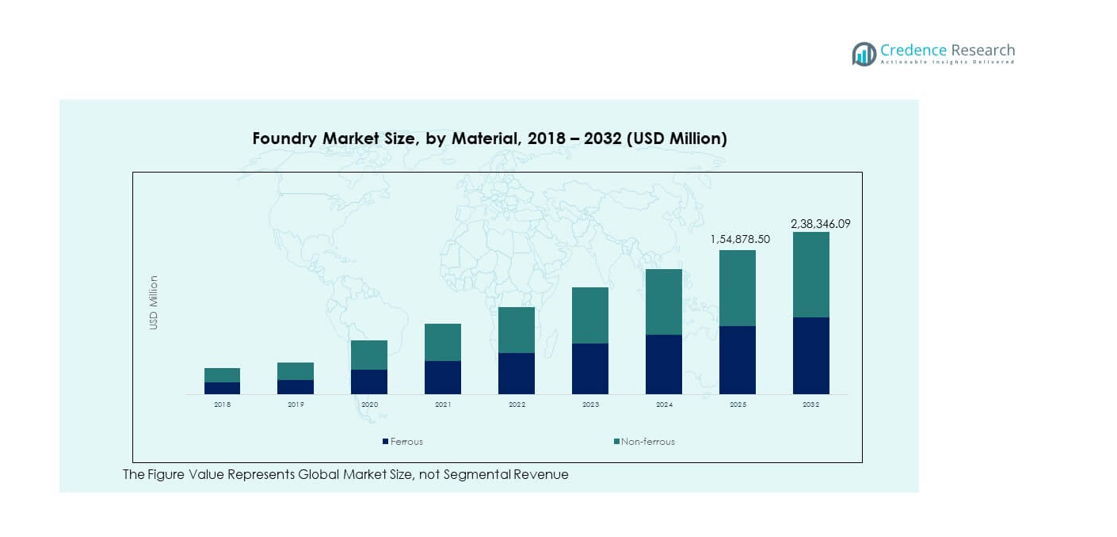
By Casting Process
- Sand Casting
- Investment Casting
- Die Casting
- Permanent Mold Casting
- Large Foundries (automation, digital foundries)
- Small & Medium Foundries (regional, niche casting)
- Automotive (engine blocks, chassis, EV parts)
- Aerospace
- Construction & Infrastructure
- Energy (wind turbines, power generation components)
- Digital Foundries (IoT, AI, predictive maintenance)
- 3D Sand Printing (complex cores)
- Sustainable Casting (low-carbon alloys, recycling, green melting)
- Ferrous (cast iron, steel)
- Non-Ferrous (aluminum, magnesium)
- North America
- U.S.
- Canada
- Mexico
- Europe
- Germany
- France
- U.K.
- Italy
- Spain
- Rest of Europe
- Asia Pacific
- China
- Japan
- India
- South Korea
- South-east Asia
- Rest of Asia Pacific
- Latin America
- Brazil
- Argentina
- Rest of Latin America
- Middle East & Africa
- GCC Countries
- South Africa
- Rest of the Middle East and Africa
Regional Analysis:
North America
The North America Foundry Market size was valued at USD 30,739.32 million in 2018 to USD 35,857.84 million in 2024 and is anticipated to reach USD 58,109.21 million by 2032, at a CAGR of 6.4% during the forecast period. Regional Share (2024): 24.42% North America maintains strong demand for high-quality cast components across major industries, with automotive production supporting steady sourcing of complex engine and structural parts while aerospace spending drives precision casting programs. Construction activity strengthens orders for durable metal products and energy operators use cast units for turbines and power systems. The Global Foundry Market gains stable traction in the region due to diversified applications, and it benefits from digital upgrades across leading foundries. Strong engineering capabilities improve product consistency and reliability across multiple production sites.
Europe
The Europe Foundry Market size was valued at USD 23,978.40 million in 2018 to USD 26,974.43 million in 2024 and is anticipated to reach USD 40,459.88 million by 2032, at a CAGR of 5.3% during the forecast period. Regional Share (2024): 18.38% Europe secures strong adoption due to long-standing industrial clusters and advanced engineering standards, with automotive hubs in Germany, Italy, and France maintaining high-volume sourcing and aerospace manufacturing demanding precision parts with tight tolerance levels. Construction and infrastructure projects drive sustained orders for heavy cast products while sustainable casting practices gain rapid momentum across EU countries. The Global Foundry Market strengthens in Europe through material innovation and improved melting systems, and it benefits from strong regulatory frameworks that encourage quality improvements. Energy transition projects raise demand for durable cast components across major economies.
Asia Pacific
The Asia Pacific Foundry Market size was valued at USD 55,076.16 million in 2018 to USD 66,997.80 million in 2024 and is anticipated to reach USD 115,097.52 million by 2032, at a CAGR of 7.1% during the forecast period. Regional Share (2024): 45.63% Asia Pacific leads global consumption due to strong industrial expansion and large manufacturing bases, with China and India supporting heavy automotive and machinery requirements and Japan and South Korea demanding precision castings for electronics and advanced systems. Infrastructure spending boosts orders from construction supply chains while regional suppliers adopt new melting and molding technologies to meet higher quality standards. The Global Foundry Market benefits from competitive production costs and deep supply networks, and it gains further traction through strong export activity. Rapid industrialization creates long-term demand across multiple sectors in the region.
Latin America
The Latin America Foundry Market size was valued at USD 8,899.20 million in 2018 to USD 10,478.73 million in 2024 and is anticipated to reach USD 15,938.20 million by 2032, at a CAGR of 5.5% during the forecast period. Regional Share (2024): 7.14% Latin America shows steady growth supported by automotive and construction industries, with Brazil maintaining the largest installed capacity for cast components and regional manufacturing growth boosting sourcing of ferrous and non-ferrous parts. Infrastructure investment raises demand for heavy industrial castings while local foundries adopt new quality systems to meet global standards. The Global Foundry Market strengthens its position in the region due to rising industrial output, and it gains support from expanding supplier networks. Export-focused manufacturing improves long-term growth potential across key countries.
Middle East
The Middle East Foundry Market size was valued at USD 2,916.96 million in 2018 to USD 3,110.81 million in 2024 and is anticipated to reach USD 4,220.04 million by 2032, at a CAGR of 4.0% during the forecast period. Regional Share (2024): 2.12% The Middle East generates stable demand through ongoing infrastructure and energy projects, with oil and gas operators sourcing durable cast products for critical equipment and construction programs raising orders for structural components across major cities. Regional diversification strategies support broader industrial activity while modernization of foundries improves capability across several countries. The Global Foundry Market gains moderate traction in the region due to consistent project pipelines, and it benefits from strategic investments in industrial clusters. Local suppliers expand capacity to serve regional and export markets across key sectors.
Africa
The Africa Foundry Market size was valued at USD 1,989.96 million in 2018 to USD 3,361.89 million in 2024 and is anticipated to reach USD 4,521.25 million by 2032, at a CAGR of 3.3% during the forecast period. Regional Share (2024): 2.29% Africa shows gradual growth supported by mining, construction, and infrastructure sectors, with rising demand for cast parts used in heavy machinery and transportation fleets and urban expansion driving sourcing for metal components across major projects. Regional foundries invest in better molding and melting systems while imports supplement local production due to capability gaps. The Global Foundry Market gains steady traction in Africa through emerging industrial zones, and it supports long-term development in energy and manufacturing supply chains. Skills training programs improve operational efficiency across multiple countries.
Key Player Analysis:
- JSW Steel Ltd.
- Kirloskar Ferrous Industries Ltd.
- Larsen & Toubro (L&T)
- Electrosteel Castings Ltd.
- Brakes India Pvt. Ltd.
Competitive Analysis:
The Global Foundry Market shows strong competition driven by rapid expansion across automotive, aerospace, and industrial sectors. Large players focus on automation upgrades, digital systems, and high-capacity lines to secure long-term contracts. Regional foundries gain relevance through flexible production and niche capabilities. Firms invest in precision casting, new alloys, and advanced molding technologies to serve demanding applications. It supports differentiation in performance, supply reliability, and engineering support. Partnerships between OEMs and foundries strengthen integrated development programs. Competitors enhance service depth through design support and material expertise. Continuous upgrades in sustainability, energy efficiency, and quality systems shape competitive positioning across global and regional markets.
Recent Developments:
- In a major capital expansion initiative, Kirloskar Ferrous Industries Ltd. unveiled a ₹3000 crore plan to bolster its production capacity in pig iron, ductile iron pipes, and alloy castings in early November 2025. The expansion reflects the company’s strategic intent to capture growing demand from automotive and infrastructure sectors. This move is anchored by improvements in operational efficiency and green energy adoption, anticipating margin growth and stronger market positioning. The expansion supports Kirloskar Ferrous Industries Ltd.’s ongoing momentum in the casting segment, particularly targeting the surge in demand from tractor and automotive industries.
- Larsen & Toubro (L&T) advanced its diversification strategy by exploring entry into the electronics manufacturing sector, according to late October 2025 reports. The conglomerate is holding preliminary discussions with the Tamil Nadu government to acquire land for potential manufacturing operations near Chennai. Notably, Larsen & Toubro Semiconductor Technologies (LTSCT) entered a long-term partnership in October 2025 with Foxconn subsidiary Hon Young Semiconductor (HYS) to develop high-voltage semiconductor wafers for automotive and industrial applications, leveraging HYS's foundry capacities in Taiwan. These moves indicate a strategic push towards integration in the electronics and semiconductor segment, aligning with global demand for smart devices and components in the foundry market.
- JSW Steel Ltd. continued to reinforce its growth plans for FY26, outlining a substantial annual capex of INR 20,000 crore and reaffirming its expansion in steel output. In recent management updates, JSW Steel anticipated higher steel prices in November-December 2025 and projected a potential 30–35 million ton reduction in Chinese steel production by 2026. The company’s strategic focus on modernization and capacity enhancement is framed against global market shifts, especially as Chinese output declines. Additionally, JSW Steel updated its acquisition of additional economic interest in MRes NEW HCC Pty Ltd, reinforcing its engagement with global supply chains and resource security for foundry production.
Report Coverage:
The research report offers an in-depth analysis based on Casting Process, Foundry Size, End-User, Technology, and Material segments. It details leading market players, providing an overview of their business, product offerings, investments, revenue streams, and key applications. Additionally, the report includes insights into the competitive environment, SWOT analysis, current market trends, as well as the primary drivers and constraints. Furthermore, it discusses various factors that have driven market expansion in recent years. The report also explores market dynamics, regulatory scenarios, and technological advancements that are shaping the industry. It assesses the impact of external factors and global economic changes on market growth. Lastly, it provides strategic recommendations for new entrants and established companies to navigate the complexities of the market.
Future Outlook:
- Rising demand for precision cast parts will strengthen high-tech manufacturing needs.
- Automation and digital monitoring will shape next-generation production systems.
- Lightweight metal adoption will grow due to EV and aerospace requirements.
- Wider use of sustainable alloys will support low-carbon development goals.
- Regional supply expansion will reduce dependency on single-source markets.
- Growth in heavy infrastructure projects will raise casting demand worldwide.
- New material innovations will enhance performance across industrial systems.
- Integration of predictive maintenance will reduce downtime in large foundries.
- 3D sand printing will gain traction for complex cores and rapid prototyping.
- Strategic partnerships will expand capabilities across global supply chains.
Request a Free Sample
Fill in your details and we'll send you a free sample report.
- Sample data tables & charts
- Research methodology
Need a Custom Version of This Report?
Tailor the scope, geography, or segments to your exact requirements.
- Custom geography or segment scope
- Direct access to our analyst team
Frequently Asked Questions
What is the current market size for the Foundry market, and what is its projected size in 2032?
At what Compound Annual Growth Rate is the Foundry market projected to grow between 2025 and 2032?
Which Foundry market segment held the largest share in 2024?
What are the primary factors fueling the growth of the Foundry market?
Who are the leading companies in the Foundry market?
Which region commanded the largest share of the Foundry market in 2024?
Table of Content
Chapter 1. Report Introduction
- 1.1 Report Description & Purpose
- 1.1.1 Report Title & Market Definition
- 1.1.2 Unique Selling Propositions (USP) & Key Differentiators
- 1.1.3 Value Proposition for Stakeholders
- 1.2 Research Objectives
- 1.2.1 Market Sizing Objectives (Volume & Revenue)
- 1.2.2 Segmentation Objectives
- 1.2.3 Competitive Intelligence Objectives
- 1.2.4 Forecast & Scenario Objectives
- 1.3 Report Scope
- 1.3.1 Foundry Scope – Types & Subtypes Covered
- 1.3.2 Geographic Scope – Regions & Countries Covered
- 1.3.3 Historical Period, Base Year & Forecast Period (2024; forecast to 2032)
- 1.3.4 Inclusions & Exclusions
- 1.4 HS Code & Classification Framework
- 1.5 Currency, Units & Pricing Basis
- 1.6 Target Stakeholders
- 1.7 Limitations & Assumptions
Chapter 2. Executive Summary
- 2.1 Global Foundry Market Snapshot
- 2.1.1 Market Size – Historical (2024) & Forecast (2024-2032) (2024: USD 146,781.49 million → 2032: USD 238,346.09 million)
- 2.1.2 Volume & Revenue – Global Totals
- 2.1.3 Key Market Highlights – Top Five Facts
- 2.2 Foundry Market Segmentation Snapshot
- 2.2.1 Market Split by Region – 2024 vs. 2032
- 2.3 Competitive Snapshot
- 2.3.1 Top 10 Players by Revenue Share – 2024
- 2.3.2 Top 10 Players by Volume Share – 2024
- 2.3.3 Recent Strategic Developments (18-Month Summary)
- 2.4 Key Investment Highlights & Strategic Conclusions
Chapter 3. Foundry Market Dynamics & Industry Analysis
- 3.1 Market Overview & Context
- 3.1.1 Foundry Market Position in the Broader Automotive Value Chain
- 3.1.2 OEM vs. Replacement Market Dynamics
- 3.1.3 Market Maturity & Development Stage by Region
- 3.2 Foundry Market Drivers
- 3.3 Foundry Market Restraints & Challenges
- 3.4 Foundry Market Opportunities
- 3.5 Porter's Five Forces Analysis
- 3.5.1 Threat of New Entrants
- 3.5.2 Bargaining Power of Suppliers
- 3.5.3 Bargaining Power of Buyers
- 3.5.4 Threat of Substitutes
- 3.5.5 Competitive Rivalry – Intensity Assessment
- 3.6 Foundry Value Chain Analysis
- 3.6.1 Upstream – Raw Material/Input Suppliers
- 3.6.1.1 Raw Material/Input 1
- 3.6.1.2 Raw Material/Input 2
- 3.6.1.3 Raw Material/Input 3
- 3.6.2 Midstream – Production/Manufacturing/Service Delivery
- 3.6.2.1 Production/Process Overview
- 3.6.2.2 Key Facility Locations & Capacity by Manufacturer
- 3.6.3 Downstream – Distribution & End Consumer
- 3.6.3.1 Primary Channel – B2B/OEM
- 3.6.3.2 Secondary Channels – Dealer, Retail, Online, Direct
- 3.6.4 Value Chain Profitability Analysis
- 3.6.1 Upstream – Raw Material/Input Suppliers
- 3.7 PESTEL Analysis
- 3.7.1 Political Factors
- 3.7.2 Economic Factors
- 3.7.3 Social Factors
- 3.7.4 Technological Factors
- 3.7.5 Environmental Factors
- 3.7.6 Legal Factors
- 3.8 Foundry Supply Chain Analysis
- 3.8.1 Raw Material/Input Supply Risk Assessment
- 3.8.2 Manufacturing Concentration Risk (Geographic Exposure)
- 3.8.3 Trade Disruption Impact Analysis
- 3.9 Regulatory & Policy Landscape
Note: The regulatory and policy landscape section covers regulations based on their applicability to the market, Foundry category, geography, and scope of the study. Only regulatory frameworks with a material impact on operations, compliance, trade, sustainability, or market access are analyzed in detail.
Chapter 4. Key Investment Pockets & Opportunity Analysis
- 4.1 Foundry Market Attractiveness Analysis
- 4.1.1 By Region – Investment Attractiveness Matrix (Volume × CAGR)
- 4.2 Absolute Revenue Growth Opportunity
- 4.2.1 By Region – Absolute USD Growth Through 2032
- 4.3 Incremental Volume Opportunity
- 4.3.1 By Region – Incremental Volume Through 2032
- 4.3.2 Segment – Incremental Volume
- 4.4 Emerging Submarket Opportunity Deep Dive (Subject to Applicability)
- 4.5 Emerging Market Opportunity Scorecards
- 4.5.1 United States
- 4.5.2 Europe
- 4.5.3 Asia
- 4.5.4 Middle East & Africa
Note: Emerging Market Opportunity Scorecards will be included based on relevance and strategic importance. Regions listed are indicative and may vary depending on data availability and market dynamics.
Chapter 5. Foundry Import-Export Analysis & Trade Flows
- 5.1 Global Trade Overview
- 5.1.1 Global Export Value by Country (2024)
- 5.1.2 Global Export Volume by Country (2024)
- 5.1.3 Global Import Value by Country (2024)
- 5.1.4 Global Import Volume by Country (2024)
- 5.1.5 Net Trade Balance by Country (2024)
- 5.2 Export Analysis – Segment
- 5.2.1 Type 1 (HS Code)
- 5.2.2 Type 2 (HS Code)
- 5.2.3 Type 3 (HS Code)
- 5.2.4 Type 4 (HS Code)
- 5.2.5 Type 5 (HS Code)
- 5.3 Import Analysis – Segment
- 5.3.1 Type 1 (HS Code)
- 5.3.2 Type 2 (HS Code)
- 5.3.3 Type 3 (HS Code)
- 5.3.4 Type 4 (HS Code)
- 5.3.5 Type 5 (HS Code)
- 5.4 Average Unit Trade Prices
- 5.4.1 Average Export Price – Segment & Country
- 5.4.2 Average Import Price – Segment & Source Country
- 5.4.3 Price Trends (2024)
- 5.5 Key Trade Route Analysis
- 5.5.1 Trade Route 1
- 5.5.2 Trade Route 2
- 5.5.3 Trade Route 3
- 5.5.4 Trade Route 4
- 5.5.5 Trade Route 5
- 5.6 Trade Policy Impact Assessment
- 5.6.1 US Anti-Dumping & Section 301 Tariffs
- 5.6.2 EU Customs Union Impact
- 5.6.3 Major Free Trade Agreements
- 5.6.4 USMCA Rules of Origin
Note: Trade policy analysis will be included only where relevant to the Foundry market.
Chapter 6. Competitive Landscape & Company Benchmarking
- 6.1 Foundry Market Concentration & Structure
- 6.1.1 Herfindahl-Hirschman Index (HHI) – vs. 2024
- 6.1.2 Tier 1, Tier 2 & Tier 3 Market Structure
- 6.1.3 Global, Regional & Local Player Dynamics
- 6.2 Foundry Market Share Analysis – 2024
- 6.2.1 Global Revenue Share by Company
- 6.2.2 Global Volume Share by Company
- 6.2.3 Regional Revenue Share
- 6.2.4 Market Share Evolution ( vs. 2024)
- 6.2.5 OEM Segment Share by Company
- 6.2.6 Replacement Segment Share by Company
- 6.3 Production/Delivery Capacity & Facility Analysis
- 6.3.1 Global Installed Capacity
- 6.3.2 Capacity Utilization Rates
- 6.3.3 Production/Output Volume
- 6.3.4 Facility Locations & Capacity Map
- 6.3.5 Planned Capacity Additions
- 6.4 Foundry Competitive Benchmarking Matrix
- 6.4.1 Revenue, Volume, CAGR & Profitability Comparison
- 6.4.2 Channel Revenue Mix
- 6.4.3 Geographic Revenue Exposure
- 6.4.4 R&D Intensity
- 6.4.5 Sustainability Maturity
- 6.5 Strategic Developments in Foundry (Last 24 Months)
- 6.5.1 Mergers, Acquisitions & Divestments
- 6.5.2 New Foundry Launches
- 6.5.3 Facility Expansions
- 6.5.4 Strategic Alliances, Joint Ventures & Partnerships
- 6.5.5 Distribution Expansion & Market Entry
- 6.5.6 Sustainability & ESG Initiatives
- 6.6 Competitive Strategy Mapping
- 6.6.1 Leader, Challenger, Follower & Niche Classification
- 6.6.2 Pricing Strategy Comparison
- 6.6.3 Channel Strategy Matrix
Note: Strategic developments are included based on their materiality and the availability of reliable information.
Chapter 7. Global Foundry Market – By Distribution Channel
- 7.1 Segment Overview
- 7.1.1 Volume & Revenue Split by Channel (2024 & 2032)
- 7.1.2 Channel Mix Evolution (2024-2032)
Chapter 8. Regional Market Analysis – Global Overview
- 8.1 Global Regional Overview
- 8.1.1 Regional Volume Share
- 8.1.2 Regional Revenue Share
- 8.1.3 Regional Volume by Region
- 8.1.4 Regional Revenue by Region
- 8.1.5 Regional Forecast Through 2032
- 8.2 Cross-Regional Segment Analysis
- 8.2.1 By Distribution Channel
- 8.2.2 By Brand/Price Tier
Chapter 9. North America Foundry Market
- 9.1 United States
- 9.2 Canada
- 9.3 Mexico
Chapter 10. Europe Foundry Market
- 10.1 Germany
- 10.2 France
- 10.3 Italy
- 10.4 United Kingdom
- 10.5 Spain
- 10.6 Poland
- 10.7 Russia
- 10.8 Netherlands
- 10.9 Belgium
- 10.10 Sweden
- 10.11 Denmark
- 10.12 Norway
- 10.13 Rest of Europe
Chapter 11. Asia Pacific Foundry Market
- 11.1 China
- 11.2 India
- 11.3 Japan
- 11.4 South Korea
- 11.5 Thailand
- 11.6 Indonesia
- 11.7 Vietnam
- 11.8 Malaysia
- 11.9 Australia
- 11.10 Rest of Asia Pacific
Chapter 12. Latin America Foundry Market
- 12.1 Brazil
- 12.2 Argentina
- 12.3 Colombia
- 12.4 Chile
- 12.5 Rest of Latin America
Chapter 13. Middle East Foundry Market
- 13.1 Saudi Arabia
- 13.2 United Arab Emirates
- 13.3 Turkey
- 13.4 Israel
- 13.5 Iran
- 13.6 Rest of the Middle East
Chapter 14. Africa Foundry Market
- 14.1 South Africa
- 14.2 Egypt
- 14.3 Nigeria
- 14.4 Morocco
- 14.5 Rest of Africa
Chapter 15. Foundry Company Profiles
- 15.1 [Company 01]
- 15.1.1 Company Overview
- 15.1.2 Key Management Personnel
- 15.1.3 Products & Services Portfolio
- 15.1.4 Financial Performance
- 15.1.5 Key Market Focus & Geographic Presence
- 15.1.6 Recent Developments & Strategic Initiatives
Note: The company profile list is preliminary and may change based on research findings, market developments, data availability, and client requirements.
Chapter 16. Appendices
- Appendix A – List of Abbreviations & Acronyms
- Appendix B – Industry Classification Code Reference – Full Series
- Appendix C – Production & Capacity Data Tables
- Appendix D – End-Use & Demand Base Tables
- Appendix E – Consumption & Replacement Rate Assumptions
- Appendix F – ASP Reference Tables
- Appendix G – Manufacturing & Facility Database
- Appendix H – Import-Export Data Tables
- Appendix I – Regulatory Summary Tables
- Appendix J – Primary Research Participant List (Anonymized)
- Appendix K – Primary Research Questionnaire Framework
- Appendix L – Data Sources & Bibliography
- Appendix M – Market Size Divergence & Source Comparison
Chapter 17. Research Methodology
- 17.1 Research Framework & Philosophy
- 17.2 Secondary Research – Sources, Hierarchy & Data Extraction
- 17.3 Data Modeling – Bottom-Up & Top-Down Market Sizing
- 17.4 Primary Research – Stakeholder Framework, LOI & Sample Sizes
- 17.5 Forecast Methodology – Regression, Scenario & Sensitivity Analysis
- 17.6 Quality Control – Four-Layer Validation Framework
- 17.7 Limitations & Standard Assumptions
- 17.8 Disclaimer
