
QatarEnergy to Acquire 25% Stake in Chevron-Operated PEL 82 Exploration License Offshore Namibia
QatarEnergy has agreed to acquire a 25% participating interest in Petroleum Exploration License 82 (PEL 82), a Chevron-operated deepwater exploration license in Namibia's Walvis Basin, the Qatari state energy company said in Doha on Nov. 9, 2026. The stake comes from Chevron Namibia Exploration II Limited, a Chevron subsidiary, and the transaction remains subject to customary regulatory approvals. Neither company disclosed the price. Sintana Energy, which holds an indirect interest in the license, confirmed the deal in a separate release from Toronto and London on Nov. 10.
Key developments
- QatarEnergy will buy a 25% interest in PEL 82 from a Chevron affiliate. Chevron's stake falls from 80% to 55%, and it remains operator.
- Namibia's state-owned Namcor and privately held Custos Energy each keep their 10% interests. Sintana owns 49% of Custos, so its indirect exposure to the license does not change.
- PEL 82 covers blocks 2112B and 2212A, about 11,450 square kilometers, in water depths of 350 to 2,300 meters.
- Sintana said existing seismic data covers about 70% of the license area. The license is still in its exploration period, and no reserves or resources have been attributed to it.
- Financial terms, a work program and a completion date were not announced.
Industry background
Namibia became one of the most closely watched frontier oil provinces after a series of deepwater discoveries in the Orange Basin, off the country's southern coast. Those finds include TotalEnergies' Venus discovery and the Mopane discoveries first made by Galp. The National, citing industry estimates, reported that Orange Basin discoveries hold about 11 billion barrels of light oil and 2.2 trillion cubic feet of natural gas. None of that volume has yet reached production, and Namibia still has no producing offshore oil field.
The Walvis Basin, where PEL 82 sits, lies farther north and has drawn far less drilling. Sintana said previous wells on the acreage include Wingat-1 and Murombe-1. Chevron took an 80% interest and operatorship of PEL 82 through a farm-in with Custos and Namcor, a deal Offshore Engineer reported in February 2025.
QatarEnergy already works with Chevron in Namibia. The two are partners in PEL 90 in the Orange Basin, where Rigzone reported that Chevron said in August it expected to start drilling the Nabba-1X well before the end of 2026. QatarEnergy also holds positions alongside Shell and TotalEnergies in other Namibian blocks. Saad Sherida Al-Kaabi, Qatar's minister of state for energy affairs and QatarEnergy's president and CEO, said the company was "pleased to further strengthen our relations with Chevron through this agreement." He also said the deal would expand and diversify QatarEnergy's footprint in the country.
Industry implications
The deal reflects a steady pattern in African frontier exploration: large operators sell down part of their equity before drilling to share costs and geological risk. Deepwater wells in water up to 2,300 meters deep are expensive, and exploration campaigns can run for years before a commercial decision. Taking a well-funded national oil company as a 25% partner gives Chevron a co-investor for seismic work and any future wells while it keeps majority control and operatorship.
For QatarEnergy, PEL 82 adds acreage in a separate basin from its Orange Basin holdings. That spreads its Namibian exposure across more than one geological play. Because the Walvis Basin has seen fewer modern wells, entry costs at this stage are usually lower than in proven areas, though the risk of dry holes is higher. Sintana chief executive Robert Bose described QatarEnergy's entry as an endorsement of the Walvis Basin.
The agreement also shows that Namibia's offshore licenses still attract capital even though no offshore oil field there has yet reached production. Partner entries like this one tend to come before drilling rather than after it, which makes them an early sign of where operators plan to spend exploration budgets.
Competitive and supply chain implications
Namibia's offshore acreage is now held mostly by a few international companies, including TotalEnergies, Shell, Chevron, Galp and Equinor, together with QatarEnergy and Namcor. Offshore Magazine reported in September 2026 that TotalEnergies had become operator of the Mopane discovery in PEL 83 and planned a three-well appraisal campaign ahead of a targeted final investment decision in 2028. Rigzone reported that Equinor agreed to buy a 17.4% stake in PEL 90 from Chevron, which marked the Norwegian company's entry into Namibia.
As more partners commit capital, demand grows for deepwater drilling rigs, seismic vessels and offshore support services in a region with limited local infrastructure. Walvis Bay, Namibia's main port, already serves as a logistics base for offshore campaigns. Any drilling on PEL 82 would compete for the same pool of rigs and service crews already working the Orange Basin and fields off West Africa.
Smaller license holders such as Custos and Sintana gain from larger partners carrying more of the spending. Sintana's statement focused on keeping its indirect interest intact rather than on any cash consideration, which suggests the value for minority holders lies mainly in the drilling that larger partners can fund.
Regional implications
For Namibia, a new partner in a northern basin widens exploration beyond the Orange Basin, where most activity has been concentrated so far. Namcor keeps its 10% interest, so the state retains a direct stake in any discovery on the license.
For Qatar, the deal adds to a string of upstream and supply agreements outside the Gulf. In October 2026, The National reported, QatarEnergy signed a 20-year agreement to buy up to 3 million metric tons a year of LNG from Woodside Energy's Louisiana LNG project. Exploration acreage in southern Africa diversifies the company further, adding oil-weighted assets far from its gas base at home.
Credence Research analysis
This is an exploration-stage deal, not a production deal, and it should be read that way. There are no reserves, no disclosed price and no announced well on PEL 82. What the transaction does show is that Chevron and QatarEnergy are willing to extend their Namibian partnership from the Orange Basin into the less-tested Walvis Basin before results from their joint PEL 90 drilling are known. That sequencing points to a portfolio approach: both companies appear to be buying exposure across several plays rather than betting on a single prospect.
The deal also fits a wider pattern in which Gulf national oil companies act as financial and strategic partners to Western majors in frontier basins. For Chevron, selling down 25% keeps its spending in Namibia in check while it retains control of the work program. The next real signal will come from the drill bit. Results from Nabba-1X in PEL 90 and appraisal wells at Mopane will shape how much capital partners are prepared to commit to the Walvis Basin, and whether PEL 82 moves from seismic interpretation to a drilling decision.
What comes next
- Namibian regulatory approvals and completion of the 25% transfer to QatarEnergy.
- Any announcement by Chevron and partners of a work program or drilling plans for PEL 82.
- Results from Chevron's planned Nabba-1X well in PEL 90, where QatarEnergy is also a partner.
- TotalEnergies' three-well Mopane appraisal campaign and progress toward a final investment decision targeted for 2028.
- Further farm-ins or license transfers in the Walvis and Orange basins as operators reshape their Namibian portfolios.
Sources
- Qatar News Agency: QatarEnergy Acquires 25% Interest in Namibian Offshore Exploration License
- Sintana Energy: PEL 82 - QatarEnergy to Acquire 25% Participating Interest from Chevron
- Rigzone: QatarEnergy, Chevron Expand Exploration Partnership Offshore Namibia
- Offshore Magazine: TotalEnergies Takes Operatorship of Namibia's Mopane Discovery
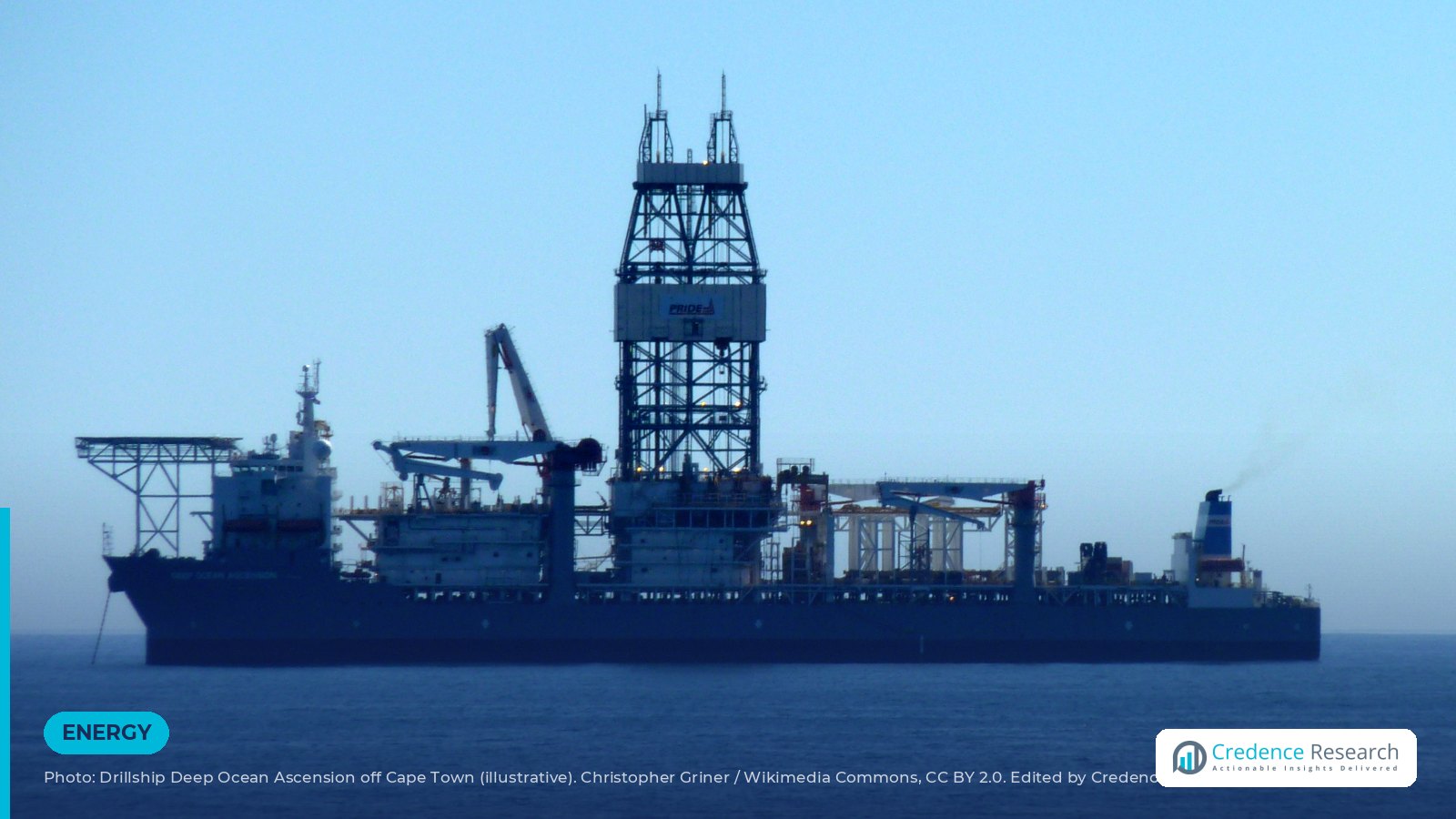
Image: Drillship Deep Ocean Ascension off Cape Town, South Africa (illustrative), by Christopher Griner via Wikimedia Commons, CC BY 2.0. Cropped and edited by Credence Research.

About the Author

Senior News Editor at Credence Research Inc