
Senate Passes Bipartisan Permitting Bill That Makes Data Centers Pay More for Grid Costs
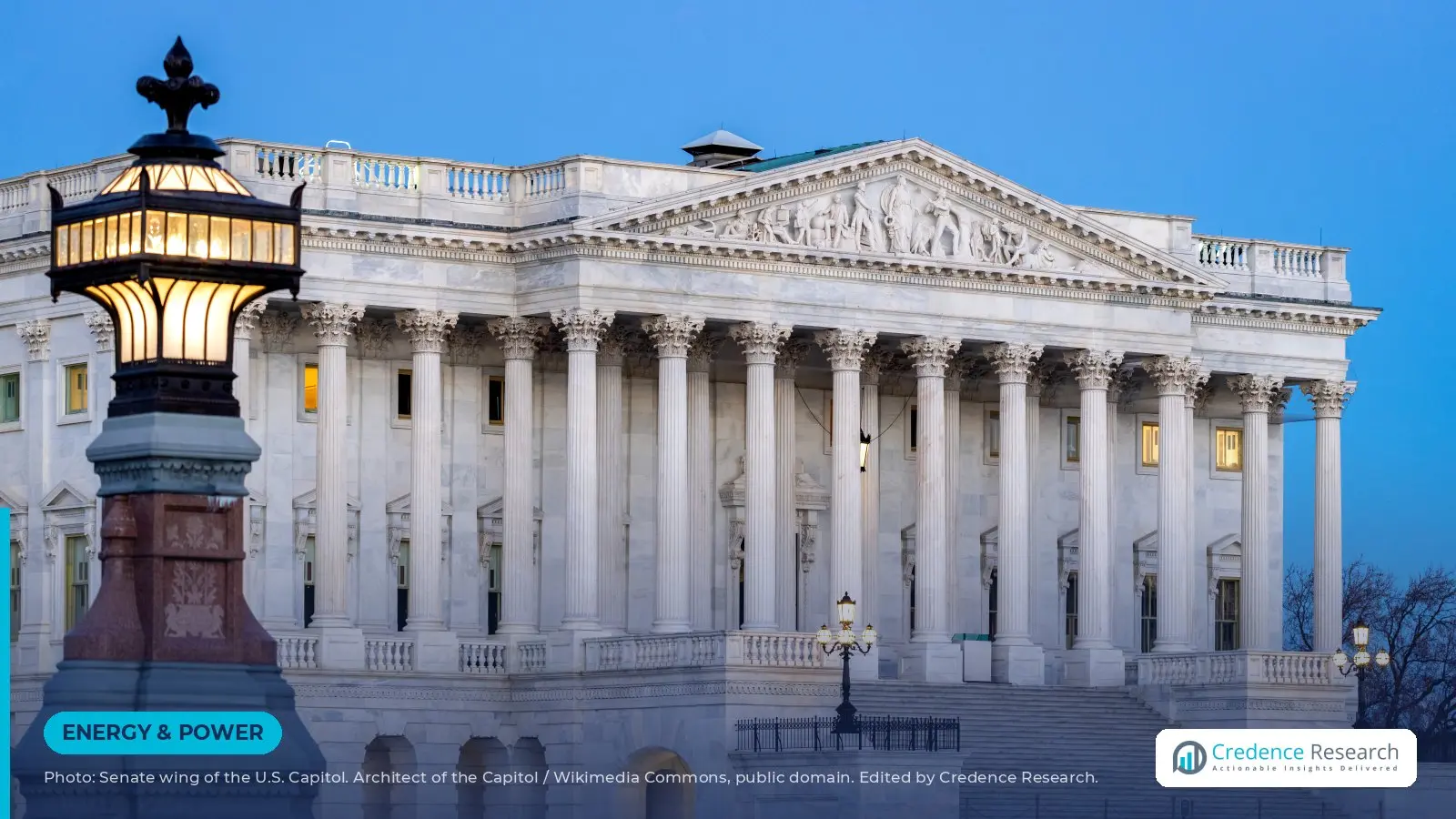
The U.S. Senate on Thursday, Nov. 19, 2026, passed the Bipartisan American Affordability and Jobs Act of 2026 by a vote of 62-33, approving a wide-ranging rewrite of federal permitting rules for energy and infrastructure projects and attaching new requirements that large data centers cover more of the grid costs they create. The bill, written by Sens. Mike Lee, R-Utah, Shelley Moore Capito, R-W.Va., Martin Heinrich, D-N.M., and Sheldon Whitehouse, D-R.I., now moves to the House of Representatives, which must pass it before it can reach the president's desk.
Key developments
- The Senate passed the bill 62-33 on Nov. 19, according to a statement from Sen. Chris Coons, D-Del., following a 73-25 vote on Nov. 9 that advanced the legislation, as reported by the Senate Environment and Public Works Committee.
- The package pairs Environment and Public Works Committee reforms to the National Environmental Policy Act, the Clean Water Act and the Endangered Species Act with Energy and Natural Resources Committee changes to the National Historic Preservation Act and the Federal Power Act.
- It includes the Ratepayer Protection Act, which Capito said is designed to make proposed data centers pay their own way for grid service, and Heinrich said it would make data centers pay their fair share of electricity and grid costs.
- Heinrich's office cited an Employ America analysis projecting up to 105,600 trades and manufacturing jobs through 2040.
- Amendments sought by rank-and-file senators did not receive votes, according to Coons and AP reporting carried by MPR News.
How the bill came together
The four sponsors lead the Senate's two energy and environment committees, and they built the measure in two parts that track those panels' jurisdictions. Heinrich's office said the bill was introduced in September and that a substitute amendment was released earlier in November, before floor action. Capito, in floor remarks published by the committee, said permitted projects would keep their permits as long as they remain in compliance with the law, and she argued the bill would curb what she described as unnecessary delays and endless litigation.
Specific procedural changes were described in media coverage rather than in the sponsors' releases. The Deseret News reported that the bill bars agencies from pausing reviews to wait for new scientific, technical or environmental studies, and quoted Lee as saying a court that finds a violation of NEPA or the historic preservation law could require an agency to fix its paperwork but could not stop construction. The same outlet reported that critics say a rewritten Section 106 process shortens the window for tribal consultation, a point Heinrich's office disputed by saying the bill strengthens tribal consultation.
Supporters frame the bill around construction timelines. Heinrich pointed to the SunZia transmission and wind project, which came online in June after nearly two decades of planning and permitting, noting that the actual construction took about two years. Capito cited a National Association of Manufacturers estimate that permitting delays cost manufacturers $12.1 billion every year.
Industry implications
For developers, the core change is predictability. Faster federal reviews, limits on open-ended study requests and narrower remedies in court would reduce the risk that a project is halted after capital is committed. Capito listed coal mines, wind farms, gas pipelines, solar farms and steel mills as beneficiaries, and AP reporting said both clean energy developers and oil and gas groups backed the bill.
For data center operators, the bill introduces a cost obligation alongside the faster approvals. Lee said in a Nov. 20 statement that the measure makes data centers pay more to interconnect to the grid so that other customers' rates do not rise. Hyperscale and colocation developers that have relied on utilities spreading interconnection costs across all ratepayers would face higher upfront grid charges in exchange for a clearer path to power.
Competitive and supply chain implications
Shorter permitting cycles would shift competitive advantage toward developers with shovel-ready pipelines of projects and toward suppliers able to deliver transformers, conductors, turbines and steel on compressed schedules. Equipment lead times, already a constraint for grid expansion, could become the binding limit on how quickly the faster approvals translate into steel in the ground.
The data center cost provisions may also reshape site selection. If interconnection becomes more expensive in congested regions, developers could favor locations with spare transmission capacity or pair campuses with on-site generation. Critics cited by MPR News, including the Environmental Integrity Project, warned the bill would support gas power plants for data centers, oil and gas pipelines and liquefied natural gas terminals, while Sen. Jeff Merkley, D-Ore., argued in remarks reported by OilPrice.com that it could open the door for wind and solar but doubted the administration would allow it.
Regional implications
The West and Appalachia stand to see the most direct effects. Utah Gov. Spencer Cox called it the most important bill in a long time, according to the Deseret News, and Western senators highlighted gains for public lands projects. Capito pointed to permitting delay costs in West Virginia. Heinrich's New Mexico is home to the SunZia project he cited as a case study in permitting delay.
Opposition also had a regional profile. Sen. Alex Padilla, D-Calif., voted no, saying provisions would harm California, and Oregon Democrats Jeff Merkley and Ron Wyden pressed amendments, including a Wyden proposal reported by the Deseret News to bar data centers on public lands. Tribal leaders, including Oneida Nation Vice Chairman Jameson Wilson, raised concerns about sacred sites, AP reported. Republicans Josh Hawley of Missouri and Mike Rounds of South Dakota voted against the bill, while 15 Democrats including Minority Leader Chuck Schumer voted for it, according to AP.
Credence Research analysis
The 62-33 margin, comfortably above the 60 votes needed to overcome a filibuster, shows that permitting reform has moved from a partisan bargaining chip to a shared priority driven by electricity demand from data centers and manufacturing. The key design choice is linking faster approvals to a data center cost obligation. That gives Democrats a consumer protection argument and gives Republicans the review and litigation limits they have sought for years, a trade that explains why environmental groups split from many Democratic senators on the final vote.
The commercial effect depends on the House and on implementation. The House passed a narrower, industry-friendly version last year, AP reported, and Capito noted the SPEED Act and the PERMIT Act had already cleared that chamber. Reconciling those bills during a lame-duck session is a tight timeline. If the measure becomes law, the first measurable signals will be agency review durations and the share of data center interconnection costs assigned to large loads, both of which will matter more to project economics than headline reform language.
What comes next
- House consideration of the Senate-passed bill, which Coons urged the chamber to take up without delay.
- A lame-duck push to finish the legislation before the current Congress ends, as reported by the Deseret News.
- Possible negotiation with House versions, including the SPEED Act and the PERMIT Act.
- Presidential action; AP reported that President Donald Trump urged lawmakers to approve the bill.
- If enacted, agency rulemaking on review procedures and on data center grid cost rules under the Federal Power Act changes.
Sources
- Sen. Martin Heinrich: Senate passage of bipartisan permitting deal (Nov. 19, 2026)
- Sen. Chris Coons: Statement on final passage of permitting reform bill (Nov. 19, 2026)
- Senate EPW Committee: Senate advances Bipartisan American Affordability and Jobs Act (Nov. 9, 2026)
- MPR News (AP): Senate approves bill to speed up permitting reviews (Nov. 20, 2026)
Image: Senate wing of the U.S. Capitol, by the Architect of the Capitol via Wikimedia Commons, public domain. Cropped and edited by Credence Research.

About the Author

Senior News Editor at Credence Research Inc