
SOCAR Signs $1.65 Billion Deal for Comstock Haynesville Stakes as Comstock Moves to Retire Debt
Azerbaijan's state oil company agreed on Nov. 4 to pay $1.65 billion in cash for non-operated stakes in Comstock Resources' Haynesville natural gas assets in North Louisiana and East Texas, moving a partnership first outlined in September into a binding contract. Comstock, based in Frisco, Texas, disclosed the signing in its third-quarter results and said it expects to close by year-end and use the money to retire debt.
Key developments
- The State Oil Company of the Republic of Azerbaijan (SOCAR) will buy non-operated working interests equal to 20% of Comstock's interest in its Legacy Haynesville upstream assets and 15% of its interest in its Western Haynesville upstream assets.
- SOCAR will also take 15% of Comstock's interest in Pinnacle Gas Services LLC, the gathering and treating business that supports Western Haynesville operations.
- SOCAR's Western Haynesville interest falls to 7.5% after five years, once SOCAR has achieved a 15% return on its investment in those assets.
- The transaction has a July 1, 2026, effective date, and the price is subject to customary adjustments. Closing depends on customary conditions and required government approvals.
- Comstock also amended its bank credit facility on Nov. 4, extending maturity to Nov. 15, 2028, and to Nov. 15, 2031, once the deal closes and the proceeds retire debt.
Deal background
Comstock first announced the transaction on Sept. 1 as a letter of intent that targeted a definitive agreement by Oct. 31. The two companies followed with a framework agreement in late September. Offshore Technology reported that the framework was signed at the Azerbaijan International Investment Forum. The final contract arrived a few days after the original target, on the same terms for price, stake sizes and effective date.
The September filing set out the logic on each side. Comstock said the proceeds would cut pro forma net debt, measured at June 30, from $3.1 billion to $1.5 billion, and support development of its Western Haynesville position, which covers 545,000 net acres. It described SOCAR as a route to international gas customers through the Azerbaijani company's global LNG marketing operations. SOCAR President Rovshan Najaf said at the time that the company wanted to invest alongside a team with a record of developing the basin.
Comstock has been raising outside capital from several directions. Its September filing also described a drilling venture with a partnership owned by the family of Jerry Jones, the company's majority stockholder, covering about $450 million of well costs. The partnership funds 85% of 18 Western Haynesville wells and 80% of nine Legacy Haynesville wells over 12 months, with half of the interest reverting to Comstock after a 15% return. Offshore Technology also reported that funds managed by Sixth Street bought a 27% stake in Pinnacle for $600 million in June.
Industry implications
The agreement shows how expensive it can be to prove up deep gas acreage, and how operators are sharing that cost. The six Western Haynesville wells Comstock listed in its latest update reach vertical depths between about 14,970 and 18,274 feet. They reported initial production rates of 26 to 40 million cubic feet per day, on laterals ranging from 6,936 to 14,783 feet. Comstock spent $382.9 million on exploration and development in the third quarter alone, against $180.2 million of operating cash flow.
That gap explains the balance sheet focus. Long-term debt stood at $3.357 billion at Sept. 30, up from $2.809 billion at the end of 2025. Realized prices were $2.61 per thousand cubic feet equivalent before hedging and $2.94 after, on production of 122.4 billion cubic feet equivalent. Selling minority, non-operated interests lets Comstock reduce debt without giving up operating control.
Competitive and supply chain implications
SOCAR joins a growing group of overseas energy buyers seeking direct exposure to U.S. gas at the wellhead. Mitsubishi Corp. announced in January a deal to acquire Aethon's Haynesville business, with a total equity investment of about $5.2 billion and output of roughly 2.1 billion cubic feet per day. Mitsubishi said it wanted a value chain running from production through domestic sales and exports. SOCAR's position differs in scale and control, since it is buying non-operated interests and leaves all operations with Comstock.
The midstream piece matters too. Owning part of Pinnacle gives SOCAR a stake in the system that gathers and treats Western Haynesville gas, rather than exposure to wellhead volumes alone. Comstock retains control of Pinnacle, and the Jones venture is intended to help supply volumes to that system. For gas buyers along the Gulf Coast, Comstock said in September that the Western Haynesville is positioned to serve LNG, power generation and data center demand. The definitive agreement does not itself commit any volumes to a specific LNG terminal or customer.
Regional implications
For Louisiana and East Texas, the proceeds are aimed first at debt rather than new spending, though Comstock has tied a stronger balance sheet to continued Western Haynesville development. Comstock turned 23 operated wells to sales in the third quarter across the two areas. It also pointed in September to the Texas Power Generation Hub in Anderson County as a potential outlet for regional gas.
For Azerbaijan, the deal extends a national oil company best known for Caspian production into U.S. shale. Offshore Technology linked the agreement to wider U.S.-Azerbaijan economic cooperation following a June 2026 protocol between the two governments. Trend News Agency, citing a SOCAR statement on Nov. 5, reported that the required government approvals and legal procedures were underway. Neither company has named the agencies involved in the sources reviewed.
Credence Research analysis
The most telling term is the Western Haynesville step-down. By accepting a cut from 15% to 7.5% once a return hurdle has been met and five years have passed, SOCAR is taking a return-driven position in the less developed acreage, while Comstock keeps more long-term upside if the wells perform. The Legacy interest carries no such reversion in the disclosed terms, which suggests SOCAR sees it as the steadier part of the package. The same 15% return threshold appears in the Jones venture, which points to a consistent price Comstock is willing to pay for outside capital.
The bigger open question is whether the LNG marketing link becomes commercial. Comstock has framed SOCAR as a path to international customers, yet the disclosures so far describe access rather than signed offtake. Until contracts appear, the clearest measurable effect is financial: lower debt, a credit facility maturity stretching to 2031 and more room to fund deep drilling. The partnership will likely be judged on whether those benefits sustain Western Haynesville development and whether Haynesville gas eventually reaches overseas buyers.
What comes next
- Closing is expected by year-end, subject to customary conditions and government approvals.
- At closing, Comstock plans to retire debt, triggering the credit facility extension to Nov. 15, 2031. Commitments stay at $1.5 billion, with a borrowing base initially set at $1.6 billion.
- The letter of intent called for a separate development and ownership agreement to govern SOCAR's participation in future Haynesville opportunities at the same percentages.
- Comstock expects the Jones drilling venture to generate free cash flow in the fourth quarter.
- Any LNG offtake arrangements tied to SOCAR's marketing operations would be the next commercial signal to watch.
Sources
- Comstock Resources: Third quarter 2026 financial and operating results
- Comstock Resources: Sept. 1, 2026, release filed with the SEC
- Mitsubishi Corp.: Acquisition of Haynesville shale gas business
- Offshore Technology: Comstock and SOCAR formalize Haynesville partnership
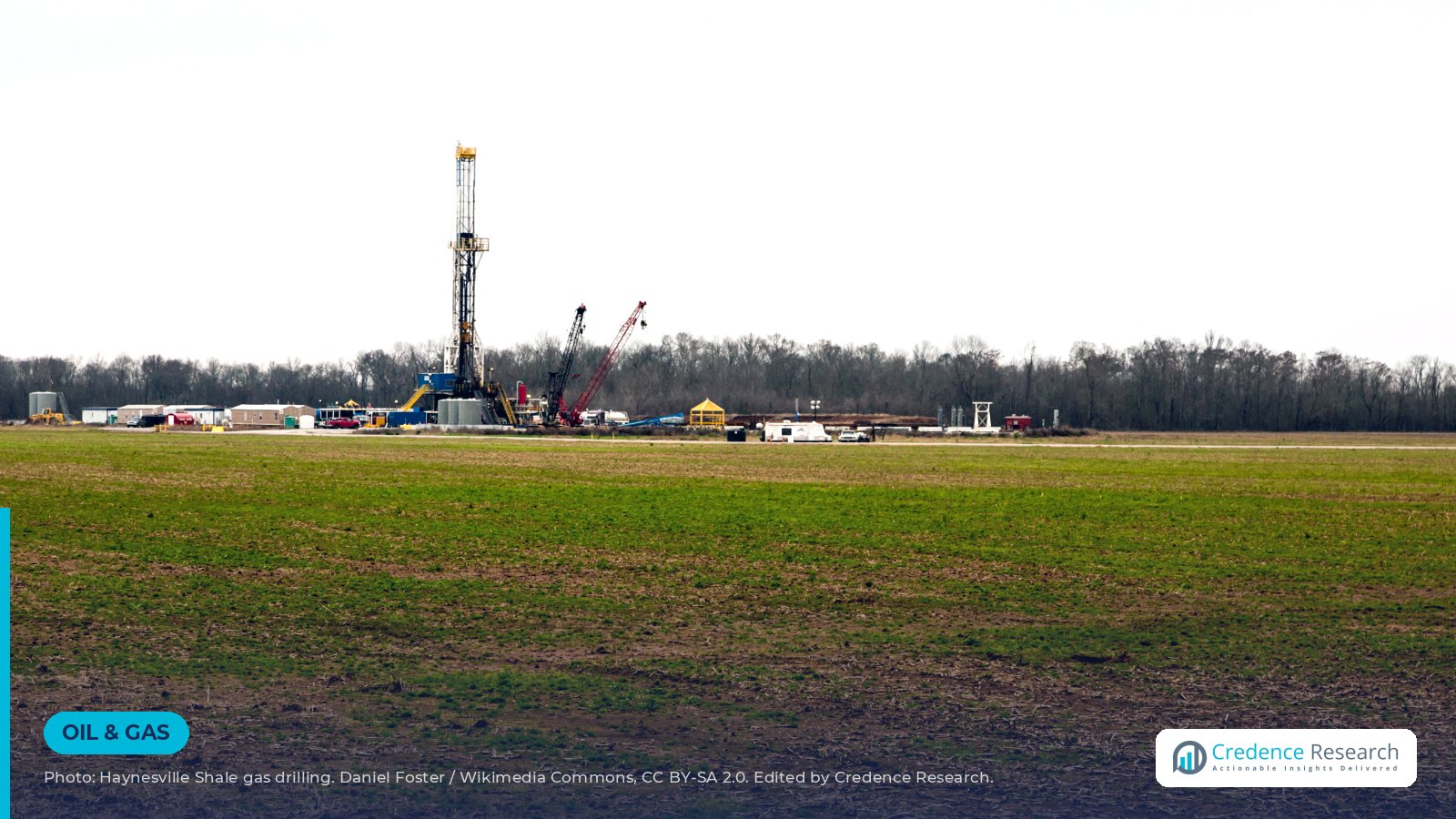
Image: Natural gas drilling in the Haynesville Shale, Louisiana, by Daniel Foster via Wikimedia Commons, CC BY-SA 2.0. Cropped and edited by Credence Research.

About the Author

Senior News Editor at Credence Research Inc