
XRG agrees to buy Shell's 16.67% North West Shelf LNG stake for $1.45 billion
Shell Australia agreed on Nov. 3, 2026, to sell its 16.67% non-operated interest in the North West Shelf project in Western Australia to subsidiaries of XRG, the international investment company wholly owned by Abu Dhabi National Oil Co. The base price is $1.45 billion, subject to customary adjustments, with a further payment tied to specified milestones. The transaction would end Shell's participation in Australia's first LNG project, and Gulf News reported it would be XRG's first investment in Australian LNG.
Key developments
- Shell Australia will transfer its entire 16.67% non-operated interest to XRG subsidiaries for a base consideration of $1.45 billion, plus a contingent payment linked to milestones.
- The effective date is Jan. 1, 2026, and Shell expects closing in 2027, subject to regulatory approvals and other conditions.
- The buyers will assume decommissioning obligations attached to the interest, according to reports on the transaction.
- Grafa reported that the contingent payment depends on a future development decision on the Browse gas field and that project partners hold pre-emption rights over the stake.
- Shell noted it will remain in Australia through Shell QGC, Prelude FLNG, the Crux development, Arrow Energy and Gorgon.
Project background
North West Shelf is widely regarded as the venture that started Australia's LNG industry. Woodside Energy operates the project, whose other participants are BP, Chevron, Japan Australia LNG (MIMI) and CNOOC, along with Shell. Woodside says the project has produced gas for domestic customers for 40 years and has delivered more than 6,500 LNG cargoes since 1989.
The Karratha Gas Plant sits at the center of the venture, about 1,260 kilometers north of Perth, according to Gulf News. The outlet also reported 14.3 million metric tons per year of liquefaction capacity and 4.4 trillion cubic feet equivalent of remaining resources. The plant produces LNG, domestic gas, condensate and liquefied petroleum gas.
The project is changing character as its original fields mature. Woodside says the plant, long dedicated to North West Shelf resources, now also processes gas for other resource owners who pay a toll to use the facility. The North West Shelf Project Extension, which covers operations beyond 2030, received Western Australian approval in December 2024 and final federal environmental approval in September 2025 after a process that began with a November 2018 referral.
Industry implications
The sale shows how legacy LNG infrastructure can attract different owners at different stages of its life. Shell framed the agreement around disciplined capital allocation and a focus on advantaged integrated gas positions. It also noted that North West Shelf is expected to move toward a third-party tolling model, a structure in which plant earnings depend more on processing fees and less on an owner's own gas.
That shift changes what a buyer is underwriting. Returns from an interest in a tolling hub depend on how much third-party gas reaches the plant, how long existing fields keep producing, and how much of the eventual cleanup bill the owner carries. By assuming decommissioning obligations, XRG takes on a long-dated liability in exchange for operating cash flow, LNG offtake and a position in the infrastructure.
XRG International Gas President Mohamed Al Aryani said the North West Shelf investment "created Australia's LNG industry" and that continued investment could help sustain domestic gas supply and create jobs, according to Gulf News. Grafa quoted him as saying the asset combines immediate production, strategic infrastructure and future upstream opportunities.
Competitive and supply chain implications
For XRG, the purchase adds LNG volumes close to Asia-Pacific buyers, the demand base the company cited in explaining the deal. It also follows a failed route into Australia: Grafa noted that XRG withdrew in September of last year from a proposed $36.4 billion takeover of Santos. A minority stake in an operating joint venture is a smaller, less complicated way into the country's gas sector.
The pre-emption rights reported by Grafa are the main near-term variable. If Woodside, BP, Chevron, MIMI or CNOOC exercised those rights, the ownership outcome could differ from the announced deal. None of those partners had publicly stated an intention in the materials reviewed for this article.
The reported Browse-linked payment also matters for the plant's supply outlook. Woodside plans to process Browse gas at Karratha through a pipeline of about 900 kilometers, and said in May that the project remains in concept definition as it works toward front-end engineering and design. Shell sold its Browse stake in 2023. A contingent payment tied to that decision suggests the parties see Browse as a real but unresolved source of value.
For Shell, the sale removes a mature non-operated position without reducing its presence in Australian gas. Its remaining assets span coal seam gas in Queensland, floating LNG and the Crux backfill project for Prelude, along with its interest in Gorgon.
Regional implications
Western Australia has the most direct stake in the outcome. North West Shelf has supplied more than 6,000 petajoules of domestic gas to the state, according to Gulf News. New ownership does not change the operator, and the plant's future will still rest on Woodside's execution and on access to third-party gas.
The transaction will also draw attention in Canberra. Grafa reported that the deal needs foreign investment approvals, and the purchase would give an Abu Dhabi state-linked company a direct holding in an established Australian energy asset. Federal scrutiny of gas supply and foreign ownership may therefore feature in the review, though no agency has commented publicly in the sources reviewed.
In Asia, Gulf News reported that most of the project's LNG goes to Japan. Buyers there have long relied on Australian supply, and the arrival of a Gulf-backed investor adds a new counterparty to a relationship dating back to the 1980s. For Abu Dhabi, the stake extends XRG's reach beyond the Middle East into a supply basin positioned close to Northeast Asian customers.
Credence Research analysis
The deal's structure says more than its headline price. A base payment, a milestone-linked payment and the transfer of decommissioning obligations indicate that buyer and seller are dividing risk across a long and uncertain timeline. Shell gets capital now and exits future liabilities. XRG receives producing assets today and pays more only if defined milestones are met, which limits its exposure if development of new feed gas stalls.
The deal also illustrates a sorting among LNG owners. Shell is concentrating on positions it considers advantaged, while a state-backed investor is buying mature, functional infrastructure that offers immediate volumes and a route to customers. The test for this transaction will be feed gas. A tolling hub only holds its value if third-party volumes arrive on time, so progress on Browse and on other resource owners' use of Karratha will be the clearest signals of whether XRG's bet pays off.
What comes next
- Project partners decide whether to exercise any pre-emption rights over Shell's interest.
- Australian regulators review the transaction, including the reported foreign investment approvals.
- Shell and XRG work toward closing, which Shell expects in 2027.
- Woodside and its partners continue the plant's transition toward third-party processing under the extension approvals.
- Any development decision on Browse would determine the reported contingent payment and provide a major signal on future feed gas.
Sources
- Shell: Shell agrees to sell interest in North West Shelf project
- Woodside: North West Shelf Project
- Woodside: NWS Project Extension
- Gulf News: XRG acquires Shell's stake in North West Shelf
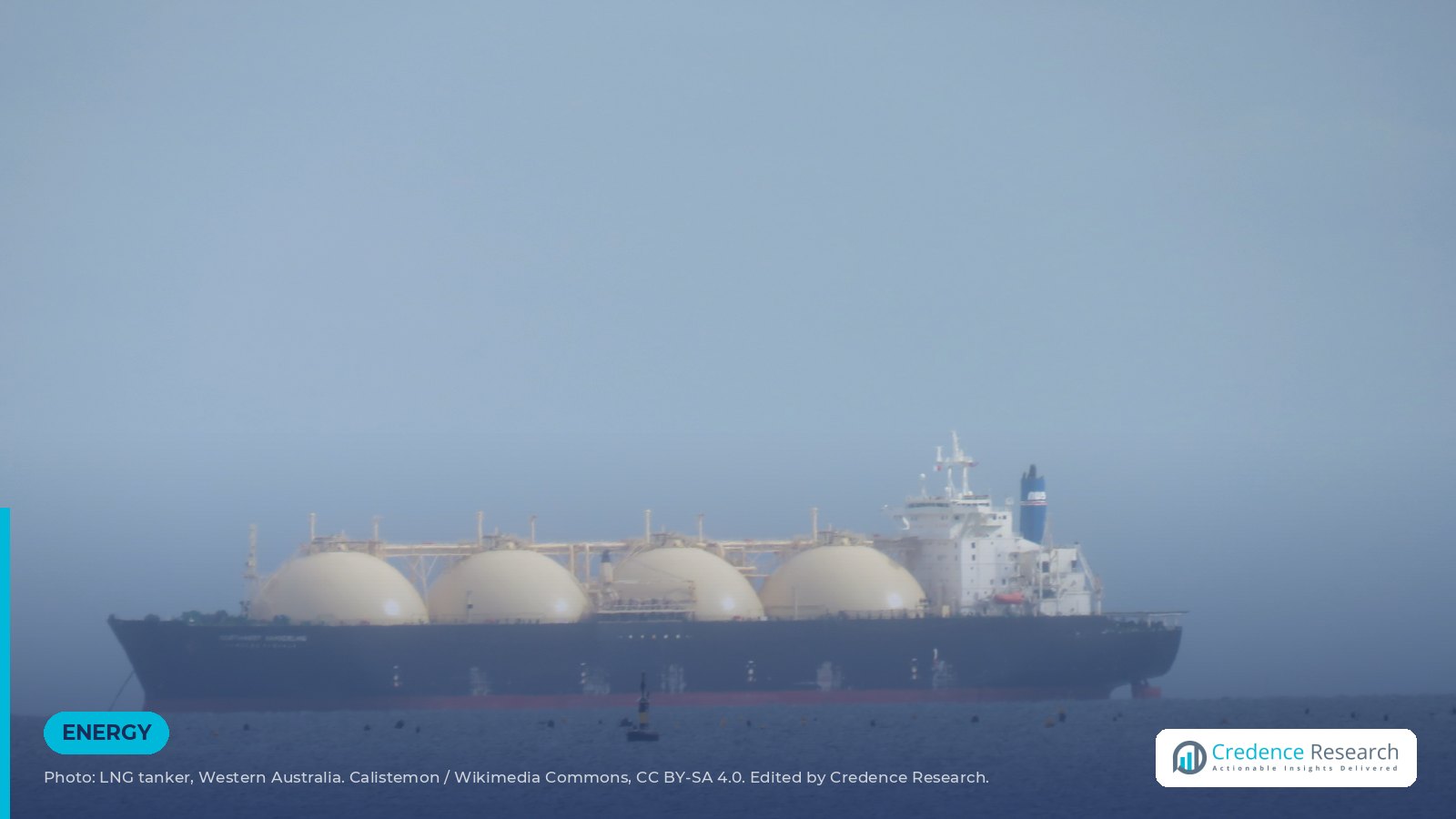
Image: LNG tanker Northwest Sanderling at anchor in Cockburn Sound, Western Australia, by Calistemon via Wikimedia Commons, CC BY-SA 4.0. Cropped and edited by Credence Research.

About the Author

Senior News Editor at Credence Research Inc