
Canola Seed Market (Seed for Sowing) Overview:
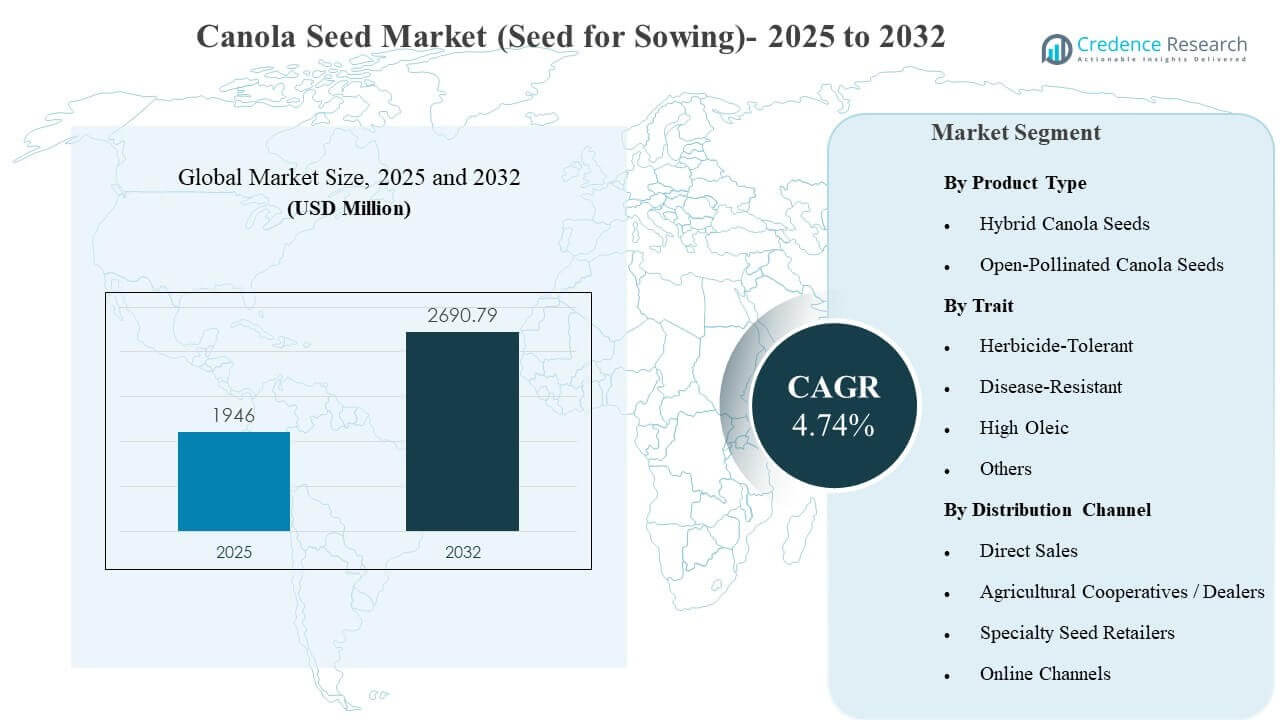
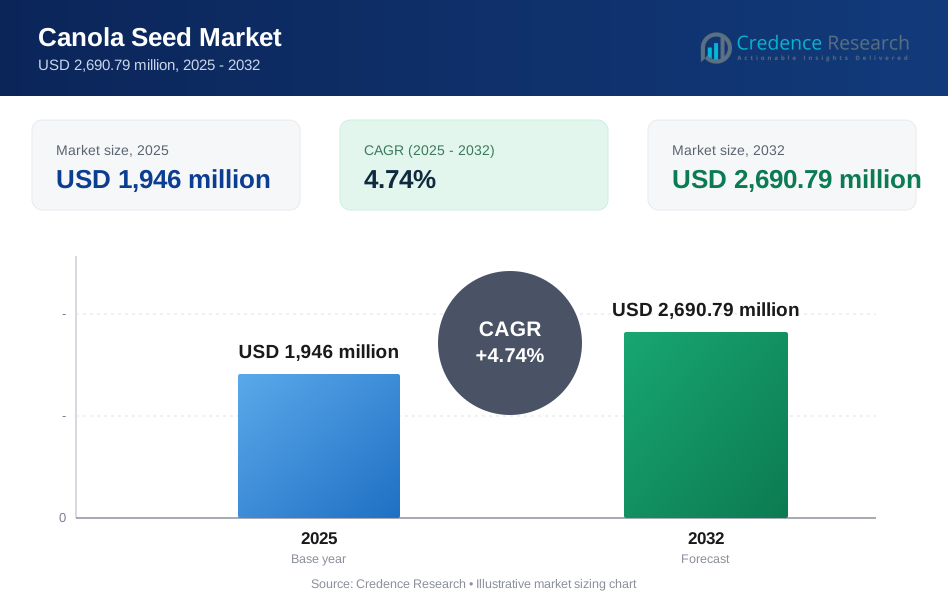
The global Canola Seed Market (Seed for Sowing) size was estimated at USD 1,946 million in 2025 and is expected to reach USD 2,690.79 million by 2032, growing at a CAGR of 4.74% from 2025 to 2032. Growth is primarily supported by the rapid shift toward high-performing hybrid varieties that provide stronger yield stability and more predictable field uniformity for commercial growers. Canola Seed Market (Seed for Sowing) expansion is also reinforced by rising demand for edible oils and renewable fuels, which strengthens oilseed acreage economics across key producing regions.
| REPORT ATTRIBUTE | DETAILS |
|---|---|
| Historical Period | 2020-2024 |
| Base Year | 2025 |
| Forecast Period | 2026-2032 |
| Canola Seed Market (Seed for Sowing) Size 2025 | USD 1,946 million |
| Canola Seed Market (Seed for Sowing), CAGR | 4.74% |
| Canola Seed Market (Seed for Sowing) Size 2032 | USD 2,690.79 million |
Key Market Trends & Insights
- Canola Seed Market (Seed for Sowing) is projected to grow from USD 1,946 million (2025) to USD 2,690.79 million (2032) at a 4.74% CAGR (2025–2032).
- Hybrid Canola Seeds accounted for the largest share of 89.65% in 2025, reflecting strong replacement demand for high-vigor commercial genetics.
- Herbicide-Tolerant traits represented 52.30% in 2025, supported by farm-level focus on weed control efficiency and risk reduction.
- Agricultural Cooperatives / Dealers held 44.60% in 2025, highlighting the importance of local agronomy support and assured availability during tight buying windows.
- North America led with 36.35% in 2025, supported by large-scale canola acreage systems and high adoption of premium hybrid and trait packages.
Segment Analysis
Canola Seed Market (Seed for Sowing) remains strongly hybrid-led because hybrid portfolios concentrate the highest-performing genetics, better stand establishment, and stronger yield consistency under variable weather and soil conditions. Hybrid offerings also enable broader trait stacking, which improves the value proposition for growers who prioritize fewer in-season interventions and more predictable output quality.
Trait preferences in Canola Seed Market (Seed for Sowing) are shaped by operational simplicity and risk management. Herbicide-tolerant solutions reduce weed-control complexity in large-acreage systems, and disease-resistance traits are increasingly valued where pathogen pressure threatens oil yield and crop survival. High-oleic positioning continues to gain relevance through premium oil programs and contract-driven specification requirements.
Distribution dynamics in Canola Seed Market (Seed for Sowing) remain relationship-driven, with dealer and cooperative networks acting as the primary route for product placement advice, seed availability, and agronomy support. Direct programs remain influential for larger growers seeking bundled solutions and performance accountability, while online channels are developing mainly for reorders and smaller lot sizes.
By Product Type Insights
Hybrid Canola Seeds accounted for the largest share of 89.65% in 2025. Canola Seed Market (Seed for Sowing) adoption favors hybrids due to higher yield stability and improved plant uniformity that supports mechanized harvest efficiency. Hybrid breeding pipelines are typically more advanced, expanding choice sets across maturity bands and agronomic conditions. Hybrid portfolios also concentrate newer trait packages, reinforcing replacement cycles in commercial farming systems.
By Trait Insights
Herbicide-Tolerant accounted for the largest share of 52.30% in 2025. Canola Seed Market (Seed for Sowing) demand for herbicide-tolerant traits increases as growers prioritize simplified weed control programs and reduced yield loss from competitive pressure. Trait-led seed selection improves season planning by lowering operational variability across large fields. Herbicide-tolerant adoption is also reinforced by farm-level economics that reward fewer passes and stronger yield protection.
By Distribution Channel Insights
Agricultural Cooperatives / Dealers accounted for the largest share of 44.60% in 2025. Canola Seed Market (Seed for Sowing) purchasing still depends heavily on local agronomy guidance, product placement recommendations, and in-season service support. Cooperative and dealer networks improve delivery reliability, financing options, and bundled input coordination. Dealer-led channels also strengthen seed company reach into regional grower clusters during concentrated order windows.
Canola Seed Market (Seed for Sowing) Drivers
Expansion Of Hybrid Seed Replacement Cycles
Canola Seed Market (Seed for Sowing) growth is supported by expanding replacement cycles for hybrid varieties across commercial farms. Hybrids deliver higher uniformity, stronger stand establishment, and improved yield reliability compared with older varieties. Growers increasingly adopt hybrids to reduce field variability and simplify harvest operations across large acreages. Seed companies also refresh hybrid portfolios frequently, reinforcing repeat purchasing as new genetics and trait stacks move into mainstream availability.
Rising Demand For Canola Oil Across Food And Industrial Uses
Canola Seed Market (Seed for Sowing) benefits from sustained demand growth for canola oil in food processing and industrial applications. Canola oil demand improves the economics of oilseed rotations, encouraging growers to maintain or expand canola acreage where agronomically suitable. Strong processing demand also supports contract programs that influence variety selection and seed purchases. Higher value realization for oil quality and consistency further raises the importance of improved seed performance.
- For instance, Cargill reported that its Regina canola processing facility is designed to process 1 million metric tons of canola per year and produce crude canola oil for both food and biofuel markets, demonstrating how downstream demand can directly reinforce seed purchasing incentives.
Trait-Led Value Propositions For Risk Management
Canola Seed Market (Seed for Sowing) demand increases as growers prioritize trait packages that protect yield and reduce operational uncertainty. Herbicide-tolerant traits support efficient weed management, particularly in large-scale systems where labor and timing constraints are significant. Disease-resistance traits improve crop resilience in regions facing recurring pathogen pressure. Trait stacking raises the overall ROI case for premium seed, supporting value-based pricing and sustained adoption momentum.
Strengthening Seed Distribution And Agronomy Support Networks
Canola Seed Market (Seed for Sowing) expands through stronger last-mile distribution networks and advisory ecosystems. Agricultural cooperatives and dealers improve access by combining seed availability, local placement knowledge, and service support. Direct sales programs strengthen performance accountability and bundled solutions for large growers. Improved logistics, seed treatment capacity, and fulfillment reliability reduce supply-side friction during concentrated buying windows, reinforcing farmer confidence in premium seed purchases.
- For instance, BrettYoung says it employs more than 250 people across four processing, warehousing, and distribution facilities in Canada and ran canola comparison trials at over 40 sites across Western Canada, underscoring how localized logistics and agronomic validation can improve placement confidence and supply reliability.
Canola Seed Market (Seed for Sowing) Challenges
Canola Seed Market (Seed for Sowing) faces affordability and margin pressure when input costs rise faster than farm-gate crop realization. Premium hybrid and trait packages can be constrained by grower budget cycles, especially in regions with higher production volatility. Weather shocks and uneven rainfall patterns raise yield uncertainty, which can delay seed upgrades in risk-averse farm operations. Regulatory divergence across regions also slows uniform adoption of next-generation traits, limiting portfolio scalability.
- For instance, Bayer reports that its DEKALB DK401TL canola hybrid outperformed comparable InVigor hybrids by 3.4 bu./acre on average, reaching 106.3% of comparator yield across 33 Western Canada trial locations in 2023-2025, with a 79% win rate.
Canola Seed Market (Seed for Sowing) also encounters challenges linked to resistance management and stewardship complexity. Herbicide tolerance improves weed control efficiency, yet repeated use can increase resistance risks and drive higher long-term management costs. Disease pressure can shift rapidly across regions, requiring continuous breeding investment and faster variety refresh cycles. Supply reliability can be strained by tight production windows, seed treatment capacity constraints, and demand spikes during favorable planting conditions.
Canola Seed Market (Seed for Sowing) Trends and Opportunities
Canola Seed Market (Seed for Sowing) is seeing stronger focus on oil-quality differentiation as processors and buyers seek more consistent performance specifications. High-oleic offerings enable premium positioning and support contract-based programs that can stabilize demand. Breeding efforts increasingly emphasize resilience traits that protect performance under heat and moisture stress. These shifts create opportunities for seed suppliers to expand premium portfolios and deepen engagement through targeted agronomy programs.
- For instance, Cargill’s high-oleic, low-saturated canola oil platform was developed through 10 years of R&D, involved more than 150 hybrids, reduced saturated fat from 7% to 4.5% or lower, and delivered a 150% improvement in fry life over commodity canola oil, highlighting how oil-quality traits can be commercialized into premium, specification-driven programs.
Canola Seed Market (Seed for Sowing) also benefits from expansion opportunities in emerging rotation systems where canola improves soil and breaks pest cycles. New acreage development is supported by improved genetics suited to diverse growing environments and maturity needs. Channel innovation is progressing through digital ordering tools and better inventory visibility, which improves reordering convenience. Partnerships across value chains can further strengthen seed demand by linking production to downstream offtake signals.
Regional Insights
North America
North America held 36.35% share in 2025, supported by large-scale canola farming systems and strong adoption of hybrid and trait-enabled seed packages. Canola Seed Market (Seed for Sowing) demand is reinforced by mature distribution networks and high replacement buying behavior linked to performance-driven farming. Canada remains a central hub for canola production and seed innovation, which supports wide portfolio availability and faster commercialization of improved genetics.
Europe
Europe represented 24.85% share in 2025, supported by established oilseed cropping systems and broad agronomy networks. Canola Seed Market (Seed for Sowing) demand remains stable where growers prioritize yield stability and disease resilience in rapeseed/canola rotations. Regulatory and stewardship requirements can lengthen trait commercialization timelines, influencing product mix and the pace of adoption for certain advanced technologies across select markets.
Asia Pacific
Asia Pacific accounted for 30.05% share in 2025, reflecting strong regional demand linked to oilseed cultivation and downstream consumption requirements. Canola Seed Market (Seed for Sowing) demand benefits from expanding commercial farming practices and rising interest in performance seed in suitable production zones. Australia supports regional supply as a major producer and exporter, and continued investment in agronomy and seed access supports market expansion.
Latin America
Latin America held 7.55% share in 2025, reflecting a smaller base but improving rotation economics and rising interest in oilseed diversification. Canola Seed Market (Seed for Sowing) adoption increases where canola fits into double-cropping or soil-health strategies and where downstream demand signals strengthen acreage incentives. Seed uptake is expected to rise as local agronomy support improves and region-specific product placement becomes more established.
Middle East & Africa
Middle East & Africa captured 1.20% share in 2025 due to a smaller addressable canola acreage base and variable agro-climatic suitability. Canola Seed Market (Seed for Sowing) demand remains concentrated in pockets where oilseed cultivation aligns with irrigation access and policy incentives. Imports and localized supply constraints can also influence adoption pace, with market growth tied to agronomy improvement and better seed availability.
Competitive Landscape
Canola Seed Market (Seed for Sowing) competition is shaped by hybrid portfolio depth, trait breadth, and agronomy-enabled differentiation. Large integrated players prioritize R&D scale, trait deployment, and channel partnerships to defend premium positioning. Regional seed specialists compete through localized product placement, service responsiveness, and distribution access in core grower communities. Product performance consistency and supply reliability remain critical differentiators in tight ordering windows.
Bayer AG maintains a strong focus on hybrid canola innovation and portfolio optimization through trait-enabled product development and operational capability building. Canola Seed Market (Seed for Sowing) positioning for Bayer AG is supported by emphasis on dependable seed supply, treatment readiness, and placement guidance tied to regional farming conditions. Continued investment in fulfillment and service ecosystems supports stronger farmer confidence and repeat buying behavior.
The industry research and growth report includes detailed analyses of the competitive landscape of the market and information about key companies, including:
- Bayer AG
- BASF SE
- Corteva Agriscience
- Nufarm Limited
- Euralis Semences
- Syngenta
- CANTERRA Seeds
- BrettYoung
- DLF Seeds
- Nutrien
- Active AgriScience
- Land O’Lakes
Qualitative and quantitative analysis of companies has been conducted to help clients understand the wider business environment as well as the strengths and weaknesses of key industry players. Data is qualitatively analyzed to categorize companies as pure play, category-focused, industry-focused, and diversified; it is quantitatively analyzed to categorize companies as dominant, leading, strong, tentative, and weak.
Recent Developments
- In June 2025, BASF launched InVigor Gold, a new canola seed innovation designed to expand canola production into hotter and drier areas of Canada and the United States. BASF said the product is expected to combine LibertyLink herbicide tolerance, pod shatter resistance, blackleg resistance, and improved heat tolerance, with U.S. availability targeted for 2027 pending regulatory approval.
- In January 2025, Bayer highlighted a partnership with the University of Alberta aimed at improving canola breeding by studying useful genes from related Brassica crops such as broccoli, cauliflower, cabbage, and kale. According to the report, the collaboration is intended to support development of new canola hybrid cultivars with higher seed yield.
- In April 2024, Bayer CropScience Inc. announced that it would acquire a canola treating and packaging facility in Coaldale, Alberta, from HyTech Production Ltd. Bayer said the deal would help strengthen its canola business by improving control over production, packaging, service, and supply for canola hybrids, with the closing anticipated for November 1.
Report Scope
| Report Attribute | Details |
| Market size value in 2025 | USD 1946 million |
| Revenue forecast in 2032 | USD 2690.79 million |
| Growth rate (CAGR) | 4.74% (2025–2032) |
| Base year | 2025 |
| Forecast period | 2026-2032 |
| Quantitative units | USD million |
| Segments covered | By Product Type Outlook: Hybrid Canola Seeds, Open-Pollinated Canola Seeds; By Trait Outlook: Herbicide-Tolerant, Disease-Resistant, High Oleic, Others; By Distribution Channel Outlook: Direct Sales, Agricultural Cooperatives / Dealers, Specialty Seed Retailers, Online Channels |
| Regional scope | North America, Europe, Asia Pacific, Latin America, Middle East & Africa |
| Key companies profiled | Bayer AG; BASF SE; Corteva Agriscience; Nufarm Limited; Euralis Semences; Syngenta; CANTERRA Seeds; BrettYoung; DLF Seeds; Nutrien; Active AgriScience; Land O’Lakes |
| No. of Pages | 331 |
By Segmentation
By Product Type
- Hybrid Canola Seeds
- Open-Pollinated Canola Seeds
By Trait
- Herbicide-Tolerant
- Disease-Resistant
- High Oleic
- Others
By Distribution Channel
- Direct Sales
- Agricultural Cooperatives / Dealers
- Specialty Seed Retailers
- Online Channels
By Region
- North America
- U.S.
- Canada
- Mexico
- Europe
- Germany
- France
- U.K.
- Italy
- Spain
- Rest of Europe
- Asia Pacific
- China
- Japan
- India
- South Korea
- South-east Asia
- Rest of Asia Pacific
- Latin America
- Brazil
- Argentina
- Rest of Latin America
- Middle East & Africa
- GCC Countries
- South Africa
- Rest of the Middle East and Africa
Request a Free Sample
Fill in your details and we'll send you a free sample report.
- Sample data tables & charts
- Research methodology
Need a Custom Version of This Report?
Tailor the scope, geography, or segments to your exact requirements.
- Custom geography or segment scope
- Direct access to our analyst team
Frequently Asked Questions
What is the market size of Canola Seed Market (Seed for Sowing) in 2025 and the forecast for 2032?
What is the CAGR for Canola Seed Market (Seed for Sowing) during 2025–2032?
Which segment is the largest by product type in 2025?
What are the main growth factors for Canola Seed Market (Seed for Sowing)?
Who are the leading companies in Canola Seed Market (Seed for Sowing)?
Which region leads Canola Seed Market (Seed for Sowing) in 2025?
Table of Content
Chapter 1. Report Introduction
- 1.1 Report Description & Purpose
- 1.1.1 Report Title & Market Definition
- 1.1.2 Unique Selling Propositions (USP) & Key Differentiators
- 1.1.3 Value Proposition for Stakeholders
- 1.2 Research Objectives
- 1.2.1 Market Sizing Objectives (Volume & Revenue)
- 1.2.2 Segmentation Objectives
- 1.2.3 Competitive Intelligence Objectives
- 1.2.4 Forecast & Scenario Objectives
- 1.3 Report Scope
- 1.3.1 Canola Seed Scope – Types & Subtypes Covered
- 1.3.2 Geographic Scope – Regions & Countries Covered
- 1.3.3 Historical Period, Base Year & Forecast Period (2025; forecast to 2032)
- 1.3.4 Inclusions & Exclusions
- 1.4 HS Code & Classification Framework
- 1.5 Currency, Units & Pricing Basis
- 1.6 Target Stakeholders
- 1.7 Limitations & Assumptions
Chapter 2. Executive Summary
- 2.1 Global Canola Seed Market Snapshot
- 2.1.1 Market Size – Historical (2025) & Forecast (2025-2032) (2025: USD 1,946 million → 2032: USD 2,690.79 million)
- 2.1.2 Volume & Revenue – Global Totals
- 2.1.3 Key Market Highlights – Top Five Facts
- 2.2 Canola Seed Market Segmentation Snapshot
- 2.2.1 Market Split by Region – 2025 vs. 2032
- 2.3 Competitive Snapshot
- 2.3.1 Top 10 Players by Revenue Share – 2025
- 2.3.2 Top 10 Players by Volume Share – 2025
- 2.3.3 Recent Strategic Developments (18-Month Summary)
- 2.4 Key Investment Highlights & Strategic Conclusions
Chapter 3. Canola Seed Market Dynamics & Industry Analysis
- 3.1 Market Overview & Context
- 3.1.1 Canola Seed Market Position in the Broader Automotive Value Chain
- 3.1.2 OEM vs. Replacement Market Dynamics
- 3.1.3 Market Maturity & Development Stage by Region
- 3.2 Canola Seed Market Drivers
- 3.3 Canola Seed Market Restraints & Challenges
- 3.4 Canola Seed Market Opportunities
- 3.5 Porter's Five Forces Analysis
- 3.5.1 Threat of New Entrants
- 3.5.2 Bargaining Power of Suppliers
- 3.5.3 Bargaining Power of Buyers
- 3.5.4 Threat of Substitutes
- 3.5.5 Competitive Rivalry – Intensity Assessment
- 3.6 Canola Seed Value Chain Analysis
- 3.6.1 Upstream – Raw Material/Input Suppliers
- 3.6.1.1 Raw Material/Input 1
- 3.6.1.2 Raw Material/Input 2
- 3.6.1.3 Raw Material/Input 3
- 3.6.2 Midstream – Production/Manufacturing/Service Delivery
- 3.6.2.1 Production/Process Overview
- 3.6.2.2 Key Facility Locations & Capacity by Manufacturer
- 3.6.3 Downstream – Distribution & End Consumer
- 3.6.3.1 Primary Channel – B2B/OEM
- 3.6.3.2 Secondary Channels – Dealer, Retail, Online, Direct
- 3.6.4 Value Chain Profitability Analysis
- 3.6.1 Upstream – Raw Material/Input Suppliers
- 3.7 PESTEL Analysis
- 3.7.1 Political Factors
- 3.7.2 Economic Factors
- 3.7.3 Social Factors
- 3.7.4 Technological Factors
- 3.7.5 Environmental Factors
- 3.7.6 Legal Factors
- 3.8 Canola Seed Supply Chain Analysis
- 3.8.1 Raw Material/Input Supply Risk Assessment
- 3.8.2 Manufacturing Concentration Risk (Geographic Exposure)
- 3.8.3 Trade Disruption Impact Analysis
- 3.9 Regulatory & Policy Landscape
Note: The regulatory and policy landscape section covers regulations based on their applicability to the market, Canola Seed category, geography, and scope of the study. Only regulatory frameworks with a material impact on operations, compliance, trade, sustainability, or market access are analyzed in detail.
Chapter 4. Key Investment Pockets & Opportunity Analysis
- 4.1 Canola Seed Market Attractiveness Analysis
- 4.1.1 By Region – Investment Attractiveness Matrix (Volume × CAGR)
- 4.2 Absolute Revenue Growth Opportunity
- 4.2.1 By Region – Absolute USD Growth Through 2032
- 4.3 Incremental Volume Opportunity
- 4.3.1 By Region – Incremental Volume Through 2032
- 4.3.2 Segment – Incremental Volume
- 4.4 Emerging Submarket Opportunity Deep Dive (Subject to Applicability)
- 4.5 Emerging Market Opportunity Scorecards
- 4.5.1 United States
- 4.5.2 Europe
- 4.5.3 Asia
- 4.5.4 Middle East & Africa
Note: Emerging Market Opportunity Scorecards will be included based on relevance and strategic importance. Regions listed are indicative and may vary depending on data availability and market dynamics.
Chapter 5. Canola Seed Import-Export Analysis & Trade Flows
- 5.1 Global Trade Overview
- 5.1.1 Global Export Value by Country (2025)
- 5.1.2 Global Export Volume by Country (2025)
- 5.1.3 Global Import Value by Country (2025)
- 5.1.4 Global Import Volume by Country (2025)
- 5.1.5 Net Trade Balance by Country (2025)
- 5.2 Export Analysis – Segment
- 5.2.1 Type 1 (HS Code)
- 5.2.2 Type 2 (HS Code)
- 5.2.3 Type 3 (HS Code)
- 5.2.4 Type 4 (HS Code)
- 5.2.5 Type 5 (HS Code)
- 5.3 Import Analysis – Segment
- 5.3.1 Type 1 (HS Code)
- 5.3.2 Type 2 (HS Code)
- 5.3.3 Type 3 (HS Code)
- 5.3.4 Type 4 (HS Code)
- 5.3.5 Type 5 (HS Code)
- 5.4 Average Unit Trade Prices
- 5.4.1 Average Export Price – Segment & Country
- 5.4.2 Average Import Price – Segment & Source Country
- 5.4.3 Price Trends (2025)
- 5.5 Key Trade Route Analysis
- 5.5.1 Trade Route 1
- 5.5.2 Trade Route 2
- 5.5.3 Trade Route 3
- 5.5.4 Trade Route 4
- 5.5.5 Trade Route 5
- 5.6 Trade Policy Impact Assessment
- 5.6.1 US Anti-Dumping & Section 301 Tariffs
- 5.6.2 EU Customs Union Impact
- 5.6.3 Major Free Trade Agreements
- 5.6.4 USMCA Rules of Origin
Note: Trade policy analysis will be included only where relevant to the Canola Seed market.
Chapter 6. Competitive Landscape & Company Benchmarking
- 6.1 Canola Seed Market Concentration & Structure
- 6.1.1 Herfindahl-Hirschman Index (HHI) – vs. 2025
- 6.1.2 Tier 1, Tier 2 & Tier 3 Market Structure
- 6.1.3 Global, Regional & Local Player Dynamics
- 6.2 Canola Seed Market Share Analysis – 2025
- 6.2.1 Global Revenue Share by Company
- 6.2.2 Global Volume Share by Company
- 6.2.3 Regional Revenue Share
- 6.2.4 Market Share Evolution ( vs. 2025)
- 6.2.5 OEM Segment Share by Company
- 6.2.6 Replacement Segment Share by Company
- 6.3 Production/Delivery Capacity & Facility Analysis
- 6.3.1 Global Installed Capacity
- 6.3.2 Capacity Utilization Rates
- 6.3.3 Production/Output Volume
- 6.3.4 Facility Locations & Capacity Map
- 6.3.5 Planned Capacity Additions
- 6.4 Canola Seed Competitive Benchmarking Matrix
- 6.4.1 Revenue, Volume, CAGR & Profitability Comparison
- 6.4.2 Channel Revenue Mix
- 6.4.3 Geographic Revenue Exposure
- 6.4.4 R&D Intensity
- 6.4.5 Sustainability Maturity
- 6.5 Strategic Developments in Canola Seed (Last 24 Months)
- 6.5.1 Mergers, Acquisitions & Divestments
- 6.5.2 New Canola Seed Launches
- 6.5.3 Facility Expansions
- 6.5.4 Strategic Alliances, Joint Ventures & Partnerships
- 6.5.5 Distribution Expansion & Market Entry
- 6.5.6 Sustainability & ESG Initiatives
- 6.6 Competitive Strategy Mapping
- 6.6.1 Leader, Challenger, Follower & Niche Classification
- 6.6.2 Pricing Strategy Comparison
- 6.6.3 Channel Strategy Matrix
Note: Strategic developments are included based on their materiality and the availability of reliable information.
Chapter 7. Global Canola Seed Market – By Distribution Channel
- 7.1 Segment Overview
- 7.1.1 Volume & Revenue Split by Channel (2025 & 2032)
- 7.1.2 Channel Mix Evolution (2025-2032)
Chapter 8. Regional Market Analysis – Global Overview
- 8.1 Global Regional Overview
- 8.1.1 Regional Volume Share
- 8.1.2 Regional Revenue Share
- 8.1.3 Regional Volume by Region
- 8.1.4 Regional Revenue by Region
- 8.1.5 Regional Forecast Through 2032
- 8.2 Cross-Regional Segment Analysis
- 8.2.1 By Distribution Channel
- 8.2.2 By Brand/Price Tier
Chapter 9. North America Canola Seed Market
- 9.1 United States
- 9.2 Canada
- 9.3 Mexico
Chapter 10. Europe Canola Seed Market
- 10.1 Germany
- 10.2 France
- 10.3 Italy
- 10.4 United Kingdom
- 10.5 Spain
- 10.6 Poland
- 10.7 Russia
- 10.8 Netherlands
- 10.9 Belgium
- 10.10 Sweden
- 10.11 Denmark
- 10.12 Norway
- 10.13 Rest of Europe
Chapter 11. Asia Pacific Canola Seed Market
- 11.1 China
- 11.2 India
- 11.3 Japan
- 11.4 South Korea
- 11.5 Thailand
- 11.6 Indonesia
- 11.7 Vietnam
- 11.8 Malaysia
- 11.9 Australia
- 11.10 Rest of Asia Pacific
Chapter 12. Latin America Canola Seed Market
- 12.1 Brazil
- 12.2 Argentina
- 12.3 Colombia
- 12.4 Chile
- 12.5 Rest of Latin America
Chapter 13. Middle East Canola Seed Market
- 13.1 Saudi Arabia
- 13.2 United Arab Emirates
- 13.3 Turkey
- 13.4 Israel
- 13.5 Iran
- 13.6 Rest of the Middle East
Chapter 14. Africa Canola Seed Market
- 14.1 South Africa
- 14.2 Egypt
- 14.3 Nigeria
- 14.4 Morocco
- 14.5 Rest of Africa
Chapter 15. Canola Seed Company Profiles
- 15.1 [Company 01]
- 15.1.1 Company Overview
- 15.1.2 Key Management Personnel
- 15.1.3 Products & Services Portfolio
- 15.1.4 Financial Performance
- 15.1.5 Key Market Focus & Geographic Presence
- 15.1.6 Recent Developments & Strategic Initiatives
Note: The company profile list is preliminary and may change based on research findings, market developments, data availability, and client requirements.
Chapter 16. Appendices
- Appendix A – List of Abbreviations & Acronyms
- Appendix B – Industry Classification Code Reference – Full Series
- Appendix C – Production & Capacity Data Tables
- Appendix D – End-Use & Demand Base Tables
- Appendix E – Consumption & Replacement Rate Assumptions
- Appendix F – ASP Reference Tables
- Appendix G – Manufacturing & Facility Database
- Appendix H – Import-Export Data Tables
- Appendix I – Regulatory Summary Tables
- Appendix J – Primary Research Participant List (Anonymized)
- Appendix K – Primary Research Questionnaire Framework
- Appendix L – Data Sources & Bibliography
- Appendix M – Market Size Divergence & Source Comparison
Chapter 17. Research Methodology
- 17.1 Research Framework & Philosophy
- 17.2 Secondary Research – Sources, Hierarchy & Data Extraction
- 17.3 Data Modeling – Bottom-Up & Top-Down Market Sizing
- 17.4 Primary Research – Stakeholder Framework, LOI & Sample Sizes
- 17.5 Forecast Methodology – Regression, Scenario & Sensitivity Analysis
- 17.6 Quality Control – Four-Layer Validation Framework
- 17.7 Limitations & Standard Assumptions
- 17.8 Disclaimer
