
Butane Gas Canisters Market Overview:
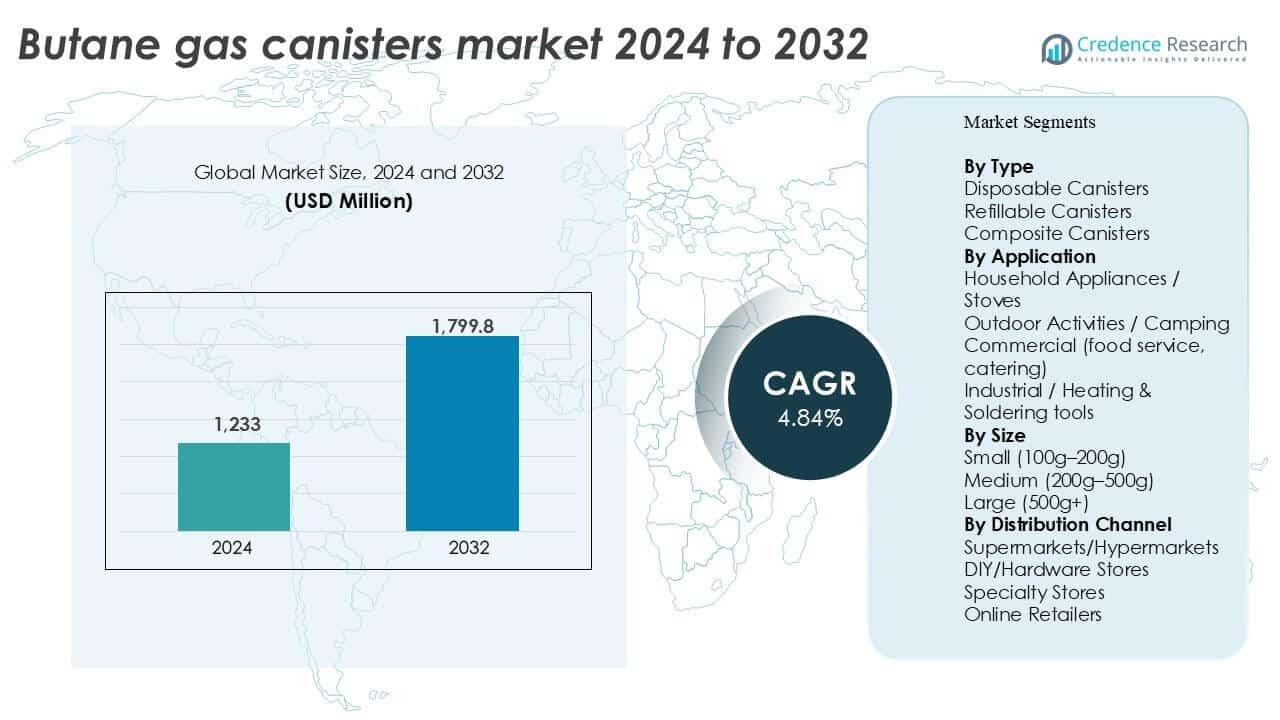
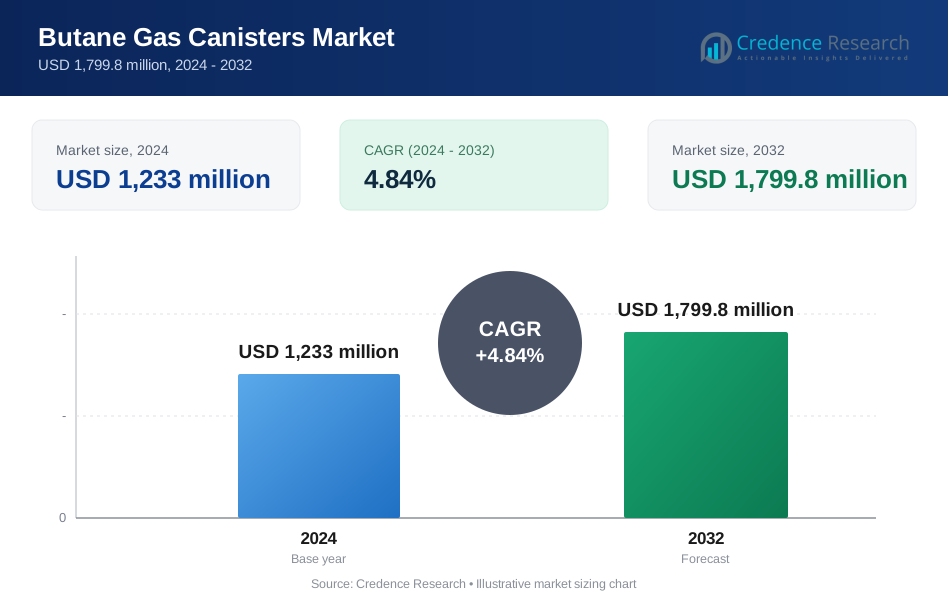
The Butane Gas Canisters Market size was valued at USD 1,233 million in 2024 and is anticipated to reach USD 1,799.8 million by 2032, at a CAGR of 4.84% during the forecast period.
| REPORT ATTRIBUTE | DETAILS |
|---|---|
| Historical Period | 2020-2023 |
| Base Year | 2024 |
| Forecast Period | 2025-2032 |
| Butane Gas Canisters Market Size 2024 | USD 1,233 million |
| Butane Gas Canisters Market , CAGR | 4.84% |
| Butane Gas Canisters Market Size 2032 | USD 1,799.8 million |
The butane gas canisters market features a mix of global and regional players competing on scale, safety, and distribution strength. Key companies include Taeyang, Maxsun, Iwatani, Coleman, Kampa, Marina, GoSystem, ONE Gas, Ultracare Products, Balkan Gasovi, and Aspire Industries. Iwatani and Taeyang lead in Asia-Pacific through strong manufacturing capacity and brand trust. Coleman holds a strong position in North America by linking canisters with outdoor equipment sales. Asia-Pacific remains the leading region, accounting for 37% of the global market share, driven by large consumer bases, off-grid cooking demand, and outdoor usage. Europe follows with steady demand supported by camping culture and refillable canister adoption. Competitive intensity remains moderate, with innovation and regional reach shaping market leadership.
Butane Gas Canisters Market Insights
- The Butane Gas Canisters Market was valued at USD 1,233 million in 2024 and is expected to reach USD 1,799.8 million by 2032, growing at a CAGR of 4.84%.
- Rising demand for portable cooking and heating solutions across households, camping, and food services is driving sustained adoption, especially in off-grid and urban transitional zones.
- Key trends include a shift toward refillable and composite canisters for sustainability and safety, along with growing online sales channels that improve access across rural and urban areas.
- Leading players such as Taeyang, Iwatani, Coleman, and Maxsun compete on product innovation and regional reach, with Asia-Pacific holding a 37% market share and dominating due to population size and outdoor use.
- Volatile raw material prices and varying safety regulations across regions remain key restraints, limiting smaller players from entering regulated markets and adding pressure on profit margins.
Butane Gas Canisters Market Segmentation Analysis:
By Type
Refillable canisters led the Butane Gas Canisters Market in 2024, accounting for over 45% of total revenue share. Their dominance stems from rising demand in outdoor cooking and industrial uses, where frequent refueling is required. Cost-efficiency and reduced waste generation further drive adoption. Disposable canisters remain popular for one-time use, particularly in camping and travel. However, environmental regulations are limiting their growth. Composite canisters are gaining traction due to safety benefits and lightweight construction, but high costs hinder widespread use. Manufacturers are investing in recyclable materials and enhanced valve technology across all canister types.
- For instance, Kovea offers innovative fuel solutions like the EZ Eco Stove, which features a refillable internal fuel tank designed to eliminate the need for disposable canisters.
By Application
The household appliances/stoves segment dominated with a market share exceeding 40% in 2024. Urban households in developing regions increasingly adopt portable gas stoves due to inconsistent electricity supply. The outdoor activities segment follows, supported by growing camping and adventure tourism trends. Commercial use is expanding in food trucks and temporary kitchens, especially in urban event catering. Industrial applications continue to grow steadily for heating and soldering tools in workshops and small-scale manufacturing. Rising demand for off-grid energy options drives cross-segment consumption, especially in Asia-Pacific and Latin America.
- For instance, many standard portable butane stoves consume approximately 120 grams of gas per hour at a standard flame output. These stoves typically have continuous burn times exceeding 2 hours on a single standard 220g canister.
By Size and Distribution Channel
Medium-sized canisters (200g–500g) held the largest market share in 2024, representing over 50% of total volume. Their popularity lies in a balance between portability and sufficient fuel capacity, ideal for both home use and light outdoor cooking. Large canisters serve commercial and industrial settings, while small canisters are favored for short-duration camping. In distribution, supermarkets/hypermarkets led with a 38% market share, thanks to strong in-store availability and bundled promotions. Online retailers are the fastest-growing channel, driven by e-commerce expansion and doorstep delivery convenience, especially in urban and remote regions.
Butane Gas Canisters Market Key Growth Drivers
Rising Demand for Portable Energy Solutions
The growing need for portable and convenient energy sources is a major growth driver for the butane gas canisters market. Urban consumers, campers, and travelers prefer lightweight, easy-to-carry canisters that support off-grid cooking and heating. In many developing countries, where grid electricity remains unreliable, portable gas stoves using butane canisters offer an accessible alternative. These canisters are also used in temporary setups, such as pop-up food stalls and emergency response shelters. Their ease of storage, quick ignition, and minimal maintenance make them a preferred choice. With increased outdoor recreational activities and urban migration patterns, the demand for mobile fuel options continues to climb, particularly in Asia-Pacific and parts of Africa.
- For instance, Iwatani produces stoves, such as the Cassette Feu Eco Premium, supporting a heat output of 2.9 kW (10,000 BTU/hr). These models feature a piezoelectric ignition system for immediate, one-motion starting.
Expansion of Outdoor and Recreational Activities
The global rise in recreational camping, trekking, and off-grid tourism is fueling demand for butane gas canisters. Consumers involved in outdoor activities rely on compact, reliable energy sources for cooking and heating, and butane canisters meet this need with ease of use and portability. Tourism recovery post-pandemic has further boosted sales, especially in regions like North America, Europe, and parts of Asia. The market benefits from an increasing trend toward experiential travel, where tourists prefer remote destinations with limited infrastructure. Equipment rental businesses and specialty outdoor retailers also drive repeat purchases. Brands are innovating with user-friendly valves and safety features, making these products more appealing to first-time and seasoned outdoor users alike.
- For instance, Campingaz supplies butane-propane canisters used with stoves consuming approximately 116 grams per hour (such as the Base Camp model). Safety testing for these self-sealing cartridges follows EN 417 standards.
Growing Food Service and Catering Applications
Mobile food vendors, pop-up kitchens, and outdoor catering services rely heavily on butane canisters due to their convenience and efficiency. In urban areas, food trucks and temporary food booths use canisters for cooking and warming food where natural gas lines are unavailable. Events, festivals, and emergency food services also adopt this fuel source due to its reliability and portability. The low emissions and controllable flame of butane enhance its appeal in food handling environments. Additionally, regulatory bodies in several regions prefer butane over other fuels for small commercial cooking due to its lower combustion temperature. With the rising trend of casual dining and flexible catering formats, demand for refillable and medium-sized canisters continues to expand.
Butane Gas Canisters Market Key Trends & Opportunities
Eco-Friendly Canisters and Sustainable Materials
Sustainability is emerging as a major trend, with manufacturers focusing on eco-friendly and recyclable canister designs. Composite and refillable canisters are gaining attention due to their lower environmental impact compared to disposable options. Rising consumer awareness about plastic waste and carbon emissions is pushing companies to adopt sustainable practices across the value chain. Innovations include reusable canisters with pressure control valves, improved sealing, and lighter composite materials. Regulatory mandates in Europe and parts of Asia are also pushing the industry toward lower-waste formats. This shift opens new opportunities for brands offering sustainable product lines targeting both consumers and institutional buyers.
- For instance, Hexagon Ragasco manufactures composite gas cylinders weighing 50% less than equivalent steel units.
E-Commerce and Direct-to-Consumer Sales Channels
Online retail has emerged as a key opportunity for butane gas canister manufacturers and distributors. Consumers increasingly prefer online platforms for convenience, access to product variety, and doorstep delivery especially in remote or urban areas with limited store access. Subscription-based models for refills and bulk purchasing options through e-commerce portals are gaining traction. Online reviews, tutorials, and social media marketing also influence purchase decisions. This shift has led manufacturers to redesign packaging for safer transit and improved unboxing experience. The growing adoption of digital payment and logistics infrastructure in emerging economies further strengthens the online market potential for butane canisters.
Butane Gas Canisters Market Key Challenges
Stringent Safety and Regulatory Compliance
The butane gas canisters market faces strict safety regulations related to pressure handling, flammability, and material standards. Government agencies across regions mandate compliance with certifications such as ISO 11117, DOT, and EN standards, depending on the region. These safety requirements demand costly testing, certification, and specialized packaging that increase production costs. Non-compliance leads to product recalls, fines, or bans, affecting brand credibility and profitability. Additionally, the risk of leakage, explosions, or improper disposal remains a concern, especially in unregulated markets. Manufacturers must continuously invest in research, quality control, and consumer education to meet evolving regulatory standards and avoid market access issues.
Volatility in Raw Material and Supply Chain Costs
Butane gas, a derivative of natural gas and crude oil, is subject to global price volatility. Any disruption in oil supply due to geopolitical tensions, natural disasters, or policy shifts directly impacts production and pricing. Fluctuating costs of metal or composite materials used for canisters also pose challenges, particularly for small manufacturers. Transportation costs, import/export duties, and container shortages further strain supply chains. Inconsistent availability of raw materials leads to delays and increased inventory costs. These challenges limit price flexibility and erode profit margins, especially in competitive regions where price sensitivity remains high.
Butane Gas Canisters Market Regional Analysis
North America
North America held approximately 21% of the global butane gas canisters market share in 2024, driven by strong demand in outdoor recreation and food service applications. The U.S. leads the region due to a high concentration of camping and RV users, along with growing mobile food vendors. DIY and portable cooking culture supports steady consumption. Canada shows moderate growth, supported by demand in heating tools for remote areas. Strict safety standards and rising sustainability awareness are pushing sales of refillable and composite canisters. E-commerce platforms and specialty outdoor retailers continue expanding distribution across rural and urban areas.
Europe
Europe accounted for nearly 26% of global market share in 2024, supported by rising outdoor leisure activities and energy-efficient heating solutions. Countries like Germany, the UK, and France dominate regional demand. The region shows high adoption of composite and eco-friendly canisters due to stringent environmental regulations. Camping, caravanning, and outdoor festivals drive seasonal spikes in demand. Regulatory compliance and product safety certifications are essential for market entry. Refillable canisters are gaining traction, especially in Western Europe. Distribution through specialty stores and DIY chains remains dominant, while online retail is rapidly growing in urban regions.
Asia-Pacific
Asia-Pacific led the butane gas canisters market in 2024 with a 37% share, fueled by large populations, urban expansion, and off-grid energy needs. China, India, Japan, and South Korea are major contributors. In developing nations, butane canisters serve as primary cooking fuel in low-infrastructure areas. Rising tourism in Southeast Asia drives demand for portable fuel in outdoor and travel settings. Japan and South Korea show mature markets with demand for high-quality, refillable canisters. Government energy programs and disaster preparedness plans further support canister adoption. Supermarkets and hardware stores dominate distribution, with online sales steadily rising.
Latin America
Latin America represented around 9% of global market share in 2024, with Brazil, Mexico, and Argentina as key markets. Growth is driven by demand in household cooking, roadside food vendors, and informal retail networks. Portable gas solutions are preferred in rural areas with limited gas pipeline access. Outdoor use for events and festivals also contributes to demand. However, fragmented distribution channels and regulatory disparities pose challenges. Disposable canisters dominate due to low upfront cost, though refillable options are gradually entering urban markets. Local manufacturers and importers compete on price and availability.
Middle East & Africa (MEA)
The Middle East & Africa accounted for nearly 7% of global butane gas canisters market share in 2024. Demand is rising in both urban and off-grid rural settings, especially in parts of North and West Africa. Household cooking, commercial catering, and heating applications drive regional consumption. In the Middle East, outdoor activities and desert tourism boost sales. Economic growth and infrastructure development support increasing adoption of portable fuel sources. However, safety regulations vary across countries, limiting standardization. Distribution remains reliant on supermarkets and local hardware outlets, with online retail yet to gain significant traction.
Butane Gas Canisters Market Segmentations:
By Type
- Disposable Canisters
- Refillable Canisters
- Composite Canisters
By Application
- Household Appliances / Stoves
- Outdoor Activities / Camping
- Commercial (food service, catering)
- Industrial / Heating & Soldering tools
By Size
- Small (100g–200g)
- Medium (200g–500g)
- Large (500g+)
By Distribution Channel
- Supermarkets/Hypermarkets
- DIY/Hardware Stores
- Specialty Stores
- Online Retailers
By Geography
- North America
- U.S.
- Canada
- Mexico
- Europe
- Germany
- France
- U.K.
- Italy
- Spain
- Rest of Europe
- Asia Pacific
- China
- Japan
- India
- South Korea
- South-east Asia
- Rest of Asia Pacific
- Latin America
- Brazil
- Argentina
- Rest of Latin America
- Middle East & Africa
- GCC Countries
- South Africa
- Rest of the Middle East and Africa
Competitive Landscape
The butane gas canisters market is moderately fragmented, with a mix of global and regional players competing across price, product design, and distribution reach. Key companies include Taeyang, Maxsun, Iwatani, Coleman, Kampa, Marina, GoSystem, ONE Gas, Ultracare Products, and Balkan Gasovi. Taeyang and Iwatani hold notable shares due to their strong brand recognition, product quality, and established distribution networks, particularly in Asia-Pacific. Coleman dominates in North America, leveraging its outdoor product ecosystem. Companies focus on expanding product lines with refillable and lightweight canisters to meet rising safety and portability standards. Strategic partnerships with outdoor equipment retailers and online platforms are common growth tactics. Emerging players compete on cost and local supply chain advantages. Technological innovation in valve safety, pressure resistance, and eco-friendly materials continues to differentiate brands. Regional compliance requirements influence market presence, with certifications and approvals acting as key barriers for new entrants in developed economies.
Key Player Analysis
- Taeyang
- Maxsun
- Marina
- Onezone Gas / ONE Gas
- Coleman
- Kampa
- GoSystem
- Iwatani
- Ultracare Products
- Balkan Gasovi
- Aspire Industries
Recent Developments
- In June 2025, Saudi Aramco cut its official selling price of butane to approximately USD 545 per tonne for July 2025, reflecting shifting global supply dynamics.
- In February 2024, NGC Energy announced the launch of Gas Go, a portable, versatile butane gas canister designed for both consumer and small business use. The product emphasizes safety and ease of use
Report Coverage
The research report offers an in-depth analysis based on Type, Application, Size, Distribution Channel and Geography. It details leading market players, providing an overview of their business, product offerings, investments, revenue streams, and key applications. Additionally, the report includes insights into the competitive environment, SWOT analysis, current market trends, as well as the primary drivers and constraints. Furthermore, it discusses various factors that have driven market expansion in recent years. The report also explores market dynamics, regulatory scenarios, and technological advancements that are shaping the industry. It assesses the impact of external factors and global economic changes on market growth. Lastly, it provides strategic recommendations for new entrants and established companies to navigate the complexities of the market.
Future Outlook
- The market will continue expanding due to rising adoption of portable energy sources in residential and outdoor use.
- Growing outdoor recreational activities and tourism will boost demand for compact and refillable canisters.
- Composite and eco-friendly canisters will gain traction as sustainability regulations tighten across key regions.
- Asia-Pacific will remain the leading region, holding over 37% of market share due to high consumption and large population.
- Medium-sized canisters will retain dominance across use cases for their balance between fuel capacity and portability.
- Online retail will grow as a preferred distribution channel, offering better access and delivery options in remote areas.
- Competitive strategies will focus on expanding product lines and meeting diverse regional safety and compliance standards.
- Volatility in raw material prices and metal supply will challenge manufacturers in maintaining stable production costs.
- Strict safety regulations across North America and Europe will restrict new entrants and delay product launches.
- Market players will invest in R&D to improve valve safety, shelf life, and lightweight materials.
Request a Free Sample
Fill in your details and we'll send you a free sample report.
- Sample data tables & charts
- Research methodology
Need a Custom Version of This Report?
Tailor the scope, geography, or segments to your exact requirements.
- Custom geography or segment scope
- Direct access to our analyst team
Frequently Asked Questions
What is the current market size for the Butane gas canisters market, and what is its projected size in 2032?
At what Compound Annual Growth Rate is the Butane gas canisters market projected to grow between 2024 and 2032?
Which Butane gas canisters market segment held the largest share in 2024?
What are the primary factors fueling the growth of the Butane gas canisters market?
Who are the leading companies in the Butane gas canisters market?
Which region commanded the largest share of the Butane gas canisters market in 2024?
Table of Content
Chapter 1. Report Introduction
- 1.1 Report Description & Purpose
- 1.1.1 Report Title & Market Definition
- 1.1.2 Unique Selling Propositions (USP) & Key Differentiators
- 1.1.3 Value Proposition for Stakeholders
- 1.2 Research Objectives
- 1.2.1 Market Sizing Objectives (Volume & Revenue)
- 1.2.2 Segmentation Objectives
- 1.2.3 Competitive Intelligence Objectives
- 1.2.4 Forecast & Scenario Objectives
- 1.3 Report Scope
- 1.3.1 Butane Gas Canisters Scope – Types & Subtypes Covered
- 1.3.2 Geographic Scope – Regions & Countries Covered
- 1.3.3 Historical Period, Base Year & Forecast Period (2024; forecast to 2032)
- 1.3.4 Inclusions & Exclusions
- 1.4 HS Code & Classification Framework
- 1.5 Currency, Units & Pricing Basis
- 1.6 Target Stakeholders
- 1.7 Limitations & Assumptions
Chapter 2. Executive Summary
- 2.1 Global Butane Gas Canisters Market Snapshot
- 2.1.1 Market Size – Historical (2024) & Forecast (2024-2032) (2024: USD 1,233 million → 2032: USD 1,799.8 million)
- 2.1.2 Volume & Revenue – Global Totals
- 2.1.3 Key Market Highlights – Top Five Facts
- 2.2 Butane Gas Canisters Market Segmentation Snapshot
- 2.2.1 Market Split by Region – 2024 vs. 2032
- 2.3 Competitive Snapshot
- 2.3.1 Top 10 Players by Revenue Share – 2024
- 2.3.2 Top 10 Players by Volume Share – 2024
- 2.3.3 Recent Strategic Developments (18-Month Summary)
- 2.4 Key Investment Highlights & Strategic Conclusions
Chapter 3. Butane Gas Canisters Market Dynamics & Industry Analysis
- 3.1 Market Overview & Context
- 3.1.1 Butane Gas Canisters Market Position in the Broader Automotive Value Chain
- 3.1.2 OEM vs. Replacement Market Dynamics
- 3.1.3 Market Maturity & Development Stage by Region
- 3.2 Butane Gas Canisters Market Drivers
- 3.3 Butane Gas Canisters Market Restraints & Challenges
- 3.4 Butane Gas Canisters Market Opportunities
- 3.5 Porter's Five Forces Analysis
- 3.5.1 Threat of New Entrants
- 3.5.2 Bargaining Power of Suppliers
- 3.5.3 Bargaining Power of Buyers
- 3.5.4 Threat of Substitutes
- 3.5.5 Competitive Rivalry – Intensity Assessment
- 3.6 Butane Gas Canisters Value Chain Analysis
- 3.6.1 Upstream – Raw Material/Input Suppliers
- 3.6.1.1 Raw Material/Input 1
- 3.6.1.2 Raw Material/Input 2
- 3.6.1.3 Raw Material/Input 3
- 3.6.2 Midstream – Production/Manufacturing/Service Delivery
- 3.6.2.1 Production/Process Overview
- 3.6.2.2 Key Facility Locations & Capacity by Manufacturer
- 3.6.3 Downstream – Distribution & End Consumer
- 3.6.3.1 Primary Channel – B2B/OEM
- 3.6.3.2 Secondary Channels – Dealer, Retail, Online, Direct
- 3.6.4 Value Chain Profitability Analysis
- 3.6.1 Upstream – Raw Material/Input Suppliers
- 3.7 PESTEL Analysis
- 3.7.1 Political Factors
- 3.7.2 Economic Factors
- 3.7.3 Social Factors
- 3.7.4 Technological Factors
- 3.7.5 Environmental Factors
- 3.7.6 Legal Factors
- 3.8 Butane Gas Canisters Supply Chain Analysis
- 3.8.1 Raw Material/Input Supply Risk Assessment
- 3.8.2 Manufacturing Concentration Risk (Geographic Exposure)
- 3.8.3 Trade Disruption Impact Analysis
- 3.9 Regulatory & Policy Landscape
Note: The regulatory and policy landscape section covers regulations based on their applicability to the market, Butane Gas Canisters category, geography, and scope of the study. Only regulatory frameworks with a material impact on operations, compliance, trade, sustainability, or market access are analyzed in detail.
Chapter 4. Key Investment Pockets & Opportunity Analysis
- 4.1 Butane Gas Canisters Market Attractiveness Analysis
- 4.1.1 By Region – Investment Attractiveness Matrix (Volume × CAGR)
- 4.2 Absolute Revenue Growth Opportunity
- 4.2.1 By Region – Absolute USD Growth Through 2032
- 4.3 Incremental Volume Opportunity
- 4.3.1 By Region – Incremental Volume Through 2032
- 4.3.2 Segment – Incremental Volume
- 4.4 Emerging Submarket Opportunity Deep Dive (Subject to Applicability)
- 4.5 Emerging Market Opportunity Scorecards
- 4.5.1 United States
- 4.5.2 Europe
- 4.5.3 Asia
- 4.5.4 Middle East & Africa
Note: Emerging Market Opportunity Scorecards will be included based on relevance and strategic importance. Regions listed are indicative and may vary depending on data availability and market dynamics.
Chapter 5. Butane Gas Canisters Import-Export Analysis & Trade Flows
- 5.1 Global Trade Overview
- 5.1.1 Global Export Value by Country (2024)
- 5.1.2 Global Export Volume by Country (2024)
- 5.1.3 Global Import Value by Country (2024)
- 5.1.4 Global Import Volume by Country (2024)
- 5.1.5 Net Trade Balance by Country (2024)
- 5.2 Export Analysis – Segment
- 5.2.1 Type 1 (HS Code)
- 5.2.2 Type 2 (HS Code)
- 5.2.3 Type 3 (HS Code)
- 5.2.4 Type 4 (HS Code)
- 5.2.5 Type 5 (HS Code)
- 5.3 Import Analysis – Segment
- 5.3.1 Type 1 (HS Code)
- 5.3.2 Type 2 (HS Code)
- 5.3.3 Type 3 (HS Code)
- 5.3.4 Type 4 (HS Code)
- 5.3.5 Type 5 (HS Code)
- 5.4 Average Unit Trade Prices
- 5.4.1 Average Export Price – Segment & Country
- 5.4.2 Average Import Price – Segment & Source Country
- 5.4.3 Price Trends (2024)
- 5.5 Key Trade Route Analysis
- 5.5.1 Trade Route 1
- 5.5.2 Trade Route 2
- 5.5.3 Trade Route 3
- 5.5.4 Trade Route 4
- 5.5.5 Trade Route 5
- 5.6 Trade Policy Impact Assessment
- 5.6.1 US Anti-Dumping & Section 301 Tariffs
- 5.6.2 EU Customs Union Impact
- 5.6.3 Major Free Trade Agreements
- 5.6.4 USMCA Rules of Origin
Note: Trade policy analysis will be included only where relevant to the Butane Gas Canisters market.
Chapter 6. Competitive Landscape & Company Benchmarking
- 6.1 Butane Gas Canisters Market Concentration & Structure
- 6.1.1 Herfindahl-Hirschman Index (HHI) – vs. 2024
- 6.1.2 Tier 1, Tier 2 & Tier 3 Market Structure
- 6.1.3 Global, Regional & Local Player Dynamics
- 6.2 Butane Gas Canisters Market Share Analysis – 2024
- 6.2.1 Global Revenue Share by Company
- 6.2.2 Global Volume Share by Company
- 6.2.3 Regional Revenue Share
- 6.2.4 Market Share Evolution ( vs. 2024)
- 6.2.5 OEM Segment Share by Company
- 6.2.6 Replacement Segment Share by Company
- 6.3 Production/Delivery Capacity & Facility Analysis
- 6.3.1 Global Installed Capacity
- 6.3.2 Capacity Utilization Rates
- 6.3.3 Production/Output Volume
- 6.3.4 Facility Locations & Capacity Map
- 6.3.5 Planned Capacity Additions
- 6.4 Butane Gas Canisters Competitive Benchmarking Matrix
- 6.4.1 Revenue, Volume, CAGR & Profitability Comparison
- 6.4.2 Channel Revenue Mix
- 6.4.3 Geographic Revenue Exposure
- 6.4.4 R&D Intensity
- 6.4.5 Sustainability Maturity
- 6.5 Strategic Developments in Butane Gas Canisters (Last 24 Months)
- 6.5.1 Mergers, Acquisitions & Divestments
- 6.5.2 New Butane Gas Canisters Launches
- 6.5.3 Facility Expansions
- 6.5.4 Strategic Alliances, Joint Ventures & Partnerships
- 6.5.5 Distribution Expansion & Market Entry
- 6.5.6 Sustainability & ESG Initiatives
- 6.6 Competitive Strategy Mapping
- 6.6.1 Leader, Challenger, Follower & Niche Classification
- 6.6.2 Pricing Strategy Comparison
- 6.6.3 Channel Strategy Matrix
Note: Strategic developments are included based on their materiality and the availability of reliable information.
Chapter 7. Global Butane Gas Canisters Market – By Distribution Channel
- 7.1 Segment Overview
- 7.1.1 Volume & Revenue Split by Channel (2024 & 2032)
- 7.1.2 Channel Mix Evolution (2024-2032)
Chapter 8. Regional Market Analysis – Global Overview
- 8.1 Global Regional Overview
- 8.1.1 Regional Volume Share
- 8.1.2 Regional Revenue Share
- 8.1.3 Regional Volume by Region
- 8.1.4 Regional Revenue by Region
- 8.1.5 Regional Forecast Through 2032
- 8.2 Cross-Regional Segment Analysis
- 8.2.1 By Distribution Channel
- 8.2.2 By Brand/Price Tier
Chapter 9. North America Butane Gas Canisters Market
- 9.1 United States
- 9.2 Canada
- 9.3 Mexico
Chapter 10. Europe Butane Gas Canisters Market
- 10.1 Germany
- 10.2 France
- 10.3 Italy
- 10.4 United Kingdom
- 10.5 Spain
- 10.6 Poland
- 10.7 Russia
- 10.8 Netherlands
- 10.9 Belgium
- 10.10 Sweden
- 10.11 Denmark
- 10.12 Norway
- 10.13 Rest of Europe
Chapter 11. Asia Pacific Butane Gas Canisters Market
- 11.1 China
- 11.2 India
- 11.3 Japan
- 11.4 South Korea
- 11.5 Thailand
- 11.6 Indonesia
- 11.7 Vietnam
- 11.8 Malaysia
- 11.9 Australia
- 11.10 Rest of Asia Pacific
Chapter 12. Latin America Butane Gas Canisters Market
- 12.1 Brazil
- 12.2 Argentina
- 12.3 Colombia
- 12.4 Chile
- 12.5 Rest of Latin America
Chapter 13. Middle East Butane Gas Canisters Market
- 13.1 Saudi Arabia
- 13.2 United Arab Emirates
- 13.3 Turkey
- 13.4 Israel
- 13.5 Iran
- 13.6 Rest of the Middle East
Chapter 14. Africa Butane Gas Canisters Market
- 14.1 South Africa
- 14.2 Egypt
- 14.3 Nigeria
- 14.4 Morocco
- 14.5 Rest of Africa
Chapter 15. Butane Gas Canisters Company Profiles
- 15.1 [Company 01]
- 15.1.1 Company Overview
- 15.1.2 Key Management Personnel
- 15.1.3 Products & Services Portfolio
- 15.1.4 Financial Performance
- 15.1.5 Key Market Focus & Geographic Presence
- 15.1.6 Recent Developments & Strategic Initiatives
Note: The company profile list is preliminary and may change based on research findings, market developments, data availability, and client requirements.
Chapter 16. Appendices
- Appendix A – List of Abbreviations & Acronyms
- Appendix B – Industry Classification Code Reference – Full Series
- Appendix C – Production & Capacity Data Tables
- Appendix D – End-Use & Demand Base Tables
- Appendix E – Consumption & Replacement Rate Assumptions
- Appendix F – ASP Reference Tables
- Appendix G – Manufacturing & Facility Database
- Appendix H – Import-Export Data Tables
- Appendix I – Regulatory Summary Tables
- Appendix J – Primary Research Participant List (Anonymized)
- Appendix K – Primary Research Questionnaire Framework
- Appendix L – Data Sources & Bibliography
- Appendix M – Market Size Divergence & Source Comparison
Chapter 17. Research Methodology
- 17.1 Research Framework & Philosophy
- 17.2 Secondary Research – Sources, Hierarchy & Data Extraction
- 17.3 Data Modeling – Bottom-Up & Top-Down Market Sizing
- 17.4 Primary Research – Stakeholder Framework, LOI & Sample Sizes
- 17.5 Forecast Methodology – Regression, Scenario & Sensitivity Analysis
- 17.6 Quality Control – Four-Layer Validation Framework
- 17.7 Limitations & Standard Assumptions
- 17.8 Disclaimer
