
Quick answer
A palm oil processing plant mills fresh fruit bunches into crude palm oil and kernels. A representative 60 tonne per hour mill, handling about 288,000 tonnes of fruit a year, costs USD 25–33 million in a producing region. Gross margin after fruit cost runs 7–11% for a mill that buys its crop, and stand-alone payback takes about 7–14 years. Estate-backed fruit supply decides feasibility more than machinery does.
Feasible when a mill is tied to secured estate or smallholder fruit; a stand-alone mill buying crop at market prices earns a thin spread and carries real utilization risk.
Palm Oil plant: key highlights
| Parameter | Indicative value | Note |
|---|---|---|
| Plant capacity | 60 tonnes FFB per hour | 20 hours, 300 days, 80% utilization; about 288,000 tonnes of fruit and 57,000 tonnes of crude oil a year |
| Total CapEx | USD 25–33 million | Producing-region greenfield mill, scaled from a disclosed RM100 million project; refinery excluded |
| Raw material share of operating cost | 93–96% | Fresh fruit bunches, on 2025 Malaysian mill-gate prices |
| Gross margin | 7–11% | Sales less fruit cost, before processing cost, for a mill buying its crop |
| Payback period | 7–14 years | Stand-alone, pre-tax, at mid-point CapEx; fruit margin in an integrated group sits upstream |
| IRR | Available in report | Post-tax, 10-year model |
| Break-even | Available in report | Capacity utilization basis |
Ranges assume a 60 tonne per hour FFB mill, 20 hours, 300 days, 80% utilization, a greenfield site in a producing region, MPOB 2025 average prices, 19.74% oil extraction, an assumed 5% kernel extraction, assumed processing and overhead cost of RM 45–60 per tonne of fruit, and RM 4.08 per USD. Excludes plantations and a refinery. Customizable to any country.
What is palm oil?
Palm oil is the edible vegetable oil pressed from the fleshy mesocarp of the oil palm fruit, Elaeis guineensis. A palm oil processing plant, usually called a palm oil mill, turns fresh fruit bunches (FFB) into crude palm oil and palm kernels, and it can feed a refinery that makes refined, bleached and deodorized oil, olein and stearin. The oil's semi-solid texture and roughly even split of saturated and unsaturated fatty acids suit frying, margarine and baked goods without hydrogenation.
Crude palm oil falls under HS code 151110, while refined oil and its fractions fall under HS code 151190. Kernels are sold on to crushers for palm kernel oil, a separate lauric product. Buyers include refiners, food manufacturers, oleochemical producers making surfactants and fatty alcohols and biodiesel blenders. Because a mill runs on perishable fruit and sells into a benchmark-priced commodity, it competes on throughput and extraction rate, not on brand.
Palm oil market overview and global demand
USDA put 2025/26 world palm oil output at a record 80.7 million tonnes in its February 2026 estimates, with Indonesia at 46.7 million tonnes and Malaysia at 20.2 million tonnes, and world exports near 45.6 million tonnes. Two countries therefore set the supply story. By October 2026, USDA had cut its 2026/27 Indonesian forecast to 45 million tonnes after dry weather, lowered world exports to 43.75 million tonnes and projected the lowest global stocks since 2017/18. Weather-driven fruit shortfalls hit a mill directly, since idle capacity is its main threat.
Demand is led by South Asia, China and Africa. USDA's October 2026 import forecasts for 2026/27 show India at 8.4 million tonnes, China at 3.7 million, Pakistan at 3.5 million and Bangladesh at 1.4 million. USDA's Malaysia post projected 2025/26 exports of 16.2 million metric tons, citing growing African demand. Malaysian palm oil Board data show India took 2.66 million tonnes of Malaysian palm oil in 2025, Kenya 1.21 million and the European Union 1.03 million.
Fuel is the swing factor in demand. USDA's Jakarta post reports a B40 allocation of 15.6 billion liters for 2026 and says B50 would need about 20 billion liters, which would pull oil away from exports and support the global biodiesel market.
Certification adds a premium layer to the market. Credence Research values the sustainable palm oil market at about USD 1.07 billion in 2025, based on its USD 1,016.48 million figure for 2024 and a 5.6% CAGR. That covers the certified segment only, not all palm oil. The EU deforestation regulation applies to large and medium-sized operators from Dec. 30, 2026, which raises the value of traceable fruit.
Palm oil manufacturing process
A mill must process bunches soon after harvest, because bruised fruit builds free fatty acids that lower oil grade and price. That single fact shapes the plant's location, its logistics and its shift pattern. The flow below shows the main stages of a conventional mill.
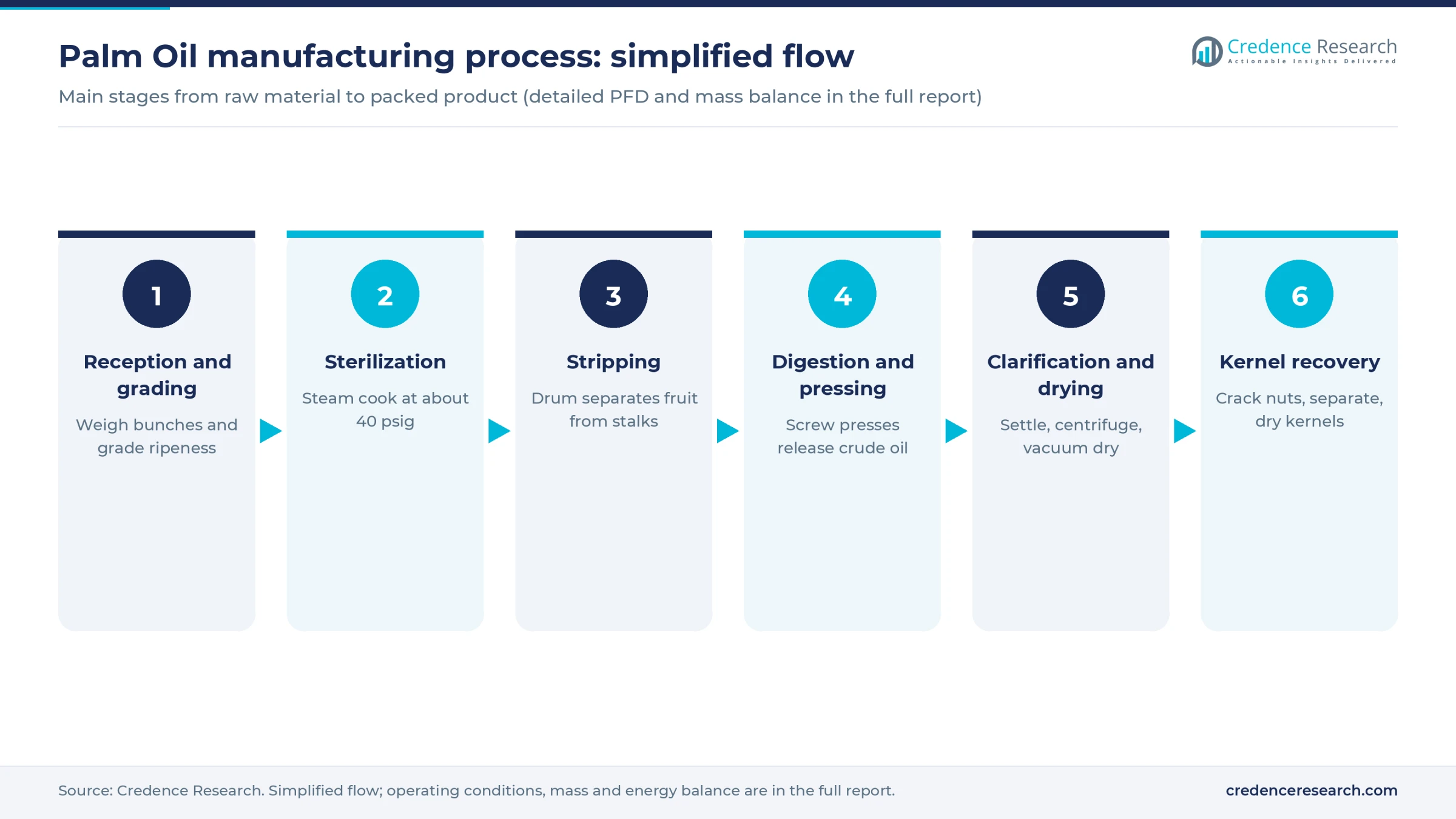
- Reception and grading. Trucks are weighed and bunches graded for ripeness on a ramp, since grading sets the price paid to growers and the extraction rate the mill can expect.
- Sterilization. Steam at about 40 psig cooks bunches for 60–90 minutes in horizontal autoclaves. This stops lipase activity, loosens fruit and conditions nuts for cracking.
- Stripping. A rotating drum knocks fruit off the stalks. Empty bunches go to mulch or boiler fuel.
- Digestion and pressing. Heated, stirred digesters break the fruit flesh, and twin-screw presses release a mix of oil, water and solids.
- Clarification and drying. Diluted oil settles in tanks or passes through decanters and centrifuges, then a vacuum dryer removes moisture before storage.
- Kernel recovery. Press cake is split into fiber and nuts. Nuts are cracked, and kernels are separated from shell and dried for sale.
The mill largely powers itself on its own biomass. Fiber and part of the shell fuel a high-pressure boiler, whose steam drives a turbine and then serves the sterilizers. Surplus shell can be sold as fuel. Effluent is the main environmental load: sterilizer condensate and clarifier sludge carry a heavy organic burden, and open ponds release methane unless covered. As a planning figure, assumed here, a mill generates 0.6–0.7 cubic meters of effluent per tonne of fruit, so the pond or digester system is a design driver, not an afterthought. A refinery step, if added, would degum, bleach and deodorize the crude oil and then fractionate it, which changes the budget materially.
Palm oil plant setup cost
Indicative CapEx for a 60 tonne per hour greenfield mill is USD 25–33 million in a producing region of Southeast Asia, West Africa or Latin America. The anchor is a disclosed project: Kim Loong's planned 60 tonne per hour mill at Pantu, Sarawak, carries a reported RM100 million capex, about USD 24.5 million at RM 4.08 per dollar. This budget treats that figure as the mill itself and adds land, pre-operative costs and working capital.
A second project supports the scale. Opalm's plant at Lengue, Cameroon, with 25,000 tonnes a year of capacity, is budgeted at CFA 9 billion, about USD 16 million. Treated as a 25 tonne per hour mill, an assumption, and scaled with a 0.6 exponent, it implies about USD 27 million at 60 tonnes per hour.
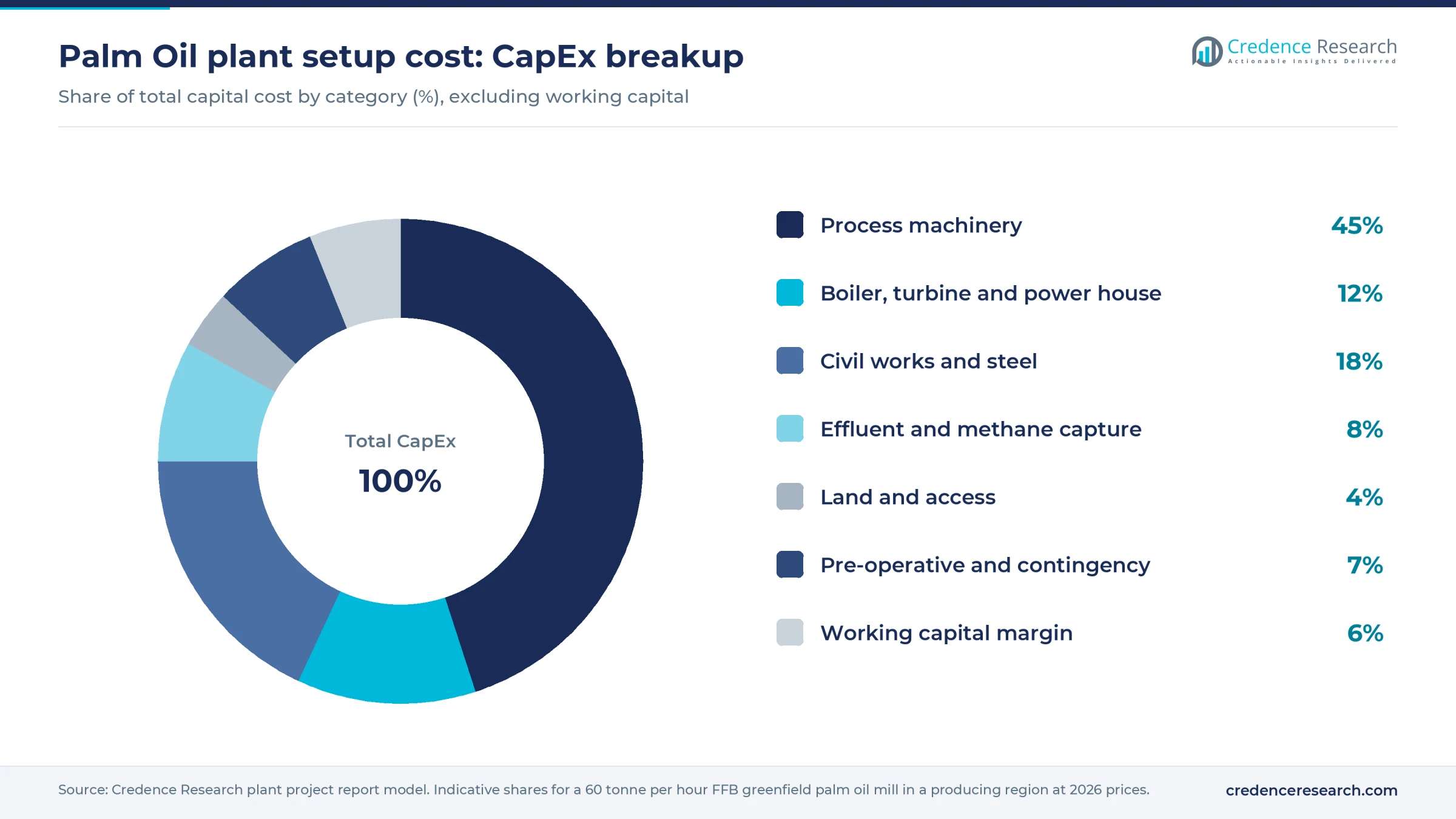
Process machinery takes about 45% of the budget, the boiler, turbine and power house 12%, civil works and steel structures 18%, and effluent treatment with methane capture 8%.
Example row, land: about 20 hectares near the crop catchment is budgeted, as an assumption, at USD 3–7 per square meter, or USD 0.6–1.4 million, about 4% of the total. Concession areas, remote sites and access roads move this figure widely, and a mill built inside an existing estate may pay little for land. Pre-operative expenses and contingency take about 7%. Working capital takes about 6%, roughly a week of fruit purchases, because growers are paid quickly while oil ships in parcels.
Operating cost is almost entirely fruit.
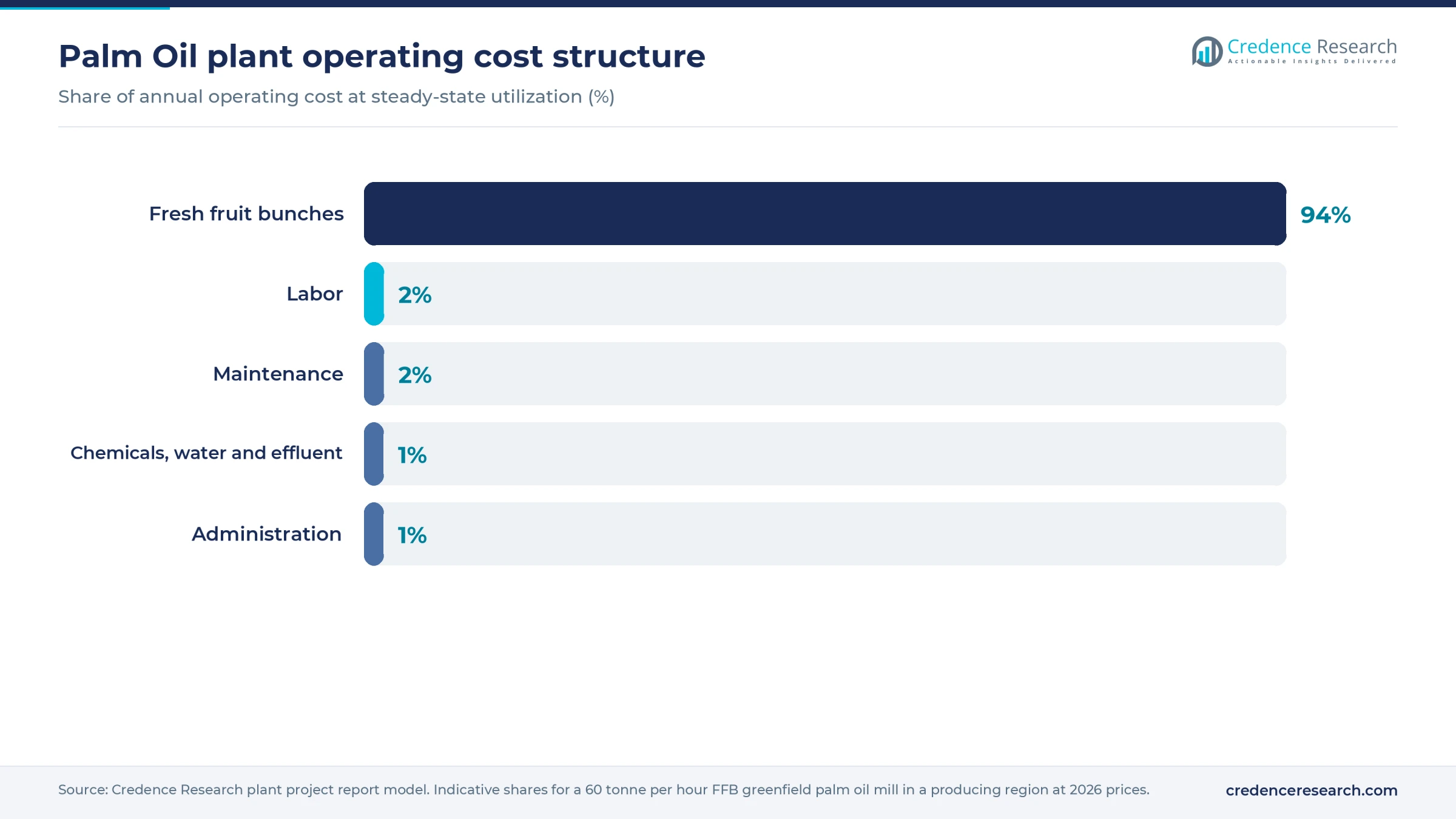
At the 2025 Malaysian mill-gate average of RM 930 per tonne, fruit makes up about 94% of cash cost. Labor and maintenance take about 2% each, with chemicals, water and effluent handling 1% and administration 1%. These non-fruit shares are assumed for planning. Fruit prices, land and labor differ most between countries, so the full report can be customized to any location.
Machinery and raw materials for a palm oil plant
A conventional line runs from the loading ramp and bunch conveyors through horizontal or vertical sterilizers, a thresher, digesters and twin-screw presses. Oil then moves through vibrating screens, a clarifier tank, decanters, purifiers, a vacuum dryer and storage tanks. The kernel plant uses a depericarper, nut silos, a ripple mill and hydrocyclones or claybaths. Utilities include a biomass boiler, a back-pressure steam turbine, water treatment, a laboratory and effluent digesters or ponds. Machine costs and supplier lists are held for the report.
The raw material is fresh fruit, and it cannot travel far. Mills sit inside the growing belt, mainly Indonesia and Malaysia, followed by Thailand, Colombia and Nigeria, with growing activity in Papua New Guinea, Guatemala, Cote d'Ivoire, Cameroon and the Indian states of Andhra Pradesh and Telangana.
The catchment arithmetic is what lenders test first. At Malaysian estates' 2025 average yield of 17.77 tonnes of fruit per hectare, a mill taking 288,000 tonnes a year needs about 16,000 hectares of mature palm within hauling range. Young plantings yield less and take years to mature, so a crop gap in the early years is a common cause of underuse. Consumables are modest by comparison: water treatment chemicals and spare press parts, with fuel largely self-supplied.
Palm oil business profit margin and ROI
Gross margin here means sales less fruit cost, before processing cost. The band is 7–11% for a mill that buys its crop. Malaysian palm oil Board averages for 2025 show crude oil at RM 4,292.50 per tonne, ex-mill kernels at RM 3,424.50, fruit at RM 930 and an extraction rate of 19.74%. With an assumed 5% kernel recovery, one tonne of fruit yields about RM 1,019 of product, or about USD 250, leaving a spread of RM 89 (8.7%).
Surplus shell sales, assumed at RM 10–20 per tonne of fruit, lift the top end. Indonesian provincial price-setting points to the lower end, since the K-index of about 93.5% in March 2026 leaves mills about 6.5% of fruit value. Older Malaysian work points the same way: an MPOB study of three mills in the 1990s found gross margins of about RM 26–33 per tonne of fruit.
Payback follows from cash profit, not the percentage. After assumed processing and overhead costs of RM 45–60 per tonne, cash profit of RM 30–60 per tonne on 288,000 tonnes gives about USD 2.1–4.2 million a year, so USD 29 million of CapEx pays back in about 7–14 years. The main sensitivity is extraction: one point of extraction rate adds about RM 43 per tonne of fruit, close to the entire typical cash profit per tonne, when the fruit price does not rise with it. Groups with their own estates recover faster because plantation margin sits with them, though that investment is excluded here.
| Return metric | Value |
|---|---|
| IRR | Available in report |
| NPV | Available in report |
| ROI | Available in report |
| DSCR | Available in report |
How to start a palm oil business, licenses and approvals
Mill approvals follow a similar sequence in most producing countries, though the palm-specific rules are unusually detailed.
- Business registration and tax identification.
- Land use or zoning clearance and building permits, plus proof of land title for any linked estate.
- Environmental approval and an effluent discharge permit, usually the longest step.
- A palm sector license or plantation-business permit where the country has one.
- Occupational safety approvals, including boiler and pressure vessel inspection.
- Food safety registration where oil enters the food chain, plus product standards.
- Sustainability certification and traceability, needed for many buyers and for EU deforestation regulation compliance.
- Export or import registration.
Examples focus on producing countries, because mills must sit where palms grow. Permit rules change, so each should be confirmed locally.
| Market | Key approvals for a palm oil mill |
|---|---|
| Malaysia | Malaysian palm oil Board license under the 2005 Licensing Regulations, for both building a mill and milling fruit; Department of Environment license under the Environmental Quality (Prescribed Premises) (Crude palm oil) Regulations 1977; MSPO certification under MS2530 |
| Indonesia | Plantation business licensing under Minister of Agriculture Regulation 98/2013 and later risk-based licensing rules, with at least 20% of raw material from the mill's own estate and the rest from long-term grower partnerships in the 2013 text, later amended; environmental approval (AMDAL or UKL-UPL by scale); ISPO framework under Presidential Regulation 16/2025 |
| India | FSSAI license; registration and monthly returns with the Directorate of Sugar and Vegetable Oils under the Vegetable Oil Products, Production and Availability Regulation Order, 2025; state pollution control board consent to establish and operate |
Key palm oil manufacturers and recent developments
Upstream milling and refining are led by integrated groups: Wilmar International, SD Guthrie, IOI Corporation, Kuala Lumpur Kepong, Golden Agri-Resources, Musim Mas and Astra Agro Lestari. Regional operators include Kim Loong Resources in Malaysia, Godrej Agrovet in India and Opalm in Cameroon. Global traders such as Cargill also run refineries in producing countries and buy from independent mills. Refined oil then flows into the wider edible oils and fats market.
Three recent developments show where capital is going:
- July 2026. Godrej Agrovet inaugurated an integrated oil palm complex at Khammam, Telangana, with a mill that started at 30 tonnes per hour and is designed to reach 60. Cumulative investment will reach 3 billion rupees, about USD 33 million at an assumed 90 rupees per dollar, once fully operational, and a refinery is planned.
- June 2026. Kim Loong said its fourth mill, 60 tonnes per hour at Pantu, Sarawak, is due to be commissioned in about two years.
- November 2025. POSCO International became the largest shareholder of Sampoerna Agro, adding 128,000 hectares, and completed a USD 210 million, 500,000-tonne-a-year refinery with GS Caltex at Balikpapan.
The pattern is integration: new mills arrive alongside secured land or grower programs, and refining capacity follows crop control.
What's inside the Palm Oil project report PDF
The report runs to 21 chapters. Open a chapter to see its sections.
1. Preface
2. Scope and Methodology
- 2.1 Objectives of the Study
- 2.2 Stakeholders
- 2.3 Research Methodology
- 2.4 Data Sources and Key Assumptions
3. Executive Summary
- 3.1 Market Snapshot
- 3.2 Project at a Glance (Capacity, CapEx, OpEx)
- 3.3 Key Financial Indicators (IRR, NPV, Payback, Break-even)
- 3.4 Feasibility Verdict
4. Product Overview
- 4.1 Palm Oil Definition and Properties
- 4.2 Grades and Specifications (BIS / ISO / ASTM)
- 4.3 HS Code and Classification
- 4.4 Key Applications
- 4.5 Substitutes
5. Global Palm Oil Market
- 5.1 Market Overview
- 5.2 Historical and Current Market Performance (Volume and Value)
- 5.3 Market Breakup by Grade / Type
- 5.4 Market Breakup by End-Use Industry
- 5.5 Market Breakup by Region
- 5.6 Market Drivers, Restraints and Trends
- 5.7 Value Chain Analysis
- 5.8 Market Forecast
6. Target Country Palm Oil Market Analysis
- 6.1 Demand and Supply Analysis
- 6.2 Installed Capacity vs Demand Gap
- 6.3 Import Dependence
- 6.4 Demand Forecast by End-Use
7. Trade Analysis
- 7.1 Imports by Volume, Value and Country
- 7.2 Exports by Volume, Value and Country
- 7.3 Trade Balance and Opportunities
8. Price Analysis
- 8.1 Historical Palm Oil Price Trends by Region
- 8.2 Raw Material / Feedstock Price Trends and Linkage
- 8.3 Price Forecast
- 8.4 Margins Across the Value Chain
9. Competitive Landscape
- 9.1 Market Structure
- 9.2 Key Players and Installed Capacities
- 9.3 Profiles of Key Players
- 9.4 Recent Developments (Expansions, M&A, New Plants)
10. Manufacturing Process and Technology
- 10.1 Comparison of Technology Routes
- 10.2 Selected Route and Process Flow Diagram
- 10.3 Unit Operations Involved
- 10.4 Chemical Reactions Involved
- 10.5 Mass Balance and Raw Material Requirements
- 10.6 Energy Balance
- 10.7 Quality Assurance Criteria and Technical Tests
- 10.8 By-products and Waste Handling
- 10.9 Technology Licensors / Providers
11. Project Details, Requirements and Costs
- 11.1 Land, Location and Site Development
- 11.1.1 Site Selection Criteria
- 11.1.2 Location Analysis
- 11.1.3 Land Requirement and Costs
- 11.1.4 Site Development Costs
- 11.2 Plant Layout
- 11.2.1 Layout Principles
- 11.2.2 Proposed Layout
- 11.2.3 Factors Influencing Layout
- 11.3 Civil Works and Buildings
- 11.4 Plant Machinery
- 11.4.1 Machinery Requirements and Specifications
- 11.4.2 Machinery Costs
- 11.4.3 Machinery Suppliers
- 11.5 Raw Materials
- 11.5.1 Requirements per Tonne of Output
- 11.5.2 Procurement and Sourcing
- 11.5.3 Costs
- 11.5.4 Suppliers
- 11.6 Packaging
- 11.6.1 Packaging Requirements
- 11.6.2 Packaging Costs
- 11.6.3 Packaging Suppliers
- 11.7 Storage and Material Handling
- 11.8 Transportation Requirements and Costs
- 11.9 Utilities
- 11.9.1 Power Requirements and Costs
- 11.9.2 Water Requirements and Costs
- 11.9.3 Steam, Fuel and Other Utilities
- 11.10 Manpower Requirements and Wages
12. Environment, Health, Safety and Sustainability
- 12.1 Effluent and Emissions Management
- 12.2 Hazard Classification and Safety Measures
- 12.3 Carbon Footprint
- 12.4 Green / Low-Carbon Process Options
13. Regulatory Procedures, Approvals and Certifications
- 13.1 Licences and Registrations
- 13.2 Environmental Clearances
- 13.3 Product Certifications (BIS, REACH, etc.)
- 13.4 Approval Timeline
14. Project Implementation Schedule
15. Project Economics
- 15.1 Capital Cost of the Project
- 15.2 Techno-Economic Parameters
- 15.3 Capacity Utilization and Ramp-up
- 15.4 Product Pricing and Margins
- 15.5 Income Projections
- 15.6 Expenditure Projections
- 15.7 Working Capital Requirement
- 15.8 Taxation
- 15.9 Depreciation
16. Financial Analysis
- 16.1 Projected Profit and Loss Account
- 16.2 Projected Cash Flow Statement
- 16.3 Projected Balance Sheet
- 16.4 Liquidity Analysis
- 16.5 Profitability Analysis (Payback, NPV, IRR, ROI)
- 16.6 Break-even Analysis
- 16.7 Debt Service Coverage Ratio (DSCR)
- 16.8 Sensitivity Analysis
- 16.9 Scenario and Uncertainty Analysis
17. Funding and Incentives
- 17.1 Means of Finance and Debt-Equity Structure
- 17.2 Loans and Financial Assistance
- 17.3 Government Schemes and Subsidies (PLI, State Policies)
18. Risk Assessment
- 18.1 Key Success Factors
- 18.2 Key Risk Factors
- 18.3 Risk Mitigation
19. Strategic Recommendations
20. Case Study of a Successful Venture
21. Appendix
- 21.1 Detailed Assumptions
- 21.2 Abbreviations
- 21.3 List of Tables and Figures
- 21.4 Sources
This page vs. the full report
| Data point | On this page (free) | In the full report |
|---|---|---|
| Total CapEx | One rounded range at one capacity | Exact figure at three capacities with a line-item breakup |
| CapEx breakup | Category shares (%) only | Cost, quantity and supplier for every machine |
| Operating cost | Share of raw materials, utilities and labor | Per-unit cost sheet with each input price and consumption |
| Profitability | Gross margin range and payback band | Exact IRR, NPV, ROI, break-even and DSCR |
| Financial statements | List of what is included | 10-year P&L, cash flow, balance sheet and Excel model |
| Sensitivity | One directional line | Full sensitivity and scenario tables |
| Process | Simplified flow diagram | Detailed process flow, mass and energy balance, operating conditions |
| Machinery | Names of the main machines | Specifications, capacity, cost and supplier list |
| Market | Headline size, growth and India demand trend | Segment, region, trade and price forecast tables |
| Suppliers and buyers | Supplier types and sourcing hubs | Named suppliers and buyers |
Palm Oil project report: FAQs
How much does it cost to set up a palm oil mill?
What gross margin does a palm oil mill earn?
What is the payback period for a palm oil mill?
How much fruit does a 60 tonne per hour mill need?
What is the HS code for palm oil?
Which licenses does a palm oil mill need?
Should a palm oil plant include a refinery?

About the analyst
Rajdeep Kumar Deb, Lead Analyst - Consumer & Finance
Rajdeep brings a decade of consumer goods and financial services insight to strategic market analysis.
Related market research
- Sustainable Palm Oil Market Size, Growth and Forecast 2032
- Edible Oils and Fats Market Size, Trends, Share and Forecast 2032
- Oleochemicals Market Size, Growth, Share and Forecast 2032
- Biodiesel Market Size, Trends, Share, Growth and Forecast 2032
- Hydrotreated Vegetable Oil Market Size, Share and Forecast 2032
- Edible Oil Packaging Market Size, Share, Growth & Forecast 2032
More plant project reports
- Perfume Manufacturing Plant Project Report (DPR) 2026
- Paper Cups Manufacturing Plant Project Report (DPR) 2026
- Cigarette Manufacturing Plant Project Report (DPR) 2026
- Ceiling Fan Manufacturing Plant Project Report (DPR) 2026
- Avocado Oil Processing Plant Project Report (DPR) 2026
- Aluminium Cans Manufacturing Plant Project Report (DPR) 2026