
Market Overview:
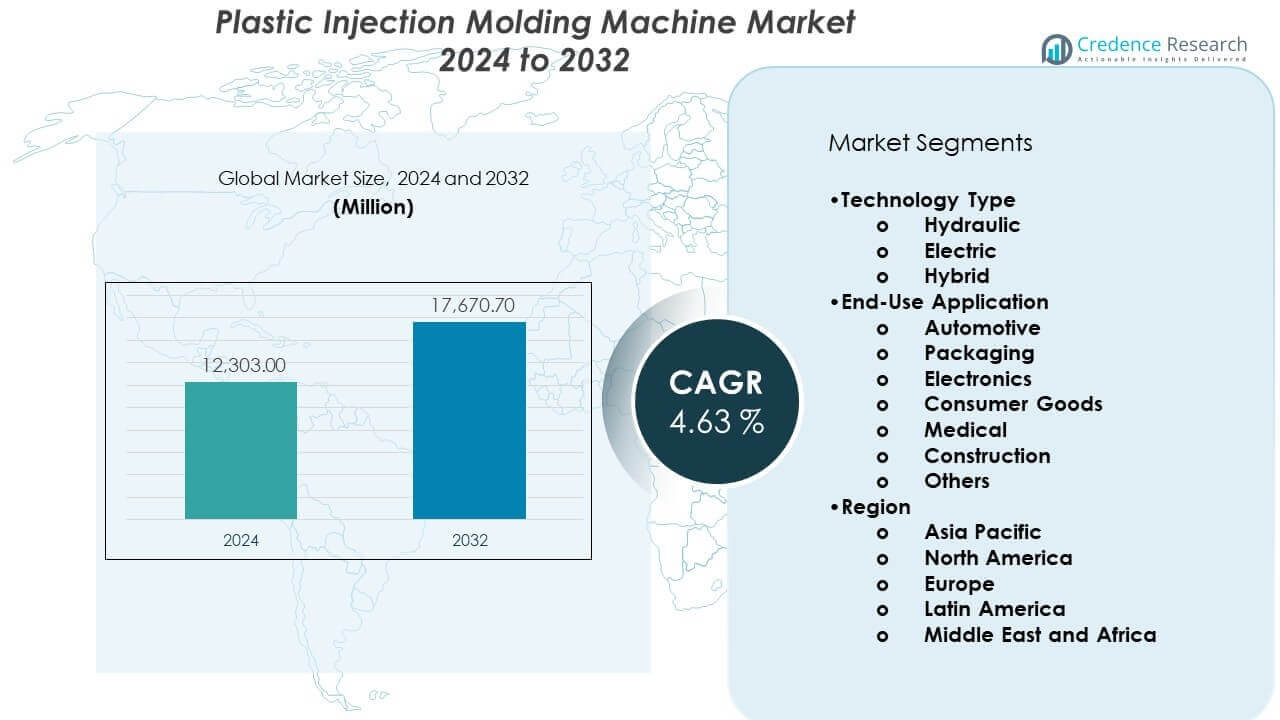
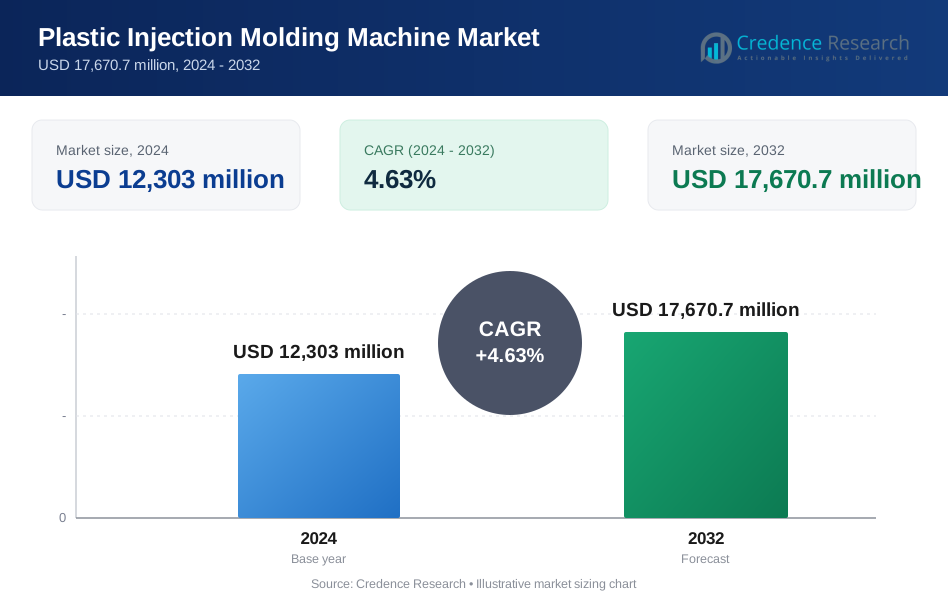
The Plastic injection molding machine market is projected to grow steadily during the forecast period. The Plastic injection molding machine market is projected to grow from USD 12,303 million in 2024 to an estimated USD 17,670.7 million by 2032, with a compound annual growth rate of 4.63% from 2024 to 2032.
| REPORT ATTRIBUTE | DETAILS |
|---|---|
| Historical Period | 2020-2023 |
| Base Year | 2024 |
| Forecast Period | 2025-2032 |
| Plastic Injection Molding Machine Market Size 2024 | USD 12,303 million |
| Plastic Injection Molding Machine Market, CAGR | 4.63% |
| Plastic Injection Molding Machine Market Size 2032 | USD 17,670.7 million |
Market growth is driven by strong demand for plastic components across automotive, packaging, electronics, and medical sectors. Manufacturers use injection molding machines to achieve high precision and repeatable output. Automotive producers rely on these machines for lightweight interior and exterior parts. Packaging companies increase adoption to meet rising demand for containers and closures. Automation improves productivity and reduces labor costs. Energy-efficient systems lower power use and operating expenses. Advanced control features support consistent quality and reduce material waste across production cycles.
Asia Pacific leads the market due to large-scale manufacturing activity and strong industrial investment. China, Japan, and India drive demand through expanding automotive and electronics production. Europe remains a key region due to advanced engineering capabilities and strong focus on precision machinery. Germany and Italy support demand through high-end machine manufacturing and adoption. North America shows stable growth supported by medical and packaging industries. Emerging regions include Southeast Asia and Latin America, driven by industrial expansion and rising foreign investment.
Market Insights:
- The Plastic injection molding machine market grew from USD 12,303 million in 2024 to an estimated USD 17,670.7 million by 2032, registering a CAGR of 4.63% during the forecast period.
- Asia Pacific leads with about 45% share due to large manufacturing bases, followed by North America at 25% driven by medical and packaging demand, and Europe at 20% supported by automotive and precision engineering strength.
- Asia Pacific remains the fastest-growing region, holding around 45% share, supported by expanding automotive production, packaging demand, cost advantages, and government-backed manufacturing initiatives.
- By technology type, hydraulic machines account for nearly 50% share due to high clamping force needs, while electric machines hold about 30% share driven by precision and energy efficiency demand.
- By end-use application, automotive represents around 30% share and packaging nearly 25% share, reflecting strong demand for lightweight components and high-volume molded products.
Market Drivers:
Rising Demand From High-Volume Manufacturing Industries
The Plastic injection molding machine market gains support from high-volume manufacturing demand. Automotive producers need precise and repeatable plastic parts. Packaging companies rely on machines for containers and closures. Consumer goods firms scale output to meet retail demand. Medical device makers require controlled molding for safety needs. High productivity supports faster delivery schedules. Consistent cycle times improve order reliability. This demand sustains steady equipment adoption.
- For instance, Husky Technologies supplies systems capable of producing over 72,000 PET bottle preforms per hour for global packaging manufacturers.
Focus On Lightweight And Complex Plastic Components
Manufacturers shift toward lightweight plastic parts across industries. Injection molding machines enable complex shapes with tight tolerances. Automotive firms reduce vehicle weight using molded plastics. Electronics brands demand compact and detailed housings. Thin-wall molding reduces material use without strength loss. Design flexibility supports faster product updates. Precision tooling lowers defect rates. This focus supports long-term machine demand.
- For instance, Engel Austria GmbH demonstrated thin-wall packaging applications achieving cycle times below 3 seconds for lightweight food containers.
Automation And Productivity Improvement Across Factories
Factories invest in automation to improve productivity levels. Injection molding machines integrate with robots and control systems. Automation reduces dependence on manual labor. Shorter cycle times raise output per shift. Smart controls support stable process conditions. Quality consistency improves across production batches. Predictable output aids supply planning. Automation strengthens capital investment confidence.
Energy Efficiency And Operating Cost Reduction Focus
Energy efficiency shapes machine purchasing decisions. Modern machines consume less power per production cycle. Servo-driven systems improve energy control accuracy. Lower heat loss reduces cooling requirements. Cost savings improve operating margins for manufacturers. Energy-efficient machines meet sustainability goals. Regulatory pressure supports efficient equipment adoption. This focus drives replacement demand.
Market Trends:
Shift Toward Smart And Digitally Controlled Machines
Manufacturers prefer machines with digital control capabilities. Touchscreen interfaces simplify machine operation. Data logging improves production tracking accuracy. Remote monitoring supports faster issue response. Smart alerts reduce unexpected downtime events. Process data supports quality audits. Digital systems improve factory connectivity. This trend influences new machine design.
- For instance, Arburg GmbH + Co KG offers ALLROUNDER machines with ALS host computer systems monitoring hundreds of process parameters in real time.
Growing Preference For Electric And Hybrid Machine Types
Electric machines gain attention for precision performance. Hybrid machines balance efficiency and power output. Low noise improves factory working conditions. Clean operation suits medical and electronics use. Stable motion control improves part quality. Reduced oil use supports cleaner floors. Compact designs save valuable space. This trend boosts premium equipment demand.
- For instance, Sumitomo Heavy Industries reports all-electric machines achieving repeatability within ±0.01 mm for medical and electronics components.
Expansion Of Customization And Modular Machine Design
Manufacturers request machines tailored to specific applications. Modular designs allow flexible configuration choices. Quick mold change features reduce idle time. Custom clamping units suit varied part sizes. Adaptable systems extend machine service life. Manufacturers avoid full system replacement. Scalable designs support phased expansion. Customization shapes supplier offerings.
Rising Adoption Of Predictive Maintenance Practices
Factories adopt predictive maintenance to limit failures. Sensors monitor machine condition in real time. Data analysis predicts component wear patterns. Maintenance schedules become more accurate. Unplanned stoppages decline across facilities. Spare part planning improves efficiency. Machine uptime supports stable operations. This trend increases equipment value.
Market Challenges Analysis:
High Initial Capital Cost And Investment Sensitivity
The Plastic injection molding machine market faces high initial cost pressure. Advanced machines require significant capital investment. Small manufacturers face budget constraints. Financing access differs across regions. Long payback periods delay buying decisions. Price sensitivity affects emerging economies. Cost concerns limit premium feature adoption. This challenge slows market penetration.
Skilled Workforce Shortage And Technical Complexity
Modern machines require skilled operators and technicians. Automation raises technical complexity levels. Skill gaps increase operational risk. Maintenance errors affect machine performance. Labor shortages persist in many regions. Training programs raise operating expenses. Complex controls extend learning curves. This challenge impacts production efficiency.
Market Opportunities:
Growth Potential In Emerging Manufacturing Economies
The Plastic injection molding machine market benefits from emerging economy growth. Developing regions expand manufacturing capacity. Government policies support local production initiatives. Foreign investment increases industrial equipment demand. Packaging and consumer goods output rises steadily. Automotive assembly expands in new locations. Infrastructure growth supports industrial clusters. These factors open new revenue paths.
Rising Demand For Sustainable And Recyclable Plastics
Manufacturers focus on recyclable plastic processing methods. Machines adapt to recycled and bio-based materials. Process stability supports material consistency. Sustainable packaging demand grows worldwide. Brands adopt cleaner production practices. Regulatory pressure supports material transition. Machine upgrades enable new resin handling. This opportunity supports long-term innovation.
Market Segmentation Analysis:
Technology Type
The Plastic injection molding machine market shows clear differentiation by technology type. Hydraulic machines hold steady demand due to high clamping force and durability. These machines suit large parts and heavy-duty industrial use. Electric machines gain preference for precision and energy efficiency. They support clean production and tight tolerance needs. Hybrid machines combine power efficiency with strong performance. This mix supports flexible production across industries. Technology choice depends on output scale, precision needs, and energy priorities.
- For instance, Haitian International manufactures hydraulic machines exceeding 8,000 kN clamping force for large automotive components.
End-Use Application
Automotive remains a key end-use due to demand for lightweight and complex plastic parts. Molding machines support interior, exterior, and under-the-hood components. Packaging relies on high-speed machines for containers, caps, and closures. Electronics demand precise machines for compact and detailed housings. Consumer goods producers use molding systems for high-volume daily products. Medical applications require clean and accurate molding for devices and disposables. Construction uses molded components for fittings and panels. Other sectors include furniture, agriculture, and industrial products.
- For instance, Japan Steel Works supplies large injection molding machines used for automotive bumpers exceeding 1.5 meters in length.
Segmentation:
- Technology Type
- Hydraulic
- Electric
- Hybrid
- End-Use Application
- Automotive
- Packaging
- Electronics
- Consumer Goods
- Medical
- Construction
- Others
- Region
- North America
- U.S.
- Canada
- Mexico
- Europe
- Germany
- France
- U.K.
- Italy
- Spain
- Rest of Europe
- Asia Pacific
- China
- Japan
- India
- South Korea
- South-east Asia
- Rest of Asia Pacific
- Latin America
- Brazil
- Argentina
- Rest of Latin America
- Middle East & Africa
- GCC Countries
- South Africa
- Rest of the Middle East and Africa
- North America
Regional Analysis:
Asia Pacific Dominance With Strong Manufacturing Base
The Plastic injection molding machine market sees Asia Pacific as the leading region with about 45% market share. China drives demand through large-scale automotive, packaging, and electronics production. Japan supports the region with advanced machinery manufacturing and precision equipment use. India shows rising demand due to expanding consumer goods and packaging industries. Cost-efficient labor and strong supply chains support equipment adoption. Government support for manufacturing strengthens capital investment. Export-oriented production sustains long-term regional demand.
North America Supported By Technology And Medical Demand
The Plastic injection molding machine market holds nearly 25% share in North America. The United States leads due to strong medical, packaging, and consumer goods production. Manufacturers prefer advanced and automated molding systems. High focus on product quality supports electric and hybrid machine demand. Medical device production drives precision equipment adoption. Stable replacement demand supports steady sales. Strong technical expertise sustains regional competitiveness.
Europe And Emerging Regions Showing Balanced Growth
The Plastic injection molding machine market accounts for about 20% share in Europe. Germany and Italy lead due to strong automotive and industrial equipment sectors. Focus on energy efficiency supports advanced machine adoption. Eastern Europe shows gradual growth from manufacturing relocation. Latin America holds nearly 6% share, led by Brazil and Mexico. Middle East and Africa account for around 4% share, supported by construction and packaging growth. Industrial diversification supports gradual expansion across emerging regions.
Key Player Analysis:
- Arburg GmbH + Co KG
- Haitian International
- Engel Austria GmbH
- KraussMaffei
- Nissei Plastic Industrial Co., Ltd.
- Chen Hsong Holdings Limited
- Milacron
- Sumitomo Heavy Industries
- Husky Technologies
- Japan Steel Works
Competitive Analysis:
The Plastic injection molding machine market features strong competition among global and regional manufacturers. Leading players compete on machine precision, energy efficiency, and automation depth. Product portfolios cover hydraulic, electric, and hybrid systems. Companies invest in smart controls and digital interfaces to strengthen value. Service networks and aftermarket support influence buyer decisions. Price competitiveness remains critical in emerging regions. Brand reputation supports long-term contracts with large manufacturers. Continuous product upgrades help firms defend market position. Strategic focus centers on efficiency, reliability, and customization.
Recent Developments:
- In October 2025, Haitian International unveiled the world premiere of its MAV/F PRO high-speed injection molding machine and the Jupiter Series two-platen solution at the K 2025 trade fair. These launches featured advanced one-step molding technology that eliminates traditional painting and trimming steps for automotive parts. Additionally, in June 2025, the company introduced its fifth-generation (Gen 5) machines, which incorporate significant enhancements in energy efficiency, intelligent adaptive control, and OPC/UA connectivity for flexible integration.
- In October 2025, KraussMaffei marked a major milestone at the K 2025 trade fair with the world premiere of its new all-electric PX injection molding machine series, which features the intuitive MC7 control system and offers outstanding energy efficiency. The company also introduced a revolutionary Chopped Fiber Processing (CFP) solution that enables the direct compounding of chopped glass fibers with standard machines, significantly reducing material costs and offering a return on investment of less than one year.
- In June 2025, Japan Steel Works (JSW) announced the launch of the J4000F-22000H, a massive 4,000-ton all-electric two-platen injection molding machine designed to meet the growing demand for large, lightweight automotive structural parts. Prior to this, in May 2024 at NPE, the company debuted its J-F Series of large electric machines and introduced the J-WiSe cloud-based networking system, which allows for comprehensive remote monitoring and management of production plants.
Report Coverage:
The research report offers an in-depth analysis based on technology type and end-use application. It details leading market players, providing an overview of their business, product offerings, investments, revenue streams, and key applications. Additionally, the report includes insights into the competitive environment, SWOT analysis, current market trends, as well as the primary drivers and constraints. Furthermore, it discusses various factors that have driven market expansion in recent years. The report also explores market dynamics, regulatory scenarios, and technological advancements that are shaping the industry. It assesses the impact of external factors and global economic changes on market growth. Lastly, it provides strategic recommendations for new entrants and established companies to navigate the complexities of the market.
Future Outlook:
- The Plastic injection molding machine market will continue to benefit from steady expansion in automotive, packaging, and medical manufacturing.
- Manufacturers will increase adoption of electric and hybrid machines to meet precision and energy efficiency requirements.
- Automation integration will strengthen productivity and reduce dependence on manual labor across production facilities.
- Smart control systems will gain wider acceptance due to demand for real-time monitoring and process stability.
- Lightweight plastic component demand will support machine upgrades in automotive and electronics industries.
- Sustainable manufacturing goals will encourage machines compatible with recycled and bio-based materials.
- Emerging economies will attract new investments in molding capacity due to industrialization and cost advantages.
- Aftermarket services and technical support will become more important for long-term customer retention.
- Customizable and modular machine designs will shape supplier differentiation strategies.
- Continuous technology improvement will support consistent replacement demand in mature markets.
Request a Free Sample
Fill in your details and we'll send you a free sample report.
- Sample data tables & charts
- Research methodology
Need a Custom Version of This Report?
Tailor the scope, geography, or segments to your exact requirements.
- Custom geography or segment scope
- Direct access to our analyst team
Frequently Asked Questions
What is the current market size for Plastic injection molding machine market, and what is its projected size in 2032?
At what Compound Annual Growth Rate is the Plastic injection molding machine market projected to grow between 2025 and 2032?
Which Plastic injection molding machine market segment held the largest share in 2024?
What are the primary factors fueling the growth of the Plastic injection molding machine market?
Who are the leading companies in the Plastic injection molding machine market?
Which region commanded the largest share of the Plastic injection molding machine market in 2024?
Table of Content
Chapter 1. Report Introduction
- 1.1 Report Description & Purpose
- 1.1.1 Report Title & Market Definition
- 1.1.2 Unique Selling Propositions (USP) & Key Differentiators
- 1.1.3 Value Proposition for Stakeholders
- 1.2 Research Objectives
- 1.2.1 Market Sizing Objectives (Volume & Revenue)
- 1.2.2 Segmentation Objectives
- 1.2.3 Competitive Intelligence Objectives
- 1.2.4 Forecast & Scenario Objectives
- 1.3 Report Scope
- 1.3.1 Plastic Injection Molding Machine Scope – Types & Subtypes Covered
- 1.3.2 Geographic Scope – Regions & Countries Covered
- 1.3.3 Historical Period, Base Year & Forecast Period (2024; forecast to 2032)
- 1.3.4 Inclusions & Exclusions
- 1.4 HS Code & Classification Framework
- 1.5 Currency, Units & Pricing Basis
- 1.6 Target Stakeholders
- 1.7 Limitations & Assumptions
Chapter 2. Executive Summary
- 2.1 Global Plastic Injection Molding Machine Market Snapshot
- 2.1.1 Market Size – Historical (2024) & Forecast (2024-2032) (2024: USD 12,303 million → 2032: USD 17,670.7 million)
- 2.1.2 Volume & Revenue – Global Totals
- 2.1.3 Key Market Highlights – Top Five Facts
- 2.2 Plastic Injection Molding Machine Market Segmentation Snapshot
- 2.2.1 Market Split by Region – 2024 vs. 2032
- 2.3 Competitive Snapshot
- 2.3.1 Top 10 Players by Revenue Share – 2024
- 2.3.2 Top 10 Players by Volume Share – 2024
- 2.3.3 Recent Strategic Developments (18-Month Summary)
- 2.4 Key Investment Highlights & Strategic Conclusions
Chapter 3. Plastic Injection Molding Machine Market Dynamics & Industry Analysis
- 3.1 Market Overview & Context
- 3.1.1 Plastic Injection Molding Machine Market Position in the Broader Automotive Value Chain
- 3.1.2 OEM vs. Replacement Market Dynamics
- 3.1.3 Market Maturity & Development Stage by Region
- 3.2 Plastic Injection Molding Machine Market Drivers
- 3.3 Plastic Injection Molding Machine Market Restraints & Challenges
- 3.4 Plastic Injection Molding Machine Market Opportunities
- 3.5 Porter's Five Forces Analysis
- 3.5.1 Threat of New Entrants
- 3.5.2 Bargaining Power of Suppliers
- 3.5.3 Bargaining Power of Buyers
- 3.5.4 Threat of Substitutes
- 3.5.5 Competitive Rivalry – Intensity Assessment
- 3.6 Plastic Injection Molding Machine Value Chain Analysis
- 3.6.1 Upstream – Raw Material/Input Suppliers
- 3.6.1.1 Raw Material/Input 1
- 3.6.1.2 Raw Material/Input 2
- 3.6.1.3 Raw Material/Input 3
- 3.6.2 Midstream – Production/Manufacturing/Service Delivery
- 3.6.2.1 Production/Process Overview
- 3.6.2.2 Key Facility Locations & Capacity by Manufacturer
- 3.6.3 Downstream – Distribution & End Consumer
- 3.6.3.1 Primary Channel – B2B/OEM
- 3.6.3.2 Secondary Channels – Dealer, Retail, Online, Direct
- 3.6.4 Value Chain Profitability Analysis
- 3.6.1 Upstream – Raw Material/Input Suppliers
- 3.7 PESTEL Analysis
- 3.7.1 Political Factors
- 3.7.2 Economic Factors
- 3.7.3 Social Factors
- 3.7.4 Technological Factors
- 3.7.5 Environmental Factors
- 3.7.6 Legal Factors
- 3.8 Plastic Injection Molding Machine Supply Chain Analysis
- 3.8.1 Raw Material/Input Supply Risk Assessment
- 3.8.2 Manufacturing Concentration Risk (Geographic Exposure)
- 3.8.3 Trade Disruption Impact Analysis
- 3.9 Regulatory & Policy Landscape
Note: The regulatory and policy landscape section covers regulations based on their applicability to the market, Plastic Injection Molding Machine category, geography, and scope of the study. Only regulatory frameworks with a material impact on operations, compliance, trade, sustainability, or market access are analyzed in detail.
Chapter 4. Key Investment Pockets & Opportunity Analysis
- 4.1 Plastic Injection Molding Machine Market Attractiveness Analysis
- 4.1.1 By Region – Investment Attractiveness Matrix (Volume × CAGR)
- 4.2 Absolute Revenue Growth Opportunity
- 4.2.1 By Region – Absolute USD Growth Through 2032
- 4.3 Incremental Volume Opportunity
- 4.3.1 By Region – Incremental Volume Through 2032
- 4.3.2 Segment – Incremental Volume
- 4.4 Emerging Submarket Opportunity Deep Dive (Subject to Applicability)
- 4.5 Emerging Market Opportunity Scorecards
- 4.5.1 United States
- 4.5.2 Europe
- 4.5.3 Asia
- 4.5.4 Middle East & Africa
Note: Emerging Market Opportunity Scorecards will be included based on relevance and strategic importance. Regions listed are indicative and may vary depending on data availability and market dynamics.
Chapter 5. Plastic Injection Molding Machine Import-Export Analysis & Trade Flows
- 5.1 Global Trade Overview
- 5.1.1 Global Export Value by Country (2024)
- 5.1.2 Global Export Volume by Country (2024)
- 5.1.3 Global Import Value by Country (2024)
- 5.1.4 Global Import Volume by Country (2024)
- 5.1.5 Net Trade Balance by Country (2024)
- 5.2 Export Analysis – Segment
- 5.2.1 Type 1 (HS Code)
- 5.2.2 Type 2 (HS Code)
- 5.2.3 Type 3 (HS Code)
- 5.2.4 Type 4 (HS Code)
- 5.2.5 Type 5 (HS Code)
- 5.3 Import Analysis – Segment
- 5.3.1 Type 1 (HS Code)
- 5.3.2 Type 2 (HS Code)
- 5.3.3 Type 3 (HS Code)
- 5.3.4 Type 4 (HS Code)
- 5.3.5 Type 5 (HS Code)
- 5.4 Average Unit Trade Prices
- 5.4.1 Average Export Price – Segment & Country
- 5.4.2 Average Import Price – Segment & Source Country
- 5.4.3 Price Trends (2024)
- 5.5 Key Trade Route Analysis
- 5.5.1 Trade Route 1
- 5.5.2 Trade Route 2
- 5.5.3 Trade Route 3
- 5.5.4 Trade Route 4
- 5.5.5 Trade Route 5
- 5.6 Trade Policy Impact Assessment
- 5.6.1 US Anti-Dumping & Section 301 Tariffs
- 5.6.2 EU Customs Union Impact
- 5.6.3 Major Free Trade Agreements
- 5.6.4 USMCA Rules of Origin
Note: Trade policy analysis will be included only where relevant to the Plastic Injection Molding Machine market.
Chapter 6. Competitive Landscape & Company Benchmarking
- 6.1 Plastic Injection Molding Machine Market Concentration & Structure
- 6.1.1 Herfindahl-Hirschman Index (HHI) – vs. 2024
- 6.1.2 Tier 1, Tier 2 & Tier 3 Market Structure
- 6.1.3 Global, Regional & Local Player Dynamics
- 6.2 Plastic Injection Molding Machine Market Share Analysis – 2024
- 6.2.1 Global Revenue Share by Company
- 6.2.2 Global Volume Share by Company
- 6.2.3 Regional Revenue Share
- 6.2.4 Market Share Evolution ( vs. 2024)
- 6.2.5 OEM Segment Share by Company
- 6.2.6 Replacement Segment Share by Company
- 6.3 Production/Delivery Capacity & Facility Analysis
- 6.3.1 Global Installed Capacity
- 6.3.2 Capacity Utilization Rates
- 6.3.3 Production/Output Volume
- 6.3.4 Facility Locations & Capacity Map
- 6.3.5 Planned Capacity Additions
- 6.4 Plastic Injection Molding Machine Competitive Benchmarking Matrix
- 6.4.1 Revenue, Volume, CAGR & Profitability Comparison
- 6.4.2 Channel Revenue Mix
- 6.4.3 Geographic Revenue Exposure
- 6.4.4 R&D Intensity
- 6.4.5 Sustainability Maturity
- 6.5 Strategic Developments in Plastic Injection Molding Machine (Last 24 Months)
- 6.5.1 Mergers, Acquisitions & Divestments
- 6.5.2 New Plastic Injection Molding Machine Launches
- 6.5.3 Facility Expansions
- 6.5.4 Strategic Alliances, Joint Ventures & Partnerships
- 6.5.5 Distribution Expansion & Market Entry
- 6.5.6 Sustainability & ESG Initiatives
- 6.6 Competitive Strategy Mapping
- 6.6.1 Leader, Challenger, Follower & Niche Classification
- 6.6.2 Pricing Strategy Comparison
- 6.6.3 Channel Strategy Matrix
Note: Strategic developments are included based on their materiality and the availability of reliable information.
Chapter 7. Global Plastic Injection Molding Machine Market – By Distribution Channel
- 7.1 Segment Overview
- 7.1.1 Volume & Revenue Split by Channel (2024 & 2032)
- 7.1.2 Channel Mix Evolution (2024-2032)
Chapter 8. Regional Market Analysis – Global Overview
- 8.1 Global Regional Overview
- 8.1.1 Regional Volume Share
- 8.1.2 Regional Revenue Share
- 8.1.3 Regional Volume by Region
- 8.1.4 Regional Revenue by Region
- 8.1.5 Regional Forecast Through 2032
- 8.2 Cross-Regional Segment Analysis
- 8.2.1 By Distribution Channel
- 8.2.2 By Brand/Price Tier
Chapter 9. North America Plastic Injection Molding Machine Market
- 9.1 United States
- 9.2 Canada
- 9.3 Mexico
Chapter 10. Europe Plastic Injection Molding Machine Market
- 10.1 Germany
- 10.2 France
- 10.3 Italy
- 10.4 United Kingdom
- 10.5 Spain
- 10.6 Poland
- 10.7 Russia
- 10.8 Netherlands
- 10.9 Belgium
- 10.10 Sweden
- 10.11 Denmark
- 10.12 Norway
- 10.13 Rest of Europe
Chapter 11. Asia Pacific Plastic Injection Molding Machine Market
- 11.1 China
- 11.2 India
- 11.3 Japan
- 11.4 South Korea
- 11.5 Thailand
- 11.6 Indonesia
- 11.7 Vietnam
- 11.8 Malaysia
- 11.9 Australia
- 11.10 Rest of Asia Pacific
Chapter 12. Latin America Plastic Injection Molding Machine Market
- 12.1 Brazil
- 12.2 Argentina
- 12.3 Colombia
- 12.4 Chile
- 12.5 Rest of Latin America
Chapter 13. Middle East Plastic Injection Molding Machine Market
- 13.1 Saudi Arabia
- 13.2 United Arab Emirates
- 13.3 Turkey
- 13.4 Israel
- 13.5 Iran
- 13.6 Rest of the Middle East
Chapter 14. Africa Plastic Injection Molding Machine Market
- 14.1 South Africa
- 14.2 Egypt
- 14.3 Nigeria
- 14.4 Morocco
- 14.5 Rest of Africa
Chapter 15. Plastic Injection Molding Machine Company Profiles
- 15.1 [Company 01]
- 15.1.1 Company Overview
- 15.1.2 Key Management Personnel
- 15.1.3 Products & Services Portfolio
- 15.1.4 Financial Performance
- 15.1.5 Key Market Focus & Geographic Presence
- 15.1.6 Recent Developments & Strategic Initiatives
Note: The company profile list is preliminary and may change based on research findings, market developments, data availability, and client requirements.
Chapter 16. Appendices
- Appendix A – List of Abbreviations & Acronyms
- Appendix B – Industry Classification Code Reference – Full Series
- Appendix C – Production & Capacity Data Tables
- Appendix D – End-Use & Demand Base Tables
- Appendix E – Consumption & Replacement Rate Assumptions
- Appendix F – ASP Reference Tables
- Appendix G – Manufacturing & Facility Database
- Appendix H – Import-Export Data Tables
- Appendix I – Regulatory Summary Tables
- Appendix J – Primary Research Participant List (Anonymized)
- Appendix K – Primary Research Questionnaire Framework
- Appendix L – Data Sources & Bibliography
- Appendix M – Market Size Divergence & Source Comparison
Chapter 17. Research Methodology
- 17.1 Research Framework & Philosophy
- 17.2 Secondary Research – Sources, Hierarchy & Data Extraction
- 17.3 Data Modeling – Bottom-Up & Top-Down Market Sizing
- 17.4 Primary Research – Stakeholder Framework, LOI & Sample Sizes
- 17.5 Forecast Methodology – Regression, Scenario & Sensitivity Analysis
- 17.6 Quality Control – Four-Layer Validation Framework
- 17.7 Limitations & Standard Assumptions
- 17.8 Disclaimer
