
Quick answer
A condom plant turns natural rubber latex or synthetic polymers into electronically tested, foil-packed medical devices. For a greenfield plant rated at 1 billion pieces a year, setup cost is estimated at USD 7–24 million, excluding working capital, based on two disclosed expansion budgets. Gross margin is estimated at 22–35%, with payback of about 3–7 years at a mid-range site. Tender prices and approvals decide the result.
Feasible at scale for a sponsor that can win device approvals and steady contract volume, but thin tender pricing leaves little room for slow ramp-up.
Condom plant: key highlights
| Parameter | Indicative value | Note |
|---|---|---|
| Plant capacity | 1 billion pieces a year | Male latex condoms, about 3.3 million a day over an assumed 300 days |
| Total CapEx | USD 7–24 million | Scaled from two disclosed projects, excludes working capital |
| Raw material share of operating cost | 50–60% | Includes packaging, indicative |
| Gross margin | 22–35% | Assumed mixed price and production cost, checked against a listed producer |
| Payback period | 3–7 years | Mid-range USD 12–18 million build, includes about one ramp-up year |
| IRR | Available in report | Post-tax, 10-year model |
| Break-even | Available in report | Capacity utilization basis |
Ranges assume 1 billion male latex condoms a year, a representative greenfield site from an Asian industrial park to a U.S. or EU location, 2026 prices, 80% utilization once ramped up, 90 rupees per U.S. dollar where converted, and assumed prices, production costs and land rates. Working capital is excluded. The full report can be customized to any country or region.
What is a condom?
A condom is a thin, single-use sheath worn during intercourse to prevent pregnancy and reduce the spread of sexually transmitted infections, including HIV. Regulators treat it as a medical device rather than a simple rubber good, which shapes the whole business. A leak is a product failure with health consequences, so every piece is tested and every lot is traceable.
Most male condoms are dipped from natural rubber latex. Synthetic versions use polyisoprene, polyurethane or nitrile for users with latex sensitivity, and female condoms are a smaller, separate product made under ISO 25841. A typical latex device cleared in the United States measures about 180 millimeters long, 52 millimeters wide and 0.06–0.07 millimeters thick, and is lubricated with silicone oil.
Condoms trade under HS code 4014.10, "sheath contraceptives." Buyers fall into two groups with very different economics. Public health programs and donor agencies buy plain products by tender at very low prices, while consumer brands buy thin, textured or flavored products under contract or sell them at retail.
Condom market overview and global demand
Credence Research does not publish a single total for all condoms, but two segment reports show where value sits. The premium and luxury condom segment was about USD 10.9 billion in 2025, based on Credence Research's USD 10.33 billion for 2024 and a 5.7% CAGR. The non-latex condom segment was about USD 5.6 billion in 2025, based on USD 5.15 billion for 2024 and a 7.9% CAGR. The two may overlap and should not be added together. The wider contraceptive drugs and devices market was valued at USD 24.90 billion in 2025 and also covers pills, implants and intrauterine devices.
Volume sits with a few large producers. Karex of Malaysia makes more than 5 billion condoms a year, Thai Nippon Rubber reported about 2 billion a year in 2024, and HLL Lifecare's Peroorkada factory in India is rated at 1,246 million. Large producers sit in Thailand, Malaysia and India, with further prequalified supply from China and Vietnam.
Public demand is the unstable part. UNAIDS said in February 2025 that public and subsidized procurement had fallen by an average of 30% from its 2011 peak, and USAID-approved male condom orders were about 355 million pieces in fiscal 2023. Aid cuts then drained stock in many developing countries. Karex's chief executive said in April 2026 that demand was up about 30% that year as buyers rebuilt inventory. New capacity should be sized on contracts rather than on that restocking spike, since it may not last.
Condom manufacturing process
Production is a continuous dipping operation followed by a long testing and packing chain. The sequence below follows published accounts of large-scale latex lines, and details vary by plant and polymer.
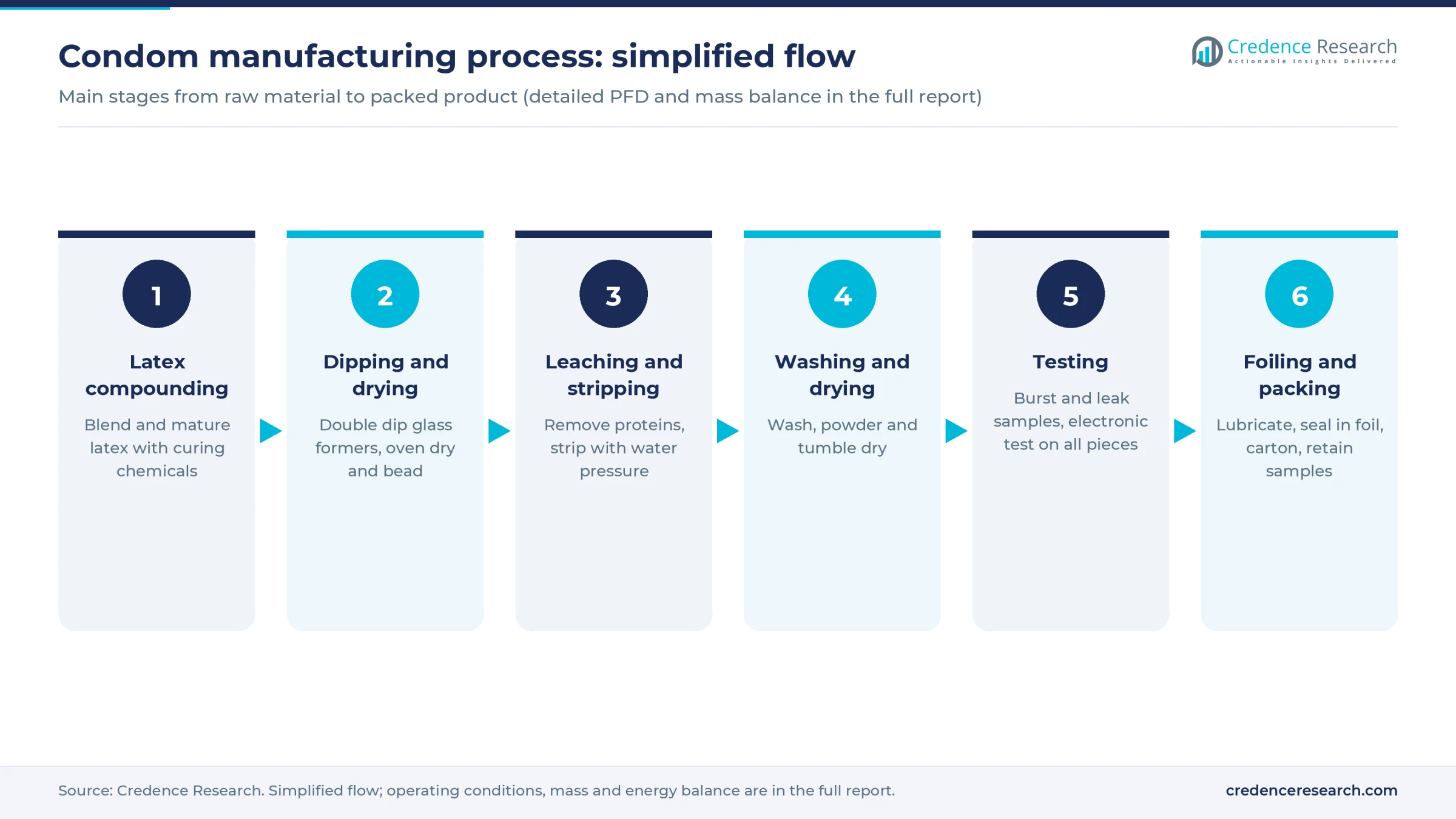
- Compounding. Ammonia-preserved latex concentrate is blended with curing chemicals and matured under controlled conditions, because an unstable compound shows up later as pinholes and thin walls.
- Dipping. Clean glass formers on a moving chain pass through the latex and rotate for an even coat. They dry in a hot oven, cool under blowers and take a second dip that builds wall thickness.
- Beading and leaching. A station rolls the open end into a ring. Two leaching tanks then remove excess protein and chemicals, which matters for skin safety and for biocompatibility testing.
- Stripping and washing. Water pressure removes the sheaths from the formers. They are washed, treated with powder to stop sticking, and dried in a tumbler.
- Testing. Random samples from each batch face burst, leak and electrical tests. At Karex's Port Klang plant, batches were sampled every two hours in a 2019 account, and a burst test had to reach at least 18 liters of air. Every piece that passes then runs over an electronic mandrel that rejects pinholes and thin spots.
- Foiling and packing. A conveyor doses lubricant and any flavor, seals each piece between two foil sheets, and cuts and cartons the foils. Lot retention samples are stored, for five years at Port Klang.
Yield is the main technical risk, as a piece rejected at the mandrel has already consumed latex, heat and labor. Thinner premium products narrow the margin for error, so a line able to run them needs tighter control. HLL Lifecare, for example, tied its recent machine upgrade directly to ultrathin and textured output.
Condom plant setup cost
Setup cost for a plant rated at 1 billion pieces a year is estimated at USD 7–24 million, excluding working capital. The range comes from two disclosed projects rather than from a standard budget, and it is wide because they differ. At the low end, Anondita Medicare told India's National Stock Exchange in January 2026 that about 1,360 million pieces a year of new capacity would cost about 750 million rupees. That is about USD 8.3 million at an assumed 90 rupees per dollar, or about USD 7 million when scaled down to this size.
At the high end, Thai Nippon Rubber planned a new Chonburi factory in 2024 for USD 14.7–23.5 million to lift capacity by about 1 billion pieces. Neither source gives a full cost breakdown, and neither says whether it covers every item, so the shares below are assumed.
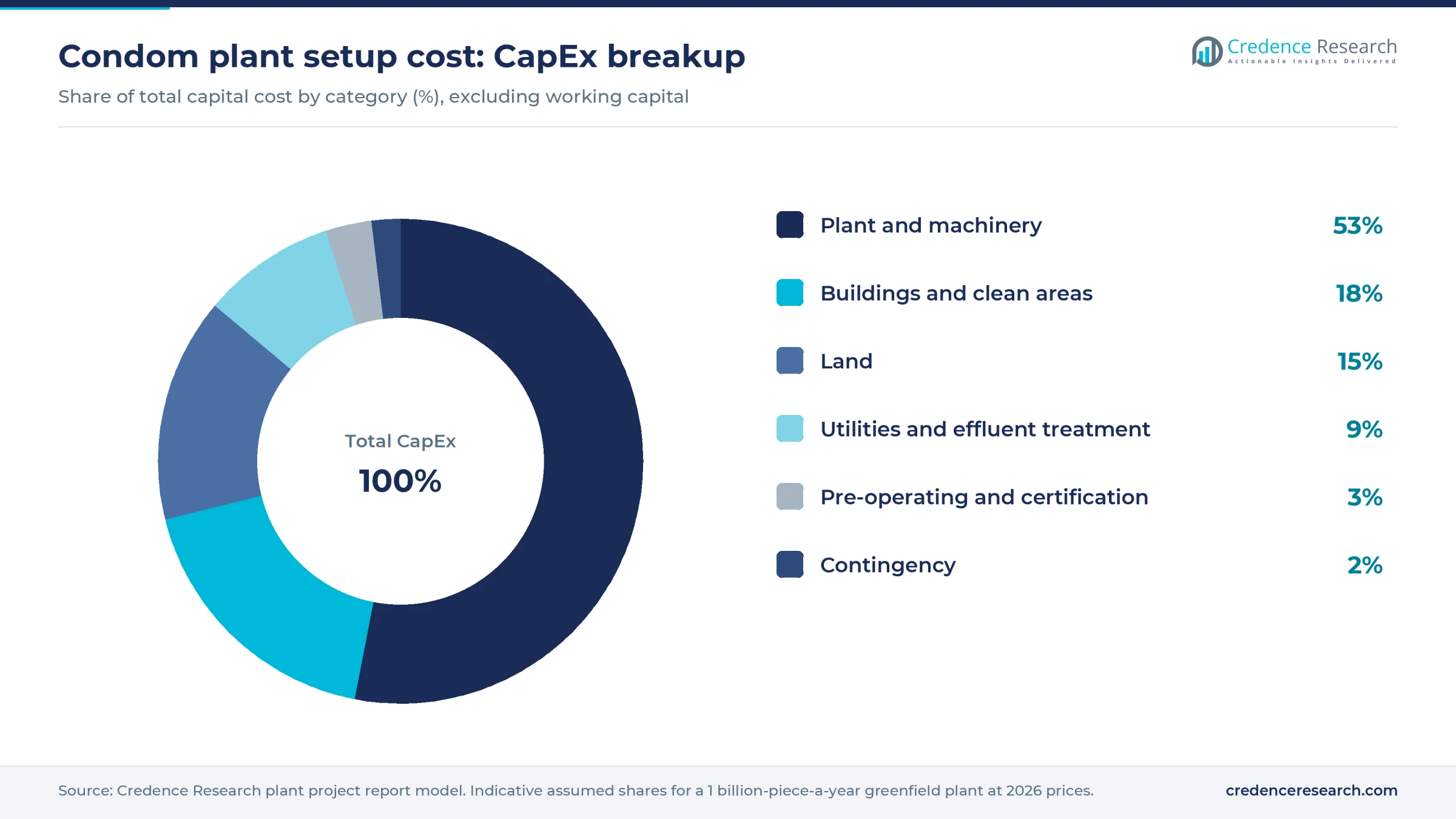
Land shows how one row is built. The Thai plan used a plot of 16 rai, about 2.5 hectares, which is a reasonable footprint here. An assumed land rate of USD 30–150 per square meter gives USD 750,000–3.75 million, with leased Asian industrial parks at the low end and U.S. or EU sites at the high end.
Machinery carries the largest share and the widest spread, since dipping lines, electronic testers and foil packers can be sourced from regional builders or from higher-specification suppliers. Line design also decides whether a later move into thin or nitrile products is possible without a rebuild.
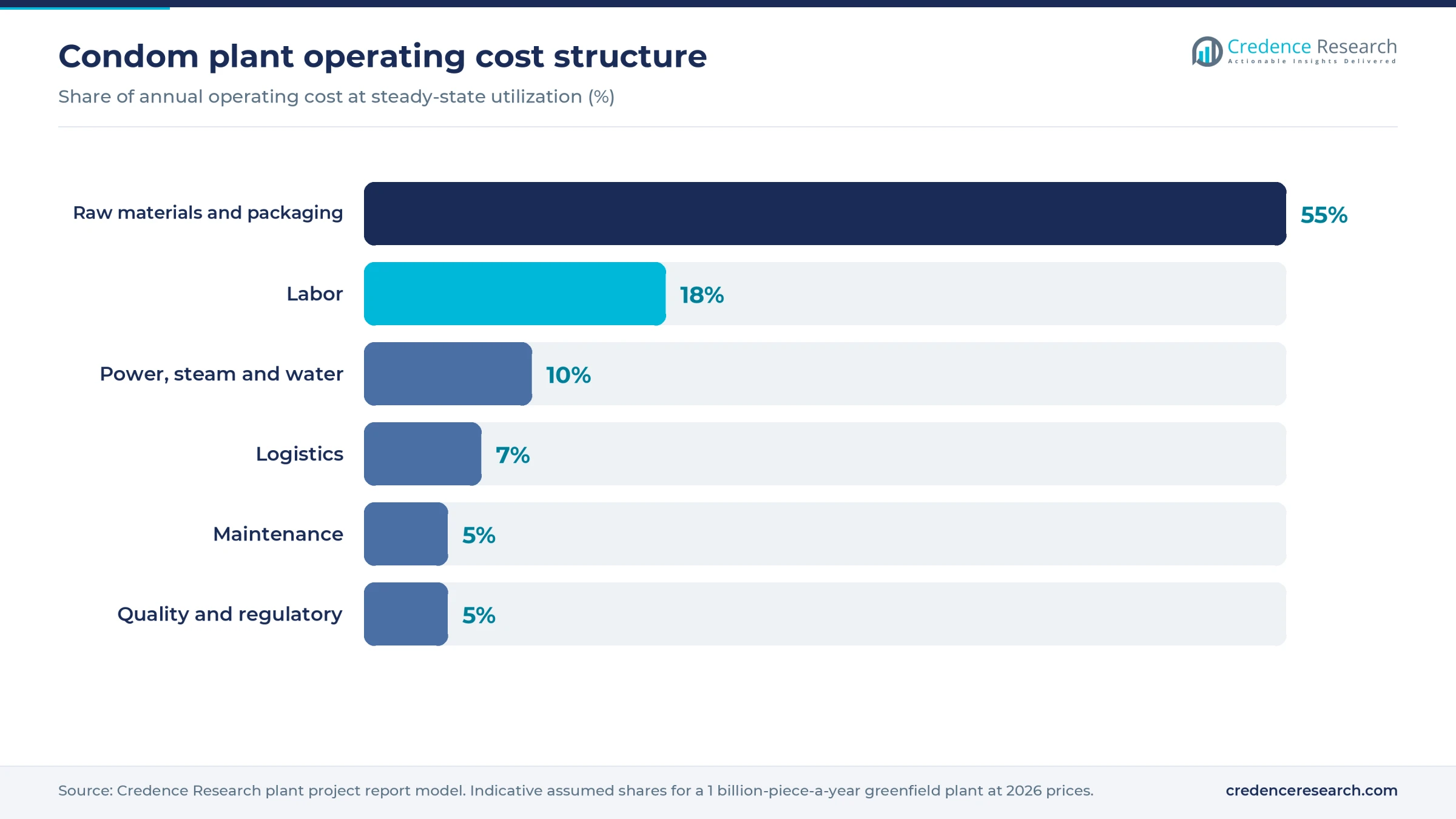
Materials and packaging lead operating cost. Labor stays significant because inspection and packing are harder to automate than dipping, while boilers and ovens make heat a steady expense. All figures can be rebuilt for a specific country or region in the full report, where wages, power and permit costs differ widely.
Machinery and raw materials for a condom plant
The core machinery list covers:
- Latex storage tanks, compounding vessels and maturation systems
- Continuous dipping lines with glass formers, ovens, cooling blowers and beading stations
- Leaching tanks, stripping units, industrial washers and tumble dryers
- Electronic pinhole testing machines with mandrels
- Lubricant dosing, foil sealing, cutting and cartoning equipment
- A quality lab for burst, leak, dimensional and aging tests
- Boilers, chilled water, compressed air and effluent treatment
Natural rubber latex concentrate is the defining input. The Association of Natural Rubber Producing Countries forecast world natural rubber output of about 14.9 million metric tons for 2025. Thailand, Indonesia and Vietnam are major producers, with Malaysia, India, China and Côte d'Ivoire adding supply. Latex concentrate is perishable compared with dry rubber, which favors plants close to Southeast Asian or South Asian processors.
Synthetic lines need different feedstock, namely isoprene rubber latex or nitrile rubber latex, largely from petrochemical supply chains in Asia, Europe and the United States.
Other inputs are silicone oil, curing chemicals, ammonia, powder and aluminum-laminate foil. These matter more than their size suggests. Analyst notes in May and June 2026 attributed about half of Karex's cost of goods to groups of inputs, and the lists differ, naming packaging, chemicals, latex, silicone oil and logistics. A prolonged shock to foil or oil can therefore hit margins even when latex is stable.
Condom business profit margin and ROI
Gross margin is estimated at 22–35%. Prices start from bulk contracts, where the UNFPA 2022 price indicator showed USD 3.83 per gross for standard male condoms, about USD 0.027 a piece. Cupid's disclosed South African award implies a similar figure for 2025–2030. A mixed price of USD 0.030–0.040 is assumed, reflecting tender work plus contract manufacturing, against assumed production costs detailed in the report.
A listed producer supports that range. Karex's margins came under pressure in fiscal 2026, and broker notes put its gross margin between about 29% and 34% over fiscal 2024–2026. Its EBITDA margin fell to 8.7%, which shows how much overhead can absorb.
Payback of 3–7 years rests on 800 million pieces at 80% utilization, assumed annual cash profit of USD 3–5 million and a mid-range USD 12–18 million build, plus about one ramp-up year. At Karex's 8.7% EBITDA margin, the same build would take about 5–10 years before tax. A USD 24 million build on thin tender prices may not repay within 10 years, while a low-cost site with branded or nitrile contracts could beat the band. Utilization is the common trap, as Anondita reported only 46% in fiscal 2025.
| Metric | Value |
|---|---|
| IRR | Available in report |
| NPV | Available in report |
| ROI | Available in report |
| DSCR | Available in report |
How to start a condom business, licenses and approvals
A new entrant needs ordinary industrial permits plus medical device approval, and the second takes the longer time. The usual steps are business registration and tax setup, land use and building permits, an environmental permit covering ammonia handling, air emissions and wastewater, occupational safety and boiler compliance, and export and import registration.
On the product side, plants generally work to ISO 13485 for quality management and ISO 4074 for latex condoms, with ISO 23409 for synthetic types and ISO 10993 biocompatibility tests. Selling into donor tenders usually also requires WHO/UNFPA prequalification, which is granted to a specific manufacturing site, so it cannot simply transfer from another plant.
Examples by market
| Market | Product regulator and route | Site permits |
|---|---|---|
| United States | FDA, Class II device under 21 CFR 884.5300, cleared through a 510(k), plus establishment registration | State environmental air and wastewater permits, OSHA workplace rules |
| European Union | Class IIb under Rule 15 of Annex VIII, Medical Device Regulation 2017/745, with CE marking through a notified body | National industrial and environmental permits |
| India | Medical device manufacturing license under the Medical Devices Rules, 2017, administered by CDSCO and state licensing authorities | State Pollution Control Board consent to establish and operate, factory license |
Key condom manufacturers and recent developments
Global supply is led by Karex in Malaysia, Thai Nippon Rubber in Thailand, and Cupid, HLL Lifecare and TTK Protective Devices in India. UNFPA's December 2023 prequalified list also names Suretex, Innolatex, Dongkuk Vietnam, Winner Guilin Latex and RRT Medical in Mexico. Many of them make products for consumer brands as well as for tenders, so a brand name rarely identifies the factory.
Three recent moves show where the industry is heading:
- April 2026. Malaysian press reported that Karex planned to raise prices by 20–30%, passing on higher input costs as Iran war disruptions strained supply.
- April 2026. HLL Lifecare inaugurated an upgraded three-dip machine at Irapuram for ultrathin and multi-textured condoms, alongside new lubricant capacity.
- March 2026. Cupid told the National Stock Exchange that it is developing a nitrile female condom, and that its expanded plant would run latex and nitrile lines side by side, with about 1.25 billion male and 125 million female condoms a year at full commissioning.
Established producers are spending on synthetic and specialty lines to move away from pure tender pricing, which a new plant should expect to compete against from the start.
What's inside the Condom project report PDF
The report runs to 21 chapters. Open a chapter to see its sections.
1. Preface
2. Scope and Methodology
- 2.1 Objectives of the Study
- 2.2 Stakeholders
- 2.3 Research Methodology
- 2.4 Data Sources and Key Assumptions
3. Executive Summary
- 3.1 Market Snapshot
- 3.2 Project at a Glance (Capacity, CapEx, OpEx)
- 3.3 Key Financial Indicators (IRR, NPV, Payback, Break-even)
- 3.4 Feasibility Verdict
4. Product Overview
- 4.1 Condom Definition and Properties
- 4.2 Grades and Specifications (BIS / ISO / ASTM)
- 4.3 HS Code and Classification
- 4.4 Key Applications
- 4.5 Substitutes
5. Global Condom Market
- 5.1 Market Overview
- 5.2 Historical and Current Market Performance (Volume and Value)
- 5.3 Market Breakup by Grade / Type
- 5.4 Market Breakup by End-Use Industry
- 5.5 Market Breakup by Region
- 5.6 Market Drivers, Restraints and Trends
- 5.7 Value Chain Analysis
- 5.8 Market Forecast
6. Target Country Condom Market Analysis
- 6.1 Demand and Supply Analysis
- 6.2 Installed Capacity vs Demand Gap
- 6.3 Import Dependence
- 6.4 Demand Forecast by End-Use
7. Trade Analysis
- 7.1 Imports by Volume, Value and Country
- 7.2 Exports by Volume, Value and Country
- 7.3 Trade Balance and Opportunities
8. Price Analysis
- 8.1 Historical Condom Price Trends by Region
- 8.2 Raw Material / Feedstock Price Trends and Linkage
- 8.3 Price Forecast
- 8.4 Margins Across the Value Chain
9. Competitive Landscape
- 9.1 Market Structure
- 9.2 Key Players and Installed Capacities
- 9.3 Profiles of Key Players
- 9.4 Recent Developments (Expansions, M&A, New Plants)
10. Manufacturing Process and Technology
- 10.1 Comparison of Technology Routes
- 10.2 Selected Route and Process Flow Diagram
- 10.3 Unit Operations Involved
- 10.4 Chemical Reactions Involved
- 10.5 Mass Balance and Raw Material Requirements
- 10.6 Energy Balance
- 10.7 Quality Assurance Criteria and Technical Tests
- 10.8 By-products and Waste Handling
- 10.9 Technology Licensors / Providers
11. Project Details, Requirements and Costs
- 11.1 Land, Location and Site Development
- 11.1.1 Site Selection Criteria
- 11.1.2 Location Analysis
- 11.1.3 Land Requirement and Costs
- 11.1.4 Site Development Costs
- 11.2 Plant Layout
- 11.2.1 Layout Principles
- 11.2.2 Proposed Layout
- 11.2.3 Factors Influencing Layout
- 11.3 Civil Works and Buildings
- 11.4 Plant Machinery
- 11.4.1 Machinery Requirements and Specifications
- 11.4.2 Machinery Costs
- 11.4.3 Machinery Suppliers
- 11.5 Raw Materials
- 11.5.1 Requirements per Tonne of Output
- 11.5.2 Procurement and Sourcing
- 11.5.3 Costs
- 11.5.4 Suppliers
- 11.6 Packaging
- 11.6.1 Packaging Requirements
- 11.6.2 Packaging Costs
- 11.6.3 Packaging Suppliers
- 11.7 Storage and Material Handling
- 11.8 Transportation Requirements and Costs
- 11.9 Utilities
- 11.9.1 Power Requirements and Costs
- 11.9.2 Water Requirements and Costs
- 11.9.3 Steam, Fuel and Other Utilities
- 11.10 Manpower Requirements and Wages
12. Environment, Health, Safety and Sustainability
- 12.1 Effluent and Emissions Management
- 12.2 Hazard Classification and Safety Measures
- 12.3 Carbon Footprint
- 12.4 Green / Low-Carbon Process Options
13. Regulatory Procedures, Approvals and Certifications
- 13.1 Licences and Registrations
- 13.2 Environmental Clearances
- 13.3 Product Certifications (BIS, REACH, etc.)
- 13.4 Approval Timeline
14. Project Implementation Schedule
15. Project Economics
- 15.1 Capital Cost of the Project
- 15.2 Techno-Economic Parameters
- 15.3 Capacity Utilization and Ramp-up
- 15.4 Product Pricing and Margins
- 15.5 Income Projections
- 15.6 Expenditure Projections
- 15.7 Working Capital Requirement
- 15.8 Taxation
- 15.9 Depreciation
16. Financial Analysis
- 16.1 Projected Profit and Loss Account
- 16.2 Projected Cash Flow Statement
- 16.3 Projected Balance Sheet
- 16.4 Liquidity Analysis
- 16.5 Profitability Analysis (Payback, NPV, IRR, ROI)
- 16.6 Break-even Analysis
- 16.7 Debt Service Coverage Ratio (DSCR)
- 16.8 Sensitivity Analysis
- 16.9 Scenario and Uncertainty Analysis
17. Funding and Incentives
- 17.1 Means of Finance and Debt-Equity Structure
- 17.2 Loans and Financial Assistance
- 17.3 Government Schemes and Subsidies (PLI, State Policies)
18. Risk Assessment
- 18.1 Key Success Factors
- 18.2 Key Risk Factors
- 18.3 Risk Mitigation
19. Strategic Recommendations
20. Case Study of a Successful Venture
21. Appendix
- 21.1 Detailed Assumptions
- 21.2 Abbreviations
- 21.3 List of Tables and Figures
- 21.4 Sources
This page vs. the full report
| Data point | On this page (free) | In the full report |
|---|---|---|
| Total CapEx | One rounded range at one capacity | Exact figure at three capacities with a line-item breakup |
| CapEx breakup | Category shares (%) only | Cost, quantity and supplier for every machine |
| Operating cost | Share of raw materials, utilities and labor | Per-unit cost sheet with each input price and consumption |
| Profitability | Gross margin range and payback band | Exact IRR, NPV, ROI, break-even and DSCR |
| Financial statements | List of what is included | 10-year P&L, cash flow, balance sheet and Excel model |
| Sensitivity | One directional line | Full sensitivity and scenario tables |
| Process | Simplified flow diagram | Detailed process flow, mass and energy balance, operating conditions |
| Machinery | Names of the main machines | Specifications, capacity, cost and supplier list |
| Market | Headline size, growth and global demand | Segment, region, trade and price forecast tables |
| Suppliers and buyers | Supplier types and sourcing hubs | Named suppliers and buyers |
Condom project report: FAQs
How much does it cost to set up a condom plant?
What is the gross margin in condom manufacturing?
What is the payback period for a condom plant?
What raw materials does a condom plant need?
What approvals are needed to sell condoms?
Who buys condoms from a new manufacturer?
Is a nitrile or synthetic line worth adding to a condom plant?

About the analyst
Dr. Pankaj Sharma, Healthcare Domain Expert & Medical Advisor
Dr. Pankaj Sharma is an anesthesiologist and healthcare strategic advisor who reviews epidemiological models, therapeutic market assessments and clinical assumptions at Credence Research Inc, so that quantitative forecasts reflect clinical realities.
Related market research
- Luxury Condoms Market Share, Growth, Share and Forecast 2032
- Non Latex Condom Market Size, Growth and Forecast 2032
- Contraceptives Drugs and Devices Market Size, Share, Growth and Forecast, 2025-2035
- Isoprene Rubber Latex Market Size, Growth and Forecast 2032
- Nitrile Butadiene Rubber Latex Market Size, Growth and Forecast 2032
- Latex Medical Disposables Market Industry Size and Forecast 2025
More plant project reports
- Egg Tray Manufacturing Plant Project Report (DPR) 2026
- Recycled Copper Manufacturing Plant Project Report (DPR) 2026
- Medical Oxygen Manufacturing Plant Project Report (DPR) 2026
- Engine Oil Manufacturing Plant Project Report (DPR) 2026
- Garlic Powder Manufacturing Plant Project Report (DPR) 2026
- Essential Oil Manufacturing Plant Project Report (DPR) 2026