
Market Overview
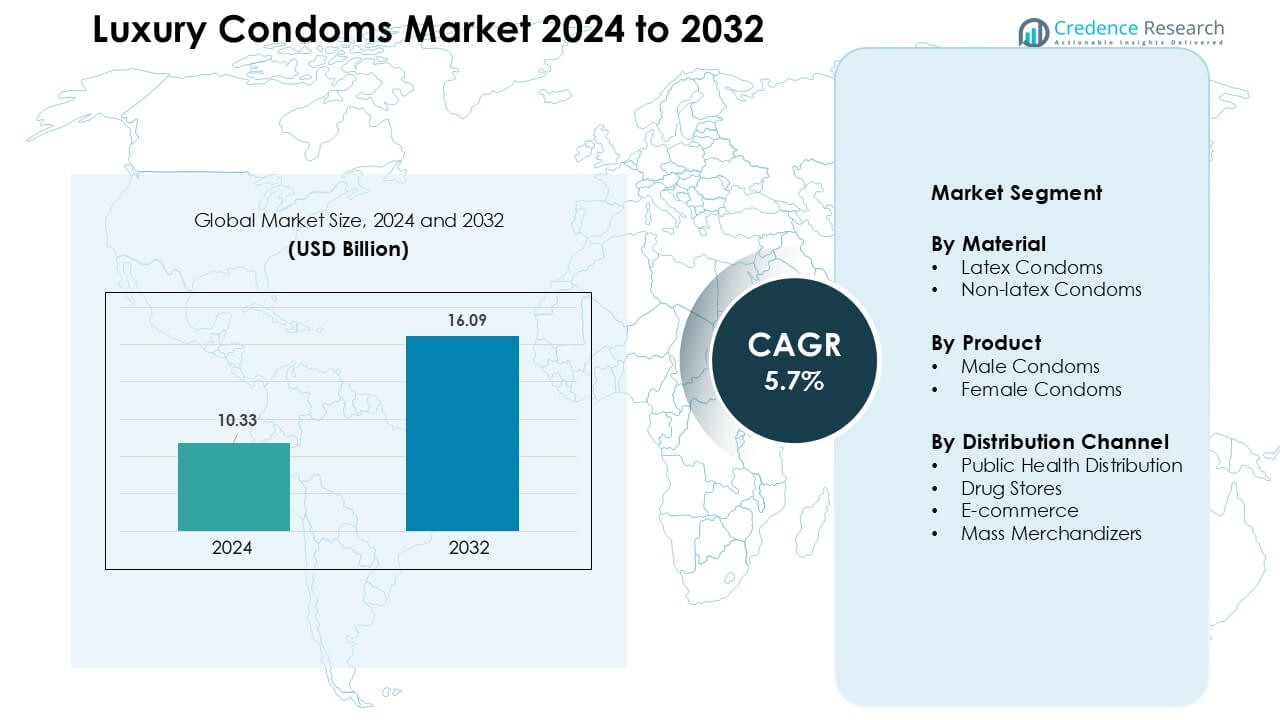
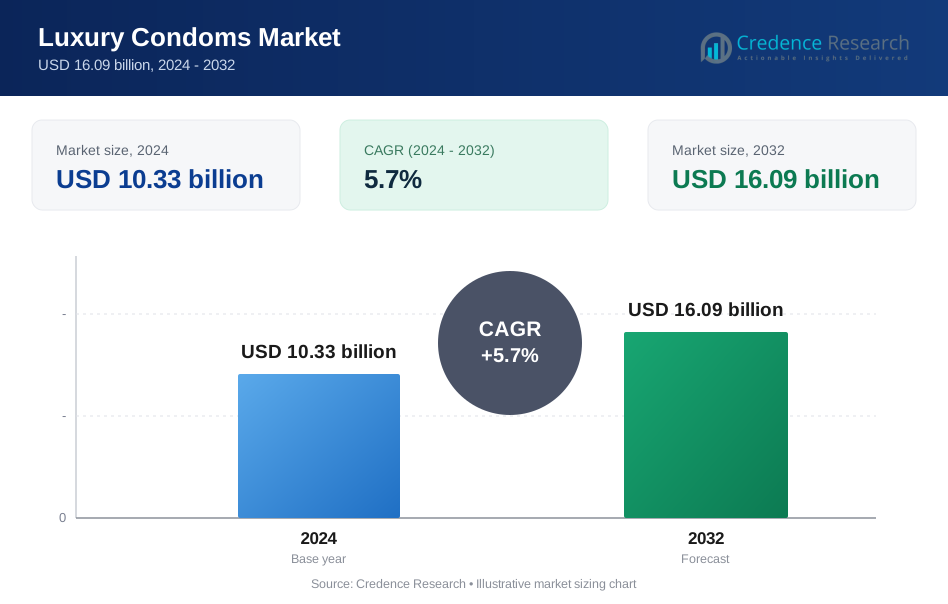
Luxury Condoms Market was valued at USD 10.33 billion in 2024 and is anticipated to reach USD 16.09 billion by 2032, growing at a CAGR of 5.7% during the forecast period.
| REPORT ATTRIBUTE | DETAILS |
|---|---|
| Historical Period | 2020-2023 |
| Base Year | 2024 |
| Forecast Period | 2025-2032 |
| Luxury Condoms Market Size 2024 | USD 10.33 Billion |
| Luxury Condoms Market, CAGR | 5.7% |
| Luxury Condoms Market Size 2032 | USD 16.09 Billion |
The luxury condoms market is led by key players such as Reckitt Benckiser Group PLC, Church & Dwight Co., Inc., Cupid Limited, Okamoto Industries, Inc., Veru Inc., Karex Berhad, MAYER LABORATORIES, INC., Lifestyles, LELO iAB, and FUJILATEX CO., LTD. These companies compete through ultra-thin designs, premium materials, and advanced lubrication technologies that enhance comfort and intimacy. Strong branding, refined packaging, and wide e-commerce presence help these brands capture upscale consumers seeking higher performance. North America emerged as the leading region in 2024 with about 36% share, supported by strong sexual wellness awareness, broad product availability, and high adoption of premium non-latex and sensation-enhancing variants.
Market Insights
- The luxury condoms market reached USD 33 billion in 2024 and is projected to hit USD 16.09 billion by 2032, growing at a CAGR of 5.7%.
- Demand rises as buyers prefer ultra-thin, hypoallergenic, and premium-feel condoms that improve comfort and intimacy, driving steady adoption across urban markets.
- Non-latex materials, designer packaging, and online subscription models shape key trends, while brands promote inclusive wellness and data-driven personalization.
- Leading players compete through fit innovation, advanced lubrication, and strong e-commerce visibility, with Reckitt Benckiser Group PLC and Okamoto Industries, Inc. holding strong positions.
- North America led the market with about 36% share in 2024, while latex held the dominant material share and male condoms accounted for the largest product segment.
Market Segmentation Analysis:
By Material
Latex condoms led the material segment in 2024 with an estimated share near 72%. Latex held a strong lead because this material offers high elasticity, strong protection, and wide global availability. Luxury brands used premium latex grades to add softness, odor-reduction, and ultra-thin designs. Non-latex options grew fast as buyers with latex allergies preferred polyisoprene and polyurethane. Demand also increased as non-latex types offered enhanced heat transfer and a more natural feel. Growth stayed steady across both materials due to rising awareness and premium positioning.
- For instance, a renowned condom brand introduced a polyurethane-based line, such as Okamoto 0.02 or Trojan Supra BareSkin, that emphasized heat transfer and thinness, marketing it as one of the thinnest non-latex condoms among major brands.
By Product
Male condoms dominated the product segment in 2024 with close to 89% share. Their dominance came from broad acceptance, easy use, and a wider range of luxury variants. Premium brands pushed ultra-thin, ribbed, flavored, and extra-lubricated options that improved user comfort. Female condoms expanded at a moderate pace as governments promoted inclusive protection choices. However, adoption remained lower due to higher price, limited availability, and lower familiarity among new buyers. Market growth across both products rose as sexual wellness brands promoted safety and sensation together.
- For instance, historically procurement data from a global health agency shows that when distributing male and female condoms together, the ratio was often heavily skewed: for one female condom procured, 37 male condoms were procured in the same program (489 million male vs 13 million female).
By Distribution Channel
Drug stores led the distribution channel segment in 2024 with an estimated 44% share. Buyers trusted pharmacies for safe storage, authenticity, and access to premium brands. E-commerce grew at a rapid pace because online platforms offer privacy, bulk deals, and wide product choice. Public health distribution continued to serve cost-sensitive users but held a smaller share in luxury formats. Mass merchandizers showed steady demand as retail chains expanded wellness aisles. Growth across all channels increased as brands adopted discreet packaging and subscription-based online delivery.
Key Growth Drivers
Rising Demand for Premium Sexual Wellness Products
Growing interest in upscale sexual wellness products drives strong demand in the luxury condoms market. Young adults prefer high-quality materials, smoother finishes, and enhanced comfort to improve intimacy. Consumers also seek advanced sensations, ultra-thin designs, and innovative lubricants that add a premium feel. Many brands highlight texture refinement and natural-fit engineering to enhance user confidence. Rising awareness of sexual health encourages buyers to choose reliable protection with a more refined experience. Luxury positioning shapes strong brand loyalty because shoppers look for trusted names that balance pleasure and safety. This shift expands market penetration in urban areas where disposable income is rising, and digital marketing helps premium offerings reach wider audiences.
- For instance, ultra-thin and textured condoms, often positioned as premium products, have seen a surge in demand because they offer enhanced sensation and maintain the same high level of safety and protection as standard condoms due to advanced material science and rigorous testing.
Product Innovation and Material Advancements
Innovation in condom materials supports growth because buyers want better feel, durability, and comfort. Latex refinement reduces odor and increases softness, making premium variants more appealing. Polyisoprene and polyurethane options attract users with latex allergies while offering improved heat transfer. Manufacturers invest in thinner films that maintain strength while delivering a natural experience. Premium lubricants, including long-lasting and warming formulas, enhance product value. Technology-driven shaping improves fit, reducing slippage and boosting confidence during use. Brands also use sleek packaging and design-focused marketing to elevate product image. These enhancements help luxury condoms stand apart from mainstream variants, expanding demand among couples seeking superior performance.
- For instance, natural-rubber latex retains very high elasticity latex condoms can stretch up to 800% of their original size before breaking, which underpins their durability and snug fit even when made thinner for premium variants.
Expanding E-commerce Adoption and Privacy Preferences
Online purchasing fuels market growth because many users prefer discreet shopping. E-commerce platforms offer broad product ranges, subscription packs, and curated premium selections. Digital channels help brands showcase benefits through detailed descriptions and user reviews. Privacy remains a major driver, as buyers avoid social hesitation linked with in-store purchases. Fast delivery and secure packaging strengthen user trust. Online promotions encourage trial of higher-end variants, supporting upgrades from basic to premium choices. Digital campaigns on wellness platforms and social media broaden reach among educated urban consumers. As internet access rises globally, e-commerce continues to shape purchasing decisions for luxury condoms.
Key Trends & Opportunities
Shift Toward Non-latex and Hypoallergenic Options
A key trend involves rising interest in non-latex condoms, driven by comfort, allergy concerns, and enhanced sensation. Polyisoprene variants offer softness and elasticity similar to latex while eliminating irritation. Polyurethane types attract buyers seeking thinness and stronger heat transmission. Brands highlight hypoallergenic features to appeal to sensitive-skin users. This shift supports broader acceptance of alternative materials in premium categories. Growing awareness on safe-sex practices combined with comfort-focused choices encourages more users to adopt non-latex options.
- For instance, Latex condoms still dominate the market, accounting for around 80% to 90% of sales in North America in 2023.
Premiumization Through Design, Packaging, and Branding
Packaging and design trends push luxury condoms toward a lifestyle product image. Brands use minimalistic boxes, matte finishes, and stylish color schemes to target young adults. Premium packaging signals quality and helps products stand out in digital and retail channels. Some companies use fragrance-free latex, soft-touch texture, and tailored shapes to enhance experience. Effective branding promotes trust, leading buyers to treat condoms as a wellness accessory rather than a basic need.
- For instance, Durex Invisible condoms are generally sold in standard Durex packaging (which can be discreet, use premium accents, and minimal text depending on the region/campaign), and marketing campaigns often focus on themes of heightened intimacy and removing barriers, which appeals to younger, urban demographics like millennials.
Growth in Female-Focused Sexual Wellness Solutions
Female-centric wellness trends create new opportunities for luxury condom makers. Awareness campaigns highlight shared responsibility in safe sex, supporting interest in premium female condoms. Improved materials and better ergonomics encourage adoption. Brands that cater to women through inclusive marketing build stronger connections with modern buyers. This segment remains underpenetrated, offering room for innovation and long-term expansion.
Key Challenges
Limited Awareness and Preference for Low-cost Alternatives
A major challenge is low awareness of premium benefits in price-sensitive regions. Many buyers choose basic condoms because affordability remains the top priority. Luxury variants cost more due to advanced materials and high-end packaging, limiting mass adoption. In emerging markets, sexual wellness education remains uneven, slowing uptake of premium options. Retailers also prioritize high-volume, low-cost products, reducing visibility of luxury options. This price gap can restrict market expansion outside urban centers.
Cultural Stigma and Purchase Discomfort
Social stigma around condom purchases affects market growth in several regions. Many buyers avoid in-store purchases due to fear of judgment, limiting the reach of premium products that rely on visibility. Cultural discomfort around open discussions of intimacy slows adoption of newer designs and female condoms. Although e-commerce helps reduce hesitation, awareness gaps remain. Stigma also affects brand marketing, pushing companies to rely on discreet advertising rather than bold campaigns. This reduces market penetration in conservative areas.
Regional Analysis
North America
North America led the luxury condoms market in 2024 with an estimated 36% share. Strong demand came from high sexual wellness awareness, wide access to premium brands, and strong e-commerce penetration. Consumers preferred ultra-thin, hypoallergenic, and sensation-enhancing variants supported by strong brand marketing. Retail pharmacies and online platforms expanded premium assortments, improving visibility. Rising emphasis on safe intimacy among young adults further supported market growth. The region benefited from early adoption of non-latex materials, subscription models, and design-focused packaging that strengthened the shift toward luxury products.
Europe
Europe held about 28% share in 2024, driven by high sexual health awareness and strong acceptance of premium wellness products. Countries in Western Europe showed high adoption of non-latex and ultra-thin variants due to preference for comfort and refined design. Pharmacies and specialty wellness stores pushed premium assortments, while online channels gained traction through discreet delivery. Marketing efforts focused on sustainability and fragrance-free latex options, appealing to eco-aware buyers. Supportive regulations and open social attitudes allowed brands to promote premium intimacy solutions more effectively across major markets.
Asia Pacific
Asia Pacific accounted for roughly 24% share in 2024 and grew fastest due to rising disposable income and expanding urban populations. Young consumers drove demand for luxury condoms with enhanced lubrication, softer materials, and aesthetic packaging. E-commerce platforms improved product access, especially in India, China, and Southeast Asia. Increased sexual wellness awareness, wider retail penetration, and brand collaborations with influencers supported growth. Although penetration varied across countries, premium offerings gained traction as buyers shifted from low-cost basic condoms to performance-driven and sensation-focused variants.
Latin America
Latin America represented nearly 7% share in 2024, supported by improving awareness and rising interest in premium wellness products. Urban consumers selected ultra-thin and textured variants as global brands expanded distribution in major cities. Growth remained uneven because economic constraints limited affordability in several markets. E-commerce adoption improved access to luxury formats through discreet delivery. Marketing focused on shared responsibility in safe intimacy helped increase demand, especially among younger demographics. Despite challenges, premium condom adoption continued to rise with better product visibility and expanding retail networks.
Middle East & Africa
Middle East & Africa held close to 5% share in 2024, reflecting gradual adoption of premium condoms in select urban regions. Rising awareness programs and improved retail availability supported a slow but steady shift toward high-quality products. Cultural sensitivity restricted open promotion, but online platforms enabled discreet purchases. Premium non-latex and ultra-thin variants gained interest among educated urban consumers. Growth remained concentrated in Gulf markets, where higher income levels allowed broader acceptance of luxury wellness products. Continued digital expansion is expected to strengthen market reach across key urban centers.
Market Segmentations:
By Material
- Latex Condoms
- Non-latex Condoms
By Product
- Male Condoms
- Female Condoms
By Distribution Channel
- Public Health Distribution
- Drug Stores
- E-commerce
- Mass Merchandizers
By Geography
- North America
- U.S.
- Canada
- Mexico
- Europe
- Germany
- France
- U.K.
- Italy
- Spain
- Rest of Europe
- Asia Pacific
- China
- Japan
- India
- South Korea
- South-east Asia
- Rest of Asia Pacific
- Latin America
- Brazil
- Argentina
- Rest of Latin America
- Middle East & Africa
- GCC Countries
- South Africa
- Rest of the Middle East and Africa
Competitive Landscape
The luxury condoms market features leading companies such as Reckitt Benckiser Group PLC, Church & Dwight Co., Inc., Cupid Limited, Okamoto Industries, Inc., Veru Inc., Karex Berhad, MAYER LABORATORIES, INC., Lifestyles, LELO iAB, and FUJILATEX CO., LTD. These companies compete through premium materials, ultra-thin designs, and advanced lubrication technologies that enhance comfort and sensation. Many brands focus on non-latex variants to meet growing demand for hypoallergenic options. Strong packaging design, discreet branding, and aesthetic appeal help premium products stand out across retail and online channels. Firms strengthen digital engagement through influencer promotions, wellness campaigns, and targeted ads. Competitive strategies include expanding e-commerce presence, launching subscription models, and improving distribution in urban markets. Leading players also invest in R&D to deliver better fit, refined textures, and enhanced safety, increasing brand loyalty. Regional expansion and partnerships with pharmacies, wellness platforms, and specialty stores further support market leadership.
Key Player Analysis
- Reckitt Benckiser Group PLC
- Church & Dwight Co., Inc.
- Cupid Limited
- Okamoto Industries, Inc.
- Veru Inc.
- Karex Berhad
- MAYER LABORATORIES, INC.
- Lifestyles
- LELO iAB
- FUJILATEX CO., LTD
Recent Developments
- In December 2024, Veru Inc. Announced the sale of its FC2 Female Condom® (internal/female condom) business to clients managed by Riva Ridge Capital Management. This transaction marked Veru’s exit from the female-condom commercial business as the company refocused on its pharmaceutical pipeline.
- In February 2024, Reckitt Benckiser Group PLC (Durex) Durex (Reckitt) has pushed new product innovations and marketing to move beyond basic condoms into premium/experience-led formats for example product launches targeting female moisturization/pleasure (Hyaluronic-acid–coated/ “anti-ageing” variants) and expansion of Durex’s presence via China livestreaming/e-commerce to reach premium buyers. These moves are positioned to lift Durex’s share of higher-priced/premium condom segments.
Report Coverage
The research report offers an in-depth analysis based on Material, Product, Distribution Channel and Geography. It details leading market players, providing an overview of their business, product offerings, investments, revenue streams, and key applications. Additionally, the report includes insights into the competitive environment, SWOT analysis, current market trends, as well as the primary drivers and constraints. Furthermore, it discusses various factors that have driven market expansion in recent years. The report also explores market dynamics, regulatory scenarios, and technological advancements that are shaping the industry. It assesses the impact of external factors and global economic changes on market growth. Lastly, it provides strategic recommendations for new entrants and established companies to navigate the complexities of the market.
Future Outlook
- Premium materials such as refined latex and polyisoprene will gain wider adoption.
- Ultra-thin and natural-feel designs will become the core focus for new launches.
- E-commerce subscriptions will expand as buyers prefer discreet recurring purchases.
- Non-latex condoms will rise faster due to allergy awareness and comfort demand.
- Designer packaging and sustainability features will attract young urban consumers.
- Digital marketing and influencer promotions will shape brand visibility across regions.
- Female-focused condom innovations will increase as inclusive wellness gains momentum.
- AI-driven personalization will guide product recommendations and sizing support.
- Retail pharmacies will expand premium assortments to meet growing demand.
- Emerging markets will see higher adoption as awareness and income levels improve.
Request a Free Sample
Fill in your details and we'll send you a free sample report.
- Sample data tables & charts
- Research methodology
Need a Custom Version of This Report?
Tailor the scope, geography, or segments to your exact requirements.
- Custom geography or segment scope
- Direct access to our analyst team
Frequently Asked Questions
What is the current market size for Luxury Condoms Market, and what is its projected size in 2032?
At what Compound Annual Growth Rate is Luxury Condoms Market projected to grow between 2024 and 2032?
Which Luxury Condoms Market segment held the largest share in 2024?
What are the primary factors fueling the growth of Luxury Condoms Market?
Who are the leading companies in Luxury Condoms Market?
Which region commanded the largest share of Luxury Condoms Market?
Table of Content
Chapter 1 Market Segmentation
- 1.1 Segmentation Framework
- 1.1.1 Product and Service Classification
- 1.1.2 Application and End-Use Classification
- 1.1.3 Technology and Solution Classification
- 1.1.4 Customer and Distribution Channel Classification
- 1.1.5 Geographic Segmentation
- 1.1.6 Market Segment Definitions and Boundaries
Chapter 2 Introduction
- 2.1 Report Objectives and Scope
- 2.2 Product Definition and Industry Terminology
- 2.3 Market Inclusions and Exclusions
- 2.4 Research Process
- 2.4.1 Primary Research and Expert Interviews
- 2.4.2 Secondary Research and Source Review
- 2.4.3 Top-Down and Bottom-Up Estimation
- 2.4.4 Data Triangulation and Verification
- 2.5 Market Size Measurement Basis
- 2.5.1 2024: USD 10.33 billion → 2032: USD 16.09 billion
- 2.6 Historical and Forecast Reference Periods
- 2.6.1 Base Year: 2024
- 2.6.2 Forecast Period: 2024-2032
- 2.7 Research Assumptions and Limitations
Chapter 3 Executive Summary
- 3.1 Market Snapshot and Key Findings
- 3.2 Base-Year Market Size, 2024
- 3.3 Forecast Market Size, 2032
- 3.4 Revenue and Volume Growth Outlook
- 3.5 Key Demand and Supply Indicators
- 3.6 Leading Market Segments
- 3.7 Fastest-Growing Market Opportunities
- 3.8 Regional Performance Highlights
- 3.9 Technology and Industry Transformation
- 3.10 Competitive Landscape Summary
- 3.11 Analyst View and Strategic Implications
Chapter 4 Global Luxury Condoms Market Trends and Developments
- 4.1 Historical Industry Development
- 4.2 Recent Market Trends and Developments
- 4.3 Demand and Customer Behavior Trends
- 4.4 Technology and Product Innovation
- 4.5 Artificial Intelligence, Automation and Digitalization
- 4.6 Local Manufacturing and Supply Chain Realignment
- 4.7 Industry Partnerships, Mergers and Acquisitions
- 4.8 Sustainability and Circular Economy Developments
- 4.9 Government and Private Sector Investment Trends
- 4.10 Emerging Business Models and Commercialization
- 4.11 Industry Developments and Announcements
Chapter 5 Global Luxury Condoms Market Production, Supply and Demand Analysis
- 5.1 Demand Trend and Consumption Analysis
- 5.2 Demand Forecast, 2024-2032
- 5.3 Production and Output Trend
- 5.4 Production and Output Forecast, 2024-2032
- 5.5 Installed Capacity and Capacity Utilization
- 5.6 Company-Wise Production Plants and Statistics
- 5.6.1 Installed Production Capacity
- 5.6.2 Actual Production
- 5.6.3 Planned Capacity and Expansion Targets
- 5.7 Supply Chain Structure and Procurement Trends
- 5.8 Supply-Demand Gap and Bottlenecks
- 5.9 Import Dependence and Sourcing Structure
- 5.10 Contract Manufacturing and Outsourcing
- 5.11 Regional Supply and Demand Concentration
Chapter 6 Global Luxury Condoms Market Pricing Analysis
- 6.1 Pricing Structure and Measurement
- 6.2 Historical Pricing Trends
- 6.3 Pricing Outlook, 2024-2032
- 6.4 Average Selling Price and Unit Economics
- 6.5 Pricing by Product and Market Segment
- 6.6 Geographic Pricing Differences
- 6.7 Key Input, Energy, Labor and Logistics Costs
- 6.8 Contract Pricing and Purchasing Models
- 6.9 Pricing Sensitivity and Competitive Positioning
- 6.10 Price, Margin and Profitability Implications
Chapter 7 Global Luxury Condoms Market Dynamics
- 7.1 Market Growth Drivers
- 7.1.1 Demand-Side Drivers
- 7.1.2 Technology and Innovation Drivers
- 7.1.3 Infrastructure and Investment Drivers
- 7.1.4 Regulatory and Policy Drivers
- 7.2 Market Restraints
- 7.2.1 Cost and Affordability Constraints
- 7.2.2 Technology and Adoption Barriers
- 7.2.3 Supply Chain and Operational Constraints
- 7.3 Market Challenges
- 7.3.1 Competitive Pressure and Margin Erosion
- 7.3.2 Skills, Infrastructure and Implementation Gaps
- 7.4 Emerging Market Opportunities
- 7.5 Market Dynamics Impact and Time-Horizon Assessment
Chapter 8 Global Luxury Condoms Value Chain Analysis
- 8.1 Industry Value Chain Overview
- 8.2 Upstream Suppliers and Critical Inputs
- 8.3 Technology and Component Providers
- 8.4 Manufacturing or Service Delivery
- 8.5 Distribution, Channel Partners and Integrators
- 8.6 Downstream Applications and End Users
- 8.7 Value Addition and Profit Pools
- 8.8 Vertical Integration and Outsourcing
- 8.9 Supplier Concentration and Risk
- 8.10 Supply Chain Localization and Resilience
Chapter 9 Global Luxury Condoms Market Regulations and Policies
- 9.1 Relevant Laws, Standards and Compliance Frameworks
- 9.2 Product, Service, Safety and Quality Requirements
- 9.3 Government Policies, Incentives and Subsidies
- 9.4 Imports, Exports and Trade Barriers
- 9.5 Public Procurement and Local Content Requirements
- 9.6 Environmental and Sustainability Compliance
- 9.7 Upcoming Policy Changes and Market Implications
Chapter 10 Global Luxury Condoms Market Hotspots and Opportunities
- 10.1 Market Opportunity Mapping and Growth Hotspots
- 10.2 High-Growth Applications and Customer Groups
- 10.3 Underserved Markets and White-Space Opportunities
- 10.4 Emerging Technology and Product Opportunities
- 10.5 New Capacity and Investment Hotspots
- 10.6 Market Entry and Expansion Opportunities
- 10.7 Distribution and Partnership Opportunities
- 10.8 Near-Term and Long-Term Commercial Potential
- 10.9 Opportunity Attractiveness and Execution Risks
Chapter 11 Global Luxury Condoms Market Outlook, 2024-2032
- 11.1 Market Size and Analysis
- 11.1.1 Revenue (Market Measurement: 2024: USD 10.33 billion → 2032: USD 16.09 billion)
- 11.1.2 Market Volume and Quantity Sold
- 11.1.3 Historical Market Size
- 11.1.4 Base-Year Market Size, 2024
- 11.2 Market Forecast, 2024-2032
- 11.2.1 Revenue Forecast to 2032
- 11.2.2 Volume Forecast to 2032
- 11.2.3 CAGR and Year-on-Year Growth
- 11.2.4 Incremental Revenue Opportunity
- 11.3 Forecast Assumptions and Scenario Analysis
- 11.3.1 Base-Case Forecast
- 11.3.2 Optimistic and Conservative Scenarios
- 11.3.3 Technology, Pricing and Policy Sensitivities
- 11.4 Market Attractiveness and Growth Outlook
Chapter 12 Global Luxury Condoms Market Segmentation and Outlook
- 12.1 Segmentation Summary and Market Shares, 2024
- 12.2 Largest and Fastest-Growing Segments
- 12.3 Segment Growth Comparison
- 12.4 Segment Attractiveness and Priority Matrix
Chapter 13 Global Luxury Condoms Geographic Market Outlook, 2024-2032
- 13.1 Regional Market Size and Share, 2024
- 13.2 Regional Market Forecast, 2024-2032
- 13.3 Regional Pricing, Production and Demand Differences
- 13.4 North America
- 13.4.1 United States
- 13.4.2 Canada
- 13.4.3 Mexico
- 13.5 Europe
- 13.5.1 Germany
- 13.5.2 France
- 13.5.3 Italy
- 13.5.4 United Kingdom
- 13.5.5 Spain
- 13.5.6 Poland
- 13.5.7 Russia
- 13.5.8 Netherlands
- 13.5.9 Belgium
- 13.5.10 Sweden
- 13.5.11 Denmark
- 13.5.12 Norway
- 13.5.13 Rest of Europe
- 13.6 Asia Pacific
- 13.6.1 China
- 13.6.2 India
- 13.6.3 Japan
- 13.6.4 South Korea
- 13.6.5 Thailand
- 13.6.6 Indonesia
- 13.6.7 Vietnam
- 13.6.8 Malaysia
- 13.6.9 Australia
- 13.6.10 Rest of Asia Pacific
- 13.7 Latin America
- 13.7.1 Brazil
- 13.7.2 Argentina
- 13.7.3 Colombia
- 13.7.4 Chile
- 13.7.5 Rest of Latin America
- 13.8 Middle East
- 13.8.1 Saudi Arabia
- 13.8.2 United Arab Emirates
- 13.8.3 Turkey
- 13.8.4 Israel
- 13.8.5 Iran
- 13.8.6 Rest of the Middle East
- 13.9 Africa
- 13.9.1 South Africa
- 13.9.2 Egypt
- 13.9.3 Nigeria
- 13.9.4 Morocco
- 13.9.5 Rest of Africa
- 13.10 Regional Investment, Policy and Supply Chain Differences
- 13.11 Regional Competitive Landscape
- 13.12 Geographic Growth Hotspots
Chapter 14 Global Luxury Condoms Technology, Innovation and Sustainability Outlook
- 14.1 Technology Landscape and Maturity
- 14.2 Product, Process and Service Innovation
- 14.3 AI, Automation and Digital Tools in the Industry
- 14.4 Technology Adoption and Performance Benchmarking
- 14.5 Innovation Pipeline and R&D Investment
- 14.6 Patent and Intellectual Property Trends
- 14.7 Energy Efficiency and Resource Management
- 14.8 Sustainability, Recycling and Circularity
- 14.9 Technology Roadmap, 2024-2032
- 14.10 Risks of Obsolescence and Technology Substitution
Chapter 15 Global Luxury Condoms Market Key Strategic Imperatives
- 15.1 Growth and Market Entry Priorities
- 15.2 High-Return Products and Segments
- 15.3 Pricing, Profitability and Cost Optimization
- 15.4 Technology Investment and Product Differentiation
- 15.5 Supply Chain Localization and Resilience
- 15.6 Distribution and Customer Acquisition
- 15.7 Partnership, Acquisition and Capacity Strategy
- 15.8 Regional Expansion Priorities
- 15.9 Short-, Medium- and Long-Term Actions
Chapter 16 Competition Outlook
- 16.1 Industry Competition Characteristics
- 16.2 Market Structure and Concentration
- 16.3 Market Share and Competitive Positioning, 2024
- 16.4 Company-Wise Revenue and Product Benchmarking
- 16.5 Production and Service Capacity Benchmarking
- 16.6 Technology, Pricing and Differentiation
- 16.7 Regional Footprint and Distribution Strength
- 16.8 Mergers, Acquisitions and Strategic Alliances
- 16.9 New Entrants and Competitive Threats
- 16.10 Porter's Five Forces and Industry Attractiveness
- 16.11 Competitive Outlook, 2024-2032
Chapter 17 Company Profiles
- 17.1 Company Coverage and Selection Criteria
- 17.2 Leading Market Participants – Standard Profile Structure
- 17.2.1 Business Description
- 17.2.2 Company Ownership and Geographic Presence
- 17.2.3 Product and Service Portfolio
- 17.2.4 Manufacturing and Operating Footprint
- 17.2.5 Production Capacity and Expansion Plans
- 17.2.6 Financial Performance and Investment
- 17.2.7 Market Share and Competitive Position
- 17.2.8 Technology and Innovation Capabilities
- 17.2.9 Strategic Alliances or Partnerships
- 17.2.10 Recent Developments
- 17.2.11 Growth Strategy and Outlook
- 17.3 Other Relevant Market Participants
Note: Every listed company is profiled on the structure shown under the first company. The company list is preliminary and may change based on research findings, market developments, data availability and client requirements.
Chapter 18 Disclaimer
- 18.1 Research and Forecast Disclaimer
- 18.2 Data Source and Estimation Limitations
Note: The depth of individual sections depends on data availability for this market. Volume, capacity, trade and other unit-based metrics are included where applicable.
