
Market Overview
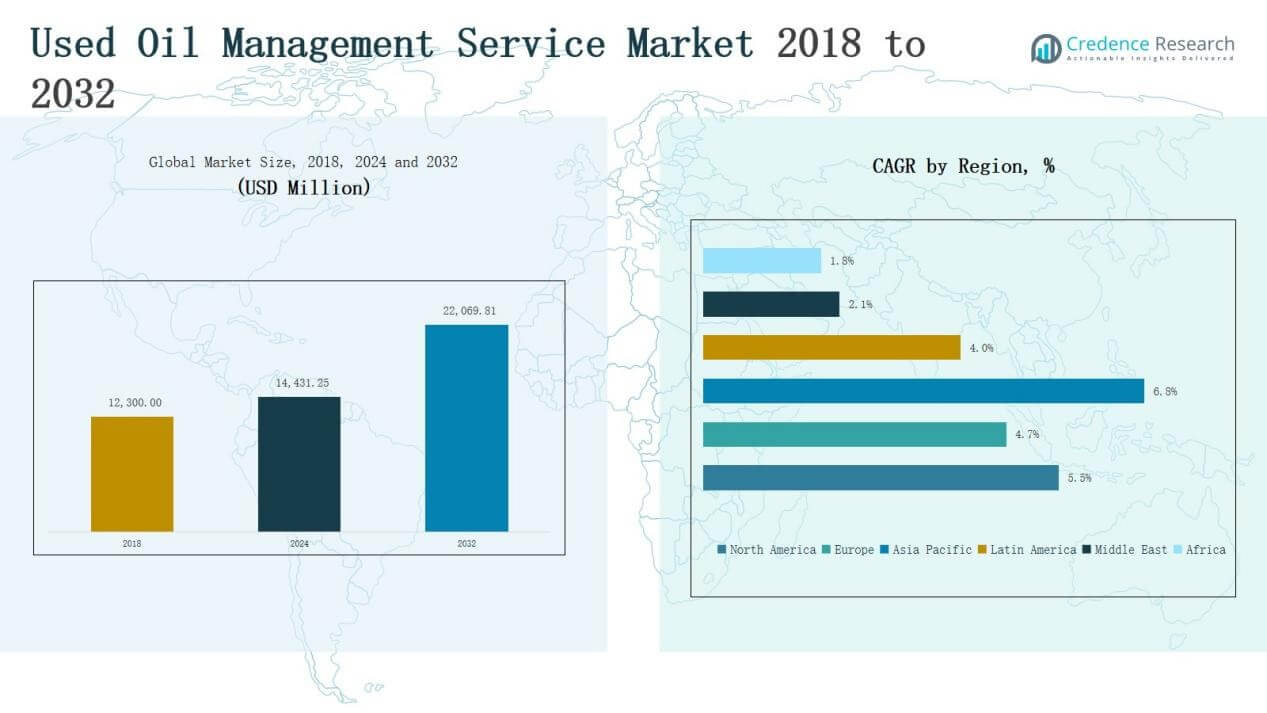
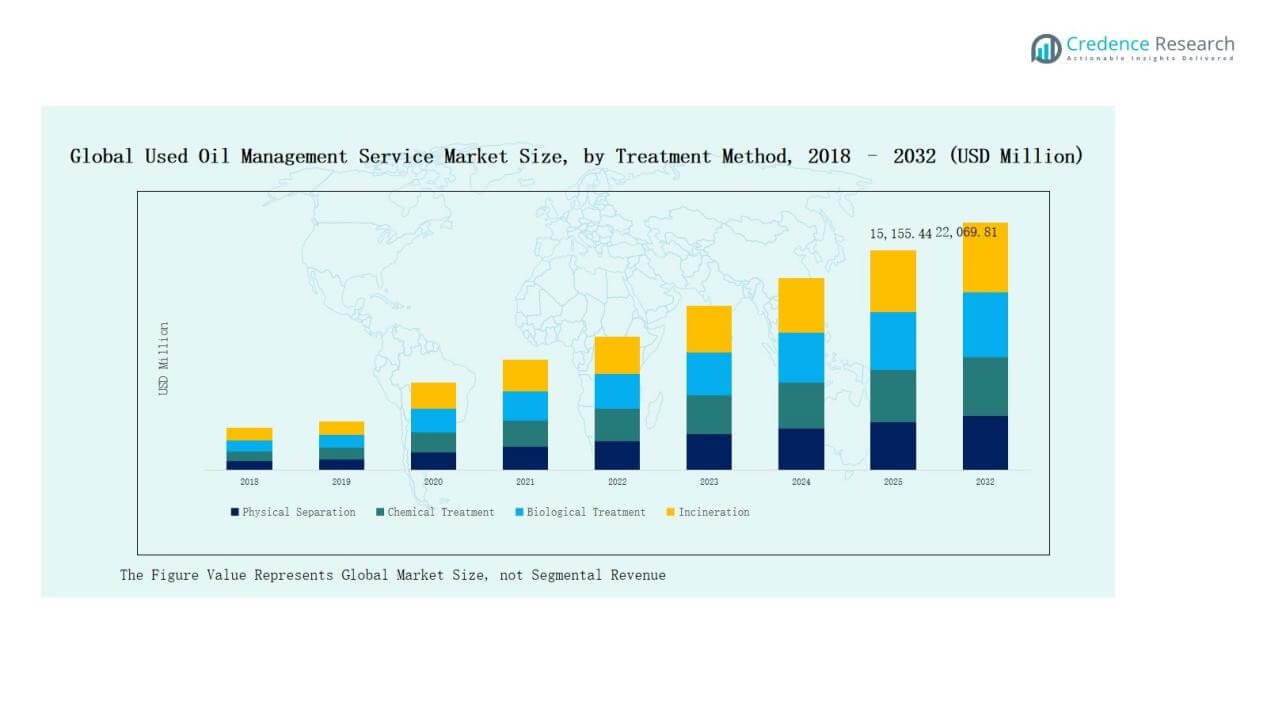
The Used Oil Management Service Market size was valued at USD 12,300.00 million in 2018, reached USD 14,431.25 million in 2024, and is anticipated to reach USD 22,069.81 million by 2032, at a CAGR of 5.52% during the forecast period.
| REPORT ATTRIBUTE | DETAILS |
|---|---|
| Historical Period | 2020-2023 |
| Base Year | 2024 |
| Forecast Period | 2025-2032 |
| Used Oil Management Service Market Size 2024 | USD 14,431.25 Million |
| Used Oil Management Service Market, CAGR | 5.52% |
| Used Oil Management Service Market Size 2032 | USD 22,069.81 Million |
The Used Oil Management Service Market is shaped by global leaders such as Veolia Environmental Services, Safety-Kleen, Cleanaway Waste Management, Stericycle, Waste Management, Inc., and TotalEnergies, alongside regional players including Resolve Energy, Greenleaf Renewables, Oil Dri Corporation of America, International Used Oil Corporation, Modern Disposal Services, Envirofluid, and Aevitas Energy Canada Inc. These companies compete through extensive collection networks, advanced recycling technologies, and regulatory compliance expertise. North America emerged as the leading region in 2024 with a 44.7% share, supported by strong environmental policies, mature infrastructure, and significant industrial and automotive oil demand.
 Market Insights
- The Used Oil Management Service Market grew from USD 12,300.00 million in 2018 to USD 14,431.25 million in 2024 and is expected to reach USD 22,069.81 million by 2032, expanding at a 52% CAGR.
- Collection and transportation dominated service type in 2024 with a 45% share, followed by treatment and recycling at 35%, and storage and disposal at 20%, driven by compliance and sustainability needs.
- By industry, the automotive sector held 40% share in 2024, followed by industrial and manufacturing at 28%, with power generation, construction, and mining contributing the remaining demand.
- By source, industrial equipment led with 38% share in 2024, followed by automotive repair centers at 30%, while power plants, construction machinery, and commercial treatment methods together made up the rest.
- North America led with 44.7% share in 2024, valued at USD 6,459.34 million, supported by strict regulations and strong infrastructure, while Asia Pacific at 24.7% share remains the fastest-growing region.
Market Segment Insights
By Type of Service
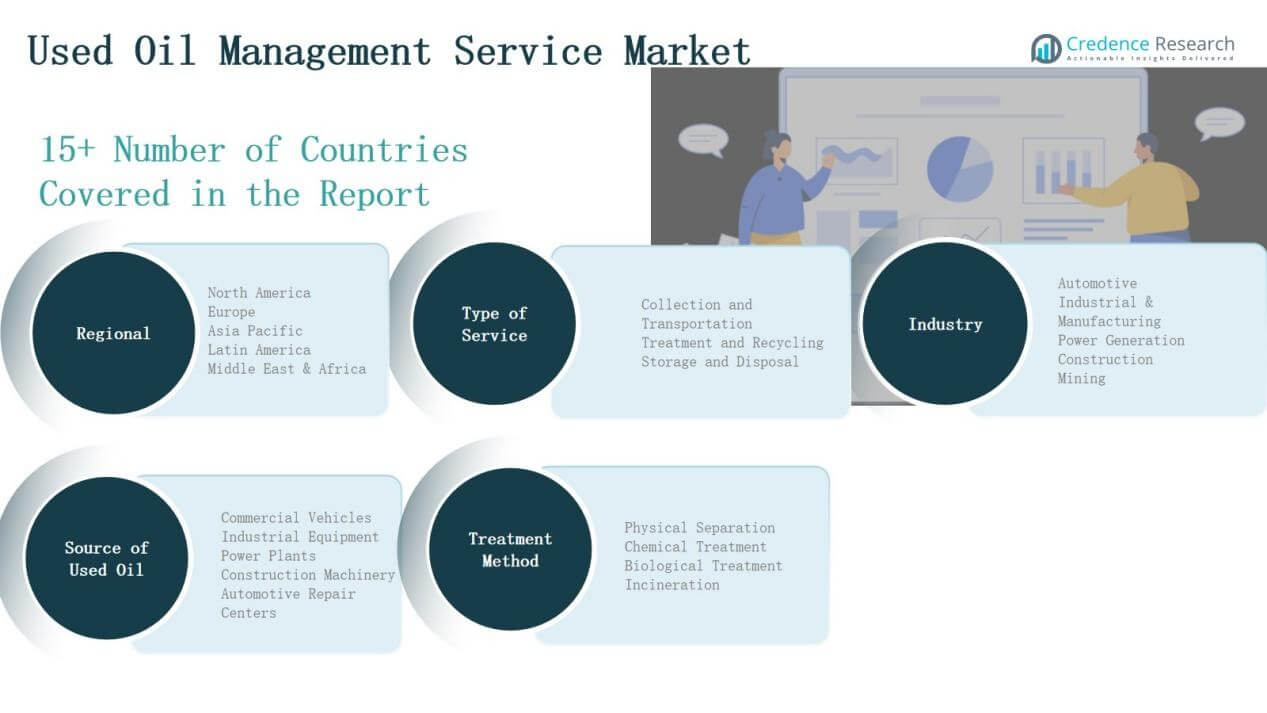
Collection and transportation accounted for the largest share of the Used Oil Management Service Market in 2024, holding 45% of total revenue. Growth is driven by rising volumes of used oil generated across automotive workshops, industrial plants, and service centers, requiring organized logistics and compliance with environmental regulations. Treatment and recycling followed with about 35%, supported by sustainability goals and demand for re-refined products. Storage and disposal represented the remaining 20%, largely addressing safe containment and hazardous waste rules.
By Industry
The automotive sector dominated the Used Oil Management Service Market with 40% share in 2024. Frequent oil changes in passenger and commercial vehicles generate consistent waste volumes, creating strong demand for collection and recycling. Industrial and manufacturing accounted for nearly 28%, driven by heavy machinery and process equipment. Power generation held around 15%, supported by oil use in turbines and backup systems. Construction and mining contributed the rest, reflecting machinery-intensive operations and increasing regulations on waste oil disposal.
For instance, Shell Lubricants India launched an initiative to collect and recycle used oil from industrial and heavy-duty machinery as part of its circular economy program.
By Source of Used Oil
Industrial equipment emerged as the leading source, contributing about 38% of market revenue in 2024, fueled by large-scale machinery, hydraulic systems, and lubricants used in production facilities. Automotive repair centers followed with around 30%, as high vehicle maintenance activity consistently generates large oil volumes. Power plants contributed nearly 15%, reflecting continuous use of lubricants in turbines and engines. Construction machinery and commercial treatment methods shared the remainder, driven by infrastructure development and third-party waste oil processing requirements.
For instance, Valvoline Global announced an expanded used-oil collection program in the United States to capture industrial and automotive waste oil directly from manufacturing plants and workshops.
 Key Growth Drivers
Rising Environmental Regulations
Stringent global regulations on hazardous waste disposal are a major driver of the Used Oil Management Service Market. Governments enforce strict guidelines on collection, transportation, and recycling, compelling industries and automotive players to comply. These frameworks create stable demand for specialized service providers. Growing awareness of environmental sustainability and the harmful effects of improper disposal further accelerate adoption. Regulatory alignment also enables international companies to standardize operations across markets, strengthening service efficiency and driving long-term market expansion.
For instance, Safety-Kleen, part of Clean Harbors, introduced its new EcoPower recycled oil program in Canada, ensuring collected used oil is re-refined into high-quality lubricants in compliance with Canadian Environmental Protection Act regulations.
Expanding Automotive and Industrial Activity
The rising demand for vehicles and industrial machinery is fueling steady volumes of waste oil. Automotive workshops generate frequent oil changes, while industrial plants rely on heavy equipment needing regular lubrication. Both segments contribute significantly to used oil streams. This trend supports the growth of collection, transportation, and recycling services. Industrial growth in emerging economies, coupled with expanding vehicle ownership, ensures a consistent flow of waste oil, positioning the market for sustained demand across multiple industry verticals.
For instance, Valvoline launched its NextGen recycled motor oil line in the U.S., highlighting the commercial reuse of collected used oil streams.
Advancements in Recycling Technologies
Technological innovation in oil re-refining and recycling is reshaping the Used Oil Management Service Market. Advanced filtration, vacuum distillation, and hydrotreating enable higher yields of base oils and lower processing costs. These improvements make recycled oil competitive with virgin products while reducing environmental impact. Industries and automotive fleets are increasingly adopting re-refined oil as a sustainable alternative. Continuous research and investment into recycling technologies further drive service adoption, strengthening the economic and ecological case for systematic used oil management.
Key Trends & Opportunities
Circular Economy Integration
The shift toward a circular economy creates new opportunities for used oil management services. Companies focus on transforming waste oil into valuable resources like base oil, lubricants, and fuel. This reduces dependency on crude oil while meeting sustainability targets. Partnerships between recyclers and end-use industries are expanding to create closed-loop systems. Governments and corporations increasingly view circular models as strategic, offering significant incentives and investment opportunities for service providers to scale operations and capture new revenue streams.
For instance, Neste partnered with Pretred to advance circular solutions in transportation by blending re-refined oils into fuels and lubricants, supporting reduced lifecycle emissions.
Expansion in Emerging Markets
Emerging economies in Asia Pacific, Latin America, and Africa present strong growth opportunities. Rising industrialization, urbanization, and vehicle ownership generate significant waste oil volumes. However, infrastructure for collection and recycling is still developing. Service providers expanding into these regions benefit from first-mover advantages, government incentives, and growing regulatory enforcement. Collaborations with local players help build efficient networks, while demand for sustainable practices further accelerates adoption. This creates a robust opportunity for global and regional companies to establish leadership positions.
For instance, LubeTech entered into a partnership with distributors in Kenya to establish waste oil collection hubs, leveraging government-backed regulations on hazardous waste disposal.
Key Challenges
High Operational Costs
Managing used oil requires significant investment in logistics, treatment facilities, and compliance systems. Collection networks, safe transport, and advanced recycling technologies add to operational costs. Smaller players struggle to achieve economies of scale, limiting market participation. Fluctuating oil prices also affect the cost-benefit balance of recycling versus disposal. While demand is growing, high upfront and running costs remain a challenge for widespread adoption, pushing companies to innovate cost-efficient models while maintaining safety and regulatory standards.
Inconsistent Collection Infrastructure
In many regions, especially in developing economies, collection infrastructure for used oil is fragmented and underdeveloped. Small workshops and informal sectors often dispose of oil improperly, bypassing organized systems. This limits the volume of oil entering formal recycling channels, reducing efficiency and profitability for service providers. Building robust collection systems requires regulatory enforcement, industry collaboration, and public awareness. Without consistent collection mechanisms, large portions of waste oil remain unaccounted for, undermining both environmental and market growth objectives.
Limited Awareness and Adoption
Awareness among small-scale industries, automotive repair shops, and consumers about the benefits of used oil management remains low. Many stakeholders continue to treat waste oil as disposable waste rather than a recyclable resource. This perception slows adoption of organized services, particularly in regions with weak enforcement. Service providers face challenges in educating stakeholders and promoting re-refined oil products. Overcoming this barrier requires sustained awareness campaigns, regulatory pressure, and evidence of economic benefits, making it a persistent market challenge.
Regional Analysis
North America
North America led the Used Oil Management Service Market with a 44.7% share in 2024, valued at USD 6,459.34 million, up from USD 5,559.60 million in 2018. The market is projected to reach USD 9,867.45 million by 2032, registering a CAGR of 5.5%. Growth is driven by strong environmental regulations, a mature automotive service industry, and widespread adoption of recycling technologies. The U.S. dominates regional demand, supported by large-scale industrial oil usage and established collection infrastructure. Canada and Mexico contribute through policy initiatives and rising industrialization, reinforcing North America’s leadership in sustainable oil management solutions.
Europe
Europe accounted for a 23.1% share of the market in 2024, with revenue rising from USD 2,966.76 million in 2018 to USD 3,333.22 million in 2024, and is forecasted to reach USD 4,788.10 million by 2032 at a CAGR of 4.7%. Strict EU directives on waste management and circular economy initiatives are the primary growth drivers. Countries such as Germany, France, and the UK are leading adopters, supported by advanced recycling infrastructure. Industrial sectors and automotive fleets create steady demand, while increasing focus on sustainable disposal practices continues to strengthen Europe’s market positioning across treatment and recycling services.
Asia Pacific
Asia Pacific is the fastest-growing region, holding a 24.7% share in 2024, with revenue increasing from USD 2,902.80 million in 2018 to USD 3,562.29 million in 2024. The market is projected to reach USD 6,031.70 million by 2032, expanding at a CAGR of 6.8%. Growth is fueled by rapid industrialization, a booming automotive sector, and government initiatives supporting sustainable waste management. China and India dominate demand due to large vehicle fleets and manufacturing activity, while Japan and South Korea drive advanced recycling adoption. Rising urbanization and environmental awareness further position Asia Pacific as the key growth hub globally.
Latin America
Latin America represented a 4.1% market share in 2024, with revenue moving from USD 506.76 million in 2018 to USD 585.76 million in 2024, and expected to reach USD 796.06 million by 2032 at a CAGR of 4.0%. Brazil is the largest contributor, driven by automotive service demand and rising industrial oil usage. Argentina and other regional markets are gradually adopting structured waste oil collection and recycling practices. Government-backed initiatives to improve environmental compliance and waste treatment capacity are supporting growth, though infrastructure gaps and limited awareness in smaller economies remain ongoing challenges for market penetration.
Middle East
The Middle East held a 1.5% share in 2024, with revenue increasing from USD 215.25 million in 2018 to USD 217.82 million in 2024, and is forecast to reach USD 256.13 million by 2032, growing at a CAGR of 2.1%. Market growth is slower compared to other regions due to limited recycling infrastructure and reliance on conventional disposal methods. However, GCC countries are adopting stricter regulations and investing in waste management services to align with sustainability goals. Oil-rich economies are gradually diversifying, with demand emerging from industrial hubs and automotive sectors in the UAE and Saudi Arabia.
Africa
Africa accounted for a 2.0% share in 2024, recording USD 148.83 million in 2018, USD 272.81 million in 2024, and projected to reach USD 330.37 million by 2032 at a CAGR of 1.8%. The region shows steady but limited growth due to underdeveloped collection networks and weak regulatory enforcement. South Africa leads regional demand, supported by its industrial and automotive base. Egypt and Nigeria are gradually expanding waste oil management systems through government-led sustainability programs. While infrastructure challenges persist, increasing industrialization and international partnerships present opportunities for service providers to expand operations in Africa’s emerging markets.
 Market Segmentations:
By Type of Service
- Collection and Transportation
- Treatment and Recycling
- Storage and Disposal
By Industry
- Automotive
- Industrial & Manufacturing
- Power Generation
- Construction
- Mining
By Source of Used Oil
- Commercial Treatment Methods
- Industrial Equipment
- Power Plants
- Construction Machinery
- Automotive Repair Centers
By Treatment Method
- Physical Separation
- Chemical Treatment
- Biological Treatment
- Incineration
By Region
- North America
- U.S.
- Canada
- Mexico
- Europe
- UK
- France
- Germany
- Italy
- Spain
- Russia
- Belgium
- Netherlands
- Austria
- Sweden
- Poland
- Denmark
- Switzerland
- Rest of Europe
- Asia Pacific
- China
- Japan
- South Korea
- India
- Australia
- Thailand
- Indonesia
- Vietnam
- Malaysia
- Philippines
- Taiwan
- Rest of Asia Pacific
- Latin America
- Brazil
- Argentina
- Peru
- Chile
- Colombia
- Rest of Latin America
- Middle East
- UAE
- KSA
- Israel
- Turkey
- Iran
- Rest of Middle East
- Africa
- Egypt
- Nigeria
- Algeria
- Morocco
- Rest of Africa
Competitive Landscape
The Used Oil Management Service Market is highly fragmented, with global leaders and regional specialists competing across collection, recycling, and disposal services. Key players such as Veolia Environmental Services, Safety-Kleen, Cleanaway Waste Management, Stericycle, and Waste Management, Inc. dominate through extensive networks, advanced recycling technologies, and compliance expertise. These companies emphasize strategic acquisitions, partnerships, and investment in re-refining facilities to strengthen market presence. Regional firms like Resolve Energy, Greenleaf Renewables, and Aevitas Energy Canada Inc. expand by offering localized solutions tailored to regulatory and industry needs. Oil majors such as TotalEnergies also integrate waste oil management into sustainability portfolios, creating competitive pressure. Price competitiveness, regulatory compliance, and service reliability remain central differentiators. Innovation in recycling processes and digital tracking solutions further intensifies rivalry, while opportunities in emerging markets encourage new entrants. Overall, competition is driven by sustainability commitments, customer partnerships, and the ability to scale operations efficiently across geographies.
Key Players
- Veolia Environmental Services
- Safety-Kleen
- Stok Corporation
- Cleanaway Waste Management
- Stericycle, Inc.
- Waste Management, Inc.
- Resolve Energy
- Greenleaf Renewables
- Oil Dri Corporation of America
- International Used Oil Corporation
- TotalEnergies
- Modern Disposal Services
- Envirofluid
- Aevitas Energy Canada Inc.
Recent Developments
- On June 26, 2025, Veolia acquired New England Disposal Technologies, New England MedWaste, and Ingenium to expand its hazardous waste and used-oil treatment capabilities in the U.S.
- On May 2, 2024, Clean Harbors / Safety-Kleen acquired Noble Oil Recycling (North Carolina) to increase its oil collection footprint and re-refining capacity.
- On April 11, 2024, Castrol and Safety-Kleen launched a multi-year “MoreCircular” program in the U.S. to collect used oil, re-refine it, and integrate re-refined base oil into new lubricants.
Report Coverage
The research report offers an in-depth analysis based on Type of Service, Industry, Source of Used Oil, Treatment Method and Region. It details leading market players, providing an overview of their business, product offerings, investments, revenue streams, and key applications. Additionally, the report includes insights into the competitive environment, SWOT analysis, current market trends, as well as the primary drivers and constraints. Furthermore, it discusses various factors that have driven market expansion in recent years. The report also explores market dynamics, regulatory scenarios, and technological advancements that are shaping the industry. It assesses the impact of external factors and global economic changes on market growth. Lastly, it provides strategic recommendations for new entrants and established companies to navigate the complexities of the market.
Future Outlook
- Demand for recycling services will rise as industries prioritize sustainability practices.
- Automotive sector will continue generating high volumes of used oil for treatment.
- Industrial expansion in emerging economies will create new growth opportunities.
- Digital tools for tracking and compliance will improve service efficiency.
- Advanced re-refining technologies will enhance quality of recycled base oils.
- Partnerships between global and regional firms will expand collection networks.
- Governments will enforce stricter disposal rules to reduce environmental risks.
- Circular economy models will drive greater adoption of used oil recycling.
- Infrastructure development in developing regions will strengthen formal waste channels.
- Service providers will diversify offerings to include energy recovery and reuse.

Request a Free Sample
Fill in your details and we'll send you a free sample report.
- Sample data tables & charts
- Research methodology
Market Dynamics
Rising Environmental Regulations
Stringent global and regional regulations on hazardous waste disposal require industries and automotive sectors to comply with proper collection, transportation, and recycling of used oil, driving demand for specialized management services.
Expanding Automotive and Industrial Activity
Growth in vehicle ownership and industrial machinery usage leads to higher volumes of used oil, necessitating organized collection and recycling services to manage the increasing waste streams.
Advancements in Recycling Technologies
Innovations in oil re-refining, such as advanced filtration and hydrotreating, improve the efficiency and quality of recycled oils, making them more competitive with virgin products and encouraging greater adoption of recycling services.
Circular Economy Integration
The shift toward circular economy models incentivizes companies to transform waste oil into valuable resources, fostering partnerships and investments in closed-loop systems that boost demand for used oil management services.
Expansion in Emerging Markets
Rapid industrialization and urbanization in Asia Pacific, Latin America, and Africa are generating significant waste oil volumes, while developing infrastructure and regulatory enforcement create new opportunities for service providers to expand their operations.
Need a Custom Version of This Report?
Tailor the scope, geography, or segments to your exact requirements.
- Custom geography or segment scope
- Direct access to our analyst team
Frequently Asked Questions
What is the current market size for Used Oil Management Service Market, and what is its projected size in 2032?
At what Compound Annual Growth Rate is the Used Oil Management Service Market projected to grow between 2025 and 2032?
Which Used Oil Management Service Market segment held the largest share in 2024?
What are the primary factors fueling the growth of the Used Oil Management Service Market?
Who are the leading companies in the Used Oil Management Service Market?
Which region commanded the largest share of the Used Oil Management Service Market in 2024?
Table of Content
Chapter 1 Market Segmentation
- 1.1 Segmentation Framework
- 1.1.1 Product and Service Classification
- 1.1.2 Application and End-Use Classification
- 1.1.3 Technology and Solution Classification
- 1.1.4 Customer and Distribution Channel Classification
- 1.1.5 Geographic Segmentation
- 1.1.6 Market Segment Definitions and Boundaries
- 1.2 By Industry
- 1.2.1 Automotive
- 1.2.2 Industrial & Manufacturing
- 1.2.3 Power Generation
- 1.2.4 Construction
- 1.2.5 Mining
- 1.3 By Type of Service
- 1.3.1 Collection and Transportation
- 1.3.2 Treatment and Recycling
- 1.3.3 Storage and Disposal
- 1.4 By Treatment Method
- 1.4.1 Physical Separation
- 1.4.2 Chemical Treatment
- 1.4.3 Biological Treatment
- 1.4.4 Incineration
- 1.5 By Source of Used Oil
- 1.5.1 Industrial Equipment
- 1.5.2 Automotive Repair Centers
- 1.5.3 Power Plants
- 1.5.4 Construction Machinery
- 1.5.5 Commercial Treatment Methods
Chapter 2 Introduction
- 2.1 Report Objectives and Scope
- 2.2 Product Definition and Industry Terminology
- 2.3 Market Inclusions and Exclusions
- 2.4 Research Process
- 2.4.1 Primary Research and Expert Interviews
- 2.4.2 Secondary Research and Source Review
- 2.4.3 Top-Down and Bottom-Up Estimation
- 2.4.4 Data Triangulation and Verification
- 2.5 Market Size Measurement Basis
- 2.5.1 2024: USD 14,431.25 million → 2032: USD 22,069.81 million
- 2.6 Historical and Forecast Reference Periods
- 2.6.1 Base Year: 2024
- 2.6.2 Forecast Period: 2024-2032
- 2.7 Research Assumptions and Limitations
Chapter 3 Executive Summary
- 3.1 Market Snapshot and Key Findings
- 3.2 Base-Year Market Size, 2024
- 3.3 Forecast Market Size, 2032
- 3.4 Revenue and Volume Growth Outlook
- 3.5 Key Demand and Supply Indicators
- 3.6 Leading Market Segments
- 3.7 Fastest-Growing Market Opportunities
- 3.8 Regional Performance Highlights
- 3.9 Technology and Industry Transformation
- 3.10 Competitive Landscape Summary
- 3.11 Analyst View and Strategic Implications
Chapter 4 Global Used Oil Management Service Market Trends and Developments
- 4.1 Historical Industry Development
- 4.2 Recent Market Trends and Developments
- 4.3 Demand and Customer Behavior Trends
- 4.4 Technology and Product Innovation
- 4.5 Artificial Intelligence, Automation and Digitalization
- 4.6 Local Manufacturing and Supply Chain Realignment
- 4.7 Industry Partnerships, Mergers and Acquisitions
- 4.8 Sustainability and Circular Economy Developments
- 4.9 Government and Private Sector Investment Trends
- 4.10 Emerging Business Models and Commercialization
- 4.11 Industry Developments and Announcements
Chapter 5 Global Used Oil Management Service Market Supply and Demand Analysis
- 5.1 Demand Trend and Consumption Analysis
- 5.2 Demand Forecast, 2024-2032
- 5.3 Supply Chain Structure and Procurement Trends
- 5.4 Supply-Demand Gap and Bottlenecks
- 5.5 Import Dependence and Sourcing Structure
- 5.6 Regional Supply and Demand Concentration
Chapter 6 Global Used Oil Management Service Market Pricing Analysis
- 6.1 Pricing Structure and Measurement
- 6.2 Historical Pricing Trends
- 6.3 Pricing Outlook, 2024-2032
- 6.4 Pricing by Product and Market Segment
- 6.5 Geographic Pricing Differences
- 6.6 Key Input, Energy, Labor and Logistics Costs
- 6.7 Contract Pricing and Purchasing Models
- 6.8 Pricing Sensitivity and Competitive Positioning
- 6.9 Price, Margin and Profitability Implications
Chapter 7 Global Used Oil Management Service Market Dynamics
- 7.1 Market Growth Drivers
- 7.1.1 Demand-Side Drivers
- 7.1.2 Technology and Innovation Drivers
- 7.1.3 Infrastructure and Investment Drivers
- 7.1.4 Regulatory and Policy Drivers
- 7.2 Market Restraints
- 7.2.1 Cost and Affordability Constraints
- 7.2.2 Technology and Adoption Barriers
- 7.2.3 Supply Chain and Operational Constraints
- 7.3 Market Challenges
- 7.3.1 Competitive Pressure and Margin Erosion
- 7.3.2 Skills, Infrastructure and Implementation Gaps
- 7.4 Emerging Market Opportunities
- 7.5 Market Dynamics Impact and Time-Horizon Assessment
Chapter 8 Global Used Oil Management Service Value Chain Analysis
- 8.1 Industry Value Chain Overview
- 8.2 Upstream Suppliers and Critical Inputs
- 8.3 Technology and Component Providers
- 8.4 Manufacturing or Service Delivery
- 8.5 Distribution, Channel Partners and Integrators
- 8.6 Downstream Applications and End Users
- 8.7 Value Addition and Profit Pools
- 8.8 Vertical Integration and Outsourcing
- 8.9 Supplier Concentration and Risk
- 8.10 Supply Chain Localization and Resilience
Chapter 9 Global Used Oil Management Service Market Regulations and Policies
- 9.1 Relevant Laws, Standards and Compliance Frameworks
- 9.2 Product, Service, Safety and Quality Requirements
- 9.3 Government Policies, Incentives and Subsidies
- 9.4 Imports, Exports and Trade Barriers
- 9.5 Public Procurement and Local Content Requirements
- 9.6 Data Protection, AI and Cybersecurity Compliance
- 9.7 Upcoming Policy Changes and Market Implications
Chapter 10 Global Used Oil Management Service Market Hotspots and Opportunities
- 10.1 Market Opportunity Mapping and Growth Hotspots
- 10.2 High-Growth Applications and Customer Groups
- 10.3 Underserved Markets and White-Space Opportunities
- 10.4 Emerging Technology and Product Opportunities
- 10.5 New Capacity and Investment Hotspots
- 10.6 Market Entry and Expansion Opportunities
- 10.7 Distribution and Partnership Opportunities
- 10.8 Near-Term and Long-Term Commercial Potential
- 10.9 Opportunity Attractiveness and Execution Risks
Chapter 11 Global Used Oil Management Service Market Outlook, 2024-2032
- 11.1 Market Size and Analysis
- 11.1.1 Revenue (Market Measurement: 2024: USD 14,431.25 million → 2032: USD 22,069.81 million)
- 11.1.2 Historical Market Size
- 11.1.3 Base-Year Market Size, 2024
- 11.2 Market Forecast, 2024-2032
- 11.2.1 Revenue Forecast to 2032
- 11.2.2 CAGR and Year-on-Year Growth
- 11.2.3 Incremental Revenue Opportunity
- 11.3 Forecast Assumptions and Scenario Analysis
- 11.3.1 Base-Case Forecast
- 11.3.2 Optimistic and Conservative Scenarios
- 11.3.3 Technology, Pricing and Policy Sensitivities
- 11.4 Market Attractiveness and Growth Outlook
Chapter 12 Global Used Oil Management Service Market Segmentation and Outlook
- 12.1 Segmentation Summary and Market Shares, 2024
- 12.2 Largest and Fastest-Growing Segments
- 12.3 By Industry - Market Size and Forecast, 2024-2032
- 12.3.1 Segment Definition and Scope
- 12.3.2 Historical Market Size
- 12.3.3 Revenue Forecast, 2024-2032
- 12.3.4 Base-Year Market Share, 2024
- 12.3.5 Segment CAGR and Growth Drivers
- 12.3.6 Subsegment Market Size and Forecast
- 12.3.6.1 Automotive
- 12.3.6.2 Industrial & Manufacturing
- 12.3.6.3 Power Generation
- 12.3.6.4 Construction
- 12.3.6.5 Mining
- 12.3.7 Subsegment Pricing and Adoption Trends
- 12.3.8 Leading Suppliers and Competition
- 12.3.9 Regional Demand and Opportunities
- 12.4 By Type of Service - Market Size and Forecast, 2024-2032
- 12.4.1 Segment Definition and Scope
- 12.4.2 Historical Market Size
- 12.4.3 Revenue Forecast, 2024-2032
- 12.4.4 Base-Year Market Share, 2024
- 12.4.5 Segment CAGR and Growth Drivers
- 12.4.6 Subsegment Market Size and Forecast
- 12.4.6.1 Collection and Transportation
- 12.4.6.2 Treatment and Recycling
- 12.4.6.3 Storage and Disposal
- 12.4.7 Subsegment Pricing and Adoption Trends
- 12.4.8 Leading Suppliers and Competition
- 12.4.9 Regional Demand and Opportunities
- 12.5 By Treatment Method - Market Size and Forecast, 2024-2032
- 12.5.1 Segment Definition and Scope
- 12.5.2 Historical Market Size
- 12.5.3 Revenue Forecast, 2024-2032
- 12.5.4 Base-Year Market Share, 2024
- 12.5.5 Segment CAGR and Growth Drivers
- 12.5.6 Subsegment Market Size and Forecast
- 12.5.6.1 Physical Separation
- 12.5.6.2 Chemical Treatment
- 12.5.6.3 Biological Treatment
- 12.5.6.4 Incineration
- 12.5.7 Subsegment Pricing and Adoption Trends
- 12.5.8 Leading Suppliers and Competition
- 12.5.9 Regional Demand and Opportunities
- 12.6 By Source of Used Oil - Market Size and Forecast, 2024-2032
- 12.6.1 Segment Definition and Scope
- 12.6.2 Historical Market Size
- 12.6.3 Revenue Forecast, 2024-2032
- 12.6.4 Base-Year Market Share, 2024
- 12.6.5 Segment CAGR and Growth Drivers
- 12.6.6 Subsegment Market Size and Forecast
- 12.6.6.1 Industrial Equipment
- 12.6.6.2 Automotive Repair Centers
- 12.6.6.3 Power Plants
- 12.6.6.4 Construction Machinery
- 12.6.6.5 Commercial Treatment Methods
- 12.6.7 Subsegment Pricing and Adoption Trends
- 12.6.8 Leading Suppliers and Competition
- 12.6.9 Regional Demand and Opportunities
- 12.7 Segment Growth Comparison
- 12.8 Segment Attractiveness and Priority Matrix
Chapter 13 Global Used Oil Management Service End-Use and Application Market Outlook
- 13.1 End-Use Industry and Customer Demand Structure
- 13.2 Leading Applications and Customer Groups
- 13.3 End-Use Market Size, Share and Forecast
- 13.4 Major End-Use Industry Deep Dives
- 13.4.1 Customer Requirements and Use Cases
- 13.4.2 Demand and Replacement Cycles
- 13.4.3 Technical and Regulatory Considerations
- 13.4.4 Purchasing and Procurement Models
- 13.4.5 Leading Vendors and Distribution Channels
- 13.4.6 Forecast and Commercial Opportunities
- 13.5 Emerging Applications and Cross-Segment Demand
- 13.6 End-Use Industry Investment Priorities
Chapter 14 Global Used Oil Management Service Geographic Market Outlook, 2024-2032
- 14.1 Regional Market Size and Share, 2024
- 14.2 Regional Market Forecast, 2024-2032
- 14.3 Regional Pricing, Production and Demand Differences
- 14.4 North America
- 14.4.1 United States
- 14.4.2 Canada
- 14.4.3 Mexico
- 14.5 Europe
- 14.5.1 Germany
- 14.5.2 France
- 14.5.3 Italy
- 14.5.4 United Kingdom
- 14.5.5 Spain
- 14.5.6 Poland
- 14.5.7 Russia
- 14.5.8 Netherlands
- 14.5.9 Belgium
- 14.5.10 Sweden
- 14.5.11 Denmark
- 14.5.12 Norway
- 14.5.13 Rest of Europe
- 14.6 Asia Pacific
- 14.6.1 China
- 14.6.2 India
- 14.6.3 Japan
- 14.6.4 South Korea
- 14.6.5 Thailand
- 14.6.6 Indonesia
- 14.6.7 Vietnam
- 14.6.8 Malaysia
- 14.6.9 Australia
- 14.6.10 Rest of Asia Pacific
- 14.7 Latin America
- 14.7.1 Brazil
- 14.7.2 Argentina
- 14.7.3 Colombia
- 14.7.4 Chile
- 14.7.5 Rest of Latin America
- 14.8 Middle East
- 14.8.1 Saudi Arabia
- 14.8.2 United Arab Emirates
- 14.8.3 Turkey
- 14.8.4 Israel
- 14.8.5 Iran
- 14.8.6 Rest of the Middle East
- 14.9 Africa
- 14.9.1 South Africa
- 14.9.2 Egypt
- 14.9.3 Nigeria
- 14.9.4 Morocco
- 14.9.5 Rest of Africa
- 14.10 Regional Investment, Policy and Supply Chain Differences
- 14.11 Regional Competitive Landscape
- 14.12 Geographic Growth Hotspots
Chapter 15 Global Used Oil Management Service Technology, Innovation and Sustainability Outlook
- 15.1 Technology Landscape and Maturity
- 15.2 Product, Process and Service Innovation
- 15.3 AI, Automation and Digital Tools in the Industry
- 15.4 Technology Adoption and Performance Benchmarking
- 15.5 Innovation Pipeline and R&D Investment
- 15.6 Energy Efficiency and Resource Management
- 15.7 Sustainability, Recycling and Circularity
- 15.8 Technology Roadmap, 2024-2032
- 15.9 Risks of Obsolescence and Technology Substitution
Chapter 16 Global Used Oil Management Service Market Key Strategic Imperatives
- 16.1 Growth and Market Entry Priorities
- 16.2 High-Return Products and Segments
- 16.3 Pricing, Profitability and Cost Optimization
- 16.4 Technology Investment and Product Differentiation
- 16.5 Supply Chain Localization and Resilience
- 16.6 Distribution and Customer Acquisition
- 16.7 Partnership, Acquisition and Capacity Strategy
- 16.8 Regional Expansion Priorities
- 16.9 Short-, Medium- and Long-Term Actions
Chapter 17 Competition Outlook
- 17.1 Industry Competition Characteristics
- 17.2 Market Structure and Concentration
- 17.3 Market Share and Competitive Positioning, 2024
- 17.4 Company-Wise Revenue and Product Benchmarking
- 17.5 Production and Service Capacity Benchmarking
- 17.6 Technology, Pricing and Differentiation
- 17.7 Regional Footprint and Distribution Strength
- 17.8 Mergers, Acquisitions and Strategic Alliances
- 17.9 New Entrants and Competitive Threats
- 17.10 Porter's Five Forces and Industry Attractiveness
- 17.11 Competitive Outlook, 2024-2032
Chapter 18 Company Profiles
- 18.1 Company Coverage and Selection Criteria
- 18.2 Veolia Environmental Services
- 18.2.1 Business Description
- 18.2.2 Company Ownership and Geographic Presence
- 18.2.3 Product and Service Portfolio
- 18.2.4 Manufacturing and Operating Footprint
- 18.2.5 Financial Performance and Investment
- 18.2.6 Market Share and Competitive Position
- 18.2.7 Technology and Innovation Capabilities
- 18.2.8 Strategic Alliances or Partnerships
- 18.2.9 Recent Developments
- 18.2.10 Growth Strategy and Outlook
- 18.3 Safety-Kleen
- 18.4 Cleanaway Waste Management
- 18.5 Stericycle, Inc.
- 18.6 Waste Management, Inc.
- 18.7 TotalEnergies
- 18.8 Resolve Energy
- 18.9 Greenleaf Renewables
- 18.10 Oil Dri Corporation of America
- 18.11 Aevitas Energy Canada Inc.
- 18.12 Other Relevant Market Participants
Note: Every listed company is profiled on the structure shown under the first company. The company list is preliminary and may change based on research findings, market developments, data availability and client requirements.
Chapter 19 Disclaimer
- 19.1 Research and Forecast Disclaimer
- 19.2 Data Source and Estimation Limitations
Note: The depth of individual sections depends on data availability for this market. Volume, capacity, trade and other unit-based metrics are included where applicable.

