
| REPORT ATTRIBUTE | DETAILS |
|---|---|
| Historical Period | 2019-2022 |
| Base Year | 2023 |
| Forecast Period | 2024-2032 |
| Dehydrated Food Market Size 2023 | USD 47512.2 Million |
| Dehydrated Food Market, CAGR | 7.00% |
| Dehydrated Food Market Size 2032 | USD 87349.2 Million |
Market Insights
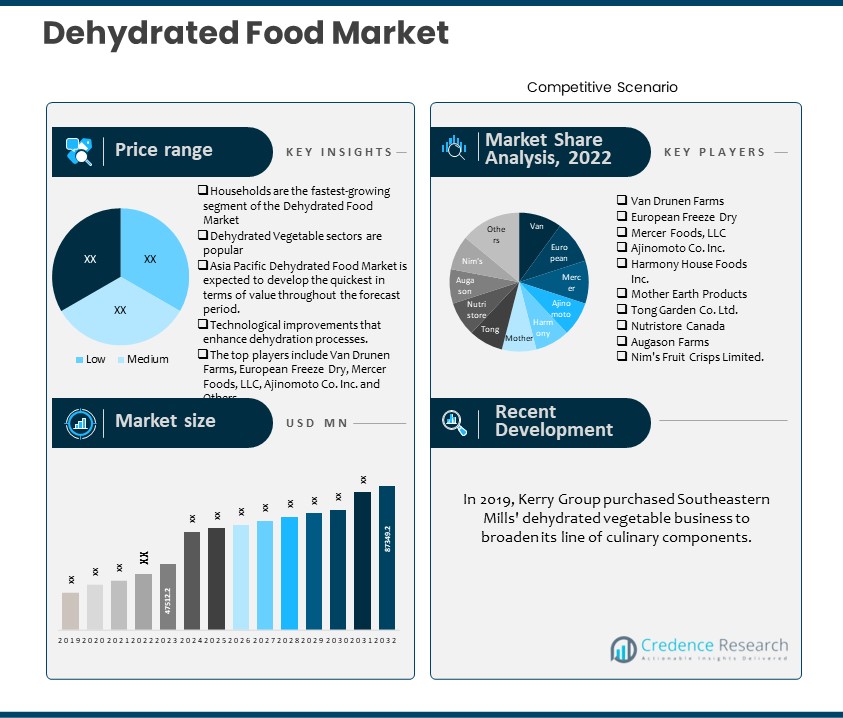
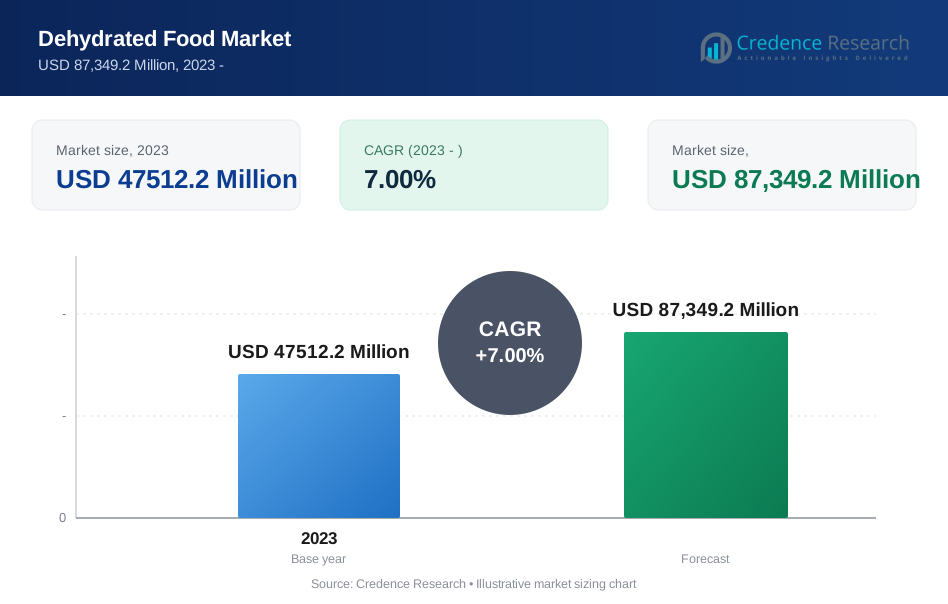
- The global demand for Dehydrated Food was valued at USD 47512.2 Million in 2023 and is expected to reach USD 87349.2 Million in 2032, growing at a CAGR of 7.00% between 2024 and 2032.
- Dehydrated meat and seafood have a significant market share, while the dehydrated vegetable sectors are popular.
- The spray drying category had a large revenue share in the worldwide dehydrated food market in 2023, and the Freeze-Drying sector is predicted to have a rapid revenue CAGR during the forecast period.
- Food processing has a significant share of the dehydrated food market.
- Households are the fastest-growing segment of the Dehydrated Food Market, followed by Food Service Providers.
- North America is predicted to dominate the market in 2023, accounting for 38.6%, while the Asia Pacific Dehydrated Food Market is expected to develop the quickest in terms of value throughout the forecast period.
- Increased Shelf Life Drives Dehydrated Food Market Growth
- Raw material shortage inhibits the dehydrated food market's expansion.
Executive Summary
Market Definition
Dehydrated food is the dry form of food obtained through the dehydration process. Dehydration allows for longer product preservation, which is the primary driver of the global market for dehydrated food items. Technology has advanced to the point that seasonal fruits and vegetables can be consumed at any time of year through dehydration and long-term preservation.
Market Overview
The global Dehydrated Food Market has witnessed steady growth in recent years and is expected to grow at a CAGR of 7.00% between 2024 and 2032. The market was valued at USD 47512.2 million in 2023 and is expected to reach USD 87349.2 million in 2032.
Drying, often known as lack of hydration, is a process that removes moisture or water content from food. Eliminating water from meals makes it lighter and more humble. It aids in the preservation of nutrients for an extended period. Dehydrated food does not require refrigeration while being stored at home or during the hour of use. Furthermore, dried food is excellent for conserving soil products that occur occasionally. Dehydrated food provides significant dietary benefits, simple capacity qualities, and accessibility at a cheap cost, which is fueling global interest in dry-out food.
Dehydrated foods are those that have had the moisture or water content removed. During the parchedness interaction, the food item is dried to remove water, hence increasing its useful life. This makes the food item lighter and more modest while maintaining its nutritional value. As a result, dried food sources can be stored for longer periods without the need for refrigeration. They are easily stored and reasonably priced. Furthermore, the long timeframe of realistic usability of dehydrated food types makes them perfect for conserving soil-derived items.
Segmentation By Product Type
- Dehydrated meat and seafood account for a sizable market share, driven by the desire for handy, long-lasting protein sources. This section is popular in the camping, military, and emergency food supply markets. The increasing popularity of snackable meat products such as jerky also contributes to the development.
- The Dehydrated Vegetable sector is popular due to its long shelf life and concentrated flavor. Ready-to-eat food meets the desire for easy, quick meal options. Herbs, spices, and pastry ingredients are among the other dehydrated goods.
Segmentation By Processing Method
- The Spray drying category accounted for a large revenue share in the global Dehydrated Food Market in 2023. Spray drying is the most efficient and cost-effective way to generate large amounts of dehydrated food. It's widely utilized in the dairy, coffee, and flavoring industries. The method enables the quick drying of liquids into powders, keeping flavor and nutritional value while increasing shelf life. The widespread applicability in a variety of food industries, combined with the development of improved spray-drying processes, contributes to this segment's dominant position.
- The Freeze-Drying sector is expected to have a quick revenue CAGR throughout the forecast period. Freeze-dried product items are regarded for their quality and nutrient retention; they are commonly utilized in fruits and high-end products. Vacuum drying is used for heat-sensitive materials.
Segmentation by Application
- Food Processing holds a major share of the Dehydrated Food Market. Food processing is important in the Dehydrated Food Market because it involves the production and packaging of dehydrated food products for a variety of consumers and industries.
Segmentation By End-User
- Households are the fastest-growing segment of the Dehydrated Food Market. Households are the primary consumers of dried foods, driven by a need for convenient, non-perishable food options. This segment's rise is driven by its attractiveness to outdoor lovers, busy households, and those looking for emergency food supplies.
- Food Service Providers are another popular area in the Dehydrated Food Market. Food service establishments, such as restaurants, cafes, and catering services, use dehydrated foods due to their ease, uniformity, and storage benefits. This industry is important for bulk and specialist dehydrated products.
Segmentation by Region
- The North America region is expected to dominate the market in 2023, accounting for 38.6%.
- The Asia Pacific Dehydrated Food Market is expected to grow the fastest in terms of value over the forecast period.
- The rest of the world, including Latin America, the Middle East, and Africa, supplies the remaining demand for Dehydrated Food.
North America accounts for approximately 35% of global dehydrated food sales. This dominance can be attributed to North America's culture of convenience and on-the-go eating habits; other key contributors include high demand for easy-to-prepare food products among a time-pressed population, as well as its well-established food processing industry and cutting-edge dehydration technology, which are an integral part of daily life in this part of the world. Consumer preferences for healthful, shelf-stable foods that match their lifestyle needs drive North American market dynamics. Furthermore, large companies that invest extensively in R&D to extend their dehydrated food product lines help to strengthen this market segment.
Moreover, the Asia-Pacific region's dehydrated food market is rapidly developing as a result of urbanization, rising disposable incomes, and an expanding labor force. Furthermore, regional culinary traditions and the increased acceptance of Western eating habits also contribute significantly to this development. The Asia-Pacific market for dehydrated organic fruits and vegetables is expected to grow rapidly due to rising consumer demand for convenience foods and expansion in the processing industry. Asia's huge agricultural output provides enough opportunities to produce dehydrated fruit and vegetables appropriate for both home and international markets.
Key Highlights of the Report
Product Type, Processing Method, Application, End-User, and region segment of the global Dehydrated Food Market. In 2023, Dehydrated meat and seafood account for a sizable market share, whereas spray drying accounts for a significant revenue share. In addition, the Freeze-Drying sector is predicted to have a high revenue CAGR, with households being the fastest-growing segment of the market with North America driving its growth.
Several factors drive the growth of the Dehydrated Food Market, including rising demand for easy and long-lasting food options, increased knowledge of the benefits of dehydrated foods, and the ongoing expansion of the food processing industry. However, some limitations exist, such as worries regarding nutritional content loss during dehydration, retaining taste and texture in dehydrated items, and competing with fresh and frozen food options. Despite these challenges, the market has several opportunities, such as developments in dehydration technologies, increased interest in outdoor activities, which raise demand for dehydrated meals, and the possibility for market expansion in developing regions.
North America accounts for almost 35% of global dehydrated food sales. This supremacy is due to North America's culture of convenience and on-the-go eating habits. The Asia-Pacific dehydrated food industry is also rapidly expanding due to urbanization, increased disposable incomes, and a growing workforce.
What Are The Main Drivers Of The Global Dehydrated Food Market?
Several factors drive the growth of the Dehydrated Food Market, including rising demand for easy and long-lasting food options, increased knowledge of the benefits of dehydrated foods, and the ongoing expansion of the food processing industry.
What Are The Major Challenges Faced By The Global Dehydrated Food Market?
However, some limitations exist, such as worries regarding nutritional content loss during dehydration, retaining taste and texture in dehydrated items, and competing with fresh and frozen food options.
What Are The Growth Opportunities In The Global Dehydrated Food Market?
Despite these challenges, the market has several opportunities, such as developments in dehydration technologies, increased interest in outdoor activities, which raise demand for dehydrated meals, and the possibility for market expansion in developing regions.
Market Drivers
Several factors drive the global Dehydrated Food Market. The following are the key drivers of the global Dehydrated Food Market:
Extended Shelf Life
Dehydrated food has a longer shelf life than fresh food, which is a major driver of industry expansion. It is also resistant to deterioration, making it perfect for long-term storage, lowering the frequency of food purchases, and reducing waste. This element is especially desirable in locations with limited access to fresh produce or during disaster planning, when long-term food supplies are essential.
The longer shelf life also benefits merchants and distributors by lowering the possibility of unsold inventory owing to spoiling. In the long run, this element of dehydrated foods is anticipated to remain a key market driver, particularly as global supply chain issues persist and consumer attention to sustainability and waste reduction grows.
Nutrient Retention in Dehydrated Foods
Retaining many critical elements in dehydrated meals increases their attractiveness and market share. Unlike other techniques of food processing, dehydration retains a considerable portion of the original produce's nutritional content. This feature makes dehydrated foods a nutritional choice for meals and snacks, appealing to health-conscious consumers.
As people become more aware of the benefits of healthy eating, there is a greater need for nutritious and convenient food options. Dehydrated fruits, vegetables, and meats offer the best balance of convenience and health, making them popular among consumers looking to maintain a nutritious diet without sacrificing convenience. As long as consumers choose nutrition over convenience, the market for dehydrated food items should continue to grow.
Market Restraints
The global Dehydrated Food Market faces some challenges that may hinder its growth. These include the following:
Raw Material Scarcity
A scarcity of high-quality raw ingredients hinders the dehydrated food market's expansion. Fresh, high-quality vegetables is essential for the manufacturing of dehydrated foods. Agricultural output changes, supply chain interruptions, and competition for these basic materials from other food industries can all contribute to shortages and higher costs. This limitation can have an impact on the consistency and volume of dehydrated food manufacturing, affecting the market's capacity to fulfill expanding customer demand while maintaining product quality.
Opportunities
The global Dehydrated Food Market offers significant growth opportunities. These include the following:
Increased Demand For Dehydrated Vegetables From Snack Food Manufacturers
The increasing demand for dehydrated veggies from snack food makers opens up significant potential opportunities in the dehydrated food sector. Snack snacks made with dehydrated veggies are becoming increasingly popular due to their convenience and supposed health benefits. Consumers are increasingly looking for healthy snack options, and dehydrated vegetables fit that requirement. Manufacturers who respond to this trend by adding dehydrated veggies to their goods are well-positioned for growth. This tendency also promotes innovation and diversification in the dehydrated food industry, hence contributing to overall market growth.
Competitive Landscape
Key Players
The global Dehydrated Food Market is highly competitive, with several key players. Some of the major players in the market and their market share are as follows:
- Van Drunen Farms
- European Freeze Dry
- Mercer Foods, LLC
- Ajinomoto Co. Inc.
- Harmony House Foods Inc.
- Mother Earth Products
- Tong Garden Co. Ltd.
- Nutristore Canada
- Augason Farms
- Nim's Fruit Crisps Limited.
These organizations prioritize product innovation, Application expansion, and mergers and acquisitions to stay competitive.
The global Dehydrated Food Market's key players continually seek to stay ahead by offering new products and developments.
In 2022, General Mills has expanded its Food Should Taste Good brand of dried snacks with new organic veggie chip options.
In 2021, Nestle released a line of dried meat pieces and chunks under the Maggi brand for healthy cooking.
In 2020, Oregon Freeze Dry increased its production capacity to satisfy the growing demand for freeze-dried components and meals.
Summary of Key Findings
- Demand for dehydrated veggies from snack food producers fuels market expansion.
- The market is segmented by Product Type, Processing Method, Application , End-User, and region.
- Households are the fastest-growing part of the Dehydrated Food Market
- Food Processing accounts for a significant portion of the dehydrated food market.
- North America is leading in market growth; the market is highly competitive, with key players including Van Drunen Farms, European Freeze Dry, Mercer Foods, LLC, Ajinomoto Co. Inc. and Others.
Future Outlook
- Demand for food products that are convenient and long-lasting continues to rise.
- Technological improvements that enhance dehydration processes.
- The use of dehydrated foods is becoming increasingly popular in outdoor and camping activities.
How CXOs Can Benefit from the Credence Research Dehydrated Food Market Report
The Credence Research Dehydrated Food Market Report provides CXOs with a comprehensive overview of the market, including:
- Market size and growth forecast: The report provides detailed estimates of the global Dehydrated Food Market size, segmented By Product Type, Processing Method, Application , End-User and region. It also includes forecasts for the market through 2032 based on key trends and drivers.
- Market segmentation: The report segments the Dehydrated Food Market By by Product Type, Processing Method, Application , End-User, and region. This segmentation provides CXOs with a granular understanding of the market and the opportunities in each segment.
- Competitive Landscape: The report profiles the key players in the Dehydrated Food Market and provides insights into their strategies, product offerings, and financial performance. This information can help CXOs identify and assess their competition.
- Key trends and drivers: The report identifies and analyzes the key trends and drivers that are shaping the Dehydrated Food Market. This information can help CXOs to make informed decisions about their investments and strategies.
CXOs can use the insights from the Credence Research Dehydrated Food Market Report to:
- Identify growth opportunities: The report can help CXOs identify new growth opportunities in the Dehydrated Food Market. By analyzing the data and trends in the report, they can make informed decisions about where to invest and expand their business.
- Make informed investment decisions: The report can help CXOs make informed investment decisions about Dehydrated Food. For example, it may provide useful insights into market trends, customer preferences, the competitive landscape, and growth prospects in the Dehydrated Food Market.
- Develop competitive strategies: The report can help CXOs develop competitive strategies for their Dehydrated Food businesses. For example, by analyzing market trends, client preferences, and the competitive environment mentioned in the report, CXOs can fine-tune their strategies, differentiate their offers, and effectively position their firms in the marketplace.
- Track market developments: The report can help CXOs monitor market developments and stay ahead of the curve. For example, it provides insights into the latest trends and innovations in the Dehydrated Food Market.
Overall, the Credence Research Dehydrated Food Market Report is a valuable reProcessing Method for CXOs who want to gain a deeper understanding of the market and identify opportunities for growth.
Segmentation
- By Product Type:
- Dehydrated Fruits
- Dehydrated Vegetables
- Dehydrated Meat and Seafood
- Dehydrated Dairy Products
- Dehydrated Grains and Legumes
- Dehydrated Herbs and Spices
- By Processing Method:
- Air Drying
- Freeze-Drying
- Spray Drying
- Sun Drying
- Vacuum Drying
- By Application:
- Retail
- Food Service
- Food Processing
- Emergency and Survival Foods
- By End-User:
- Households
- Food Industry
- Food Service Providers
- By Region
- North America
- The U.S.
- Canada
- Mexico
- Europe
- Germany
- France
- The U.K.
- Italy
- Spain
- Rest of Europe
- Asia Pacific
- China
- Japan
- India
- South Korea
- South-east Asia
- Rest of Asia Pacific
- Latin America
- Brazil
- Argentina
- Rest of Latin America
- Middle East & Africa
- GCC Countries
- South Africa
- Rest of the Middle East and Africa
- North America
Request a Free Sample
Fill in your details and we'll send you a free sample report.
- Sample data tables & charts
- Research methodology
Need a Custom Version of This Report?
Tailor the scope, geography, or segments to your exact requirements.
- Custom geography or segment scope
- Direct access to our analyst team
Frequently Asked Questions
What is the current size of the global Dehydrated Food Market?
What is the expected growth rate of the Dehydrated Food Market between 2024 and 2032?
Which segment is leading the market share in terms of Application?
Which Processing Method segment is expected to post the fastest growth rate during the forecast period?
Who are the major players in the global Dehydrated Food Market?
Table of Content
Chapter 1. Report Introduction
- 1.1 Report Description & Purpose
- 1.1.1 Report Title & Market Definition
- 1.1.2 Unique Selling Propositions (USP) & Key Differentiators
- 1.1.3 Value Proposition for Stakeholders
- 1.2 Research Objectives
- 1.2.1 Market Sizing Objectives (Volume & Revenue) (Volume Where Applicable)
- 1.2.2 Segmentation Objectives
- 1.2.3 Competitive Intelligence Objectives
- 1.2.4 Forecast & Scenario Objectives
- 1.3 Report Scope
- 1.3.1 Dehydrated Food Scope – Segments & Subsegments Covered
- 1.3.2 Geographic Scope – Regions & Countries Covered
- 1.3.3 Historical Period, Base Year & Forecast Period (2023; forecast to the forecast period)
- 1.3.4 Inclusions & Exclusions
- 1.4 Industry Classification & Applicable Codes
- 1.5 Currency, Measurement Units & Valuation Basis
- 1.6 Target Stakeholders
- 1.7 Limitations & Assumptions
Chapter 2. Executive Summary
- 2.1 Global Dehydrated Food Market Snapshot
- 2.1.1 Market Size – Historical (2023) & Forecast (the forecast period) (2023: USD 47512.2 Million → forecast year: USD 87,349.2 Million)
- 2.1.2 Volume & Revenue – Global Totals (Volume Where Applicable)
- 2.1.3 Key Market Highlights – Top Five Facts
- 2.2 Dehydrated Food Market Segmentation Snapshot
- 2.2.1 Market Split by Region – 2023 vs.
- 2.3 Competitive Snapshot
- 2.3.1 Top 10 Players by Revenue Share – 2023
- 2.3.2 Top 10 Players by Volume Share – 2023 (Volume Where Applicable)
- 2.3.3 Recent Strategic Developments (18-Month Summary)
- 2.4 Key Investment Highlights & Strategic Conclusions
Chapter 3. Dehydrated Food Market Dynamics & Industry Analysis
- 3.1 Market Overview & Context
- 3.1.1 Dehydrated Food Market Position in the Broader Industry Value Chain
- 3.1.2 Demand Structure & Purchasing Dynamics
- 3.1.3 Market Maturity & Development Stage by Region
- 3.2 Dehydrated Food Market Drivers
- 3.3 Dehydrated Food Market Restraints & Challenges
- 3.4 Dehydrated Food Market Opportunities
- 3.5 Porter's Five Forces Analysis
- 3.5.1 Threat of New Entrants
- 3.5.2 Bargaining Power of Suppliers
- 3.5.3 Bargaining Power of Buyers
- 3.5.4 Threat of Substitutes
- 3.5.5 Competitive Rivalry – Intensity Assessment
- 3.6 Dehydrated Food Value Chain Analysis
- 3.6.1 Upstream – Key Inputs, Resources & Suppliers
- 3.6.1.1 Key Input/Resource 1
- 3.6.1.2 Key Input/Resource 2
- 3.6.1.3 Key Input/Resource 3
- 3.6.2 Midstream – Core Operations & Value Creation
- 3.6.2.1 Operating Model & Process Overview
- 3.6.2.2 Key Operating Locations & Capabilities by Company
- 3.6.3 Downstream – Market Channels & End Users
- 3.6.3.1 Direct Sales & Customer Engagement Channels
- 3.6.3.2 Indirect Sales, Intermediaries & Partner Channels
- 3.6.4 Value Chain Profitability Analysis
- 3.6.1 Upstream – Key Inputs, Resources & Suppliers
- 3.7 PESTEL Analysis
- 3.7.1 Political Factors
- 3.7.2 Economic Factors
- 3.7.3 Social Factors
- 3.7.4 Technological Factors
- 3.7.5 Environmental Factors
- 3.7.6 Legal Factors
- 3.8 Dehydrated Food Supply Chain Analysis
- 3.8.1 Critical Input & Resource Availability Risk Assessment
- 3.8.2 Supplier & Operational Concentration Risk (Geographic Exposure)
- 3.8.3 Supply & Service Disruption Impact Analysis
- 3.9 Regulatory & Policy Landscape
Note: The regulatory and policy landscape section covers regulations based on their applicability to the market, Dehydrated Food category, geography, and scope of the study. Only regulatory frameworks with a material impact on operations, compliance, trade, sustainability, or market access are analyzed in detail.
Chapter 4. Key Investment Pockets & Opportunity Analysis
- 4.1 Dehydrated Food Market Attractiveness Analysis
- 4.1.1 By Region – Investment Attractiveness Matrix (Market Size × CAGR)
- 4.2 Absolute Revenue Growth Opportunity
- 4.2.1 By Region – Absolute Revenue Growth Through the forecast period
- 4.3 Incremental Demand Opportunity
- 4.3.1 By Region – Incremental Demand Through the forecast period
- 4.3.2 Segment – Incremental Demand
- 4.4 Emerging Submarket Opportunity Deep Dive (Subject to Applicability)
- 4.5 Priority Market Opportunity Scorecards
- 4.5.1 United States
- 4.5.2 Europe
- 4.5.3 Asia
- 4.5.4 Middle East & Africa
Note: Priority market opportunity scorecards reflect the geographic scope and strategic relevance of the study. Listed markets are indicative and may be adapted to the industry.
Chapter 5. Dehydrated Food Cross-Border Trade & Market Access Analysis
- 5.1 International Trade & Cross-Border Activity Overview
- 5.1.1 Global Export Value by Country (2023)
- 5.1.2 Global Export Volume by Country (2023) (Volume Where Applicable)
- 5.1.3 Global Import Value by Country (2023)
- 5.1.4 Global Import Volume by Country (2023) (Volume Where Applicable)
- 5.1.5 Net Trade Balance by Country (2023)
- 5.2 Export Analysis – Segment
- 5.2.1 Category 1 (Applicable Classification Code)
- 5.2.2 Category 2 (Applicable Classification Code)
- 5.2.3 Category 3 (Applicable Classification Code)
- 5.2.4 Category 4 (Applicable Classification Code)
- 5.2.5 Category 5 (Applicable Classification Code)
- 5.3 Import Analysis – Segment
- 5.3.1 Category 1 (Applicable Classification Code)
- 5.3.2 Category 2 (Applicable Classification Code)
- 5.3.3 Category 3 (Applicable Classification Code)
- 5.3.4 Category 4 (Applicable Classification Code)
- 5.3.5 Category 5 (Applicable Classification Code)
- 5.4 Cross-Border Pricing & Transaction Benchmarks
- 5.4.1 Export Pricing – Segment & Country
- 5.4.2 Import Pricing – Segment & Source Country
- 5.4.3 Price Trends (2023)
- 5.5 Key Cross-Border Trade & Delivery Routes
- 5.5.1 Cross-Border Trade/Delivery Route 1
- 5.5.2 Cross-Border Trade/Delivery Route 2
- 5.5.3 Cross-Border Trade/Delivery Route 3
- 5.5.4 Cross-Border Trade/Delivery Route 4
- 5.5.5 Cross-Border Trade/Delivery Route 5
- 5.6 Trade Policy & Market Access Impact Assessment
- 5.6.1 Tariff & Non-Tariff Barriers
- 5.6.2 Regional Trade & Economic Integration Frameworks
- 5.6.3 Bilateral & Multilateral Trade Agreements
- 5.6.4 Cross-Border Operating, Licensing & Localization Requirements
Note: This chapter applies where cross-border trade or delivery is relevant to Dehydrated Food. Goods, services, and digital offerings are assessed using applicable classifications and transaction measures. Import-export volumes, trade balances, and route analyses are included only where meaningful to the market.
Chapter 6. Competitive Landscape & Company Benchmarking
- 6.1 Dehydrated Food Market Concentration & Structure
- 6.1.1 Herfindahl-Hirschman Index (HHI) – vs. 2023
- 6.1.2 Leading, Mid-Sized & Emerging Player Structure
- 6.1.3 Global, Regional & Local Player Dynamics
- 6.2 Dehydrated Food Market Share Analysis – 2023
- 6.2.1 Global Revenue Share by Company
- 6.2.2 Global Volume Share by Company (Volume Where Applicable)
- 6.2.3 Regional Revenue Share
- 6.2.4 Market Share Evolution ( vs. 2023)
- 6.2.5 Company Market Share by Key Segment
- 6.2.6 Company Market Share by Customer Group
- 6.3 Operating Scale, Capacity & Infrastructure Analysis
- 6.3.1 Global Operating Scale & Supply Capacity
- 6.3.2 Resource Utilization & Operating Efficiency
- 6.3.3 Output, Service Delivery & Activity Metrics
- 6.3.4 Operating Footprint & Infrastructure Map
- 6.3.5 Planned Operational & Capacity Expansion
- 6.4 Dehydrated Food Competitive Benchmarking Matrix
- 6.4.1 Revenue, Growth, Profitability & Operating Metric Comparison
- 6.4.2 Channel Revenue Mix
- 6.4.3 Geographic Revenue Exposure
- 6.4.4 R&D Intensity
- 6.4.5 Sustainability Maturity
- 6.5 Strategic Developments in Dehydrated Food (Last 24 Months)
- 6.5.1 Mergers, Acquisitions & Divestments
- 6.5.2 New Products, Services & Solutions in Dehydrated Food
- 6.5.3 Operational & Infrastructure Expansions
- 6.5.4 Strategic Alliances, Joint Ventures & Partnerships
- 6.5.5 Distribution Expansion & Market Entry
- 6.5.6 Sustainability & ESG Initiatives
- 6.6 Competitive Strategy Mapping
- 6.6.1 Leader, Challenger, Follower & Niche Classification
- 6.6.2 Pricing Strategy Comparison
- 6.6.3 Channel Strategy Matrix
Note: Strategic developments are included based on their materiality and the availability of reliable information.
Chapter 7. Global Dehydrated Food Market – By Sales & Delivery Channel
- 7.1 Segment Overview
- 7.1.1 Volume & Revenue Split by Channel (2023 & ) (Volume Where Applicable)
- 7.1.2 Channel Mix Evolution (the forecast period)
Chapter 8. Regional Market Analysis – Global Overview
- 8.1 Global Regional Overview
- 8.1.1 Regional Volume Share (Volume Where Applicable)
- 8.1.2 Regional Revenue Share
- 8.1.3 Regional Volume by Region (Volume Where Applicable)
- 8.1.4 Regional Revenue by Region
- 8.1.5 Regional Forecast Through the forecast period
- 8.2 Cross-Regional Segment Analysis
- 8.2.1 By Sales & Delivery Channel
- 8.2.2 By Competitive Positioning & Price Tier
Chapter 9. North America Dehydrated Food Market
- 9.1 United States
- 9.2 Canada
- 9.3 Mexico
Chapter 10. Europe Dehydrated Food Market
- 10.1 Germany
- 10.2 France
- 10.3 Italy
- 10.4 United Kingdom
- 10.5 Spain
- 10.6 Poland
- 10.7 Russia
- 10.8 Netherlands
- 10.9 Belgium
- 10.10 Sweden
- 10.11 Denmark
- 10.12 Norway
- 10.13 Rest of Europe
Chapter 11. Asia Pacific Dehydrated Food Market
- 11.1 China
- 11.2 India
- 11.3 Japan
- 11.4 South Korea
- 11.5 Thailand
- 11.6 Indonesia
- 11.7 Vietnam
- 11.8 Malaysia
- 11.9 Australia
- 11.10 Rest of Asia Pacific
Chapter 12. Latin America Dehydrated Food Market
- 12.1 Brazil
- 12.2 Argentina
- 12.3 Colombia
- 12.4 Chile
- 12.5 Rest of Latin America
Chapter 13. Middle East Dehydrated Food Market
- 13.1 Saudi Arabia
- 13.2 United Arab Emirates
- 13.3 Turkey
- 13.4 Israel
- 13.5 Iran
- 13.6 Rest of the Middle East
Chapter 14. Africa Dehydrated Food Market
- 14.1 South Africa
- 14.2 Egypt
- 14.3 Nigeria
- 14.4 Morocco
- 14.5 Rest of Africa
Chapter 15. Dehydrated Food Company Profiles
- 15.1 [Company 01]
- 15.1.1 Company Overview
- 15.1.2 Key Management Personnel
- 15.1.3 Products & Services Portfolio
- 15.1.4 Financial Performance
- 15.1.5 Key Market Focus & Geographic Presence
- 15.1.6 Recent Developments & Strategic Initiatives
Note: The company profile list is preliminary and may change based on research findings, market developments, data availability, and client requirements.
Chapter 16. Appendices
- Appendix A – List of Abbreviations & Acronyms
- Appendix B – Industry Classification Code Reference – Full Series
- Appendix C – Supply, Output & Operating Capacity Data Tables
- Appendix D – End-Use & Demand Base Tables
- Appendix E – Demand, Adoption & Usage Assumptions
- Appendix F – Pricing & Revenue Metric Reference Tables
- Appendix G – Company Operations & Infrastructure Database
- Appendix H – Cross-Border Trade & Activity Data Tables (Where Applicable)
- Appendix I – Regulatory Summary Tables
- Appendix J – Primary Research Participant List (Anonymized)
- Appendix K – Primary Research Questionnaire Framework
- Appendix L – Data Sources & Bibliography
- Appendix M – Market Size Divergence & Source Comparison
Chapter 17. Research Methodology
- 17.1 Research Framework & Philosophy
- 17.2 Secondary Research – Sources, Hierarchy & Data Extraction
- 17.3 Data Modeling – Bottom-Up & Top-Down Market Sizing
- 17.4 Primary Research – Stakeholder Framework, LOI & Sample Sizes
- 17.5 Forecast Methodology – Regression, Scenario & Sensitivity Analysis
- 17.6 Quality Control – Four-Layer Validation Framework
- 17.7 Limitations & Standard Assumptions
- 17.8 Disclaimer
