Tortilla Bread Market Overview:
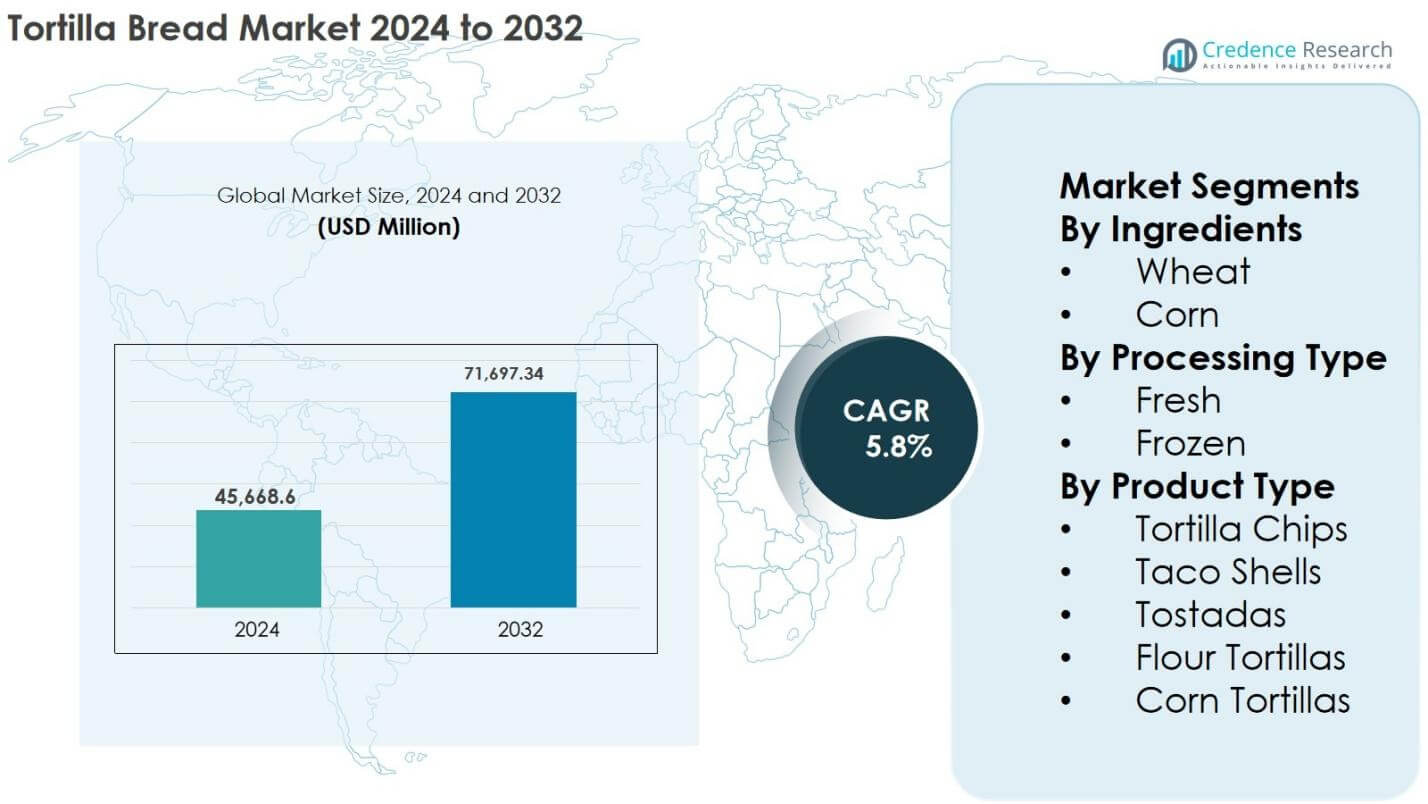
Tortilla Bread market size was valued USD 45,668.6 Million in 2024 and is anticipated to reach USD 71,697.34 Million by 2032, at a CAGR of 5.8% during the forecast period.
| REPORT ATTRIBUTE | DETAILS |
|---|---|
| Historical Period | 2020-2023 |
| Base Year | 2024 |
| Forecast Period | 2025-2032 |
| Tortilla Bread Market Size 2024 | USD 45,668.6 million |
| Tortilla Bread Market, CAGR | 5.8% |
| Tortilla Bread Market Size 2032 | USD 71,697.34 million |
Tortilla Bread Market Insights
- Market growth is driven by rising demand for convenient meals, expanding consumption of tortillas in quick-service restaurants, and increasing preference for corn and flour tortillas in wraps, burritos, and ready-to-eat food formats across urban households and foodservice sectors.
- Market trends include the introduction of whole-grain, gluten-free, multigrain, and clean-label tortilla variants, along with product innovation in flavored, fortified, and premium tortilla formats catering to health-conscious and multicultural consumer groups.
- Competitive dynamics are shaped by strong participation from key players such as Grupo Bimbo, Gruma, PepsiCo, General Mills, and Ole Mexican Foods, supported by portfolio expansion, private-label competition, and strategic partnerships with retail and foodservice chains.
- Regional analysis shows North America leading with 36.8% share, followed by Europe at 22.4% and Asia-Pacific at 18.9%, while corn tortillas dominate the ingredients segment with 58.3% share driven by traditional consumption and gluten-free appeal.
Tortilla Bread Market Segmentation Analysis:
By Ingredients
The Tortilla Bread market by ingredients is primarily divided into wheat and corn, with corn emerging as the dominant sub-segment, accounting for 58.3% market share in 2024. Its leadership is driven by strong consumer preference for traditional flavors, clean-label profiles, and gluten-free positioning that aligns with health-conscious and ethnic food trends. Corn tortillas benefit from widespread use in quick-service restaurants and household consumption, particularly in Latin American and North American cuisines. Meanwhile, wheat-based tortillas continue to grow steadily due to their softer texture and versatility in wraps, sandwiches, and fusion snack applications.
- For instance, Mission Foods highlights its corn tortillas as gluten-free and made with simple ingredients, aligning with U.S. shoppers’ growing demand for clean labels and allergen-friendly options.
By Processing Type
In terms of processing type, the market is segmented into fresh and frozen tortillas, with fresh tortillas holding the dominant position at 64.7% market share in 2024. This leadership is supported by rising demand for bakery-fresh products, shorter supply chains, and the expanding presence of in-store tortilla bakeries across supermarkets and convenience stores. Consumers increasingly associate fresh tortillas with superior taste, softness, and authenticity, driving repeat purchases. However, the frozen segment is gaining traction due to longer shelf life, export suitability, and growing adoption in foodservice formats and institutional catering environments.
- For instance, Mexican retailers like Soriana and Chedraui operate in-store tortillerías that press corn and flour tortillas on-site, reinforcing perceptions of freshness and authenticity.
By Product Type
The product-type segment includes tortilla chips, taco shells, tostadas, flour tortillas, and corn tortillas, with flour tortillas representing the dominant sub-segment at 41.6% market share in 2024. Their leadership is driven by versatility in wraps, burritos, sandwiches, and ready-to-eat meal formats, making them highly popular in both retail and foodservice channels. Demand is further supported by expanding Western-style fast-casual dining and fusion cuisines. Corn tortillas, tortilla chips, and taco shells continue to register strong growth, supported by snacking trends, rising Tex-Mex cuisine popularity, and wider penetration in global convenience food markets.
KEY GROWTH DRIVERS
Rising Demand for Convenient and Ethnic Food Products
The Tortilla Bread market is expanding rapidly as consumers increasingly prefer convenient, ready-to-use bakery and flatbread formats that support quick meal preparation and on-the-go consumption. The rising popularity of Mexican, Tex-Mex, and fusion cuisines across North America, Europe, and Asia has strengthened tortilla adoption in both household and foodservice segments. Urbanization, growing working-class populations, and lifestyle shifts toward snacking and wrap-based meals further accelerate demand. Manufacturers benefit from strong penetration in quick-service restaurants and fast-casual dining formats, where tortillas are widely used in burritos, tacos, quesadillas, and wraps. The increasing inclusion of tortillas in global retail assortments, coupled with rising brand investments in product availability, packaging innovation, and distribution networks, continues to reinforce category growth. As tortillas become mainstream alternatives to conventional bread and sandwich formats, the market experiences sustained volume expansion supported by evolving consumption habits and widening acceptance among health-conscious and multicultural consumer groups.
- For instance, Taco Bell and Chipotle Mexican Grill have built core menus around tortillas in formats such as burritos, tacos, and quesadillas across thousands of outlets worldwide, normalizing tortillas as everyday meal carriers.
Health and Nutrition Orientation Supporting Product Adoption
The Tortilla Bread market benefits significantly from growing consumer awareness of healthier and lighter bakery alternatives, particularly as tortillas are perceived to contain fewer calories and fats compared to traditional bread formats. Demand is rising for whole-grain, multigrain, low-carbohydrate, high-fiber, and gluten-free tortilla variants, especially among fitness-oriented and diabetic consumers. Corn-based tortillas appeal strongly to consumers seeking clean-label and allergen-friendly options, while wheat and protein-enriched formulations support premiumization trends. Food manufacturers actively reformulate products using natural ingredients, reduced preservatives, and fortified nutritional profiles to align with wellness preferences. The expanding vegan, plant-based, and clean-eating consumer base further fuels demand for tortillas as versatile meal carriers and healthy snack bases. Marketing campaigns emphasizing digestive health, weight management, and nutritional balance continue to reposition tortillas as a balanced and lifestyle-compatible food choice, reinforcing sustained category demand across emerging and developed markets.
- For instance, La Tortilla Factory offers low-carb, high-fiber tortillas and clearly communicates calorie and carb counts on front-of-pack labels to appeal to health-oriented buyers.
Expansion of Retail, E-Commerce, and Foodservice Distribution Channels
A major growth driver for the Tortilla Bread market is the continued expansion of modern retail, hypermarkets, convenience stores, specialty bakeries, and online grocery platforms that improve product accessibility and visibility. Globalization of food retail formats enables tortilla manufacturers to expand into new regions, enhancing consumer exposure and trial adoption. The rapid growth of e-commerce and direct-to-consumer grocery delivery services further increases product reach, particularly for premium and niche tortilla variants. At the same time, the foodservice industry - including quick-service chains, casual dining restaurants, cafés, catering services, and institutional food suppliers - remains a primary demand generator. Partnerships between tortilla producers and restaurant chains drive large-volume procurement and menu innovation. Private-label offerings in supermarkets and multinational supermarket networks also stimulate competitive pricing and product diversification. As distribution ecosystems strengthen worldwide, the market experiences continuous demand growth supported by wider consumer access and stronger commercial channel integration.
KEY TRENDS & OPPORTUNITIES
Product Innovation, Premiumization, and Clean-Label Reformulations
One of the key trends shaping the Tortilla Bread market is the rapid pace of product innovation focused on premium quality, ingredient transparency, and functional nutrition. Manufacturers increasingly develop artisan-style, flavored, organic, non-GMO, fortified, and specialty tortilla variants to appeal to evolving taste preferences and dietary lifestyles. Innovations include high-protein tortillas, keto-friendly and low-carb alternatives, vegetable-infused bases, and ancient-grain formulations that enhance nutritional appeal and diversify usage occasions. Premium packaging formats such as resealable pouches and extended-shelf-life technologies support convenience and freshness retention. Clean-label claims, reduced additives, and minimal-ingredient recipes continue to influence consumer purchasing decisions, especially among younger and health-aware demographics. These innovation-driven developments create strong differentiation opportunities for brands, enabling premium pricing strategies and new consumption occasions across snacking, meal replacement, and prepared food categories, while simultaneously strengthening brand loyalty and international category penetration.
- For instance, Old El Paso provides gluten-free and corn-based tortillas in several countries, catering to gluten-avoidant and allergen-sensitive consumers seeking simple ingredient lists.
Global Expansion of Fusion Cuisine, Snacking Culture, and Meal Customization
The Tortilla Bread market experiences strong opportunity growth from the expanding global acceptance of fusion cuisine, cross-cultural eating habits, and personalized meal formats. Tortillas increasingly replace traditional bread in wraps, rolls, sandwiches, pizzas, and gourmet snack concepts, supporting culinary creativity and customization. The rising influence of food delivery platforms, café culture, and meal-kit services stimulates tortilla consumption across convenience-driven and premium dining formats. Younger consumers, urban households, and expatriate communities favor tortillas for their versatility and ability to accommodate diverse fillings, sauces, and dietary preferences. The global snacking trend further amplifies consumption of tortilla chips, taco shells, and tostadas, reinforcing demand beyond core staple meal occasions. As international chefs, restaurant chains, and home-cooking enthusiasts integrate tortillas into contemporary and multicultural recipes, the market gains long-term opportunities driven by evolving gastronomy trends and expanding lifestyle-driven eating patterns.
- For instance, Starbucks and McDonald’s use tortilla-style wraps and breakfast burritos in multiple countries, allowing consumers to customize fillings and adapt formats to local tastes.
KEY CHALLENGES
Rising Raw Material Costs and Supply Chain Fluctuations
One of the key challenges in the Tortilla Bread market arises from volatility in the prices of key raw materials such as corn, wheat, vegetable oils, and packaging inputs, which directly affect production economics and profit margins. Climatic uncertainties, agricultural supply disruptions, trade restrictions, and global commodity fluctuations lead to unpredictable cost cycles, especially in regions dependent on import-based supply chains. Manufacturers face mounting pressure to balance cost efficiency with product quality and pricing competitiveness, particularly in price-sensitive consumer markets. Transportation expenses, labor costs, and energy-intensive production requirements further intensify operational challenges. Smaller producers often struggle to maintain consistent profitability or scale operations during cost-inflation periods, while premium brands must carefully manage value positioning. These supply-side instabilities create operational risk for market participants and may constrain expansion in emerging and developing economies.
Intense Market Competition and Product Substitution Risks
The Tortilla Bread market also faces strong competitive pressures due to the presence of multinational bakery manufacturers, regional brands, private-label suppliers, and local artisanal producers competing within similar price and product segments. High product availability and limited differentiation across standard tortilla varieties intensify price competition, particularly in mass-market retail channels. In addition, tortillas increasingly compete with alternative flatbreads such as pita, naan, lavash, chapati, and sandwich wraps, which can substitute consumption in multicultural food environments. Shifting consumer preferences, brand loyalty challenges, and evolving dietary trends may also influence purchasing behavior. To remain competitive, manufacturers must continuously invest in innovation, marketing, quality enhancement, and brand positioning. Failure to adapt to changing consumer expectations or regional taste preferences may restrict long-term growth potential and weaken market presence across key distribution channels.
Regional Analysis
North America
North America holds the leading position in the Tortilla Bread market, accounting for 36.8% market share in 2024, supported by strong consumption across the U.S. and Mexico, where tortillas serve as a staple food in household and foodservice applications. The region benefits from the widespread popularity of Tex-Mex cuisine, well-established tortilla brands, and expanding fast-casual restaurant chains. Growth is further reinforced by rising demand for convenient wraps, burritos, and ready-to-eat snacks, along with product innovations such as gluten-free, whole-grain, and high-fiber tortillas. Retail penetration, private-label expansion, and multicultural population trends continue to strengthen regional market growth.
Europe
Europe represents a rapidly expanding market with 22.4% market share in 2024, driven by increasing adoption of tortillas as versatile meal carriers in urban and health-conscious consumer segments. Demand is rising across the U.K., Germany, Spain, and France due to the growing popularity of international cuisines, premium bakery innovation, and the expansion of supermarket private-label offerings. Tortillas are increasingly used as substitutes for traditional bread in wraps, snacks, and fusion meal formats. The market continues to benefit from strong foodservice demand, product diversification, and growing acceptance of gluten-free and clean-label tortilla formulations across mainstream retail channels.
Asia-Pacific
Asia-Pacific is one of the fastest-growing regions in the Tortilla Bread market, holding 18.9% market share in 2024, supported by urbanization, rising disposable incomes, and expanding Western-style dining culture. Consumer adoption is increasing in China, India, Japan, Australia, and Southeast Asian markets, where tortillas are used in fusion cuisine, QSR menus, and ready-to-cook meal formats. The growth of e-commerce grocery platforms, international restaurant chains, and modern retail formats further enhances product accessibility. Manufacturers increasingly target younger consumers and expatriate communities, while diversified flavor variants and healthy tortilla options continue to strengthen regional market penetration.
Latin America
Latin America accounts for 14.1% market share in 2024, driven by the deep cultural integration of tortillas in traditional diets across Mexico, Central America, and parts of South America. The market benefits from strong household consumption, rising packaged tortilla production, and modernization of small-scale tortilla manufacturing facilities. Urban lifestyle changes, supermarket expansion, and the growth of value-added tortilla snacks such as tostadas and tortilla chips further support demand. Premium flour-based and fortified tortilla variants are gaining visibility in urban retail channels, while foodservice expansion and rising quick-meal consumption trends contribute significantly to regional market growth.
Middle East & Africa
The Middle East & Africa region holds 7.8% market share in 2024, with growth driven by increasing multicultural food adoption, tourism-led hospitality development, and rising acceptance of global fast-casual dining formats. Tortillas are gaining traction as substitutes for local flatbreads in wraps, shawarma-style preparations, and quick-serve snack offerings. Expanding retail chains, import availability, and growing expatriate populations in Gulf countries support category development. Demand for frozen and long-shelf-life tortilla products is particularly strong in institutional and foodservice channels. Although the market is emerging, increasing western-influenced food preferences and urban consumption patterns continue to create long-term growth opportunities.
Tortilla Bread Market Segmentations:
By Ingredients
- Wheat
- Corn
By Processing Type
- Fresh
- Frozen
By Product Type
- Tortilla Chips
- Taco Shells
- Tostadas
- Flour Tortillas
- Corn Tortillas
By Geography
- North America
- U.S.
- Canada
- Mexico
- Europe
- Germany
- France
- U.K.
- Italy
- Spain
- Rest of Europe
- Asia Pacific
- China
- Japan
- India
- South Korea
- South-east Asia
- Rest of Asia Pacific
- Latin America
- Brazil
- Argentina
- Rest of Latin America
- Middle East & Africa
- GCC Countries
- South Africa
- Rest of the Middle East and Africa
Competitive Landscape
The Tortilla Bread market features a strong and diversified competitive landscape led by global and regional players such as Grupo Bimbo SAB de CV, Gruma SAB de CV, PepsiCo Inc., General Mills, Tyson Foods Inc., Ole Mexican Foods Inc., La Tortilla Factory, Easy Foods Inc., Azteca Foods Inc., and Catallia Mexican Foods. These companies focus on product innovation, geographic expansion, and portfolio diversification across wheat, corn, fresh, frozen, and value-added tortilla variants to strengthen brand positioning. Leading manufacturers invest in automation, packaging improvements, and supply-chain optimization to enhance production efficiency and product shelf life, particularly for retail and foodservice channels. Private-label competition remains strong in supermarkets and hypermarkets, driving pricing pressure and encouraging differentiation through clean-label, gluten-free, multigrain, and high-fiber formulations. Strategic partnerships with quick-service restaurant chains and convenience food brands continue to expand volume demand. Meanwhile, acquisitions, regional manufacturing capacity additions, and new product introductions support market consolidation and competitive advantage across emerging and developed markets.
Key Player Analysis
- Ole Mexican Foods Inc.
- PepsiCo Inc.
- Catallia Mexican Foods
- Tyson Foods Inc.
- La Tortilla Factory
- Easy Foods Inc.
- Aranda's Tortilla Company Inc.
- Grupo Bimbo SAB de CV
- Azteca Foods Inc.
- General Mills
Recent Developments
- In June 2025, C.H. Guenther & Son LLC completed the acquisition of Fresca Mexican Foods, expanding its tortilla manufacturing capacity and strengthening foodservice and quick-service restaurant partnerships in North America.
- In January 2025, PepsiCo completed its acquisition of Siete Foods, a Texas-based grain-free tortilla and Mexican foods producer, enhancing its footprint in the health-focused tortilla segment.
- In June 2024, Tortilla Group acquired Fresh Burritos, the largest fast-casual Mexican restaurant group in France, marking a strategic expansion in the European casual dining segment.
Report Coverage
The research report offers an in-depth analysis based on Ingredients, Processing Type, Product Type and Geography. It details leading market players, providing an overview of their business, product offerings, investments, revenue streams, and key applications. Additionally, the report includes insights into the competitive environment, SWOT analysis, current market trends, as well as the primary drivers and constraints. Furthermore, it discusses various factors that have driven market expansion in recent years. The report also explores market dynamics, regulatory scenarios, and technological advancements that are shaping the industry. It assesses the impact of external factors and global economic changes on market growth. Lastly, it provides strategic recommendations for new entrants and established companies to navigate the complexities of the market.
Future Outlook
- The market will continue to grow as tortillas gain wider acceptance as convenient meal carriers in both household and foodservice applications.
- Manufacturers will increasingly invest in healthier product formulations, including whole-grain, multigrain, high-fiber, and low-carb tortilla variants.
- Demand for gluten-free and clean-label tortillas will rise as health-conscious and allergen-sensitive consumer groups expand across global markets.
- Product innovation will strengthen with the development of flavored, fortified, and functional tortillas tailored to evolving taste preferences.
- The foodservice and quick-service restaurant sector will remain a strong demand driver, supported by menu diversification and fusion cuisine trends.
- E-commerce and modern retail distribution will expand product accessibility, particularly in emerging markets and urban regions.
- Private-label participation will increase, intensifying price competition and encouraging quality enhancement and product differentiation.
- Frozen and extended-shelf-life tortilla products will gain traction to support export markets and institutional catering demand.
- Sustainability initiatives will influence packaging innovation and ingredient sourcing among leading manufacturers.
- Global market expansion will accelerate as tortillas continue to replace conventional bread in snacks, wraps, and prepared food categories.

Request a Free Sample
Fill in your details and we'll send you a free sample report.
- Sample data tables & charts
- Research methodology
Need a Custom Version of This Report?
Tailor the scope, geography, or segments to your exact requirements.
- Custom geography or segment scope
- Direct access to our analyst team
Frequently Asked Questions
What is the current market size for Tortilla Bread Market, and what is its projected size in 2032?
At what Compound Annual Growth Rate is the Tortilla Bread Market projected to grow between 2024 and 2032?
Which Tortilla Bread Market segment held the largest share in 2024?
What are the primary factors fueling the growth of the Tortilla Bread Market?
Who are the leading companies in the Tortilla Bread Market?
Which region commanded the largest share of the Tortilla Bread Market in 2024?
Table of Content
Chapter 1 Market Segmentation
- 1.1 Segmentation Framework
- 1.1.1 Product and Service Classification
- 1.1.2 Application and End-Use Classification
- 1.1.3 Technology and Solution Classification
- 1.1.4 Customer and Distribution Channel Classification
- 1.1.5 Geographic Segmentation
- 1.1.6 Market Segment Definitions and Boundaries
Chapter 2 Introduction
- 2.1 Report Objectives and Scope
- 2.2 Product Definition and Industry Terminology
- 2.3 Market Inclusions and Exclusions
- 2.4 Research Process
- 2.4.1 Primary Research and Expert Interviews
- 2.4.2 Secondary Research and Source Review
- 2.4.3 Top-Down and Bottom-Up Estimation
- 2.4.4 Data Triangulation and Verification
- 2.5 Market Size Measurement Basis
- 2.5.1 2024: USD 45,668.6 Million → 2032: USD 71,697.34 Million
- 2.6 Historical and Forecast Reference Periods
- 2.6.1 Base Year: 2024
- 2.6.2 Forecast Period: 2024-2032
- 2.7 Research Assumptions and Limitations
Chapter 3 Executive Summary
- 3.1 Market Snapshot and Key Findings
- 3.2 Base-Year Market Size, 2024
- 3.3 Forecast Market Size, 2032
- 3.4 Revenue and Volume Growth Outlook
- 3.5 Key Demand and Supply Indicators
- 3.6 Leading Market Segments
- 3.7 Fastest-Growing Market Opportunities
- 3.8 Regional Performance Highlights
- 3.9 Technology and Industry Transformation
- 3.10 Competitive Landscape Summary
- 3.11 Analyst View and Strategic Implications
Chapter 4 Global Tortilla Bread Market Trends and Developments
- 4.1 Historical Industry Development
- 4.2 Recent Market Trends and Developments
- 4.3 Demand and Customer Behavior Trends
- 4.4 Technology and Product Innovation
- 4.5 Artificial Intelligence, Automation and Digitalization
- 4.6 Local Manufacturing and Supply Chain Realignment
- 4.7 Industry Partnerships, Mergers and Acquisitions
- 4.8 Sustainability and Circular Economy Developments
- 4.9 Government and Private Sector Investment Trends
- 4.10 Emerging Business Models and Commercialization
- 4.11 Industry Developments and Announcements
Chapter 5 Global Tortilla Bread Market Production, Supply and Demand Analysis
- 5.1 Demand Trend and Consumption Analysis
- 5.2 Demand Forecast, 2024-2032
- 5.3 Production and Output Trend
- 5.4 Production and Output Forecast, 2024-2032
- 5.5 Installed Capacity and Capacity Utilization
- 5.6 Company-Wise Production Plants and Statistics
- 5.6.1 Installed Production Capacity
- 5.6.2 Actual Production
- 5.6.3 Planned Capacity and Expansion Targets
- 5.7 Supply Chain Structure and Procurement Trends
- 5.8 Supply-Demand Gap and Bottlenecks
- 5.9 Import Dependence and Sourcing Structure
- 5.10 Contract Manufacturing and Outsourcing
- 5.11 Regional Supply and Demand Concentration
Chapter 6 Global Tortilla Bread Market Pricing Analysis
- 6.1 Pricing Structure and Measurement
- 6.2 Historical Pricing Trends
- 6.3 Pricing Outlook, 2024-2032
- 6.4 Average Selling Price and Unit Economics
- 6.5 Pricing by Product and Market Segment
- 6.6 Geographic Pricing Differences
- 6.7 Key Input, Energy, Labor and Logistics Costs
- 6.8 Contract Pricing and Purchasing Models
- 6.9 Pricing Sensitivity and Competitive Positioning
- 6.10 Price, Margin and Profitability Implications
Chapter 7 Global Tortilla Bread Market Dynamics
- 7.1 Market Growth Drivers
- 7.1.1 Demand-Side Drivers
- 7.1.2 Technology and Innovation Drivers
- 7.1.3 Infrastructure and Investment Drivers
- 7.1.4 Regulatory and Policy Drivers
- 7.2 Market Restraints
- 7.2.1 Cost and Affordability Constraints
- 7.2.2 Technology and Adoption Barriers
- 7.2.3 Supply Chain and Operational Constraints
- 7.3 Market Challenges
- 7.3.1 Competitive Pressure and Margin Erosion
- 7.3.2 Skills, Infrastructure and Implementation Gaps
- 7.4 Emerging Market Opportunities
- 7.5 Market Dynamics Impact and Time-Horizon Assessment
Chapter 8 Global Tortilla Bread Value Chain Analysis
- 8.1 Industry Value Chain Overview
- 8.2 Upstream Suppliers and Critical Inputs
- 8.3 Technology and Component Providers
- 8.4 Manufacturing or Service Delivery
- 8.5 Distribution, Channel Partners and Integrators
- 8.6 Downstream Applications and End Users
- 8.7 Value Addition and Profit Pools
- 8.8 Vertical Integration and Outsourcing
- 8.9 Supplier Concentration and Risk
- 8.10 Supply Chain Localization and Resilience
Chapter 9 Global Tortilla Bread Market Regulations and Policies
- 9.1 Relevant Laws, Standards and Compliance Frameworks
- 9.2 Product, Service, Safety and Quality Requirements
- 9.3 Government Policies, Incentives and Subsidies
- 9.4 Imports, Exports and Trade Barriers
- 9.5 Public Procurement and Local Content Requirements
- 9.6 Environmental and Sustainability Compliance
- 9.7 Upcoming Policy Changes and Market Implications
Chapter 10 Global Tortilla Bread Market Hotspots and Opportunities
- 10.1 Market Opportunity Mapping and Growth Hotspots
- 10.2 High-Growth Applications and Customer Groups
- 10.3 Underserved Markets and White-Space Opportunities
- 10.4 Emerging Technology and Product Opportunities
- 10.5 New Capacity and Investment Hotspots
- 10.6 Market Entry and Expansion Opportunities
- 10.7 Distribution and Partnership Opportunities
- 10.8 Near-Term and Long-Term Commercial Potential
- 10.9 Opportunity Attractiveness and Execution Risks
Chapter 11 Global Tortilla Bread Market Outlook, 2024-2032
- 11.1 Market Size and Analysis
- 11.1.1 Revenue (Market Measurement: 2024: USD 45,668.6 Million → 2032: USD 71,697.34 Million)
- 11.1.2 Market Volume and Quantity Sold
- 11.1.3 Historical Market Size
- 11.1.4 Base-Year Market Size, 2024
- 11.2 Market Forecast, 2024-2032
- 11.2.1 Revenue Forecast to 2032
- 11.2.2 Volume Forecast to 2032
- 11.2.3 CAGR and Year-on-Year Growth
- 11.2.4 Incremental Revenue Opportunity
- 11.3 Forecast Assumptions and Scenario Analysis
- 11.3.1 Base-Case Forecast
- 11.3.2 Optimistic and Conservative Scenarios
- 11.3.3 Technology, Pricing and Policy Sensitivities
- 11.4 Market Attractiveness and Growth Outlook
Chapter 12 Global Tortilla Bread Market Segmentation and Outlook
- 12.1 Segmentation Summary and Market Shares, 2024
- 12.2 Largest and Fastest-Growing Segments
- 12.3 Segment Growth Comparison
- 12.4 Segment Attractiveness and Priority Matrix
Chapter 13 Global Tortilla Bread Geographic Market Outlook, 2024-2032
- 13.1 Regional Market Size and Share, 2024
- 13.2 Regional Market Forecast, 2024-2032
- 13.3 Regional Pricing, Production and Demand Differences
- 13.4 North America
- 13.4.1 United States
- 13.4.2 Canada
- 13.4.3 Mexico
- 13.5 Europe
- 13.5.1 Germany
- 13.5.2 France
- 13.5.3 Italy
- 13.5.4 United Kingdom
- 13.5.5 Spain
- 13.5.6 Poland
- 13.5.7 Russia
- 13.5.8 Netherlands
- 13.5.9 Belgium
- 13.5.10 Sweden
- 13.5.11 Denmark
- 13.5.12 Norway
- 13.5.13 Rest of Europe
- 13.6 Asia Pacific
- 13.6.1 China
- 13.6.2 India
- 13.6.3 Japan
- 13.6.4 South Korea
- 13.6.5 Thailand
- 13.6.6 Indonesia
- 13.6.7 Vietnam
- 13.6.8 Malaysia
- 13.6.9 Australia
- 13.6.10 Rest of Asia Pacific
- 13.7 Latin America
- 13.7.1 Brazil
- 13.7.2 Argentina
- 13.7.3 Colombia
- 13.7.4 Chile
- 13.7.5 Rest of Latin America
- 13.8 Middle East
- 13.8.1 Saudi Arabia
- 13.8.2 United Arab Emirates
- 13.8.3 Turkey
- 13.8.4 Israel
- 13.8.5 Iran
- 13.8.6 Rest of the Middle East
- 13.9 Africa
- 13.9.1 South Africa
- 13.9.2 Egypt
- 13.9.3 Nigeria
- 13.9.4 Morocco
- 13.9.5 Rest of Africa
- 13.10 Regional Investment, Policy and Supply Chain Differences
- 13.11 Regional Competitive Landscape
- 13.12 Geographic Growth Hotspots
Chapter 14 Global Tortilla Bread Technology, Innovation and Sustainability Outlook
- 14.1 Technology Landscape and Maturity
- 14.2 Product, Process and Service Innovation
- 14.3 AI, Automation and Digital Tools in the Industry
- 14.4 Technology Adoption and Performance Benchmarking
- 14.5 Innovation Pipeline and R&D Investment
- 14.6 Patent and Intellectual Property Trends
- 14.7 Energy Efficiency and Resource Management
- 14.8 Sustainability, Recycling and Circularity
- 14.9 Technology Roadmap, 2024-2032
- 14.10 Risks of Obsolescence and Technology Substitution
Chapter 15 Global Tortilla Bread Market Key Strategic Imperatives
- 15.1 Growth and Market Entry Priorities
- 15.2 High-Return Products and Segments
- 15.3 Pricing, Profitability and Cost Optimization
- 15.4 Technology Investment and Product Differentiation
- 15.5 Supply Chain Localization and Resilience
- 15.6 Distribution and Customer Acquisition
- 15.7 Partnership, Acquisition and Capacity Strategy
- 15.8 Regional Expansion Priorities
- 15.9 Short-, Medium- and Long-Term Actions
Chapter 16 Competition Outlook
- 16.1 Industry Competition Characteristics
- 16.2 Market Structure and Concentration
- 16.3 Market Share and Competitive Positioning, 2024
- 16.4 Company-Wise Revenue and Product Benchmarking
- 16.5 Production and Service Capacity Benchmarking
- 16.6 Technology, Pricing and Differentiation
- 16.7 Regional Footprint and Distribution Strength
- 16.8 Mergers, Acquisitions and Strategic Alliances
- 16.9 New Entrants and Competitive Threats
- 16.10 Porter's Five Forces and Industry Attractiveness
- 16.11 Competitive Outlook, 2024-2032
Chapter 17 Company Profiles
- 17.1 Company Coverage and Selection Criteria
- 17.2 Leading Market Participants – Standard Profile Structure
- 17.2.1 Business Description
- 17.2.2 Company Ownership and Geographic Presence
- 17.2.3 Product and Service Portfolio
- 17.2.4 Manufacturing and Operating Footprint
- 17.2.5 Production Capacity and Expansion Plans
- 17.2.6 Financial Performance and Investment
- 17.2.7 Market Share and Competitive Position
- 17.2.8 Technology and Innovation Capabilities
- 17.2.9 Strategic Alliances or Partnerships
- 17.2.10 Recent Developments
- 17.2.11 Growth Strategy and Outlook
- 17.3 Other Relevant Market Participants
Note: Every listed company is profiled on the structure shown under the first company. The company list is preliminary and may change based on research findings, market developments, data availability and client requirements.
Chapter 18 Disclaimer
- 18.1 Research and Forecast Disclaimer
- 18.2 Data Source and Estimation Limitations
Note: The depth of individual sections depends on data availability for this market. Volume, capacity, trade and other unit-based metrics are included where applicable.