
Market Overview
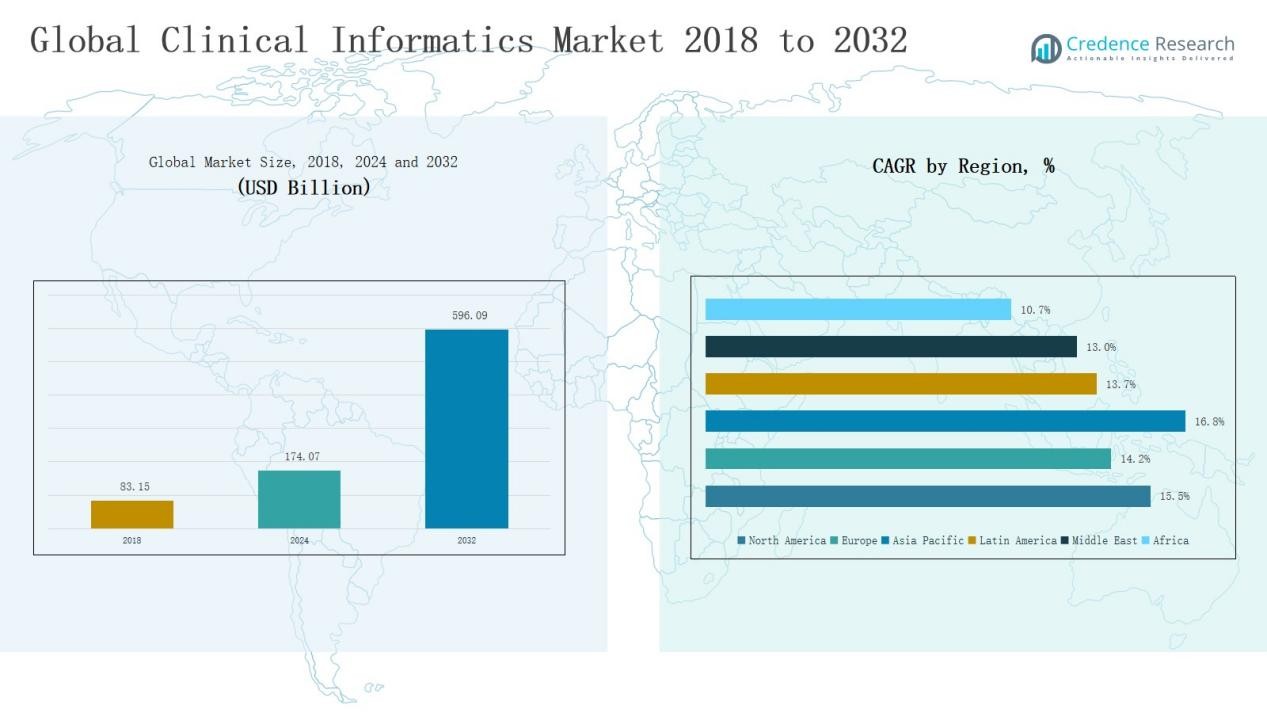
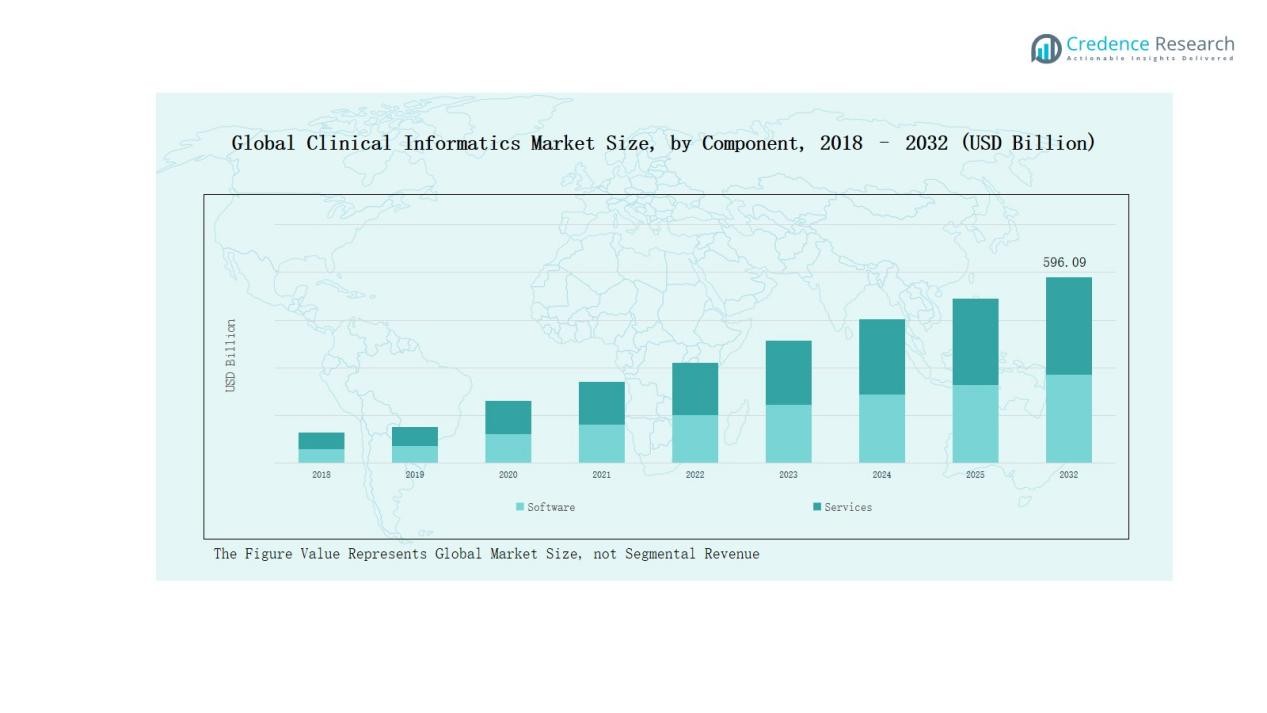
Clinical Informatics Market size was valued at USD 83.15 billion in 2018 to USD 174.07 billion in 2024 and is anticipated to reach USD 596.09 billion by 2032, at a CAGR of 15.51% during the forecast period.
| REPORT ATTRIBUTE | DETAILS |
|---|---|
| Historical Period | 2020-2024 |
| Base Year | 2024 |
| Forecast Period | 2025-2032 |
| Clinical Informatics Market Size 2024 | USD 174.07 Billion |
| Clinical Informatics Market, CAGR | 15.51% |
| Clinical Informatics Market Size 2032 | USD 596.09 Billion |
In the global Clinical Informatics Market, leading companies such as UnitedHealth Group, Koninklijke Philips N.V., GE HealthCare, Cognizant, Oracle (including Cerner), and Epic Systems dominate through strategic investments in clinical information systems, electronic health records, and data analytics platforms. Their competitive positioning is reinforced by strong service portfolios, advanced interoperability solutions, technology integration strategies, and extensive global reach. These players continually enhance product capabilities, engage in strategic partnerships, and expand into emerging markets to strengthen their market presence. Regionally, North America emerges as the largest market, capturing approximately 32.3 % of the total Clinical Informatics Market in 2025, driven by advanced healthcare infrastructure, widespread IT adoption, favorable regulatory policies, and the concentration of key industry innovators.
Market Insights
- The Clinical Informatics Market grew from USD 83.15 million in 2018 to USD 174.07 Billion in 2024 and is projected to reach USD 596.09 Billion by 2032 at a CAGR of 15.51%.
- Leading companies such as UnitedHealth Group, Koninklijke Philips N.V., GE HealthCare, Cognizant, Oracle (Cerner), and Epic Systems dominate through advanced product portfolios, interoperability solutions, and global market reach.
- Growth is fueled by rising EHR adoption, demand for data-driven healthcare decisions, government healthcare IT investments, and the integration of AI and cloud-based platforms.
- Challenges include data privacy risks, interoperability gaps across systems, and high implementation and maintenance costs, particularly for smaller healthcare providers in budget-constrained regions.
- North America leads with 35.7% market share in 2024, followed by Asia Pacific at 25.0% and Europe at 14.9%, supported by advanced infrastructure, regulatory backing, and high technology adoption.
Key Growth Drivers
Rising Adoption of Electronic Health Records (EHRs)
The increasing implementation of EHR systems across healthcare facilities significantly drives the Clinical Informatics Market. Hospitals, clinics, and research centers are transitioning from paper-based records to integrated digital platforms to enhance patient data management, reduce errors, and improve clinical outcomes. Regulatory mandates for digital health record adoption and the need for real-time access to patient information further accelerate this trend. As interoperability standards improve, EHR systems are becoming more user-friendly and capable of integrating with advanced clinical decision support systems.
- For instance, Henry County Hospital achieved top-tier EHR experience scores five years after implementing MEDITECH Expanse, reflecting successful digital transformation and clinician satisfaction.
Growing Demand for Data-Driven Healthcare Decision-Making
The healthcare industry’s shift toward evidence-based practices is fueling demand for robust clinical informatics solutions. Advanced analytics tools, integrated within informatics systems, enable clinicians to interpret large volumes of patient data for diagnosis, treatment planning, and preventive care. The rising complexity of medical data, including genomic and imaging datasets, requires efficient management solutions. This demand is amplified by the need to improve operational efficiency, reduce healthcare costs, and support personalized medicine approaches that optimize treatment effectiveness.
- For instance, Johnson & Johnson introduced the Polyphonic Digital Ecosystem in June 2024, a suite of tools that supports surgical teams in securely sharing and analyzing surgical videos to improve decision-making and outcomes.
Government Initiatives and Healthcare IT Investments
Substantial government funding and healthcare IT modernization initiatives contribute to market growth. Programs supporting telehealth, digital patient records, and health information exchanges encourage adoption of clinical informatics systems. Incentives for healthcare providers to implement certified technology solutions have accelerated deployment rates. Public-private partnerships also play a pivotal role in enhancing infrastructure for health data management. This regulatory and financial support enables wider access to advanced technologies, fosters innovation, and ensures compliance with data protection and security standards.
Key Trends & Opportunities
Integration of Artificial Intelligence (AI) and Machine Learning (ML)
AI and ML are increasingly integrated into clinical informatics platforms to enhance predictive analytics, automate administrative tasks, and improve diagnostic accuracy. These technologies analyze complex datasets, such as patient histories and imaging records, to detect patterns and support early disease detection. AI-powered tools also enable population health management, remote patient monitoring, and resource allocation optimization. As algorithms become more refined and regulatory acceptance grows, AI integration offers a significant competitive edge for vendors and opens new market opportunities.
- For instance, Corewell Health implemented AI-driven predictive analytics to identify patients with high readmission risk, preventing 200 readmissions and saving $5 million in associated costs.
Expansion of Cloud-Based Deployment Models
The shift toward cloud-based clinical informatics solutions is creating opportunities for scalability, cost-efficiency, and remote access to patient data. Cloud infrastructure supports real-time collaboration among healthcare professionals across geographies and ensures faster deployment of system updates. It also reduces the burden of on-premises IT maintenance while enhancing disaster recovery capabilities. With advancements in cybersecurity measures and increasing trust in cloud platforms, more healthcare organizations are migrating their data to secure, compliant cloud environments, further expanding market potential.
- For instance, Mount Sinai Health System scaled its Epic electronic health record (EHR) database on Microsoft Azure's "Large Instances," handling up to 50 million database accesses to meet growing demands.
Key Challenges
Data Privacy and Security Concerns
The storage and exchange of sensitive patient information in clinical informatics systems raise significant privacy and security concerns. Healthcare organizations face increasing risks of data breaches, ransomware attacks, and unauthorized access. Compliance with stringent data protection regulations, such as HIPAA and GDPR, adds complexity to system design and maintenance. Vendors must invest heavily in encryption, access control, and threat detection technologies, which can increase implementation costs and slow down adoption among smaller healthcare providers.
Interoperability Issues Across Systems
A major challenge in the Clinical Informatics Market is the lack of seamless interoperability between different healthcare IT systems. Disparate data formats, proprietary software designs, and inconsistent standards hinder smooth information exchange. These integration gaps limit the ability of healthcare providers to obtain a complete patient profile, impacting care coordination and efficiency. Efforts to adopt universal data standards are ongoing, but achieving full interoperability requires significant collaboration among technology vendors, healthcare institutions, and regulatory bodies.
High Implementation and Maintenance Costs
Deploying comprehensive clinical informatics solutions involves substantial upfront investments in hardware, software, and staff training. Smaller healthcare facilities often find these costs prohibitive, especially in regions with limited healthcare funding. Ongoing maintenance, system upgrades, and cybersecurity measures further add to the financial burden. The return on investment may take several years to materialize, making budget-conscious organizations hesitant to adopt advanced informatics platforms despite their long-term benefits.
Regional Analysis
North America
North America leads the Clinical Informatics Market with an estimated 35.7% share in 2024, driven by advanced healthcare infrastructure, high EHR adoption, and strong regulatory support. The market grew from USD 36.45 billion in 2018 to USD 75.51 billion in 2024 and is projected to reach USD 259.30 billion by 2032, registering a 15.5% CAGR. Significant investments in AI-driven healthcare solutions and interoperability initiatives strengthen the region’s dominance. The presence of major industry players and a favorable reimbursement environment further accelerate adoption, while continued government funding fosters technological innovation and data-driven healthcare practices.
Europe
Europe accounts for 14.9% of the market in 2024, supported by strong regulatory frameworks, public healthcare funding, and digital transformation initiatives across hospitals. The market expanded from USD 15.90 billion in 2018 to USD 31.51 billion in 2024, with projections indicating USD 98.36 billion by 2032 at a 14.2% CAGR. Key growth drivers include the EU’s emphasis on healthcare data security, interoperability projects, and increased demand for telehealth platforms. Countries such as the UK, Germany, and France lead adoption, while emerging Eastern European markets are gradually investing in clinical informatics to improve healthcare delivery efficiency.
Asia Pacific
Asia Pacific captures 25.0% of the global share in 2024, showing the fastest expansion with a 16.8% CAGR. Market value rose from USD 23.89 billion in 2018 to USD 52.83 billion in 2024, and is expected to reach USD 197.38 billion by 2032. Rapid digitization of healthcare systems, government-backed eHealth initiatives, and growing medical tourism in countries like India, China, and Singapore drive demand. The region benefits from a rising population, increasing chronic disease burden, and strong investments in telemedicine and AI-powered healthcare analytics, making it a highly attractive market for global vendors.
Latin America
Latin America holds a 5.8% market share in 2024, expanding at a 13.7% CAGR. Market size increased from USD 3.76 billion in 2018 to USD 7.77 billion in 2024, with forecasts showing USD 23.42 billion by 2032. Growth is fueled by modernization of healthcare IT infrastructure, expanding private hospital networks, and increasing telehealth adoption in Brazil, Mexico, and Argentina. Government-led digital health programs and improved internet connectivity support wider deployment of cloud-based clinical informatics solutions, though budget constraints and uneven technology access remain challenges in rural areas.
Middle East
The Middle East represents 4.1% of the global market in 2024, with a growth rate of 13.0% CAGR. The market rose from USD 2.26 billion in 2018 to USD 4.32 billion in 2024, and is projected to hit USD 12.42 billion by 2032. Increasing investments in smart hospital projects, digital health initiatives by GCC countries, and growing AI adoption in diagnostics fuel market expansion. The UAE and Saudi Arabia lead regional adoption, supported by government strategies to create paperless healthcare systems, while data security regulations ensure safe integration of clinical informatics platforms.
Africa
Africa holds the smallest share at 3.5% in 2024, but demonstrates steady growth with a 10.7% CAGR. The market expanded from USD 0.88 billion in 2018 to USD 2.13 billion in 2024, with projections reaching USD 5.22 billion by 2032. Demand is driven by gradual digitalization of public hospitals, international health aid programs, and rising telemedicine adoption in South Africa, Egypt, and Nigeria. Infrastructure limitations, workforce shortages, and low IT budgets remain challenges; however, mobile health solutions and donor-funded digital health projects offer strong potential for market expansion.
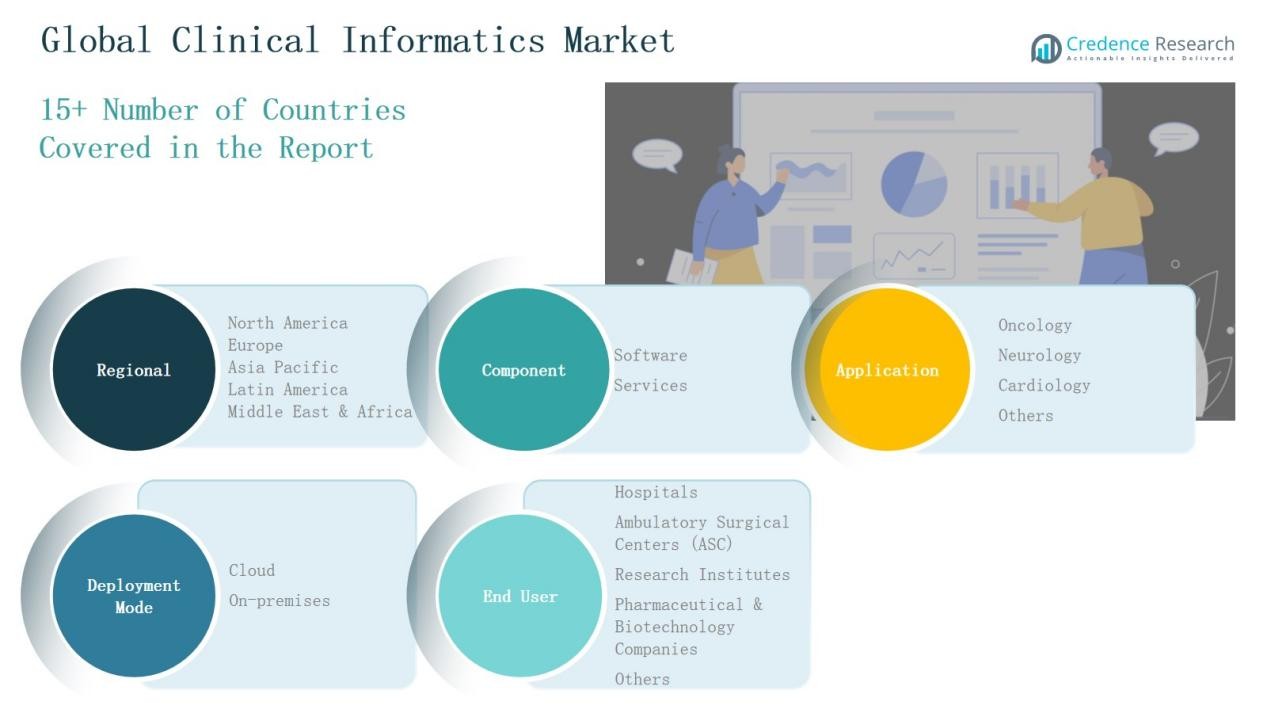
Market Segmentations:
By Component
- Software
- Services
By Application
- Oncology
- Neurology
- Cardiology
- Others
By Deployment Mode
- Cloud
- On-premises
By End User
- Hospitals
- Ambulatory Surgical Centers (ASC)
- Research Institutes
- Pharmaceutical & Biotechnology Companies
- Others
By Region
- North America
- U.S.
- Canada
- Mexico
- Europe
- Germany
- France
- U.K.
- Italy
- Spain
- Rest of Europe
- Asia Pacific
- China
- Japan
- India
- South Korea
- South-east Asia
- Rest of Asia Pacific
- Latin America
- Brazil
- Argentina
- Rest of Latin America
- Middle East & Africa
- GCC Countries
- South Africa
- Rest of the Middle East and Africa
Competitive Landscape
The competitive landscape of the Clinical Informatics Market is characterized by the presence of global technology leaders, healthcare IT specialists, and emerging innovators competing to deliver advanced, interoperable, and secure solutions. Key players such as Cerner Corporation, Epic Systems Corporation, Allscripts Healthcare Solutions, McKesson Corporation, Philips Healthcare, Siemens Healthineers, IBM Watson Health, GE Healthcare, Oracle Corporation, and NextGen Healthcare maintain strong market positions through extensive product portfolios, large customer bases, and long-term contracts with healthcare providers. These companies focus on strategic partnerships, mergers, and acquisitions to expand their capabilities, geographic reach, and technology integration, particularly in areas like AI, predictive analytics, and cloud-based platforms. Innovation in interoperability, patient engagement tools, and data analytics remains central to competitive differentiation. Intense competition drives continuous investment in R&D, while market growth opportunities in emerging economies encourage global vendors to adapt solutions to local regulatory requirements, infrastructure constraints, and specific clinical needs.
Key Players
- Cerner Corporation
- Epic Systems Corporation
- Allscripts Healthcare Solutions
- McKesson Corporation
- Meditech
- Philips Healthcare
- Siemens Healthineers
- IBM Watson Health
- GE Healthcare
- Oracle Corporation
- NextGen Healthcare
- Athenahealth
Recent Developments
- In November 2023, Certara launched its Simcyp Biopharmaceutics software to enhance drug formulation efficiency and streamline pharmaceutical development processes.
- In January 2024, Evotec collaborated with the Crohn's & Colitis Foundation to accelerate the development of innovative drug targets for inflammatory bowel diseases.
- In June 2023, STARLIMS entered a strategic partnership with INFOCOM to expand and strengthen informatics solutions across the Japanese market.
- In May 2025, Cambio Healthcare Systems announced its acquisition plan for LeapScribe AB, scheduled for completion by June 30, 2025, to boost clinical decision support capabilities.
- In February 2025, Philips partnered with Mass General Brigham (MGB) to develop an AI-powered data infrastructure for integrating and analyzing real-time healthcare data across multiple systems.
Market Concentration & Characteristics
The Clinical Informatics Market demonstrates a moderately high level of concentration, with a few dominant players controlling a significant share through established client relationships, comprehensive product suites, and strong brand recognition. It is characterized by steady technological innovation, driven by the demand for interoperability, predictive analytics, and integrated healthcare IT solutions. The market features a mix of global leaders, regional vendors, and niche specialists, each targeting specific segments such as electronic health records, clinical decision support, and telehealth integration. Competition is intense, prompting continuous investment in R&D, strategic alliances, and geographic expansion. Regulatory compliance, data security, and scalability remain critical differentiators influencing vendor selection. The adoption of cloud-based platforms and AI-powered analytics is accelerating market transformation, while growth opportunities in emerging economies encourage tailored offerings. The ability to provide secure, interoperable, and user-friendly solutions positions vendors to strengthen their competitive standing in this dynamic healthcare technology environment.
Report Coverage
The research report offers an in-depth analysis based on Component, Application, Deployment mode, End User and Region. It details leading market players, providing an overview of their business, product offerings, investments, revenue streams, and key applications. Additionally, the report includes insights into the competitive environment, SWOT analysis, current market trends, as well as the primary drivers and constraints. Furthermore, it discusses various factors that have driven market expansion in recent years. The report also explores market dynamics, regulatory scenarios, and technological advancements that are shaping the industry. It assesses the impact of external factors and global economic changes on market growth. Lastly, it provides strategic recommendations for new entrants and established companies to navigate the complexities of the market.
Future Outlook
- Demand for interoperable systems will increase to enable seamless data exchange across healthcare networks.
- Adoption of AI and machine learning will enhance predictive analytics and clinical decision-making.
- Cloud-based deployment will expand, offering scalability, cost efficiency, and remote accessibility.
- Integration of telehealth platforms will strengthen real-time patient monitoring and care delivery.
- Government initiatives will continue to drive healthcare IT modernization and digital record adoption.
- Personalized medicine will benefit from advanced data analytics and patient-specific insights.
- Cybersecurity measures will become more sophisticated to protect sensitive patient information.
- Emerging markets will adopt clinical informatics solutions to improve healthcare infrastructure.
- Vendor competition will intensify, leading to accelerated innovation and technology integration.
- Mobile health applications will become a key component of patient engagement and self-care management.

Request a Free Sample
Fill in your details and we'll send you a free sample report.
- Sample data tables & charts
- Research methodology
Market Dynamics
Rising Adoption of Electronic Health Records (EHRs)
Healthcare facilities are rapidly transitioning from paper-based records to integrated digital platforms, driven by regulatory mandates and the need for real-time patient data access. This shift enhances patient data management, reduces errors, and improves clinical outcomes, fueling demand for clinical informatics solutions.
Growing Demand for Data-Driven Healthcare Decision-Making
The increasing complexity of medical data and the shift toward evidence-based practices require robust informatics systems with advanced analytics. These tools help clinicians interpret large datasets for diagnosis, treatment planning, and preventive care, supporting operational efficiency and personalized medicine.
Government Initiatives and Healthcare IT Investments
Substantial government funding and modernization programs for healthcare IT, including incentives for digital record adoption and telehealth, are accelerating the deployment of clinical informatics systems. Regulatory and financial support enables broader access to advanced technologies and fosters innovation.
Integration of Artificial Intelligence (AI) and Machine Learning (ML)
AI and ML are being embedded into clinical informatics platforms to enhance predictive analytics, automate administrative tasks, and improve diagnostic accuracy. These technologies support early disease detection, population health management, and resource optimization, offering a competitive edge to vendors.
Expansion of Cloud-Based Deployment Models
The shift to cloud-based informatics solutions enables scalability, cost efficiency, and remote access to patient data. Cloud infrastructure supports real-time collaboration, faster system updates, and improved disaster recovery, making it increasingly attractive for healthcare organizations.
Need a Custom Version of This Report?
Tailor the scope, geography, or segments to your exact requirements.
- Custom geography or segment scope
- Direct access to our analyst team
Frequently Asked Questions
What is the current market size for Clinical Informatics Market, and what is its projected size in 2032?
At what Compound Annual Growth Rate is the Clinical Informatics Market projected to grow between 2025 and 2032?
Which Clinical Informatics Market segment held the largest share in 2024?
What are the primary factors fueling the growth of the Clinical Informatics Market?
Who are the leading companies in the Clinical Informatics Market?
Which region commanded the largest share of the Clinical Informatics Market in 2024?
Table of Content
Chapter 1 Market Segmentation
- 1.1 Segmentation Framework
- 1.1.1 Product and Service Classification
- 1.1.2 Application and End-Use Classification
- 1.1.3 Technology and Solution Classification
- 1.1.4 Customer and Distribution Channel Classification
- 1.1.5 Geographic Segmentation
- 1.1.6 Market Segment Definitions and Boundaries
- 1.2 By End User
- 1.2.1 Hospitals
- 1.2.2 Ambulatory Surgical Centers (ASC)
- 1.2.3 Research Institutes
- 1.2.4 Pharmaceutical & Biotechnology Companies
- 1.2.5 Others
- 1.3 By Component
- 1.3.1 Software
- 1.3.2 Services
- 1.4 By Application
- 1.4.1 Oncology
- 1.4.2 Neurology
- 1.4.3 Cardiology
- 1.4.4 Others
- 1.5 By Deployment Mode
- 1.5.1 Cloud
- 1.5.2 On-premises
Chapter 2 Introduction
- 2.1 Report Objectives and Scope
- 2.2 Product Definition and Industry Terminology
- 2.3 Market Inclusions and Exclusions
- 2.4 Research Process
- 2.4.1 Primary Research and Expert Interviews
- 2.4.2 Secondary Research and Source Review
- 2.4.3 Top-Down and Bottom-Up Estimation
- 2.4.4 Data Triangulation and Verification
- 2.5 Market Size Measurement Basis
- 2.5.1 2024: USD 174.07 billion → 2032: USD 596.09 billion
- 2.6 Historical and Forecast Reference Periods
- 2.6.1 Base Year: 2024
- 2.6.2 Forecast Period: 2024-2032
- 2.7 Research Assumptions and Limitations
Chapter 3 Executive Summary
- 3.1 Market Snapshot and Key Findings
- 3.2 Base-Year Market Size, 2024
- 3.3 Forecast Market Size, 2032
- 3.4 Revenue and Volume Growth Outlook
- 3.5 Key Demand and Supply Indicators
- 3.6 Leading Market Segments
- 3.7 Fastest-Growing Market Opportunities
- 3.8 Regional Performance Highlights
- 3.9 Technology and Industry Transformation
- 3.10 Competitive Landscape Summary
- 3.11 Analyst View and Strategic Implications
Chapter 4 Global Clinical Informatics Market Trends and Developments
- 4.1 Historical Industry Development
- 4.2 Recent Market Trends and Developments
- 4.3 Demand and Customer Behavior Trends
- 4.4 Technology and Product Innovation
- 4.5 Artificial Intelligence, Automation and Digitalization
- 4.6 Local Manufacturing and Supply Chain Realignment
- 4.7 Industry Partnerships, Mergers and Acquisitions
- 4.8 Sustainability and Circular Economy Developments
- 4.9 Government and Private Sector Investment Trends
- 4.10 Emerging Business Models and Commercialization
- 4.11 Industry Developments and Announcements
Chapter 5 Global Clinical Informatics Market Production, Supply and Demand Analysis
- 5.1 Demand Trend and Consumption Analysis
- 5.2 Demand Forecast, 2024-2032
- 5.3 Production and Output Trend
- 5.4 Production and Output Forecast, 2024-2032
- 5.5 Installed Capacity and Capacity Utilization
- 5.6 Company-Wise Production Plants and Statistics
- 5.6.1 Installed Production Capacity
- 5.6.2 Actual Production
- 5.6.3 Planned Capacity and Expansion Targets
- 5.7 Supply Chain Structure and Procurement Trends
- 5.8 Supply-Demand Gap and Bottlenecks
- 5.9 Import Dependence and Sourcing Structure
- 5.10 Contract Manufacturing and Outsourcing
- 5.11 Regional Supply and Demand Concentration
Chapter 6 Global Clinical Informatics Market Pricing Analysis
- 6.1 Pricing Structure and Measurement
- 6.2 Historical Pricing Trends
- 6.3 Pricing Outlook, 2024-2032
- 6.4 Average Selling Price and Unit Economics
- 6.5 Pricing by Product and Market Segment
- 6.6 Geographic Pricing Differences
- 6.7 Key Input, Energy, Labor and Logistics Costs
- 6.8 Contract Pricing and Purchasing Models
- 6.9 Pricing Sensitivity and Competitive Positioning
- 6.10 Price, Margin and Profitability Implications
Chapter 7 Global Clinical Informatics Market Dynamics
- 7.1 Market Growth Drivers
- 7.1.1 Demand-Side Drivers
- 7.1.2 Technology and Innovation Drivers
- 7.1.3 Infrastructure and Investment Drivers
- 7.1.4 Regulatory and Policy Drivers
- 7.2 Market Restraints
- 7.2.1 Cost and Affordability Constraints
- 7.2.2 Technology and Adoption Barriers
- 7.2.3 Supply Chain and Operational Constraints
- 7.3 Market Challenges
- 7.3.1 Competitive Pressure and Margin Erosion
- 7.3.2 Skills, Infrastructure and Implementation Gaps
- 7.4 Emerging Market Opportunities
- 7.5 Market Dynamics Impact and Time-Horizon Assessment
Chapter 8 Global Clinical Informatics Value Chain Analysis
- 8.1 Industry Value Chain Overview
- 8.2 Upstream Suppliers and Critical Inputs
- 8.3 Technology and Component Providers
- 8.4 Manufacturing or Service Delivery
- 8.5 Distribution, Channel Partners and Integrators
- 8.6 Downstream Applications and End Users
- 8.7 Value Addition and Profit Pools
- 8.8 Vertical Integration and Outsourcing
- 8.9 Supplier Concentration and Risk
- 8.10 Supply Chain Localization and Resilience
Chapter 9 Global Clinical Informatics Market Regulations and Policies
- 9.1 Relevant Laws, Standards and Compliance Frameworks
- 9.2 Product, Service, Safety and Quality Requirements
- 9.3 Government Policies, Incentives and Subsidies
- 9.4 Imports, Exports and Trade Barriers
- 9.5 Public Procurement and Local Content Requirements
- 9.6 Environmental and Sustainability Compliance
- 9.7 Upcoming Policy Changes and Market Implications
Chapter 10 Global Clinical Informatics Market Hotspots and Opportunities
- 10.1 Market Opportunity Mapping and Growth Hotspots
- 10.2 High-Growth Applications and Customer Groups
- 10.3 Underserved Markets and White-Space Opportunities
- 10.4 Emerging Technology and Product Opportunities
- 10.5 New Capacity and Investment Hotspots
- 10.6 Market Entry and Expansion Opportunities
- 10.7 Distribution and Partnership Opportunities
- 10.8 Near-Term and Long-Term Commercial Potential
- 10.9 Opportunity Attractiveness and Execution Risks
Chapter 11 Global Clinical Informatics Market Outlook, 2024-2032
- 11.1 Market Size and Analysis
- 11.1.1 Revenue (Market Measurement: 2024: USD 174.07 billion → 2032: USD 596.09 billion)
- 11.1.2 Market Volume and Quantity Sold
- 11.1.3 Historical Market Size
- 11.1.4 Base-Year Market Size, 2024
- 11.2 Market Forecast, 2024-2032
- 11.2.1 Revenue Forecast to 2032
- 11.2.2 Volume Forecast to 2032
- 11.2.3 CAGR and Year-on-Year Growth
- 11.2.4 Incremental Revenue Opportunity
- 11.3 Forecast Assumptions and Scenario Analysis
- 11.3.1 Base-Case Forecast
- 11.3.2 Optimistic and Conservative Scenarios
- 11.3.3 Technology, Pricing and Policy Sensitivities
- 11.4 Market Attractiveness and Growth Outlook
Chapter 12 Global Clinical Informatics Market Segmentation and Outlook
- 12.1 Segmentation Summary and Market Shares, 2024
- 12.2 Largest and Fastest-Growing Segments
- 12.3 By End User - Market Size and Forecast, 2024-2032
- 12.3.1 Segment Definition and Scope
- 12.3.2 Historical Market Size
- 12.3.3 Revenue Forecast, 2024-2032
- 12.3.4 Volume Forecast, 2024-2032
- 12.3.5 Base-Year Market Share, 2024
- 12.3.6 Segment CAGR and Growth Drivers
- 12.3.7 Subsegment Market Size and Forecast
- 12.3.7.1 Hospitals
- 12.3.7.2 Ambulatory Surgical Centers (ASC)
- 12.3.7.3 Research Institutes
- 12.3.7.4 Pharmaceutical & Biotechnology Companies
- 12.3.7.5 Others
- 12.3.8 Subsegment Pricing and Adoption Trends
- 12.3.9 Leading Suppliers and Competition
- 12.3.10 Regional Demand and Opportunities
- 12.4 By Component - Market Size and Forecast, 2024-2032
- 12.4.1 Segment Definition and Scope
- 12.4.2 Historical Market Size
- 12.4.3 Revenue Forecast, 2024-2032
- 12.4.4 Volume Forecast, 2024-2032
- 12.4.5 Base-Year Market Share, 2024
- 12.4.6 Segment CAGR and Growth Drivers
- 12.4.7 Subsegment Market Size and Forecast
- 12.4.7.1 Software
- 12.4.7.2 Services
- 12.4.8 Subsegment Pricing and Adoption Trends
- 12.4.9 Leading Suppliers and Competition
- 12.4.10 Regional Demand and Opportunities
- 12.5 By Application - Market Size and Forecast, 2024-2032
- 12.5.1 Segment Definition and Scope
- 12.5.2 Historical Market Size
- 12.5.3 Revenue Forecast, 2024-2032
- 12.5.4 Volume Forecast, 2024-2032
- 12.5.5 Base-Year Market Share, 2024
- 12.5.6 Segment CAGR and Growth Drivers
- 12.5.7 Subsegment Market Size and Forecast
- 12.5.7.1 Oncology
- 12.5.7.2 Neurology
- 12.5.7.3 Cardiology
- 12.5.7.4 Others
- 12.5.8 Subsegment Pricing and Adoption Trends
- 12.5.9 Leading Suppliers and Competition
- 12.5.10 Regional Demand and Opportunities
- 12.6 By Deployment Mode - Market Size and Forecast, 2024-2032
- 12.6.1 Segment Definition and Scope
- 12.6.2 Historical Market Size
- 12.6.3 Revenue Forecast, 2024-2032
- 12.6.4 Volume Forecast, 2024-2032
- 12.6.5 Base-Year Market Share, 2024
- 12.6.6 Segment CAGR and Growth Drivers
- 12.6.7 Subsegment Market Size and Forecast
- 12.6.7.1 Cloud
- 12.6.7.2 On-premises
- 12.6.8 Subsegment Pricing and Adoption Trends
- 12.6.9 Leading Suppliers and Competition
- 12.6.10 Regional Demand and Opportunities
- 12.7 Segment Growth Comparison
- 12.8 Segment Attractiveness and Priority Matrix
Chapter 13 Global Clinical Informatics End-Use and Application Market Outlook
- 13.1 End-Use Industry and Customer Demand Structure
- 13.2 Leading Applications and Customer Groups
- 13.3 End-Use Market Size, Share and Forecast
- 13.4 Major End-Use Industry Deep Dives
- 13.4.1 Customer Requirements and Use Cases
- 13.4.2 Demand and Replacement Cycles
- 13.4.3 Technical and Regulatory Considerations
- 13.4.4 Purchasing and Procurement Models
- 13.4.5 Leading Vendors and Distribution Channels
- 13.4.6 Forecast and Commercial Opportunities
- 13.5 Emerging Applications and Cross-Segment Demand
- 13.6 End-Use Industry Investment Priorities
Chapter 14 Global Clinical Informatics Geographic Market Outlook, 2024-2032
- 14.1 Regional Market Size and Share, 2024
- 14.2 Regional Market Forecast, 2024-2032
- 14.3 Regional Pricing, Production and Demand Differences
- 14.4 North America
- 14.4.1 United States
- 14.4.2 Canada
- 14.4.3 Mexico
- 14.5 Europe
- 14.5.1 Germany
- 14.5.2 France
- 14.5.3 Italy
- 14.5.4 United Kingdom
- 14.5.5 Spain
- 14.5.6 Poland
- 14.5.7 Russia
- 14.5.8 Netherlands
- 14.5.9 Belgium
- 14.5.10 Sweden
- 14.5.11 Denmark
- 14.5.12 Norway
- 14.5.13 Rest of Europe
- 14.6 Asia Pacific
- 14.6.1 China
- 14.6.2 India
- 14.6.3 Japan
- 14.6.4 South Korea
- 14.6.5 Thailand
- 14.6.6 Indonesia
- 14.6.7 Vietnam
- 14.6.8 Malaysia
- 14.6.9 Australia
- 14.6.10 Rest of Asia Pacific
- 14.7 Latin America
- 14.7.1 Brazil
- 14.7.2 Argentina
- 14.7.3 Colombia
- 14.7.4 Chile
- 14.7.5 Rest of Latin America
- 14.8 Middle East
- 14.8.1 Saudi Arabia
- 14.8.2 United Arab Emirates
- 14.8.3 Turkey
- 14.8.4 Israel
- 14.8.5 Iran
- 14.8.6 Rest of the Middle East
- 14.9 Africa
- 14.9.1 South Africa
- 14.9.2 Egypt
- 14.9.3 Nigeria
- 14.9.4 Morocco
- 14.9.5 Rest of Africa
- 14.10 Regional Investment, Policy and Supply Chain Differences
- 14.11 Regional Competitive Landscape
- 14.12 Geographic Growth Hotspots
Chapter 15 Global Clinical Informatics Technology, Innovation and Sustainability Outlook
- 15.1 Technology Landscape and Maturity
- 15.2 Product, Process and Service Innovation
- 15.3 AI, Automation and Digital Tools in the Industry
- 15.4 Technology Adoption and Performance Benchmarking
- 15.5 Innovation Pipeline and R&D Investment
- 15.6 Patent and Intellectual Property Trends
- 15.7 Energy Efficiency and Resource Management
- 15.8 Sustainability, Recycling and Circularity
- 15.9 Technology Roadmap, 2024-2032
- 15.10 Risks of Obsolescence and Technology Substitution
Chapter 16 Global Clinical Informatics Market Key Strategic Imperatives
- 16.1 Growth and Market Entry Priorities
- 16.2 High-Return Products and Segments
- 16.3 Pricing, Profitability and Cost Optimization
- 16.4 Technology Investment and Product Differentiation
- 16.5 Supply Chain Localization and Resilience
- 16.6 Distribution and Customer Acquisition
- 16.7 Partnership, Acquisition and Capacity Strategy
- 16.8 Regional Expansion Priorities
- 16.9 Short-, Medium- and Long-Term Actions
Chapter 17 Competition Outlook
- 17.1 Industry Competition Characteristics
- 17.2 Market Structure and Concentration
- 17.3 Market Share and Competitive Positioning, 2024
- 17.4 Company-Wise Revenue and Product Benchmarking
- 17.5 Production and Service Capacity Benchmarking
- 17.6 Technology, Pricing and Differentiation
- 17.7 Regional Footprint and Distribution Strength
- 17.8 Mergers, Acquisitions and Strategic Alliances
- 17.9 New Entrants and Competitive Threats
- 17.10 Porter's Five Forces and Industry Attractiveness
- 17.11 Competitive Outlook, 2024-2032
Chapter 18 Company Profiles
- 18.1 Company Coverage and Selection Criteria
- 18.2 UnitedHealth Group
- 18.2.1 Business Description
- 18.2.2 Company Ownership and Geographic Presence
- 18.2.3 Product and Service Portfolio
- 18.2.4 Manufacturing and Operating Footprint
- 18.2.5 Production Capacity and Expansion Plans
- 18.2.6 Financial Performance and Investment
- 18.2.7 Market Share and Competitive Position
- 18.2.8 Technology and Innovation Capabilities
- 18.2.9 Strategic Alliances or Partnerships
- 18.2.10 Recent Developments
- 18.2.11 Growth Strategy and Outlook
- 18.3 Koninklijke Philips N.V.
- 18.4 GE HealthCare
- 18.5 Cognizant
- 18.6 Oracle (Cerner)
- 18.7 Epic Systems
- 18.8 Siemens Healthineers
- 18.9 IBM Watson Health
- 18.10 Allscripts Healthcare Solutions
- 18.11 Meditech
- 18.12 Other Relevant Market Participants
Note: Every listed company is profiled on the structure shown under the first company. The company list is preliminary and may change based on research findings, market developments, data availability and client requirements.
Chapter 19 Disclaimer
- 19.1 Research and Forecast Disclaimer
- 19.2 Data Source and Estimation Limitations
Note: The depth of individual sections depends on data availability for this market. Volume, capacity, trade and other unit-based metrics are included where applicable.

