
Market Overview
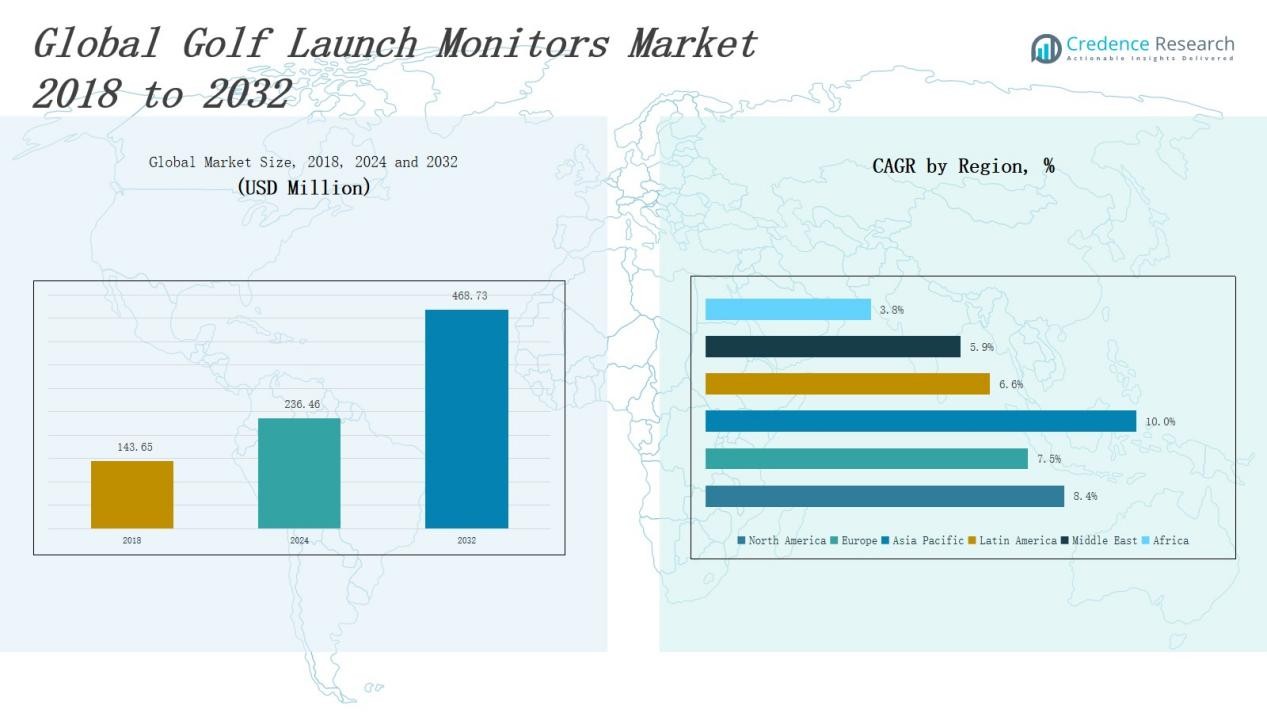
Golf Launch Monitors Market size was valued at USD 143.65million in 2018 to USD 236.46 million in 2024 and is anticipated to reach USD 468.73 million by 2032, at a CAGR of 8.32% during the forecast period.
| REPORT ATTRIBUTE | DETAILS |
|---|---|
| Historical Period | 2020-2024 |
| Base Year | 2024 |
| Forecast Period | 2025-2032 |
| Golf Launch Monitors Market Size 2024 | USD 236.46 Million |
| Golf Launch Monitors Market, CAGR | 8.32% |
| Golf Launch Monitors Market Size 2032 | USD 468.73 Million |
The Golf Launch Monitors Market is dominated by key players such as TrackMan, FlightScope, Garmin, SkyTrak, and Foresight Sports, which lead through continuous innovation and advanced technology integration. North America holds the largest market share at 42.5% in 2024, driven by high adoption rates among professional and amateur golfers, widespread golf facility infrastructure, and increasing demand for data-driven performance analysis. The region’s strong emphasis on technological advancements and training aids further strengthens its leading position and growth prospects in the market.
Market Insights
- The Golf Launch Monitors Market size grew from USD 143.65million in 2018 to USD 236.46million in 2024 and is expected to reach USD 468.73million by 2032, driven by rising golf participation and technological advances.
- Leading companies such as TrackMan, FlightScope, Garmin, SkyTrak, and Foresight Sports dominate the market through continuous innovation and integration of advanced technologies.
- North America holds the largest market share at 42.5% in 2024, fueled by widespread golf infrastructure, high adoption among professionals and amateurs, and growing demand for data-driven performance tools.
- Key growth drivers include increasing demand for precise performance analysis, technological advancements in radar and sensor systems, and expanding golf infrastructure worldwide, particularly in emerging regions.
- Challenges such as high product costs, complexity in usage, and dependence on environmental and infrastructure conditions may limit market penetration and require cost-effective, user-friendly solutions to sustain growth.
Market Segment Insights
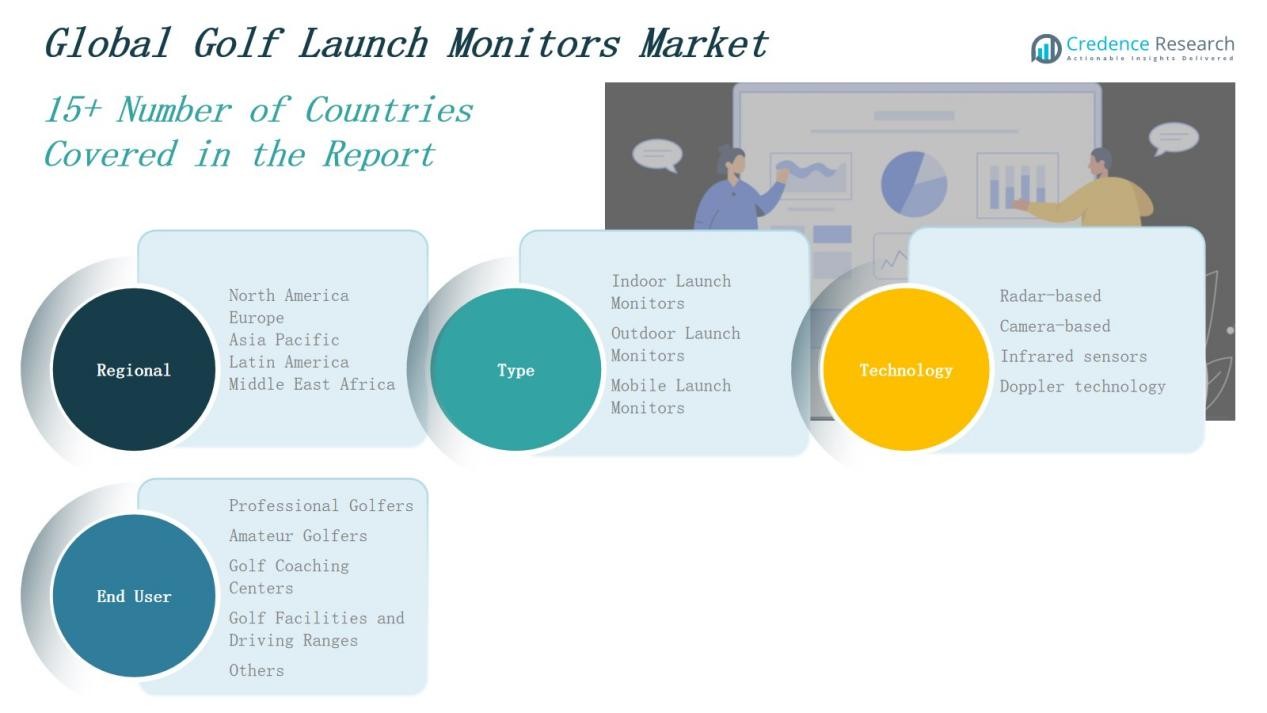
By Type
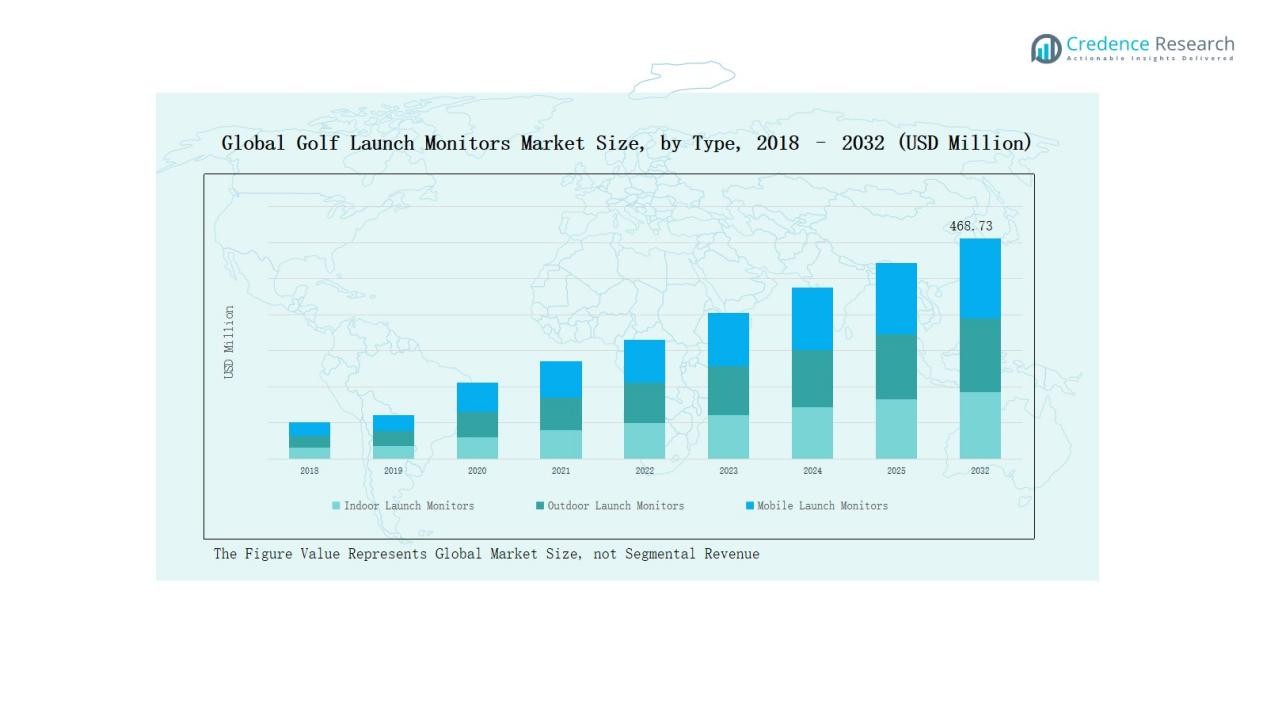
The Golf Launch Monitors Market segmented by type includes Indoor Launch Monitors, Outdoor Launch Monitors, and Mobile Launch Monitors. Indoor Launch Monitors dominate the segment, capturing the largest market share due to their increasing adoption in golf simulators and training facilities. Their ability to provide precise data in controlled environments appeals to both professional and amateur users, driving growth. Outdoor Launch Monitors, favored for on-course practice, and Mobile Launch Monitors, valued for portability, also contribute significantly but hold smaller shares compared to indoor systems.
- For instance, SkyTrak, indoor launch monitors integrate with popular golf simulators to offer real-time data, catering to serious golfers and enthusiasts alike.
By Technology
The market segments into Radar-based, Camera-based, Infrared Sensors, and Doppler Technology. Radar-based launch monitors lead the segment with the highest market share, attributed to their accuracy in tracking ball flight and club movement over long distances. Camera-based systems are gaining traction due to their detailed swing analysis and visual feedback. Infrared sensors and Doppler technology find niche applications but lag behind radar and camera-based technologies in volume and revenue.
- For example, the Foresight Sports GCQuad employs high-speed cameras to capture thousands of images per second at impact, enabling comprehensive club and ball data analysis indoors.
By End User
The end-user segmentation comprises Professional Golfers, Amateur Golfers, Golf Coaching Centers, Golf Facilities and Driving Ranges, and Others. Professional Golfers constitute the dominant sub-segment, driven by their need for precise performance data to enhance competitive play. Amateur Golfers show rising adoption due to growing interest in data-driven improvement tools. Golf Coaching Centers and Golf Facilities leverage launch monitors to enhance training quality and customer experience, contributing to steady market expansion. The Others category includes corporate users and recreational players with a modest share.
Key Growth Drivers
Rising Demand for Data-Driven Performance Analysis
The growing emphasis on performance improvement among both professional and amateur golfers drives demand for golf launch monitors. These devices provide accurate data on ball flight, swing speed, and club impact, enabling users to refine their techniques effectively. Increasing awareness of data analytics in sports performance and the adoption of advanced technology in training enhance market growth. Golfers and coaches rely on precise metrics to optimize practice sessions, boosting the popularity and sales of launch monitors globally.
- For instance, Trackman launch monitors measure over 40 data parameters such as ball speed, launch angle, spin rate, and club path, allowing golfers to analyze and adjust their swing mechanics effectively.
Advancements in Technology and Product Innovation
Continuous innovation in radar, camera, and sensor technologies fuels market expansion. Enhanced accuracy, portability, and integration with software platforms offer users comprehensive performance insights. Manufacturers focus on developing user-friendly interfaces and real-time feedback features, attracting a broader audience. The integration of mobile connectivity and virtual simulations further propels demand. These technological improvements enable diverse applications, from professional training to recreational use, thereby widening the market scope.
- For instance, Tesla activated an in-cabin radar system using a 60-64 GHz millimeter-wave radar in its Model Y, enhancing passenger safety features such as dynamic airbag deployment and child presence detection.
Growing Golf Participation and Infrastructure Development
The increase in golf participation worldwide, especially among amateurs and seniors, supports market growth. Expansion of golf courses, driving ranges, and coaching centers creates a larger user base for launch monitors. Rising disposable incomes and health awareness contribute to the sport’s popularity, particularly in emerging regions. Infrastructure investments by sports authorities and private entities also facilitate the adoption of launch monitors as essential training tools, reinforcing their presence across all skill levels.
Key Trends & Opportunities
Integration with Virtual and Augmented Reality
Golf launch monitors increasingly integrate with virtual and augmented reality technologies, offering immersive training experiences. This trend creates opportunities for innovative golf simulators and interactive coaching solutions. VR/AR integration enhances user engagement, making practice sessions more realistic and enjoyable. Such advancements attract tech-savvy players and facilities aiming to provide cutting-edge services, thereby expanding market reach and opening new revenue streams.
- For instance, Foresight Sports incorporates augmented reality overlays within their simulator platform to enhance training by displaying real-time swing data and course conditions directly over the virtual environment, helping golfers improve technique through immediate visual feedback.
Expansion in Emerging Markets
Emerging regions such as Asia-Pacific and Latin America present significant growth opportunities due to rising golf interest and improving sports infrastructure. Increasing awareness about advanced training tools and expanding middle-class populations drive demand. Companies focusing on affordable and portable launch monitor solutions can capitalize on these markets. Strategic partnerships and localized marketing efforts further enable penetration and sustained growth in these untapped regions.
- For instance, Acushnet utilizes strategic collaborations with local sports facilities in Asia-Pacific, enhancing distribution and market presence for their putting mats designed for various skill levels.
Key Challenges
High Product Costs and Affordability Issues
The high price point of advanced golf launch monitors limits accessibility, especially among amateur golfers and emerging markets. Expensive hardware and associated software subscriptions pose affordability challenges. This barrier restricts widespread adoption and market penetration, forcing manufacturers to balance technological sophistication with cost-effectiveness. Addressing this challenge requires innovation in cost-efficient designs without compromising accuracy and functionality.
Complexity and User Learning Curve
Despite technological advancements, some golf launch monitors remain complex to operate for casual users. The need for technical knowledge to interpret data and use software platforms can discourage adoption. Manufacturers must focus on simplifying interfaces and offering comprehensive user support. Bridging this usability gap is critical to attract a wider customer base beyond professional players and coaching centers.
Dependence on Infrastructure and Environmental Conditions
Certain launch monitor types, particularly outdoor models, depend heavily on environmental factors like lighting and weather, affecting accuracy and reliability. Additionally, indoor systems require dedicated spaces and compatible simulators, limiting flexibility. These dependencies pose challenges for consistent usage across diverse conditions and locations, potentially restricting market growth in areas lacking adequate infrastructure.
Regional Analysis
North America
North America leads the Golf Launch Monitors Market with a significant share, growing from USD 63.38 million in 2018 to USD 103.26 million in 2024. The region is expected to reach USD 205.26 million by 2032, expanding at a CAGR of 8.4%. This growth reflects strong adoption among professional and amateur golfers, supported by widespread golf infrastructure and technological advancements. The U.S., as the largest contributor, benefits from a mature market, high consumer spending, and increasing interest in data-driven training tools. These factors consolidate North America’s position as the dominant regional market.
Europe
Europe holds a substantial share in the Golf Launch Monitors Market, rising from USD 41.12 million in 2018 to USD 65.27 million in 2024. The market is projected to grow to USD 121.87 million by 2032, with a CAGR of 7.5%. Growth is driven by increasing golf participation across countries such as the UK, Germany, and France, alongside expanding golf facility networks. Technological adoption in coaching centers and professional training enhances demand. Investments in sports technology and rising consumer awareness fuel steady expansion in this region.
Asia Pacific
Asia Pacific is the fastest-growing region, with market value increasing from USD 27.06 million in 2018 to USD 48.35 million in 2024. It is forecast to reach USD 108.80 million by 2032, growing at a CAGR of 10.0%. Growth is fueled by rising golf popularity, expanding middle-class populations, and improving sports infrastructure in countries like China, Japan, and India. The region offers vast opportunities due to increasing health awareness and technological penetration. Affordable and portable launch monitor solutions drive adoption in emerging markets.
Latin America
Latin America shows moderate growth in the Golf Launch Monitors Market, rising from USD 6.64 million in 2018 to USD 10.79 million in 2024. The market is expected to reach USD 18.88 million by 2032, registering a CAGR of 6.6%. Growth is supported by growing golf interest and infrastructure development in countries such as Brazil and Argentina. Increasing disposable incomes and investments in sports technology facilitate market expansion. However, limited awareness and affordability challenges temper growth compared to more developed regions.
Middle East
The Middle East market grew from USD 3.91 million in 2018 to USD 5.87 million in 2024 and is projected to reach USD 9.76 million by 2032, at a CAGR of 5.9%. Growth is driven by rising investments in golf courses and sports facilities across GCC countries, along with increasing participation among affluent populations. Technological adoption in training and coaching centers supports market development. The region's evolving sports culture and government initiatives to promote recreational activities offer promising growth prospects.
Africa
Africa remains a nascent market for golf launch monitors, growing from USD 1.54 million in 2018 to USD 2.92 million in 2024 and expected to reach USD 4.16 million by 2032, at a CAGR of 3.8%. Growth is limited by underdeveloped golf infrastructure and lower awareness levels. However, expanding urbanization, increasing disposable income in key countries like South Africa and Egypt, and growing interest in golf as a recreational sport present long-term opportunities. Market expansion hinges on improved accessibility and education about advanced training tools.
Market Segmentations:
By Type:
- Indoor Launch Monitors
- Outdoor Launch Monitors
- Mobile Launch Monitors
By Technology:
- Radar-based
- Camera-based
- Infrared Sensors
- Doppler Technology
By End User:
- Professional Golfers
- Amateur Golfers
- Golf Coaching Centers
- Golf Facilities and Driving Ranges
- Others
By Region:
- North America (U.S., Canada, Mexico)
- Europe (UK, France, Germany, Italy, Spain, Russia, Rest of Europe)
- Asia Pacific (China, Japan, South Korea, India, Australia, Southeast Asia, Rest of Asia Pacific)
- Latin America (Brazil, Argentina, Rest of Latin America)
- Middle East (GCC Countries, Israel, Turkey, Rest of Middle East)
- Africa (South Africa, Egypt, Rest of Africa)
Competitive Landscape
The Golf Launch Monitors Market features a competitive landscape dominated by several key players that focus on innovation, technology integration, and customer-centric solutions to maintain and expand their market positions. Leading companies such as TrackMan, Foresight Sports, SkyTrak, FlightScope, and TruGolf continuously invest in research and development to enhance product accuracy, portability, and user experience. These players differentiate through advanced radar and camera technologies, seamless software integration, and comprehensive performance analytics tailored for professional and amateur golfers alike. Market entrants face high barriers due to technological complexity and brand loyalty. Strategic partnerships, product launches, and geographic expansion remain critical tactics to capture emerging markets, particularly in Asia-Pacific and Latin America. The market also witnesses steady competition in pricing, features, and after-sales service. Overall, innovation and adaptation to evolving customer needs dictate competitive advantage in this technologically driven market.
Key Players
- TrackMan
- Foresight Sports
- SkyTrak (SkyTrak Golf)
- FlightScope
- TruGolf
- Ernest Sports
- Voice Caddie
- Rapsodo
- Garmin Approach
- OptiShot
Recent Developments
- In January 2024, Foresight Sports unveiled the Falcon launch monitor, a compact version of the GCHawk, offering advanced simulation capabilities in a more portable form factor.
- In December 12, 2024, Whoosh partnered with Foresight Sports to provide a complete solution for simulator management, integrating Foresight’s launch monitor technology with Whoosh’s club operations software.
- In early 2025, Golfjoy unveiled four new golf launch monitors-GDS Pro, Spica 3, Rigel 2, and Rigel 3-designed to provide precise data and insights to improve golfer performance.
- In June 2025, TruGolf Holdings acquired AI firm mlSpatial to strengthen artificial intelligence integration across its product lineup, including the Apogee Launch Monitor.
Market Concentration & Characteristics
The Golf Launch Monitors Market exhibits a moderately concentrated structure, with a few leading players holding significant market shares. These companies focus on continuous innovation, high-quality product offerings, and strong brand recognition to maintain their competitive edge. The market features a mix of established global firms and emerging technology providers, fostering healthy competition that drives technological advancements. It demands substantial investment in research and development due to the complexity of radar, camera, and sensor technologies. Customer preference for accuracy, ease of use, and integration with digital platforms influences product development and market dynamics. The market also experiences segmentation based on end users, including professional golfers, amateurs, and coaching centers, each with distinct needs. Geographic expansion into emerging regions further shapes competitive behavior. Overall, the Golf Launch Monitors Market balances innovation, quality, and strategic positioning to meet evolving user requirements and sustain growth.
Report Coverage
The research report offers an in-depth analysis based on Type, Technology, End User and Region. It details leading market players, providing an overview of their business, product offerings, investments, revenue streams, and key applications. Additionally, the report includes insights into the competitive environment, SWOT analysis, current market trends, as well as the primary drivers and constraints. Furthermore, it discusses various factors that have driven market expansion in recent years. The report also explores market dynamics, regulatory scenarios, and technological advancements that are shaping the industry. It assesses the impact of external factors and global economic changes on market growth. Lastly, it provides strategic recommendations for new entrants and established companies to navigate the complexities of the market.
Future Outlook
- Adoption of advanced technologies will accelerate product innovation and user experience improvements.
- Increasing golf participation worldwide will expand the customer base for launch monitors.
- Integration with virtual and augmented reality will enhance training and simulation capabilities.
- Portable and affordable devices will attract a broader range of amateur golfers.
- Expansion in emerging markets will drive regional revenue growth and market diversification.
- Professional coaching centers will increasingly rely on launch monitors for data-driven training.
- Collaboration between hardware manufacturers and software developers will create comprehensive solutions.
- Demand for real-time analytics and performance tracking will push technological enhancements.
- Market players will focus on simplifying user interfaces to improve accessibility.
- Environmental sustainability in product design and manufacturing will gain attention among consumers.

Request a Free Sample
Fill in your details and we'll send you a free sample report.
- Sample data tables & charts
- Research methodology
Market Dynamics
Demand for Data-Driven Performance Analysis
Golfers and coaches increasingly rely on launch monitors for precise metrics such as ball flight, swing speed, and club impact, enabling targeted technique improvement and fueling adoption among both professionals and amateurs.
Technological Advancements and Product Innovation
Continuous improvements in radar, camera, and sensor technologies have enhanced accuracy, portability, and integration with software platforms, making launch monitors more appealing and accessible to a broader user base.
Expansion of Golf Infrastructure and Participation
The global increase in golf courses, driving ranges, and coaching centers, especially in emerging markets, is expanding the potential customer base for launch monitors and supporting sustained market growth.
Integration with Virtual and Augmented Reality
The adoption of VR and AR technologies in launch monitors is creating immersive training experiences, attracting tech-savvy users and facilities seeking to differentiate their offerings and improve engagement.
Rising Affordability and Portability
Manufacturers are developing more cost-effective and portable launch monitor solutions, lowering barriers for amateur golfers and enabling use in a wider range of environments, which broadens market reach.
Need a Custom Version of This Report?
Tailor the scope, geography, or segments to your exact requirements.
- Custom geography or segment scope
- Direct access to our analyst team
Frequently Asked Questions
What is the current market size for Golf Launch Monitors Market, and what is its projected size in 2032?
At what Compound Annual Growth Rate is the Golf Launch Monitors Market projected to grow between 2025 and 2032?
Which Golf Launch Monitors Market segment held the largest share in 2024?
What are the primary factors fueling the growth of the Golf Launch Monitors Market?
Who are the leading companies in the Golf Launch Monitors Market?
Table of Content
Chapter 1 Market Segmentation
- 1.1 Segmentation Framework
- 1.1.1 Product and Service Classification
- 1.1.2 Application and End-Use Classification
- 1.1.3 Technology and Solution Classification
- 1.1.4 Customer and Distribution Channel Classification
- 1.1.5 Geographic Segmentation
- 1.1.6 Market Segment Definitions and Boundaries
- 1.2 By Type
- 1.2.1 Indoor Launch Monitors
- 1.2.2 Outdoor Launch Monitors
- 1.2.3 Mobile Launch Monitors
- 1.3 By End User
- 1.3.1 Professional Golfers
- 1.3.2 Amateur Golfers
- 1.3.3 Golf Coaching Centers
- 1.3.4 Golf Facilities and Driving Ranges
- 1.3.5 Others
- 1.4 By Technology
- 1.4.1 Radar-based
- 1.4.2 Camera-based
- 1.4.3 Infrared Sensors
- 1.4.4 Doppler Technology
Chapter 2 Introduction
- 2.1 Report Objectives and Scope
- 2.2 Product Definition and Industry Terminology
- 2.3 Market Inclusions and Exclusions
- 2.4 Research Process
- 2.4.1 Primary Research and Expert Interviews
- 2.4.2 Secondary Research and Source Review
- 2.4.3 Top-Down and Bottom-Up Estimation
- 2.4.4 Data Triangulation and Verification
- 2.5 Market Size Measurement Basis
- 2.5.1 2024: USD 236.46 million → 2032: USD 468.73 million
- 2.6 Historical and Forecast Reference Periods
- 2.6.1 Base Year: 2024
- 2.6.2 Forecast Period: 2024-2032
- 2.7 Research Assumptions and Limitations
Chapter 3 Executive Summary
- 3.1 Market Snapshot and Key Findings
- 3.2 Base-Year Market Size, 2024
- 3.3 Forecast Market Size, 2032
- 3.4 Revenue and Volume Growth Outlook
- 3.5 Key Demand and Supply Indicators
- 3.6 Leading Market Segments
- 3.7 Fastest-Growing Market Opportunities
- 3.8 Regional Performance Highlights
- 3.9 Technology and Industry Transformation
- 3.10 Competitive Landscape Summary
- 3.11 Analyst View and Strategic Implications
Chapter 4 Global Golf Launch Monitors Market Trends and Developments
- 4.1 Historical Industry Development
- 4.2 Recent Market Trends and Developments
- 4.3 Demand and Customer Behavior Trends
- 4.4 Technology and Product Innovation
- 4.5 Artificial Intelligence, Automation and Digitalization
- 4.6 Local Manufacturing and Supply Chain Realignment
- 4.7 Industry Partnerships, Mergers and Acquisitions
- 4.8 Sustainability and Circular Economy Developments
- 4.9 Government and Private Sector Investment Trends
- 4.10 Emerging Business Models and Commercialization
- 4.11 Industry Developments and Announcements
Chapter 5 Global Golf Launch Monitors Market Production, Supply and Demand Analysis
- 5.1 Demand Trend and Consumption Analysis
- 5.2 Demand Forecast, 2024-2032
- 5.3 Production and Output Trend
- 5.4 Production and Output Forecast, 2024-2032
- 5.5 Installed Capacity and Capacity Utilization
- 5.6 Company-Wise Production Plants and Statistics
- 5.6.1 Installed Production Capacity
- 5.6.2 Actual Production
- 5.6.3 Planned Capacity and Expansion Targets
- 5.7 Supply Chain Structure and Procurement Trends
- 5.8 Supply-Demand Gap and Bottlenecks
- 5.9 Import Dependence and Sourcing Structure
- 5.10 Contract Manufacturing and Outsourcing
- 5.11 Regional Supply and Demand Concentration
Chapter 6 Global Golf Launch Monitors Market Pricing Analysis
- 6.1 Pricing Structure and Measurement
- 6.2 Historical Pricing Trends
- 6.3 Pricing Outlook, 2024-2032
- 6.4 Average Selling Price and Unit Economics
- 6.5 Pricing by Product and Market Segment
- 6.6 Geographic Pricing Differences
- 6.7 Key Input, Energy, Labor and Logistics Costs
- 6.8 Contract Pricing and Purchasing Models
- 6.9 Pricing Sensitivity and Competitive Positioning
- 6.10 Price, Margin and Profitability Implications
Chapter 7 Global Golf Launch Monitors Market Dynamics
- 7.1 Market Growth Drivers
- 7.1.1 Demand-Side Drivers
- 7.1.2 Technology and Innovation Drivers
- 7.1.3 Infrastructure and Investment Drivers
- 7.1.4 Regulatory and Policy Drivers
- 7.2 Market Restraints
- 7.2.1 Cost and Affordability Constraints
- 7.2.2 Technology and Adoption Barriers
- 7.2.3 Supply Chain and Operational Constraints
- 7.3 Market Challenges
- 7.3.1 Competitive Pressure and Margin Erosion
- 7.3.2 Skills, Infrastructure and Implementation Gaps
- 7.4 Emerging Market Opportunities
- 7.5 Market Dynamics Impact and Time-Horizon Assessment
Chapter 8 Global Golf Launch Monitors Value Chain Analysis
- 8.1 Industry Value Chain Overview
- 8.2 Upstream Suppliers and Critical Inputs
- 8.3 Technology and Component Providers
- 8.4 Manufacturing or Service Delivery
- 8.5 Distribution, Channel Partners and Integrators
- 8.6 Downstream Applications and End Users
- 8.7 Value Addition and Profit Pools
- 8.8 Vertical Integration and Outsourcing
- 8.9 Supplier Concentration and Risk
- 8.10 Supply Chain Localization and Resilience
Chapter 9 Global Golf Launch Monitors Market Regulations and Policies
- 9.1 Relevant Laws, Standards and Compliance Frameworks
- 9.2 Product, Service, Safety and Quality Requirements
- 9.3 Government Policies, Incentives and Subsidies
- 9.4 Imports, Exports and Trade Barriers
- 9.5 Public Procurement and Local Content Requirements
- 9.6 Environmental and Sustainability Compliance
- 9.7 Upcoming Policy Changes and Market Implications
Chapter 10 Global Golf Launch Monitors Market Hotspots and Opportunities
- 10.1 Market Opportunity Mapping and Growth Hotspots
- 10.2 High-Growth Applications and Customer Groups
- 10.3 Underserved Markets and White-Space Opportunities
- 10.4 Emerging Technology and Product Opportunities
- 10.5 New Capacity and Investment Hotspots
- 10.6 Market Entry and Expansion Opportunities
- 10.7 Distribution and Partnership Opportunities
- 10.8 Near-Term and Long-Term Commercial Potential
- 10.9 Opportunity Attractiveness and Execution Risks
Chapter 11 Global Golf Launch Monitors Market Outlook, 2024-2032
- 11.1 Market Size and Analysis
- 11.1.1 Revenue (Market Measurement: 2024: USD 236.46 million → 2032: USD 468.73 million)
- 11.1.2 Market Volume and Quantity Sold
- 11.1.3 Historical Market Size
- 11.1.4 Base-Year Market Size, 2024
- 11.2 Market Forecast, 2024-2032
- 11.2.1 Revenue Forecast to 2032
- 11.2.2 Volume Forecast to 2032
- 11.2.3 CAGR and Year-on-Year Growth
- 11.2.4 Incremental Revenue Opportunity
- 11.3 Forecast Assumptions and Scenario Analysis
- 11.3.1 Base-Case Forecast
- 11.3.2 Optimistic and Conservative Scenarios
- 11.3.3 Technology, Pricing and Policy Sensitivities
- 11.4 Market Attractiveness and Growth Outlook
Chapter 12 Global Golf Launch Monitors Market Segmentation and Outlook
- 12.1 Segmentation Summary and Market Shares, 2024
- 12.2 Largest and Fastest-Growing Segments
- 12.3 By Type - Market Size and Forecast, 2024-2032
- 12.3.1 Segment Definition and Scope
- 12.3.2 Historical Market Size
- 12.3.3 Revenue Forecast, 2024-2032
- 12.3.4 Volume Forecast, 2024-2032
- 12.3.5 Base-Year Market Share, 2024
- 12.3.6 Segment CAGR and Growth Drivers
- 12.3.7 Subsegment Market Size and Forecast
- 12.3.7.1 Indoor Launch Monitors
- 12.3.7.2 Outdoor Launch Monitors
- 12.3.7.3 Mobile Launch Monitors
- 12.3.8 Subsegment Pricing and Adoption Trends
- 12.3.9 Leading Suppliers and Competition
- 12.3.10 Regional Demand and Opportunities
- 12.4 By End User - Market Size and Forecast, 2024-2032
- 12.4.1 Segment Definition and Scope
- 12.4.2 Historical Market Size
- 12.4.3 Revenue Forecast, 2024-2032
- 12.4.4 Volume Forecast, 2024-2032
- 12.4.5 Base-Year Market Share, 2024
- 12.4.6 Segment CAGR and Growth Drivers
- 12.4.7 Subsegment Market Size and Forecast
- 12.4.7.1 Professional Golfers
- 12.4.7.2 Amateur Golfers
- 12.4.7.3 Golf Coaching Centers
- 12.4.7.4 Golf Facilities and Driving Ranges
- 12.4.7.5 Others
- 12.4.8 Subsegment Pricing and Adoption Trends
- 12.4.9 Leading Suppliers and Competition
- 12.4.10 Regional Demand and Opportunities
- 12.5 By Technology - Market Size and Forecast, 2024-2032
- 12.5.1 Segment Definition and Scope
- 12.5.2 Historical Market Size
- 12.5.3 Revenue Forecast, 2024-2032
- 12.5.4 Volume Forecast, 2024-2032
- 12.5.5 Base-Year Market Share, 2024
- 12.5.6 Segment CAGR and Growth Drivers
- 12.5.7 Subsegment Market Size and Forecast
- 12.5.7.1 Radar-based
- 12.5.7.2 Camera-based
- 12.5.7.3 Infrared Sensors
- 12.5.7.4 Doppler Technology
- 12.5.8 Subsegment Pricing and Adoption Trends
- 12.5.9 Leading Suppliers and Competition
- 12.5.10 Regional Demand and Opportunities
- 12.6 Segment Growth Comparison
- 12.7 Segment Attractiveness and Priority Matrix
Chapter 13 Global Golf Launch Monitors End-Use and Application Market Outlook
- 13.1 End-Use Industry and Customer Demand Structure
- 13.2 Leading Applications and Customer Groups
- 13.3 End-Use Market Size, Share and Forecast
- 13.4 Major End-Use Industry Deep Dives
- 13.4.1 Customer Requirements and Use Cases
- 13.4.2 Demand and Replacement Cycles
- 13.4.3 Technical and Regulatory Considerations
- 13.4.4 Purchasing and Procurement Models
- 13.4.5 Leading Vendors and Distribution Channels
- 13.4.6 Forecast and Commercial Opportunities
- 13.5 Emerging Applications and Cross-Segment Demand
- 13.6 End-Use Industry Investment Priorities
Chapter 14 Global Golf Launch Monitors Geographic Market Outlook, 2024-2032
- 14.1 Regional Market Size and Share, 2024
- 14.2 Regional Market Forecast, 2024-2032
- 14.3 Regional Pricing, Production and Demand Differences
- 14.4 North America
- 14.4.1 United States
- 14.4.2 Canada
- 14.4.3 Mexico
- 14.5 Europe
- 14.5.1 Germany
- 14.5.2 France
- 14.5.3 Italy
- 14.5.4 United Kingdom
- 14.5.5 Spain
- 14.5.6 Poland
- 14.5.7 Russia
- 14.5.8 Netherlands
- 14.5.9 Belgium
- 14.5.10 Sweden
- 14.5.11 Denmark
- 14.5.12 Norway
- 14.5.13 Rest of Europe
- 14.6 Asia Pacific
- 14.6.1 China
- 14.6.2 India
- 14.6.3 Japan
- 14.6.4 South Korea
- 14.6.5 Thailand
- 14.6.6 Indonesia
- 14.6.7 Vietnam
- 14.6.8 Malaysia
- 14.6.9 Australia
- 14.6.10 Rest of Asia Pacific
- 14.7 Latin America
- 14.7.1 Brazil
- 14.7.2 Argentina
- 14.7.3 Colombia
- 14.7.4 Chile
- 14.7.5 Rest of Latin America
- 14.8 Middle East
- 14.8.1 Saudi Arabia
- 14.8.2 United Arab Emirates
- 14.8.3 Turkey
- 14.8.4 Israel
- 14.8.5 Iran
- 14.8.6 Rest of the Middle East
- 14.9 Africa
- 14.9.1 South Africa
- 14.9.2 Egypt
- 14.9.3 Nigeria
- 14.9.4 Morocco
- 14.9.5 Rest of Africa
- 14.10 Regional Investment, Policy and Supply Chain Differences
- 14.11 Regional Competitive Landscape
- 14.12 Geographic Growth Hotspots
Chapter 15 Global Golf Launch Monitors Technology, Innovation and Sustainability Outlook
- 15.1 Technology Landscape and Maturity
- 15.2 Product, Process and Service Innovation
- 15.3 AI, Automation and Digital Tools in the Industry
- 15.4 Technology Adoption and Performance Benchmarking
- 15.5 Innovation Pipeline and R&D Investment
- 15.6 Patent and Intellectual Property Trends
- 15.7 Energy Efficiency and Resource Management
- 15.8 Sustainability, Recycling and Circularity
- 15.9 Technology Roadmap, 2024-2032
- 15.10 Risks of Obsolescence and Technology Substitution
Chapter 16 Global Golf Launch Monitors Market Key Strategic Imperatives
- 16.1 Growth and Market Entry Priorities
- 16.2 High-Return Products and Segments
- 16.3 Pricing, Profitability and Cost Optimization
- 16.4 Technology Investment and Product Differentiation
- 16.5 Supply Chain Localization and Resilience
- 16.6 Distribution and Customer Acquisition
- 16.7 Partnership, Acquisition and Capacity Strategy
- 16.8 Regional Expansion Priorities
- 16.9 Short-, Medium- and Long-Term Actions
Chapter 17 Competition Outlook
- 17.1 Industry Competition Characteristics
- 17.2 Market Structure and Concentration
- 17.3 Market Share and Competitive Positioning, 2024
- 17.4 Company-Wise Revenue and Product Benchmarking
- 17.5 Production and Service Capacity Benchmarking
- 17.6 Technology, Pricing and Differentiation
- 17.7 Regional Footprint and Distribution Strength
- 17.8 Mergers, Acquisitions and Strategic Alliances
- 17.9 New Entrants and Competitive Threats
- 17.10 Porter's Five Forces and Industry Attractiveness
- 17.11 Competitive Outlook, 2024-2032
Chapter 18 Company Profiles
- 18.1 Company Coverage and Selection Criteria
- 18.2 TrackMan
- 18.2.1 Business Description
- 18.2.2 Company Ownership and Geographic Presence
- 18.2.3 Product and Service Portfolio
- 18.2.4 Manufacturing and Operating Footprint
- 18.2.5 Production Capacity and Expansion Plans
- 18.2.6 Financial Performance and Investment
- 18.2.7 Market Share and Competitive Position
- 18.2.8 Technology and Innovation Capabilities
- 18.2.9 Strategic Alliances or Partnerships
- 18.2.10 Recent Developments
- 18.2.11 Growth Strategy and Outlook
- 18.3 Foresight Sports
- 18.4 SkyTrak (SkyTrak Golf)
- 18.5 FlightScope
- 18.6 TruGolf
- 18.7 Ernest Sports
- 18.8 Voice Caddie
- 18.9 Rapsodo
- 18.10 Garmin Approach
- 18.11 OptiShot
- 18.12 Other Relevant Market Participants
Note: Every listed company is profiled on the structure shown under the first company. The company list is preliminary and may change based on research findings, market developments, data availability and client requirements.
Chapter 19 Disclaimer
- 19.1 Research and Forecast Disclaimer
- 19.2 Data Source and Estimation Limitations
Note: The depth of individual sections depends on data availability for this market. Volume, capacity, trade and other unit-based metrics are included where applicable.

