
Market Overview
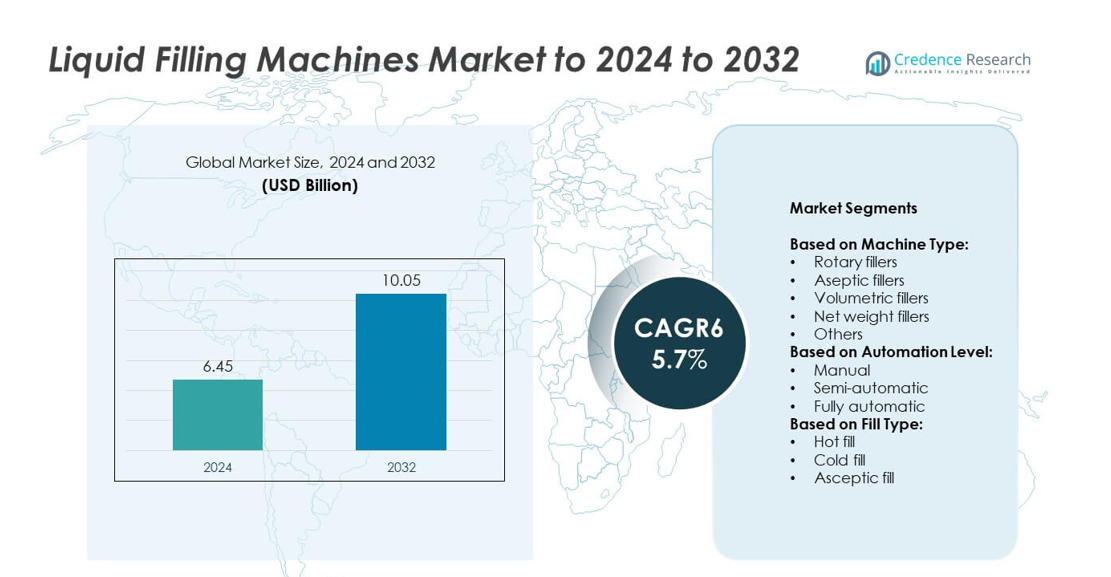
The Liquid Filling Machines Market size was valued at USD 6.45 billion in 2024 and is anticipated to reach USD 10.05 billion by 2032, at a CAGR of 5.7% during the forecast period.
| REPORT ATTRIBUTE | DETAILS |
|---|---|
| Historical Period | 2020-2023 |
| Base Year | 2024 |
| Forecast Period | 2025-2032 |
| Liquid Filling Machines Market Size 2024 | USD 6.45 billion |
| Liquid Filling Machines Market, CAGR | 5.7% |
| Liquid Filling Machines Market Size 2032 | USD 10.05 billion |
The liquid filling machines market is shaped by leading players such as Krones, GEA Group, Tetra Pak International, KHS, Sidel Group, Coesia, ProMach, Serac Group, Ronchi Mario, Trepko Group, Weightpack, Inline Filling Systems, JBT Corporation, and E-PAK Machinery. These companies focus on automation, aseptic technologies, and energy-efficient solutions to strengthen their positions in global markets. Asia Pacific emerged as the dominant region, holding 32% of the market share in 2024, driven by rapid industrialization and strong demand from food, beverage, and pharmaceutical sectors. North America followed with 28%, supported by advanced automation adoption, while Europe contributed 25% through stringent regulatory standards and technological expertise.
Market Insights
- The liquid filling machines market was valued at USD 6.45 billion in 2024 and is projected to reach USD 10.05 billion by 2032, growing at a CAGR of 5.7% during the forecast period.
- Rising demand from food and beverage industries, coupled with growth in pharmaceuticals, is driving adoption of automated and aseptic filling technologies across global markets.
- Market trends highlight a shift toward fully automatic machines, integration of IoT and Industry 4.0, and development of sustainable, energy-efficient solutions catering to environmental standards.
- The competitive landscape is defined by global players focusing on innovation, mergers, and partnerships, aiming to expand portfolios and strengthen positions across packaging and healthcare industries.
- Asia Pacific leads with 32% market share in 2024, followed by North America at 28% and Europe at 25%, while Latin America holds 8% and the Middle East and Africa account for 7%, showcasing balanced but region-specific growth opportunities.
Market Segmentation Analysis:
By Machine Type
Rotary fillers dominated the liquid filling machines market in 2024, accounting for nearly 35% share. Their popularity stems from high-speed operations, precision filling, and adaptability across industries such as food, beverage, and pharmaceuticals. Aseptic fillers are growing steadily due to increasing demand for sterile packaging in dairy and healthcare sectors. Volumetric and net weight fillers are preferred for cost efficiency and accurate dosing, particularly in chemicals and cosmetics. The dominance of rotary fillers is driven by automation compatibility, reduced downtime, and ability to handle varied container sizes efficiently.
- For instance, a Krones brochure mentions outputs of up to 78,000 containers per hour for other Modulfill models, and describes a Modulfill VFS-C reaching 72,000 containers per hour for CSD.
By Automation Level
Fully automatic machines held the largest share of more than 55% in 2024, reflecting rising adoption of Industry 4.0 practices. These systems are widely used in large-scale beverage and pharmaceutical plants for faster throughput and minimal human error. Semi-automatic fillers remain significant in mid-sized enterprises, offering a balance of efficiency and affordability. Manual machines are gradually declining but remain viable for small businesses and niche production lines. The dominance of fully automatic fillers is fueled by labor cost reduction, productivity enhancement, and consistent demand from high-volume packaging operations.
- For instance, Filamatic DAB-5 achieves up to 70 bottles/minute with two nozzles.
By Fill Type
Hot fill technology led the market in 2024 with approximately 40% share, widely applied in juices, sauces, and ready-to-drink beverages requiring microbial stability. Cold fill systems are gaining traction in bottled water and carbonated soft drinks due to energy efficiency and cost savings. Aseptic fill continues to expand rapidly in pharmaceuticals and dairy products, ensuring sterility and longer shelf life. The dominance of hot fill is supported by strong demand for packaged foods and beverages in emerging markets, coupled with technological improvements in sealing and contamination prevention.
Key Growth Drivers
Rising Demand from Food and Beverage Industry
The food and beverage sector is the largest consumer of liquid filling machines, driving substantial market growth. Increasing consumption of packaged drinks, sauces, and dairy products fuels higher adoption of efficient fillers. Manufacturers prefer advanced rotary and hot fill systems for speed, hygiene, and extended shelf life. The rising trend of ready-to-drink beverages, coupled with urban lifestyle shifts, further strengthens demand. This segment remains the key growth driver as global beverage brands invest in modern, automated filling lines to scale production and ensure consistent quality.
- For instance, Nestlé plans to boost cereal beverage production by ~15 % at its Avanca plant via a €30 million machinery upgrade.
Advancements in Automation and Industry 4.0
The integration of automation, robotics, and smart monitoring systems enhances efficiency in liquid filling operations. Fully automatic machines dominate due to their capability to reduce human error and optimize production cycles. Industry 4.0 features like IoT-enabled sensors and predictive maintenance are increasingly deployed to improve uptime. The need for scalability in large production facilities boosts demand for advanced filling lines. This driver is critical as manufacturers aim to achieve cost savings, higher productivity, and real-time quality monitoring, pushing automation as a central growth enabler in the market.
- For instance, SIG’s CFA 812 filling machine at a Nestlé plant achieved 94 % technical line efficiency with <0.2 % average loss.
Expansion of Pharmaceutical and Healthcare Applications
Pharmaceuticals and healthcare are adopting aseptic fillers at a rapid pace to ensure sterility and precision. Growth in liquid drugs, vaccines, and nutraceuticals has created strong demand for advanced filling machines. Compliance with stringent regulations encourages companies to invest in high-quality, contamination-free systems. The pandemic accelerated these investments, particularly in sterile packaging solutions. This expansion is a key growth driver, as manufacturers focus on safety, traceability, and efficiency. Long-term growth is expected as biologics, intravenous solutions, and nutraceutical products continue to see rising global consumption.
Key Trends and Opportunities
Shift Toward Sustainable and Energy-Efficient Solutions
Sustainability is a major trend shaping the liquid filling machines market, with manufacturers investing in energy-efficient and eco-friendly systems. Companies are adopting machines that minimize water use, reduce power consumption, and support recyclable packaging materials. This aligns with global initiatives on carbon neutrality and circular economy practices. Opportunities are rising for suppliers who innovate with green technologies and low-waste processes. The focus on sustainability presents strong growth potential, making it a key trend and opportunity that appeals to environmentally conscious brands and regulatory bodies worldwide.
- For instance, SIG’s alu-free barrier packs are compatible with high-speed filling lines capable of producing up to 15,000 packs per hour for multi-serve formats. A May 2025 press release from SIG noted that since 2023, over 300 million single-serve alu-free full-barrier packs had been sold in China.
Rising Demand for Customization and Flexible Filling Systems
Manufacturers increasingly demand flexible liquid filling machines capable of handling multiple container shapes and sizes. The growing variety of consumer products, from premium beverages to personal care items, drives this trend. Machines with modular designs and quick-change features gain preference for enhancing operational agility. This creates opportunities for equipment makers offering highly adaptable solutions. The trend highlights an industry shift toward versatile filling technologies, catering to frequent product launches and diversified portfolios. Such flexibility forms a key trend and opportunity, particularly for competitive consumer-driven markets.
- For instance, Romaco’s Oftalmica reaches 12,000 bottles/hour with up to 8 dosing pumps and plug-and-play format parts.
Key Challenges
High Initial Investment and Maintenance Costs
One of the key challenges for the liquid filling machines market is the significant upfront investment required. Fully automatic and aseptic filling systems involve high purchase costs, installation expenses, and ongoing maintenance needs. Small and medium-scale manufacturers often hesitate to adopt advanced machines due to these financial constraints. Additionally, specialized technicians are required for servicing and upkeep, adding to operational costs. This challenge restrains adoption among cost-sensitive businesses, particularly in emerging markets, and slows down market penetration despite the efficiency benefits of modern filling systems.
Stringent Regulatory Compliance and Operational Complexity
Compliance with strict hygiene, safety, and packaging standards poses another key challenge for manufacturers. In sectors like pharmaceuticals and food, companies must meet global regulations such as FDA, GMP, and EU directives. Operating advanced aseptic systems also requires skilled labor, extensive training, and careful monitoring, which complicates adoption. The complexity of handling sterile environments can slow production and increase error risks if not managed properly. These regulatory and operational hurdles limit the pace of adoption, particularly for small enterprises lacking resources to invest in compliance-ready technologies.
Regional Analysis
North America
North America accounted for 28% of the liquid filling machines market share in 2024, driven by strong demand from the food, beverage, and pharmaceutical industries. The United States leads regional adoption, supported by high investments in automation and advanced packaging technologies. Regulatory requirements for safety and hygiene further push companies toward aseptic and fully automatic fillers. Growing demand for ready-to-drink beverages and personalized healthcare products also contributes to steady growth. The region’s mature industrial base, combined with ongoing technological innovation, ensures sustained adoption of high-speed, energy-efficient filling systems across multiple industries.
Europe
Europe held 25% of the global market share in 2024, supported by robust pharmaceutical, food, and dairy industries. Germany, France, and Italy remain key contributors, driven by advanced packaging machinery expertise and high-quality standards. Stringent EU regulations on safety and environmental sustainability encourage adoption of aseptic and eco-friendly filling technologies. Demand for automation and flexible filling solutions continues to rise, especially in beverage and cosmetics segments. With strong focus on efficiency and compliance, Europe maintains a leading role in the adoption of advanced liquid filling systems, ensuring consistent market growth through modernization.
Asia Pacific
Asia Pacific dominated the market with 32% share in 2024, making it the largest regional market. Rapid industrialization, expanding food and beverage consumption, and growing pharmaceutical production drive strong demand. China and India lead regional adoption due to large-scale manufacturing, while Japan and South Korea invest in advanced technologies. Rising disposable incomes and increasing consumption of packaged products fuel long-term growth. Additionally, government support for automation in manufacturing boosts adoption of fully automatic machines. Asia Pacific’s cost advantages, coupled with growing end-user industries, position the region as the primary growth hub in this market.
Latin America
Latin America captured 8% of the liquid filling machines market share in 2024, driven mainly by Brazil and Mexico. Rising demand for packaged beverages, cosmetics, and pharmaceuticals supports steady adoption of advanced filling technologies. However, the region faces challenges such as fluctuating economic conditions and limited automation investments. Despite these hurdles, multinational food and beverage companies continue to expand operations, creating opportunities for machine suppliers. Growing middle-class consumption and urbanization trends further support demand. Latin America’s gradual move toward semi-automatic and fully automatic fillers reflects an ongoing modernization of packaging infrastructure in key industries.
Middle East and Africa
The Middle East and Africa accounted for 7% of the global market share in 2024, reflecting emerging opportunities. Demand is supported by growing food and beverage processing industries, particularly in the Gulf countries and South Africa. Expanding pharmaceutical investments in sterile packaging also contribute to regional growth. However, limited local manufacturing capacity and high import dependency slow adoption of advanced systems. The region shows rising interest in automation to improve efficiency and hygiene standards. With increasing urbanization and consumer demand for packaged goods, MEA presents gradual but promising growth opportunities for liquid filling machines.
Market Segmentations:
By Machine Type:
- Rotary fillers
- Aseptic fillers
- Volumetric fillers
- Net weight fillers
- Others
By Automation Level:
- Manual
- Semi-automatic
- Fully automatic
By Fill Type:
- Hot fill
- Cold fill
- Asceptic fill
By Geography:
- North America
- U.S.
- Canada
- Mexico
- Europe
- Germany
- France
- U.K.
- Italy
- Spain
- Rest of Europe
- Asia Pacific
- China
- Japan
- India
- South Korea
- South-east Asia
- Rest of Asia Pacific
- Latin America
- Brazil
- Argentina
- Rest of Latin America
- Middle East & Africa
- GCC Countries
- South Africa
- Rest of the Middle East and Africa
Competitive Landscape
Inline Filling Systems, Ronchi Mario, Coesia, Serac Group, JBT Corporation, E-PAK Machinery, KHS, Weightpack, Sidel Group, Krones, ProMach, Tetra Pak International, Trepko Group, and GEA Group are among the prominent players shaping the competitive landscape of the liquid filling machines market. The market is highly competitive, with companies focusing on automation, precision, and efficiency to strengthen their market positions. Advanced technologies, including IoT-enabled monitoring, aseptic filling, and energy-efficient systems, are increasingly integrated into product portfolios to meet evolving industry standards. Strategic initiatives such as mergers, acquisitions, and partnerships with beverage, food, and pharmaceutical manufacturers are common, enabling suppliers to expand global reach and address specialized customer requirements. Continuous investment in research and development remains a central strategy, particularly to enhance flexibility, improve hygiene compliance, and reduce operating costs. Intense rivalry among established manufacturers ensures ongoing innovation, while growing demand from emerging markets creates opportunities for expansion and competitive differentiation.
Key Player Analysis
- Inline Filling Systems
- Ronchi Mario
- Coesia
- Serac Group
- JBT Corporation
- E-PAK Machinery
- KHS
- Weightpack
- Sidel Group
- Krones
- ProMach
- Tetra Pak International
- Trepko Group
- GEA Group
Recent Developments
- In 2025, Sidel Delivered three new high-speed aseptic complete lines to Chinese beverage company CR Beverage to boost production of sensitive products and meet market demand.
- In 2025, Krones AG Introduced Ingeniq, a data-based and fully automated line system for filling still water into PET containers.
- In 2023, Tetra Pak Collaborated with Lactogal to launch an aseptic carton with a paper-based barrier, replacing the traditional aluminum layer
Report Coverage
The research report offers an in-depth analysis based on Machine Type, Automation Level, Fill Type and Geography. It details leading market players, providing an overview of their business, product offerings, investments, revenue streams, and key applications. Additionally, the report includes insights into the competitive environment, SWOT analysis, current market trends, as well as the primary drivers and constraints. Furthermore, it discusses various factors that have driven market expansion in recent years. The report also explores market dynamics, regulatory scenarios, and technological advancements that are shaping the industry. It assesses the impact of external factors and global economic changes on market growth. Lastly, it provides strategic recommendations for new entrants and established companies to navigate the complexities of the market.
Future Outlook
- The market will grow steadily with expanding applications in food, beverage, and pharmaceuticals.
- Fully automatic machines will lead adoption as industries prioritize speed and accuracy.
- Aseptic filling solutions will gain traction due to stricter hygiene and safety regulations.
- Demand for sustainable and energy-efficient technologies will influence machine design and innovation.
- Asia Pacific will remain the largest regional market, supported by manufacturing and consumption growth.
- Flexible and modular filling systems will see higher demand for diverse packaging needs.
- Integration of digital technologies like IoT and AI will improve operational efficiency.
- Emerging economies will increasingly adopt semi-automatic machines to modernize production processes.
- Strategic collaborations and partnerships will expand the global footprint of key manufacturers.
- High costs and regulatory pressures will challenge adoption but drive further innovation.

Request a Free Sample
Fill in your details and we'll send you a free sample report.
- Sample data tables & charts
- Research methodology
Market Dynamics
Expansion of Food and Beverage Industry
The food and beverage sector is the largest consumer of liquid filling machines, with rising consumption of packaged drinks, sauces, and dairy products fueling demand for efficient, high-speed, and hygienic filling solutions.
Advancements in Automation and Industry 4.0
Integration of automation, robotics, and IoT-enabled monitoring systems is driving adoption of fully automatic liquid filling machines, enabling higher productivity, reduced labor costs, and real-time quality control in large-scale production environments.
Growth in Pharmaceutical and Healthcare Applications
Increasing production of liquid drugs, vaccines, and nutraceuticals is boosting demand for aseptic and precision filling machines, as manufacturers prioritize sterility, regulatory compliance, and traceability.
Shift Toward Sustainable and Energy-Efficient Solutions
Manufacturers are investing in energy-efficient, eco-friendly filling machines that minimize water and power consumption and support recyclable packaging, aligning with global sustainability initiatives and regulatory requirements.
Rising Demand for Customization and Flexible Filling Systems
The need to handle diverse container shapes and frequent product launches is driving demand for modular, flexible filling machines that can quickly adapt to changing production requirements, especially in consumer-driven markets.
Need a Custom Version of This Report?
Tailor the scope, geography, or segments to your exact requirements.
- Custom geography or segment scope
- Direct access to our analyst team
Frequently Asked Questions
What is the current market size for Liquid Filling Machines Market, and what is its projected size in 2032?
At what Compound Annual Growth Rate is the Liquid Filling Machines Market projected to grow between 2025 and 2032?
Which Liquid Filling Machines Market segment held the largest share in 2024?
What are the primary factors fueling the growth of the Liquid Filling Machines Market?
Who are the leading companies in the Liquid Filling Machines Market?
Table of Content
Chapter 1 Market Segmentation
- 1.1 Segmentation Framework
- 1.1.1 Product and Service Classification
- 1.1.2 Application and End-Use Classification
- 1.1.3 Technology and Solution Classification
- 1.1.4 Customer and Distribution Channel Classification
- 1.1.5 Geographic Segmentation
- 1.1.6 Market Segment Definitions and Boundaries
- 1.2 By Fill Type
- 1.2.1 Hot fill
- 1.2.2 Cold fill
- 1.2.3 Aseptic fill
- 1.3 By Machine Type
- 1.3.1 Rotary fillers
- 1.3.2 Aseptic fillers
- 1.3.3 Volumetric fillers
- 1.3.4 Net weight fillers
- 1.3.5 Others
- 1.4 By Automation Level
- 1.4.1 Manual
- 1.4.2 Semi-automatic
- 1.4.3 Fully automatic
Chapter 2 Introduction
- 2.1 Report Objectives and Scope
- 2.2 Product Definition and Industry Terminology
- 2.3 Market Inclusions and Exclusions
- 2.4 Research Process
- 2.4.1 Primary Research and Expert Interviews
- 2.4.2 Secondary Research and Source Review
- 2.4.3 Top-Down and Bottom-Up Estimation
- 2.4.4 Data Triangulation and Verification
- 2.5 Market Size Measurement Basis
- 2.5.1 2024: USD 6.45 billion → 2032: USD 10.05 billion
- 2.6 Historical and Forecast Reference Periods
- 2.6.1 Base Year: 2024
- 2.6.2 Forecast Period: 2024-2032
- 2.7 Research Assumptions and Limitations
Chapter 3 Executive Summary
- 3.1 Market Snapshot and Key Findings
- 3.2 Base-Year Market Size, 2024
- 3.3 Forecast Market Size, 2032
- 3.4 Revenue and Volume Growth Outlook
- 3.5 Key Demand and Supply Indicators
- 3.6 Leading Market Segments
- 3.7 Fastest-Growing Market Opportunities
- 3.8 Regional Performance Highlights
- 3.9 Technology and Industry Transformation
- 3.10 Competitive Landscape Summary
- 3.11 Analyst View and Strategic Implications
Chapter 4 Global Liquid Filling Machines Market Trends and Developments
- 4.1 Historical Industry Development
- 4.2 Recent Market Trends and Developments
- 4.3 Demand and Customer Behavior Trends
- 4.4 Technology and Product Innovation
- 4.5 Artificial Intelligence, Automation and Digitalization
- 4.6 Local Manufacturing and Supply Chain Realignment
- 4.7 Industry Partnerships, Mergers and Acquisitions
- 4.8 Sustainability and Circular Economy Developments
- 4.9 Government and Private Sector Investment Trends
- 4.10 Emerging Business Models and Commercialization
- 4.11 Industry Developments and Announcements
Chapter 5 Global Liquid Filling Machines Market Production, Supply and Demand Analysis
- 5.1 Demand Trend and Consumption Analysis
- 5.2 Demand Forecast, 2024-2032
- 5.3 Production and Output Trend
- 5.4 Production and Output Forecast, 2024-2032
- 5.5 Installed Capacity and Capacity Utilization
- 5.6 Company-Wise Production Plants and Statistics
- 5.6.1 Installed Production Capacity
- 5.6.2 Actual Production
- 5.6.3 Planned Capacity and Expansion Targets
- 5.7 Supply Chain Structure and Procurement Trends
- 5.8 Supply-Demand Gap and Bottlenecks
- 5.9 Import Dependence and Sourcing Structure
- 5.10 Contract Manufacturing and Outsourcing
- 5.11 Regional Supply and Demand Concentration
Chapter 6 Global Liquid Filling Machines Market Pricing Analysis
- 6.1 Pricing Structure and Measurement
- 6.2 Historical Pricing Trends
- 6.3 Pricing Outlook, 2024-2032
- 6.4 Average Selling Price and Unit Economics
- 6.5 Pricing by Product and Market Segment
- 6.6 Geographic Pricing Differences
- 6.7 Key Input, Energy, Labor and Logistics Costs
- 6.8 Contract Pricing and Purchasing Models
- 6.9 Pricing Sensitivity and Competitive Positioning
- 6.10 Price, Margin and Profitability Implications
Chapter 7 Global Liquid Filling Machines Market Dynamics
- 7.1 Market Growth Drivers
- 7.1.1 Demand-Side Drivers
- 7.1.2 Technology and Innovation Drivers
- 7.1.3 Infrastructure and Investment Drivers
- 7.1.4 Regulatory and Policy Drivers
- 7.2 Market Restraints
- 7.2.1 Cost and Affordability Constraints
- 7.2.2 Technology and Adoption Barriers
- 7.2.3 Supply Chain and Operational Constraints
- 7.3 Market Challenges
- 7.3.1 Competitive Pressure and Margin Erosion
- 7.3.2 Skills, Infrastructure and Implementation Gaps
- 7.4 Emerging Market Opportunities
- 7.5 Market Dynamics Impact and Time-Horizon Assessment
Chapter 8 Global Liquid Filling Machines Value Chain Analysis
- 8.1 Industry Value Chain Overview
- 8.2 Upstream Suppliers and Critical Inputs
- 8.3 Technology and Component Providers
- 8.4 Manufacturing or Service Delivery
- 8.5 Distribution, Channel Partners and Integrators
- 8.6 Downstream Applications and End Users
- 8.7 Value Addition and Profit Pools
- 8.8 Vertical Integration and Outsourcing
- 8.9 Supplier Concentration and Risk
- 8.10 Supply Chain Localization and Resilience
Chapter 9 Global Liquid Filling Machines Market Regulations and Policies
- 9.1 Relevant Laws, Standards and Compliance Frameworks
- 9.2 Product, Service, Safety and Quality Requirements
- 9.3 Government Policies, Incentives and Subsidies
- 9.4 Imports, Exports and Trade Barriers
- 9.5 Public Procurement and Local Content Requirements
- 9.6 Environmental and Sustainability Compliance
- 9.7 Upcoming Policy Changes and Market Implications
Chapter 10 Global Liquid Filling Machines Market Hotspots and Opportunities
- 10.1 Market Opportunity Mapping and Growth Hotspots
- 10.2 High-Growth Applications and Customer Groups
- 10.3 Underserved Markets and White-Space Opportunities
- 10.4 Emerging Technology and Product Opportunities
- 10.5 New Capacity and Investment Hotspots
- 10.6 Market Entry and Expansion Opportunities
- 10.7 Distribution and Partnership Opportunities
- 10.8 Near-Term and Long-Term Commercial Potential
- 10.9 Opportunity Attractiveness and Execution Risks
Chapter 11 Global Liquid Filling Machines Market Outlook, 2024-2032
- 11.1 Market Size and Analysis
- 11.1.1 Revenue (Market Measurement: 2024: USD 6.45 billion → 2032: USD 10.05 billion)
- 11.1.2 Market Volume and Quantity Sold
- 11.1.3 Historical Market Size
- 11.1.4 Base-Year Market Size, 2024
- 11.2 Market Forecast, 2024-2032
- 11.2.1 Revenue Forecast to 2032
- 11.2.2 Volume Forecast to 2032
- 11.2.3 CAGR and Year-on-Year Growth
- 11.2.4 Incremental Revenue Opportunity
- 11.3 Forecast Assumptions and Scenario Analysis
- 11.3.1 Base-Case Forecast
- 11.3.2 Optimistic and Conservative Scenarios
- 11.3.3 Technology, Pricing and Policy Sensitivities
- 11.4 Market Attractiveness and Growth Outlook
Chapter 12 Global Liquid Filling Machines Market Segmentation and Outlook
- 12.1 Segmentation Summary and Market Shares, 2024
- 12.2 Largest and Fastest-Growing Segments
- 12.3 By Fill Type - Market Size and Forecast, 2024-2032
- 12.3.1 Segment Definition and Scope
- 12.3.2 Historical Market Size
- 12.3.3 Revenue Forecast, 2024-2032
- 12.3.4 Volume Forecast, 2024-2032
- 12.3.5 Base-Year Market Share, 2024
- 12.3.6 Segment CAGR and Growth Drivers
- 12.3.7 Subsegment Market Size and Forecast
- 12.3.7.1 Hot fill
- 12.3.7.2 Cold fill
- 12.3.7.3 Aseptic fill
- 12.3.8 Subsegment Pricing and Adoption Trends
- 12.3.9 Leading Suppliers and Competition
- 12.3.10 Regional Demand and Opportunities
- 12.4 By Machine Type - Market Size and Forecast, 2024-2032
- 12.4.1 Segment Definition and Scope
- 12.4.2 Historical Market Size
- 12.4.3 Revenue Forecast, 2024-2032
- 12.4.4 Volume Forecast, 2024-2032
- 12.4.5 Base-Year Market Share, 2024
- 12.4.6 Segment CAGR and Growth Drivers
- 12.4.7 Subsegment Market Size and Forecast
- 12.4.7.1 Rotary fillers
- 12.4.7.2 Aseptic fillers
- 12.4.7.3 Volumetric fillers
- 12.4.7.4 Net weight fillers
- 12.4.7.5 Others
- 12.4.8 Subsegment Pricing and Adoption Trends
- 12.4.9 Leading Suppliers and Competition
- 12.4.10 Regional Demand and Opportunities
- 12.5 By Automation Level - Market Size and Forecast, 2024-2032
- 12.5.1 Segment Definition and Scope
- 12.5.2 Historical Market Size
- 12.5.3 Revenue Forecast, 2024-2032
- 12.5.4 Volume Forecast, 2024-2032
- 12.5.5 Base-Year Market Share, 2024
- 12.5.6 Segment CAGR and Growth Drivers
- 12.5.7 Subsegment Market Size and Forecast
- 12.5.7.1 Manual
- 12.5.7.2 Semi-automatic
- 12.5.7.3 Fully automatic
- 12.5.8 Subsegment Pricing and Adoption Trends
- 12.5.9 Leading Suppliers and Competition
- 12.5.10 Regional Demand and Opportunities
- 12.6 Segment Growth Comparison
- 12.7 Segment Attractiveness and Priority Matrix
Chapter 13 Global Liquid Filling Machines Geographic Market Outlook, 2024-2032
- 13.1 Regional Market Size and Share, 2024
- 13.2 Regional Market Forecast, 2024-2032
- 13.3 Regional Pricing, Production and Demand Differences
- 13.4 North America
- 13.4.1 United States
- 13.4.2 Canada
- 13.4.3 Mexico
- 13.5 Europe
- 13.5.1 Germany
- 13.5.2 France
- 13.5.3 Italy
- 13.5.4 United Kingdom
- 13.5.5 Spain
- 13.5.6 Poland
- 13.5.7 Russia
- 13.5.8 Netherlands
- 13.5.9 Belgium
- 13.5.10 Sweden
- 13.5.11 Denmark
- 13.5.12 Norway
- 13.5.13 Rest of Europe
- 13.6 Asia Pacific
- 13.6.1 China
- 13.6.2 India
- 13.6.3 Japan
- 13.6.4 South Korea
- 13.6.5 Thailand
- 13.6.6 Indonesia
- 13.6.7 Vietnam
- 13.6.8 Malaysia
- 13.6.9 Australia
- 13.6.10 Rest of Asia Pacific
- 13.7 Latin America
- 13.7.1 Brazil
- 13.7.2 Argentina
- 13.7.3 Colombia
- 13.7.4 Chile
- 13.7.5 Rest of Latin America
- 13.8 Middle East
- 13.8.1 Saudi Arabia
- 13.8.2 United Arab Emirates
- 13.8.3 Turkey
- 13.8.4 Israel
- 13.8.5 Iran
- 13.8.6 Rest of the Middle East
- 13.9 Africa
- 13.9.1 South Africa
- 13.9.2 Egypt
- 13.9.3 Nigeria
- 13.9.4 Morocco
- 13.9.5 Rest of Africa
- 13.10 Regional Investment, Policy and Supply Chain Differences
- 13.11 Regional Competitive Landscape
- 13.12 Geographic Growth Hotspots
Chapter 14 Global Liquid Filling Machines Technology, Innovation and Sustainability Outlook
- 14.1 Technology Landscape and Maturity
- 14.2 Product, Process and Service Innovation
- 14.3 AI, Automation and Digital Tools in the Industry
- 14.4 Technology Adoption and Performance Benchmarking
- 14.5 Innovation Pipeline and R&D Investment
- 14.6 Patent and Intellectual Property Trends
- 14.7 Energy Efficiency and Resource Management
- 14.8 Sustainability, Recycling and Circularity
- 14.9 Technology Roadmap, 2024-2032
- 14.10 Risks of Obsolescence and Technology Substitution
Chapter 15 Global Liquid Filling Machines Market Key Strategic Imperatives
- 15.1 Growth and Market Entry Priorities
- 15.2 High-Return Products and Segments
- 15.3 Pricing, Profitability and Cost Optimization
- 15.4 Technology Investment and Product Differentiation
- 15.5 Supply Chain Localization and Resilience
- 15.6 Distribution and Customer Acquisition
- 15.7 Partnership, Acquisition and Capacity Strategy
- 15.8 Regional Expansion Priorities
- 15.9 Short-, Medium- and Long-Term Actions
Chapter 16 Competition Outlook
- 16.1 Industry Competition Characteristics
- 16.2 Market Structure and Concentration
- 16.3 Market Share and Competitive Positioning, 2024
- 16.4 Company-Wise Revenue and Product Benchmarking
- 16.5 Production and Service Capacity Benchmarking
- 16.6 Technology, Pricing and Differentiation
- 16.7 Regional Footprint and Distribution Strength
- 16.8 Mergers, Acquisitions and Strategic Alliances
- 16.9 New Entrants and Competitive Threats
- 16.10 Porter's Five Forces and Industry Attractiveness
- 16.11 Competitive Outlook, 2024-2032
Chapter 17 Company Profiles
- 17.1 Company Coverage and Selection Criteria
- 17.2 Krones
- 17.2.1 Business Description
- 17.2.2 Company Ownership and Geographic Presence
- 17.2.3 Product and Service Portfolio
- 17.2.4 Manufacturing and Operating Footprint
- 17.2.5 Production Capacity and Expansion Plans
- 17.2.6 Financial Performance and Investment
- 17.2.7 Market Share and Competitive Position
- 17.2.8 Technology and Innovation Capabilities
- 17.2.9 Strategic Alliances or Partnerships
- 17.2.10 Recent Developments
- 17.2.11 Growth Strategy and Outlook
- 17.3 GEA Group
- 17.4 Tetra Pak International
- 17.5 KHS
- 17.6 Sidel Group
- 17.7 Coesia
- 17.8 ProMach
- 17.9 Serac Group
- 17.10 Ronchi Mario
- 17.11 JBT Corporation
- 17.12 Other Relevant Market Participants
Note: Every listed company is profiled on the structure shown under the first company. The company list is preliminary and may change based on research findings, market developments, data availability and client requirements.
Chapter 18 Disclaimer
- 18.1 Research and Forecast Disclaimer
- 18.2 Data Source and Estimation Limitations
Note: The depth of individual sections depends on data availability for this market. Volume, capacity, trade and other unit-based metrics are included where applicable.

