
| REPORT ATTRIBUTE | DETAILS |
|---|---|
| Historical Period | 2020-2023 |
| Base Year | 2024 |
| Forecast Period | 2025-2032 |
| Neuromorphic Computing ASIC Market Size 2024 | USD 246.04 million |
| Neuromorphic Computing ASIC Market, CAGR | 31.40% |
| Neuromorphic Computing ASIC Market Size 2032 | USD 2,186.57 million |
Market Overview:
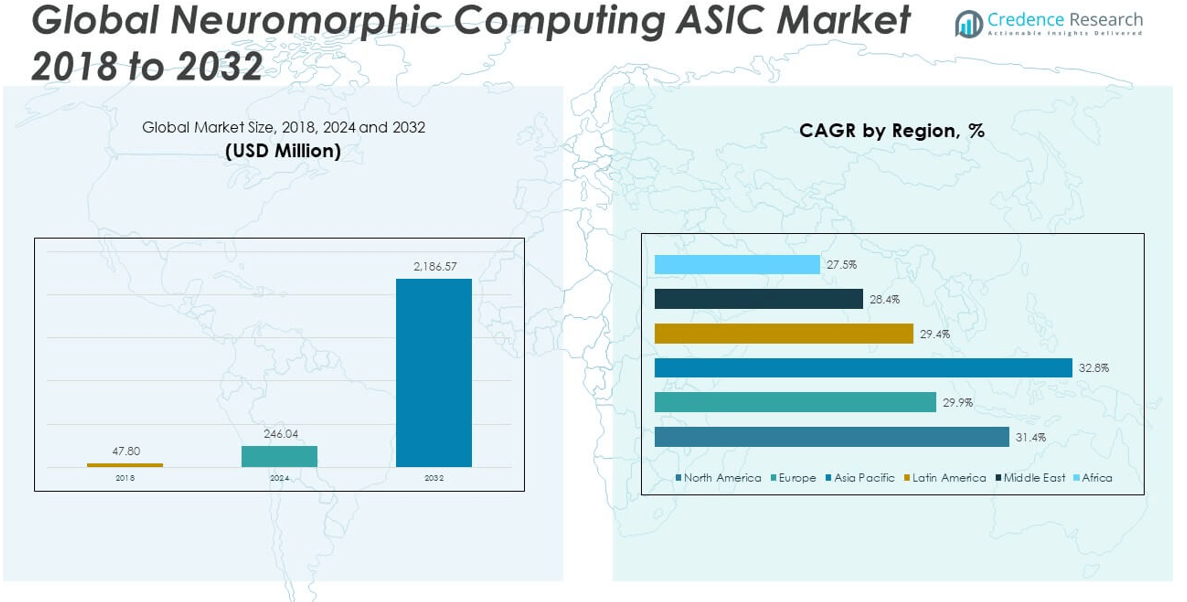
The Global Neuromorphic Computing ASIC Market size was valued at USD 47.80 million in 2018 to USD 246.04 million in 2024 and is anticipated to reach USD 2,186.57 million by 2032, at a CAGR of 31.40% during the forecast period.
The Global Neuromorphic Computing ASIC Market is primarily driven by the growing demand for energy-efficient, real-time processing solutions in artificial intelligence and edge computing applications. Unlike traditional computing systems, neuromorphic chips mimic the architecture of the human brain, enabling event-driven data processing with significantly reduced power consumption. The proliferation of AI across sectors such as healthcare, consumer electronics, and defense has further intensified the need for specialized processors capable of handling complex, adaptive tasks efficiently. Technological advancements in spiking neural networks and increasing investments in R&D have accelerated the development of neuromorphic ASICs. Additionally, collaborations between chip manufacturers and academic institutions, along with rising government funding for AI hardware innovation, are reinforcing the market’s growth trajectory. The ability of neuromorphic ASICs to deliver high-performance computing at the edge while maintaining minimal energy usage positions them as a transformative solution for next-generation intelligent systems.
Regionally, North America holds the largest share of the neuromorphic computing ASIC market, driven by robust technological infrastructure, early adoption of advanced AI hardware, and the presence of leading companies such as Intel, IBM, and BrainChip. The United States continues to lead in neuromorphic research, backed by significant government and institutional funding, especially for defense, healthcare, and autonomous technologies. Meanwhile, the Asia-Pacific region is projected to witness the fastest growth during the forecast period. This acceleration is fueled by rapid industrialization, increasing investments in semiconductor innovation, and expanding adoption of AI-powered consumer electronics in countries like China, Japan, and South Korea. Europe also demonstrates strong potential, supported by government-backed initiatives such as the Human Brain Project and growing demand for sustainable computing solutions. Emerging regions, including Latin America and the Middle East & Africa, are in earlier stages of adoption but are expected to contribute to market growth as digital infrastructure and AI integration improve steadily.
Market Insights:
- The market was valued at USD 246.04 million in 2024 and is expected to reach USD 2,186.57 million by 2032, growing at a CAGR of 31.40% during the forecast period.
- Neuromorphic ASICs are in high demand due to their energy-efficient and real-time AI processing capabilities, ideal for edge computing and autonomous systems.
- Rapid advancements in spiking neural networks and neuromorphic chip architecture are enabling new levels of adaptability, learning, and sensory data processing.
- The rise of edge computing applications in sectors like wearables, surveillance, and industrial automation is fueling demand for distributed, low-power AI hardware.
- Strong government and institutional support, including funding and research initiatives in the U.S., EU, and Asia-Pacific, is accelerating product development and deployment.
- The market faces challenges such as complex chip design, lack of standardization, and limited software ecosystem, which slow down widespread adoption.
- North America holds the largest market share, driven by companies like Intel and BrainChip, while Asia-Pacific is projected to grow fastest due to investments in AI and semiconductor innovation.
Market Drivers:
Increasing Demand for Energy-Efficient and Real-Time AI Processing Solutions
The Global Neuromorphic Computing ASIC Market is experiencing significant growth due to the rising need for energy-efficient AI hardware. Traditional processors struggle to meet the demands of real-time data processing while maintaining low power consumption. Neuromorphic ASICs, modeled after the human brain, deliver advanced computational capabilities while minimizing energy usage. This makes them highly suitable for edge devices, autonomous systems, and real-time analytics platforms. Their architecture supports parallel data processing and event-driven responses, which are essential for responsive AI applications. The growing adoption of AI in sectors such as automotive, healthcare, and consumer electronics reinforces the market’s momentum.
- For example, Intel’s Loihi 2 neuromorphic processor demonstrates a significant leap in energy-efficient, real-time AI processing. According to Intel, Loihi 2 achieves up to 10x faster processing speeds and up to 15x greater resource density compared to its predecessor, while maintaining ultra-low power consumption-consuming as little as 23 milliwatts in certain workloads.
Expansion of Edge Computing Applications Driving ASIC Adoption
Edge computing is transforming how data is processed, and neuromorphic ASICs are central to this shift. These chips support localized, low-latency decision-making, which eliminates the need to transfer data to centralized cloud systems. It enables applications in wearables, industrial automation, and surveillance systems to operate independently and efficiently. As the demand for intelligent edge devices rises, so does the need for hardware capable of supporting distributed AI workloads. The market is responding with ASIC designs optimized for edge deployment, reinforcing their utility in bandwidth-sensitive environments. The Global Neuromorphic Computing ASIC Market is benefiting directly from this evolution in computing infrastructure.
Rapid Advancements in Neuromorphic Architecture and Spiking Neural Networks
Breakthroughs in chip architecture and spiking neural networks are redefining what neuromorphic systems can achieve. ASICs designed for neuromorphic computing are now capable of adapting to changing data inputs and mimicking human-like learning mechanisms. These innovations improve performance in applications requiring pattern recognition, anomaly detection, and adaptive behavior. Leading semiconductor firms and research institutions are investing in scalable, high-performance ASICs to support commercial deployment. It fosters a competitive environment where continuous innovation shapes the product landscape. The market’s growth is tightly linked to these ongoing hardware advancements and their ability to address real-world computational challenges.
- For instance, IBM’s TrueNorth chip is a benchmark for innovation in neuromorphic architecture. The chip integrates 1 million programmable neurons and 256 million synapses, consuming just 70 milliwatts during operation. IBM’s research shows that TrueNorth can perform complex pattern recognition tasks, such as real-time video analysis, at 1,000 frames per second with less than 100 milliwatts of power orders of magnitude more efficient than standard digital architectures.
Strong Institutional and Government Support for AI Hardware Innovation
National governments and research agencies are recognizing the strategic importance of neuromorphic computing. Public funding, defense grants, and university partnerships are driving ASIC development at a global scale. The United States, European Union, and several Asia-Pacific nations are prioritizing investments in next-generation AI processors. It reflects a commitment to building sovereign capability in advanced computing technologies. These efforts support both foundational research and commercial scalability, accelerating time to market for neuromorphic solutions. The Global Neuromorphic Computing ASIC Market is well-positioned to benefit from this structured, multi-stakeholder support network.
Market Trends:
Integration of Neuromorphic ASICs into Sensor Fusion and Multimodal Systems
The convergence of neuromorphic computing with sensor fusion technologies is creating new application opportunities. Multimodal systems that combine data from visual, auditory, and tactile sensors benefit from the real-time processing capabilities of neuromorphic ASICs. These chips enable intelligent decision-making in devices that must interpret complex, variable inputs, such as robotics and autonomous drones. It enhances system responsiveness while maintaining low power usage. The trend aligns with the growing need for context-aware machines in dynamic environments. The Global Neuromorphic Computing ASIC Market is evolving to support this integration, pushing the boundaries of machine perception and autonomy.
- For example, Intel’s Loihi 2 neuromorphic processor has been integrated into advanced robotics platforms for real-time sensor fusion. In a collaboration with ETH Zurich, Loihi 2 was used in a robotic arm that combined visual, auditory, and tactile sensor data to perform complex object manipulation tasks. The system achieved sub-5 millisecond response times while consuming less than 100 milliwatts,
Commercial Deployment in Smart Infrastructure and Urban Technology
Cities are beginning to adopt neuromorphic chips to support smart infrastructure systems. These include intelligent traffic control, energy-efficient public lighting, and real-time surveillance. Neuromorphic ASICs enable decentralized data processing, which reduces latency and improves responsiveness in urban management systems. It allows for predictive maintenance, adaptive control, and autonomous system coordination without constant cloud dependency. The shift toward smarter cities is encouraging public-private investments in scalable neuromorphic hardware solutions. The Global Neuromorphic Computing ASIC Market is capitalizing on these infrastructure modernization efforts.
Increasing Role of Neuromorphic ASICs in Financial and Security Analytics
Financial institutions and cybersecurity firms are exploring neuromorphic ASICs for pattern detection and anomaly analysis. These chips offer low-latency processing capabilities that are critical for fraud prevention, risk management, and predictive analytics. It enables real-time recognition of subtle data irregularities that conventional systems may overlook. The ability to operate on streaming data with minimal energy overhead makes neuromorphic hardware attractive for high-frequency trading and intrusion detection systems. Growing concerns over data breaches and financial manipulation are driving interest in specialized ASIC architectures. The Global Neuromorphic Computing ASIC Market is expanding its reach into these high-value, high-sensitivity domains.
Use of Neuromorphic Hardware in Brain-Computer Interface Development
Researchers and biotech firms are applying neuromorphic ASICs in brain-computer interface (BCI) technologies. These applications demand processors that can interpret bioelectrical signals with high temporal precision and minimal energy consumption. It supports advancements in neuroprosthetics, mental health monitoring, and cognitive augmentation tools. The neuromorphic approach offers a natural fit for decoding neural signals in real time, which traditional hardware cannot replicate efficiently. Growing investment in neurotechnology is reinforcing the relevance of customized neuromorphic solutions. The Global Neuromorphic Computing ASIC Market is emerging as a foundational element in the future of human-machine interaction.
- For example, the National Institute of Advanced Industrial Science and Technology (AIST) in Japan is a recognized leader in neuromorphic computing research, with documented work on energy-efficient AI chips for robotics, edge computing, and sensor applications.
Market Challenges Analysis:
Technical Complexity and Lack of Standardization in Hardware Design
The Global Neuromorphic Computing ASIC Market faces challenges related to the complexity of chip architecture and the absence of unified design standards. Neuromorphic systems require a fundamentally different approach from conventional computing, which complicates design, testing, and scalability. Developers must address issues such as neuron modeling, synaptic behavior, and asynchronous data handling, which demand specialized expertise. It slows down the commercialization process and increases development costs for both startups and established semiconductor firms. The lack of interoperability across platforms and tools further limits widespread adoption. Without standardized frameworks, integrating neuromorphic ASICs into existing systems remains a significant barrier.
Limited Ecosystem Support and Low Software Compatibility
Market growth is also constrained by the underdeveloped ecosystem surrounding neuromorphic computing. Software tools, development environments, and training resources remain limited when compared to those available for traditional CPUs and GPUs. It creates a steep learning curve for developers seeking to build or port applications to neuromorphic platforms. The scarcity of compatible frameworks and simulation tools makes it difficult to validate performance and functionality at scale. This fragmentation slows down innovation and deters potential adopters from investing in neuromorphic solutions. The Global Neuromorphic Computing ASIC Market must overcome these ecosystem gaps to enable broader commercialization and integration across industries.
Market Opportunities:
Growing Demand for Autonomous Intelligence Across Emerging Industries
The Global Neuromorphic Computing ASIC Market has strong opportunities in sectors seeking autonomous, low-power intelligence. Industries such as logistics, defense, agriculture, and healthcare are exploring AI systems that operate independently in real-time environments. Neuromorphic ASICs offer the ability to process sensory data efficiently without constant cloud connectivity. It enables machines to adapt to dynamic conditions while preserving battery life and reducing computational overhead. These capabilities align well with the demands of next-generation robotics, smart wearables, and mobile medical devices. The expanding focus on autonomy and decentralization creates favorable ground for neuromorphic chip adoption.
Rising Investment in AI Research and Next-Generation Computing Architectures
Global investment in artificial intelligence and neuromorphic computing research is accelerating across public and private sectors. Governments and enterprises are funding initiatives that prioritize energy-efficient AI and scalable hardware innovation. It creates a fertile environment for startups and established players to introduce specialized ASIC solutions. Academic partnerships and pilot deployments are supporting early use cases in neurotechnology, edge computing, and sensory systems. The Global Neuromorphic Computing ASIC Market is positioned to benefit from these investments by providing customized architectures for mission-critical applications. The convergence of research momentum and commercial interest signals a strong future opportunity landscape.
Market Segmentation Analysis:
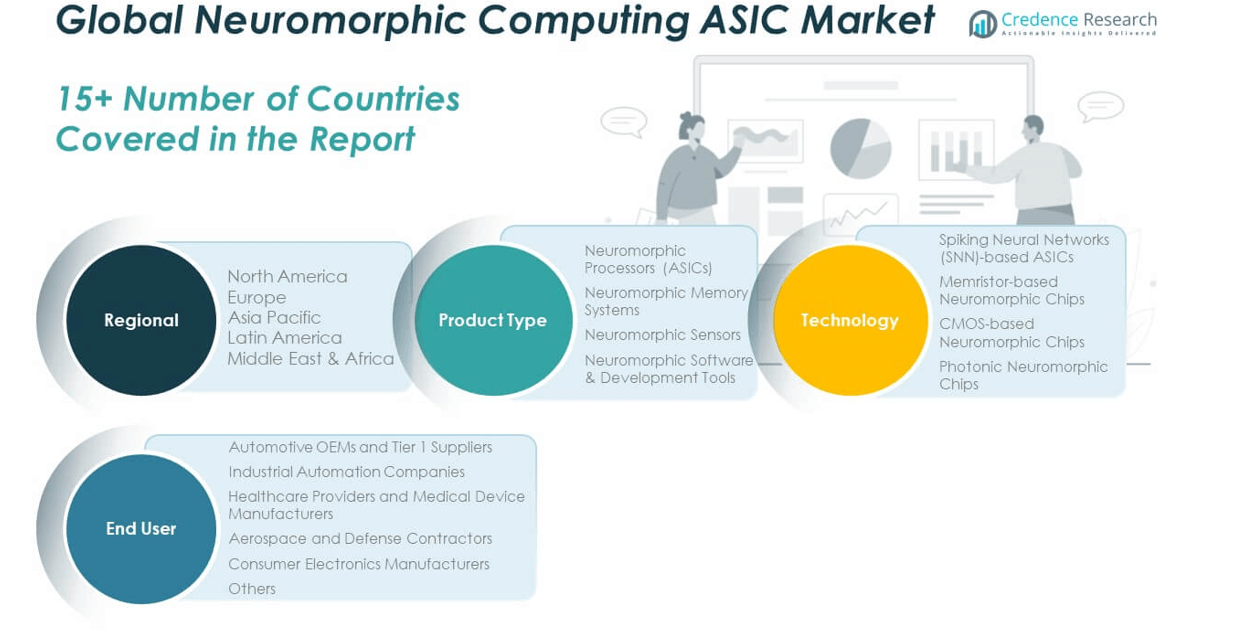
The Global Neuromorphic Computing ASIC Market is segmented by product type, technology, and end user, each contributing uniquely to the market's growth trajectory.
By product type, neuromorphic processors (ASICs) hold the largest share, driven by demand for high-performance, energy-efficient computing. Neuromorphic memory systems and sensors are gaining traction in embedded and autonomous systems. Neuromorphic software and development tools support hardware integration and system-level optimization.
By technology, spiking neural networks (SNN)-based ASICs dominate due to their ability to mimic brain-like activity for event-driven data processing. Memristor-based and CMOS-based chips are also expanding, offering scalable solutions for adaptive learning models. Photonic neuromorphic chips, though in early stages, promise ultra-fast processing for high-demand applications.
- For example, a memristor crossbar array was shown to reliably process biomedical sequential data, highlighting its potential in edge devices for healthcare and robotics.
By end user, automotive OEMs and Tier 1 suppliers lead adoption, leveraging neuromorphic chips for autonomous driving systems. Industrial automation companies and aerospace and defense contractors follow, integrating these chips into real-time, mission-critical systems. Healthcare providers, medical device manufacturers, and consumer electronics firms are expanding use cases across diagnostics, wearables, and intelligent sensing platforms. The Global Neuromorphic Computing ASIC Market reflects strong cross-industry adoption driven by rapid advancements in hardware and AI applications.
- For instance, industrial and aerospace sectors are integrating neuromorphic chips into real-time, mission-critical systems for tasks such as predictive maintenance, adaptive control, and autonomous robotics.
Segmentation:
By Product Type
- Neuromorphic Processors (ASICs)
- Neuromorphic Memory Systems
- Neuromorphic Sensors
- Neuromorphic Software & Development Tools
By Technology
- Spiking Neural Networks (SNN)-based ASICs
- Memristor-based Neuromorphic Chips
- CMOS-based Neuromorphic Chips
- Photonic Neuromorphic Chips
By End User
- Automotive OEMs and Tier 1 Suppliers
- Industrial Automation Companies
- Healthcare Providers and Medical Device Manufacturers
- Aerospace and Defense Contractors
- Consumer Electronics Manufacturers
- Others
By Region
- North America
- U.S.
- Canada
- Mexico
- Europe
- Germany
- France
- U.K.
- Italy
- Spain
- Rest of Europe
- Asia Pacific
- China
- Japan
- India
- South Korea
- South-east Asia
- Rest of Asia Pacific
- Latin America
- Brazil
- Argentina
- Rest of Latin America
- Middle East & Africa
- GCC Countries
- South Africa
- Rest of the Middle East and Africa
Regional Analysis:
North America
The North America Neuromorphic Computing ASIC Market size was valued at USD 19.95 million in 2018 to USD 101.57 million in 2024 and is anticipated to reach USD 905.26 million by 2032, at a CAGR of 31.4% during the forecast period. North America holds the largest share of the Global Neuromorphic Computing ASIC Market, accounting for 34.2% of the global revenue in 2024. This dominance is driven by the strong presence of industry leaders such as Intel, IBM, and BrainChip, along with government funding for advanced AI hardware. The United States leads regional adoption due to its well-established research ecosystem, early-stage commercialization, and significant defense-sector investments. It continues to serve as a hub for neuromorphic R&D through academic and public-private collaborations. The region also benefits from a robust infrastructure supporting high-performance computing and AI integration in critical industries. North America’s strong momentum reinforces its position as a strategic growth center for neuromorphic innovation.
Europe
The Europe Neuromorphic Computing ASIC Market size was valued at USD 9.33 million in 2018 to USD 45.52 million in 2024 and is anticipated to reach USD 369.54 million by 2032, at a CAGR of 29.9% during the forecast period. Europe contributes 15.3% of the 2024 global market share, supported by significant investments in sustainable AI and ethical computing frameworks. Countries such as Germany, France, and the Netherlands are advancing neuromorphic research through national programs and the European Union’s Human Brain Project. The region emphasizes low-power, privacy-conscious AI deployments in healthcare, automotive, and industrial automation. It is gradually transitioning from research-led initiatives to early commercialization. Regulatory frameworks also support the development of secure and transparent AI systems that benefit from neuromorphic capabilities. The European market is steadily maturing, with growing participation from academic labs and semiconductor startups.
Asia Pacific
The Asia Pacific Neuromorphic Computing ASIC Market size was valued at USD 14.26 million in 2018 to USD 77.37 million in 2024 and is anticipated to reach USD 748.06 million by 2032, at a CAGR of 32.8% during the forecast period. Asia Pacific holds a 26.1% share of the global market in 2024, making it the fastest-growing regional segment. China, Japan, and South Korea are leading investments in neuromorphic chip design, driven by their advanced semiconductor manufacturing capabilities. It benefits from strong government backing and initiatives focused on AI industrialization, smart city development, and defense modernization. Regional companies are actively developing custom ASICs for consumer electronics, surveillance systems, and robotics. Universities and corporate labs across the region are expanding neuromorphic research through collaborative programs. Asia Pacific’s scale, technical talent, and market demand continue to propel rapid growth and adoption.
Latin America
The Latin America Neuromorphic Computing ASIC Market size was valued at USD 2.30 million in 2018 to USD 11.70 million in 2024 and is anticipated to reach USD 92.22 million by 2032, at a CAGR of 29.4% during the forecast period. Latin America accounts for 3.9% of the global market in 2024 and is gradually embracing neuromorphic technologies in academic and government-backed research settings. Countries like Brazil and Mexico are piloting AI applications in public safety, education, and agriculture. It faces infrastructure limitations but benefits from growing interest in edge computing and energy-efficient AI hardware. Regional universities and startups are experimenting with neuromorphic platforms for adaptive systems. While deployment remains limited, the region is laying groundwork for future commercialization. The presence of global tech vendors and improving connectivity will support growth over time.
Middle East
The Middle East Neuromorphic Computing ASIC Market size was valued at USD 1.25 million in 2018 to USD 5.86 million in 2024 and is anticipated to reach USD 43.35 million by 2032, at a CAGR of 28.4% during the forecast period. The Middle East holds a 2.0% share of the global market and is beginning to explore neuromorphic computing for defense, surveillance, and smart infrastructure applications. Countries such as the UAE and Saudi Arabia are making strategic investments in AI-driven development as part of national transformation agendas. It offers a favorable environment for pilot deployments and public sector innovation. Partnerships with global technology providers are helping introduce neuromorphic systems in government and energy sectors. The regional focus on innovation hubs and data sovereignty adds momentum to adoption. Growth potential is strong, although still in early phases.
Africa
The Africa Neuromorphic Computing ASIC Market size was valued at USD 0.70 million in 2018 to USD 4.02 million in 2024 and is anticipated to reach USD 28.14 million by 2032, at a CAGR of 27.5% during the forecast period. Africa represents 1.4% of the 2024 global market, reflecting early-stage adoption and limited infrastructure readiness. Research institutions in South Africa and Kenya are initiating small-scale neuromorphic studies in agriculture, renewable energy, and education technology. It faces challenges in terms of connectivity, local expertise, and funding, which constrain commercial growth. Despite this, the need for low-power, cost-effective AI solutions aligns well with the promise of neuromorphic chips. International collaborations and capacity-building efforts are beginning to create pathways for technology transfer. Africa’s role in the Global Neuromorphic Computing ASIC Market is emerging, with long-term potential tied to foundational digital expansion.
Key Player Analysis:
- Intel Corporation
- IBM Corporation
- Samsung Electronics
- BrainChip Holdings Ltd.
- Qualcomm
- NVIDIA Corporation
- Microsoft Corporation
- Amazon Web Services (AWS)
- Apple Inc.
- MediaTek
Competitive Analysis:
The Global Neuromorphic Computing ASIC Market features a competitive landscape shaped by innovation, strategic partnerships, and sustained R&D investment. Key players such as Intel Corporation, IBM, BrainChip Holdings Ltd., Qualcomm Inc., and General Vision Inc. are leading advancements in neuromorphic chip design and deployment. These companies focus on spiking neural networks and energy-efficient architectures tailored for real-time edge processing. It is witnessing increased collaboration between semiconductor firms and research institutions to accelerate commercialization and optimize chip functionality. Startups and emerging firms are entering the space with application-specific solutions targeting healthcare, autonomous systems, and IoT. Market participants are competing on scalability, power efficiency, and the ability to support adaptive learning models. The Global Neuromorphic Computing ASIC Market continues to evolve through technological differentiation and domain-specific innovation, driving both consolidation and diversification across end-use sectors. Competitive intensity is expected to rise as product maturity improves and new use cases emerge across industries.
Recent Developments:
- In June 2025, Intel unveiled “Hala Point,” the world’s largest neuromorphic computing system powered by 1,152 Loihi 2 chips intended for research at Sandia National Laboratories.
- In June 2025, IBM announced a joint study agreement with Inclusive Brains, a company specializing in non-invasive neurotechnologies. This partnership focuses on leveraging advanced AI and quantum machine learning techniques to enhance brain-machine interfaces (BMIs).
Market Concentration & Characteristics:
The Global Neuromorphic Computing ASIC Market exhibits a moderate to high level of market concentration, with a few established players holding a significant share of the global revenue. Companies such as Intel, IBM, and BrainChip dominate early-stage commercialization due to their proprietary chip architectures and strong research capabilities. It remains technology-intensive, with high entry barriers stemming from the complexity of neuromorphic design and the lack of standardized development frameworks. The market is characterized by long innovation cycles, limited production volumes, and a strong focus on energy efficiency and real-time processing. Strategic collaborations with academic institutions and government-funded projects play a central role in accelerating product development. The Global Neuromorphic Computing ASIC Market continues to favor firms with deep expertise in AI hardware and the ability to deliver customized, scalable solutions for emerging applications across industries.
Report Coverage:
The research report offers an in-depth analysis based on product type, technology, and end user. It details leading market players, providing an overview of their business, product offerings, investments, revenue streams, and key applications. Additionally, the report includes insights into the competitive environment, SWOT analysis, current market trends, as well as the primary drivers and constraints. Furthermore, it discusses various factors that have driven market expansion in recent years. The report also explores market dynamics, regulatory scenarios, and technological advancements that are shaping the industry. It assesses the impact of external factors and global economic changes on market growth. Lastly, it provides strategic recommendations for new entrants and established companies to navigate the complexities of the market.
Future Outlook:
- Demand for low-power AI hardware will accelerate neuromorphic ASIC adoption across edge computing environments.
- Advancements in spiking neural networks will enhance real-time learning and sensory data processing.
- Integration with robotics and autonomous vehicles will expand industrial and mobility use cases.
- Rising R&D funding from governments and defense sectors will support chip innovation and deployment.
- Commercialization will increase as leading tech firms refine scalable neuromorphic architectures.
- Healthcare applications such as neuroprosthetics and brain-computer interfaces will gain traction.
- Asia Pacific will emerge as a global manufacturing and innovation hub for neuromorphic chips.
- Standardization efforts will improve interoperability and accelerate software ecosystem development.
- Growing partnerships between academic institutions and semiconductor companies will drive breakthroughs.
- The market will diversify beyond research labs into mainstream applications across security, finance, and smart infrastructure.

Request a Free Sample
Fill in your details and we'll send you a free sample report.
- Sample data tables & charts
- Research methodology
Market Dynamics
Increasing Demand for Energy-Efficient and Real-Time AI Processing Solutions
Neuromorphic ASICs are designed to mimic the human brain, enabling advanced computational capabilities with minimal energy consumption. This makes them ideal for edge devices and real-time analytics platforms where traditional processors are inefficient, driving adoption across sectors such as automotive, healthcare, and consumer electronics.
Expansion of Edge Computing Applications
The shift toward edge computing requires localized, low-latency decision-making, which neuromorphic ASICs are uniquely suited to provide. Their ability to process data on-device without constant cloud connectivity is fueling their integration into wearables, industrial automation, and surveillance systems.
Rapid Advancements in Neuromorphic Architecture and Spiking Neural Networks
Breakthroughs in chip design and spiking neural networks are enabling neuromorphic ASICs to adapt to changing data inputs and perform complex pattern recognition with high efficiency. This continuous innovation is expanding the range of commercial applications and improving performance in real-world scenarios.
Strong Institutional and Government Support for AI Hardware Innovation
Significant investments from governments and research agencies in the U.S., EU, and Asia-Pacific are accelerating the development and deployment of neuromorphic ASICs. Public funding, defense grants, and academic partnerships are fostering a robust ecosystem for next-generation AI hardware.
Integration into Emerging Applications such as Brain-Computer Interfaces and Smart Infrastructure
Neuromorphic ASICs are increasingly being used in advanced applications like brain-computer interfaces, smart city infrastructure, and financial analytics. Their ability to process multimodal sensory data in real time with low power consumption is opening new markets and driving further growth.
Need a Custom Version of This Report?
Tailor the scope, geography, or segments to your exact requirements.
- Custom geography or segment scope
- Direct access to our analyst team
Frequently Asked Questions
What is the current size of the Global Neuromorphic Computing ASIC Market?
What factors are driving the growth of the Global Neuromorphic Computing ASIC Market?
What are the key segments within the Global Neuromorphic Computing ASIC Market?
Who are the major players in the Global Neuromorphic Computing ASIC Market?
Table of Content
Chapter 1 Market Segmentation
- 1.1 Segmentation Framework
- 1.1.1 Product and Service Classification
- 1.1.2 Application and End-Use Classification
- 1.1.3 Technology and Solution Classification
- 1.1.4 Customer and Distribution Channel Classification
- 1.1.5 Geographic Segmentation
- 1.1.6 Market Segment Definitions and Boundaries
- 1.2 By End User
- 1.2.1 Automotive OEMs and Tier 1 Suppliers
- 1.2.2 Industrial Automation Companies
- 1.2.3 Healthcare Providers and Medical Device Manufacturers
- 1.2.4 Aerospace and Defense Contractors
- 1.2.5 Consumer Electronics Manufacturers
- 1.2.6 Others
- 1.3 By Technology
- 1.3.1 Spiking Neural Networks (SNN)-based ASICs
- 1.3.2 Memristor-based Neuromorphic Chips
- 1.3.3 CMOS-based Neuromorphic Chips
- 1.3.4 Photonic Neuromorphic Chips
- 1.4 By Product Type
- 1.4.1 Neuromorphic Processors (ASICs)
- 1.4.2 Neuromorphic Memory Systems
- 1.4.3 Neuromorphic Sensors
- 1.4.4 Neuromorphic Software & Development Tools
Chapter 2 Introduction
- 2.1 Report Objectives and Scope
- 2.2 Product Definition and Industry Terminology
- 2.3 Market Inclusions and Exclusions
- 2.4 Research Process
- 2.4.1 Primary Research and Expert Interviews
- 2.4.2 Secondary Research and Source Review
- 2.4.3 Top-Down and Bottom-Up Estimation
- 2.4.4 Data Triangulation and Verification
- 2.5 Market Size Measurement Basis
- 2.5.1 2024: USD 246.04 million → 2032: USD 2,186.57 million
- 2.6 Historical and Forecast Reference Periods
- 2.6.1 Base Year: 2024
- 2.6.2 Forecast Period: 2024-2032
- 2.7 Research Assumptions and Limitations
Chapter 3 Executive Summary
- 3.1 Market Snapshot and Key Findings
- 3.2 Base-Year Market Size, 2024
- 3.3 Forecast Market Size, 2032
- 3.4 Revenue and Volume Growth Outlook
- 3.5 Key Demand and Supply Indicators
- 3.6 Leading Market Segments
- 3.7 Fastest-Growing Market Opportunities
- 3.8 Regional Performance Highlights
- 3.9 Technology and Industry Transformation
- 3.10 Competitive Landscape Summary
- 3.11 Analyst View and Strategic Implications
Chapter 4 Global Neuromorphic Computing ASIC Market Trends and Developments
- 4.1 Historical Industry Development
- 4.2 Recent Market Trends and Developments
- 4.3 Demand and Customer Behavior Trends
- 4.4 Technology and Product Innovation
- 4.5 Artificial Intelligence, Automation and Digitalization
- 4.6 Local Manufacturing and Supply Chain Realignment
- 4.7 Industry Partnerships, Mergers and Acquisitions
- 4.8 Sustainability and Circular Economy Developments
- 4.9 Government and Private Sector Investment Trends
- 4.10 Emerging Business Models and Commercialization
- 4.11 Industry Developments and Announcements
Chapter 5 Global Neuromorphic Computing ASIC Market Production, Supply and Demand Analysis
- 5.1 Demand Trend and Consumption Analysis
- 5.2 Demand Forecast, 2024-2032
- 5.3 Production and Output Trend
- 5.4 Production and Output Forecast, 2024-2032
- 5.5 Installed Capacity and Capacity Utilization
- 5.6 Company-Wise Production Plants and Statistics
- 5.6.1 Installed Production Capacity
- 5.6.2 Actual Production
- 5.6.3 Planned Capacity and Expansion Targets
- 5.7 Supply Chain Structure and Procurement Trends
- 5.8 Supply-Demand Gap and Bottlenecks
- 5.9 Import Dependence and Sourcing Structure
- 5.10 Contract Manufacturing and Outsourcing
- 5.11 Regional Supply and Demand Concentration
Chapter 6 Global Neuromorphic Computing ASIC Market Pricing Analysis
- 6.1 Pricing Structure and Measurement
- 6.2 Historical Pricing Trends
- 6.3 Pricing Outlook, 2024-2032
- 6.4 Average Selling Price and Unit Economics
- 6.5 Pricing by Product and Market Segment
- 6.6 Geographic Pricing Differences
- 6.7 Key Input, Energy, Labor and Logistics Costs
- 6.8 Contract Pricing and Purchasing Models
- 6.9 Pricing Sensitivity and Competitive Positioning
- 6.10 Price, Margin and Profitability Implications
Chapter 7 Global Neuromorphic Computing ASIC Market Dynamics
- 7.1 Market Growth Drivers
- 7.1.1 Demand-Side Drivers
- 7.1.2 Technology and Innovation Drivers
- 7.1.3 Infrastructure and Investment Drivers
- 7.1.4 Regulatory and Policy Drivers
- 7.2 Market Restraints
- 7.2.1 Cost and Affordability Constraints
- 7.2.2 Technology and Adoption Barriers
- 7.2.3 Supply Chain and Operational Constraints
- 7.3 Market Challenges
- 7.3.1 Competitive Pressure and Margin Erosion
- 7.3.2 Skills, Infrastructure and Implementation Gaps
- 7.4 Emerging Market Opportunities
- 7.5 Market Dynamics Impact and Time-Horizon Assessment
Chapter 8 Global Neuromorphic Computing ASIC Value Chain Analysis
- 8.1 Industry Value Chain Overview
- 8.2 Upstream Suppliers and Critical Inputs
- 8.3 Technology and Component Providers
- 8.4 Manufacturing or Service Delivery
- 8.5 Distribution, Channel Partners and Integrators
- 8.6 Downstream Applications and End Users
- 8.7 Value Addition and Profit Pools
- 8.8 Vertical Integration and Outsourcing
- 8.9 Supplier Concentration and Risk
- 8.10 Supply Chain Localization and Resilience
Chapter 9 Global Neuromorphic Computing ASIC Market Regulations and Policies
- 9.1 Relevant Laws, Standards and Compliance Frameworks
- 9.2 Product, Service, Safety and Quality Requirements
- 9.3 Government Policies, Incentives and Subsidies
- 9.4 Imports, Exports and Trade Barriers
- 9.5 Public Procurement and Local Content Requirements
- 9.6 Environmental and Sustainability Compliance
- 9.7 Upcoming Policy Changes and Market Implications
Chapter 10 Global Neuromorphic Computing ASIC Market Hotspots and Opportunities
- 10.1 Market Opportunity Mapping and Growth Hotspots
- 10.2 High-Growth Applications and Customer Groups
- 10.3 Underserved Markets and White-Space Opportunities
- 10.4 Emerging Technology and Product Opportunities
- 10.5 New Capacity and Investment Hotspots
- 10.6 Market Entry and Expansion Opportunities
- 10.7 Distribution and Partnership Opportunities
- 10.8 Near-Term and Long-Term Commercial Potential
- 10.9 Opportunity Attractiveness and Execution Risks
Chapter 11 Global Neuromorphic Computing ASIC Market Outlook, 2024-2032
- 11.1 Market Size and Analysis
- 11.1.1 Revenue (Market Measurement: 2024: USD 246.04 million → 2032: USD 2,186.57 million)
- 11.1.2 Market Volume and Quantity Sold
- 11.1.3 Historical Market Size
- 11.1.4 Base-Year Market Size, 2024
- 11.2 Market Forecast, 2024-2032
- 11.2.1 Revenue Forecast to 2032
- 11.2.2 Volume Forecast to 2032
- 11.2.3 CAGR and Year-on-Year Growth
- 11.2.4 Incremental Revenue Opportunity
- 11.3 Forecast Assumptions and Scenario Analysis
- 11.3.1 Base-Case Forecast
- 11.3.2 Optimistic and Conservative Scenarios
- 11.3.3 Technology, Pricing and Policy Sensitivities
- 11.4 Market Attractiveness and Growth Outlook
Chapter 12 Global Neuromorphic Computing ASIC Market Segmentation and Outlook
- 12.1 Segmentation Summary and Market Shares, 2024
- 12.2 Largest and Fastest-Growing Segments
- 12.3 By End User - Market Size and Forecast, 2024-2032
- 12.3.1 Segment Definition and Scope
- 12.3.2 Historical Market Size
- 12.3.3 Revenue Forecast, 2024-2032
- 12.3.4 Volume Forecast, 2024-2032
- 12.3.5 Base-Year Market Share, 2024
- 12.3.6 Segment CAGR and Growth Drivers
- 12.3.7 Subsegment Market Size and Forecast
- 12.3.7.1 Automotive OEMs and Tier 1 Suppliers
- 12.3.7.2 Industrial Automation Companies
- 12.3.7.3 Healthcare Providers and Medical Device Manufacturers
- 12.3.7.4 Aerospace and Defense Contractors
- 12.3.7.5 Consumer Electronics Manufacturers
- 12.3.7.6 Others
- 12.3.8 Subsegment Pricing and Adoption Trends
- 12.3.9 Leading Suppliers and Competition
- 12.3.10 Regional Demand and Opportunities
- 12.4 By Technology - Market Size and Forecast, 2024-2032
- 12.4.1 Segment Definition and Scope
- 12.4.2 Historical Market Size
- 12.4.3 Revenue Forecast, 2024-2032
- 12.4.4 Volume Forecast, 2024-2032
- 12.4.5 Base-Year Market Share, 2024
- 12.4.6 Segment CAGR and Growth Drivers
- 12.4.7 Subsegment Market Size and Forecast
- 12.4.7.1 Spiking Neural Networks (SNN)-based ASICs
- 12.4.7.2 Memristor-based Neuromorphic Chips
- 12.4.7.3 CMOS-based Neuromorphic Chips
- 12.4.7.4 Photonic Neuromorphic Chips
- 12.4.8 Subsegment Pricing and Adoption Trends
- 12.4.9 Leading Suppliers and Competition
- 12.4.10 Regional Demand and Opportunities
- 12.5 By Product Type - Market Size and Forecast, 2024-2032
- 12.5.1 Segment Definition and Scope
- 12.5.2 Historical Market Size
- 12.5.3 Revenue Forecast, 2024-2032
- 12.5.4 Volume Forecast, 2024-2032
- 12.5.5 Base-Year Market Share, 2024
- 12.5.6 Segment CAGR and Growth Drivers
- 12.5.7 Subsegment Market Size and Forecast
- 12.5.7.1 Neuromorphic Processors (ASICs)
- 12.5.7.2 Neuromorphic Memory Systems
- 12.5.7.3 Neuromorphic Sensors
- 12.5.7.4 Neuromorphic Software & Development Tools
- 12.5.8 Subsegment Pricing and Adoption Trends
- 12.5.9 Leading Suppliers and Competition
- 12.5.10 Regional Demand and Opportunities
- 12.6 Segment Growth Comparison
- 12.7 Segment Attractiveness and Priority Matrix
Chapter 13 Global Neuromorphic Computing ASIC End-Use and Application Market Outlook
- 13.1 End-Use Industry and Customer Demand Structure
- 13.2 Leading Applications and Customer Groups
- 13.3 End-Use Market Size, Share and Forecast
- 13.4 Major End-Use Industry Deep Dives
- 13.4.1 Customer Requirements and Use Cases
- 13.4.2 Demand and Replacement Cycles
- 13.4.3 Technical and Regulatory Considerations
- 13.4.4 Purchasing and Procurement Models
- 13.4.5 Leading Vendors and Distribution Channels
- 13.4.6 Forecast and Commercial Opportunities
- 13.5 Emerging Applications and Cross-Segment Demand
- 13.6 End-Use Industry Investment Priorities
Chapter 14 Global Neuromorphic Computing ASIC Geographic Market Outlook, 2024-2032
- 14.1 Regional Market Size and Share, 2024
- 14.2 Regional Market Forecast, 2024-2032
- 14.3 Regional Pricing, Production and Demand Differences
- 14.4 North America
- 14.4.1 United States
- 14.4.2 Canada
- 14.4.3 Mexico
- 14.5 Europe
- 14.5.1 Germany
- 14.5.2 France
- 14.5.3 Italy
- 14.5.4 United Kingdom
- 14.5.5 Spain
- 14.5.6 Poland
- 14.5.7 Russia
- 14.5.8 Netherlands
- 14.5.9 Belgium
- 14.5.10 Sweden
- 14.5.11 Denmark
- 14.5.12 Norway
- 14.5.13 Rest of Europe
- 14.6 Asia Pacific
- 14.6.1 China
- 14.6.2 India
- 14.6.3 Japan
- 14.6.4 South Korea
- 14.6.5 Thailand
- 14.6.6 Indonesia
- 14.6.7 Vietnam
- 14.6.8 Malaysia
- 14.6.9 Australia
- 14.6.10 Rest of Asia Pacific
- 14.7 Latin America
- 14.7.1 Brazil
- 14.7.2 Argentina
- 14.7.3 Colombia
- 14.7.4 Chile
- 14.7.5 Rest of Latin America
- 14.8 Middle East
- 14.8.1 Saudi Arabia
- 14.8.2 United Arab Emirates
- 14.8.3 Turkey
- 14.8.4 Israel
- 14.8.5 Iran
- 14.8.6 Rest of the Middle East
- 14.9 Africa
- 14.9.1 South Africa
- 14.9.2 Egypt
- 14.9.3 Nigeria
- 14.9.4 Morocco
- 14.9.5 Rest of Africa
- 14.10 Regional Investment, Policy and Supply Chain Differences
- 14.11 Regional Competitive Landscape
- 14.12 Geographic Growth Hotspots
Chapter 15 Global Neuromorphic Computing ASIC Technology, Innovation and Sustainability Outlook
- 15.1 Technology Landscape and Maturity
- 15.2 Product, Process and Service Innovation
- 15.3 AI, Automation and Digital Tools in the Industry
- 15.4 Technology Adoption and Performance Benchmarking
- 15.5 Innovation Pipeline and R&D Investment
- 15.6 Patent and Intellectual Property Trends
- 15.7 Energy Efficiency and Resource Management
- 15.8 Sustainability, Recycling and Circularity
- 15.9 Technology Roadmap, 2024-2032
- 15.10 Risks of Obsolescence and Technology Substitution
Chapter 16 Global Neuromorphic Computing ASIC Market Key Strategic Imperatives
- 16.1 Growth and Market Entry Priorities
- 16.2 High-Return Products and Segments
- 16.3 Pricing, Profitability and Cost Optimization
- 16.4 Technology Investment and Product Differentiation
- 16.5 Supply Chain Localization and Resilience
- 16.6 Distribution and Customer Acquisition
- 16.7 Partnership, Acquisition and Capacity Strategy
- 16.8 Regional Expansion Priorities
- 16.9 Short-, Medium- and Long-Term Actions
Chapter 17 Competition Outlook
- 17.1 Industry Competition Characteristics
- 17.2 Market Structure and Concentration
- 17.3 Market Share and Competitive Positioning, 2024
- 17.4 Company-Wise Revenue and Product Benchmarking
- 17.5 Production and Service Capacity Benchmarking
- 17.6 Technology, Pricing and Differentiation
- 17.7 Regional Footprint and Distribution Strength
- 17.8 Mergers, Acquisitions and Strategic Alliances
- 17.9 New Entrants and Competitive Threats
- 17.10 Porter's Five Forces and Industry Attractiveness
- 17.11 Competitive Outlook, 2024-2032
Chapter 18 Company Profiles
- 18.1 Company Coverage and Selection Criteria
- 18.2 Intel Corporation
- 18.2.1 Business Description
- 18.2.2 Company Ownership and Geographic Presence
- 18.2.3 Product and Service Portfolio
- 18.2.4 Manufacturing and Operating Footprint
- 18.2.5 Production Capacity and Expansion Plans
- 18.2.6 Financial Performance and Investment
- 18.2.7 Market Share and Competitive Position
- 18.2.8 Technology and Innovation Capabilities
- 18.2.9 Strategic Alliances or Partnerships
- 18.2.10 Recent Developments
- 18.2.11 Growth Strategy and Outlook
- 18.3 IBM Corporation
- 18.4 Samsung Electronics
- 18.5 BrainChip Holdings Ltd.
- 18.6 Qualcomm
- 18.7 NVIDIA Corporation
- 18.8 Microsoft Corporation
- 18.9 Amazon Web Services (AWS)
- 18.10 Apple Inc.
- 18.11 MediaTek
- 18.12 Other Relevant Market Participants
Note: Every listed company is profiled on the structure shown under the first company. The company list is preliminary and may change based on research findings, market developments, data availability and client requirements.
Chapter 19 Disclaimer
- 19.1 Research and Forecast Disclaimer
- 19.2 Data Source and Estimation Limitations
Note: The depth of individual sections depends on data availability for this market. Volume, capacity, trade and other unit-based metrics are included where applicable.

