North American CNS drug sales grow on new mechanisms
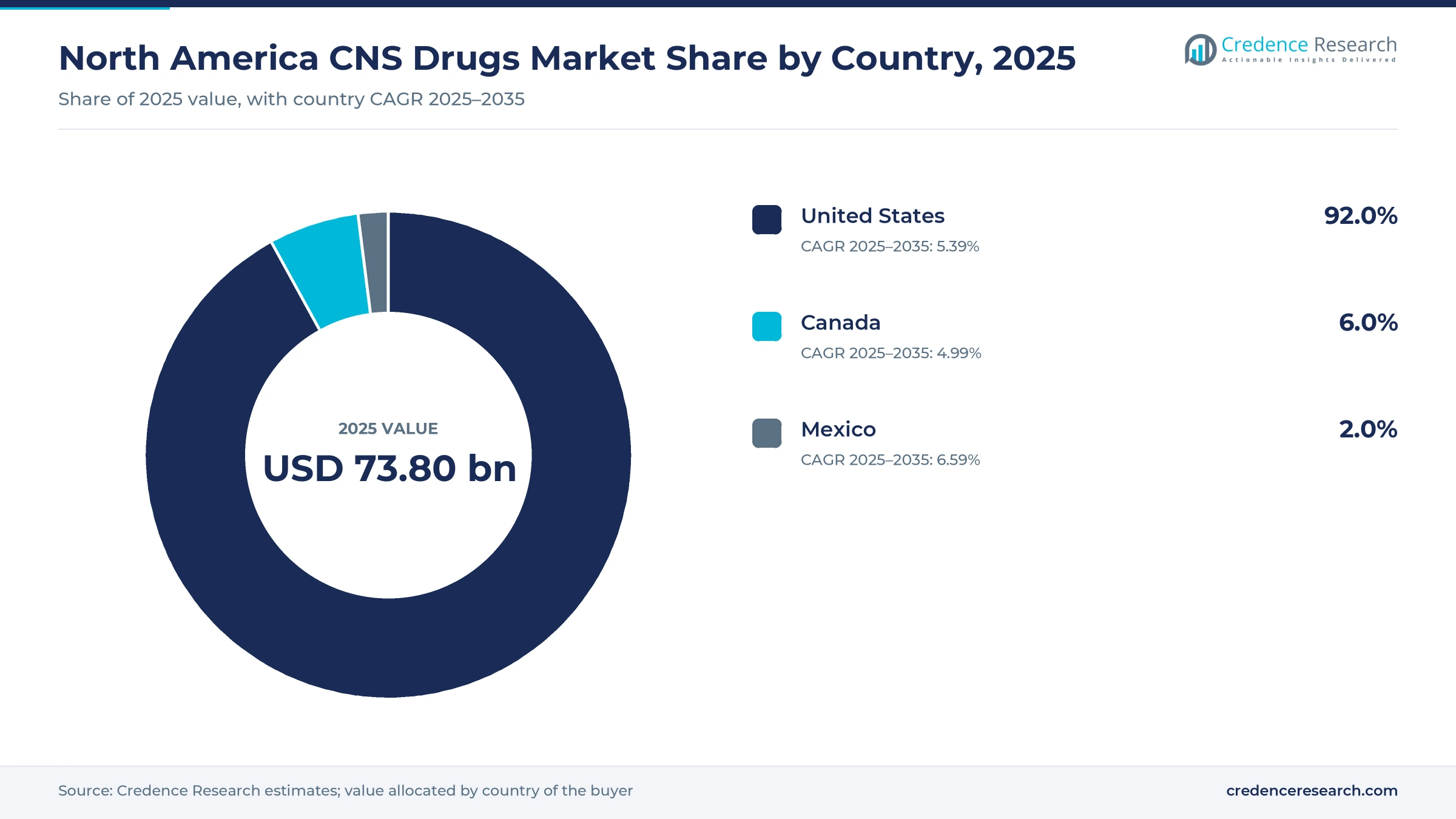
The North America CNS drugs market was valued at USD 73.80 billion in 2025 and is projected to increase from USD 77.75 billion in 2026 to USD 124.80 billion by 2035, registering a CAGR of 5.39% during 2025–2035. Demand comes from first-in-class psychiatric drugs, high-priced antibody and gene therapies for rare nerve and muscle diseases, an older population with more Parkinson’s disease and dementia, and wider diagnosis of depression, anxiety and ADHD. The United States held the largest country share, 92.0% in 2025, because it launches new brands first and pays the highest prices. Mexico, by contrast, is the fastest-growing country at 6.59% a year. The main commercial change is the shift from daily pills toward long-acting injections and home self-injection of biologics, while patent expiries and Medicare price negotiation squeeze older multiple sclerosis, epilepsy and ADHD brands.
Which prescription medicines count toward North American CNS drug sales?
The estimate counts branded and generic prescription drugs for disorders of the brain, spinal cord and nerves across 3 countries. Psychiatric drugs cover schizophrenia, bipolar disorder, depression, anxiety, ADHD and sleep disorders. Neurology drugs cover multiple sclerosis, migraine, epilepsy, movement disorders, neuromuscular disorders and Alzheimer’s disease. All dosage forms are included, valued after rebates and discounts.
Pain medicines, opioids, anesthetics and drugs for brain cancers are excluded, as are over-the-counter sleep aids, supplements and devices such as neurostimulators. Medicare, Medicaid, private insurers and provincial or public plans pay most of the bill.
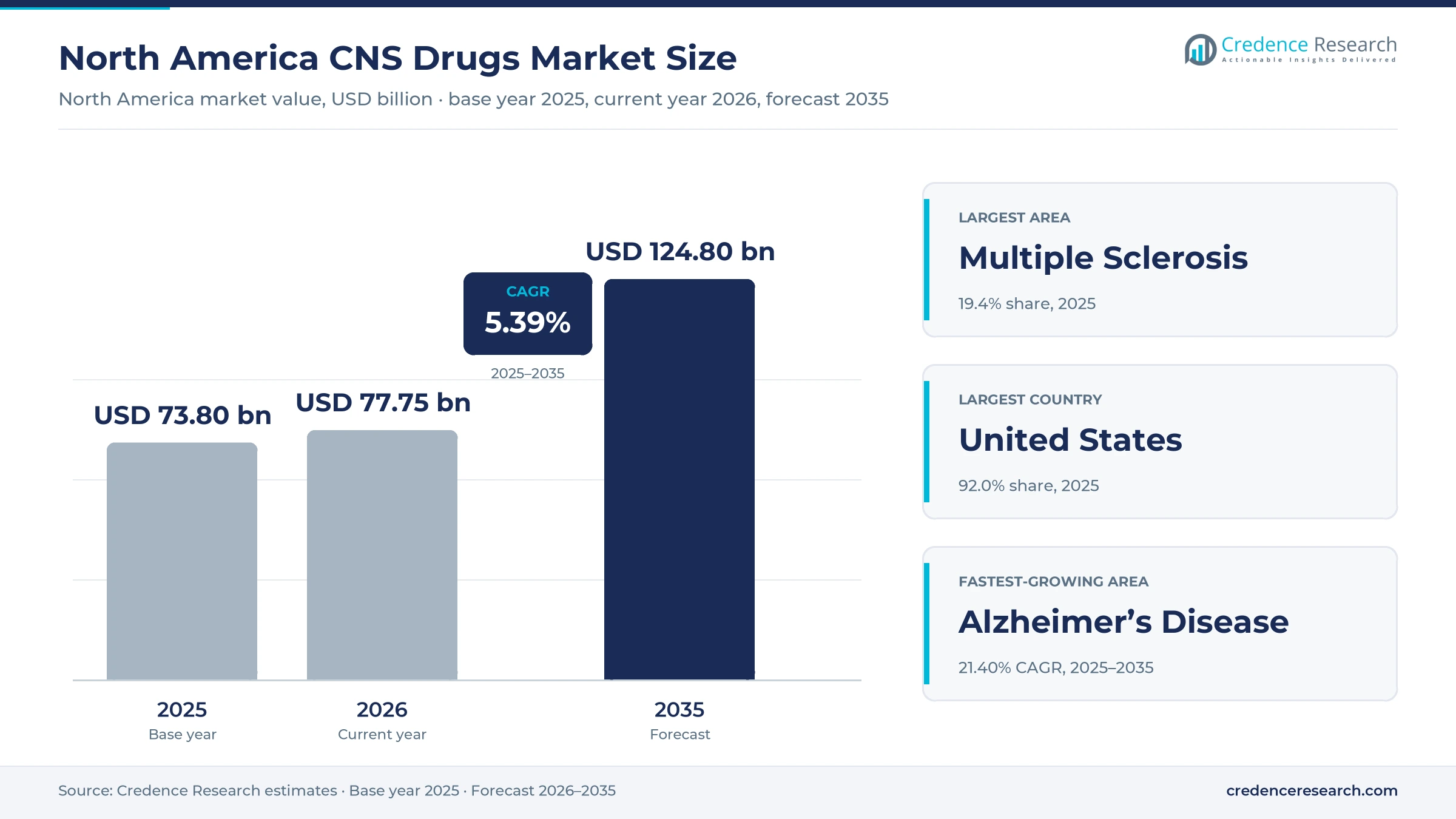
North America CNS Drugs Market Insights
- The North America CNS drugs market is projected to grow from USD 77.75 billion in 2026 to USD 124.80 billion by 2035, a 5.39% CAGR, as first-in-class drugs offset generic losses.
- The United States held 92.0% of 2025 value, the largest country share, because new CNS brands launch there first at the highest net prices.
- Multiple sclerosis accounted for 19.4% of 2025 value, the largest therapeutic area, as high-efficacy antibodies stay in use for years per patient.
- Alzheimer’s disease and dementia drugs grow fastest at 21.40% a year as anti-amyloid antibodies move toward subcutaneous home dosing after an August 2025 approval.
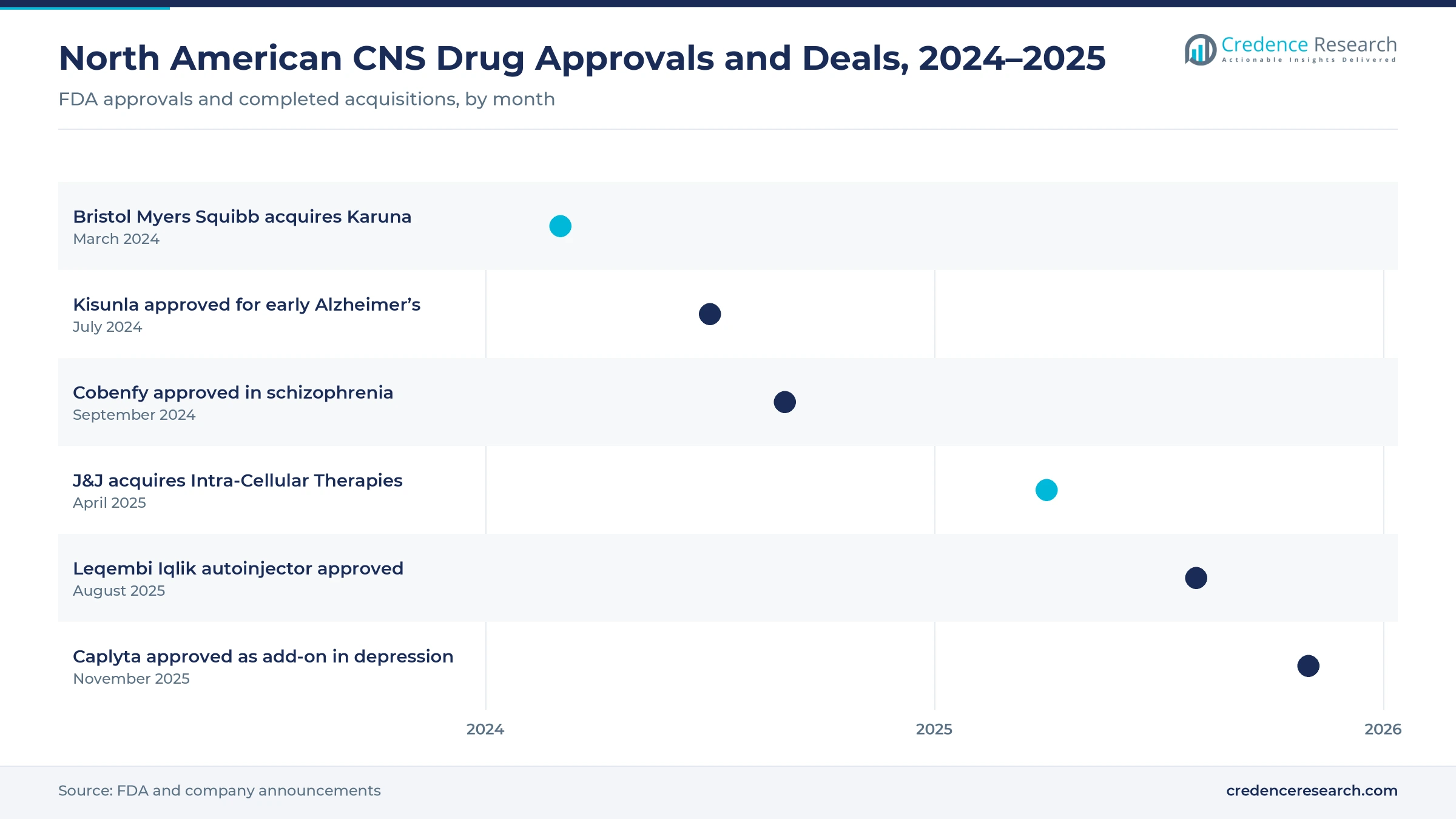
- Johnson & Johnson acquired Intra-Cellular Therapies in April 2025 after Bristol Myers Squibb bought Karuna in 2024, showing that large drug makers pay for late-stage CNS assets.
Multiple sclerosis and pills lead as Alzheimer’s drugs gain
Multiple sclerosis leads while Alzheimer’s drugs grow fastest
Based on therapeutic area, the market is categorized into multiple sclerosis, schizophrenia and bipolar disorder, movement disorders, neuromuscular disorders, migraine, ADHD and sleep disorders, depression and anxiety, epilepsy and Alzheimer’s disease and dementia. Multiple sclerosis led with a 19.4% share of 2025 value, because antibodies such as Ocrevus and Kesimpta are used for years. Alzheimer’s disease and dementia grows fastest at 21.40% a year from a small base as anti-amyloid antibodies reach more patients.
Pills keep volume while injectables add growth
Based on route of administration, the market is categorized into oral, injectable and infusion, and nasal, transdermal and other forms. Oral drugs led with a 54.0% share of 2025 value, because most antipsychotics, antidepressants, stimulants and anticonvulsants are taken as pills, many of them generic. Injectable and infused drugs grow fastest at 6.94% a year, lifted by long-acting antipsychotic injections, neurology antibodies and the move from hospital infusion to self-injection at home.
| Segment Group | Leading Sub-segment | Share, 2025 | Fastest-growing Sub-segment | CAGR, 2025–2035 |
|---|---|---|---|---|
| By Therapeutic Area | Multiple Sclerosis | 19.4% | Alzheimer’s Disease & Dementia | 21.40% |
| By Route of Administration | Oral | 54.0% | Injectable & Infusion | 6.94% |
Request a Free Sample
Fill in your details and we'll send you a free sample report.
- Sample data tables & charts
- Research methodology
New mechanisms and rare-disease biologics drive demand
First new schizophrenia mechanism in decades opens fresh prescribing
For decades, schizophrenia drugs worked by blocking dopamine, but in September 2024, the U.S. Food and Drug Administration approved Cobenfy, the first schizophrenia drug with a new mechanism of action in decades. In November 2025, Johnson & Johnson announced FDA approval of Caplyta as an add-on treatment for major depressive disorder, according to Johnson & Johnson. Psychiatrists treating patients who fail 2 or more older drugs gain options, which drives demand for the new brands, and the effect builds over the medium term as Medicaid and Medicare plans list the brands.
Antibodies and gene therapies turn rare nerve diseases into high-value classes
Antibody and fusion-protein drugs now treat myasthenia gravis, neuromyelitis optica and other rare nerve and muscle diseases, and gene and RNA therapies treat spinal muscular atrophy. These medicines carry high prices and are used for years, so a few thousand patients add large value, mostly in U.S. specialist centers, where argenx leads in myasthenia gravis. The effect is long term, because each approval in a new rare disease adds a decade of revenue.
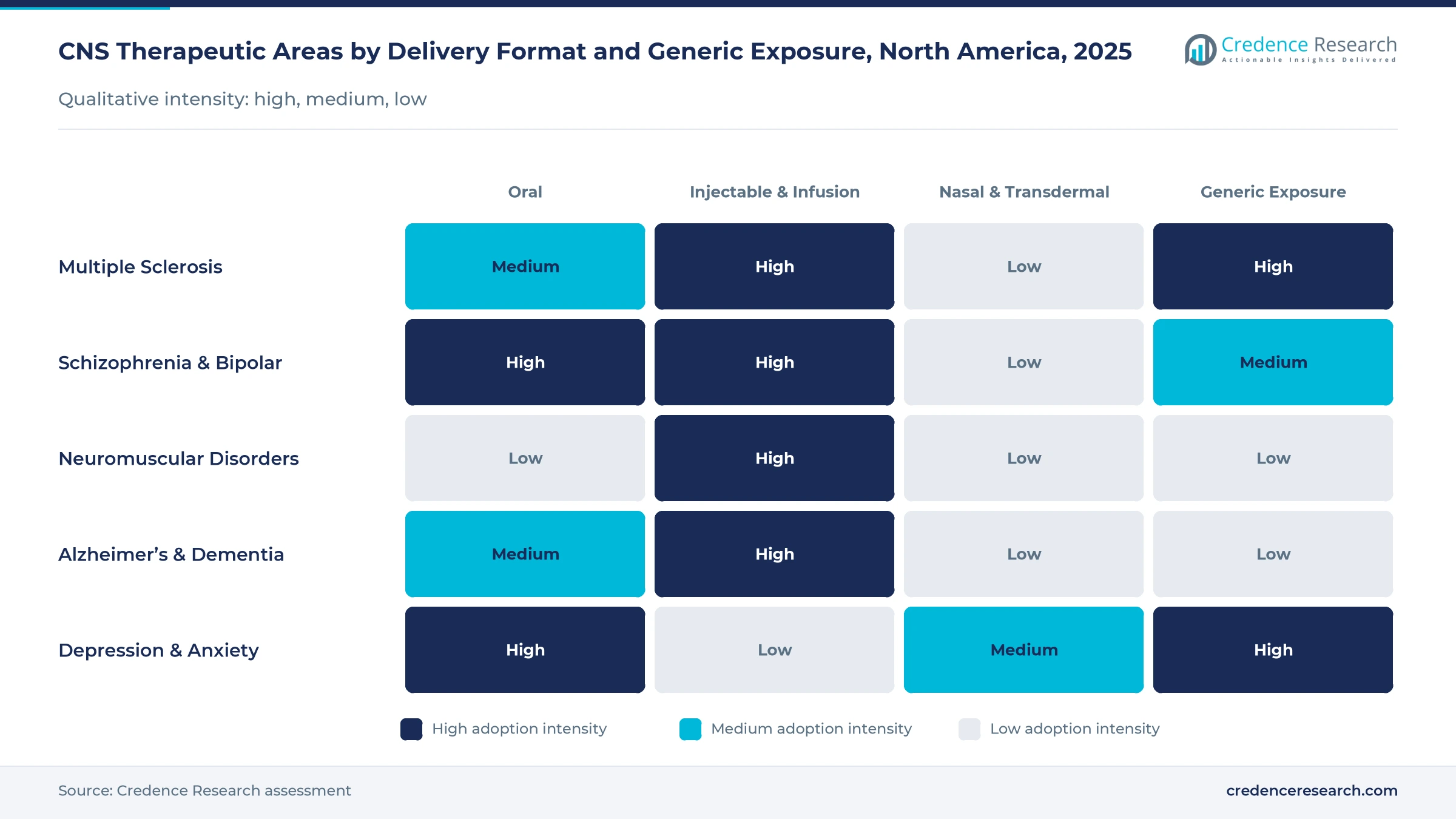
An older population raises Parkinson’s, dementia and movement disorder treatment
Parkinson’s disease, tardive dyskinesia and dementia rise sharply with age across the United States and Canada. In July 2024, the FDA approved Eli Lilly’s Kisunla for early Alzheimer’s disease, giving doctors a second anti-amyloid antibody after Leqembi. Each treated patient needs regular infusions or injections and brain scans, so value per patient is high. As a result, Alzheimer’s disease and dementia drugs grow at 21.40% a year, and the effect strengthens after 2030 as more patients qualify.
Wider diagnosis and protected drug classes sustain psychiatric prescriptions
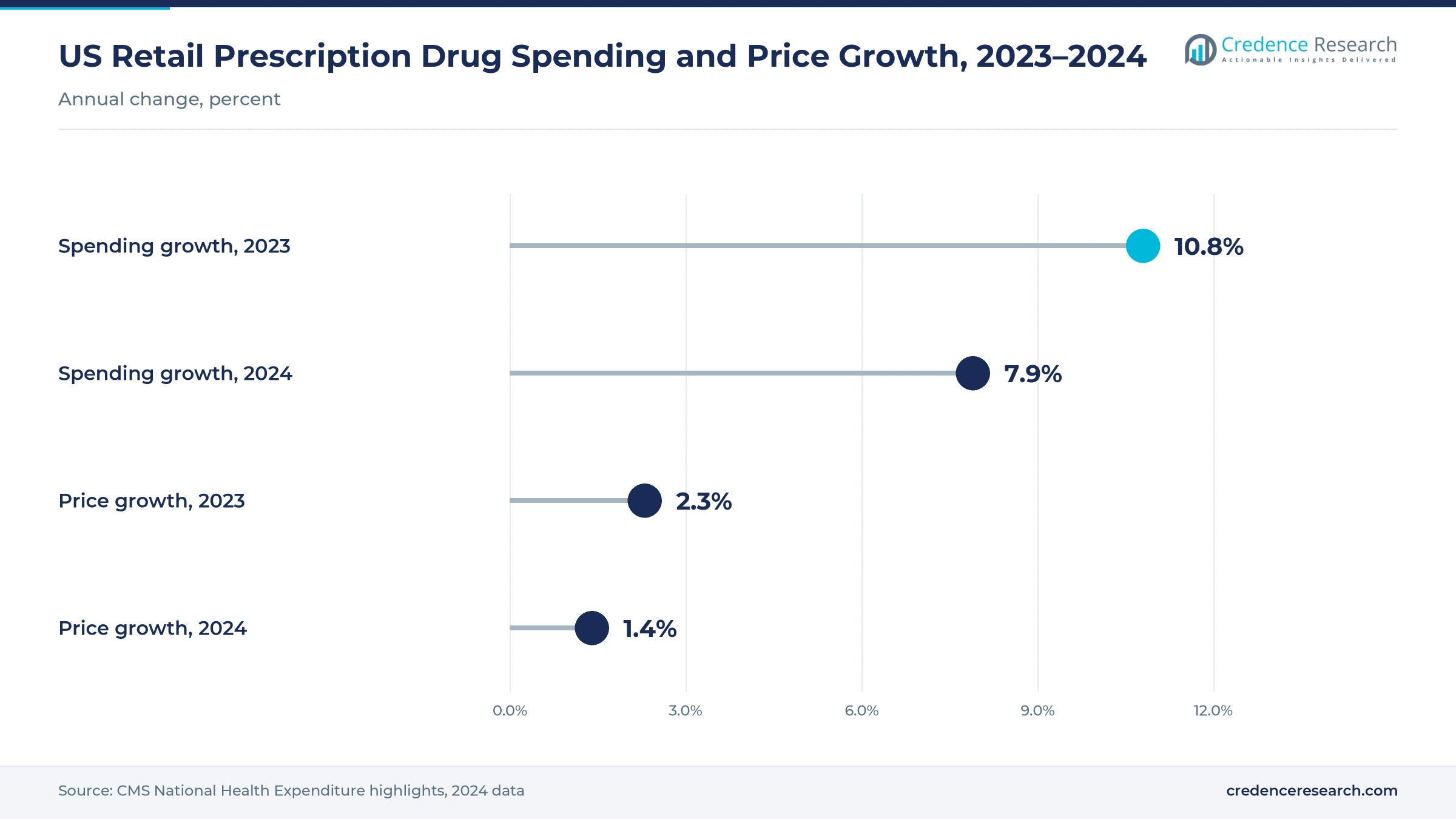
More adults are diagnosed with ADHD, depression and anxiety, and telehealth makes starting treatment easier. At the same time, Medicare Part D protected-class rules limit how far plans restrict antipsychotics, antidepressants and anticonvulsants. Centers for Medicare & Medicaid Services data show U.S. retail prescription drug spending rose 7.9% to USD 467.0 billion in 2024, after 10.8% in 2023. However, much new volume uses low-cost generics, so prescriptions grow faster than value through 2035.
Long-acting injections and home dosing change CNS care
Long-acting antipsychotic injections gain ground in schizophrenia
Monthly, 2-monthly and 6-monthly antipsychotic injections reduce missed doses and relapse, and their use is rising across community mental health services. The shift supports value even as oral antipsychotics turn generic, because a single injection carries a branded price. Johnson & Johnson’s Invega range and the Abilify injectables from Otsuka and Lundbeck lead the format, though uptake is faster in integrated health systems than in solo practices with limited clinic capacity.
Neurology biologics shift from infusion chairs to home autoinjectors
Drug makers are moving neurology antibodies from hospital infusion to injections at home. In August 2025, Eisai and Biogen announced FDA approval of Leqembi Iqlik, a subcutaneous autoinjector for maintenance treatment of early Alzheimer’s disease, according to Biogen. Injectable and infused drugs grow at 6.94% a year, the fastest route, because home dosing frees infusion capacity, lowers site-of-care cost for payers and favors specialty pharmacies, rewarding brands with simple devices.
Preventive migraine care opens an opportunity
CGRP-blocking pills and antibodies have moved migraine care from rescue to prevention, and Pfizer, Eli Lilly and AbbVie all compete in the class. Many patients with 4 or more headache days a month still use only acute drugs, which leaves room for neurologists and primary care doctors to add preventive therapy. Companies that win formulary placement with large U.S. pharmacy benefit managers and secure step-therapy exceptions can expand use well before 2035.
Late-stage CNS assets offer an acquisition opportunity
Large drug makers refill pipelines by buying CNS specialists, and in March 2024, Bristol Myers Squibb acquired Karuna Therapeutics and with it Cobenfy. In April 2025, Johnson & Johnson acquired Intra-Cellular Therapies, the maker of Caplyta. Biotechs with Phase 3 psychiatric or rare-neurology assets, such as Axsome Therapeutics, stand to gain. Buyers favor 1 or 2 differentiated mechanisms with clear U.S. launch paths over broad early pipelines, which supports biotech valuations.
Generic entry and Medicare negotiation hold back revenue
Patent expiries erode multiple sclerosis, epilepsy and ADHD brands
Several large multiple sclerosis, epilepsy and ADHD drugs have already turned generic, and more brands lose exclusivity before 2035. Generic and biosimilar entry cuts net prices sharply within 1 to 2 years, which hits the companies that rely on a single franchise and slows growth in multiple sclerosis, the largest therapeutic area at 19.4% of 2025 value. Makers respond with long-acting or subcutaneous versions, new indications and earlier launches of follow-on products, but each step needs its own trial and payer review.
Payer controls and Medicare price negotiation squeeze branded neurology drugs
Insurers use prior authorization and step therapy for expensive brands, especially in migraine, ADHD and multiple sclerosis. Medicare drug price negotiation adds pressure on older, high-spend products used by people aged 65 and over, which slows uptake and lowers net prices for second- and third-line brands. Companies mitigate the risk with outcome data, patient support programs and lifecycle plans that move volume to newer, protected products before negotiation dates.
High placebo response and late-stage failures raise CNS development risk
Brain disorders are hard to measure, and placebo responses are high in psychiatric trials, so many Phase 3 CNS programs fail. Each failure wastes years of spending and thins the flow of new products that would replace expiring brands. Small biotechs face the greatest funding risk, and developers reduce it with biomarkers, enriched trial populations and partnerships with large companies that can fund 2 or more confirmatory studies and absorb a setback.
Brain scans and supervised dosing slow uptake of newer CNS drugs
Some newer drugs need special monitoring, such as MRI brain scans for anti-amyloid antibodies or supervised dosing for nasal esketamine. These rules add clinic time and cost, so uptake concentrates in large treatment centers and lags in rural areas of all 3 countries, and revenue per launch builds more slowly. Subcutaneous dosing, simpler monitoring schedules and wider imaging capacity are the main ways makers and health systems reduce the friction.
The United States dominates while Mexico grows fastest
| Country | Share, 2025 | CAGR, 2025–2035 |
|---|---|---|
| United States | 92.0% | 5.39% |
| Canada | 6.0% | 4.99% |
| Mexico | 2.0% | 6.59% |
United States leads with first launches and the highest prices
The United States held a 92.0% share of 2025 value and grows at 5.39% a year. It launches new CNS drugs first, pays the highest prices and has the largest neurology and psychiatry specialist networks. Retail drug prices rose only 1.4% in 2024, according to CMS, so utilization and new brands drove most of the 7.9% spending gain. Medicare price negotiation is the main factor that could slow branded CNS revenue.
Canada's provincial formularies pace the uptake of new neurology biologics
Canada held a 6.0% share of 2025 value and grows at 4.99% a year. Health Canada approvals usually follow the FDA, and provincial drug plans negotiate prices through a national alliance before listing new brands, which slows the uptake of costly neurology biologics and anti-amyloid antibodies compared with U.S. commercial plans. Generic substitution in psychiatry and epilepsy is high, so new value comes mainly from multiple sclerosis, migraine prevention and rare neuromuscular diseases.
Mexico's private hospitals and insurers make it the fastest-growing country
Mexico held 2.0% of 2025 value and is the fastest-growing country at 6.59% a year. Public institutions rely mainly on generics for epilepsy, depression and schizophrenia, while private hospitals and insurers in large cities drive demand for newer branded drugs as private coverage and specialist care expand. Branded launches usually reach Mexico 1 or more years after U.S. approval, which keeps its share small despite faster growth.
Psychiatry approvals and 2 takeovers mark 2024–2025
| Development | Status and market relevance |
|---|---|
| In November 2025, Johnson & Johnson announced FDA approval of Caplyta as an add-on treatment for major depressive disorder in adults. | Approved. Extends a schizophrenia and bipolar drug into depression. |
| In August 2025, Eisai and Biogen announced FDA approval of Leqembi Iqlik, a subcutaneous autoinjector for maintenance treatment of early Alzheimer’s disease. | Approved. Moves anti-amyloid dosing from infusion centers toward the home. |
| In April 2025, Johnson & Johnson acquired Intra-Cellular Therapies, the maker of Caplyta, completing the deal. | Completed. Adds Caplyta to one of the largest neuroscience portfolios. |
| In September 2024, the FDA approved Cobenfy, the first schizophrenia drug with a new mechanism of action in decades. | Approved. Opens a class beyond dopamine-blocking antipsychotics. |
| In March 2024, Bristol Myers Squibb acquired Karuna Therapeutics, bringing the Cobenfy program into its portfolio. | Completed. Shows the price large buyers pay for late-stage CNS assets. |
Muscarinic drugs, subcutaneous antibodies and gene therapy
- Mechanisms in muscarinic antipsychotics such as Cobenfy break the 70-year reliance on dopamine blockade and open a new class for patients who fail older drugs.
- Delivery through long-acting injections given every 1, 2 or 6 months and subcutaneous autoinjectors for antibodies moves treatment out of clinics and improves adherence.
- Biologics such as antibodies, fusion proteins and gene and RNA therapies extend treatment to rare nerve and muscle diseases with high prices and long use.
- Regulation through Medicare price negotiation, protected-class rules and safety monitoring requirements shapes launch pricing, uptake speed and lifecycle plans for every brand.
Need a Custom Version of This Report?
Tailor the scope, geography, or segments to your exact requirements.
- Custom geography or segment scope
- Direct access to our analyst team
CNS majors defend brands as rare-disease biotechs rise
The field splits into 3 groups, led by neuroscience majors that hold the largest brands. AbbVie leads in psychiatry with Vraylar, Johnson & Johnson holds Invega long-acting injectables, Spravato and Caplyta, and Roche and Novartis lead multiple sclerosis with Ocrevus and Kesimpta. Specialist CNS companies such as Neurocrine Biosciences, Teva, Otsuka, Lundbeck, Axsome Therapeutics and Alkermes focus on a few disorders, including movement disorders, depression and sleep. Rare-disease and biologics companies, led by argenx in myasthenia gravis and Biogen and Eisai with Leqembi, compete on new mechanisms. No company reports North American CNS sales on a comparable basis, so no share ranking is given.
Companies profiled and their roles
| Company | Type | Role in the market |
|---|---|---|
| AbbVie | Neuroscience major | Vraylar in schizophrenia and bipolar disorder; migraine drugs |
| Johnson & Johnson | Neuroscience major | Invega long-acting injectables, Spravato and Caplyta |
| Roche | Neuroscience major | Ocrevus in multiple sclerosis |
| Novartis | Neuroscience major | Kesimpta in multiple sclerosis |
| Bristol Myers Squibb | Neuroscience major | Cobenfy in schizophrenia, from the Karuna acquisition |
| Eli Lilly | Neuroscience major | Kisunla in early Alzheimer’s disease; migraine drugs |
| Pfizer | Diversified drug maker | Migraine drugs |
| Otsuka | Specialist CNS company | Rexulti and Abilify long-acting injectables, co-marketed in psychiatry |
| Lundbeck | Specialist CNS company | Psychiatry partner of Otsuka |
| Neurocrine Biosciences | Specialist CNS company | Ingrezza in movement disorders |
| Teva | Specialist and generic maker | Austedo in movement disorders; generics |
| argenx | Rare-disease biotech | Leading company in myasthenia gravis |
| Biogen | Neurology specialist | Leqembi, marketed jointly in early Alzheimer’s disease |
| Eisai | Neurology specialist | Leqembi and Leqembi Iqlik with Biogen |
| Axsome Therapeutics | Focused challenger | Psychiatric and neurology pipeline |
| Alkermes | Focused challenger | Psychiatry and sleep products |
CNS value moves from mature pills to new biologics
Credence Research’s view is that North American CNS drug value is shifting from large, maturing pill franchises, which make oral drugs 54.0% of 2025 value, to first-in-class drugs and biologics with narrower but better-paying patient groups. The largest new revenue lies in neuromuscular biologics, new-mechanism psychiatric drugs and Alzheimer’s antibodies, and companies that pair a differentiated mechanism with convenient dosing are best placed. The main risk is net price erosion from Medicare negotiation and generic entry, so investors should watch Phase 3 readouts, subcutaneous launches, Mexican private insurance growth and CMS negotiation lists.
Filings, generic volumes and CMS data underpin the estimate
The report uses 2025 as the base year and forecasts to 2035. Values come from Credence Research’s model, built from branded CNS product sales in company filings and from prescription volumes and net prices for generic classes, checked against national prescription drug spending; therapeutic area, route and country splits are Credence Research estimates. Supporting evidence comes from company filings, FDA approval notices and CMS spending data.
Value tilts from blockbuster pills to specialist biologics
Through 2035, CNS drug value in North America will tilt from blockbuster pills toward specialist biologics, long-acting injections and first-in-class psychiatric drugs. Alzheimer’s antibodies will grow fastest as subcutaneous dosing widens access, while multiple sclerosis and epilepsy slow as generics spread. The pace will depend on Medicare negotiation outcomes, Phase 3 success rates and how quickly provincial and private plans list new drugs, which together carry the market from USD 77.75 billion in 2026 to USD 124.80 billion by 2035.
Frequently Asked Questions
What was the size of the North America CNS drugs market in 2025?
What is the forecast value and CAGR of the North America CNS drugs market?
What is driving CNS drug demand in North America?
Which country holds the largest share of the North America CNS drugs market?
Which therapeutic area leads the North America CNS drugs market?
Who are the major companies in North American CNS drugs?
How are CNS drugs mainly given?
What challenges could slow the North America CNS drugs market?
Table of Content
Chapter 1 Market Segmentation
- 1.1 Segmentation Framework
- 1.1.1 Product and Service Classification
- 1.1.2 Application and End-Use Classification
- 1.1.3 Technology and Solution Classification
- 1.1.4 Customer and Distribution Channel Classification
- 1.1.5 Geographic Segmentation
- 1.1.6 Market Segment Definitions and Boundaries
- 1.2 By Therapeutic Area
- 1.2.1 Multiple Sclerosis
- 1.2.2 Schizophrenia & Bipolar Disorder
- 1.2.3 Movement Disorders
- 1.2.4 Neuromuscular Disorders
- 1.2.5 Migraine
- 1.2.6 ADHD & Sleep Disorders
- 1.2.7 Depression & Anxiety
- 1.2.8 Epilepsy
- 1.2.9 Alzheimer’s Disease & Dementia
- 1.3 By Route of Administration
- 1.3.1 Oral
- 1.3.2 Injectable & Infusion
- 1.3.3 Nasal, Transdermal & Other
- 1.4 By Country
- 1.4.1 United States
- 1.4.2 Canada
- 1.4.3 Mexico
Chapter 2 Introduction
- 2.1 Report Objectives and Scope
- 2.2 Product Definition and Industry Terminology
- 2.3 Market Inclusions and Exclusions
- 2.4 Research Process
- 2.4.1 Primary Research and Expert Interviews
- 2.4.2 Secondary Research and Source Review
- 2.4.3 Top-Down and Bottom-Up Estimation
- 2.4.4 Data Triangulation and Verification
- 2.5 Market Size Measurement Basis
- 2.5.1 2025: USD 73.80 billion → 2035: USD 124.80 billion
- 2.6 Historical and Forecast Reference Periods
- 2.6.1 Historical Period: 2018-2025
- 2.6.2 Base Year: 2025
- 2.6.3 Forecast Period: 2025-2035
- 2.7 Research Assumptions and Limitations
Chapter 3 Executive Summary
- 3.1 Market Snapshot and Key Findings
- 3.2 Base-Year Market Size, 2025
- 3.3 Forecast Market Size, 2035
- 3.4 Revenue and Volume Growth Outlook
- 3.5 Key Demand and Supply Indicators
- 3.6 Leading Market Segments
- 3.7 Fastest-Growing Market Opportunities
- 3.8 Regional Performance Highlights
- 3.9 Technology and Industry Transformation
- 3.10 Competitive Landscape Summary
- 3.11 Analyst View and Strategic Implications
Chapter 4 North America CNS Drugs Market Trends and Developments
- 4.1 Historical Industry Development, 2018-2025
- 4.2 Recent Market Trends and Developments
- 4.3 Demand and Customer Behavior Trends
- 4.4 Technology and Product Innovation
- 4.5 Artificial Intelligence, Automation and Digitalization
- 4.6 Local Manufacturing and Supply Chain Realignment
- 4.7 Industry Partnerships, Mergers and Acquisitions
- 4.8 Sustainability and Circular Economy Developments
- 4.9 Government and Private Sector Investment Trends
- 4.10 Emerging Business Models and Commercialization
- 4.11 Industry Developments and Announcements
Chapter 5 North America CNS Drugs Market Production, Supply and Demand Analysis
- 5.1 Demand Trend and Consumption Analysis, 2018-2025
- 5.2 Demand Forecast, 2025-2035
- 5.3 Production and Output Trend, 2018-2025
- 5.4 Production and Output Forecast, 2025-2035
- 5.5 Installed Capacity and Capacity Utilization
- 5.6 Company-Wise Production Plants and Statistics
- 5.6.1 Installed Production Capacity
- 5.6.2 Actual Production
- 5.6.3 Planned Capacity and Expansion Targets
- 5.7 Supply Chain Structure and Procurement Trends
- 5.8 Supply-Demand Gap and Bottlenecks
- 5.9 Import Dependence and Sourcing Structure
- 5.10 Contract Manufacturing and Outsourcing
- 5.11 Regional Supply and Demand Concentration
Chapter 6 North America CNS Drugs Market Pricing Analysis
- 6.1 Pricing Structure and Measurement
- 6.2 Historical Pricing Trends, 2018-2025
- 6.3 Pricing Outlook, 2025-2035
- 6.4 Average Selling Price and Unit Economics
- 6.5 Pricing by Product and Market Segment
- 6.6 Geographic Pricing Differences
- 6.7 Key Input, Energy, Labor and Logistics Costs
- 6.8 Contract Pricing and Purchasing Models
- 6.9 Pricing Sensitivity and Competitive Positioning
- 6.10 Price, Margin and Profitability Implications
Chapter 7 North America CNS Drugs Market Dynamics
- 7.1 Market Growth Drivers
- 7.1.1 Demand-Side Drivers
- 7.1.2 Technology and Innovation Drivers
- 7.1.3 Infrastructure and Investment Drivers
- 7.1.4 Regulatory and Policy Drivers
- 7.2 Market Restraints
- 7.2.1 Cost and Affordability Constraints
- 7.2.2 Technology and Adoption Barriers
- 7.2.3 Supply Chain and Operational Constraints
- 7.3 Market Challenges
- 7.3.1 Competitive Pressure and Margin Erosion
- 7.3.2 Skills, Infrastructure and Implementation Gaps
- 7.4 Emerging Market Opportunities
- 7.5 Market Dynamics Impact and Time-Horizon Assessment
Chapter 8 North America CNS Drugs Value Chain Analysis
- 8.1 Industry Value Chain Overview
- 8.2 Upstream Suppliers and Critical Inputs
- 8.3 Technology and Component Providers
- 8.4 Manufacturing or Service Delivery
- 8.5 Distribution, Channel Partners and Integrators
- 8.6 Downstream Applications and End Users
- 8.7 Value Addition and Profit Pools
- 8.8 Vertical Integration and Outsourcing
- 8.9 Supplier Concentration and Risk
- 8.10 Supply Chain Localization and Resilience
Chapter 9 North America CNS Drugs Market Regulations and Policies
- 9.1 Relevant Laws, Standards and Compliance Frameworks
- 9.2 Product, Service, Safety and Quality Requirements
- 9.3 Government Policies, Incentives and Subsidies
- 9.4 Imports, Exports and Trade Barriers
- 9.5 Public Procurement and Local Content Requirements
- 9.6 Environmental and Sustainability Compliance
- 9.7 Upcoming Policy Changes and Market Implications
Chapter 10 North America CNS Drugs Market Hotspots and Opportunities
- 10.1 Market Opportunity Mapping and Growth Hotspots
- 10.2 High-Growth Applications and Customer Groups
- 10.3 Underserved Markets and White-Space Opportunities
- 10.4 Emerging Technology and Product Opportunities
- 10.5 New Capacity and Investment Hotspots
- 10.6 Market Entry and Expansion Opportunities
- 10.7 Distribution and Partnership Opportunities
- 10.8 Near-Term and Long-Term Commercial Potential
- 10.9 Opportunity Attractiveness and Execution Risks
Chapter 11 North America CNS Drugs Market Outlook, 2025-2035
- 11.1 Market Size and Analysis
- 11.1.1 Revenue (Market Measurement: 2025: USD 73.80 billion → 2035: USD 124.80 billion)
- 11.1.2 Market Volume and Quantity Sold
- 11.1.3 Historical Market Size, 2018-2025
- 11.1.4 Base-Year Market Size, 2025
- 11.2 Market Forecast, 2025-2035
- 11.2.1 Revenue Forecast to 2035
- 11.2.2 Volume Forecast to 2035
- 11.2.3 CAGR and Year-on-Year Growth
- 11.2.4 Incremental Revenue Opportunity
- 11.3 Forecast Assumptions and Scenario Analysis
- 11.3.1 Base-Case Forecast
- 11.3.2 Optimistic and Conservative Scenarios
- 11.3.3 Technology, Pricing and Policy Sensitivities
- 11.4 Market Attractiveness and Growth Outlook
Chapter 12 North America CNS Drugs Market Segmentation and Outlook
- 12.1 Segmentation Summary and Market Shares, 2025
- 12.2 Largest and Fastest-Growing Segments
- 12.3 By Therapeutic Area - Market Size and Forecast, 2025-2035
- 12.3.1 Segment Definition and Scope
- 12.3.2 Historical Market Size, 2018-2025
- 12.3.3 Revenue Forecast, 2025-2035
- 12.3.4 Volume Forecast, 2025-2035
- 12.3.5 Base-Year Market Share, 2025
- 12.3.6 Segment CAGR and Growth Drivers
- 12.3.7 Subsegment Market Size and Forecast
- 12.3.7.1 Multiple Sclerosis
- 12.3.7.2 Schizophrenia & Bipolar Disorder
- 12.3.7.3 Movement Disorders
- 12.3.7.4 Neuromuscular Disorders
- 12.3.7.5 Migraine
- 12.3.7.6 ADHD & Sleep Disorders
- 12.3.7.7 Depression & Anxiety
- 12.3.7.8 Epilepsy
- 12.3.7.9 Alzheimer’s Disease & Dementia
- 12.3.8 Subsegment Pricing and Adoption Trends
- 12.3.9 Leading Suppliers and Competition
- 12.3.10 Regional Demand and Opportunities
- 12.4 By Route of Administration - Market Size and Forecast, 2025-2035
- 12.4.1 Segment Definition and Scope
- 12.4.2 Historical Market Size, 2018-2025
- 12.4.3 Revenue Forecast, 2025-2035
- 12.4.4 Volume Forecast, 2025-2035
- 12.4.5 Base-Year Market Share, 2025
- 12.4.6 Segment CAGR and Growth Drivers
- 12.4.7 Subsegment Market Size and Forecast
- 12.4.7.1 Oral
- 12.4.7.2 Injectable & Infusion
- 12.4.7.3 Nasal, Transdermal & Other
- 12.4.8 Subsegment Pricing and Adoption Trends
- 12.4.9 Leading Suppliers and Competition
- 12.4.10 Regional Demand and Opportunities
- 12.5 By Country - Market Size and Forecast, 2025-2035
- 12.5.1 Segment Definition and Scope
- 12.5.2 Historical Market Size, 2018-2025
- 12.5.3 Revenue Forecast, 2025-2035
- 12.5.4 Volume Forecast, 2025-2035
- 12.5.5 Base-Year Market Share, 2025
- 12.5.6 Segment CAGR and Growth Drivers
- 12.5.7 Subsegment Market Size and Forecast
- 12.5.7.1 United States
- 12.5.7.2 Canada
- 12.5.7.3 Mexico
- 12.5.8 Subsegment Pricing and Adoption Trends
- 12.5.9 Leading Suppliers and Competition
- 12.5.10 Regional Demand and Opportunities
- 12.6 Segment Growth Comparison
- 12.7 Segment Attractiveness and Priority Matrix
Chapter 13 North America CNS Drugs Geographic Market Outlook, 2025-2035
- 13.1 Regional Market Size and Country-Level Shares, 2025
- 13.2 Country Market Size Comparison, 2025
- 13.3 Country Market Forecasts, 2025-2035
- 13.4 Subregional Industrial and Demand Clusters
- 13.5 Intra-Regional Pricing and Cost Differences
- 13.6 Cross-Border Trade and Supply Networks
- 13.7 Regional Supply and Demand Balances
- 13.8 Country Opportunity Comparison and Prioritization
Note: Every listed country is covered on the structure shown under the first country.
Chapter 14 North America CNS Drugs Technology, Innovation and Sustainability Outlook
- 14.1 Technology Landscape and Maturity
- 14.2 Product, Process and Service Innovation
- 14.3 AI, Automation and Digital Tools in the Industry
- 14.4 Technology Adoption and Performance Benchmarking
- 14.5 Innovation Pipeline and R&D Investment
- 14.6 Patent and Intellectual Property Trends
- 14.7 Energy Efficiency and Resource Management
- 14.8 Sustainability, Recycling and Circularity
- 14.9 Technology Roadmap, 2025-2035
- 14.10 Risks of Obsolescence and Technology Substitution
Chapter 15 North America CNS Drugs Market Key Strategic Imperatives
- 15.1 Growth and Market Entry Priorities
- 15.2 High-Return Products and Segments
- 15.3 Pricing, Profitability and Cost Optimization
- 15.4 Technology Investment and Product Differentiation
- 15.5 Supply Chain Localization and Resilience
- 15.6 Distribution and Customer Acquisition
- 15.7 Partnership, Acquisition and Capacity Strategy
- 15.8 Regional Expansion Priorities
- 15.9 Short-, Medium- and Long-Term Actions
Chapter 16 Competition Outlook
- 16.1 Industry Competition Characteristics
- 16.2 Market Structure and Concentration
- 16.3 Market Share and Competitive Positioning, 2025
- 16.4 Company-Wise Revenue and Product Benchmarking
- 16.5 Production and Service Capacity Benchmarking
- 16.6 Technology, Pricing and Differentiation
- 16.7 Regional Footprint and Distribution Strength
- 16.8 Mergers, Acquisitions and Strategic Alliances
- 16.9 New Entrants and Competitive Threats
- 16.10 Porter's Five Forces and Industry Attractiveness
- 16.11 Competitive Outlook, 2025-2035
Chapter 17 Company Profiles
- 17.1 Company Coverage and Selection Criteria
- 17.2 AbbVie
- 17.2.1 Business Description
- 17.2.2 Company Ownership and Geographic Presence
- 17.2.3 Product and Service Portfolio
- 17.2.4 Manufacturing and Operating Footprint
- 17.2.5 Production Capacity and Expansion Plans
- 17.2.6 Financial Performance and Investment
- 17.2.7 Market Share and Competitive Position
- 17.2.8 Technology and Innovation Capabilities
- 17.2.9 Strategic Alliances or Partnerships
- 17.2.10 Recent Developments
- 17.2.11 Growth Strategy and Outlook
- 17.3 Johnson & Johnson
- 17.4 Roche
- 17.5 Novartis
- 17.6 Otsuka
- 17.7 Lundbeck
- 17.8 Bristol Myers Squibb
- 17.9 Neurocrine Biosciences
- 17.10 Teva
- 17.11 argenx
- 17.12 Biogen
- 17.13 Eisai
- 17.14 Pfizer
- 17.15 Eli Lilly
- 17.16 Axsome Therapeutics
- 17.17 Alkermes
- 17.18 Other Relevant Market Participants
Note: Every listed company is profiled on the structure shown under the first company. The company list is preliminary and may change based on research findings, market developments, data availability and client requirements.
Chapter 18 Disclaimer
- 18.1 Research and Forecast Disclaimer
- 18.2 Data Source and Estimation Limitations
Note: The depth of individual sections depends on data availability for this market. Volume, capacity, trade and other unit-based metrics are included where applicable.