Antipsychotic Drugs Market Overview:
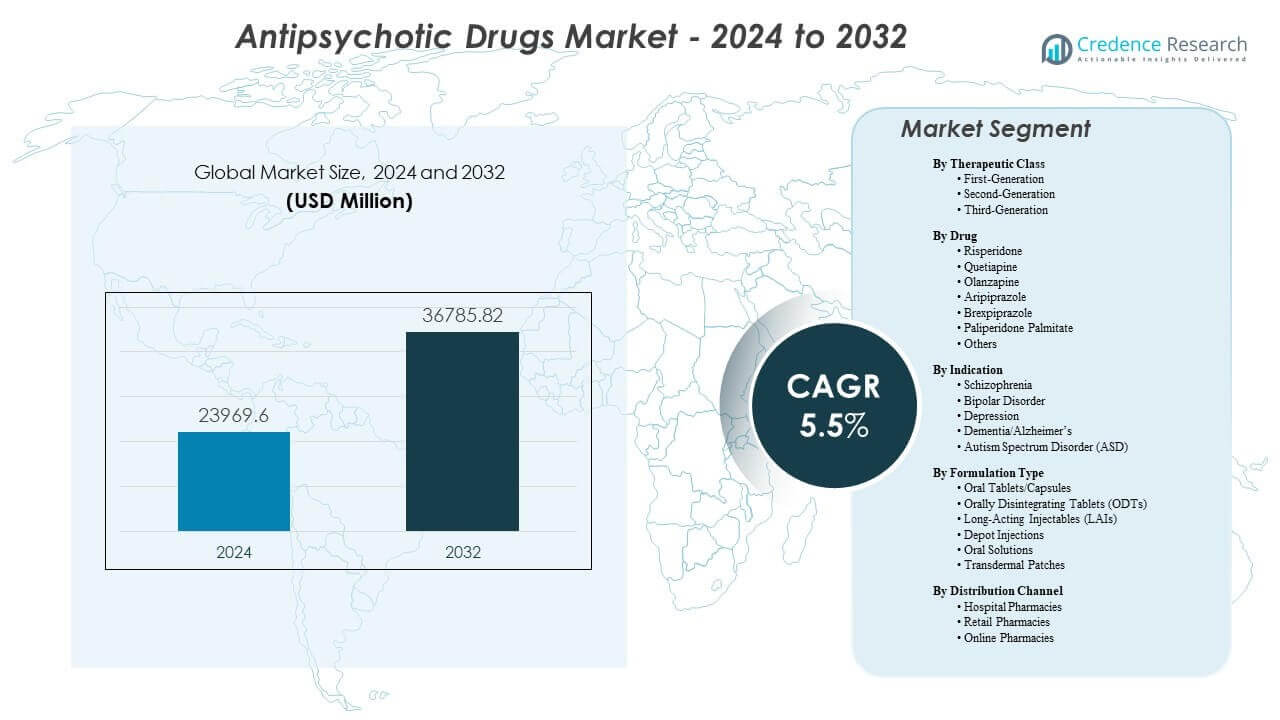
The Antipsychotic Drugs Market is projected to grow from USD 23,969.6 million in 2024 to an estimated USD 36,785.82 million by 2032, with a compound annual growth rate (CAGR) of 5.5% from 2024 to 2032.
| REPORT ATTRIBUTE |
DETAILS |
| Historical Period |
2020-2023 |
| Base Year |
2024 |
| Forecast Period |
2025-2032 |
| Antipsychotic Drugs Market Size 2024 |
USD 23,969.6 million |
| Antipsychotic Drugs Market, CAGR |
5.5% |
| Antipsychotic Drugs Market Size 2032 |
USD 36,785.82 million |
Growth is driven by wider adoption of second-generation and third-generation antipsychotics that offer improved safety and better functional outcomes. Long-acting injectables continue to gain momentum due to their ability to reduce relapse risk and maintain consistent symptom control. Innovation in muscarinic-based, dopamine-sparing, and multi-receptor therapies further strengthens clinical choices. Rising awareness of mental health, improved diagnostic reach, and expanded treatment access support higher prescription rates across outpatient and inpatient settings.
North America remains the leading region due to strong healthcare infrastructure, high treatment uptake, and early availability of advanced formulations. Europe maintains a significant share with structured psychiatric care pathways and broad clinician acceptance of new therapies. Asia-Pacific emerges as the fastest-growing region, supported by expanding mental health programs and improved access to specialty care in countries with large patient populations. Latin America and the Middle East & Africa show steady progress as awareness increases and treatment resources expand across developing markets.
Antipsychotic Drugs Market Insights:
- The Antipsychotic Drugs Market is projected to grow from USD 23,969.6 million in 2024 to USD 36,785.82 million by 2032, registering a CAGR of 5.5%.
- Demand rises due to broader use of second- and third-generation antipsychotics, stronger diagnosis rates, and wider adoption of long-acting injectables.
- Growth faces restraints from safety concerns, high discontinuation rates, and limited specialist access in underserved regions.
- North America leads the market due to strong infrastructure and early adoption of advanced therapies.
- Asia-Pacific grows rapidly as expanded mental health programs, rising awareness, and greater access to psychiatric care increase treatment uptake.
Access crucial information at unmatched prices!
Request your sample report today & start making informed decisions powered by Credence Research Inc.!
Download Sample
Antipsychotic Drugs Market Drivers
Rising Therapeutic Demand Driven by Higher Diagnosis Rates and Expanding Access to Psychiatric Care
The Antipsychotic Drugs Market benefits from broader screening programs that detect mental health disorders earlier. Healthcare providers adopt better diagnostic tools that support timely intervention. Treatment plans include second-generation and third-generation agents that improve stability for patients with severe psychiatric conditions. Many regions increase investments in mental health services that improve medication access. New guidelines promote evidence-based therapies that strengthen physician confidence. Digital health support encourages treatment adherence for chronic mental illness. Product pipelines advance toward safer mechanisms that reduce common adverse effects. Market penetration grows steadily across urban and semi-urban centers.
Growing Shift Toward Long-Acting Injectables and Patient-Centric Treatment Models
Long-acting injectables gain higher adoption due to lower relapse risk and controlled dosing. These drugs improve adherence for individuals who struggle with daily oral therapies. Prescribers emphasize predictable dosing schedules that create better clinical outcomes. The shift supports the Antipsychotic Drugs Market by reducing hospitalization rates. Multiple companies invest in extended-release platforms that support multidose schedules. Regulatory bodies endorse these formulations due to strong safety data. Health systems promote them to reduce long-term care costs. Demand rises in community clinics that aim to stabilize high-risk patients.
- For instance, Teva Pharmaceuticals and MedinCell received FDA approval for Uzedy, a subcutaneous long-acting injectable using SteadyTeq technology that achieves therapeutic plasma concentrations within 6 to 24 hours of a single dose and maintains them for up to 2 months.
Expanding Innovation in Multi-Receptor and Novel Mechanism Therapies
Research groups develop therapies that target dopamine, serotonin, and glutamate pathways for improved symptom control. These therapies seek to reduce movement-related adverse effects common in older agents. Early clinical programs test receptor-selective designs that improve patient tolerance. Drug developers explore precision-based dosing supported by biomarker insights. Broader innovation strengthens confidence among clinicians who treat complex psychiatric profiles. New entrants expand the therapeutic mix with alternative delivery modes. Pharma companies secure partnerships that accelerate development cycles. These efforts guide sustained interest across multiple care settings.
- For instance, Karuna Therapeutics (acquired by Bristol-Myers Squibb) pioneered the M1/M4 muscarinic agonist KarXT, which achieved an 11.6-point reduction in the PANSS total score in the EMERGENT-2 trial without causing the weight gain or extrapyramidal symptoms typically associated with D2 dopamine receptor antagonists.
Rising Investment in Mental Health Infrastructure and Public Awareness Programs
Governments increase mental health budgets that support medication access. Public campaigns help reduce stigma around psychiatric treatment. More individuals seek timely evaluation after greater exposure to mental health education. Hospitals integrate specialized psychiatric units that improve continuity of care. This shift lifts utilization of new treatment options within the Antipsychotic Drugs Market. Health insurers broaden reimbursement for advanced formulations. Workforce expansion supports clinical monitoring and better patient engagement. Adoption grows due to consistent exposure to community-based programs.
Antipsychotic Drugs Market Trends
Growth of Digital Therapeutic Integration and Technology-Enabled Psychiatric Support Tools
Technology platforms integrate with treatment plans to improve disease monitoring. Many digital tools track symptoms that influence medication adjustments. AI-enabled insights guide clinicians toward more personalized drug strategies. These tools enable better prediction of relapse patterns. The Antipsychotic Drugs Market gains stronger support from connected health models. Electronic adherence systems record dosing behavior in real time. Wearable sensors help evaluate subtle behavioral shifts. Broader adoption enhances collaboration between psychiatrists and caregivers.
- For instance, Otsuka Pharmaceutical developed Abilify MyCite, the first FDA-approved digital medicine system, which utilizes an ingestible sensor to record a 97% accuracy rate in tracking daily ingestion data transmitted directly to a mobile application for physician review.
Emergence of Novel Combination Approaches for Enhanced Clinical Stability
Combination strategies emerge to target diverse symptom clusters across psychiatric disorders. Clinicians adopt these combinations to improve long-term patient stability. More research explores the pairing of antipsychotics with mood stabilizers or antidepressants. Developers examine synergistic effects that enhance functional recovery. High-risk patients gain more benefit from structured multi-drug regimens. The shift influences demand patterns in the Antipsychotic Drugs Market. Safety monitoring supports broader acceptance of complex treatment blends. Real-world data strengthens evidence for combination models.
Increasing Focus on Metabolic Safety and Improved Tolerability Profiles
Pharma groups refine drug designs that reduce metabolic risks. Stronger awareness around weight gain and glucose imbalance drives this shift. Clinical guidelines prioritize products with improved side-effect profiles. Health providers favor therapies that reduce discontinuation rates. The Antipsychotic Drugs Market adapts to these expectations with safer pipelines. Manufacturers highlight cardio-metabolic performance measures during development. Clinicians apply closer metabolic screening across treatment cycles. Patients gain confidence in safer long-term regimens.
- For instance, Alkermes developed Lybalvi, a combination of olanzapine and samidorphan, which achieved a 50% reduction in the risk of gaining 10% or more of baseline body weight over 24 weeks compared to patients taking olanzapine monotherapy.
Greater Penetration of Community-Based Care and Decentralized Treatment Delivery
Community care networks manage a growing share of chronic psychiatric cases. These settings increase medication continuity for underserved populations. Psychiatrists coordinate care with local health teams to expand access. This model strengthens outpatient treatment pathways. The Antipsychotic Drugs Market aligns with this shift through flexible dosing forms. Multidisciplinary teams adopt structured medication review programs. Better care coordination helps reduce relapse frequency. Treatment distribution expands into remote and semi-urban regions.
Antipsychotic Drugs Market Challenges Analysis
Complex Side-Effect Profiles and Safety Concerns Across Diverse Patient Populations
Many drugs carry metabolic, neurological, and cardiovascular risks that require careful monitoring. Clinicians often adjust doses to balance efficacy with tolerability. Patients may discontinue therapy due to persistent adverse reactions. This pattern influences long-term outcomes within the Antipsychotic Drugs Market. Providers need comprehensive support tools to identify patient-specific risks. Complex symptom variance complicates treatment selection. Regulatory oversight increases due to safety concerns. It pressures companies to refine clinical data requirements.
Barriers in Treatment Adherence, Limited Specialist Access, and Uneven Global Infrastructure
Patients often fail to maintain consistent medication use due to stigma or poor insight into disease progression. Specialist shortages restrict advanced treatment access in rural regions. Healthcare networks vary widely in psychiatric readiness. These issues slow stable adoption of innovative drug options within the Antipsychotic Drugs Market. Fragmented reimbursement policies limit access to premium therapies. Providers face hurdles in maintaining continuous patient engagement. Diagnostic disparities create delays in starting appropriate treatment. Infrastructure gaps prolong unmet therapeutic needs.
Antipsychotic Drugs Market Opportunities
Advancement of Personalized Psychiatry, Innovative Drug Platforms, and Precision-Focused Therapies
Precision psychiatry gains traction due to improved biomarker research. Drug developers study response patterns to reduce trial-and-error prescribing. Personalized dosing tools create stronger appeal for advanced formulations. These trends support new growth avenues for the Antipsychotic Drugs Market. Companies test genetically driven treatment models that improve predictability. Greater access to clinical data refines therapeutic decision-making. Targeted therapies help address resistant patient segments. Novel platforms encourage sustained investment from global manufacturers.
Expansion of Long-Acting Formulations, Community-Level Programs, and Emerging Market Uptake
Many regions support broader adoption of injectables that reduce relapse risk. These products offer consistent symptom control for vulnerable populations. Expansion in community health networks boosts distribution scale. Uptake increases in developing countries with expanding mental health budgets. The Antipsychotic Drugs Market gains momentum from structured awareness campaigns. Improved insurance coverage encourages trial of advanced therapies. Remote care models bring psychiatric treatment closer to underserved groups. Stronger global attention toward mental health builds long-term opportunity.
Antipsychotic Drugs Market Segmentation Analysis:
By Therapeutic Class
The Antipsychotic Drugs Market reflects strong demand for second-generation drugs due to their balanced efficacy and safer profiles. First-generation products hold a smaller share because many providers prefer alternatives with fewer movement-related side effects. Third-generation options gain momentum through improved tolerability and receptor-selective activity. Many clinicians shift prescribing patterns toward agents that support long-term stability and reduce relapse frequency. It continues to experience change as new therapies introduce broader receptor coverage and better adherence outcomes across treatment plans.
- For instance, Bristol-Myers Squibb’s newly approved KarXT (Cobenfy) represents a technological shift as the first muscarinic agonist, demonstrating a 9.6-point greater reduction in the Positive and Negative Syndrome Scale (PANSS) score compared to placebo in clinical trials.
By Drug
Risperidone, olanzapine, and quetiapine remain widely used due to strong clinical familiarity and broad indications. Aripiprazole and brexpiprazole gain adoption through improved safety metrics and flexible dosing. Paliperidone palmitate leads the long-acting injectable space with extended dosing intervals that support adherence. Other emerging products extend options for resistant cases and complex psychiatric profiles. The Antipsychotic Drugs Market benefits from this mix because providers prioritize reliable symptom control and lower discontinuation risk.
By Indication
Schizophrenia represents the largest treatment segment due to high medication dependence for long-term management. Bipolar disorder forms a major share with strong prescribing rates for mood stabilization. Depression-related use grows in specific subgroups needing adjunct therapy. Dementia-related symptoms require cautious use yet maintain steady demand in monitored settings. The Antipsychotic Drugs Market gains additional traction in autism-related irritability, where specific drugs deliver measurable behavioral improvement.
- For instance, AbbVie’s Vraylar (cariprazine) strengthened its clinical position after Phase III trials showed significant improvement in depressive symptoms, with active-treatment groups achieving mean reductions of approximately 14–16 points on the MADRS scale and demonstrating clear superiority over placebo in adjunctive Major Depressive Disorder.
By Formulation Type
Oral tablets dominate due to convenience and wide availability. Orally disintegrating tablets assist patients with swallowing challenges and adherence issues. Long-acting injectables strengthen their position through reduced relapse risk and scheduled dosing. Depot injections support stable plasma levels in chronic cases. Oral solutions and transdermal patches serve niche needs within the Antipsychotic Drugs Market where flexible delivery is preferred.
By Distribution Channel
Hospital pharmacies maintain a strong share due to acute psychiatric care needs. Retail pharmacies support long-term community treatment. Online pharmacies expand access through home delivery and discreet purchasing, giving the Antipsychotic Drugs Market broader reach.
Segmentation:
By Therapeutic Class
- First-Generation
- Second-Generation
- Third-Generation
By Drug
- Risperidone
- Quetiapine
- Olanzapine
- Aripiprazole
- Brexpiprazole
- Paliperidone Palmitate
- Others
By Indication
- Schizophrenia
- Bipolar Disorder
- Depression
- Dementia/Alzheimer’s
- Autism Spectrum Disorder (ASD)
By Formulation Type
- Oral Tablets/Capsules
- Orally Disintegrating Tablets (ODTs)
- Long-Acting Injectables (LAIs)
- Depot Injections
- Oral Solutions
- Transdermal Patches
By Distribution Channel
- Hospital Pharmacies
- Retail Pharmacies
- Online Pharmacies
By Region
- North America
- Europe
- Germany
- France
- U.K.
- Italy
- Spain
- Rest of Europe
- Asia Pacific
- China
- Japan
- India
- South Korea
- South-east Asia
- Rest of Asia Pacific
- Latin America
- Brazil
- Argentina
- Rest of Latin America
- Middle East & Africa
- GCC Countries
- South Africa
- Rest of the Middle East and Africa
Regional Analysis:
North America holds the largest share of the Antipsychotic Drugs Market with strong adoption of advanced therapies and broad insurance coverage. The region benefits from well-structured mental health programs and high awareness levels among patients and clinicians. Many providers prefer long-acting formulations that support better adherence outcomes. New product approvals strengthen treatment choices for complex psychiatric needs. It maintains dominance due to deep penetration of branded and generic drugs. Market growth continues through steady investments in community mental health networks.
Europe accounts for a significant share of global revenue with strong support from national healthcare systems. Treatment guidelines promote the use of second-generation and third-generation agents with improved tolerability. Many countries adopt standardized psychiatric care pathways that support medication continuity. Demand grows in regions updating mental health frameworks and expanding digital support tools. The Antipsychotic Drugs Market gains stability from high diagnosis rates and reliable reimbursement structures. It strengthens its position as more countries integrate specialized mental health services.
Asia-Pacific records the fastest growth rate due to rising awareness, expanding healthcare access, and larger patient populations. Many countries increase investments in psychiatric infrastructure and workforce training. Generic availability improves affordability and broadens treatment reach. Urban centers lead uptake while rural areas experience steady progress. The Antipsychotic Drugs Market benefits from wider screening programs that support earlier diagnosis. It gains momentum through growing demand for long-acting injectables and safer therapeutic options across emerging economies.
Shape Your Report to Specific Countries or Regions & Enjoy 30% Off!
Key Player Analysis:
- Lundbeck A/S
- Otsuka Pharmaceutical Co., Ltd.
- Janssen Pharmaceuticals, Inc.
- Eli Lilly and Company
- AbbVie, Inc.
- Teva Pharmaceutical Industries Ltd.
- Reddy’s Laboratories Ltd.
- Sumitomo Pharma Co., Ltd.
- Alkermes plc
- Bristol-Myers Squibb Company
- Pfizer Inc.
- AstraZeneca plc
- Johnson & Johnson
Competitive Analysis:
The Antipsychotic Drugs Market features strong competition among global pharmaceutical leaders with extensive psychiatric portfolios. Companies invest in next-generation compounds that improve safety, tolerability, and functional outcomes for chronic mental illness. Many firms focus on long-acting injectables that improve adherence and reduce relapse risk. Several brands secure dominant positions through established real-world evidence and broad clinical familiarity. It experiences rising competitive intensity as new entrants introduce receptor-selective therapies for resistant conditions. Partnerships and licensing deals expand research pipelines across serotonin, dopamine, and glutamate pathways. Generic manufacturers strengthen price competition in mature segments. Leading players enhance market presence through lifecycle strategies and targeted portfolio expansions.
Recent Developments:
- In February 2026, Vanda Pharmaceuticals received FDA approval for Bysanti (milsaperidone), an antipsychotic for acute bipolar I disorder and schizophrenia, with a planned U.S. launch in Q3 2026.
- In October 2025, AbbVie, Inc. completed the acquisition of bretisilocin, a Phase 2 psychedelic compound from Gilgamesh Pharmaceuticals for major depressive disorder with potential psychiatric applications expanding its neuroscience pipeline.
- In September 2025, H. Lundbeck A/S announced three new regional partnerships with Swixx Group, Zuellig Pharma, and NewBridge Pharmaceuticals to handle commercial activities across 27 countries in Europe and International Operations, ensuring continued patient access to its antipsychotic and neuro medicines.
- In January 2025, Sumitomo Pharma Co., Ltd. entered a co-promotion agreement with Janssen Pharmaceutical K.K. for the long-acting antipsychotics XEPLION® and XEPLION TRI® in Japan, with promotional activities starting around February 2025 to enhance schizophrenia treatment access.
Report Coverage:
The research report offers an in-depth analysis based on Therapeutic Class, Drug, Indication, Formulation Type, Distribution Channel, and Region. It details leading market players, providing an overview of their business, product offerings, investments, revenue streams, and key applications. Additionally, the report includes insights into the competitive environment, SWOT analysis, current market trends, as well as the primary drivers and constraints. Furthermore, it discusses various factors that have driven market expansion in recent years. The report also explores market dynamics, regulatory scenarios, and technological advancements that are shaping the industry. It assesses the impact of external factors and global economic changes on market growth. Lastly, it provides strategic recommendations for new entrants and established companies to navigate the complexities of the market.
Future Outlook:
- Growing demand for safer therapies will guide strong interest in next-generation agents with improved tolerability.
- Wider adoption of long-acting injectables will support better adherence and reduce relapse episodes in chronic psychiatric cases.
- Precision-based treatment models will expand as biomarkers and digital tools refine therapy selection.
- Strong investment in CNS pipelines will introduce novel receptor-targeting drugs for complex symptom profiles.
- Mental health programs will expand across developing regions, strengthening treatment access for underserved groups.
- Digital monitoring platforms will support personalized dose adjustments and strengthen clinical decision-making.
- Market competition will intensify as branded and generic portfolios expand across major therapeutic classes.
- Global awareness campaigns will encourage earlier diagnosis and higher treatment initiation rates.
- Community-based psychiatric services will drive steady demand for flexible formulations.
- Evolving regulatory frameworks will accelerate approvals for innovative therapies and broaden clinical adoption.



