Plant molecular Farming Market Overview:
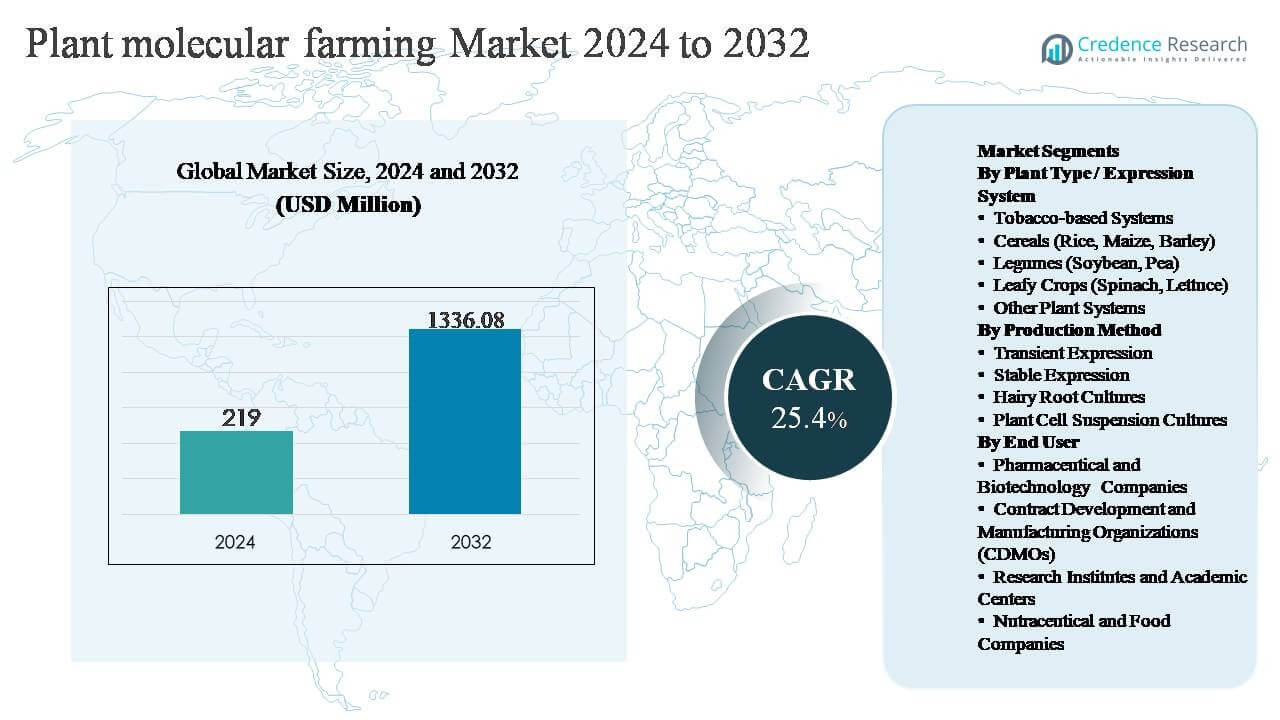
The plant molecular farming market was valued at USD 219 million in 2024 and is projected to reach USD 1,336.08 million by 2032, expanding at a compound annual growth rate (CAGR) of 25.4% during the forecast period (2025-2032).
| REPORT ATTRIBUTE | DETAILS |
|---|---|
| Historical Period | 2020-2023 |
| Base Year | 2024 |
| Forecast Period | 2025-2032 |
| Plant molecular Farming Market Size 2024 | USD 219 million |
| Plant molecular Farming Market, CAGR | 25.4% |
| Plant molecular Farming Market Size 2032 | USD 1,336.08 million |
Plant molecular Farming Market Insights
- Market growth is primarily driven by rising demand for cost-effective and rapidly scalable production of vaccines, antibodies, and therapeutic proteins, with transient expression systems and tobacco-based platforms holding the dominant segment share due to speed, yield efficiency, and regulatory familiarity.
- Key trends include expanding use of plant-derived vaccines, increasing CDMO participation, and growing interest in edible and oral biologics, while pharmaceutical and biotechnology companies represent the largest end-user segment by market share.
- The competitive landscape features specialized players such as Medicago, Protalix, KBP, and iBio, competing through proprietary expression technologies, GMP manufacturing capabilities, and strategic collaborations with pharma and public health agencies.
- Regionally, North America leads with ~41% market share, followed by Europe (~29%), Asia Pacific (~20%), while Latin America (~6%) and Middle East & Africa (~4%) represent emerging markets with long-term growth potential.
Plant molecular Farming Market Segmentation Analysis:
By Plant Type / Expression System
The plant molecular farming market by plant type is dominated by tobacco-based systems, which account for the largest market share due to their high biomass yield, well-characterized genetics, and proven compatibility with transient expression platforms. Tobacco remains the preferred host for rapid recombinant protein production, particularly for vaccines and monoclonal antibodies. Cereals such as rice and maize follow, driven by scalability and seed-based protein stability. Leafy crops gain traction for oral and edible vaccines, while legumes and other systems support niche therapeutic and industrial protein applications.
- For instance, Medicago successfully used Nicotiana benthamiana to produce virus-like particle vaccines at its Québec facility with a production cycle of approximately 21 days from gene sequence to purified antigen, supported by greenhouse capacity exceeding 44,000 square meters.
By Production Method
By production method, transient expression represents the dominant sub-segment, holding the highest market share due to its rapid production timelines, flexibility, and suitability for outbreak-driven biologics manufacturing. This method enables gram-scale protein yields within weeks, making it highly attractive for vaccines and emergency therapeutics. Stable expression systems remain important for long-term, large-volume protein production where consistency is critical. Hairy root cultures and plant cell suspension cultures serve specialized applications requiring controlled environments, such as enzymes and secondary metabolites, supporting diversification of manufacturing strategies.
- For instance, Protalix Biotherapeutics employs stable expression in carrot cell suspension cultures to manufacture taliglucerase alfa using single-use bioreactors with working volumes up to 400 liters, enabling reproducible glycosylation and continuous commercial supply.
By End User
Among end users, pharmaceutical and biotechnology companies dominate the market, driven by increasing adoption of plant-derived platforms for vaccines, antibodies, and therapeutic enzymes. These companies leverage molecular farming to reduce capital costs and accelerate development cycles. CDMOs represent the fastest-growing segment as outsourcing demand rises for clinical-scale and commercial production. Research institutes and academic centers support innovation and platform validation, while nutraceutical and food companies expand use of plant-based bioactives, functional proteins, and oral delivery formats, broadening commercial applications beyond therapeutics.
Key Growth Drivers
Rising Demand for Cost-Effective Biologics Manufacturing
Plant molecular farming is gaining momentum as pharmaceutical developers seek alternatives to capital-intensive mammalian and microbial expression systems. Plant-based platforms significantly reduce upstream infrastructure requirements, eliminating the need for sterile fermenters and lowering energy consumption. This cost advantage is especially attractive for high-volume biologics such as vaccines, antibodies, and therapeutic enzymes. Additionally, plants enable scalable production using greenhouse or vertical farming infrastructure, allowing rapid capacity expansion without proportional capital expenditure. As biologics pipelines expand globally, particularly in emerging markets with constrained healthcare budgets, plant molecular farming offers a viable pathway to improve affordability while maintaining functional protein integrity and biosafety.
- For instance, iBio’s FastPharming system integrates automated vacuum infiltration and hydroponic growth, allowing parallel cultivation of thousands of tobacco plants per batch within standard greenhouse footprints rather than purpose-built fermentation suites.
Acceleration of Vaccine and Biodefense Programs
The ability of plant molecular farming systems to rapidly express recombinant proteins has positioned the technology as a strategic asset for pandemic preparedness and biodefense. Transient expression platforms allow vaccine antigens to be produced within weeks, supporting fast response to emerging infectious threats. Governments and public health agencies increasingly recognize plant-based production as a complementary manufacturing route that can bypass bottlenecks associated with traditional cell culture facilities. This driver is reinforced by growing investments in decentralized and resilient biologics manufacturing infrastructure, particularly for emergency stockpiling and regional vaccine self-sufficiency.
- For instance, Fraunhofer IME has established plant-based recombinant protein production capabilities using contained vertical farming and transient expression systems capable of completing full expression and harvest cycles within roughly 30 to 35 days, supporting regional vaccine self-sufficiency and rapid-response stockpiling initiatives.
Advancements in Genetic Engineering and Expression Technologies
Continuous innovation in plant biotechnology has significantly improved expression efficiency, protein folding, and downstream recovery. Advances in vector design, promoter optimization, glycoengineering, and host plant modification have enhanced yield consistency and therapeutic compatibility. These improvements reduce historical concerns around batch variability and post-translational differences, making plant-derived proteins increasingly acceptable for regulated pharmaceutical use. As gene editing tools and expression control systems mature, plant molecular farming platforms are becoming more predictable, robust, and commercially viable across a broader range of biologic products.
Key Trends & Opportunities
Expansion of CDMO-Based Plant Molecular Farming Services
A notable trend is the emergence of specialized CDMOs offering end-to-end plant molecular farming services, from vector development to GMP-compliant manufacturing. Pharmaceutical companies increasingly prefer outsourcing plant-based production to reduce internal risk and accelerate clinical timelines. This trend creates opportunities for service providers to standardize platforms, validate regulatory pathways, and support late-stage commercialization. As more plant-derived biologics enter clinical trials, CDMOs are positioned to become critical enablers of scale-up and regulatory compliance.
- For instance, Kentucky BioProcessing (KBP) operates a GMP-capable plant-based biomanufacturing facility in Owensboro, Kentucky, with more than 150,000 square feet of controlled indoor space and the ability to process tens of thousands of Nicotiana benthamiana plants per production campaign using transient expression for clinical and government-sponsored programs.
Growth of Oral and Edible Biologics Applications
Plant molecular farming opens new opportunities for oral delivery of vaccines and nutraceuticals through edible plant tissues. Leafy crops and cereals enable the development of heat-stable, needle-free formulations that simplify distribution and improve patient compliance. This trend is particularly relevant for low-resource settings where cold-chain logistics remain a barrier. Expanding interest in functional foods and preventive healthcare further supports the integration of plant-derived bioactives into mainstream nutraceutical and food applications.
- For instance, ORF Genetics has developed barley-based stable expression systems for recombinant growth factors, operating controlled cultivation and processing workflows that deliver purified bioactives suitable for oral and topical formulations from multi-kilogram barley grain batches.
Key Challenges
Regulatory Complexity and Limited Standardization
Despite technological progress, regulatory frameworks for plant-derived biologics remain fragmented across regions. Limited harmonization in approval pathways, containment requirements, and environmental risk assessments increases development timelines and compliance costs. Regulatory authorities often require extensive comparability data to demonstrate equivalence with conventional expression systems. This uncertainty discourages smaller developers and slows broader commercial adoption, particularly for therapeutic applications intended for global markets.
Downstream Processing and Yield Variability Constraints
While upstream production costs are lower, downstream purification of plant-expressed proteins can be complex due to plant-specific metabolites, proteases, and biomass heterogeneity. Achieving consistent recovery and high purity at commercial scale remains a technical challenge, particularly for complex proteins. Yield variability influenced by growth conditions and plant physiology also impacts production predictability. Addressing these challenges requires continued investment in purification technologies and process standardization to ensure reliable, scalable manufacturing outcomes.
Regional Analysis
North America
North America dominates the plant molecular farming market, accounting for approximately 41% of global market share. The region benefits from strong biotechnology infrastructure, advanced plant expression platforms, and early adoption of transient expression technologies for vaccines and therapeutic proteins. The United States leads regional growth due to active participation of pharmaceutical companies, government-backed biodefense initiatives, and a mature regulatory environment supporting plant-derived biologics. Presence of specialized CDMOs and sustained funding for recombinant protein research further strengthen commercialization. Canada contributes through academic research and public–private collaborations focused on scalable and rapid-response biologics manufacturing.
Europe
Europe represents around 29% of the global plant molecular farming market, supported by robust academic research networks and strong regulatory emphasis on sustainable biomanufacturing. Countries such as Germany, the UK, and France lead adoption through investments in plant-based vaccine development, therapeutic enzymes, and industrial proteins. The region places high importance on biosafety, environmental containment, and standardized production protocols, which supports long-term credibility of plant-derived systems. Increasing EU-level funding for green biotechnology and alternative expression platforms further drives innovation, while pharmaceutical companies actively explore plant molecular farming to diversify biologics manufacturing capacity.
Asia Pacific
Asia Pacific accounts for approximately 20% of the global market and is the fastest-growing regional segment. Growth is driven by expanding pharmaceutical manufacturing capacity, rising government investment in vaccine self-sufficiency, and increasing demand for cost-effective biologics. China, Japan, South Korea, and India are key contributors, supported by strong plant biotechnology research and large-scale agricultural infrastructure. The region also shows growing interest in edible vaccines and nutraceutical applications using leafy crops and cereals. Rapid industrialization of biotechnology and favorable production economics position Asia Pacific as a major future manufacturing hub.
Latin America
Latin America holds an estimated 6% share of the global plant molecular farming market, with growth supported by favorable agro-climatic conditions and expanding biotechnology research initiatives. Countries such as Brazil, Argentina, and Chile leverage strong agricultural capabilities to support plant-based expression systems. Regional research institutes actively explore plant-derived vaccines, enzymes, and diagnostic proteins, often in collaboration with global pharmaceutical players. While commercial-scale adoption remains limited, increasing government focus on biotechnology self-reliance and lower production costs create opportunities for regional expansion, particularly in public health and veterinary biologics applications.
Middle East & Africa
The Middle East & Africa region accounts for roughly 4% of the global market, reflecting an early-stage but emerging adoption of plant molecular farming technologies. Growth is supported by increasing investments in life sciences infrastructure, especially in the Gulf Cooperation Council countries, and rising interest in localized vaccine production. Academic institutions and public health agencies are exploring plant-based platforms to improve access to biologics and reduce import dependence. In Africa, plant molecular farming aligns with initiatives targeting affordable vaccines and oral delivery systems, supporting long-term potential despite current scale limitations.
Plant molecular Farming Market Segmentations:
By Plant Type / Expression System
- Tobacco-based Systems
- Cereals (Rice, Maize, Barley)
- Legumes (Soybean, Pea)
- Leafy Crops (Spinach, Lettuce)
- Other Plant Systems
By Production Method
- Transient Expression
- Stable Expression
- Hairy Root Cultures
- Plant Cell Suspension Cultures
By End User
- Pharmaceutical and Biotechnology Companies
- Contract Development and Manufacturing Organizations (CDMOs)
- Research Institutes and Academic Centers
- Nutraceutical and Food Companies
By Geography
- North America
- U.S.
- Canada
- Mexico
- Europe
- Germany
- France
- U.K.
- Italy
- Spain
- Rest of Europe
- Asia Pacific
- China
- Japan
- India
- South Korea
- South-east Asia
- Rest of Asia Pacific
- Latin America
- Brazil
- Argentina
- Rest of Latin America
- Middle East & Africa
- GCC Countries
- South Africa
- Rest of the Middle East and Africa
Competitive Landscape
The competitive landscape of the plant molecular farming market is characterized by a mix of specialized biotechnology companies, emerging CDMOs, and research-driven organizations advancing plant-based expression platforms. Market participants compete primarily on expression efficiency, speed to production, scalability, and regulatory readiness. Leading players focus on transient expression technologies and proprietary host plant systems to support rapid vaccine and therapeutic protein development. Strategic collaborations with pharmaceutical companies, public health agencies, and academic institutions are common, enabling clinical validation and commercialization. Companies are also investing in glycoengineering, downstream processing optimization, and GMP-compliant manufacturing to enhance product consistency and regulatory acceptance. Competitive differentiation increasingly depends on the ability to provide end-to-end solutions, from gene design to purified biologics, positioning established platform providers and service-oriented players favorably as plant-derived biologics advance toward broader clinical and commercial adoption.
Key Player Analysis
- Protalix Biotherapeutics
- iBio Inc.
- Fraunhofer IME
- Medicago Inc.
- ORF Genetics
- Kentucky BioProcessing (KBP)
- PlantForm Corporation
- Synthon Biopharmaceuticals
- Icon Genetics GmbH
- Ventria Bioscience
Recent Developments
- In November 2025, Protalix announced it will publish its financial results for the quarter ended September 30, 2025 and host a webcast where business updates, including progress in its proprietary ProCellEx® plant-cell based protein expression system, will be discussed. The company reiterates that it remains the first to gain FDA approval for a therapeutic protein produced via plant cell suspension expression, underscoring ongoing commercialization activities for its plant-derived biologics.
- In May 2025, Fraunhofer IME showcased integration of its OrbiLoop® vertical farming test system into a double-skin glass facade as part of the “Mittendrin” joint project demonstrating urban integration of plant cultivation technologies. While focused on vertical farming infrastructure, this reflects Fraunhofer IME’s broader work in plant biotechnology systems that contribute to controlled-environment molecular farming research and scalable plant production technologies.
Report Coverage
The research report offers an in-depth analysis based on Plant Type / Expression System, Production Method, End User and Geography. It details leading market players, providing an overview of their business, product offerings, investments, revenue streams, and key applications. Additionally, the report includes insights into the competitive environment, SWOT analysis, current market trends, as well as the primary drivers and constraints. Furthermore, it discusses various factors that have driven market expansion in recent years. The report also explores market dynamics, regulatory scenarios, and technological advancements that are shaping the industry. It assesses the impact of external factors and global economic changes on market growth. Lastly, it provides strategic recommendations for new entrants and established companies to navigate the complexities of the market.
Future Outlook
- Plant molecular farming will increasingly complement conventional biologics manufacturing by offering faster scale-up and flexible capacity for vaccines and therapeutic proteins.
- Transient expression systems will remain the primary production method due to rapid turnaround times and suitability for outbreak-response applications.
- Tobacco-based expression platforms will continue to dominate, supported by well-established genetics and high biomass productivity.
- Pharmaceutical and biotechnology companies will expand adoption as regulatory confidence in plant-derived biologics improves.
- CDMOs specializing in plant molecular farming will play a larger role in late-stage development and commercial manufacturing.
- Advances in glycoengineering will enhance protein compatibility and broaden therapeutic use cases.
- Edible vaccines and oral biologics will gain traction, particularly in low-resource and emerging healthcare markets.
- Asia Pacific will strengthen its position as a manufacturing hub due to favorable production economics and government support.
- Process automation and controlled-environment agriculture will improve consistency and yield reliability.
- Strategic partnerships between industry, academia, and public health agencies will accelerate clinical validation and market penetration.

Request a Free Sample
Fill in your details and we'll send you a free sample report.
- Sample data tables & charts
- Research methodology
Need a Custom Version of This Report?
Tailor the scope, geography, or segments to your exact requirements.
- Custom geography or segment scope
- Direct access to our analyst team
Frequently Asked Questions
What is the current market size for Plant Molecular Farming, and what is its projected size in 2032?
At what Compound Annual Growth Rate is the Plant Molecular Farming market projected to grow between 2024 and 2032?
Which Plant Molecular Farming segment held the largest share in 2024?
What are the primary factors fueling the growth of the Plant Molecular Farming market?
Who are the leading companies in the Plant Molecular Farming market?
Which region commanded the largest share of the Plant Molecular Farming market in 2024?
Table of Content
Chapter 1 Market Segmentation
- 1.1 Segmentation Framework
- 1.1.1 Product and Service Classification
- 1.1.2 Application and End-Use Classification
- 1.1.3 Technology and Solution Classification
- 1.1.4 Customer and Distribution Channel Classification
- 1.1.5 Geographic Segmentation
- 1.1.6 Market Segment Definitions and Boundaries
Chapter 2 Introduction
- 2.1 Report Objectives and Scope
- 2.2 Product Definition and Industry Terminology
- 2.3 Market Inclusions and Exclusions
- 2.4 Research Process
- 2.4.1 Primary Research and Expert Interviews
- 2.4.2 Secondary Research and Source Review
- 2.4.3 Top-Down and Bottom-Up Estimation
- 2.4.4 Data Triangulation and Verification
- 2.5 Market Size Measurement Basis
- 2.5.1 2024: USD 219 million → 2032: USD 1,336.08 million
- 2.6 Historical and Forecast Reference Periods
- 2.6.1 Base Year: 2024
- 2.6.2 Forecast Period: 2024-2032
- 2.7 Research Assumptions and Limitations
Chapter 3 Executive Summary
- 3.1 Market Snapshot and Key Findings
- 3.2 Base-Year Market Size, 2024
- 3.3 Forecast Market Size, 2032
- 3.4 Revenue and Volume Growth Outlook
- 3.5 Key Demand and Supply Indicators
- 3.6 Leading Market Segments
- 3.7 Fastest-Growing Market Opportunities
- 3.8 Regional Performance Highlights
- 3.9 Technology and Industry Transformation
- 3.10 Competitive Landscape Summary
- 3.11 Analyst View and Strategic Implications
Chapter 4 Global Plant molecular Farming Market Trends and Developments
- 4.1 Historical Industry Development
- 4.2 Recent Market Trends and Developments
- 4.3 Demand and Customer Behavior Trends
- 4.4 Technology and Product Innovation
- 4.5 Artificial Intelligence, Automation and Digitalization
- 4.6 Local Manufacturing and Supply Chain Realignment
- 4.7 Industry Partnerships, Mergers and Acquisitions
- 4.8 Sustainability and Circular Economy Developments
- 4.9 Government and Private Sector Investment Trends
- 4.10 Emerging Business Models and Commercialization
- 4.11 Industry Developments and Announcements
Chapter 5 Global Plant molecular Farming Market Production, Supply and Demand Analysis
- 5.1 Demand Trend and Consumption Analysis
- 5.2 Demand Forecast, 2024-2032
- 5.3 Production and Output Trend
- 5.4 Production and Output Forecast, 2024-2032
- 5.5 Installed Capacity and Capacity Utilization
- 5.6 Company-Wise Production Plants and Statistics
- 5.6.1 Installed Production Capacity
- 5.6.2 Actual Production
- 5.6.3 Planned Capacity and Expansion Targets
- 5.7 Supply Chain Structure and Procurement Trends
- 5.8 Supply-Demand Gap and Bottlenecks
- 5.9 Import Dependence and Sourcing Structure
- 5.10 Contract Manufacturing and Outsourcing
- 5.11 Regional Supply and Demand Concentration
Chapter 6 Global Plant molecular Farming Market Pricing Analysis
- 6.1 Pricing Structure and Measurement
- 6.2 Historical Pricing Trends
- 6.3 Pricing Outlook, 2024-2032
- 6.4 Average Selling Price and Unit Economics
- 6.5 Pricing by Product and Market Segment
- 6.6 Geographic Pricing Differences
- 6.7 Key Input, Energy, Labor and Logistics Costs
- 6.8 Contract Pricing and Purchasing Models
- 6.9 Pricing Sensitivity and Competitive Positioning
- 6.10 Price, Margin and Profitability Implications
Chapter 7 Global Plant molecular Farming Market Dynamics
- 7.1 Market Growth Drivers
- 7.1.1 Demand-Side Drivers
- 7.1.2 Technology and Innovation Drivers
- 7.1.3 Infrastructure and Investment Drivers
- 7.1.4 Regulatory and Policy Drivers
- 7.2 Market Restraints
- 7.2.1 Cost and Affordability Constraints
- 7.2.2 Technology and Adoption Barriers
- 7.2.3 Supply Chain and Operational Constraints
- 7.3 Market Challenges
- 7.3.1 Competitive Pressure and Margin Erosion
- 7.3.2 Skills, Infrastructure and Implementation Gaps
- 7.4 Emerging Market Opportunities
- 7.5 Market Dynamics Impact and Time-Horizon Assessment
Chapter 8 Global Plant molecular Farming Value Chain Analysis
- 8.1 Industry Value Chain Overview
- 8.2 Upstream Suppliers and Critical Inputs
- 8.3 Technology and Component Providers
- 8.4 Manufacturing or Service Delivery
- 8.5 Distribution, Channel Partners and Integrators
- 8.6 Downstream Applications and End Users
- 8.7 Value Addition and Profit Pools
- 8.8 Vertical Integration and Outsourcing
- 8.9 Supplier Concentration and Risk
- 8.10 Supply Chain Localization and Resilience
Chapter 9 Global Plant molecular Farming Market Regulations and Policies
- 9.1 Relevant Laws, Standards and Compliance Frameworks
- 9.2 Product, Service, Safety and Quality Requirements
- 9.3 Government Policies, Incentives and Subsidies
- 9.4 Imports, Exports and Trade Barriers
- 9.5 Public Procurement and Local Content Requirements
- 9.6 Environmental and Sustainability Compliance
- 9.7 Upcoming Policy Changes and Market Implications
Chapter 10 Global Plant molecular Farming Market Hotspots and Opportunities
- 10.1 Market Opportunity Mapping and Growth Hotspots
- 10.2 High-Growth Applications and Customer Groups
- 10.3 Underserved Markets and White-Space Opportunities
- 10.4 Emerging Technology and Product Opportunities
- 10.5 New Capacity and Investment Hotspots
- 10.6 Market Entry and Expansion Opportunities
- 10.7 Distribution and Partnership Opportunities
- 10.8 Near-Term and Long-Term Commercial Potential
- 10.9 Opportunity Attractiveness and Execution Risks
Chapter 11 Global Plant molecular Farming Market Outlook, 2024-2032
- 11.1 Market Size and Analysis
- 11.1.1 Revenue (Market Measurement: 2024: USD 219 million → 2032: USD 1,336.08 million)
- 11.1.2 Market Volume and Quantity Sold
- 11.1.3 Historical Market Size
- 11.1.4 Base-Year Market Size, 2024
- 11.2 Market Forecast, 2024-2032
- 11.2.1 Revenue Forecast to 2032
- 11.2.2 Volume Forecast to 2032
- 11.2.3 CAGR and Year-on-Year Growth
- 11.2.4 Incremental Revenue Opportunity
- 11.3 Forecast Assumptions and Scenario Analysis
- 11.3.1 Base-Case Forecast
- 11.3.2 Optimistic and Conservative Scenarios
- 11.3.3 Technology, Pricing and Policy Sensitivities
- 11.4 Market Attractiveness and Growth Outlook
Chapter 12 Global Plant molecular Farming Market Segmentation and Outlook
- 12.1 Segmentation Summary and Market Shares, 2024
- 12.2 Largest and Fastest-Growing Segments
- 12.3 Segment Growth Comparison
- 12.4 Segment Attractiveness and Priority Matrix
Chapter 13 Global Plant molecular Farming Geographic Market Outlook, 2024-2032
- 13.1 Regional Market Size and Share, 2024
- 13.2 Regional Market Forecast, 2024-2032
- 13.3 Regional Pricing, Production and Demand Differences
- 13.4 North America
- 13.4.1 United States
- 13.4.2 Canada
- 13.4.3 Mexico
- 13.5 Europe
- 13.5.1 Germany
- 13.5.2 France
- 13.5.3 Italy
- 13.5.4 United Kingdom
- 13.5.5 Spain
- 13.5.6 Poland
- 13.5.7 Russia
- 13.5.8 Netherlands
- 13.5.9 Belgium
- 13.5.10 Sweden
- 13.5.11 Denmark
- 13.5.12 Norway
- 13.5.13 Rest of Europe
- 13.6 Asia Pacific
- 13.6.1 China
- 13.6.2 India
- 13.6.3 Japan
- 13.6.4 South Korea
- 13.6.5 Thailand
- 13.6.6 Indonesia
- 13.6.7 Vietnam
- 13.6.8 Malaysia
- 13.6.9 Australia
- 13.6.10 Rest of Asia Pacific
- 13.7 Latin America
- 13.7.1 Brazil
- 13.7.2 Argentina
- 13.7.3 Colombia
- 13.7.4 Chile
- 13.7.5 Rest of Latin America
- 13.8 Middle East
- 13.8.1 Saudi Arabia
- 13.8.2 United Arab Emirates
- 13.8.3 Turkey
- 13.8.4 Israel
- 13.8.5 Iran
- 13.8.6 Rest of the Middle East
- 13.9 Africa
- 13.9.1 South Africa
- 13.9.2 Egypt
- 13.9.3 Nigeria
- 13.9.4 Morocco
- 13.9.5 Rest of Africa
- 13.10 Regional Investment, Policy and Supply Chain Differences
- 13.11 Regional Competitive Landscape
- 13.12 Geographic Growth Hotspots
Chapter 14 Global Plant molecular Farming Technology, Innovation and Sustainability Outlook
- 14.1 Technology Landscape and Maturity
- 14.2 Product, Process and Service Innovation
- 14.3 AI, Automation and Digital Tools in the Industry
- 14.4 Technology Adoption and Performance Benchmarking
- 14.5 Innovation Pipeline and R&D Investment
- 14.6 Patent and Intellectual Property Trends
- 14.7 Energy Efficiency and Resource Management
- 14.8 Sustainability, Recycling and Circularity
- 14.9 Technology Roadmap, 2024-2032
- 14.10 Risks of Obsolescence and Technology Substitution
Chapter 15 Global Plant molecular Farming Market Key Strategic Imperatives
- 15.1 Growth and Market Entry Priorities
- 15.2 High-Return Products and Segments
- 15.3 Pricing, Profitability and Cost Optimization
- 15.4 Technology Investment and Product Differentiation
- 15.5 Supply Chain Localization and Resilience
- 15.6 Distribution and Customer Acquisition
- 15.7 Partnership, Acquisition and Capacity Strategy
- 15.8 Regional Expansion Priorities
- 15.9 Short-, Medium- and Long-Term Actions
Chapter 16 Competition Outlook
- 16.1 Industry Competition Characteristics
- 16.2 Market Structure and Concentration
- 16.3 Market Share and Competitive Positioning, 2024
- 16.4 Company-Wise Revenue and Product Benchmarking
- 16.5 Production and Service Capacity Benchmarking
- 16.6 Technology, Pricing and Differentiation
- 16.7 Regional Footprint and Distribution Strength
- 16.8 Mergers, Acquisitions and Strategic Alliances
- 16.9 New Entrants and Competitive Threats
- 16.10 Porter's Five Forces and Industry Attractiveness
- 16.11 Competitive Outlook, 2024-2032
Chapter 17 Company Profiles
- 17.1 Company Coverage and Selection Criteria
- 17.2 Leading Market Participants – Standard Profile Structure
- 17.2.1 Business Description
- 17.2.2 Company Ownership and Geographic Presence
- 17.2.3 Product and Service Portfolio
- 17.2.4 Manufacturing and Operating Footprint
- 17.2.5 Production Capacity and Expansion Plans
- 17.2.6 Financial Performance and Investment
- 17.2.7 Market Share and Competitive Position
- 17.2.8 Technology and Innovation Capabilities
- 17.2.9 Strategic Alliances or Partnerships
- 17.2.10 Recent Developments
- 17.2.11 Growth Strategy and Outlook
- 17.3 Other Relevant Market Participants
Note: Every listed company is profiled on the structure shown under the first company. The company list is preliminary and may change based on research findings, market developments, data availability and client requirements.
Chapter 18 Disclaimer
- 18.1 Research and Forecast Disclaimer
- 18.2 Data Source and Estimation Limitations
Note: The depth of individual sections depends on data availability for this market. Volume, capacity, trade and other unit-based metrics are included where applicable.