
Customizable Hair Dye Market Overview:
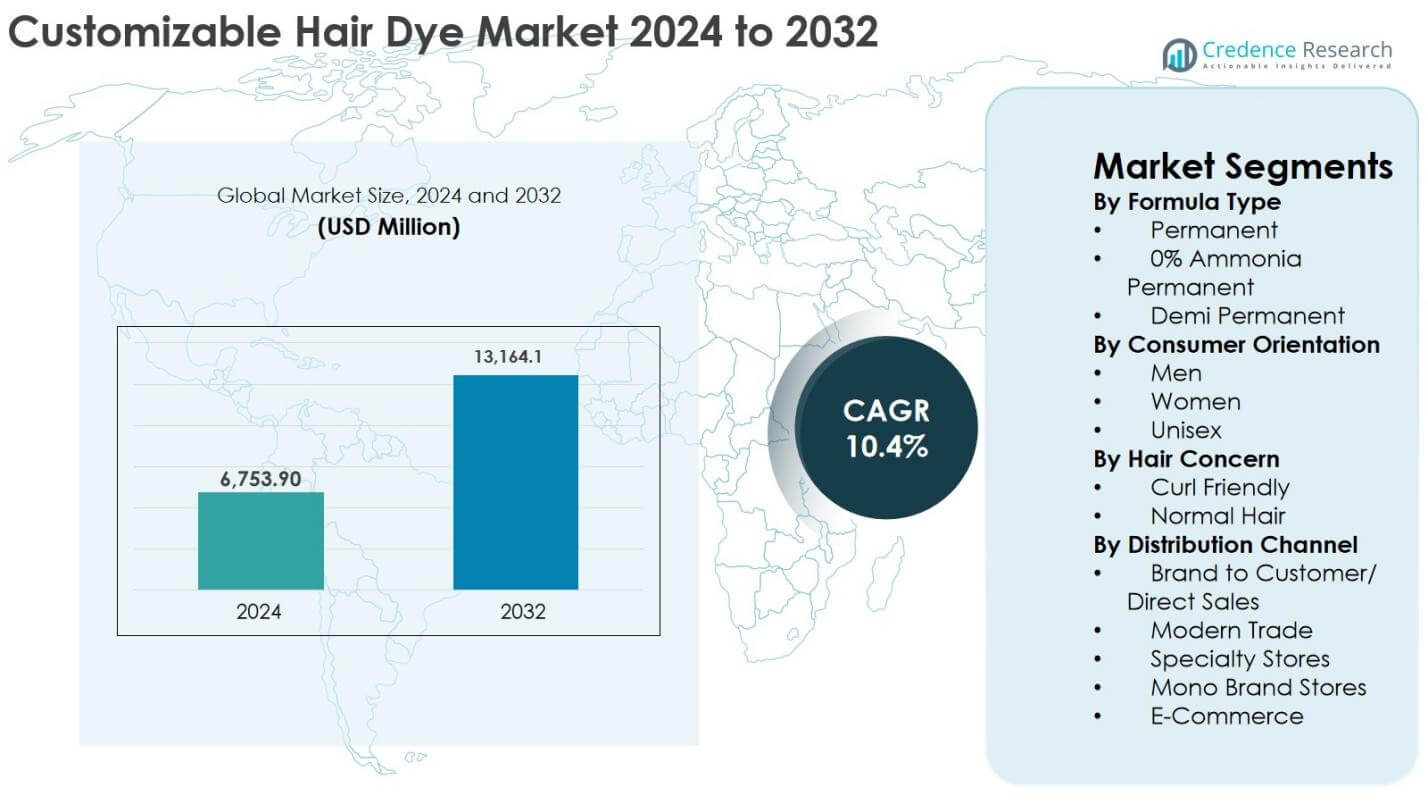
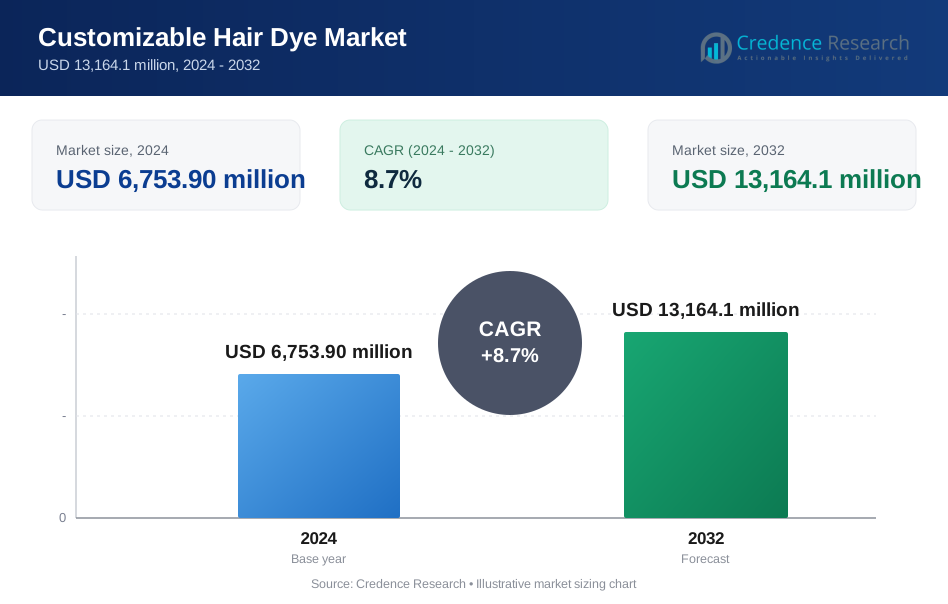
The Customizable Hair Dye Market size was valued at USD 6,753.90 million in 2024 and is anticipated to reach USD 13,164.1 million by 2032, expanding at a CAGR of 8.7% during the forecast period.
| REPORT ATTRIBUTE | DETAILS |
|---|---|
| Historical Period | 2020-2023 |
| Base Year | 2024 |
| Forecast Period | 2025-2032 |
| Customizable Hair Dye Market Size 2024 | USD 6,753.90 million |
| Customizable Hair Dye Market, CAGR | 8.7% |
| Customizable Hair Dye Market Size 2032 | USD 13,164.1 million |
Customizable Hair Dye Market Insights
- Market growth is driven by rising demand for personalized beauty solutions, increasing preference for ammonia-free and clean-label formulations, and strong adoption of direct-to-consumer models that enable shade customization, ingredient selection, and subscription-based repeat purchases.
- Key trends include the use of AI-driven shade matching, virtual consultations, inclusive and gender-neutral branding, and multifunctional formulas combining hair color with conditioning benefits, while women consumers dominate with a 62.4% share and permanent dyes lead with 46.8% share in 2024.
- The landscape remains highly competitive with brands differentiating through digital engagement, customization depth, vegan formulations, fast fulfillment, and strong social media communities to retain customers and expand global reach.
- Regionally, North America leads with 38.6% share, followed by Europe at 27.4%, Asia Pacific at 22.1%, Latin America at 7.4%, and Middle East & Africa at 4.5%, reflecting varied adoption levels and digital maturity.
Customizable Hair Dye Market Segmentation Analysis:
By Formula Type:
The By Formula Type segment in the Customizable Hair Dye market is led by permanent hair dyes, which accounted for 46.8% market share in 2024, driven by long-lasting color performance, better gray coverage, and rising consumer preference for salon-like results at home. Permanent formulations benefit from strong demand among aging populations and frequent users seeking durability. The 0% ammonia permanent sub-segment is expanding rapidly due to increasing awareness of scalp safety and reduced hair damage, while demi-permanent dyes gain traction among younger consumers seeking low-commitment and tone-enhancing solutions, supporting overall segment growth.
- For instance, Garnier Olia promotes its ammonia-free permanent color powered by an oil-based formula that aims to reduce harsh odor and improve hair feel, while Schwarzkopf’s Simply Color line emphasizes dermatologist-tested, ammonia-free formulations targeting sensitive scalps.
By Consumer Orientation:
The By Consumer Orientation segment is dominated by women, holding 62.4% market share in 2024, supported by higher grooming expenditure, frequent color experimentation, and strong adoption of personalized beauty products. Women consumers actively seek shade customization, ingredient transparency, and hair-specific formulations, driving repeat purchases. The unisex sub-segment is gaining momentum due to inclusive branding and neutral color offerings, while the men segment continues to grow steadily, fueled by rising gray-coverage awareness, increasing self-grooming trends, and expanding direct-to-consumer customization platforms.
- For instance, Just For Men has expanded from traditional gray-coverage kits into beard and subtle-blending solutions, and subscription-based brands such as Hims report increasing male interest in hair and appearance-focused products, reflecting a shift toward more regular at-home grooming routines
By Hair Concern:
Within the By Hair Concern segment, normal hair emerged as the dominant sub-segment with a 55.1% market share in 2024, owing to its broad consumer base and compatibility with a wide range of customizable dye formulations. Manufacturers prioritize normal-hair solutions due to predictable absorption and consistent color results. Meanwhile, curl-friendly hair dyes are witnessing strong growth, driven by rising acceptance of textured hair, demand for moisture-rich and sulfate-free formulas, and increased consumer focus on maintaining curl integrity while achieving personalized color outcomes.
Key Growth Drivers
Rising Demand for Personalized Beauty Solutions
The Customizable Hair Dye market is increasingly driven by rising consumer demand for personalized beauty solutions that reflect individual hair type, shade preference, lifestyle, and ingredient sensitivity. Consumers are moving away from standardized, one-size-fits-all hair dyes toward customized blends that deliver precise color matching, undertone accuracy, and targeted hair-care benefits. Digital questionnaires, virtual consultations, and data-driven shade diagnostics enhance selection accuracy and user confidence, reducing dissatisfaction and encouraging repeat purchases. This driver is particularly strong among millennials and Gen Z, who value self-expression, transparency, and control over beauty routines. Growing awareness of individuality, coupled with the desire for salon-quality results at home, continues to accelerate adoption of customizable hair coloring across both premium and mass-market consumer segments globally.
- For instance, L’Oréal’s ModiFace technology powers virtual hair color try-on tools for brands such as L’Oréal Paris and Garnier, enabling real-time shade simulation that helps consumers choose more accurately
Expansion of Direct-to-Consumer and E-commerce Channels
The rapid expansion of direct-to-consumer and e-commerce channels is a major growth driver for the Customizable Hair Dye market. Digital platforms enable brands to collect detailed consumer data, offer tailored product recommendations, and maintain long-term customer relationships without reliance on traditional retail networks. Subscription-based delivery models improve convenience and customer retention, while virtual color consultations and online diagnostics enhance personalization accuracy. E-commerce also allows emerging and niche brands to scale globally with lower operational costs and faster market entry. The growing influence of social media, influencer marketing, and online beauty communities further strengthens brand visibility and trust, making digital-first distribution a core pillar supporting sustained market growth.
- For instance, Madison Reed operates a digital-first model with an online quiz, personalized recommendations, and subscription color kits, reporting millions of orders shipped directly to consumers in the U.S.
Growing Awareness of Hair Health and Clean-Label Ingredients
Rising awareness of hair health, scalp safety, and ingredient transparency is significantly driving the Customizable Hair Dye market. Consumers are increasingly avoiding harsh chemicals such as ammonia, parabens, and sulfates, favoring clean-label, vegan, and dermatologically tested formulations. Customizable products allow users to select formulas that align with specific hair concerns, including dryness, damage, sensitivity, or curl protection. This shift reflects a broader wellness-oriented approach to personal care, where hair coloring is viewed as both a cosmetic and treatment solution. Brands that integrate nourishing oils, conditioning agents, and scalp-friendly ingredients into customized dyes are gaining traction, supporting long-term demand and reinforcing market expansion.
Key Trends & Opportunities
Integration of AI and Digital Customization Tools
The integration of AI-driven and digital customization tools represents a major trend and opportunity in the Customizable Hair Dye market. Virtual try-on technologies, predictive shade algorithms, and personalized diagnostics improve color accuracy and reduce uncertainty in purchasing decisions. These tools enhance customer experience, lower return rates, and increase brand loyalty by delivering consistent results. Advanced analytics also enable companies to analyze consumer behavior, forecast trends, and optimize product development. As digital engagement continues to rise, brands investing in intelligent customization platforms can achieve scalable personalization, faster innovation cycles, and stronger differentiation, positioning themselves for sustained competitive advantage in an increasingly technology-driven beauty landscape.
- For instance, Perfect Corp’s AI and AR hair color solutions are integrated into multiple beauty apps and brand websites, enabling personalized shade recommendations based on hair type, skin tone, and user-uploaded images
Inclusive Branding and Gender-Neutral Product Expansion
Inclusive branding and the expansion of gender-neutral hair dye products are emerging as significant opportunities within the market. Consumers increasingly reject traditional gender-based segmentation, favoring products that emphasize individuality, creativity, and functionality. Unisex formulations, neutral packaging, and inclusive marketing strategies resonate strongly with younger and socially conscious demographics. This trend broadens the addressable consumer base and strengthens brand relevance across diverse population groups. By aligning with evolving cultural values and promoting self-expression without gender labels, companies can enhance engagement, improve brand authenticity, and unlock new revenue streams within the customizable hair dye category.
- For instance, many indie and DTC color brands now present shade finders and online quizzes without gender filters, signaling that any shade is intended for any user, which supports higher adoption across demographics.
Key Challenges
High Product Cost and Price Sensitivity
High product costs remain a key challenge for the Customizable Hair Dye market. Personalized formulations, premium ingredients, digital platforms, and individualized packaging increase production and operational expenses, resulting in higher retail prices. Price sensitivity among consumers, particularly in emerging economies, can limit widespread adoption. Subscription fatigue, shipping costs, and perceived premium positioning may also affect repeat purchase behavior. To overcome this challenge, brands must focus on cost optimization, scalable production models, tiered pricing strategies, and localized sourcing. Balancing affordability with personalization is critical to expanding market reach while maintaining product quality and brand value.
Complexity in Ensuring Consistent Results
Ensuring consistent coloring results across diverse hair types and conditions presents a significant operational challenge in the Customizable Hair Dye market. Variations in hair texture, porosity, previous treatments, and application techniques can lead to unpredictable outcomes, increasing the risk of customer dissatisfaction. Managing consumer expectations through digital tools, detailed instructions, and customer support adds further complexity. Inconsistent results may lead to higher returns, reformulation requests, or negative reviews, impacting brand credibility. Companies must invest in robust testing, accurate diagnostics, continuous data refinement, and strong post-purchase engagement to deliver reliable outcomes and maintain long-term consumer trust.
Regional Analysis
North America
North America dominated the Customizable Hair Dye market with a 38.6% market share in 2024, driven by strong consumer adoption of personalized beauty solutions, high disposable income, and advanced digital retail infrastructure. The region benefits from widespread use of direct-to-consumer platforms, subscription-based models, and virtual color consultation tools. Consumers show high preference for ammonia-free, vegan, and clean-label formulations, supporting premium product uptake. Frequent hair coloring, strong brand awareness, and innovation in AI-driven customization further strengthen demand. The United States leads regional growth due to mature e-commerce penetration and evolving self-grooming trends.
Europe
Europe accounted for 27.4% market share in 2024, supported by rising demand for sustainable, cruelty-free, and dermatologically tested hair dye solutions. Consumers in the region prioritize ingredient transparency, scalp safety, and eco-friendly packaging, driving adoption of customized formulations. Strong salon culture combined with increasing at-home coloring trends supports steady market expansion. Western European countries contribute significantly due to higher grooming expenditure and premium product acceptance, while Eastern Europe shows growing demand driven by urbanization and expanding online beauty retail. Regulatory emphasis on chemical safety further accelerates demand for customizable and gentle hair dye options.
Asia Pacific
Asia Pacific held 22.1% market share in 2024 and represents the fastest-growing region in the Customizable Hair Dye market. Growth is driven by a large young population, rising beauty consciousness, and rapid expansion of e-commerce platforms. Increasing experimentation with hair color, influence of social media trends, and growing demand for personalized grooming solutions support market momentum. Countries such as China, Japan, South Korea, and India lead regional demand due to strong digital adoption and evolving consumer lifestyles. Affordable customization models and expanding middle-class income further enhance market penetration across the region.
Latin America
Latin America captured 7.4% market share in 2024, supported by increasing beauty awareness, urbanization, and growing influence of global hair fashion trends. Consumers show rising interest in customized shades suited to diverse hair textures and climate conditions. Brazil and Mexico lead regional demand due to higher cosmetic consumption and expanding online retail access. Price sensitivity remains a challenge; however, affordable customizable offerings and social-media-driven marketing are improving adoption. Growth in direct-to-consumer platforms and rising demand for conditioning and curl-friendly hair dyes continue to support steady market development.
Middle East & Africa
The Middle East & Africa region accounted for 4.5% market share in 2024, driven by increasing grooming awareness, premium beauty product demand, and expanding urban populations. The market benefits from rising disposable income in Gulf countries and growing acceptance of personalized beauty solutions. Consumers seek hair dyes tailored to hair strength, heat exposure, and scalp sensitivity. E-commerce growth and international brand expansion support gradual adoption, while Africa shows emerging potential due to a young population and increasing digital connectivity. Limited availability and pricing constraints currently moderate growth but long-term prospects remain positive.
Customizable Hair Dye Market Segmentations:
By Formula Type
- Permanent
- 0% Ammonia Permanent
- Demi Permanent
By Consumer Orientation
- Men
- Women
- Unisex
By Hair Concern
- Curl Friendly
- Normal Hair
By Distribution Channel
- Brand to Customer/ Direct Sales
- Modern Trade
- Specialty Stores
- Mono Brand Stores
- E-Commerce
By Geography
- North America
- U.S.
- Canada
- Mexico
- Europe
- Germany
- France
- U.K.
- Italy
- Spain
- Rest of Europe
- Asia Pacific
- China
- Japan
- India
- South Korea
- South-east Asia
- Rest of Asia Pacific
- Latin America
- Brazil
- Argentina
- Rest of Latin America
- Middle East & Africa
- GCC Countries
- South Africa
- Rest of the Middle East and Africa
Competitive Landscape
The Customizable Hair Dye market features a dynamic mix of direct-to-consumer specialists, indie color brands, and established professional players competing on personalization depth, clean-label formulations, and digital engagement. eSalon and Madison Reed strengthen their positioning through at-home color kits supported by consultations, shade personalization, and subscription convenience, while Function of Beauty leverages customization platforms to align color and care benefits with individual profiles. Vibrant-fashion brands such as oVertone, Arctic Fox, Lime Crime, Good Dye Young, Manic Panic, Punky Colour, Splat Hair Color, Ion Color Brilliance, and Brite Organix focus on trend shades, vegan or gentler formulas, and strong social-media-led communities to drive repeat purchases. Across the landscape, companies invest in shade-matching tools, improved conditioning performance, faster fulfillment, and inclusive marketing to expand customer reach, enhance loyalty, and differentiate in a crowded, innovation-driven category.
Key Player Analysis
- Manic Panic
- Madison Reed
- Arctic Fox
- Ion Color Brilliance
- eSalon
- Good Dye Young
- Lime Crime
- oVertone
- Punky Colour
- Function of Beauty
Recent Developments
- In April 2025, Madison Reed strengthened its market presence with a retail partnership expansion into Sally Beauty stores, broadening access to its customizable hair color products through mainstream beauty retail channels
- • In March 2025, Madison Reed unveiled UConnic Blonde, a first-of-its-kind signature hair color shade created in collaboration with UConn women’s basketball player Paige Bueckers, expanding its customizable color offerings and brand presence
- In September 2024, eSalon expanded its customizable hair offerings by launching a new customizable hair care line that includes personalized shampoos, conditioners, leave-in sprays and hair masks designed to complement their custom hair color routines and tailored to individual hair needs.
Report Coverage
The research report offers an in-depth analysis based on Formula Type, Consumer Orientation, Hair Concern, Distribution Channel and Geography. It details leading market players, providing an overview of their business, product offerings, investments, revenue streams, and key applications. Additionally, the report includes insights into the competitive environment, SWOT analysis, current market trends, as well as the primary drivers and constraints. Furthermore, it discusses various factors that have driven market expansion in recent years. The report also explores market dynamics, regulatory scenarios, and technological advancements that are shaping the industry. It assesses the impact of external factors and global economic changes on market growth. Lastly, it provides strategic recommendations for new entrants and established companies to navigate the complexities of the market.
Future Outlook
- The Customizable Hair Dye market will continue to expand as consumers increasingly prioritize personalized beauty and self-expression.
- Digital-first brands will gain stronger traction by integrating advanced shade-matching and customization technologies.
- Demand for ammonia-free, vegan, and clean-label formulations will accelerate product innovation across the market.
- Subscription-based and direct-to-consumer models will remain central to customer retention and recurring revenue.
- Gender-neutral and inclusive product positioning will broaden the consumer base and enhance brand relevance.
- Asia Pacific will witness the fastest growth due to rising beauty awareness and expanding e-commerce adoption.
- Multifunctional hair dyes combining coloring with conditioning and repair benefits will gain popularity.
- Social media and influencer-driven marketing will play a critical role in shaping color trends and brand loyalty.
- Brands will focus on improving formulation consistency to reduce dissatisfaction and returns.
- Strategic partnerships and technology investments will strengthen scalability and long-term competitiveness.
Request a Free Sample
Fill in your details and we'll send you a free sample report.
- Sample data tables & charts
- Research methodology
Need a Custom Version of This Report?
Tailor the scope, geography, or segments to your exact requirements.
- Custom geography or segment scope
- Direct access to our analyst team
Frequently Asked Questions
What is the current market size for Customizable Hair Dye market, and what is its projected size in 2032?
At what Compound Annual Growth Rate is the Customizable Hair Dye market projected to grow between 2024 and 2032?
Which Customizable Hair Dye market segment held the largest share in 2024?
What are the primary factors fueling the growth of the Customizable Hair Dye market?
Who are the leading companies in the Customizable Hair Dye market?
Which region commanded the largest share of the Customizable Hair Dye market in 2024?
Table of Content
Chapter 1. Report Introduction
- 1.1 Report Description & Purpose
- 1.1.1 Report Title & Market Definition
- 1.1.2 Unique Selling Propositions (USP) & Key Differentiators
- 1.1.3 Value Proposition for Stakeholders
- 1.2 Research Objectives
- 1.2.1 Market Sizing Objectives (Volume & Revenue)
- 1.2.2 Segmentation Objectives
- 1.2.3 Competitive Intelligence Objectives
- 1.2.4 Forecast & Scenario Objectives
- 1.3 Report Scope
- 1.3.1 Customizable Hair Dye Scope – Types & Subtypes Covered
- 1.3.2 Geographic Scope – Regions & Countries Covered
- 1.3.3 Historical Period, Base Year & Forecast Period (2024; forecast to 2032)
- 1.3.4 Inclusions & Exclusions
- 1.4 HS Code & Classification Framework
- 1.5 Currency, Units & Pricing Basis
- 1.6 Target Stakeholders
- 1.7 Limitations & Assumptions
Chapter 2. Executive Summary
- 2.1 Global Customizable Hair Dye Market Snapshot
- 2.1.1 Market Size – Historical (2024) & Forecast (2024-2032) (2024: USD 6,753.90 million → 2032: USD 13,164.1 million)
- 2.1.2 Volume & Revenue – Global Totals
- 2.1.3 Key Market Highlights – Top Five Facts
- 2.2 Customizable Hair Dye Market Segmentation Snapshot
- 2.2.1 Market Split by Region – 2024 vs. 2032
- 2.3 Competitive Snapshot
- 2.3.1 Top 10 Players by Revenue Share – 2024
- 2.3.2 Top 10 Players by Volume Share – 2024
- 2.3.3 Recent Strategic Developments (18-Month Summary)
- 2.4 Key Investment Highlights & Strategic Conclusions
Chapter 3. Customizable Hair Dye Market Dynamics & Industry Analysis
- 3.1 Market Overview & Context
- 3.1.1 Customizable Hair Dye Market Position in the Broader Automotive Value Chain
- 3.1.2 OEM vs. Replacement Market Dynamics
- 3.1.3 Market Maturity & Development Stage by Region
- 3.2 Customizable Hair Dye Market Drivers
- 3.3 Customizable Hair Dye Market Restraints & Challenges
- 3.4 Customizable Hair Dye Market Opportunities
- 3.5 Porter's Five Forces Analysis
- 3.5.1 Threat of New Entrants
- 3.5.2 Bargaining Power of Suppliers
- 3.5.3 Bargaining Power of Buyers
- 3.5.4 Threat of Substitutes
- 3.5.5 Competitive Rivalry – Intensity Assessment
- 3.6 Customizable Hair Dye Value Chain Analysis
- 3.6.1 Upstream – Raw Material/Input Suppliers
- 3.6.1.1 Raw Material/Input 1
- 3.6.1.2 Raw Material/Input 2
- 3.6.1.3 Raw Material/Input 3
- 3.6.2 Midstream – Production/Manufacturing/Service Delivery
- 3.6.2.1 Production/Process Overview
- 3.6.2.2 Key Facility Locations & Capacity by Manufacturer
- 3.6.3 Downstream – Distribution & End Consumer
- 3.6.3.1 Primary Channel – B2B/OEM
- 3.6.3.2 Secondary Channels – Dealer, Retail, Online, Direct
- 3.6.4 Value Chain Profitability Analysis
- 3.6.1 Upstream – Raw Material/Input Suppliers
- 3.7 PESTEL Analysis
- 3.7.1 Political Factors
- 3.7.2 Economic Factors
- 3.7.3 Social Factors
- 3.7.4 Technological Factors
- 3.7.5 Environmental Factors
- 3.7.6 Legal Factors
- 3.8 Customizable Hair Dye Supply Chain Analysis
- 3.8.1 Raw Material/Input Supply Risk Assessment
- 3.8.2 Manufacturing Concentration Risk (Geographic Exposure)
- 3.8.3 Trade Disruption Impact Analysis
- 3.9 Regulatory & Policy Landscape
Note: The regulatory and policy landscape section covers regulations based on their applicability to the market, Customizable Hair Dye category, geography, and scope of the study. Only regulatory frameworks with a material impact on operations, compliance, trade, sustainability, or market access are analyzed in detail.
Chapter 4. Key Investment Pockets & Opportunity Analysis
- 4.1 Customizable Hair Dye Market Attractiveness Analysis
- 4.1.1 By Region – Investment Attractiveness Matrix (Volume × CAGR)
- 4.2 Absolute Revenue Growth Opportunity
- 4.2.1 By Region – Absolute USD Growth Through 2032
- 4.3 Incremental Volume Opportunity
- 4.3.1 By Region – Incremental Volume Through 2032
- 4.3.2 Segment – Incremental Volume
- 4.4 Emerging Submarket Opportunity Deep Dive (Subject to Applicability)
- 4.5 Emerging Market Opportunity Scorecards
- 4.5.1 United States
- 4.5.2 Europe
- 4.5.3 Asia
- 4.5.4 Middle East & Africa
Note: Emerging Market Opportunity Scorecards will be included based on relevance and strategic importance. Regions listed are indicative and may vary depending on data availability and market dynamics.
Chapter 5. Customizable Hair Dye Import-Export Analysis & Trade Flows
- 5.1 Global Trade Overview
- 5.1.1 Global Export Value by Country (2024)
- 5.1.2 Global Export Volume by Country (2024)
- 5.1.3 Global Import Value by Country (2024)
- 5.1.4 Global Import Volume by Country (2024)
- 5.1.5 Net Trade Balance by Country (2024)
- 5.2 Export Analysis – Segment
- 5.2.1 Type 1 (HS Code)
- 5.2.2 Type 2 (HS Code)
- 5.2.3 Type 3 (HS Code)
- 5.2.4 Type 4 (HS Code)
- 5.2.5 Type 5 (HS Code)
- 5.3 Import Analysis – Segment
- 5.3.1 Type 1 (HS Code)
- 5.3.2 Type 2 (HS Code)
- 5.3.3 Type 3 (HS Code)
- 5.3.4 Type 4 (HS Code)
- 5.3.5 Type 5 (HS Code)
- 5.4 Average Unit Trade Prices
- 5.4.1 Average Export Price – Segment & Country
- 5.4.2 Average Import Price – Segment & Source Country
- 5.4.3 Price Trends (2024)
- 5.5 Key Trade Route Analysis
- 5.5.1 Trade Route 1
- 5.5.2 Trade Route 2
- 5.5.3 Trade Route 3
- 5.5.4 Trade Route 4
- 5.5.5 Trade Route 5
- 5.6 Trade Policy Impact Assessment
- 5.6.1 US Anti-Dumping & Section 301 Tariffs
- 5.6.2 EU Customs Union Impact
- 5.6.3 Major Free Trade Agreements
- 5.6.4 USMCA Rules of Origin
Note: Trade policy analysis will be included only where relevant to the Customizable Hair Dye market.
Chapter 6. Competitive Landscape & Company Benchmarking
- 6.1 Customizable Hair Dye Market Concentration & Structure
- 6.1.1 Herfindahl-Hirschman Index (HHI) – vs. 2024
- 6.1.2 Tier 1, Tier 2 & Tier 3 Market Structure
- 6.1.3 Global, Regional & Local Player Dynamics
- 6.2 Customizable Hair Dye Market Share Analysis – 2024
- 6.2.1 Global Revenue Share by Company
- 6.2.2 Global Volume Share by Company
- 6.2.3 Regional Revenue Share
- 6.2.4 Market Share Evolution ( vs. 2024)
- 6.2.5 OEM Segment Share by Company
- 6.2.6 Replacement Segment Share by Company
- 6.3 Production/Delivery Capacity & Facility Analysis
- 6.3.1 Global Installed Capacity
- 6.3.2 Capacity Utilization Rates
- 6.3.3 Production/Output Volume
- 6.3.4 Facility Locations & Capacity Map
- 6.3.5 Planned Capacity Additions
- 6.4 Customizable Hair Dye Competitive Benchmarking Matrix
- 6.4.1 Revenue, Volume, CAGR & Profitability Comparison
- 6.4.2 Channel Revenue Mix
- 6.4.3 Geographic Revenue Exposure
- 6.4.4 R&D Intensity
- 6.4.5 Sustainability Maturity
- 6.5 Strategic Developments in Customizable Hair Dye (Last 24 Months)
- 6.5.1 Mergers, Acquisitions & Divestments
- 6.5.2 New Customizable Hair Dye Launches
- 6.5.3 Facility Expansions
- 6.5.4 Strategic Alliances, Joint Ventures & Partnerships
- 6.5.5 Distribution Expansion & Market Entry
- 6.5.6 Sustainability & ESG Initiatives
- 6.6 Competitive Strategy Mapping
- 6.6.1 Leader, Challenger, Follower & Niche Classification
- 6.6.2 Pricing Strategy Comparison
- 6.6.3 Channel Strategy Matrix
Note: Strategic developments are included based on their materiality and the availability of reliable information.
Chapter 7. Global Customizable Hair Dye Market – By Distribution Channel
- 7.1 Segment Overview
- 7.1.1 Volume & Revenue Split by Channel (2024 & 2032)
- 7.1.2 Channel Mix Evolution (2024-2032)
Chapter 8. Regional Market Analysis – Global Overview
- 8.1 Global Regional Overview
- 8.1.1 Regional Volume Share
- 8.1.2 Regional Revenue Share
- 8.1.3 Regional Volume by Region
- 8.1.4 Regional Revenue by Region
- 8.1.5 Regional Forecast Through 2032
- 8.2 Cross-Regional Segment Analysis
- 8.2.1 By Distribution Channel
- 8.2.2 By Brand/Price Tier
Chapter 9. North America Customizable Hair Dye Market
- 9.1 United States
- 9.2 Canada
- 9.3 Mexico
Chapter 10. Europe Customizable Hair Dye Market
- 10.1 Germany
- 10.2 France
- 10.3 Italy
- 10.4 United Kingdom
- 10.5 Spain
- 10.6 Poland
- 10.7 Russia
- 10.8 Netherlands
- 10.9 Belgium
- 10.10 Sweden
- 10.11 Denmark
- 10.12 Norway
- 10.13 Rest of Europe
Chapter 11. Asia Pacific Customizable Hair Dye Market
- 11.1 China
- 11.2 India
- 11.3 Japan
- 11.4 South Korea
- 11.5 Thailand
- 11.6 Indonesia
- 11.7 Vietnam
- 11.8 Malaysia
- 11.9 Australia
- 11.10 Rest of Asia Pacific
Chapter 12. Latin America Customizable Hair Dye Market
- 12.1 Brazil
- 12.2 Argentina
- 12.3 Colombia
- 12.4 Chile
- 12.5 Rest of Latin America
Chapter 13. Middle East Customizable Hair Dye Market
- 13.1 Saudi Arabia
- 13.2 United Arab Emirates
- 13.3 Turkey
- 13.4 Israel
- 13.5 Iran
- 13.6 Rest of the Middle East
Chapter 14. Africa Customizable Hair Dye Market
- 14.1 South Africa
- 14.2 Egypt
- 14.3 Nigeria
- 14.4 Morocco
- 14.5 Rest of Africa
Chapter 15. Customizable Hair Dye Company Profiles
- 15.1 [Company 01]
- 15.1.1 Company Overview
- 15.1.2 Key Management Personnel
- 15.1.3 Products & Services Portfolio
- 15.1.4 Financial Performance
- 15.1.5 Key Market Focus & Geographic Presence
- 15.1.6 Recent Developments & Strategic Initiatives
Note: The company profile list is preliminary and may change based on research findings, market developments, data availability, and client requirements.
Chapter 16. Appendices
- Appendix A – List of Abbreviations & Acronyms
- Appendix B – Industry Classification Code Reference – Full Series
- Appendix C – Production & Capacity Data Tables
- Appendix D – End-Use & Demand Base Tables
- Appendix E – Consumption & Replacement Rate Assumptions
- Appendix F – ASP Reference Tables
- Appendix G – Manufacturing & Facility Database
- Appendix H – Import-Export Data Tables
- Appendix I – Regulatory Summary Tables
- Appendix J – Primary Research Participant List (Anonymized)
- Appendix K – Primary Research Questionnaire Framework
- Appendix L – Data Sources & Bibliography
- Appendix M – Market Size Divergence & Source Comparison
Chapter 17. Research Methodology
- 17.1 Research Framework & Philosophy
- 17.2 Secondary Research – Sources, Hierarchy & Data Extraction
- 17.3 Data Modeling – Bottom-Up & Top-Down Market Sizing
- 17.4 Primary Research – Stakeholder Framework, LOI & Sample Sizes
- 17.5 Forecast Methodology – Regression, Scenario & Sensitivity Analysis
- 17.6 Quality Control – Four-Layer Validation Framework
- 17.7 Limitations & Standard Assumptions
- 17.8 Disclaimer
