
Market Overview:
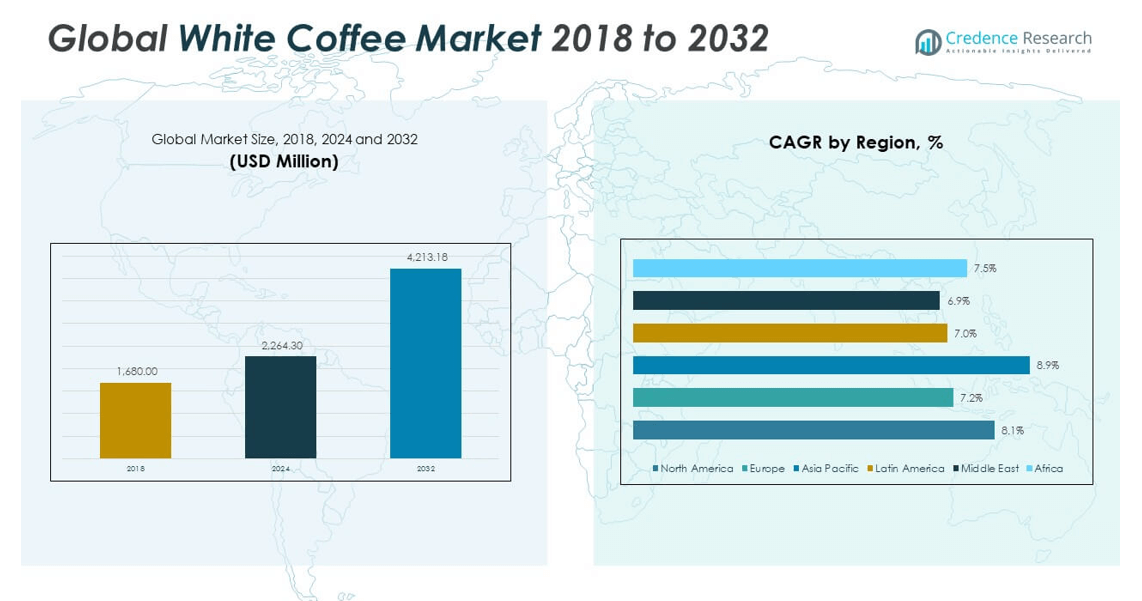
The White Coffee Market size was valued at USD 1,680.00 million in 2018 to USD 2,264.30 million in 2024 and is anticipated to reach USD 4,213.18 million by 2032, at a CAGR of 8.13% during the forecast period.
| REPORT ATTRIBUTE | DETAILS |
|---|---|
| Historical Period | 2020-2023 |
| Base Year | 2024 |
| Forecast Period | 2025-2032 |
| White Coffee Market Size 2024 | USD 2,264.30 million |
| White Coffee Market, CAGR | 8.13% |
| White Coffee Market Size 2032 | USD 4,213.18 million |
The market for white coffee is experiencing robust growth, driven by increasing consumer preference for unique and mild-flavored coffee beverages. Health-conscious consumers are gravitating toward white coffee due to its higher antioxidant content and lower acidity compared to traditional dark roasts. The rising popularity of specialty cafés, coupled with the influence of global coffee culture, has further propelled demand. Additionally, younger demographics are actively seeking innovative coffee experiences, and white coffee offers a distinct taste and perceived health benefits, which are fueling its rapid global expansion.
Regionally, Southeast Asia, particularly Malaysia and Indonesia, continues to dominate the white coffee market due to its cultural origins and established consumer base. North America and Europe are emerging as high-growth regions, driven by growing interest in alternative coffee blends and artisanal beverages. The rise of specialty coffee shops and a strong café culture in urban centers support this trend. In the Middle East, white coffee’s traditional link with lightly roasted Arabic blends is fostering niche demand. Meanwhile, emerging markets in Latin America and parts of Africa are showing potential due to rising urbanization and increased exposure to global coffee trends.
Market Insights:
- The White Coffee Market was valued at USD 2,264.30 million in 2024 and is expected to reach USD 4,213.18 million by 2032, registering a CAGR of 8.13%.
- Rising health consciousness is driving demand for low-acidity and antioxidant-rich white coffee, particularly among wellness-focused consumers.
- Urban millennials and Gen Z are boosting market momentum by seeking unique coffee experiences, supported by specialty cafés and social media trends.
- Product innovation in flavored and ready-to-drink white coffee formats is helping brands attract new customer segments and enhance shelf appeal.
- Limited consumer awareness in Western and emerging regions hinders broader adoption and requires sustained education efforts to boost trial rates.
- Inconsistent roasting standards and supply chain challenges affect product quality and scalability, limiting expansion for smaller players.
- Southeast Asia remains the largest regional market, while North America and Europe show high growth potential due to evolving coffee preferences and specialty café culture.
Market Drivers:
Rising Health Awareness Fuels Preference for Low-Acidity Beverages
Consumers are increasingly seeking coffee alternatives that offer health benefits without compromising taste. White coffee, known for its lower acidity and higher antioxidant content, appeals to this segment. It supports digestive health and reduces the risk of acid reflux, making it a favorable option over darker roasts. This shift in dietary preference has encouraged manufacturers to introduce white coffee variants with organic or clean-label positioning. The White Coffee Market benefits from this health-driven trend, particularly in regions with strong wellness movements. It aligns well with evolving consumer expectations related to natural and minimally processed beverages. Health-centric marketing has amplified white coffee's appeal across younger demographics.
- For instance, Lifeboost Coffee promotes its low-acid coffee with third-party lab-verified pH levels consistently above 5.5, positioning it as a gentler choice for individuals with acid sensitivity.
Expanding Coffee Culture Among Urban Millennials and Gen Z
Younger populations are significantly contributing to the popularity of white coffee. Urban millennials and Gen Z consumers are looking for novelty and personalization in their daily coffee routines. White coffee’s distinctive light flavor and smooth profile cater to their demand for differentiation. These consumers prioritize unique beverage experiences, often discovering white coffee through social media, specialty cafés, or travel. The White Coffee Market benefits from this rising interest in non-traditional roasts and innovative brewing formats. Coffee festivals, influencer-led promotions, and café collaborations create momentum around white coffee’s awareness. It continues to emerge as a symbol of modern café culture and lifestyle branding.
Product Innovation and Flavor Customization Drive Brand Differentiation
Manufacturers are investing in product innovation to meet evolving taste preferences. Flavored white coffee variants, including vanilla, hazelnut, and caramel, are gaining traction among consumers. These additions help bridge the gap between specialty coffee and mainstream consumption. The White Coffee Market benefits from brands exploring ready-to-drink (RTD), instant sachets, and cold brew formats. It enables broader market access and convenience for time-conscious consumers. Customized roasting levels and origin-based bean sourcing add further uniqueness to offerings. Brands use this versatility to build premium portfolios that stand out in crowded shelves. Retailers and e-commerce platforms are expanding product visibility, leading to improved customer engagement.
- For example, OldTown White Coffee launched a Signature Hazelnut White Coffee series in Malaysia and Singapore in 2024, focusing on flavored innovation as a key strategy.
Growth of Specialty Coffee Chains and Global Distribution Networks
The global expansion of specialty coffee outlets plays a key role in promoting white coffee. Chains and independent cafés are adding white coffee to diversify their offerings and attract curious consumers. It provides a competitive advantage in delivering unique customer experiences. The White Coffee Market benefits from collaborations between roasters and café operators to introduce signature brews. Global distribution partnerships and improved supply chain efficiency support wider availability across regions. It supports penetration into supermarkets, convenience stores, and online retail platforms. Coffee retailers now curate white coffee options to reflect evolving consumer sophistication. These networks increase exposure and improve accessibility for niche variants.
Market Trends
Premiumization and Craft Positioning Redefine Product Appeal
Consumers now associate white coffee with premium quality and artisanal preparation. Brands leverage this perception by offering single-origin white coffee and micro-lot roasts. It creates exclusivity and positions white coffee as a sophisticated beverage choice. The White Coffee Market reflects this trend with an increasing number of limited-edition releases. Packaging designs emphasize origin stories, sustainability, and hand-roasting methods to enhance brand value. It appeals to consumers who appreciate craftsmanship and transparency in sourcing. Boutique roasters use this narrative to elevate product pricing and drive loyalty. Coffee tasting events and cupping sessions reinforce white coffee’s standing in premium segments.
- For instance, in Malaysia’s OldTown White Coffee introduced its “Heritage Artisanal Series,” highlighting single-origin beans and traditional brewing techniques in limited-edition formats, which quickly sold out in key ASEAN markets. Packaging designs emphasize origin stories, sustainability, and hand-roasting methods to enhance brand value.
E-Commerce and Direct-to-Consumer Channels Boost Market Reach
Online platforms are expanding the visibility and accessibility of white coffee brands. E-commerce allows niche roasters to sell directly to consumers without intermediaries. It supports customer education, loyalty programs, and subscription-based models. The White Coffee Market benefits from personalized online experiences, including brewing guides and virtual tastings. Social media campaigns help drive product awareness and customer engagement. User-generated content promotes authenticity and peer validation for new consumers. Online retailers also provide diverse packaging and bundle options to encourage trial. It creates opportunities for global market entry without physical store dependency.
- For instance, Nestlé Malaysia introduced fully recyclable packaging for its Nescafé White Coffee line, aligning with the company’s global packaging pledge and reducing plastic waste across Southeast Asia.
Integration of Sustainable Practices Across Supply Chains
Sustainability has become a major consideration across the coffee sector. Consumers expect brands to source ethically and reduce environmental impact. The White Coffee Market aligns with these values through traceable sourcing, biodegradable packaging, and reduced roasting emissions. It encourages smallholder partnerships and environmentally conscious processing techniques. Certifications such as Fair Trade and Rainforest Alliance help build consumer trust. It also influences procurement and packaging decisions at the brand level. Retailers highlight sustainable credentials to differentiate products in competitive aisles. Coffee chains are also adopting sustainability practices in brewing and waste management.
Cultural Crossovers and Global Influence Shape Consumer Demand
White coffee’s origin in Malaysia and the Middle East is influencing coffee offerings globally. Chefs and mixologists incorporate white coffee into culinary pairings and specialty beverages. The White Coffee Market sees rising global interest in regional styles and traditional preparations. It encourages fusion recipes, including white coffee lattes and cold infusions. Cultural storytelling enhances appeal, particularly among food explorers and gourmet consumers. The integration of white coffee into seasonal menus strengthens cross-cultural appreciation. It creates opportunities for global brands to localize products with authentic influences.
Market Challenges Analysis
Limited Consumer Awareness in Key Markets Restricts Adoption
A primary challenge for the White Coffee Market is limited awareness in Western and emerging regions. Many consumers are unfamiliar with the product’s taste profile and health benefits. It creates hesitancy in trying white coffee, especially when traditional coffee preferences dominate. Brands face difficulties in explaining the difference between white coffee and regular coffee with milk. It impacts retail visibility and product turnover on shelves. Education through marketing remains resource-intensive and slow to scale. Cafés often hesitate to include white coffee on menus due to low initial demand. This challenge reduces exposure and limits organic market expansion. Overcoming awareness gaps requires targeted campaigns and sensory-based promotions.
Supply Chain Inconsistencies and Roasting Standards Vary by Region
Roasting white coffee requires precise temperature control and expertise. Inconsistencies in roasting techniques across regions lead to varied product quality. The White Coffee Market faces operational challenges in standardizing flavor and freshness across batches. It affects customer expectations and repeat purchase behavior. Sourcing light-roast-grade beans suitable for white coffee limits supplier options. Fluctuating bean availability and logistics costs also disrupt production planning. Smaller roasters often struggle with scalability due to limited automation and roasting infrastructure. Quality assurance becomes a bottleneck in expanding product lines. This challenge impacts both profitability and brand reputation in a competitive landscape.
Market Opportunities
Expansion into Untapped Urban Markets with Café Partnerships
Rapid urbanization and café culture growth in new markets present expansion opportunities. The White Coffee Market can capitalize on this by forming partnerships with specialty cafés in cities lacking product exposure. It allows brands to introduce white coffee through controlled trials and experiential events. Consumers in metropolitan regions show openness to alternative roasts and premium experiences. These settings offer ideal environments to build brand loyalty and drive repeat purchases.
Product Line Diversification with Functional and RTD Variants
Functional coffee trends and convenience-focused products open new avenues for growth. The White Coffee Market can benefit from launching ready-to-drink beverages infused with vitamins, collagen, or adaptogens. Functional benefits appeal to wellness-focused consumers seeking multi-purpose beverages. Single-serve capsules and instant blends offer entry points for home brewers. These extensions support broader demographic targeting and shelf presence.
Market Segmentation Analysis:
The White Coffee Market demonstrates diversified segmentation, reflecting evolving consumer preferences and product innovation.
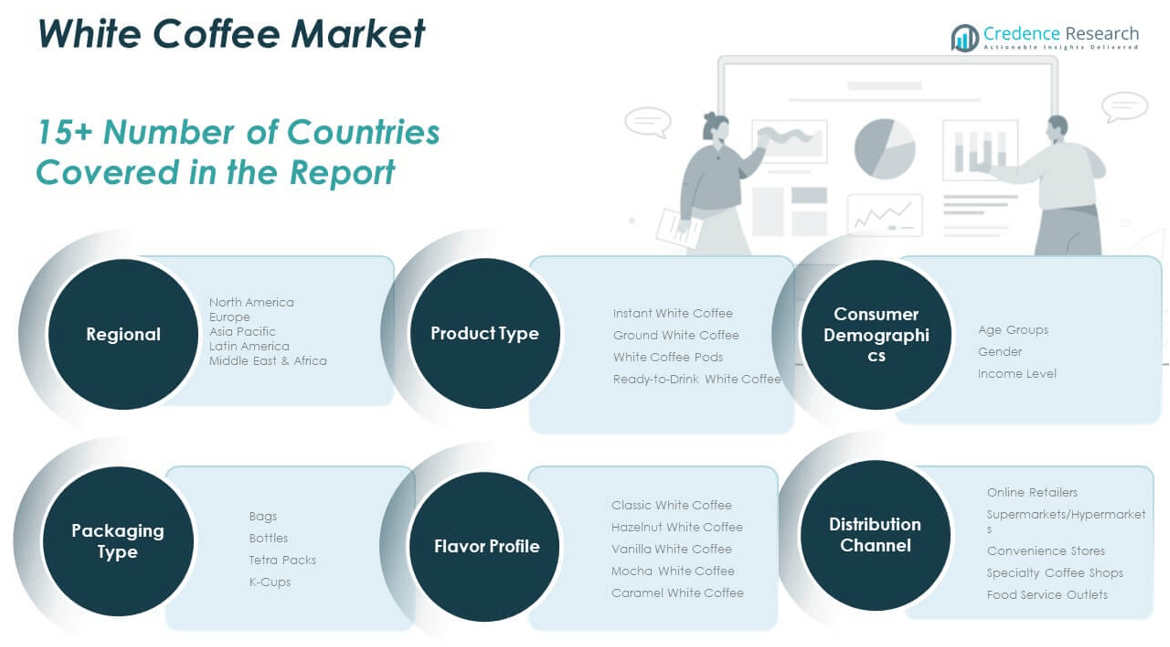
By product type, instant white coffee holds a prominent share due to its convenience and fast preparation, appealing to busy consumers. Ground white coffee attracts traditional coffee drinkers who prioritize flavor depth and brewing rituals. White coffee pods are gaining popularity in single-serve systems, especially in urban households. Ready-to-drink white coffee sees rising demand from on-the-go consumers and retail chains.
- For example, OldTown White Coffee reported strong retail growth for its 3-in-1 instant white coffee and introduced a Ready-to-Drink White Coffee can series in Malaysia and Singapore, targeting mobile consumers and vending channels.
By demographics, age groups significantly influence product selection. Young adults prefer trendy formats such as pods and RTD variants, while older consumers favor ground coffee. Gender-based consumption varies slightly, with female consumers showing higher affinity toward flavored options. Income level affects brand preference and volume, with premium product types targeting higher-income segments and instant formats appealing to mass-market consumers.
By Packaging type plays a crucial role in product appeal and shelf life. Bags dominate in traditional retail formats, while bottles and tetra packs serve ready-to-drink options effectively. K-Cups align with growing use of coffee machines in homes and offices.
By Flavor profile segmentation reveals that classic white coffee remains the preferred choice globally. Hazelnut, vanilla, mocha, and caramel variants appeal to consumers seeking variety and indulgence, expanding the market’s flavor portfolio.
By distribution channel, supermarkets and hypermarkets account for significant volume, offering accessibility and variety. Online retailers see growth due to convenience and expanding digital reach. Specialty coffee shops and food service outlets contribute to premium product exposure, while convenience stores support impulse and small-format purchases.
- For example, a survey by Euromonitor found that consumers aged 25–34 in Southeast Asia showed the highest adoption of RTD white coffee formats, particularly among working professionals in urban areas.
Segmentation:
By Product Type:
- Instant White Coffee
- Ground White Coffee
- White Coffee Pods
- Ready-to-Drink White Coffee
By Consumer Demographics:
- Age Groups
- Gender
- Income Level
By Packaging Type:
- Bags
- Bottles
- Tetra Packs
- K-Cups
By Flavor Profile:
- Classic White Coffee
- Hazelnut White Coffee
- Vanilla White Coffee
- Mocha White Coffee
- Caramel White Coffee
By Distribution Channel:
- Online Retailers
- Supermarkets/Hypermarkets
- Convenience Stores
- Specialty Coffee Shops
- Food Service Outlets
By Region:
- North America
- U.S.
- Canada
- Mexico
- Europe
- Germany
- France
- U.K.
- Italy
- Spain
- Rest of Europe
- Asia Pacific
- China
- Japan
- India
- South Korea
- South-east Asia
- Rest of Asia Pacific
- Latin America
- Brazil
- Argentina
- Rest of Latin America
- Middle East & Africa
- GCC Countries
- South Africa
- Rest of the Middle East and Africa
Regional Analysis:
North America
The North America White Coffee Market size was valued at USD 446.71 million in 2018 to USD 592.10 million in 2024 and is anticipated to reach USD 1,096.65 million by 2032, at a CAGR of 8.1% during the forecast period. North America holds a 26.1% share of the global market. The region benefits from a mature coffee culture and a high rate of specialty café adoption. It drives demand for innovative coffee variants such as white coffee, which appeals to health-conscious and premium-seeking consumers. Urban populations in the U.S. and Canada show a growing preference for unique taste profiles and less acidic options. The expansion of café chains and retail brands offering white coffee contributes to greater visibility. Consumer awareness around the antioxidant properties of white coffee continues to grow. E-commerce and direct-to-consumer platforms further increase market accessibility. White coffee’s inclusion in wellness and gourmet product categories supports steady regional expansion.
Europe
The Europe White Coffee Market size was valued at USD 358.18 million in 2018 to USD 459.59 million in 2024 and is anticipated to reach USD 796.09 million by 2032, at a CAGR of 7.2% during the forecast period. Europe accounts for 20.3% of the global market. European consumers increasingly value sustainable sourcing and artisanal quality in coffee products. It supports the demand for white coffee as a niche but growing segment. Countries like Germany, the UK, and France are witnessing increased shelf presence for white coffee in specialty and organic retail stores. Café operators introduce white coffee to diversify offerings and enhance the customer experience. The strong presence of ethical and clean-label movements aligns with the perceived health benefits of white coffee. Product innovations, including flavored blends and eco-friendly packaging, enhance market visibility. Consumers continue to explore non-traditional roasts in pursuit of lighter and smoother profiles. The trend toward wellness beverages positions white coffee favorably in the regional landscape.
Asia Pacific
The Asia Pacific White Coffee Market size was valued at USD 676.70 million in 2018 to USD 936.62 million in 2024 and is anticipated to reach USD 1,844.19 million by 2032, at a CAGR of 8.9% during the forecast period. Asia Pacific leads with a dominant 43.7% share of the global market. The region represents the traditional heart of white coffee consumption, particularly in Malaysia and Indonesia. It benefits from cultural familiarity, high domestic demand, and strong retail integration. Brands actively expand their product portfolios to cater to both local tastes and modern health preferences. Increasing urbanization and disposable income in China, India, and Southeast Asia support rising consumption. White coffee continues to gain ground through both instant and ready-to-drink offerings. Café chains in the region incorporate white coffee to meet evolving consumer tastes. Social media and influencer-driven marketing contribute to increased trial and brand recognition. The region’s dynamic coffee culture and production base ensure sustained momentum.
Latin America
The Latin America White Coffee Market size was valued at USD 95.76 million in 2018 to USD 127.68 million in 2024 and is anticipated to reach USD 218.54 million by 2032, at a CAGR of 7.0% during the forecast period. Latin America holds a 5.2% share of the global market. The region is gradually adopting white coffee through premium retail and foodservice channels. It has a well-established coffee production heritage, which aids in white coffee positioning among connoisseurs. Consumers in Brazil, Mexico, and Colombia are showing interest in lighter roast options and wellness-oriented beverages. It benefits from increasing café culture in urban centers and exposure to global coffee trends. Brands are focusing on education and sampling to introduce white coffee to new customers. The growth of online retail platforms supports broader availability across tier-one and tier-two cities. Sustainable packaging and health messaging are emerging as key differentiators. Local roasters experiment with light roasting techniques to cater to shifting consumer preferences.
Middle East
The Middle East White Coffee Market size was valued at USD 68.88 million in 2018 to USD 87.39 million in 2024 and is anticipated to reach USD 147.91 million by 2032, at a CAGR of 6.9% during the forecast period. The region contributes 3.5% to the global market. The Middle East shares a cultural connection with white coffee through its traditional use of lightly roasted beans and cardamom-infused blends. It influences both domestic consumption and product development. Specialty cafés in the UAE, Saudi Arabia, and Qatar are incorporating modern white coffee interpretations into their menus. Consumers show growing interest in low-acidity options that blend heritage with health consciousness. It aligns well with regional hospitality trends and premium beverage preferences. Retail growth in the Gulf Cooperation Council countries boosts shelf presence. Rising tourism also helps introduce white coffee to a broader audience. Health messaging and premium branding resonate strongly with affluent consumers in urban centers.
Africa
The Africa White Coffee Market size was valued at USD 33.77 million in 2018 to USD 60.92 million in 2024 and is anticipated to reach USD 109.81 million by 2032, at a CAGR of 7.5% during the forecast period. Africa holds a 2.6% share of the global market. While traditionally focused on coffee production, the region is slowly embracing specialty formats such as white coffee. Urban populations in South Africa, Kenya, and Nigeria are showing interest in artisanal and health-focused coffee options. It benefits from rising café culture and the entry of international coffee chains. Local brands experiment with lighter roasting profiles to cater to evolving urban tastes. Online platforms and specialty stores play a role in improving product accessibility. Consumer education remains important to drive adoption and differentiate white coffee from conventional offerings. It continues to grow through targeted promotions and collaborations with local roasters. Regional adoption remains in early stages but shows long-term potential.
Key Player Analysis:
- Nestlé S.A.
- Jacobs Douwe Egberts
- PT Mayora Indah Tbk
- Alicafe Arabia
- Aik Cheong Coffee Roaster Sdn. Bhd.
- Orgabio Manufacturing Sdn Bhd
- Home’s Café
- Poverty Bay Coffee Company
- Bargreen Coffee Company
Competitive Analysis:
The White Coffee Market features a mix of established coffee brands, specialty roasters, and emerging regional players. Key participants focus on product differentiation through unique flavor profiles, organic certifications, and sustainable sourcing practices. It exhibits rising competition in ready-to-drink, instant, and café-based formats, encouraging innovation in packaging and taste. Companies such as OldTown White Coffee, Bario, and Java House leverage cultural authenticity and strong retail networks to maintain market presence. New entrants emphasize health claims and minimal processing to appeal to younger consumers. Strategic partnerships with cafés and online retailers enhance distribution reach. The market rewards companies that balance quality, origin traceability, and brand storytelling. Competition intensifies as more players expand into emerging regions and capitalize on the health-driven beverage shift.
Recent Developments:
- In July 2025, Aik Cheong Coffee Roaster Sdn. Bhd. showcased its global ambitions at Expo 2025 Osaka. According to the director, the event serves as a major step for Aik Cheong to enhance its international presence. The company is embracing partnerships and technological innovation, aiming to become Malaysia's largest local coffee brand by 2030 while staying true to its heritage and evolving with consumer trends.
- In June 2025, Poverty Bay Coffee Company saw a 15% sales increase after expanding its sales channels through Amazon. This growth enabled the company to provide wage increases and additional benefits to its employees. The brand also deepened its social impact by donating its café to a non-profit supporting women and families in need, underscoring its commitment to community values while boosting its market presence.
Market Concentration & Characteristics
The White Coffee Market is moderately fragmented, with a few dominant brands leading in Asia Pacific and multiple small-to-medium players operating globally. It favors companies that offer artisanal quality, localized flavors, and eco-friendly packaging. Consumer demand centers on mild taste, lower acidity, and health benefits. It features both traditional and modern retail models, spanning cafés, supermarkets, and e-commerce. Market growth depends on regional awareness, cultural acceptance, and product innovation. White coffee’s distinct roasting process and niche positioning create barriers for mass replication. Competitive dynamics encourage quality consistency, marketing investment, and direct consumer engagement.
Report Coverage:
The research report offers an in-depth analysis based on Product Type, Consumer Demographics, Packaging Type, Distribution Channel and Flavor Profile. It details leading market players, providing an overview of their business, product offerings, investments, revenue streams, and key applications. Additionally, the report includes insights into the competitive environment, SWOT analysis, current market trends, as well as the primary drivers and constraints. Furthermore, it discusses various factors that have driven market expansion in recent years. The report also explores market dynamics, regulatory scenarios, and technological advancements that are shaping the industry. It assesses the impact of external factors and global economic changes on market growth. Lastly, it provides strategic recommendations for new entrants and established companies to navigate the complexities of the market.
Future Outlook:
- Demand for white coffee will grow due to increasing consumer interest in low-acid, antioxidant-rich beverages.
- Specialty cafés will expand white coffee offerings, attracting urban millennials and Gen Z consumers.
- E-commerce and direct-to-consumer models will play a key role in market penetration across underserved regions.
- Brands will focus on product diversification through flavored, functional, and ready-to-drink white coffee variants.
- Sustainable sourcing and eco-friendly packaging will remain essential for long-term consumer engagement.
- Asia Pacific will maintain dominance, while North America and Europe continue to emerge as high-growth regions.
- Digital marketing, influencer campaigns, and cultural storytelling will shape brand visibility and customer loyalty.
- Technological advancements in roasting and packaging will enhance quality control and shelf stability.
- Regulatory developments related to health claims and organic labeling may influence product positioning.
- Strategic collaborations between roasters and retail chains will accelerate global market expansion.

Request a Free Sample
Fill in your details and we'll send you a free sample report.
- Sample data tables & charts
- Research methodology
Market Dynamics
Rising Health Awareness and Demand for Low-Acidity Beverages
Consumers are increasingly seeking coffee options that are gentler on the stomach and rich in antioxidants. White coffee’s lower acidity and higher antioxidant content compared to traditional dark roasts make it especially attractive to health-conscious individuals, driving market growth.
Expansion of Specialty Café Culture and Urbanization
The proliferation of specialty cafés and the influence of global coffee culture, particularly in urban centers, are introducing more consumers to white coffee. Millennials and Gen Z are fueling demand by seeking unique, premium coffee experiences, which white coffee provides.
Product Innovation and Diversification
Brands are launching new flavored, ready-to-drink, and instant white coffee variants to cater to evolving consumer preferences and convenience needs. This innovation attracts new customer segments and enhances the market’s appeal, especially among younger and on-the-go consumers.
Growth of E-Commerce and Direct-to-Consumer Channels
Online retail platforms and direct-to-consumer models are making white coffee more accessible, especially in regions where traditional retail presence is limited. These channels support customer education, trial, and loyalty, accelerating market penetration.
Premiumization and Sustainability Trends
Consumers increasingly associate white coffee with artisanal quality, single-origin sourcing, and eco-friendly packaging. Brands leveraging these trends are able to command premium pricing and foster stronger customer loyalty, supporting sustained market expansion.
Need a Custom Version of This Report?
Tailor the scope, geography, or segments to your exact requirements.
- Custom geography or segment scope
- Direct access to our analyst team
Frequently Asked Questions
What is the current size of the White Coffee Market?
What are the key segments within the White Coffee Market?
What are some challenges faced by the White Coffee Market?
Who are the major players in the White Coffee Market?
Table of Content
Chapter 1 Market Segmentation
- 1.1 Segmentation Framework
- 1.1.1 Product and Service Classification
- 1.1.2 Application and End-Use Classification
- 1.1.3 Technology and Solution Classification
- 1.1.4 Customer and Distribution Channel Classification
- 1.1.5 Geographic Segmentation
- 1.1.6 Market Segment Definitions and Boundaries
- 1.2 By Product Type
- 1.2.1 Instant White Coffee
- 1.2.2 Ground White Coffee
- 1.2.3 White Coffee Pods
- 1.2.4 Ready-to-Drink White Coffee
- 1.3 By Flavor Profile
- 1.3.1 Classic White Coffee
- 1.3.2 Hazelnut White Coffee
- 1.3.3 Vanilla White Coffee
- 1.3.4 Mocha White Coffee
- 1.3.5 Caramel White Coffee
- 1.4 By Packaging Type
- 1.4.1 Bags
- 1.4.2 Bottles
- 1.4.3 Tetra Packs
- 1.4.4 K-Cups
Chapter 2 Introduction
- 2.1 Report Objectives and Scope
- 2.2 Product Definition and Industry Terminology
- 2.3 Market Inclusions and Exclusions
- 2.4 Research Process
- 2.4.1 Primary Research and Expert Interviews
- 2.4.2 Secondary Research and Source Review
- 2.4.3 Top-Down and Bottom-Up Estimation
- 2.4.4 Data Triangulation and Verification
- 2.5 Market Size Measurement Basis
- 2.5.1 2018: USD 1,680.00 million → 2032: USD 4,213.18 million
- 2.6 Historical and Forecast Reference Periods
- 2.6.1 Base Year: 2018
- 2.6.2 Forecast Period: 2018-2032
- 2.7 Research Assumptions and Limitations
Chapter 3 Executive Summary
- 3.1 Market Snapshot and Key Findings
- 3.2 Base-Year Market Size, 2018
- 3.3 Forecast Market Size, 2032
- 3.4 Revenue and Volume Growth Outlook
- 3.5 Key Demand and Supply Indicators
- 3.6 Leading Market Segments
- 3.7 Fastest-Growing Market Opportunities
- 3.8 Regional Performance Highlights
- 3.9 Technology and Industry Transformation
- 3.10 Competitive Landscape Summary
- 3.11 Analyst View and Strategic Implications
Chapter 4 Global White Coffee Market Trends and Developments
- 4.1 Historical Industry Development
- 4.2 Recent Market Trends and Developments
- 4.3 Demand and Customer Behavior Trends
- 4.4 Technology and Product Innovation
- 4.5 Artificial Intelligence, Automation and Digitalization
- 4.6 Local Manufacturing and Supply Chain Realignment
- 4.7 Industry Partnerships, Mergers and Acquisitions
- 4.8 Sustainability and Circular Economy Developments
- 4.9 Government and Private Sector Investment Trends
- 4.10 Emerging Business Models and Commercialization
- 4.11 Industry Developments and Announcements
Chapter 5 Global White Coffee Market Production, Supply and Demand Analysis
- 5.1 Demand Trend and Consumption Analysis
- 5.2 Demand Forecast, 2018-2032
- 5.3 Production and Output Trend
- 5.4 Production and Output Forecast, 2018-2032
- 5.5 Installed Capacity and Capacity Utilization
- 5.6 Company-Wise Production Plants and Statistics
- 5.6.1 Installed Production Capacity
- 5.6.2 Actual Production
- 5.6.3 Planned Capacity and Expansion Targets
- 5.7 Supply Chain Structure and Procurement Trends
- 5.8 Supply-Demand Gap and Bottlenecks
- 5.9 Import Dependence and Sourcing Structure
- 5.10 Contract Manufacturing and Outsourcing
- 5.11 Regional Supply and Demand Concentration
Chapter 6 Global White Coffee Market Pricing Analysis
- 6.1 Pricing Structure and Measurement
- 6.2 Historical Pricing Trends
- 6.3 Pricing Outlook, 2018-2032
- 6.4 Average Selling Price and Unit Economics
- 6.5 Pricing by Product and Market Segment
- 6.6 Geographic Pricing Differences
- 6.7 Key Input, Energy, Labor and Logistics Costs
- 6.8 Contract Pricing and Purchasing Models
- 6.9 Pricing Sensitivity and Competitive Positioning
- 6.10 Price, Margin and Profitability Implications
Chapter 7 Global White Coffee Market Dynamics
- 7.1 Market Growth Drivers
- 7.1.1 Demand-Side Drivers
- 7.1.2 Technology and Innovation Drivers
- 7.1.3 Infrastructure and Investment Drivers
- 7.1.4 Regulatory and Policy Drivers
- 7.2 Market Restraints
- 7.2.1 Cost and Affordability Constraints
- 7.2.2 Technology and Adoption Barriers
- 7.2.3 Supply Chain and Operational Constraints
- 7.3 Market Challenges
- 7.3.1 Competitive Pressure and Margin Erosion
- 7.3.2 Skills, Infrastructure and Implementation Gaps
- 7.4 Emerging Market Opportunities
- 7.5 Market Dynamics Impact and Time-Horizon Assessment
Chapter 8 Global White Coffee Value Chain Analysis
- 8.1 Industry Value Chain Overview
- 8.2 Upstream Suppliers and Critical Inputs
- 8.3 Technology and Component Providers
- 8.4 Manufacturing or Service Delivery
- 8.5 Distribution, Channel Partners and Integrators
- 8.6 Downstream Applications and End Users
- 8.7 Value Addition and Profit Pools
- 8.8 Vertical Integration and Outsourcing
- 8.9 Supplier Concentration and Risk
- 8.10 Supply Chain Localization and Resilience
Chapter 9 Global White Coffee Market Regulations and Policies
- 9.1 Relevant Laws, Standards and Compliance Frameworks
- 9.2 Product, Service, Safety and Quality Requirements
- 9.3 Government Policies, Incentives and Subsidies
- 9.4 Imports, Exports and Trade Barriers
- 9.5 Public Procurement and Local Content Requirements
- 9.6 Environmental and Sustainability Compliance
- 9.7 Upcoming Policy Changes and Market Implications
Chapter 10 Global White Coffee Market Hotspots and Opportunities
- 10.1 Market Opportunity Mapping and Growth Hotspots
- 10.2 High-Growth Applications and Customer Groups
- 10.3 Underserved Markets and White-Space Opportunities
- 10.4 Emerging Technology and Product Opportunities
- 10.5 New Capacity and Investment Hotspots
- 10.6 Market Entry and Expansion Opportunities
- 10.7 Distribution and Partnership Opportunities
- 10.8 Near-Term and Long-Term Commercial Potential
- 10.9 Opportunity Attractiveness and Execution Risks
Chapter 11 Global White Coffee Market Outlook, 2018-2032
- 11.1 Market Size and Analysis
- 11.1.1 Revenue (Market Measurement: 2018: USD 1,680.00 million → 2032: USD 4,213.18 million)
- 11.1.2 Market Volume and Quantity Sold
- 11.1.3 Historical Market Size
- 11.1.4 Base-Year Market Size, 2018
- 11.2 Market Forecast, 2018-2032
- 11.2.1 Revenue Forecast to 2032
- 11.2.2 Volume Forecast to 2032
- 11.2.3 CAGR and Year-on-Year Growth
- 11.2.4 Incremental Revenue Opportunity
- 11.3 Forecast Assumptions and Scenario Analysis
- 11.3.1 Base-Case Forecast
- 11.3.2 Optimistic and Conservative Scenarios
- 11.3.3 Technology, Pricing and Policy Sensitivities
- 11.4 Market Attractiveness and Growth Outlook
Chapter 12 Global White Coffee Market Segmentation and Outlook
- 12.1 Segmentation Summary and Market Shares, 2018
- 12.2 Largest and Fastest-Growing Segments
- 12.3 By Product Type - Market Size and Forecast, 2018-2032
- 12.3.1 Segment Definition and Scope
- 12.3.2 Historical Market Size
- 12.3.3 Revenue Forecast, 2018-2032
- 12.3.4 Volume Forecast, 2018-2032
- 12.3.5 Base-Year Market Share, 2018
- 12.3.6 Segment CAGR and Growth Drivers
- 12.3.7 Subsegment Market Size and Forecast
- 12.3.7.1 Instant White Coffee
- 12.3.7.2 Ground White Coffee
- 12.3.7.3 White Coffee Pods
- 12.3.7.4 Ready-to-Drink White Coffee
- 12.3.8 Subsegment Pricing and Adoption Trends
- 12.3.9 Leading Suppliers and Competition
- 12.3.10 Regional Demand and Opportunities
- 12.4 By Flavor Profile - Market Size and Forecast, 2018-2032
- 12.4.1 Segment Definition and Scope
- 12.4.2 Historical Market Size
- 12.4.3 Revenue Forecast, 2018-2032
- 12.4.4 Volume Forecast, 2018-2032
- 12.4.5 Base-Year Market Share, 2018
- 12.4.6 Segment CAGR and Growth Drivers
- 12.4.7 Subsegment Market Size and Forecast
- 12.4.7.1 Classic White Coffee
- 12.4.7.2 Hazelnut White Coffee
- 12.4.7.3 Vanilla White Coffee
- 12.4.7.4 Mocha White Coffee
- 12.4.7.5 Caramel White Coffee
- 12.4.8 Subsegment Pricing and Adoption Trends
- 12.4.9 Leading Suppliers and Competition
- 12.4.10 Regional Demand and Opportunities
- 12.5 By Packaging Type - Market Size and Forecast, 2018-2032
- 12.5.1 Segment Definition and Scope
- 12.5.2 Historical Market Size
- 12.5.3 Revenue Forecast, 2018-2032
- 12.5.4 Volume Forecast, 2018-2032
- 12.5.5 Base-Year Market Share, 2018
- 12.5.6 Segment CAGR and Growth Drivers
- 12.5.7 Subsegment Market Size and Forecast
- 12.5.7.1 Bags
- 12.5.7.2 Bottles
- 12.5.7.3 Tetra Packs
- 12.5.7.4 K-Cups
- 12.5.8 Subsegment Pricing and Adoption Trends
- 12.5.9 Leading Suppliers and Competition
- 12.5.10 Regional Demand and Opportunities
- 12.6 Segment Growth Comparison
- 12.7 Segment Attractiveness and Priority Matrix
Chapter 13 Global White Coffee Geographic Market Outlook, 2018-2032
- 13.1 Regional Market Size and Share, 2018
- 13.2 Regional Market Forecast, 2018-2032
- 13.3 Regional Pricing, Production and Demand Differences
- 13.4 North America
- 13.4.1 United States
- 13.4.2 Canada
- 13.4.3 Mexico
- 13.5 Europe
- 13.5.1 Germany
- 13.5.2 France
- 13.5.3 Italy
- 13.5.4 United Kingdom
- 13.5.5 Spain
- 13.5.6 Poland
- 13.5.7 Russia
- 13.5.8 Netherlands
- 13.5.9 Belgium
- 13.5.10 Sweden
- 13.5.11 Denmark
- 13.5.12 Norway
- 13.5.13 Rest of Europe
- 13.6 Asia Pacific
- 13.6.1 China
- 13.6.2 India
- 13.6.3 Japan
- 13.6.4 South Korea
- 13.6.5 Thailand
- 13.6.6 Indonesia
- 13.6.7 Vietnam
- 13.6.8 Malaysia
- 13.6.9 Australia
- 13.6.10 Rest of Asia Pacific
- 13.7 Latin America
- 13.7.1 Brazil
- 13.7.2 Argentina
- 13.7.3 Colombia
- 13.7.4 Chile
- 13.7.5 Rest of Latin America
- 13.8 Middle East
- 13.8.1 Saudi Arabia
- 13.8.2 United Arab Emirates
- 13.8.3 Turkey
- 13.8.4 Israel
- 13.8.5 Iran
- 13.8.6 Rest of the Middle East
- 13.9 Africa
- 13.9.1 South Africa
- 13.9.2 Egypt
- 13.9.3 Nigeria
- 13.9.4 Morocco
- 13.9.5 Rest of Africa
- 13.10 Regional Investment, Policy and Supply Chain Differences
- 13.11 Regional Competitive Landscape
- 13.12 Geographic Growth Hotspots
Chapter 14 Global White Coffee Technology, Innovation and Sustainability Outlook
- 14.1 Technology Landscape and Maturity
- 14.2 Product, Process and Service Innovation
- 14.3 AI, Automation and Digital Tools in the Industry
- 14.4 Technology Adoption and Performance Benchmarking
- 14.5 Innovation Pipeline and R&D Investment
- 14.6 Patent and Intellectual Property Trends
- 14.7 Energy Efficiency and Resource Management
- 14.8 Sustainability, Recycling and Circularity
- 14.9 Technology Roadmap, 2018-2032
- 14.10 Risks of Obsolescence and Technology Substitution
Chapter 15 Global White Coffee Market Key Strategic Imperatives
- 15.1 Growth and Market Entry Priorities
- 15.2 High-Return Products and Segments
- 15.3 Pricing, Profitability and Cost Optimization
- 15.4 Technology Investment and Product Differentiation
- 15.5 Supply Chain Localization and Resilience
- 15.6 Distribution and Customer Acquisition
- 15.7 Partnership, Acquisition and Capacity Strategy
- 15.8 Regional Expansion Priorities
- 15.9 Short-, Medium- and Long-Term Actions
Chapter 16 Competition Outlook
- 16.1 Industry Competition Characteristics
- 16.2 Market Structure and Concentration
- 16.3 Market Share and Competitive Positioning, 2018
- 16.4 Company-Wise Revenue and Product Benchmarking
- 16.5 Production and Service Capacity Benchmarking
- 16.6 Technology, Pricing and Differentiation
- 16.7 Regional Footprint and Distribution Strength
- 16.8 Mergers, Acquisitions and Strategic Alliances
- 16.9 New Entrants and Competitive Threats
- 16.10 Porter's Five Forces and Industry Attractiveness
- 16.11 Competitive Outlook, 2018-2032
Chapter 17 Company Profiles
- 17.1 Company Coverage and Selection Criteria
- 17.2 Nestlé S.A.
- 17.2.1 Business Description
- 17.2.2 Company Ownership and Geographic Presence
- 17.2.3 Product and Service Portfolio
- 17.2.4 Manufacturing and Operating Footprint
- 17.2.5 Production Capacity and Expansion Plans
- 17.2.6 Financial Performance and Investment
- 17.2.7 Market Share and Competitive Position
- 17.2.8 Technology and Innovation Capabilities
- 17.2.9 Strategic Alliances or Partnerships
- 17.2.10 Recent Developments
- 17.2.11 Growth Strategy and Outlook
- 17.3 Jacobs Douwe Egberts
- 17.4 PT Mayora Indah Tbk
- 17.5 Alicafe Arabia
- 17.6 Aik Cheong Coffee Roaster Sdn. Bhd.
- 17.7 Orgabio Manufacturing Sdn Bhd
- 17.8 Home’s Café
- 17.9 Poverty Bay Coffee Company
- 17.10 OldTown White Coffee
- 17.11 Bargreen Coffee Company
- 17.12 Other Relevant Market Participants
Note: Every listed company is profiled on the structure shown under the first company. The company list is preliminary and may change based on research findings, market developments, data availability and client requirements.
Chapter 18 Disclaimer
- 18.1 Research and Forecast Disclaimer
- 18.2 Data Source and Estimation Limitations
Note: The depth of individual sections depends on data availability for this market. Volume, capacity, trade and other unit-based metrics are included where applicable.

