Market Overview
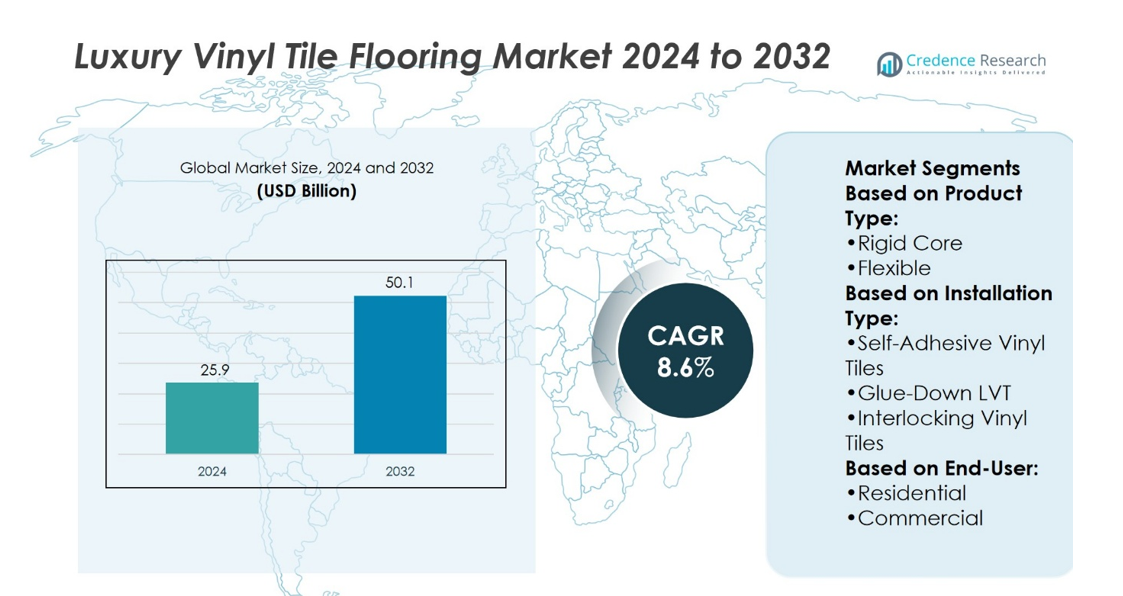
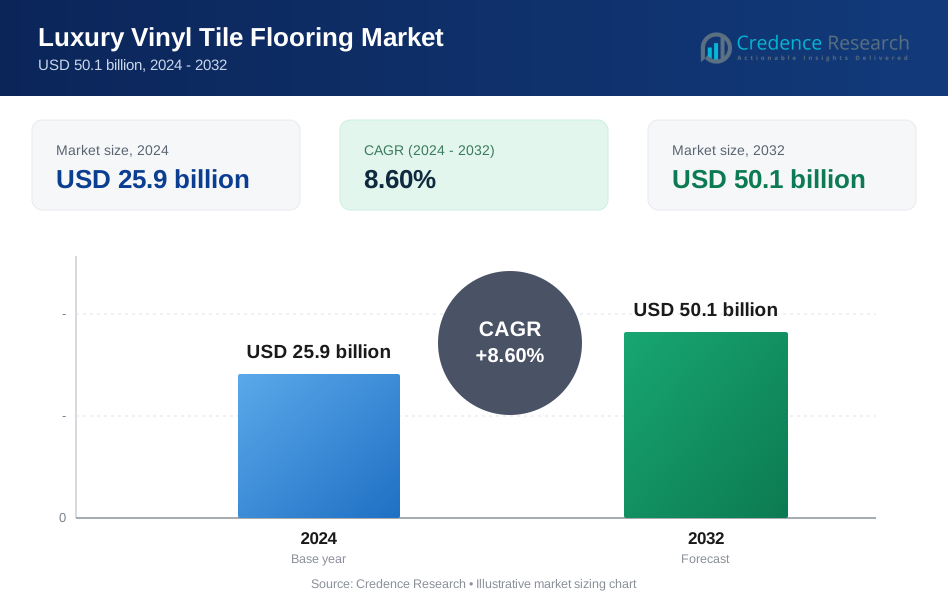
Luxury Vinyl Tile Flooring Market size was valued at USD 25.9 billion in 2024 and is anticipated to reach USD 50.1 billion by 2032, at a CAGR of 8.6% during the forecast period.
| REPORT ATTRIBUTE | DETAILS |
|---|---|
| Historical Period | 2020-2023 |
| Base Year | 2024 |
| Forecast Period | 2025-2032 |
| Luxury Vinyl Tile Flooring Market Size 2024 | USD 25.9 billion |
| Luxury Vinyl Tile Flooring Market, CAGR | 8.6% |
| Luxury Vinyl Tile Flooring Market Size 2032 | USD 50.1 billion |
The Luxury Vinyl Tile Flooring Market is driven by rising demand for durable, affordable, and visually appealing flooring solutions across residential and commercial spaces. Consumers prefer LVT for its water resistance, easy installation, and ability to replicate wood and stone finishes at lower cost. Renovation projects, urban housing growth, and increasing disposable incomes further strengthen adoption. Market trends highlight a clear shift toward sustainable, recyclable, and low-emission products that meet green building standards. Advancements in digital printing and rigid core technology enhance product quality, while e-commerce platforms and expanding distribution networks boost accessibility and global market penetration.
The Luxury Vinyl Tile Flooring Market shows strong regional presence, with Asia-Pacific holding the largest share, followed by North America and Europe, while Latin America and the Middle East & Africa show steady growth. Expanding urbanization, renovation projects, and sustainability trends drive adoption across these regions. Key players shaping the market include Armstrong Flooring, Forbo Flooring Systems, Mohawk Industries, Tarkett, Mannington Mills, Shaw Industries, LG Hausys, Gerflor, Fatra A.S., and Beaulieu International Group, all competing through innovation, design variety, and distribution strength.
Market Insights
- Luxury Vinyl Tile Flooring Market size was valued at USD 25.9 billion in 2024 and is projected to reach USD 50.1 billion by 2032, at a CAGR of 8.6%.
- Rising demand for durable, affordable, and visually appealing flooring drives strong adoption in both residential and commercial sectors.
- Trends show increasing preference for recyclable, low-emission, and eco-friendly products aligned with green building standards.
- Competition remains intense, with players focusing on product innovation, design variety, and stronger distribution networks.
- Restraints include raw material dependency, environmental concerns, and strong competition from substitute flooring options.
- Asia-Pacific holds the largest share, followed by North America and Europe, while Latin America and the Middle East & Africa record steady growth.
- Key companies such as Armstrong Flooring, Forbo Flooring Systems, Mohawk Industries, Tarkett, Mannington Mills, Shaw Industries, LG Hausys, Gerflor, Fatra A.S., and Beaulieu International Group drive the market through innovation and sustainability efforts.
Market Drivers
Rising Demand for Durable and Aesthetic Flooring Solutions
The Luxury Vinyl Tile Flooring Market gains momentum due to rising demand for durable yet stylish flooring materials. Consumers seek surfaces that balance performance with attractive design, driving steady adoption across residential and commercial spaces. It resists scratches, stains, and moisture, making it suitable for high-traffic areas. The ability to replicate natural materials like wood or stone at lower costs also strengthens demand. Developers, contractors, and homeowners prefer it for flexible installation and long-term value. These factors make durability and design versatility a central driver for market growth.
- For instance, Fatra’s Thermofix PRO luxury vinyl tiles feature a 0.8 mm wear layer-significantly thicker than standard vinyl tiles. Their 1200 × 180 mm plank size and ultra-matte finish with 4V beveled edges deliver both mechanical resilience and a premium look, and the product comes with a 25-year warranty.
Expanding Use in Residential and Commercial Renovation Projects
Renovation activity across housing and commercial real estate fuels growth for the Luxury Vinyl Tile Flooring Market. Property owners and developers replace outdated flooring with modern, cost-effective solutions that enhance aesthetics and functionality. It provides faster installation, minimal maintenance, and customization that align with varied project needs. Offices, hotels, and retail spaces adopt it to improve interior appeal without high costs. Growing urbanization supports renovation projects, while rising consumer income boosts investment in premium interiors. Renovation trends continue to strengthen the market’s expansion worldwide.
- For instance, Mohawk Industries reported net earnings of $147 million in the second quarter of 2025, highlighting its financial strength and capacity to invest in durable product offerings like SolidTech Essentials.
Advancements in Product Technology and Design Innovation
Technological progress supports broader adoption of the Luxury Vinyl Tile Flooring Market. Manufacturers introduce advanced printing, embossing, and wear-layer technologies that replicate textures of natural surfaces. It offers high-definition visuals and improved resilience, which elevate user experience. New innovations include eco-friendly materials and waterproof variants that appeal to sustainability-conscious buyers. Smart design features, such as click-lock systems, simplify installation and reduce labor costs. Innovation ensures consistent improvements in product quality and consumer appeal.
Growing Preference for Cost-Effective and Low-Maintenance Options
Affordability and ease of upkeep drive steady demand in the Luxury Vinyl Tile Flooring Market. Consumers view it as a cost-efficient alternative to hardwood, stone, and ceramic tiles. Its low maintenance reduces long-term expenses for cleaning and replacement. Commercial buyers favor it for large projects, where budgets and durability play key roles. Availability across multiple price ranges allows it to meet diverse consumer segments. Strong value-for-money positioning ensures its relevance in both developed and emerging markets.
Market Trends
Rising Popularity of Eco-Friendly and Sustainable Flooring Materials
The Luxury Vinyl Tile Flooring Market reflects a strong trend toward sustainability, with buyers seeking environmentally responsible products. Manufacturers introduce recyclable materials and phthalate-free options that appeal to eco-conscious consumers. It aligns with global green building certifications and corporate sustainability goals. Low-emission adhesives and improved recycling processes also support this movement. Commercial developers prefer eco-friendly flooring to meet stricter regulatory standards. Growing awareness of indoor air quality further strengthens demand for sustainable vinyl tile solutions.
- For instance, Beaulieu International Group (B.I.G.), which reported €2 billion in sales for 2024, invested heavily in capital expenditures, including modernizing production sites and implementing sustainability initiatives, to highlight its commitment to innovation and durable flooring solutions.
Increasing Adoption of Digital Printing and Advanced Design Technologies
Technological advancement shapes new trends in the Luxury Vinyl Tile Flooring Market. Digital printing and embossing techniques create highly realistic textures that replicate wood, stone, or ceramic surfaces. It enables customization for both residential and commercial buyers. New design flexibility supports unique patterns, colors, and finishes that appeal to diverse markets. Improved wear-layer technology enhances durability while preserving visual appeal. The trend of high-definition design innovation raises consumer expectations and adoption rates.
- For instance, Shaw Industries has made several significant investments in its Ringgold, GA facility (Plant RP) to enhance its resilient flooring manufacturing capabilities. While a $30 million investment for composite core LVT was completed in 2017, the company has continued to expand. Notably, in October 2024, Shaw announced an additional $90 million investment in the plant to more than double its resilient flooring capacity by 2026.
Growing Demand in Residential Renovation and Remodeling Projects
Renovation activity continues to influence trends in the Luxury Vinyl Tile Flooring Market. Homeowners choose it for cost efficiency, aesthetic upgrades, and easy installation methods. The shift toward open-floor layouts and modern interiors supports its usage in living spaces, kitchens, and bathrooms. DIY-friendly products with click-lock features attract homeowners seeking quick renovation solutions. Rising disposable income drives investment in premium flooring finishes. Residential remodeling remains a key factor shaping market demand patterns.
Expanding Use of Luxury Vinyl Tile in Commercial Applications
Commercial real estate significantly contributes to the evolving trends of the Luxury Vinyl Tile Flooring Market. Businesses adopt it in offices, hospitality, retail, and healthcare settings for durability and design flexibility. It withstands heavy foot traffic while maintaining visual appeal. Developers appreciate its lower lifecycle cost compared to traditional flooring. Improved acoustic properties and comfort underfoot make it suitable for employee-friendly workspaces. Commercial adoption grows steadily as industries prioritize functional and stylish flooring solutions.
Market Challenges Analysis
Environmental Concerns and Raw Material Dependency
The Luxury Vinyl Tile Flooring Market faces challenges related to environmental impact and raw material reliance. Production often depends on polyvinyl chloride, which raises concerns about emissions and recycling difficulties. It encounters criticism from sustainability advocates who question the long-term ecological footprint of vinyl flooring. Rising demand for eco-friendly solutions pressures manufacturers to adopt greener alternatives, which can increase production costs. Dependence on petrochemical-based raw materials also exposes the industry to price fluctuations and supply risks. Regulatory pressures on emissions and waste management further complicate the competitive landscape.
Intense Market Competition and Product Substitution Risks
The Luxury Vinyl Tile Flooring Market experiences strong competition from alternative flooring materials such as laminate, ceramic tile, and engineered wood. It struggles to differentiate in a market where rivals also promote durability and aesthetic appeal. Price sensitivity in residential and commercial segments often pushes buyers toward low-cost substitutes. Intense rivalry among global and regional players limits profit margins and creates pricing pressure. Fluctuating quality in low-grade products can damage consumer perception and hinder brand trust. Market fragmentation challenges companies to maintain consistent innovation while defending share in competitive environments.
Market Opportunities
Expanding Demand in Emerging Economies and Infrastructure Growth
The Luxury Vinyl Tile Flooring Market holds strong opportunities in emerging economies driven by rapid urbanization and infrastructure expansion. Rising construction activity in residential and commercial sectors increases demand for durable and cost-effective flooring. It benefits from the growing middle-class population seeking affordable premium interiors. Government investments in smart cities and housing projects create steady growth avenues. Retail and hospitality sectors in developing regions also adopt vinyl tiles to enhance design appeal. Expanding distribution networks further strengthen accessibility and market penetration.
Innovation in Product Development and Sustainable Offerings
The Luxury Vinyl Tile Flooring Market gains opportunities through innovation and eco-friendly product development. It advances with waterproof, scratch-resistant, and recyclable flooring that appeals to sustainability-focused buyers. Manufacturers introducing phthalate-free and low-VOC options capture rising demand for healthier indoor solutions. Digital printing technologies allow greater customization, opening new prospects in high-end residential and commercial projects. Smart installation systems also support adoption among DIY consumers and professional contractors. Innovation-focused strategies position companies to strengthen long-term competitiveness.
Market Segmentation Analysis:
By Product Type
The Luxury Vinyl Tile Flooring Market is segmented into rigid core and flexible categories. Rigid core products gain traction due to their superior durability, stability, and resistance to temperature fluctuations. It is widely used in commercial and high-traffic residential spaces where performance is critical. Flexible variants remain popular for their ease of cutting, handling, and installation. These options appeal to homeowners seeking versatile design solutions with cost efficiency. Both types continue to play distinct roles, meeting diverse consumer needs across regions.
- For instance, in 2020, Mannington Mills announced a major expansion at its Calhoun, Georgia facility to meet the rising demand for luxury vinyl flooring. The project was a $35 million investment that was expected to create 240 new jobs. The expansion included building a new 125,000 sq ft facility to produce Rigid Core flooring.
By Installation Type
Installation type divides the market into self-adhesive vinyl tiles, glue-down LVT, interlocking vinyl tiles, and others. Self-adhesive options attract DIY homeowners due to simple application and minimal labor needs. Glue-down tiles dominate in large-scale commercial projects where long-term stability is essential. It provides strong bonding and durability in high-use environments. Interlocking vinyl tiles gain attention for quick installation, flexibility, and reduced downtime in renovation projects. Other methods, though smaller in share, serve niche needs where specialized flooring applications are required. Together, these installation types provide broad adoption choices across consumer and business segments.
- For instance, Gerflor reported a turnover of €1.5 billion ($1.6 billion USD) in 2023, reflecting substantial company scale and capacity to invest in high-performance and stylish flooring technologies.
By End User
End-user segmentation includes residential and commercial applications. The residential sector drives strong adoption, supported by rising renovation activity and growing preference for stylish, affordable flooring. It offers moisture resistance and easy maintenance, making it suitable for kitchens, bathrooms, and living spaces. Commercial applications, including offices, retail, and hospitality, prioritize LVT for its ability to handle heavy foot traffic while maintaining design appeal. Developers value its lower lifecycle cost and quick installation features. Both segments remain vital contributors, with commercial demand showing steady expansion.
Segments:
Based on Product Type:
- Rigid Core
- Flexible
Based on Installation Type:
- Self-Adhesive Vinyl Tiles
- Glue-Down LVT
- Interlocking Vinyl Tiles
Based on End-User:
- Residential
- Commercial
Based on the Geography:
- North America
- U.S.
- Canada
- Mexico
- Europe
- UK
- France
- Germany
- Italy
- Spain
- Russia
- Belgium
- Netherlands
- Austria
- Sweden
- Poland
- Denmark
- Switzerland
- Rest of Europe
- Asia Pacific
- China
- Japan
- South Korea
- India
- Australia
- Thailand
- Indonesia
- Vietnam
- Malaysia
- Philippines
- Taiwan
- Rest of Asia Pacific
- Latin America
- Brazil
- Argentina
- Peru
- Chile
- Colombia
- Rest of Latin America
- Middle East
- UAE
- KSA
- Israel
- Turkey
- Iran
- Rest of Middle East
- Africa
- Egypt
- Nigeria
- Algeria
- Morocco
- Rest of Africa
Regional Analysis
North America
North America held 13.8% share in 2024 of the Luxury Vinyl Tile Flooring Market. The region is driven by strong renovation activity across both residential and commercial properties. Homeowners adopt LVT for kitchens, bathrooms, and living spaces because of its water resistance and design flexibility. Offices, hotels, and retail spaces also prefer it for durability and low maintenance. Major retail chains and flooring specialists provide easy access to a wide variety of products. Innovation in rigid core and premium textured finishes continues to attract buyers. North America remains a stable market due to consistent investment in housing upgrades and commercial construction.
Europe
Europe accounts for a notable share, ranking after North America in the Luxury Vinyl Tile Flooring Market. Buyers place strong emphasis on eco-friendly and recyclable flooring solutions due to strict green building standards. Leading countries include Germany, France, and the United Kingdom, where demand is high in both commercial and residential projects. LVT serves as an affordable alternative to natural wood and stone while offering better moisture resistance. It is especially popular in hotels, offices, and retail outlets seeking stylish yet functional flooring. Renovation projects across major cities further increase adoption rates. Europe’s focus on sustainability and premium design continues to shape long-term growth.
Asia-Pacific
Asia-Pacific dominated with the largest share of 42.84% in 2024, making it the global leader. Rapid urbanization, large-scale housing projects, and commercial expansion in China, India, and Southeast Asia drive strong demand. Consumers with rising incomes increasingly invest in durable and stylish flooring for new homes and apartments. Commercial growth in offices, retail, and hospitality also contributes to widespread adoption. Local manufacturing strengthens supply chains and keeps products affordable for a wide customer base. Online platforms and modern retail expand reach across both urban and rural regions. Asia-Pacific stands out as the fastest-growing region and is expected to continue leading the global market.
Latin America
Latin America holds a smaller share of the global Luxury Vinyl Tile Flooring Market but shows steady growth. Brazil leads adoption, supported by expanding urban populations and rising construction activity. Homeowners prefer LVT for cost-effectiveness, ease of installation, and attractive designs that upgrade modern interiors. Growing demand in hospitality and retail further supports regional adoption. The market relies heavily on imports, which creates challenges in pricing and product availability. Opportunities lie in building local manufacturing capacity and expanding distribution networks. Latin America’s share is expected to rise gradually with continued urbanization and lifestyle upgrades.
Middle East & Africa
Middle East & Africa accounted for over 2% of the global share in 2023, making it the smallest but one of the fastest-developing regions. Gulf countries such as the United Arab Emirates and Saudi Arabia lead adoption, driven by large real estate and infrastructure projects. LVT is valued for its durability, moisture resistance, and suitability for both luxury residential and hospitality projects. Expanding smart city developments and urban housing projects continue to boost regional demand. The market depends heavily on imports, which increases costs and limits availability. Opportunities exist in local production and eco-friendly product development to meet growing demand. Though smaller in share, the region shows strong potential for future expansion.
Key Player Analysis
- Fatra A.S.
- Mohawk Industries, Inc.
- Beaulieu International Group
- Shaw Industries Group, Inc.
- Mannington Mills, Inc.
- Gerflor
- Tarkett S.A.
- Forbo Flooring Systems
- LG Hausys
- Armstrong Flooring, Inc.
Competitive Analysis
The Luxury Vinyl Tile Flooring Market players include Armstrong Flooring, Inc., Forbo Flooring Systems, Mohawk Industries, Inc., Tarkett S.A., Mannington Mills, Inc., Shaw Industries Group, Inc., LG Hausys, Gerflor, Fatra A.S., and Beaulieu International Group. The Luxury Vinyl Tile Flooring Market is defined by intense competition, with companies focusing on product innovation, sustainability, and regional expansion to maintain leadership. Manufacturers prioritize advanced technologies such as rigid core construction, waterproof designs, and high-definition printing to meet evolving consumer expectations. Sustainability plays a central role, with producers introducing recyclable and low-emission flooring to align with green building standards. Strong distribution networks and brand visibility remain critical in securing both residential and commercial demand. Firms also pursue mergers, acquisitions, and partnerships to strengthen their market presence and diversify product offerings. Continuous investment in design, performance, and cost efficiency ensures that competition remains dynamic and highly customer driven.
Recent Developments
- In July 2025, Mohawk Industries, Inc. continues to expand globally with manufacturing facilities in 19 countries, providing luxury vinyl products under brands like Quick-Step, Pergo, and IVC Resilient Design. The company emphasizes product innovation to meet residential and commercial demand worldwide, especially in North America and Asia.
- In April 2025, Shaw Industries Group, Inc.'s EcoWorx™ resilient flooring received a bronze Edison Award for circular design innovation, highlighting advances in sustainability and eco-friendly product lines within the vinyl flooring sector.
- In June 2024, Transom Capital Group acquired Virginia Tile Company, merging it with Galleher to form a leading flooring and tile products distributor with enhanced product development and fulfillment capabilities.
Report Coverage
The research report offers an in-depth analysis based on Product Type, Installation Type, End-User and Geography. It details leading market players, providing an overview of their business, product offerings, investments, revenue streams, and key applications. Additionally, the report includes insights into the competitive environment, SWOT analysis, current market trends, as well as the primary drivers and constraints. Furthermore, it discusses various factors that have driven market expansion in recent years. The report also explores market dynamics, regulatory scenarios, and technological advancements that are shaping the industry. It assesses the impact of external factors and global economic changes on market growth. Lastly, it provides strategic recommendations for new entrants and established companies to navigate the complexities of the market.
Future Outlook
- The market will expand as demand for durable and stylish flooring increases.
- Sustainability will drive growth with recyclable and low-emission product development.
- Advanced printing and embossing will enhance realistic wood and stone finishes.
- Waterproof and rigid core formats will gain wider acceptance in residential spaces.
- Commercial adoption will rise in offices, hotels, and retail due to durability needs.
- Renovation and remodeling projects will continue to boost product replacement demand.
- Online platforms and e-commerce will strengthen product accessibility for consumers.
- Emerging economies will create strong opportunities through urban housing projects.
- Competition will intensify as firms invest in innovation and distribution networks.
- Consumer preference for low-maintenance and cost-efficient flooring will support long-term growth.
Request a Free Sample
Fill in your details and we'll send you a free sample report.
- Sample data tables & charts
- Research methodology
Market Dynamics
Demand for Durable and Aesthetic Flooring
Consumers and commercial developers increasingly seek flooring that combines high durability with attractive design, making luxury vinyl tile (LVT) a preferred choice for high-traffic and visually prominent spaces. LVT’s ability to replicate wood and stone at lower cost further boosts its appeal.
Growth in Renovation and Urban Housing Projects
Rising renovation activity and rapid urbanization, especially in Asia-Pacific and emerging markets, are driving the replacement of outdated flooring with modern, cost-effective LVT solutions. The ease of installation and low maintenance requirements make LVT ideal for both residential and commercial renovations.
Advancements in Technology and Design Innovation
Technological improvements such as digital printing, rigid core construction, and enhanced wear layers have elevated the realism, durability, and performance of LVT products. These innovations attract consumers seeking premium finishes and long-lasting flooring.
Shift Toward Sustainable and Eco-Friendly Products
Increasing regulatory and consumer focus on sustainability is pushing manufacturers to develop recyclable, low-emission, and phthalate-free LVT products. This aligns with green building standards and appeals to environmentally conscious buyers in both residential and commercial sectors.
Expansion of Distribution Networks and E-Commerce
The growth of online platforms and improved distribution channels has made LVT flooring more accessible to a wider customer base globally. This expansion supports market penetration in both developed and emerging regions, facilitating easier product selection and purchase.
Need a Custom Version of This Report?
Tailor the scope, geography, or segments to your exact requirements.
- Custom geography or segment scope
- Direct access to our analyst team
Frequently Asked Questions
What is the current size of the Global Luxury Vinyl Tiles Flooring Market?
What factors are driving the growth of the Global Luxury Vinyl Tiles Flooring Market?
What are the key segments within the Global Luxury Vinyl Tiles Flooring Market?
What are some challenges faced by the Global Luxury Vinyl Tiles Flooring Market?
Who are the major players in the Global Luxury Vinyl Tiles Flooring Market?
Table of Content
Chapter 1 Market Segmentation
- 1.1 Segmentation Framework
- 1.1.1 Product and Service Classification
- 1.1.2 Application and End-Use Classification
- 1.1.3 Technology and Solution Classification
- 1.1.4 Customer and Distribution Channel Classification
- 1.1.5 Geographic Segmentation
- 1.1.6 Market Segment Definitions and Boundaries
- 1.2 By End-User
- 1.2.1 Residential
- 1.2.2 Commercial
- 1.3 By Product Type
- 1.3.1 Rigid Core
- 1.3.2 Flexible
- 1.4 By Installation Type
- 1.4.1 Self-Adhesive Vinyl Tiles
- 1.4.2 Glue-Down LVT
- 1.4.3 Interlocking Vinyl Tiles
Chapter 2 Introduction
- 2.1 Report Objectives and Scope
- 2.2 Product Definition and Industry Terminology
- 2.3 Market Inclusions and Exclusions
- 2.4 Research Process
- 2.4.1 Primary Research and Expert Interviews
- 2.4.2 Secondary Research and Source Review
- 2.4.3 Top-Down and Bottom-Up Estimation
- 2.4.4 Data Triangulation and Verification
- 2.5 Market Size Measurement Basis
- 2.5.1 2024: USD 25.9 billion → 2032: USD 50.1 billion
- 2.6 Historical and Forecast Reference Periods
- 2.6.1 Base Year: 2024
- 2.6.2 Forecast Period: 2024-2032
- 2.7 Research Assumptions and Limitations
Chapter 3 Executive Summary
- 3.1 Market Snapshot and Key Findings
- 3.2 Base-Year Market Size, 2024
- 3.3 Forecast Market Size, 2032
- 3.4 Revenue and Volume Growth Outlook
- 3.5 Key Demand and Supply Indicators
- 3.6 Leading Market Segments
- 3.7 Fastest-Growing Market Opportunities
- 3.8 Regional Performance Highlights
- 3.9 Technology and Industry Transformation
- 3.10 Competitive Landscape Summary
- 3.11 Analyst View and Strategic Implications
Chapter 4 Global Luxury Vinyl Tile Flooring Market Trends and Developments
- 4.1 Historical Industry Development
- 4.2 Recent Market Trends and Developments
- 4.3 Demand and Customer Behavior Trends
- 4.4 Technology and Product Innovation
- 4.5 Artificial Intelligence, Automation and Digitalization
- 4.6 Local Manufacturing and Supply Chain Realignment
- 4.7 Industry Partnerships, Mergers and Acquisitions
- 4.8 Sustainability and Circular Economy Developments
- 4.9 Government and Private Sector Investment Trends
- 4.10 Emerging Business Models and Commercialization
- 4.11 Industry Developments and Announcements
Chapter 5 Global Luxury Vinyl Tile Flooring Market Production, Supply and Demand Analysis
- 5.1 Demand Trend and Consumption Analysis
- 5.2 Demand Forecast, 2024-2032
- 5.3 Production and Output Trend
- 5.4 Production and Output Forecast, 2024-2032
- 5.5 Installed Capacity and Capacity Utilization
- 5.6 Company-Wise Production Plants and Statistics
- 5.6.1 Installed Production Capacity
- 5.6.2 Actual Production
- 5.6.3 Planned Capacity and Expansion Targets
- 5.7 Supply Chain Structure and Procurement Trends
- 5.8 Supply-Demand Gap and Bottlenecks
- 5.9 Import Dependence and Sourcing Structure
- 5.10 Contract Manufacturing and Outsourcing
- 5.11 Regional Supply and Demand Concentration
Chapter 6 Global Luxury Vinyl Tile Flooring Market Pricing Analysis
- 6.1 Pricing Structure and Measurement
- 6.2 Historical Pricing Trends
- 6.3 Pricing Outlook, 2024-2032
- 6.4 Average Selling Price and Unit Economics
- 6.5 Pricing by Product and Market Segment
- 6.6 Geographic Pricing Differences
- 6.7 Key Input, Energy, Labor and Logistics Costs
- 6.8 Contract Pricing and Purchasing Models
- 6.9 Pricing Sensitivity and Competitive Positioning
- 6.10 Price, Margin and Profitability Implications
Chapter 7 Global Luxury Vinyl Tile Flooring Market Dynamics
- 7.1 Market Growth Drivers
- 7.1.1 Demand-Side Drivers
- 7.1.2 Technology and Innovation Drivers
- 7.1.3 Infrastructure and Investment Drivers
- 7.1.4 Regulatory and Policy Drivers
- 7.2 Market Restraints
- 7.2.1 Cost and Affordability Constraints
- 7.2.2 Technology and Adoption Barriers
- 7.2.3 Supply Chain and Operational Constraints
- 7.3 Market Challenges
- 7.3.1 Competitive Pressure and Margin Erosion
- 7.3.2 Skills, Infrastructure and Implementation Gaps
- 7.4 Emerging Market Opportunities
- 7.5 Market Dynamics Impact and Time-Horizon Assessment
Chapter 8 Global Luxury Vinyl Tile Flooring Value Chain Analysis
- 8.1 Industry Value Chain Overview
- 8.2 Upstream Suppliers and Critical Inputs
- 8.3 Technology and Component Providers
- 8.4 Manufacturing or Service Delivery
- 8.5 Distribution, Channel Partners and Integrators
- 8.6 Downstream Applications and End Users
- 8.7 Value Addition and Profit Pools
- 8.8 Vertical Integration and Outsourcing
- 8.9 Supplier Concentration and Risk
- 8.10 Supply Chain Localization and Resilience
Chapter 9 Global Luxury Vinyl Tile Flooring Market Regulations and Policies
- 9.1 Relevant Laws, Standards and Compliance Frameworks
- 9.2 Product, Service, Safety and Quality Requirements
- 9.3 Government Policies, Incentives and Subsidies
- 9.4 Imports, Exports and Trade Barriers
- 9.5 Public Procurement and Local Content Requirements
- 9.6 Environmental and Sustainability Compliance
- 9.7 Upcoming Policy Changes and Market Implications
Chapter 10 Global Luxury Vinyl Tile Flooring Market Hotspots and Opportunities
- 10.1 Market Opportunity Mapping and Growth Hotspots
- 10.2 High-Growth Applications and Customer Groups
- 10.3 Underserved Markets and White-Space Opportunities
- 10.4 Emerging Technology and Product Opportunities
- 10.5 New Capacity and Investment Hotspots
- 10.6 Market Entry and Expansion Opportunities
- 10.7 Distribution and Partnership Opportunities
- 10.8 Near-Term and Long-Term Commercial Potential
- 10.9 Opportunity Attractiveness and Execution Risks
Chapter 11 Global Luxury Vinyl Tile Flooring Market Outlook, 2024-2032
- 11.1 Market Size and Analysis
- 11.1.1 Revenue (Market Measurement: 2024: USD 25.9 billion → 2032: USD 50.1 billion)
- 11.1.2 Market Volume and Quantity Sold
- 11.1.3 Historical Market Size
- 11.1.4 Base-Year Market Size, 2024
- 11.2 Market Forecast, 2024-2032
- 11.2.1 Revenue Forecast to 2032
- 11.2.2 Volume Forecast to 2032
- 11.2.3 CAGR and Year-on-Year Growth
- 11.2.4 Incremental Revenue Opportunity
- 11.3 Forecast Assumptions and Scenario Analysis
- 11.3.1 Base-Case Forecast
- 11.3.2 Optimistic and Conservative Scenarios
- 11.3.3 Technology, Pricing and Policy Sensitivities
- 11.4 Market Attractiveness and Growth Outlook
Chapter 12 Global Luxury Vinyl Tile Flooring Market Segmentation and Outlook
- 12.1 Segmentation Summary and Market Shares, 2024
- 12.2 Largest and Fastest-Growing Segments
- 12.3 By End-User - Market Size and Forecast, 2024-2032
- 12.3.1 Segment Definition and Scope
- 12.3.2 Historical Market Size
- 12.3.3 Revenue Forecast, 2024-2032
- 12.3.4 Volume Forecast, 2024-2032
- 12.3.5 Base-Year Market Share, 2024
- 12.3.6 Segment CAGR and Growth Drivers
- 12.3.7 Subsegment Market Size and Forecast
- 12.3.7.1 Residential
- 12.3.7.2 Commercial
- 12.3.8 Subsegment Pricing and Adoption Trends
- 12.3.9 Leading Suppliers and Competition
- 12.3.10 Regional Demand and Opportunities
- 12.4 By Product Type - Market Size and Forecast, 2024-2032
- 12.4.1 Segment Definition and Scope
- 12.4.2 Historical Market Size
- 12.4.3 Revenue Forecast, 2024-2032
- 12.4.4 Volume Forecast, 2024-2032
- 12.4.5 Base-Year Market Share, 2024
- 12.4.6 Segment CAGR and Growth Drivers
- 12.4.7 Subsegment Market Size and Forecast
- 12.4.7.1 Rigid Core
- 12.4.7.2 Flexible
- 12.4.8 Subsegment Pricing and Adoption Trends
- 12.4.9 Leading Suppliers and Competition
- 12.4.10 Regional Demand and Opportunities
- 12.5 By Installation Type - Market Size and Forecast, 2024-2032
- 12.5.1 Segment Definition and Scope
- 12.5.2 Historical Market Size
- 12.5.3 Revenue Forecast, 2024-2032
- 12.5.4 Volume Forecast, 2024-2032
- 12.5.5 Base-Year Market Share, 2024
- 12.5.6 Segment CAGR and Growth Drivers
- 12.5.7 Subsegment Market Size and Forecast
- 12.5.7.1 Self-Adhesive Vinyl Tiles
- 12.5.7.2 Glue-Down LVT
- 12.5.7.3 Interlocking Vinyl Tiles
- 12.5.8 Subsegment Pricing and Adoption Trends
- 12.5.9 Leading Suppliers and Competition
- 12.5.10 Regional Demand and Opportunities
- 12.6 Segment Growth Comparison
- 12.7 Segment Attractiveness and Priority Matrix
Chapter 13 Global Luxury Vinyl Tile Flooring End-Use and Application Market Outlook
- 13.1 End-Use Industry and Customer Demand Structure
- 13.2 Leading Applications and Customer Groups
- 13.3 End-Use Market Size, Share and Forecast
- 13.4 Major End-Use Industry Deep Dives
- 13.4.1 Customer Requirements and Use Cases
- 13.4.2 Demand and Replacement Cycles
- 13.4.3 Technical and Regulatory Considerations
- 13.4.4 Purchasing and Procurement Models
- 13.4.5 Leading Vendors and Distribution Channels
- 13.4.6 Forecast and Commercial Opportunities
- 13.5 Emerging Applications and Cross-Segment Demand
- 13.6 End-Use Industry Investment Priorities
Chapter 14 Global Luxury Vinyl Tile Flooring Geographic Market Outlook, 2024-2032
- 14.1 Regional Market Size and Share, 2024
- 14.2 Regional Market Forecast, 2024-2032
- 14.3 Regional Pricing, Production and Demand Differences
- 14.4 North America
- 14.4.1 United States
- 14.4.2 Canada
- 14.4.3 Mexico
- 14.5 Europe
- 14.5.1 Germany
- 14.5.2 France
- 14.5.3 Italy
- 14.5.4 United Kingdom
- 14.5.5 Spain
- 14.5.6 Poland
- 14.5.7 Russia
- 14.5.8 Netherlands
- 14.5.9 Belgium
- 14.5.10 Sweden
- 14.5.11 Denmark
- 14.5.12 Norway
- 14.5.13 Rest of Europe
- 14.6 Asia Pacific
- 14.6.1 China
- 14.6.2 India
- 14.6.3 Japan
- 14.6.4 South Korea
- 14.6.5 Thailand
- 14.6.6 Indonesia
- 14.6.7 Vietnam
- 14.6.8 Malaysia
- 14.6.9 Australia
- 14.6.10 Rest of Asia Pacific
- 14.7 Latin America
- 14.7.1 Brazil
- 14.7.2 Argentina
- 14.7.3 Colombia
- 14.7.4 Chile
- 14.7.5 Rest of Latin America
- 14.8 Middle East
- 14.8.1 Saudi Arabia
- 14.8.2 United Arab Emirates
- 14.8.3 Turkey
- 14.8.4 Israel
- 14.8.5 Iran
- 14.8.6 Rest of the Middle East
- 14.9 Africa
- 14.9.1 South Africa
- 14.9.2 Egypt
- 14.9.3 Nigeria
- 14.9.4 Morocco
- 14.9.5 Rest of Africa
- 14.10 Regional Investment, Policy and Supply Chain Differences
- 14.11 Regional Competitive Landscape
- 14.12 Geographic Growth Hotspots
Chapter 15 Global Luxury Vinyl Tile Flooring Technology, Innovation and Sustainability Outlook
- 15.1 Technology Landscape and Maturity
- 15.2 Product, Process and Service Innovation
- 15.3 AI, Automation and Digital Tools in the Industry
- 15.4 Technology Adoption and Performance Benchmarking
- 15.5 Innovation Pipeline and R&D Investment
- 15.6 Patent and Intellectual Property Trends
- 15.7 Energy Efficiency and Resource Management
- 15.8 Sustainability, Recycling and Circularity
- 15.9 Technology Roadmap, 2024-2032
- 15.10 Risks of Obsolescence and Technology Substitution
Chapter 16 Global Luxury Vinyl Tile Flooring Market Key Strategic Imperatives
- 16.1 Growth and Market Entry Priorities
- 16.2 High-Return Products and Segments
- 16.3 Pricing, Profitability and Cost Optimization
- 16.4 Technology Investment and Product Differentiation
- 16.5 Supply Chain Localization and Resilience
- 16.6 Distribution and Customer Acquisition
- 16.7 Partnership, Acquisition and Capacity Strategy
- 16.8 Regional Expansion Priorities
- 16.9 Short-, Medium- and Long-Term Actions
Chapter 17 Competition Outlook
- 17.1 Industry Competition Characteristics
- 17.2 Market Structure and Concentration
- 17.3 Market Share and Competitive Positioning, 2024
- 17.4 Company-Wise Revenue and Product Benchmarking
- 17.5 Production and Service Capacity Benchmarking
- 17.6 Technology, Pricing and Differentiation
- 17.7 Regional Footprint and Distribution Strength
- 17.8 Mergers, Acquisitions and Strategic Alliances
- 17.9 New Entrants and Competitive Threats
- 17.10 Porter's Five Forces and Industry Attractiveness
- 17.11 Competitive Outlook, 2024-2032
Chapter 18 Company Profiles
- 18.1 Company Coverage and Selection Criteria
- 18.2 Armstrong Flooring, Inc.
- 18.2.1 Business Description
- 18.2.2 Company Ownership and Geographic Presence
- 18.2.3 Product and Service Portfolio
- 18.2.4 Manufacturing and Operating Footprint
- 18.2.5 Production Capacity and Expansion Plans
- 18.2.6 Financial Performance and Investment
- 18.2.7 Market Share and Competitive Position
- 18.2.8 Technology and Innovation Capabilities
- 18.2.9 Strategic Alliances or Partnerships
- 18.2.10 Recent Developments
- 18.2.11 Growth Strategy and Outlook
- 18.3 Forbo Flooring Systems
- 18.4 Mohawk Industries, Inc.
- 18.5 Tarkett S.A.
- 18.6 Mannington Mills, Inc.
- 18.7 Shaw Industries Group, Inc.
- 18.8 LG Hausys
- 18.9 Gerflor
- 18.10 Fatra A.S.
- 18.11 Beaulieu International Group
- 18.12 Other Relevant Market Participants
Note: Every listed company is profiled on the structure shown under the first company. The company list is preliminary and may change based on research findings, market developments, data availability and client requirements.
Chapter 19 Disclaimer
- 19.1 Research and Forecast Disclaimer
- 19.2 Data Source and Estimation Limitations
Note: The depth of individual sections depends on data availability for this market. Volume, capacity, trade and other unit-based metrics are included where applicable.