
Market Overview:
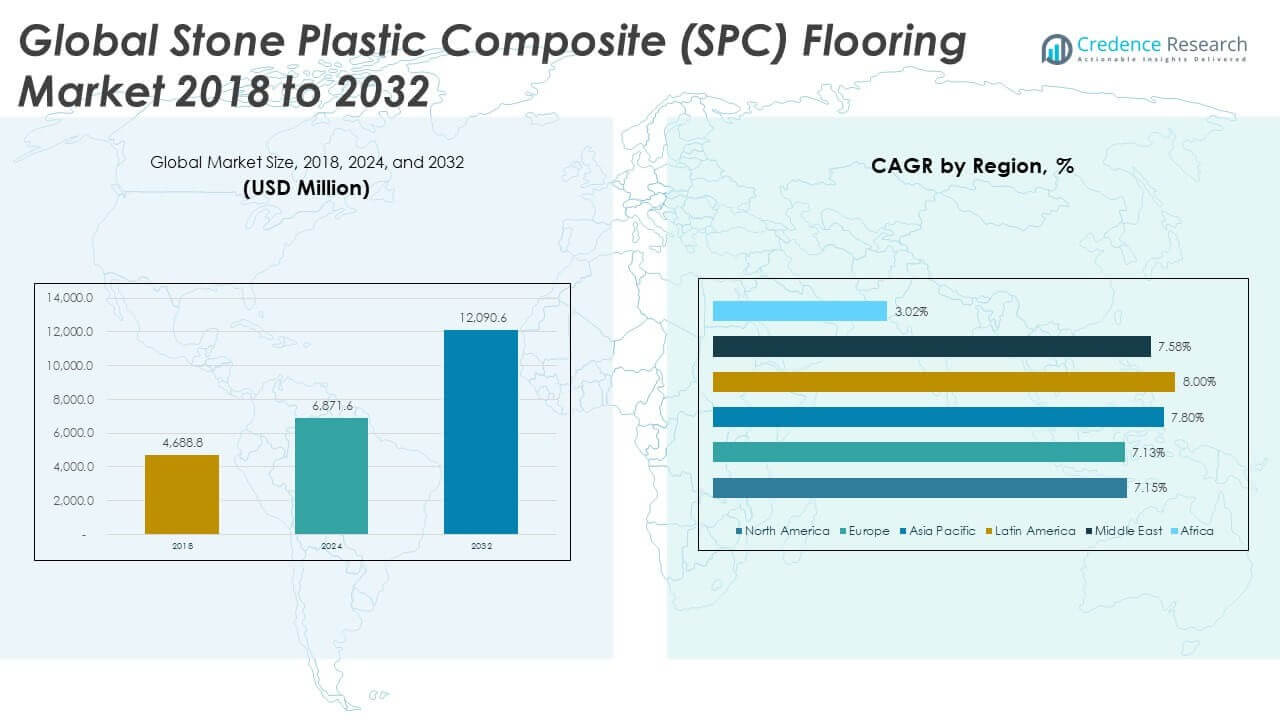
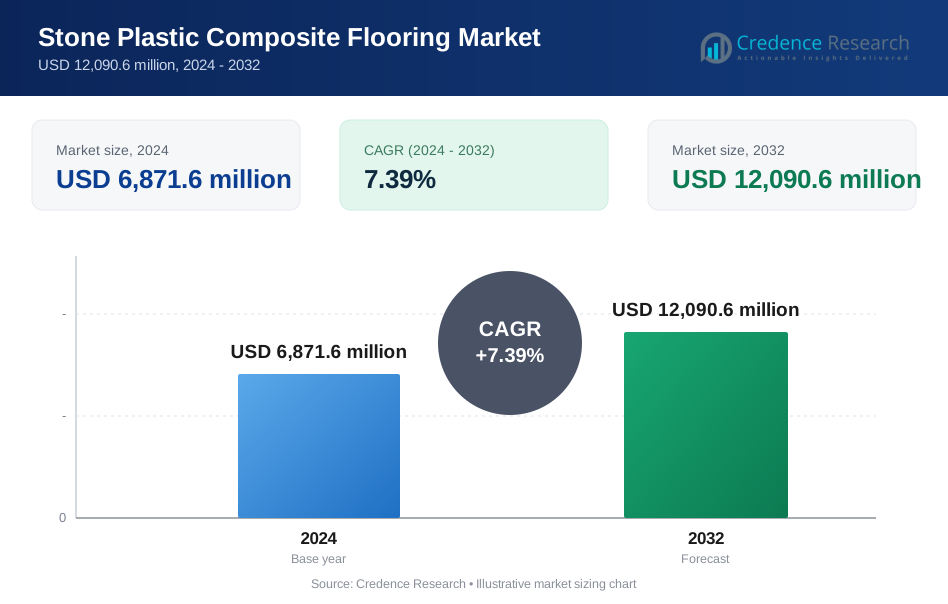
The Global Stone Plastic Composite (SPC) Flooring Market size was valued at USD 4,688.8 million in 2018 to USD 6,871.6 million in 2024 and is anticipated to reach USD 12,090.6 million by 2032, at a CAGR of 7.39% during the forecast period.
| REPORT ATTRIBUTE | DETAILS |
|---|---|
| Historical Period | 2020-2023 |
| Base Year | 2024 |
| Forecast Period | 2025-2032 |
| Stone Plastic Composite (SPC) Flooring Market Size 2024 | USD 6,871.6 million |
| Stone Plastic Composite (SPC) Flooring Market, CAGR | 7.39% |
| Stone Plastic Composite (SPC) Flooring Market Size 2032 | USD 12,090.6 million |
Growth is driven by rising demand for durable, low-maintenance, and waterproof flooring across residential, commercial, and institutional spaces. SPC flooring offers high dimensional stability, ease of installation, and realistic surface designs, which make it attractive for remodeling and new construction projects. Builders and property owners are shifting from traditional materials like laminate and ceramic tiles to SPC due to its better wear resistance and quick installation. Advancements in click-lock systems and rigid core structures improve both performance and visual appeal, supporting widespread adoption across urban housing and hospitality environments.
Asia Pacific leads the market due to strong construction activity, housing developments, and cost-effective manufacturing in China and India. North America and Europe show steady demand from renovation projects and preference for eco-compliant materials. The Middle East is growing rapidly with demand from hospitality and commercial real estate. Latin America and Africa are emerging markets, supported by urbanization, rising awareness, and gradual retail network expansion. Regional growth varies based on infrastructure development, product accessibility, and consumer preferences.
Market Insights:
- The Global Stone Plastic Composite (SPC) Flooring Market was valued at USD 4,688.8 million in 2018, reached USD 6,871.6 million in 2024, and is expected to hit USD 12,090.6 million by 2032, growing at a CAGR of 7.39%.
- Asia Pacific led the market in 2024 with a 33.46% share, followed by Europe at 26.61% and North America at 23.78%, driven by construction activity, renovation demand, and sustainability adoption.
- Latin America is the fastest-growing region with a CAGR of 8.00%, supported by urbanization, rising home renovation activity, and distribution expansion in Brazil and Mexico.
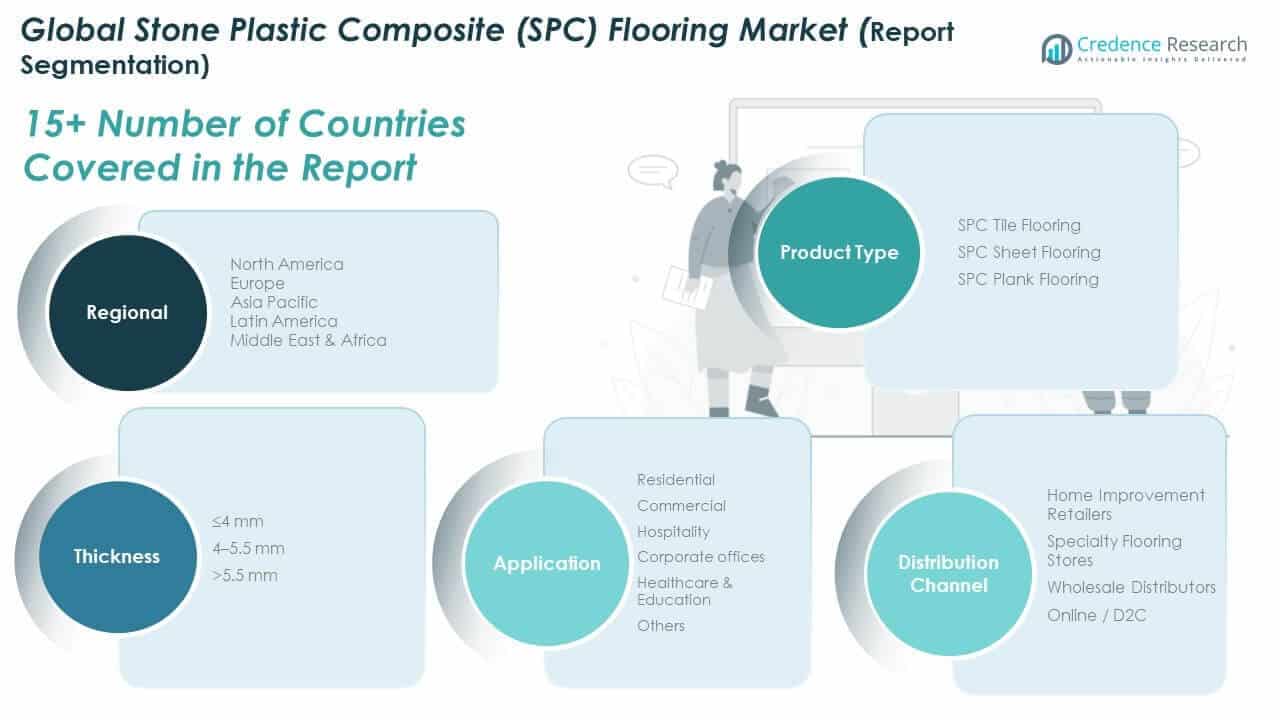
- In 2024, SPC plank flooring accounted for the highest share among product types, driven by consumer preference for wood-look finishes and ease of installation.
- SPC sheet flooring held the second-highest share due to seamless design needs in healthcare and education, while tile flooring served niche segments focused on modular replacement.
Market Drivers
Rising Demand for Durable and Moisture-Resistant Flooring Across End-Use Sectors
The Global Stone Plastic Composite (SPC) Flooring Market benefits from rising demand for long-lasting flooring solutions. Homeowners prefer durable surfaces that resist scratches and stains. Commercial users select SPC flooring for heavy footfall areas. Moisture resistance supports use in kitchens and bathrooms. The rigid core structure improves dimensional stability. Property owners value long product life and reduced replacement needs. Builders trust consistent performance across climate conditions. These factors strengthen adoption across residential and commercial projects.
- For instance, Mohawk Industries offers its SolidTech SPC range with up to 20 mil wear layer protection and a waterproof rigid core, which has shown 30% better indentation resistance compared to traditional vinyl.
Growing Construction and Renovation Activity in Urban Housing Projects
Urban housing growth supports steady demand for modern flooring products. Renovation activity increases across apartments and individual homes. SPC flooring suits retrofit projects due to thin profiles. Easy installation shortens renovation timelines. Developers favor standardized flooring solutions for large housing clusters. Cost control remains a key factor for mass housing projects. SPC flooring meets budget and performance needs. Urban lifestyle upgrades continue to support market demand.
Preference for Low-Maintenance Flooring in Commercial Spaces
Commercial property owners seek flooring with minimal upkeep needs. SPC flooring requires simple cleaning practices. Surface durability reduces repair frequency. Retail stores value uniform appearance over long periods. Office spaces prefer noise-reducing underlay compatibility. Hospitality venues use SPC flooring for quick room turnaround. Facility managers favor predictable maintenance costs. These benefits drive steady adoption across commercial sectors.
- For instance, Gerflor’s Creation 70 Clic System provides a 0.7 mm wear layer and has been installed across over 2,000 hotels and retail stores in Europe, reducing maintenance interventions by over 25% annually.
Shift Toward Cost-Effective Alternatives to Natural Flooring Materials
Natural wood and stone flooring face cost and availability limits. SPC flooring offers similar visual appeal at lower cost. Digital printing improves texture and pattern realism. Buyers value consistent quality across large areas. Supply stability supports bulk procurement. Transport and handling costs remain lower than stone products. SPC flooring reduces project budget risks. This shift supports long-term demand growth.
Market Trends
Increasing Adoption of Advanced Surface Textures and Visual Designs
Design innovation shapes current flooring preferences. Manufacturers introduce deeper embossing techniques. Surface textures replicate natural wood grain more closely. Matte finishes gain preference over glossy surfaces. Consumers value premium appearance at affordable prices. Designers specify SPC flooring for modern interiors. Product differentiation supports brand positioning. Visual upgrades influence buying decisions across segments.
Rising Focus on Click-Lock and Floating Floor Installation Systems
Click-lock systems gain traction across installation channels. Contractors prefer faster and cleaner installation methods. Floating floors reduce dependency on adhesives. Subfloor preparation requirements remain minimal. DIY users adopt SPC flooring for home projects. Installation flexibility expands end-user reach. Retailers promote ease of use as a selling point. This trend supports wider market penetration.
- For instance, Tarkett’s Starfloor Click Ultimate uses an angle-angle click system that reduces installation time by nearly 30% in residential units compared to glue-down methods, enhancing project efficiency.
Growing Use of SPC Flooring in Mixed-Use and Retail Developments
Mixed-use developments drive demand for uniform flooring solutions. Retail chains seek consistent branding across outlets. SPC flooring supports standardized design layouts. High wear resistance suits public access areas. Property developers prefer scalable flooring options. The material adapts to varied interior themes. Multi-location projects favor reliable supply. These factors increase adoption in complex developments.
Expansion of Product Lines Across Thickness and Wear Layer Options
Manufacturers expand product portfolios to meet diverse needs. Thicker cores support high-impact environments. Thinner options serve residential renovation projects. Wear layer customization improves performance matching. Buyers select products based on traffic levels. Distributors stock varied specifications for flexibility. Portfolio depth improves supplier competitiveness. This trend supports market maturity.
- For instance, Shaw Industries’ Floorte Pro 7 Series offers SPC planks in 6 mm and 8 mm thickness with 20 mil wear layers, tailored for both commercial zones and upscale residential applications.
Market Challenges Analysis
Price Sensitivity and Competition from Other Rigid Flooring Products
The Global Stone Plastic Composite (SPC) Flooring Market faces pricing pressure across regions. Buyers compare SPC flooring with laminate and LVT products. Cost-driven decisions affect premium product uptake. Local manufacturers intensify price competition. Import duties influence final pricing in some countries. Brand differentiation remains limited in low-cost segments. Retail margins face compression. These factors challenge consistent value realization.
Quality Variability and Limited Awareness in Emerging Markets
Product quality varies across suppliers and regions. Low-grade cores affect long-term performance. Limited awareness leads to incorrect product selection. Improper installation causes customer dissatisfaction. Training gaps exist among local installers. Certification standards vary by country. End-users struggle to assess product claims. These issues slow trust-building in developing markets.
Market Opportunities
Rising Demand from Hospitality and Institutional Infrastructure Projects
The Global Stone Plastic Composite (SPC) Flooring Market gains opportunity from hospitality expansion. Hotels seek durable and visually appealing flooring. Quick installation supports tight project timelines. Educational and healthcare facilities require hygienic surfaces. SPC flooring supports frequent cleaning needs. Government infrastructure spending creates steady demand. Large projects enable volume contracts. This segment offers long-term growth potential.
Expansion into Emerging Economies with Growing Urban Middle Class
Emerging economies present strong demand potential. Urban middle-class populations invest in home upgrades. Retail availability improves access to SPC flooring. Local partnerships strengthen distribution networks. Affordable product variants suit price-sensitive buyers. Housing development supports volume growth. Brand awareness continues to rise. These markets offer scalable expansion opportunities.
Market Segmentation Analysis:
By product type, SPC plank flooring leads demand due to its realistic wood-like appearance and strong consumer preference in residential spaces. SPC tile flooring follows in commercial and hospitality segments where uniform designs and ease of replacement are key. SPC sheet flooring finds niche applications in healthcare and education sectors due to its seamless surface and hygiene benefits.
By thickness, the 4–5.5 mm category dominates the Global Stone Plastic Composite (SPC) Flooring Market owing to its balance between cost and durability for both residential and commercial settings. The ≤4 mm segment caters to price-sensitive renovation projects, while >5.5 mm thickness targets high-traffic areas such as malls and public offices. It supports greater sound insulation and wear resistance.
- For instance, Shaw Industries’ Floorte Pro Series includes 6 mm and 7.5 mm SPC variants with 20 mil wear layers, optimized for high-traffic retail and public spaces where durability is critical.
By distribution channel, home improvement retailers capture the largest share through wide in-store availability and promotional campaigns. Specialty flooring stores serve niche and premium buyers seeking expert guidance. Wholesale distributors enable bulk supply to construction firms and contractors. Online and direct-to-consumer (D2C) platforms are expanding through DIY product demand and improved delivery networks.
- For instance, Floor & Decor, a major U.S. home improvement retailer, expanded its SPC flooring visibility across its warehouse-format stores and continues to invest in in-store design services to support consumer decision-making and improve product turnover in metropolitan markets.
By application, residential use remains dominant due to renovation activity, new housing, and rising awareness of SPC benefits. Commercial spaces like retail outlets and office complexes prefer it for its long wear life and low maintenance. Hospitality facilities choose SPC for design variety and quick installation. Corporate offices and institutions use it to standardize interiors. Healthcare and education settings prioritize hygiene and slip resistance. Other segments include industrial and mixed-use developments where SPC flooring offers practical and aesthetic advantages.
Segmentation:
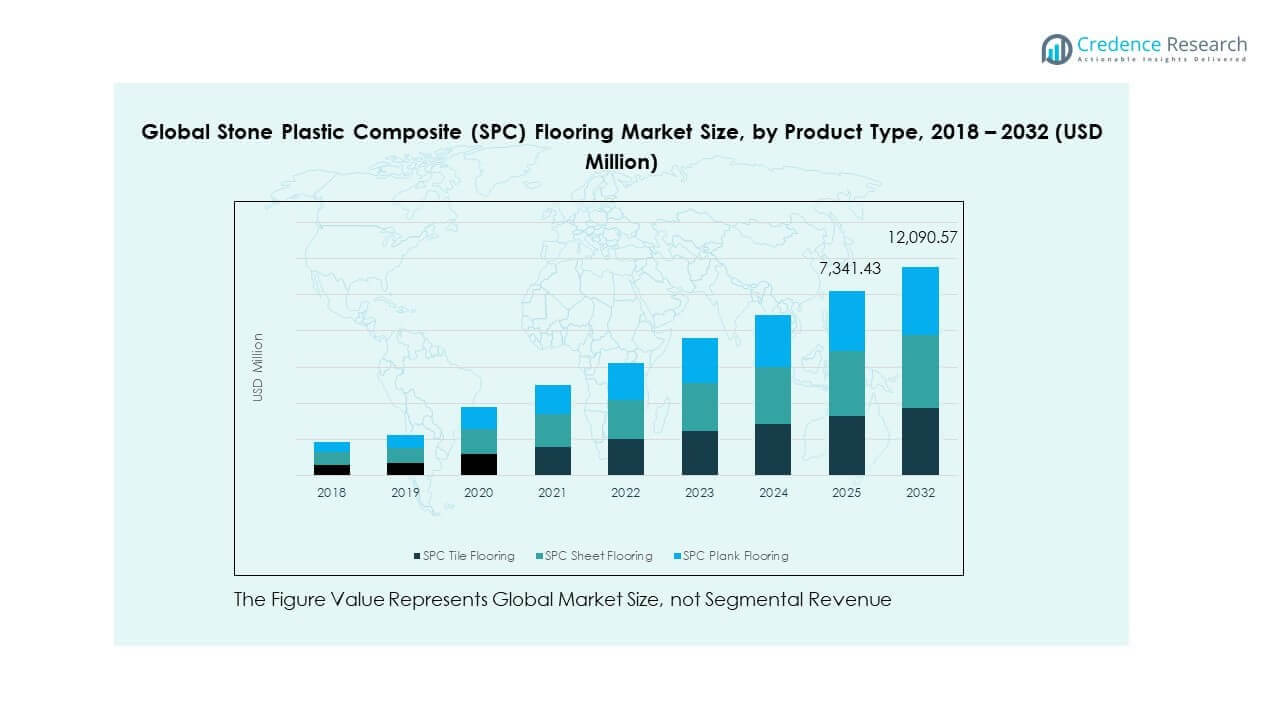
By Product Type
- SPC Tile Flooring
- SPC Sheet Flooring
- SPC Plank Flooring
By Thickness
- ≤4 mm
- 4–5.5 mm
- 5 mm
By Distribution Channel
- Home Improvement Retailers
- Specialty Flooring Stores
- Wholesale Distributors
- Online / Direct-to-Consumer (D2C)
By Application
- Residential
- Commercial
- Hospitality
- Corporate Offices
- Healthcare & Education
- Others
By Region
- North America (U.S., Canada, Mexico)
- Europe (UK, France, Germany, Italy, Spain, Russia, Rest of Europe)
- Asia Pacific (China, Japan, South Korea, India, Australia, Southeast Asia, Rest of APAC)
- Latin America (Brazil, Argentina, Rest of Latin America)
- Middle East (GCC, Israel, Turkey, Rest of ME)
- Africa (South Africa, Egypt, Rest of Africa)
Regional Analysis:
North America
The North America Global Stone Plastic Composite (SPC) Flooring Market size was valued at USD 1,130.46 million in 2018 to USD 1,635.54 million in 2024 and is anticipated to reach USD 2,827.99 million by 2032, at a CAGR of 7.15% during the forecast period. North America accounted for around 23.78% of the global market share in 2024. It maintains strong demand due to remodeling trends, durable flooring preferences, and widespread retail penetration. The U.S. leads regional sales, supported by residential upgrades and a preference for waterproof surfaces. Home improvement chains and D2C channels drive consumer access. Commercial adoption rises across hospitality and office spaces. Product innovation with textured designs supports premium segment growth. Environmental compliance and indoor air quality standards also influence product selection across states.
Europe
The Europe Global Stone Plastic Composite (SPC) Flooring Market size was valued at USD 1,265.97 million in 2018 to USD 1,828.82 million in 2024 and is anticipated to reach USD 3,155.64 million by 2032, at a CAGR of 7.13% during the forecast period. Europe held a 26.61% share of the global market in 2024. Regional growth is driven by eco-friendly construction practices and stringent building codes. Germany, the UK, and France lead adoption through residential renovations and sustainable product mandates. Demand in commercial interiors and education sectors continues to rise. Design aesthetics and acoustics play a key role in product selection. Distribution through specialty flooring stores supports tailored customer experiences. Companies focus on recycled content and emissions control in product design. Innovation in glue-free and click-lock systems enhances appeal.
Asia Pacific
The Asia Pacific Global Stone Plastic Composite (SPC) Flooring Market size was valued at USD 1,531.82 million in 2018 to USD 2,299.13 million in 2024 and is anticipated to reach USD 4,172.46 million by 2032, at a CAGR of 7.80% during the forecast period. It accounted for the largest market share of 33.46% in 2024. China leads due to massive construction activity and low-cost manufacturing. India, Southeast Asia, and South Korea contribute with growing urban middle-class demand. Real estate growth and retail expansion support volume sales. Builders adopt SPC for fast deployment and design flexibility. Local brands compete aggressively on price and availability. Export-focused production also supports regional growth. Government-backed infrastructure adds to institutional demand.
Latin America
The Latin America Global Stone Plastic Composite (SPC) Flooring Market size was valued at USD 410.74 million in 2018 to USD 623.74 million in 2024 and is anticipated to reach USD 1,148.60 million by 2032, at a CAGR of 8.00% during the forecast period. It represented a 9.09% share of the global market in 2024. Brazil and Mexico dominate regional sales through growing retail and commercial construction. Residential demand grows with changing lifestyle and interior preferences. Local distribution networks support home renovation trends. Builders prefer cost-effective, moisture-resistant solutions in urban housing. SPC's durability and easy installation suit quick turnaround projects. Limited awareness in remote areas restricts deeper penetration. Online retail channels are slowly emerging as viable platforms.
Middle East
The Middle East Global Stone Plastic Composite (SPC) Flooring Market size was valued at USD 224.12 million in 2018 to USD 332.00 million in 2024 and is anticipated to reach USD 592.44 million by 2032, at a CAGR of 7.58% during the forecast period. The region accounted for 4.83% of the global share in 2024. GCC countries lead market demand due to large-scale hospitality and retail developments. Flooring demand links closely to commercial interior upgrades and modern housing. SPC’s heat resistance and dimensional stability support use in regional climates. Developers use it for rapid deployment in hotels and mixed-use projects. Large showrooms and malls prefer uniform, easy-to-maintain surfaces. Dubai and Riyadh remain major urban demand hubs. Regulatory alignment with green building standards supports long-term product acceptance.
Africa
The Africa Global Stone Plastic Composite (SPC) Flooring Market size was valued at USD 125.66 million in 2018 to USD 152.35 million in 2024 and is anticipated to reach USD 193.45 million by 2032, at a CAGR of 3.02% during the forecast period. Africa represented just 2.22% of the global market in 2024. Growth remains limited but steady, supported by urbanization and small-scale construction. South Africa and Egypt lead regional demand with rising awareness of modern flooring options. SPC flooring attracts attention for moisture resistance and affordability. Renovation in schools and clinics supports institutional usage. High import dependence affects price competitiveness in several countries. Local retail presence is still developing. Market entry efforts by global brands are gradually increasing in key cities.
Key Player Analysis:
- Mohawk Industries
- Shaw Industries
- Armstrong Flooring
- Flooring Group
- Mannington Mills
- Kaka Industries Limited
- Tarkett
- Karndean Designflooring
- Gerflor
- Decno Floorings
- Other Key Players
Competitive Analysis:
The Global Stone Plastic Composite (SPC) Flooring Market features a mix of global and regional players competing on product innovation, distribution reach, and pricing. Mohawk Industries, Shaw Industries, and Tarkett lead the market with extensive portfolios and strong dealer networks. It attracts competition through demand for durable, low-maintenance flooring solutions across residential and commercial sectors. Companies focus on enhancing product textures, expanding click-lock technologies, and offering wider design options. New entrants and Asian manufacturers compete by offering cost-effective alternatives. Strategic moves include mergers, facility expansions, and partnerships with builders and retailers. Leading players invest in eco-certifications and digital printing capabilities to meet evolving customer expectations. Brand loyalty, supply reliability, and localized service remain key differentiators in high-volume markets. Market share shifts based on regional focus, channel strength, and response to material innovation. The competitive landscape continues to evolve with rising demand from emerging economies and shifting regulatory standards.
Recent Developments:
- In January 2026, Egypt inaugurated its first SPC flooring factory in Ain Sokhna. The Kamstone Advanced Industries facility, launched by the Prime Minister, will produce high-quality SPC flooring locally, supporting regional supply and reducing import reliance.
- In December 2025, i4F acquired Beaulieu International Group’s rigid core and LVT patent portfolio. i4F purchased more than 100 patents, strengthening its technology base for rigid-core and SPC flooring innovations and expanding its intellectual property assets in the global flooring industry.
- In August 2025, Korner partnered with DS Supplies to enter the Irish market with its SPeCtra SPC wall tiles. This agreement enables Korner to expand distribution of SPC-related products into Ireland through the new partner network.
- In May 2025, Milat Floor signed a drop-lock license agreement with i4F. Milat Floor will use the i4F drop-lock system in its new SPC flooring ranges, starting production at its facility and distributing the enhanced products globally.
Report Coverage:
The research report offers an in-depth analysis based on Product Type, Thickness, Distribution Channel, and Application. It details leading market players, providing an overview of their business, product offerings, investments, revenue streams, and key applications. Additionally, the report includes insights into the competitive environment, SWOT analysis, current market trends, as well as the primary drivers and constraints. Furthermore, it discusses various factors that have driven market expansion in recent years. The report also explores market dynamics, regulatory scenarios, and technological advancements that are shaping the industry. It assesses the impact of external factors and global economic changes on market growth. Lastly, it provides strategic recommendations for new entrants and established companies to navigate the complexities of the market.
Future Outlook:
- Rising demand for waterproof and scratch-resistant flooring will drive residential and commercial renovation activity.
- Innovation in surface textures and digital printing will enhance product appeal across mid to premium segments.
- Click-lock installation systems will gain traction due to ease of use and reduced labor dependency.
- SPC flooring adoption will grow in healthcare and education sectors for hygiene and safety compliance.
- Online and direct-to-consumer channels will expand reach, supported by DIY trends and home improvement.
- Emerging economies will contribute to volume growth through urbanization and housing expansion.
- Manufacturers will focus on product sustainability and low-emission materials to meet green building standards.
- Global players will continue expanding through regional partnerships, facility upgrades, and M&A strategies.
- Design uniformity needs in retail and hospitality chains will support large-scale commercial adoption.
- Import-export dynamics will shape pricing strategies and competitiveness in cost-sensitive regional markets.
Request a Free Sample
Fill in your details and we'll send you a free sample report.
- Sample data tables & charts
- Research methodology
Need a Custom Version of This Report?
Tailor the scope, geography, or segments to your exact requirements.
- Custom geography or segment scope
- Direct access to our analyst team
Frequently Asked Questions
What is the current market size for Global Stone Plastic Composite (SPC) Flooring Market, and what is its projected size in 2032?
At what Compound Annual Growth Rate is the Global Stone Plastic Composite (SPC) Flooring Market projected to grow between 2024 and 2032?
Which Global Stone Plastic Composite (SPC) Flooring Market segment held the largest share in 2024?
What are the primary factors fueling the growth of the Global Stone Plastic Composite (SPC) Flooring Market?
Who are the leading companies in the Global Stone Plastic Composite (SPC) Flooring Market?
Which region commanded the largest share of the Global Stone Plastic Composite (SPC) Flooring Market in 2024?
Table of Content
Chapter 1. Report Introduction
- 1.1 Report Description & Purpose
- 1.1.1 Report Title & Market Definition
- 1.1.2 Unique Selling Propositions (USP) & Key Differentiators
- 1.1.3 Value Proposition for Stakeholders
- 1.2 Research Objectives
- 1.2.1 Market Sizing Objectives (Volume & Revenue)
- 1.2.2 Segmentation Objectives
- 1.2.3 Competitive Intelligence Objectives
- 1.2.4 Forecast & Scenario Objectives
- 1.3 Report Scope
- 1.3.1 Stone Plastic Composite Flooring Scope – Types & Subtypes Covered
- 1.3.2 Geographic Scope – Regions & Countries Covered
- 1.3.3 Historical Period, Base Year & Forecast Period (2024; forecast to 2032)
- 1.3.4 Inclusions & Exclusions
- 1.4 HS Code & Classification Framework
- 1.5 Currency, Units & Pricing Basis
- 1.6 Target Stakeholders
- 1.7 Limitations & Assumptions
Chapter 2. Executive Summary
- 2.1 Global Stone Plastic Composite Flooring Market Snapshot
- 2.1.1 Market Size – Historical (2024) & Forecast (2024-2032) (2024: USD 6,871.6 million → 2032: USD 12,090.6 million)
- 2.1.2 Volume & Revenue – Global Totals
- 2.1.3 Key Market Highlights – Top Five Facts
- 2.2 Stone Plastic Composite Flooring Market Segmentation Snapshot
- 2.2.1 Market Split by Region – 2024 vs. 2032
- 2.3 Competitive Snapshot
- 2.3.1 Top 10 Players by Revenue Share – 2024
- 2.3.2 Top 10 Players by Volume Share – 2024
- 2.3.3 Recent Strategic Developments (18-Month Summary)
- 2.4 Key Investment Highlights & Strategic Conclusions
Chapter 3. Stone Plastic Composite Flooring Market Dynamics & Industry Analysis
- 3.1 Market Overview & Context
- 3.1.1 Stone Plastic Composite Flooring Market Position in the Broader Automotive Value Chain
- 3.1.2 OEM vs. Replacement Market Dynamics
- 3.1.3 Market Maturity & Development Stage by Region
- 3.2 Stone Plastic Composite Flooring Market Drivers
- 3.3 Stone Plastic Composite Flooring Market Restraints & Challenges
- 3.4 Stone Plastic Composite Flooring Market Opportunities
- 3.5 Porter's Five Forces Analysis
- 3.5.1 Threat of New Entrants
- 3.5.2 Bargaining Power of Suppliers
- 3.5.3 Bargaining Power of Buyers
- 3.5.4 Threat of Substitutes
- 3.5.5 Competitive Rivalry – Intensity Assessment
- 3.6 Stone Plastic Composite Flooring Value Chain Analysis
- 3.6.1 Upstream – Raw Material/Input Suppliers
- 3.6.1.1 Raw Material/Input 1
- 3.6.1.2 Raw Material/Input 2
- 3.6.1.3 Raw Material/Input 3
- 3.6.2 Midstream – Production/Manufacturing/Service Delivery
- 3.6.2.1 Production/Process Overview
- 3.6.2.2 Key Facility Locations & Capacity by Manufacturer
- 3.6.3 Downstream – Distribution & End Consumer
- 3.6.3.1 Primary Channel – B2B/OEM
- 3.6.3.2 Secondary Channels – Dealer, Retail, Online, Direct
- 3.6.4 Value Chain Profitability Analysis
- 3.6.1 Upstream – Raw Material/Input Suppliers
- 3.7 PESTEL Analysis
- 3.7.1 Political Factors
- 3.7.2 Economic Factors
- 3.7.3 Social Factors
- 3.7.4 Technological Factors
- 3.7.5 Environmental Factors
- 3.7.6 Legal Factors
- 3.8 Stone Plastic Composite Flooring Supply Chain Analysis
- 3.8.1 Raw Material/Input Supply Risk Assessment
- 3.8.2 Manufacturing Concentration Risk (Geographic Exposure)
- 3.8.3 Trade Disruption Impact Analysis
- 3.9 Regulatory & Policy Landscape
Note: The regulatory and policy landscape section covers regulations based on their applicability to the market, Stone Plastic Composite Flooring category, geography, and scope of the study. Only regulatory frameworks with a material impact on operations, compliance, trade, sustainability, or market access are analyzed in detail.
Chapter 4. Key Investment Pockets & Opportunity Analysis
- 4.1 Stone Plastic Composite Flooring Market Attractiveness Analysis
- 4.1.1 By Region – Investment Attractiveness Matrix (Volume × CAGR)
- 4.2 Absolute Revenue Growth Opportunity
- 4.2.1 By Region – Absolute USD Growth Through 2032
- 4.3 Incremental Volume Opportunity
- 4.3.1 By Region – Incremental Volume Through 2032
- 4.3.2 Segment – Incremental Volume
- 4.4 Emerging Submarket Opportunity Deep Dive (Subject to Applicability)
- 4.5 Emerging Market Opportunity Scorecards
- 4.5.1 United States
- 4.5.2 Europe
- 4.5.3 Asia
- 4.5.4 Middle East & Africa
Note: Emerging Market Opportunity Scorecards will be included based on relevance and strategic importance. Regions listed are indicative and may vary depending on data availability and market dynamics.
Chapter 5. Stone Plastic Composite Flooring Import-Export Analysis & Trade Flows
- 5.1 Global Trade Overview
- 5.1.1 Global Export Value by Country (2024)
- 5.1.2 Global Export Volume by Country (2024)
- 5.1.3 Global Import Value by Country (2024)
- 5.1.4 Global Import Volume by Country (2024)
- 5.1.5 Net Trade Balance by Country (2024)
- 5.2 Export Analysis – Segment
- 5.2.1 Type 1 (HS Code)
- 5.2.2 Type 2 (HS Code)
- 5.2.3 Type 3 (HS Code)
- 5.2.4 Type 4 (HS Code)
- 5.2.5 Type 5 (HS Code)
- 5.3 Import Analysis – Segment
- 5.3.1 Type 1 (HS Code)
- 5.3.2 Type 2 (HS Code)
- 5.3.3 Type 3 (HS Code)
- 5.3.4 Type 4 (HS Code)
- 5.3.5 Type 5 (HS Code)
- 5.4 Average Unit Trade Prices
- 5.4.1 Average Export Price – Segment & Country
- 5.4.2 Average Import Price – Segment & Source Country
- 5.4.3 Price Trends (2024)
- 5.5 Key Trade Route Analysis
- 5.5.1 Trade Route 1
- 5.5.2 Trade Route 2
- 5.5.3 Trade Route 3
- 5.5.4 Trade Route 4
- 5.5.5 Trade Route 5
- 5.6 Trade Policy Impact Assessment
- 5.6.1 US Anti-Dumping & Section 301 Tariffs
- 5.6.2 EU Customs Union Impact
- 5.6.3 Major Free Trade Agreements
- 5.6.4 USMCA Rules of Origin
Note: Trade policy analysis will be included only where relevant to the Stone Plastic Composite Flooring market.
Chapter 6. Competitive Landscape & Company Benchmarking
- 6.1 Stone Plastic Composite Flooring Market Concentration & Structure
- 6.1.1 Herfindahl-Hirschman Index (HHI) – vs. 2024
- 6.1.2 Tier 1, Tier 2 & Tier 3 Market Structure
- 6.1.3 Global, Regional & Local Player Dynamics
- 6.2 Stone Plastic Composite Flooring Market Share Analysis – 2024
- 6.2.1 Global Revenue Share by Company
- 6.2.2 Global Volume Share by Company
- 6.2.3 Regional Revenue Share
- 6.2.4 Market Share Evolution ( vs. 2024)
- 6.2.5 OEM Segment Share by Company
- 6.2.6 Replacement Segment Share by Company
- 6.3 Production/Delivery Capacity & Facility Analysis
- 6.3.1 Global Installed Capacity
- 6.3.2 Capacity Utilization Rates
- 6.3.3 Production/Output Volume
- 6.3.4 Facility Locations & Capacity Map
- 6.3.5 Planned Capacity Additions
- 6.4 Stone Plastic Composite Flooring Competitive Benchmarking Matrix
- 6.4.1 Revenue, Volume, CAGR & Profitability Comparison
- 6.4.2 Channel Revenue Mix
- 6.4.3 Geographic Revenue Exposure
- 6.4.4 R&D Intensity
- 6.4.5 Sustainability Maturity
- 6.5 Strategic Developments in Stone Plastic Composite Flooring (Last 24 Months)
- 6.5.1 Mergers, Acquisitions & Divestments
- 6.5.2 New Stone Plastic Composite Flooring Launches
- 6.5.3 Facility Expansions
- 6.5.4 Strategic Alliances, Joint Ventures & Partnerships
- 6.5.5 Distribution Expansion & Market Entry
- 6.5.6 Sustainability & ESG Initiatives
- 6.6 Competitive Strategy Mapping
- 6.6.1 Leader, Challenger, Follower & Niche Classification
- 6.6.2 Pricing Strategy Comparison
- 6.6.3 Channel Strategy Matrix
Note: Strategic developments are included based on their materiality and the availability of reliable information.
Chapter 7. Global Stone Plastic Composite Flooring Market – By Distribution Channel
- 7.1 Segment Overview
- 7.1.1 Volume & Revenue Split by Channel (2024 & 2032)
- 7.1.2 Channel Mix Evolution (2024-2032)
Chapter 8. Regional Market Analysis – Global Overview
- 8.1 Global Regional Overview
- 8.1.1 Regional Volume Share
- 8.1.2 Regional Revenue Share
- 8.1.3 Regional Volume by Region
- 8.1.4 Regional Revenue by Region
- 8.1.5 Regional Forecast Through 2032
- 8.2 Cross-Regional Segment Analysis
- 8.2.1 By Distribution Channel
- 8.2.2 By Brand/Price Tier
Chapter 9. North America Stone Plastic Composite Flooring Market
- 9.1 United States
- 9.2 Canada
- 9.3 Mexico
Chapter 10. Europe Stone Plastic Composite Flooring Market
- 10.1 Germany
- 10.2 France
- 10.3 Italy
- 10.4 United Kingdom
- 10.5 Spain
- 10.6 Poland
- 10.7 Russia
- 10.8 Netherlands
- 10.9 Belgium
- 10.10 Sweden
- 10.11 Denmark
- 10.12 Norway
- 10.13 Rest of Europe
Chapter 11. Asia Pacific Stone Plastic Composite Flooring Market
- 11.1 China
- 11.2 India
- 11.3 Japan
- 11.4 South Korea
- 11.5 Thailand
- 11.6 Indonesia
- 11.7 Vietnam
- 11.8 Malaysia
- 11.9 Australia
- 11.10 Rest of Asia Pacific
Chapter 12. Latin America Stone Plastic Composite Flooring Market
- 12.1 Brazil
- 12.2 Argentina
- 12.3 Colombia
- 12.4 Chile
- 12.5 Rest of Latin America
Chapter 13. Middle East Stone Plastic Composite Flooring Market
- 13.1 Saudi Arabia
- 13.2 United Arab Emirates
- 13.3 Turkey
- 13.4 Israel
- 13.5 Iran
- 13.6 Rest of the Middle East
Chapter 14. Africa Stone Plastic Composite Flooring Market
- 14.1 South Africa
- 14.2 Egypt
- 14.3 Nigeria
- 14.4 Morocco
- 14.5 Rest of Africa
Chapter 15. Stone Plastic Composite Flooring Company Profiles
- 15.1 [Company 01]
- 15.1.1 Company Overview
- 15.1.2 Key Management Personnel
- 15.1.3 Products & Services Portfolio
- 15.1.4 Financial Performance
- 15.1.5 Key Market Focus & Geographic Presence
- 15.1.6 Recent Developments & Strategic Initiatives
Note: The company profile list is preliminary and may change based on research findings, market developments, data availability, and client requirements.
Chapter 16. Appendices
- Appendix A – List of Abbreviations & Acronyms
- Appendix B – Industry Classification Code Reference – Full Series
- Appendix C – Production & Capacity Data Tables
- Appendix D – End-Use & Demand Base Tables
- Appendix E – Consumption & Replacement Rate Assumptions
- Appendix F – ASP Reference Tables
- Appendix G – Manufacturing & Facility Database
- Appendix H – Import-Export Data Tables
- Appendix I – Regulatory Summary Tables
- Appendix J – Primary Research Participant List (Anonymized)
- Appendix K – Primary Research Questionnaire Framework
- Appendix L – Data Sources & Bibliography
- Appendix M – Market Size Divergence & Source Comparison
Chapter 17. Research Methodology
- 17.1 Research Framework & Philosophy
- 17.2 Secondary Research – Sources, Hierarchy & Data Extraction
- 17.3 Data Modeling – Bottom-Up & Top-Down Market Sizing
- 17.4 Primary Research – Stakeholder Framework, LOI & Sample Sizes
- 17.5 Forecast Methodology – Regression, Scenario & Sensitivity Analysis
- 17.6 Quality Control – Four-Layer Validation Framework
- 17.7 Limitations & Standard Assumptions
- 17.8 Disclaimer
