
Central Nervous System Stimulant Drugs Market Overview:
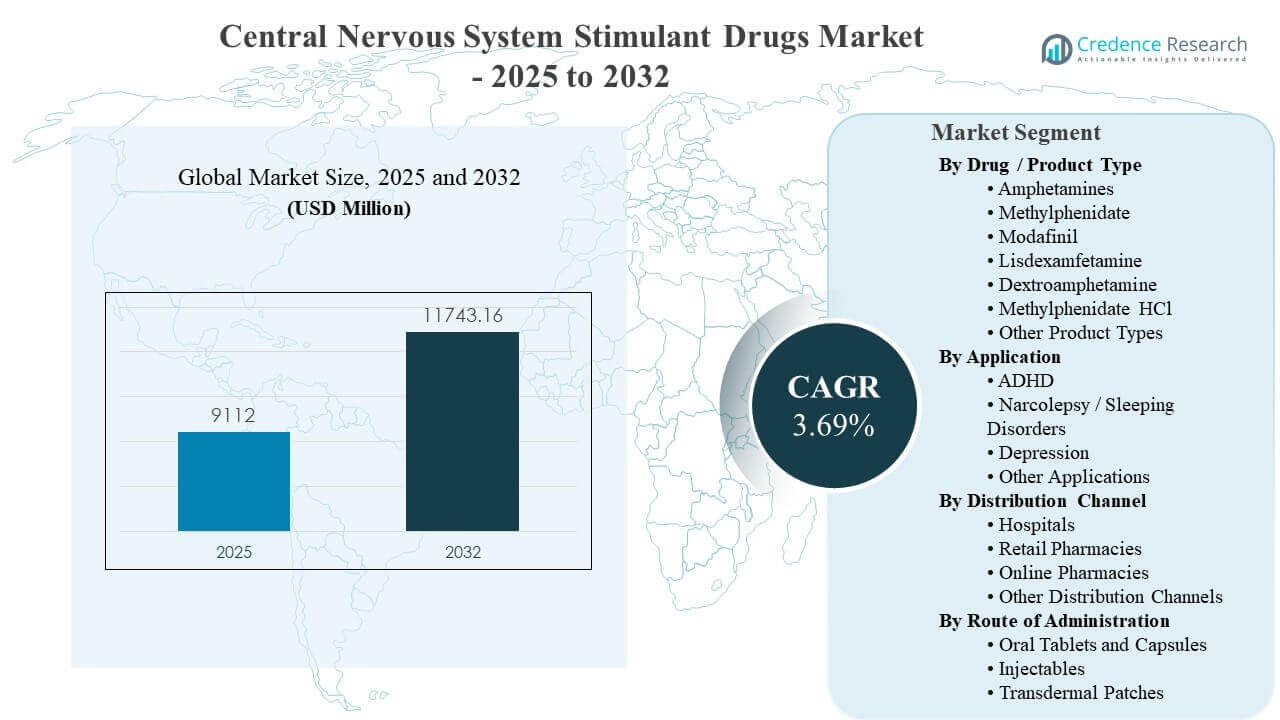
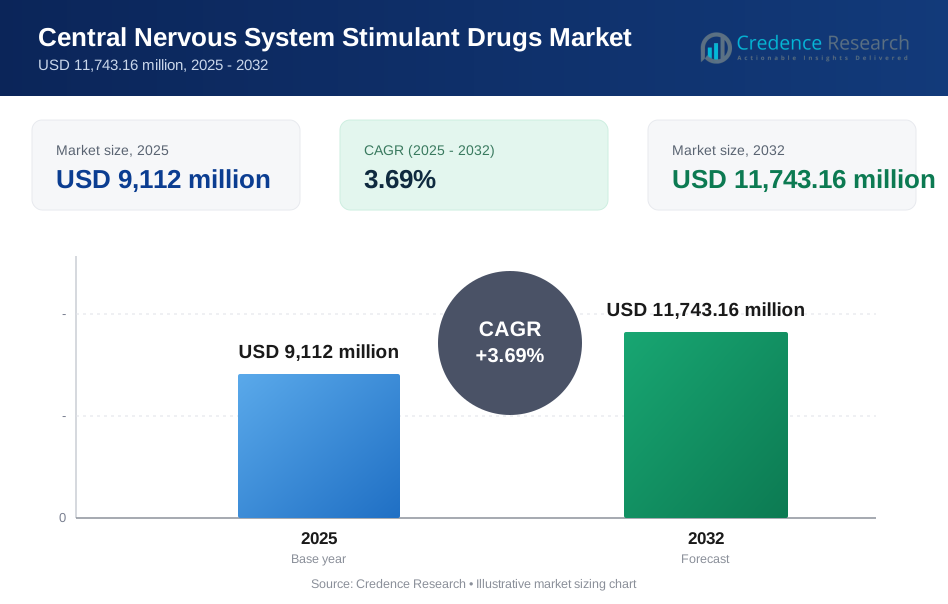
The global Central Nervous System Stimulant Drugs Market size was estimated at USD 9,112 million in 2025 and is expected to reach USD 11,743.16 million by 2032, growing at a CAGR of 3.69% from 2025 to 2032. Demand is primarily shaped by sustained prescribing of stimulant therapies for attention-deficit hyperactivity disorder across pediatric and adult care pathways, supported by long-acting formulations and structured titration protocols that improve symptom control during school and work hours. Market expansion also reflects wider diagnosis and follow-up access enabled by digitally supported care models, alongside continued product lifecycle activity that protects franchise value in core molecules and delivery formats.
| REPORT ATTRIBUTE | DETAILS |
|---|---|
| Historical Period | 2020-2024 |
| Base Year | 2025 |
| Forecast Period | 2026-2032 |
| Central Nervous System Stimulant Drugs Market Size 2025 | USD 9,112 million |
| Central Nervous System Stimulant Drugs Market, CAGR | 3.69% |
| Central Nervous System Stimulant Drugs Market Size 2032 | USD 11,743.16 million |
Key Market Trends & Insights
- North America represented 41.3% share in 2025, reflecting strong diagnosis density and mature controlled-substance dispensing infrastructure.
- Asia Pacific reached 25.4% share in 2025, supported by expanding access to specialist care and rising awareness in high-population countries.
- Amphetamines led product-type demand with 41.7% share in 2025, reflecting broad clinical use and multiple branded and generic options.
- ADHD accounted for 63.4% share in 2025, positioning ADHD as the dominant application driver for stimulant prescribing volumes.
- Oral tablets and capsules held 89.1% share in 2025, reinforcing oral delivery as the standard route across long-term therapy.
Segment Analysis
Central Nervous System Stimulant Drugs Market segment performance is anchored in high-volume, chronic-use indications where clinical guidelines and payer frameworks favor established stimulant options with predictable efficacy and manageable titration. Prescription continuity is reinforced by extended-release formats, school-to-workday coverage expectations, and care pathways that include regular monitoring for dose optimization and safety management. Channel dynamics reflect the operational realities of controlled-substance dispensing, refill workflows, and verification steps that shape patient access.
Patient and prescriber decision-making is increasingly influenced by tolerability profiles, adherence convenience, and the ability to tailor dosing to daily functional needs. Formulation differentiation, including extended-release and alternative delivery formats, supports switching and persistence in therapy when symptom control or administration constraints emerge. Supply availability, enforcement intensity, and monitoring expectations can also shift demand across molecules and delivery options, particularly when shortages or policy changes affect preferred products.
By Drug / Product Type Insights
Amphetamines accounted for the largest share of 41.7% in 2025. Amphetamine-class products benefit from wide clinical familiarity, broad availability across branded and generic portfolios, and multiple extended-release options that fit structured daily schedules. Prescribing momentum is strengthened by established response patterns in ADHD management and flexibility across dose strengths. Formulation variety also supports clinician customization when balancing onset, duration, and tolerability across age groups.
By Application Insights
ADHD accounted for the largest share of 63.4% in 2025. ADHD treatment volumes remain elevated due to sustained screening and diagnosis activity across pediatrics and growing recognition in adult populations. Long-term disease management frameworks promote follow-up visits, dose titration, and continuity of prescriptions that stabilize annual demand. Care delivery improvements that streamline consultation and refill processes further reinforce treated-patient persistence within ADHD therapy pathways.
By Distribution Channel Insights
Retail Pharmacies accounted for the largest share of 58.2% in 2025. Retail dispensing remains central due to widespread geographic reach, established controlled-substance handling procedures, and integrated e-prescribing workflows that reduce friction for refills. Pharmacy networks also support continuity through inventory management, prior authorization support, and patient counseling services. Local access convenience and routine refill cadence make retail settings the most consistent channel for maintenance therapy.
By Route of Administration Insights
Oral Tablets and Capsules accounted for the largest share of 89.1% in 2025. Oral delivery dominates because oral dosing aligns with long-term outpatient therapy and supports once-daily extended-release regimens. Oral formats also simplify titration, reduce administration burden, and fit standardized prescribing practices in ADHD and sleep-related disorders. Transdermal options address specific administration barriers but remain niche, and injectable use is typically limited to supervised or acute contexts.
Central Nervous System Stimulant Drugs Market Drivers
Expanding Diagnosis And Long-Term Management Of ADHD
Central Nervous System Stimulant Drugs Market growth is driven by sustained ADHD diagnosis activity and long-term treatment pathways that require ongoing prescription continuity. Pediatric screening programs, school performance concerns, and structured follow-up practices sustain demand for stimulant options. Adult ADHD recognition increases the treated population and extends therapy duration. Long-acting formulations support daily functional coverage, which improves adherence and reinforces prescription persistence across clinical settings.
- For instance, Shire’s VYVANSE label update was supported by a randomized, double-blind, placebo-controlled classroom study in 129 children aged 6 to 12 years, where ADHD symptom control was significant from 1.5 hours through 13 hours post-dose, reinforcing its use in long-duration daily management.
Product Differentiation Through Extended-Release And Alternative Formulations
Central Nervous System Stimulant Drugs Market expansion benefits from formulation innovation that improves dosing convenience and reduces symptom rebound risk. Extended-release technologies support once-daily regimens and improve usability for patients with busy schedules. Alternative formats, including liquids and patches, broaden addressable groups with swallowing challenges or adherence constraints. Portfolio refresh activity also supports brand resilience and competitive positioning across mature stimulant molecules.
- For instance, Tris Pharma’s DYANAVEL XR combines a 2.5 mg/mL extended-release oral suspension with 5 mg, 10 mg, 15 mg, and 20 mg tablet options, and its Phase 3 pediatric study showed statistically significant ADHD symptom improvement from 1 hour through 13 hours after once-daily dosing.
Infrastructure For Controlled-Substance Prescribing And Dispensing
Central Nervous System Stimulant Drugs Market demand is supported by established prescribing, verification, and dispensing infrastructure in mature healthcare systems. E-prescribing, pharmacy workflows, and insurer checks enable predictable access while maintaining compliance expectations. Routine monitoring and refill cadence create stable purchasing patterns in outpatient care. Structured protocols also reduce interruptions, supporting consistent utilization levels even as oversight and documentation requirements evolve.
Broader Clinical Use Across Sleep And Mood-Related Needs
Central Nervous System Stimulant Drugs Market momentum is reinforced by stimulant use across narcolepsy and other sleep-related disorders where wakefulness support remains a clinical priority. Modafinil-class agents and other stimulants address functional needs in selected patient populations. Specialty care pathways and improved recognition of sleep disorders expand treated cohorts. Adjunct use considerations in complex mood or fatigue presentations can also contribute to incremental demand.
Central Nervous System Stimulant Drugs Market Challenges
Central Nervous System Stimulant Drugs Market faces persistent challenges from misuse risk, diversion concerns, and tightening oversight that can constrain prescribing flexibility. Controlled-substance compliance increases documentation burden across clinicians and pharmacies, affecting access speed and follow-up cadence. Safety monitoring expectations around cardiovascular and psychiatric side effects can drive conservative titration practices. Policy shifts and enforcement variability across jurisdictions can also create regional swings in prescribing and dispensing.
Central Nervous System Stimulant Drugs Market performance is also influenced by supply reliability, including shortages that disrupt continuity for patients stabilized on specific formulations. Inventory constraints can trigger forced switching, reduced adherence, and temporary therapy gaps. Competitive pressure from generics limits pricing flexibility and increases the need for differentiation through formulation or service support. Reimbursement friction and prior authorization requirements can further slow therapy initiation and product uptake.
- For instance, Ironshore’s JORNAY PM uses delayed-release and extended-release bead technology in which no more than 5% of methylphenidate becomes available within the first 10 hours after an evening dose, the median Tmax is 14.0 hours, and relative bioavailability is 73.9% versus the same total daily dose of immediate-release methylphenidate given three times daily, demonstrating a formulation-level differentiation strategy in a market pressured by generic substitution and product switching.
Central Nervous System Stimulant Drugs Market Trends and Opportunities
Central Nervous System Stimulant Drugs Market opportunities are expanding through differentiated dosage forms that address administration barriers and improve persistence in therapy. Liquid formulations, once-daily extended-release designs, and tailored release profiles create room for premium positioning in targeted patient groups. Patient support programs and adherence tools can strengthen outcomes and reduce discontinuation. Portfolio strategies that emphasize tolerability, predictable coverage, and simplified dosing can capture switching demand.
Central Nervous System Stimulant Drugs Market trends also include more structured treatment journeys supported by digital follow-up workflows and standardized monitoring. Data-driven titration support and routine symptom tracking improve medication optimization. Expansion of specialist access in emerging markets can raise diagnosis rates and broaden therapy penetration. Partnerships that improve supply resilience and broaden dispensing access can also lift continuity and stabilize product availability across regions.
- For instance, Tris Pharma’s Quillivant ER received its first ex-US authorization in Canada for children aged 6 to 12 as a once-daily methylphenidate oral suspension and chewable tablet, and the product has demonstrated onset as soon as 45 minutes with efficacy through 12 hours post-dose, highlighting how formulation flexibility and regional commercialization partnerships can improve treatment continuity and dispensing access.
Regional Insights
North America
North America held 41.3% share in 2025, reflecting high diagnosis rates, strong specialist density, and mature reimbursement and pharmacy infrastructure. Controlled-substance dispensing workflows are well established, supporting repeat prescription patterns and consistent utilization. Long-acting formulations and structured follow-up practices strengthen adherence across pediatric and adult cohorts. Market activity is also shaped by formulary management, supply availability, and active lifecycle strategies across branded and generic portfolios.
Europe
Europe accounted for 26.1% share in 2025, supported by established healthcare systems and structured prescribing practices. National guidelines and reimbursement frameworks influence product selection, favoring consistent therapy pathways for diagnosed patients. Monitoring expectations and access differences across countries shape utilization variability. Growth is supported by sustained demand in ADHD and sleep-related disorders, alongside steady penetration of extended-release options.
Asia Pacific
Asia Pacific reached 25.4% share in 2025, driven by expanding diagnosis capability, rising awareness, and improving access to specialty care in large populations. Urban healthcare expansion and broader availability of branded and generic options support market participation. Regulatory and prescribing controls vary widely, creating uneven penetration across countries. Growth potential remains strong where clinical training, pharmacy access, and monitoring systems continue to develop.
Latin America
Latin America represented 4.9% share in 2025, reflecting more limited specialist access and uneven diagnostic coverage across countries. Access constraints, reimbursement variability, and controlled-substance regulations can restrict therapy continuity. Private-sector channels often play a larger role in access for diagnosed patients. Expansion opportunities depend on improved screening, clearer prescribing pathways, and stronger distribution reliability.
Middle East & Africa
Middle East & Africa held 2.3% share in 2025, shaped by varying healthcare infrastructure and uneven specialist availability. Demand is concentrated in markets with stronger private healthcare penetration and more developed pharmacy systems. Regulatory controls and access pathways influence prescribing pace and refill consistency. Market expansion depends on improved diagnosis capacity, trained clinicians, and reliable supply availability.
Competitive Landscape
Central Nervous System Stimulant Drugs Market competition is characterized by a mix of established pharmaceutical portfolios, specialty-focused formulation players, and broad generic manufacturers. Differentiation is driven by release profiles, administration formats, supply reliability, and payer access strategies. Companies compete through lifecycle management, selective innovation in delivery platforms, and channel execution in controlled-substance dispensing environments. Partnerships, acquisitions, and product line expansions support portfolio breadth and market reach.
Ironshore Pharmaceuticals Inc. competes through differentiated ADHD-focused products and commercialization strategies that emphasize dosing timing, adherence convenience, and patient-specific regimen needs. Portfolio positioning focuses on sustaining demand in high-volume ADHD pathways and defending share through product differentiation and channel execution. Market participation is strengthened by relationships across prescribers and pharmacies that support ongoing refill cadence. Strategic portfolio actions can further extend reach across adjacent CNS therapy needs.
The industry research and growth report includes detailed analyses of the competitive landscape of the market and information about key companies, including:
- Ironshore Pharmaceuticals Inc.
- Novartis AG
- Takeda Pharmaceutical Co. Ltd.
- Azurity Pharmaceuticals, Inc.
- Noven Therapeutics, LLC
- Janssen Pharmaceuticals Inc.
- Elite Pharmaceuticals Inc.
- KemPharm Inc.
- Adlon Therapeutics LP
- Jazz Pharmaceuticals Plc
- Hisamitsu Pharmaceutical Co. Inc.
- Teva Pharmaceutical Industries Ltd.
- Tris Pharma Inc.
- Viatris Inc.
Qualitative and quantitative analysis of companies has been conducted to help clients understand the wider business environment as well as the strengths and weaknesses of key industry players. Data is qualitatively analyzed to categorize companies as pure play, category-focused, industry-focused, and diversified; it is quantitatively analyzed to categorize companies as dominant, leading, strong, tentative, and weak.
Recent Developments
- In March 2026, Collegium Pharmaceutical and Corium Therapeutics announced a definitive agreement under which Collegium will acquire AZSTARYS for $650 million in cash, with potential additional milestone payments of up to $135 million. AZSTARYS is a CNS stimulant prescription medicine for ADHD, and the companies said the acquisition is expected to strengthen Collegium’s position in the ADHD market and close in the second quarter of 2026, subject to customary approvals.
- In May 2025, Cingulate replaced its earlier joint commercialization agreement with Indegene with a master services agreement for commercialization support of CTx-1301 in the United States. Cingulate’s filing says Indegene can support marketing, market access, pricing, and commercial operations for CTx-1301, which earlier company disclosures described as a once-daily stimulant medication being developed for ADHD.
- In April 2025, Glenmark Pharmaceuticals Inc., USA announced the upcoming launch of dextroamphetamine saccharate, amphetamine aspartate, dextroamphetamine sulfate, and amphetamine sulfate tablets in 5 mg, 10 mg, 15 mg, 20 mg, and 30 mg strengths, with distribution scheduled to begin in May 2025. These mixed amphetamine salts tablets are bioequivalent and therapeutically equivalent to Adderall tablets, making this a notable new product launch in the ADHD stimulant segment.
Report Scope
| Report Attribute | Details |
| Market size value in 2025 | USD 9112 million |
| Revenue forecast in 2032 | USD 11743.16 million by 2032 |
| Growth rate (CAGR) | 3.69% (2025–2032) |
| Base year | 2025 |
| Forecast period | 2026-2032 |
| Quantitative units | USD million |
| Segments covered | By Drug / Product Type Outlook: Amphetamines, Methylphenidate, Modafinil, Lisdexamfetamine, Dextroamphetamine, Methylphenidate HCl, Other Product Types; By Application Outlook: ADHD, Narcolepsy / Sleeping Disorders, Depression, Other Applications; By Distribution Channel Outlook: Hospitals, Retail Pharmacies, Online Pharmacies, Other Distribution Channels; By Route of Administration Outlook: Oral Tablets and Capsules, Injectables, Transdermal Patches |
| Regional scope | North America, Europe, Asia Pacific, Latin America, Middle East & Africa |
| Key companies profiled | Ironshore Pharmaceuticals Inc.; Novartis AG; Takeda Pharmaceutical Co. Ltd.; Azurity Pharmaceuticals, Inc.; Noven Therapeutics, LLC; Janssen Pharmaceuticals Inc.; Elite Pharmaceuticals Inc.; KemPharm Inc.; Adlon Therapeutics LP; Jazz Pharmaceuticals Plc; Hisamitsu Pharmaceutical Co. Inc.; Teva Pharmaceutical Industries Ltd.; Tris Pharma Inc.; Viatris Inc. |
| No. of Pages | 336 |
Segmentation
By Drug / Product Type
- Amphetamines
- Methylphenidate
- Modafinil
- Lisdexamfetamine
- Dextroamphetamine
- Methylphenidate HCl
- Other Product Types
By Application
- ADHD
- Narcolepsy / Sleeping Disorders
- Depression
- Other Applications
By Distribution Channel
- Hospitals
- Retail Pharmacies
- Online Pharmacies
- Other Distribution Channels
By Route of Administration
- Oral Tablets and Capsules
- Injectables
- Transdermal Patches
By Region
- North America
- U.S.
- Canada
- Mexico
- Europe
- Germany
- France
- U.K.
- Italy
- Spain
- Rest of Europe
- Asia Pacific
- China
- Japan
- India
- South Korea
- South-east Asia
- Rest of Asia Pacific
- Latin America
- Brazil
- Argentina
- Rest of Latin America
- Middle East & Africa
- GCC Countries
- South Africa
- Rest of the Middle East and Africa
Request a Free Sample
Fill in your details and we'll send you a free sample report.
- Sample data tables & charts
- Research methodology
Need a Custom Version of This Report?
Tailor the scope, geography, or segments to your exact requirements.
- Custom geography or segment scope
- Direct access to our analyst team
Frequently Asked Questions
What is the market size of the Central Nervous System Stimulant Drugs Market in 2025 and the forecast for 2032?
What is the CAGR for the Central Nervous System Stimulant Drugs Market during 2025–2032?
Which segment holds the largest share in the market?
What factors are driving growth in the Central Nervous System Stimulant Drugs Market?
Who are the leading companies operating in this market?
Which region leads the market in 2025?
Table of Content
Chapter 1. Report Introduction
- 1.1 Report Description & Purpose
- 1.1.1 Report Title & Market Definition
- 1.1.2 Unique Selling Propositions (USP) & Key Differentiators
- 1.1.3 Value Proposition for Stakeholders
- 1.2 Research Objectives
- 1.2.1 Market Sizing Objectives (Volume & Revenue) (Volume Where Applicable)
- 1.2.2 Segmentation Objectives
- 1.2.3 Competitive Intelligence Objectives
- 1.2.4 Forecast & Scenario Objectives
- 1.3 Report Scope
- 1.3.1 Central Nervous System Stimulant Drugs Scope – Segments & Subsegments Covered
- 1.3.2 Geographic Scope – Regions & Countries Covered
- 1.3.3 Historical Period, Base Year & Forecast Period (2025; forecast to 2032)
- 1.3.4 Inclusions & Exclusions
- 1.4 Industry Classification & Applicable Codes
- 1.5 Currency, Measurement Units & Valuation Basis
- 1.6 Target Stakeholders
- 1.7 Limitations & Assumptions
Chapter 2. Executive Summary
- 2.1 Global Central Nervous System Stimulant Drugs Market Snapshot
- 2.1.1 Market Size – Historical (2025) & Forecast (2025-2032) (2025: USD 9,112 million → 2032: USD 11,743.16 million)
- 2.1.2 Volume & Revenue – Global Totals (Volume Where Applicable)
- 2.1.3 Key Market Highlights – Top Five Facts
- 2.2 Central Nervous System Stimulant Drugs Market Segmentation Snapshot
- 2.2.1 Market Split by Region – 2025 vs. 2032
- 2.3 Competitive Snapshot
- 2.3.1 Top 10 Players by Revenue Share – 2025
- 2.3.2 Top 10 Players by Volume Share – 2025 (Volume Where Applicable)
- 2.3.3 Recent Strategic Developments (18-Month Summary)
- 2.4 Key Investment Highlights & Strategic Conclusions
Chapter 3. Central Nervous System Stimulant Drugs Market Dynamics & Industry Analysis
- 3.1 Market Overview & Context
- 3.1.1 Central Nervous System Stimulant Drugs Market Position in the Broader Industry Value Chain
- 3.1.2 Demand Structure & Purchasing Dynamics
- 3.1.3 Market Maturity & Development Stage by Region
- 3.2 Central Nervous System Stimulant Drugs Market Drivers
- 3.3 Central Nervous System Stimulant Drugs Market Restraints & Challenges
- 3.4 Central Nervous System Stimulant Drugs Market Opportunities
- 3.5 Porter's Five Forces Analysis
- 3.5.1 Threat of New Entrants
- 3.5.2 Bargaining Power of Suppliers
- 3.5.3 Bargaining Power of Buyers
- 3.5.4 Threat of Substitutes
- 3.5.5 Competitive Rivalry – Intensity Assessment
- 3.6 Central Nervous System Stimulant Drugs Value Chain Analysis
- 3.6.1 Upstream – Key Inputs, Resources & Suppliers
- 3.6.1.1 Key Input/Resource 1
- 3.6.1.2 Key Input/Resource 2
- 3.6.1.3 Key Input/Resource 3
- 3.6.2 Midstream – Core Operations & Value Creation
- 3.6.2.1 Operating Model & Process Overview
- 3.6.2.2 Key Operating Locations & Capabilities by Company
- 3.6.3 Downstream – Market Channels & End Users
- 3.6.3.1 Direct Sales & Customer Engagement Channels
- 3.6.3.2 Indirect Sales, Intermediaries & Partner Channels
- 3.6.4 Value Chain Profitability Analysis
- 3.6.1 Upstream – Key Inputs, Resources & Suppliers
- 3.7 PESTEL Analysis
- 3.7.1 Political Factors
- 3.7.2 Economic Factors
- 3.7.3 Social Factors
- 3.7.4 Technological Factors
- 3.7.5 Environmental Factors
- 3.7.6 Legal Factors
- 3.8 Central Nervous System Stimulant Drugs Supply Chain Analysis
- 3.8.1 Critical Input & Resource Availability Risk Assessment
- 3.8.2 Supplier & Operational Concentration Risk (Geographic Exposure)
- 3.8.3 Supply & Service Disruption Impact Analysis
- 3.9 Regulatory & Policy Landscape
Note: The regulatory and policy landscape section covers regulations based on their applicability to the market, Central Nervous System Stimulant Drugs category, geography, and scope of the study. Only regulatory frameworks with a material impact on operations, compliance, trade, sustainability, or market access are analyzed in detail.
Chapter 4. Key Investment Pockets & Opportunity Analysis
- 4.1 Central Nervous System Stimulant Drugs Market Attractiveness Analysis
- 4.1.1 By Region – Investment Attractiveness Matrix (Market Size × CAGR)
- 4.2 Absolute Revenue Growth Opportunity
- 4.2.1 By Region – Absolute Revenue Growth Through 2032
- 4.3 Incremental Demand Opportunity
- 4.3.1 By Region – Incremental Demand Through 2032
- 4.3.2 Segment – Incremental Demand
- 4.4 Emerging Submarket Opportunity Deep Dive (Subject to Applicability)
- 4.5 Priority Market Opportunity Scorecards
- 4.5.1 United States
- 4.5.2 Europe
- 4.5.3 Asia
- 4.5.4 Middle East & Africa
Note: Priority market opportunity scorecards reflect the geographic scope and strategic relevance of the study. Listed markets are indicative and may be adapted to the industry.
Chapter 5. Central Nervous System Stimulant Drugs Cross-Border Trade & Market Access Analysis
- 5.1 International Trade & Cross-Border Activity Overview
- 5.1.1 Global Export Value by Country (2025)
- 5.1.2 Global Export Volume by Country (2025) (Volume Where Applicable)
- 5.1.3 Global Import Value by Country (2025)
- 5.1.4 Global Import Volume by Country (2025) (Volume Where Applicable)
- 5.1.5 Net Trade Balance by Country (2025)
- 5.2 Export Analysis – Segment
- 5.2.1 Category 1 (Applicable Classification Code)
- 5.2.2 Category 2 (Applicable Classification Code)
- 5.2.3 Category 3 (Applicable Classification Code)
- 5.2.4 Category 4 (Applicable Classification Code)
- 5.2.5 Category 5 (Applicable Classification Code)
- 5.3 Import Analysis – Segment
- 5.3.1 Category 1 (Applicable Classification Code)
- 5.3.2 Category 2 (Applicable Classification Code)
- 5.3.3 Category 3 (Applicable Classification Code)
- 5.3.4 Category 4 (Applicable Classification Code)
- 5.3.5 Category 5 (Applicable Classification Code)
- 5.4 Cross-Border Pricing & Transaction Benchmarks
- 5.4.1 Export Pricing – Segment & Country
- 5.4.2 Import Pricing – Segment & Source Country
- 5.4.3 Price Trends (2025)
- 5.5 Key Cross-Border Trade & Delivery Routes
- 5.5.1 Cross-Border Trade/Delivery Route 1
- 5.5.2 Cross-Border Trade/Delivery Route 2
- 5.5.3 Cross-Border Trade/Delivery Route 3
- 5.5.4 Cross-Border Trade/Delivery Route 4
- 5.5.5 Cross-Border Trade/Delivery Route 5
- 5.6 Trade Policy & Market Access Impact Assessment
- 5.6.1 Tariff & Non-Tariff Barriers
- 5.6.2 Regional Trade & Economic Integration Frameworks
- 5.6.3 Bilateral & Multilateral Trade Agreements
- 5.6.4 Cross-Border Operating, Licensing & Localization Requirements
Note: This chapter applies where cross-border trade or delivery is relevant to Central Nervous System Stimulant Drugs. Goods, services, and digital offerings are assessed using applicable classifications and transaction measures. Import-export volumes, trade balances, and route analyses are included only where meaningful to the market.
Chapter 6. Competitive Landscape & Company Benchmarking
- 6.1 Central Nervous System Stimulant Drugs Market Concentration & Structure
- 6.1.1 Herfindahl-Hirschman Index (HHI) – vs. 2025
- 6.1.2 Leading, Mid-Sized & Emerging Player Structure
- 6.1.3 Global, Regional & Local Player Dynamics
- 6.2 Central Nervous System Stimulant Drugs Market Share Analysis – 2025
- 6.2.1 Global Revenue Share by Company
- 6.2.2 Global Volume Share by Company (Volume Where Applicable)
- 6.2.3 Regional Revenue Share
- 6.2.4 Market Share Evolution ( vs. 2025)
- 6.2.5 Company Market Share by Key Segment
- 6.2.6 Company Market Share by Customer Group
- 6.3 Operating Scale, Capacity & Infrastructure Analysis
- 6.3.1 Global Operating Scale & Supply Capacity
- 6.3.2 Resource Utilization & Operating Efficiency
- 6.3.3 Output, Service Delivery & Activity Metrics
- 6.3.4 Operating Footprint & Infrastructure Map
- 6.3.5 Planned Operational & Capacity Expansion
- 6.4 Central Nervous System Stimulant Drugs Competitive Benchmarking Matrix
- 6.4.1 Revenue, Growth, Profitability & Operating Metric Comparison
- 6.4.2 Channel Revenue Mix
- 6.4.3 Geographic Revenue Exposure
- 6.4.4 R&D Intensity
- 6.4.5 Sustainability Maturity
- 6.5 Strategic Developments in Central Nervous System Stimulant Drugs (Last 24 Months)
- 6.5.1 Mergers, Acquisitions & Divestments
- 6.5.2 New Products, Services & Solutions in Central Nervous System Stimulant Drugs
- 6.5.3 Operational & Infrastructure Expansions
- 6.5.4 Strategic Alliances, Joint Ventures & Partnerships
- 6.5.5 Distribution Expansion & Market Entry
- 6.5.6 Sustainability & ESG Initiatives
- 6.6 Competitive Strategy Mapping
- 6.6.1 Leader, Challenger, Follower & Niche Classification
- 6.6.2 Pricing Strategy Comparison
- 6.6.3 Channel Strategy Matrix
Note: Strategic developments are included based on their materiality and the availability of reliable information.
Chapter 7. Global Central Nervous System Stimulant Drugs Market – By Sales & Delivery Channel
- 7.1 Segment Overview
- 7.1.1 Volume & Revenue Split by Channel (2025 & 2032) (Volume Where Applicable)
- 7.1.2 Channel Mix Evolution (2025-2032)
Chapter 8. Regional Market Analysis – Global Overview
- 8.1 Global Regional Overview
- 8.1.1 Regional Volume Share (Volume Where Applicable)
- 8.1.2 Regional Revenue Share
- 8.1.3 Regional Volume by Region (Volume Where Applicable)
- 8.1.4 Regional Revenue by Region
- 8.1.5 Regional Forecast Through 2032
- 8.2 Cross-Regional Segment Analysis
- 8.2.1 By Sales & Delivery Channel
- 8.2.2 By Competitive Positioning & Price Tier
Chapter 9. North America Central Nervous System Stimulant Drugs Market
- 9.1 United States
- 9.2 Canada
- 9.3 Mexico
Chapter 10. Europe Central Nervous System Stimulant Drugs Market
- 10.1 Germany
- 10.2 France
- 10.3 Italy
- 10.4 United Kingdom
- 10.5 Spain
- 10.6 Poland
- 10.7 Russia
- 10.8 Netherlands
- 10.9 Belgium
- 10.10 Sweden
- 10.11 Denmark
- 10.12 Norway
- 10.13 Rest of Europe
Chapter 11. Asia Pacific Central Nervous System Stimulant Drugs Market
- 11.1 China
- 11.2 India
- 11.3 Japan
- 11.4 South Korea
- 11.5 Thailand
- 11.6 Indonesia
- 11.7 Vietnam
- 11.8 Malaysia
- 11.9 Australia
- 11.10 Rest of Asia Pacific
Chapter 12. Latin America Central Nervous System Stimulant Drugs Market
- 12.1 Brazil
- 12.2 Argentina
- 12.3 Colombia
- 12.4 Chile
- 12.5 Rest of Latin America
Chapter 13. Middle East Central Nervous System Stimulant Drugs Market
- 13.1 Saudi Arabia
- 13.2 United Arab Emirates
- 13.3 Turkey
- 13.4 Israel
- 13.5 Iran
- 13.6 Rest of the Middle East
Chapter 14. Africa Central Nervous System Stimulant Drugs Market
- 14.1 South Africa
- 14.2 Egypt
- 14.3 Nigeria
- 14.4 Morocco
- 14.5 Rest of Africa
Chapter 15. Central Nervous System Stimulant Drugs Company Profiles
- 15.1 [Company 01]
- 15.1.1 Company Overview
- 15.1.2 Key Management Personnel
- 15.1.3 Products & Services Portfolio
- 15.1.4 Financial Performance
- 15.1.5 Key Market Focus & Geographic Presence
- 15.1.6 Recent Developments & Strategic Initiatives
Note: The company profile list is preliminary and may change based on research findings, market developments, data availability, and client requirements.
Chapter 16. Appendices
- Appendix A – List of Abbreviations & Acronyms
- Appendix B – Industry Classification Code Reference – Full Series
- Appendix C – Supply, Output & Operating Capacity Data Tables
- Appendix D – End-Use & Demand Base Tables
- Appendix E – Demand, Adoption & Usage Assumptions
- Appendix F – Pricing & Revenue Metric Reference Tables
- Appendix G – Company Operations & Infrastructure Database
- Appendix H – Cross-Border Trade & Activity Data Tables (Where Applicable)
- Appendix I – Regulatory Summary Tables
- Appendix J – Primary Research Participant List (Anonymized)
- Appendix K – Primary Research Questionnaire Framework
- Appendix L – Data Sources & Bibliography
- Appendix M – Market Size Divergence & Source Comparison
Chapter 17. Research Methodology
- 17.1 Research Framework & Philosophy
- 17.2 Secondary Research – Sources, Hierarchy & Data Extraction
- 17.3 Data Modeling – Bottom-Up & Top-Down Market Sizing
- 17.4 Primary Research – Stakeholder Framework, LOI & Sample Sizes
- 17.5 Forecast Methodology – Regression, Scenario & Sensitivity Analysis
- 17.6 Quality Control – Four-Layer Validation Framework
- 17.7 Limitations & Standard Assumptions
- 17.8 Disclaimer
