
Vitamin K Market Overview:
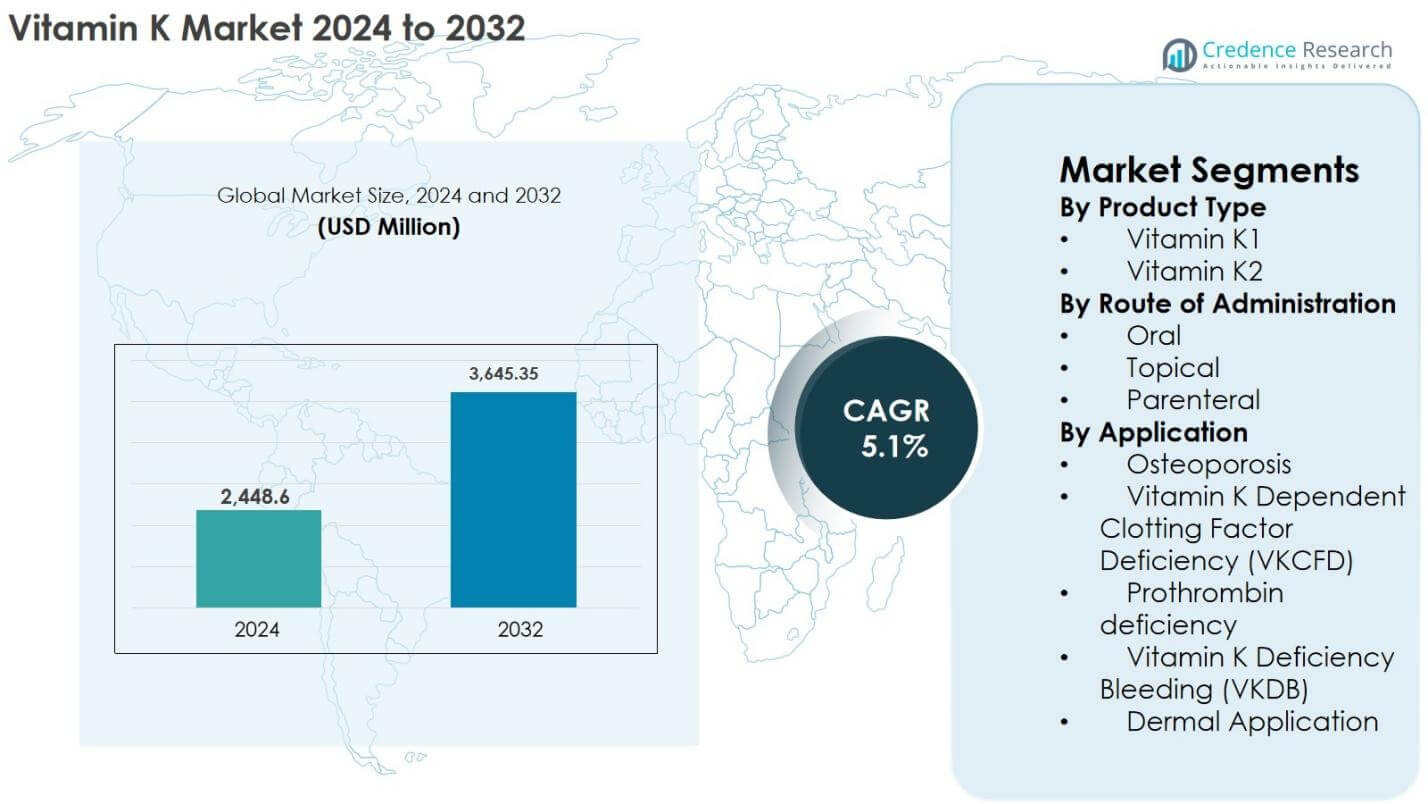
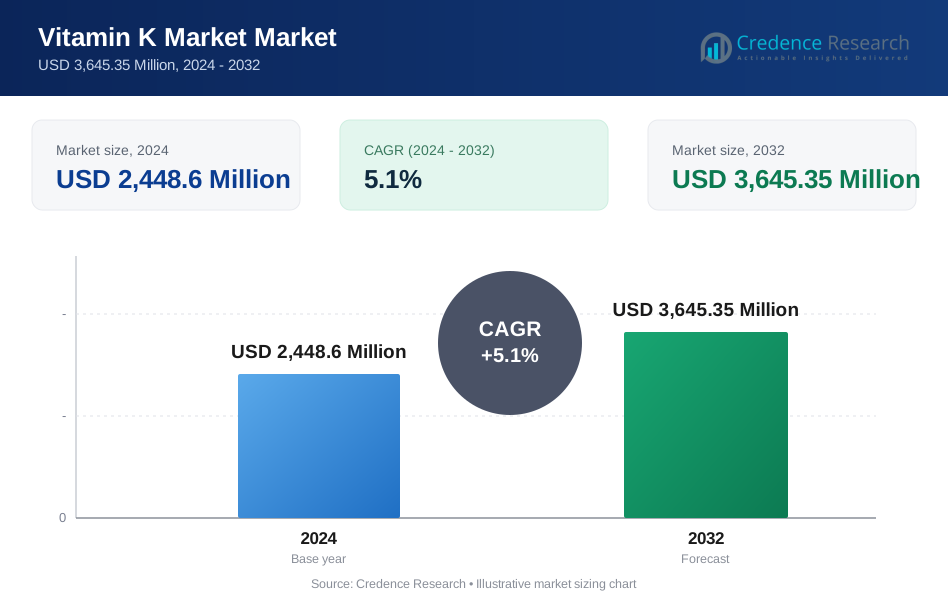
Vitamin K market size was valued USD 2,448.6 Million in 2024 and is anticipated to reach USD 3,645.35 Million by 2032, at a CAGR of 5.1% during the forecast period.
| REPORT ATTRIBUTE | DETAILS |
|---|---|
| Historical Period | 2020-2023 |
| Base Year | 2024 |
| Forecast Period | 2025-2032 |
| Vitamin K Market Size 2024 | USD 2,448.6 million |
| Vitamin K Market, CAGR | 5.1% |
| Vitamin K Market Size 2032 | USD 3,645.35 million |
Vitamin K Market Insights
- Market growth is driven by rising prevalence of osteoporosis and cardiovascular disorders, increasing adoption of preventive healthcare, and strong demand for Vitamin K2 supplements, with the Vitamin K2 segment holding 56.8% share and the oral delivery route leading with 64.2% share in 2024.
- Market trends include expanding nutraceutical and fortified food applications, greater clinical validation for K2 bioavailability, and growing integration of Vitamin K in bone health, pediatrics, and metabolic wellness formulations across global consumer health sectors.
- Competitive landscape is shaped by global leaders focusing on high-purity ingredients, fermentation-based K2 production, product innovation, and partnerships across pharmaceutical and dietary supplement industries to strengthen presence in both mature and emerging markets.
- Regional analysis shows North America leading with 32.6% share in 2024, followed by Europe at 29.4% and Asia-Pacific at 23.8% with the fastest growth, while Latin America and Middle East & Africa account for 7.6% and 6.6% shares respectively.
Vitamin K Market Segmentation Analysis:
By Product Type
The Vitamin K market by product type is led by Vitamin K2, which accounts for 56.8% market share in 2024, making it the dominant sub-segment. Growth is driven by rising adoption in osteoporosis management, cardiovascular health supplements, and functional nutrition, along with increasing awareness of K2’s superior bioavailability compared to K1. Expanding use in nutraceutical formulations, growing clinical validation, and stronger penetration across dietary supplements and fortified foods further support demand. Vitamin K1 continues to play a role in deficiency treatment and medical therapies, but its growth is slower due to the market shift toward K2-based products.
- For instance, NattoPharma’s MenaQ7 (vitamin K2 as MK-7) has been used in randomized clinical trials showing improvements in bone mineral density and arterial stiffness in postmenopausal women over 3 years.
By Route of Administration
The market by route of administration is dominated by the oral segment, representing 64.2% market share in 2024, supported by strong use of capsules, tablets, and fortified food supplements. Growth is fueled by ease of administration, better patient compliance, and rising consumer adoption of preventive healthcare worldwide. The expansion of e-commerce nutraceutical channels and the growing preference for self-care supplements also accelerate market growth. Topical administration is gaining traction in dermatology and cosmetics, while parenteral delivery remains crucial in hospital-based treatments for acute vitamin K deficiency and neonatal care applications.
- For instance, Nestlé’s infant nutrition portfolio and hospital-use products include vitamin K in oral formulations to support pediatric nutrition and deficiency prevention in line with clinical guidelines.
By Application
In terms of application, Osteoporosis is the dominant sub-segment with 38.5% market share in 2024, driven by the aging population, increasing fracture risk, and greater clinical acceptance of Vitamin K2 for improving bone mineral density. Rising post-menopausal osteoporosis incidence and the strong integration of vitamin K in bone health nutraceutical products further boost demand. Other significant application areas include Vitamin K Deficiency Bleeding (VKDB), Prothrombin deficiency, and VKCFD, supported by increasing therapeutic adoption and awareness in medical care, while dermal application continues to expand in cosmetic and skincare formulations.
Key Growth Drivers
Rising Prevalence of Bone and Joint Disorders
The Vitamin K market grows significantly due to the increasing prevalence of osteoporosis, osteopenia, and age-related bone degeneration, particularly among the elderly and post-menopausal women. Clinicians increasingly recommend Vitamin K2 for improving bone mineral density and reducing fracture risk, which strengthens its integration into bone health supplements and orthopedic nutrition therapies. The global shift toward preventive healthcare and proactive nutrition further accelerates supplement adoption as consumers prioritize long-term skeletal strength. Increased awareness of Vitamin K’s synergistic role with calcium and Vitamin D also supports formulation innovation in nutraceuticals and fortified food products. Growing research validating K2’s impact on bone metabolism and the expansion of geriatric populations across Asia-Pacific, Europe, and North America continue to reinforce demand, making bone health management one of the strongest long-term growth drivers for the Vitamin K market.
- For instance, NattoPharma has published clinical data on its MenaQ7 vitamin K2 showing improvements in bone mineral content and reduced bone loss in postmenopausal women over 3 years.
Expanding Applications in Cardiovascular and Metabolic Health
Vitamin K’s therapeutic relevance in cardiovascular health is emerging as a powerful growth catalyst, supported by clinical evidence linking K2 intake with reduced arterial calcification and improved vascular elasticity. Rising cases of cardiovascular disorders, lifestyle diseases, and metabolic syndromes have increased consumer and clinical interest in Vitamin K-based preventive therapies. Nutraceutical manufacturers are increasingly incorporating K2 into heart-health supplement portfolios, while pharmaceutical players explore its adjunct use in chronic disease management. Growing awareness among healthcare professionals and consumers about Vitamin K-dependent proteins involved in calcium regulation strengthens market acceptance. Additionally, its integration into functional foods, personalized nutrition, and preventive wellness programs enhances accessibility and consumption. This expanding therapeutic scope beyond bone health positions Vitamin K as a multifunctional micronutrient with strong market growth potential across healthcare and wellness ecosystems.
- For instance, Kappa Bioscience’s K2VITAL is widely used in cardiovascular-focused nutraceuticals that combine vitamin K2 with vitamin D3 and omega-3 fatty acids, reflecting strong demand for comprehensive heart-health formulations in Europe and North America.
Rising Adoption of Nutraceuticals and Fortified Foods
The global shift toward health-focused lifestyles and preventive nutrition strongly supports Vitamin K market expansion. Consumers increasingly adopt nutraceutical supplements, fortified dairy products, beverages, and dietary formulations enriched with Vitamin K for everyday wellness benefits. The rapid growth of e-commerce, direct-to-consumer supplement brands, and personalized nutrition platforms accelerates product accessibility and market penetration. Manufacturers invest in clean-label, plant-derived, and bio-optimized Vitamin K2 formulations to meet evolving consumer preferences, especially in premium health supplement categories. Government initiatives promoting micronutrient enrichment and nutritional security in emerging economies further stimulate fortified food applications. Rising disposable incomes, growing awareness of micronutrient deficiencies, and lifestyle-driven health consciousness collectively strengthen market volumes. As preventive nutrition becomes mainstream, Vitamin K-based supplements and fortified products continue to gain significant traction across global consumer health markets.
Key Trends & Opportunities
Increasing Focus on Clinical Research and Product Innovation
A major trend shaping the Vitamin K market is the surge in clinical research focused on understanding its role in bone, cardiovascular, neurological, and metabolic health pathways. Ongoing studies supporting K2’s superior bioavailability and physiological benefits create strong opportunities for advanced formulations and pharmaceutical-grade innovations. Manufacturers increasingly invest in microencapsulation, sustained-release delivery systems, vegan-fermented K2, and synergistic blends with Vitamin D and calcium to enhance therapeutic efficiency. The growing demand for science-backed nutraceuticals encourages product premiumization and differentiation. Regulatory approvals and expanding health claim recognition further strengthen market credibility. Partnerships between dietary supplement companies, research institutions, and biotechnology firms enable pipeline expansion and novel application development. This innovation-driven landscape positions Vitamin K as an evolving functional ingredient with significant long-term commercialization opportunities across healthcare, nutrition, and wellness sectors.
- For instance, Gnosis by Lesaffre’s vitaMK7, produced via bio-fermentation, is featured in high-purity, vegan vitamin K2 ingredients used in synergistic blends with vitamin D3 and calcium for bone and heart health supplements.
Emerging Demand in Pediatrics, Cosmetics, and Preventive Healthcare
Expanding applications beyond traditional therapeutic segments create new opportunities for market growth. In pediatrics, Vitamin K remains essential for neonatal care and deficiency-related bleeding prevention, supporting sustained pharmaceutical demand. The increasing inclusion of Vitamin K in skincare and cosmetic formulations—particularly for wound healing, scar reduction, and skin barrier strengthening—drives growth in the dermal and cosmeceutical space. Preventive healthcare adoption in developing economies further boosts supplement uptake among health-conscious consumers and aging populations. Opportunities also emerge in sports nutrition, personalized health programs, and functional beverages. Market expansion is supported by rising healthcare awareness campaigns, improved accessibility to supplements, and the growing acceptance of micronutrient-based wellness routines. These emerging segments collectively diversify revenue streams and strengthen the broader commercial potential of the Vitamin K market.
- For instance, cosmetic brands market topical vitamin K creams and gels for post-procedure bruising and under-eye discoloration, reflecting growing dermato-cosmetic interest in vitamin K–based formulations.
Key Challenges
Regulatory Variations and Standardization Barriers
Regulatory inconsistencies across regions present a major challenge to Vitamin K market expansion. Differences in health claim approvals, supplement classification rules, dosage limits, and pharmaceutical labeling standards create operational complexities for manufacturers operating across global markets. Lengthy approval timelines for nutraceutical and therapeutic formulations further slow product commercialization. Limited harmonization between food-grade and pharmaceutical regulatory frameworks also affects innovation speed and product positioning strategies. Additionally, varying quality control requirements and compliance obligations increase production and certification costs for suppliers. These regulatory barriers make market entry difficult for emerging brands while restraining large-scale expansion initiatives. Overcoming standardization issues remains essential for ensuring global market scalability, transparent product claims, and long-term industry growth.
Supply Chain Constraints and Limited Consumer Awareness
The Vitamin K market faces challenges related to raw material availability, fermentation costs, and concentration of key producers, particularly in Vitamin K2 production. Fluctuations in supply chain stability and manufacturing costs may impact pricing and profitability. In many developing markets, consumer awareness of Vitamin K’s benefits remains limited compared to more widely recognized micronutrients such as Vitamin D or calcium, leading to lower adoption rates. Misconceptions regarding supplementation needs and lack of clinical education among healthcare providers also hinder market penetration. Competitive pressure from substitute nutritional therapies further challenges category growth. Addressing awareness gaps through education initiatives, affordability strategies, and broader distribution networks will be critical for unlocking full market potential and sustaining long-term demand.
Regional Analysis
North America
North America holds a leading position in the Vitamin K market with a 32.6% market share in 2024, driven by strong adoption of nutraceutical supplements, fortified food products, and pharmaceutical-grade formulations. The region benefits from high consumer awareness of bone and cardiovascular health, rising geriatric demographics, and widespread preventive healthcare practices. The presence of major dietary supplement manufacturers and advanced healthcare infrastructure supports sustained product innovation and commercialization. Demand continues to grow across osteoporosis management, pediatric care, and cardiovascular wellness applications, while expanding retail and e-commerce distribution networks further strengthen market penetration across the United States and Canada.
Europe
Europe accounts for a 29.4% market share in 2024, supported by strong regulatory emphasis on nutritional health, structured clinical research activity, and increasing prescription and supplement-based use of Vitamin K2 in bone and vascular health therapies. Countries such as Germany, the United Kingdom, France, and Italy contribute significantly due to high supplement consumption rates and aging population trends. Government-supported nutritional awareness programs and the popularity of fortified dairy and functional food products further enhance market growth. The pharmaceutical sector also plays a critical role, particularly in neonatal care and deficiency-related treatments, reinforcing Europe’s position as a key demand center.
Asia-Pacific
Asia-Pacific represents the fastest-growing regional market with a 23.8% market share in 2024, driven by rising healthcare awareness, expanding middle-class populations, and increasing consumption of dietary supplements in countries such as China, Japan, India, and South Korea. Rapid urbanization, changing dietary habits, and growing incidence of osteoporosis and lifestyle-related disorders stimulate higher demand for Vitamin K2-based products. The regional nutraceutical and functional food industries continue to expand, supported by domestic manufacturing growth and government focus on nutritional security. Strengthening retail networks and e-commerce supplement platforms further accelerate accessibility and market penetration across emerging Asian economies.
Latin America
Latin America holds a 7.6% market share in 2024, with growth primarily driven by increasing awareness of micronutrient deficiency management and rising adoption of preventive healthcare practices in countries such as Brazil, Mexico, Argentina, and Chile. Demand is supported by expanding pharmaceutical use of Vitamin K in neonatal care and therapeutic applications, alongside growing interest in dietary supplements and fortified food products. Economic development and improving healthcare access continue to stimulate market participation, although pricing sensitivity and limited awareness in rural areas moderate growth. Ongoing investments by nutraceutical brands and distributors are gradually strengthening regional consumption trends.
Middle East & Africa
The Middle East and Africa region accounts for 6.6% market share in 2024, supported by improving healthcare infrastructure, rising urban population, and increasing awareness of vitamin deficiency management across Gulf countries and parts of Africa. Growth is primarily driven by hospital-based therapeutic use, neonatal care applications, and gradual expansion of nutritional supplement consumption. Markets such as the UAE, Saudi Arabia, and South Africa demonstrate stronger uptake due to higher income levels and expanding retail supplement channels. However, lower awareness levels and uneven product availability across developing economies continue to limit broader market penetration, resulting in moderate but steadily improving growth prospects.
Vitamin K Market Segmentations:
By Product Type
- Vitamin K1
- Vitamin K2
By Route of Administration
- Oral
- Topical
- Parenteral
By Application
- Osteoporosis
- Vitamin K Dependent Clotting Factor Deficiency (VKCFD)
- Prothrombin deficiency
- Vitamin K Deficiency Bleeding (VKDB)
- Dermal Application
By Geography
- North America
- U.S.
- Canada
- Mexico
- Europe
- Germany
- France
- U.K.
- Italy
- Spain
- Rest of Europe
- Asia Pacific
- China
- Japan
- India
- South Korea
- South-east Asia
- Rest of Asia Pacific
- Latin America
- Brazil
- Argentina
- Rest of Latin America
- Middle East & Africa
- GCC Countries
- South Africa
- Rest of the Middle East and Africa
Competitive Landscape
The Vitamin K market features a diverse mix of multinational nutraceutical companies, pharmaceutical manufacturers, and specialty ingredient suppliers that actively invest in product innovation, clinical validation, and geographic expansion. Leading players include BASF SE, DSM, Lonza Group, Glanbia Plc, ADM, Kappa Bioscience, NattoPharma, Adisseo, SternVitamin GmbH & Co. K.G., Farbest Brands, Pfizer Inc., NOW Foods, Solgar Inc., Amphastar Pharmaceuticals Inc., and Livealth Biopharma. These companies focus on developing high-purity Vitamin K1 and K2 ingredients, bioavailable formulations, and fortified food and supplement products tailored to bone, cardiovascular, and metabolic health markets. Strategic initiatives such as mergers, partnerships with nutraceutical brands, investment in fermentation-based K2 production, and expansion into emerging economies strengthen their competitive positioning. Increasing emphasis on clean-label formulations, personalized nutrition, and evidence-based health claims further drives differentiation, while ongoing R&D and regulatory compliance efforts help key market participants maintain leadership in a rapidly evolving global Vitamin K industry.
Key Player Analysis
- NattoPharma
- Lonza Group
- Amphastar Pharmaceuticals Inc.
- SternVitamin GmbH & Co. K.G.
- BASF SE
- Pfizer Inc
- Rabar Pty Ltd
- NOW Foods
- Kappa Bioscience
- ADM
Recent Developments
- In September 2025, Balchem launched its first consumer-facing initiative for its K2VITAL™ vitamin K2 brand, showcasing the product at the Allianz Arena during the FC Bayern Women’s Bundesliga season opener.
- In February 2025, Balchem announced a multi-year partnership with the women’s FC Bayern Munich squad to raise awareness of the benefits of vitamin K2 and promote its K2VITAL formulation.
Report Coverage
The research report offers an in-depth analysis based on Product Type, Route of Administration, Application, and Geography. It details leading market players, providing an overview of their business, product offerings, investments, revenue streams, and key applications. Additionally, the report includes insights into the competitive environment, SWOT analysis, current market trends, as well as the primary drivers and constraints. Furthermore, it discusses various factors that have driven market expansion in recent years. The report also explores market dynamics, regulatory scenarios, and technological advancements that are shaping the industry. It assesses the impact of external factors and global economic changes on market growth. Lastly, it provides strategic recommendations for new entrants and established companies to navigate the complexities of the market.
Future Outlook
- The market will experience steady growth as preventive healthcare and nutraceutical supplementation continue to gain consumer acceptance worldwide.
- Demand for Vitamin K2 will increase due to its higher bioavailability and expanding clinical validation in bone and cardiovascular health applications.
- Manufacturers will focus on advanced formulations, including synergistic blends with Vitamin D and calcium to enhance therapeutic effectiveness.
- The pharmaceutical segment will expand as Vitamin K use strengthens in neonatal care, deficiency treatment, and hospital-based therapies.
- Functional and fortified food applications will grow as consumers adopt nutrition-focused lifestyles and wellness-oriented diets.
- Asia-Pacific will emerge as a key growth hub due to rising health awareness, urbanization, and expanding supplement manufacturing capabilities.
- Strategic collaborations between nutraceutical companies, research institutions, and ingredient suppliers will drive innovation and product diversification.
- Clean-label, vegan-fermented, and naturally sourced Vitamin K formulations will gain preference among health-conscious consumers.
- E-commerce and direct-to-consumer channels will strengthen product accessibility and global market reach.
- Continued regulatory harmonization and quality-standard development will support market transparency and long-term industry expansion.
Request a Free Sample
Fill in your details and we'll send you a free sample report.
- Sample data tables & charts
- Research methodology
Need a Custom Version of This Report?
Tailor the scope, geography, or segments to your exact requirements.
- Custom geography or segment scope
- Direct access to our analyst team
Frequently Asked Questions
What is the current market size for Vitamin K market, and what is its projected size in 2032?
At what Compound Annual Growth Rate is the Vitamin K market projected to grow between 2024 and 2032?
Which Vitamin K market segment held the largest share in 2024?
What are the primary factors fueling the growth of the Vitamin K market?
Who are the leading companies in the Vitamin K market?
Which region commanded the largest share of the Vitamin K market in 2024?
Table of Content
Chapter 1. Report Introduction
- 1.1 Report Description & Purpose
- 1.1.1 Report Title & Market Definition
- 1.1.2 Unique Selling Propositions (USP) & Key Differentiators
- 1.1.3 Value Proposition for Stakeholders
- 1.2 Research Objectives
- 1.2.1 Market Sizing Objectives (Volume & Revenue)
- 1.2.2 Segmentation Objectives
- 1.2.3 Competitive Intelligence Objectives
- 1.2.4 Forecast & Scenario Objectives
- 1.3 Report Scope
- 1.3.1 Vitamin K Market Scope – Types & Subtypes Covered
- 1.3.2 Geographic Scope – Regions & Countries Covered
- 1.3.3 Historical Period, Base Year & Forecast Period (2024; forecast to 2032)
- 1.3.4 Inclusions & Exclusions
- 1.4 HS Code & Classification Framework
- 1.5 Currency, Units & Pricing Basis
- 1.6 Target Stakeholders
- 1.7 Limitations & Assumptions
Chapter 2. Executive Summary
- 2.1 Global Vitamin K Market Market Snapshot
- 2.1.1 Market Size – Historical (2024) & Forecast (2024-2032) (2024: USD 2,448.6 Million → 2032: USD 3,645.35 Million)
- 2.1.2 Volume & Revenue – Global Totals
- 2.1.3 Key Market Highlights – Top Five Facts
- 2.2 Vitamin K Market Market Segmentation Snapshot
- 2.2.1 Market Split by Region – 2024 vs. 2032
- 2.3 Competitive Snapshot
- 2.3.1 Top 10 Players by Revenue Share – 2024
- 2.3.2 Top 10 Players by Volume Share – 2024
- 2.3.3 Recent Strategic Developments (18-Month Summary)
- 2.4 Key Investment Highlights & Strategic Conclusions
Chapter 3. Vitamin K Market Market Dynamics & Industry Analysis
- 3.1 Market Overview & Context
- 3.1.1 Vitamin K Market Market Position in the Broader Automotive Value Chain
- 3.1.2 OEM vs. Replacement Market Dynamics
- 3.1.3 Market Maturity & Development Stage by Region
- 3.2 Vitamin K Market Market Drivers
- 3.3 Vitamin K Market Market Restraints & Challenges
- 3.4 Vitamin K Market Market Opportunities
- 3.5 Porter's Five Forces Analysis
- 3.5.1 Threat of New Entrants
- 3.5.2 Bargaining Power of Suppliers
- 3.5.3 Bargaining Power of Buyers
- 3.5.4 Threat of Substitutes
- 3.5.5 Competitive Rivalry – Intensity Assessment
- 3.6 Vitamin K Market Value Chain Analysis
- 3.6.1 Upstream – Raw Material/Input Suppliers
- 3.6.1.1 Raw Material/Input 1
- 3.6.1.2 Raw Material/Input 2
- 3.6.1.3 Raw Material/Input 3
- 3.6.2 Midstream – Production/Manufacturing/Service Delivery
- 3.6.2.1 Production/Process Overview
- 3.6.2.2 Key Facility Locations & Capacity by Manufacturer
- 3.6.3 Downstream – Distribution & End Consumer
- 3.6.3.1 Primary Channel – B2B/OEM
- 3.6.3.2 Secondary Channels – Dealer, Retail, Online, Direct
- 3.6.4 Value Chain Profitability Analysis
- 3.6.1 Upstream – Raw Material/Input Suppliers
- 3.7 PESTEL Analysis
- 3.7.1 Political Factors
- 3.7.2 Economic Factors
- 3.7.3 Social Factors
- 3.7.4 Technological Factors
- 3.7.5 Environmental Factors
- 3.7.6 Legal Factors
- 3.8 Vitamin K Market Supply Chain Analysis
- 3.8.1 Raw Material/Input Supply Risk Assessment
- 3.8.2 Manufacturing Concentration Risk (Geographic Exposure)
- 3.8.3 Trade Disruption Impact Analysis
- 3.9 Regulatory & Policy Landscape
Note: The regulatory and policy landscape section covers regulations based on their applicability to the market, Vitamin K Market category, geography, and scope of the study. Only regulatory frameworks with a material impact on operations, compliance, trade, sustainability, or market access are analyzed in detail.
Chapter 4. Key Investment Pockets & Opportunity Analysis
- 4.1 Vitamin K Market Market Attractiveness Analysis
- 4.1.1 By Region – Investment Attractiveness Matrix (Volume × CAGR)
- 4.2 Absolute Revenue Growth Opportunity
- 4.2.1 By Region – Absolute USD Growth Through 2032
- 4.3 Incremental Volume Opportunity
- 4.3.1 By Region – Incremental Volume Through 2032
- 4.3.2 Segment – Incremental Volume
- 4.4 Emerging Submarket Opportunity Deep Dive (Subject to Applicability)
- 4.5 Emerging Market Opportunity Scorecards
- 4.5.1 United States
- 4.5.2 Europe
- 4.5.3 Asia
- 4.5.4 Middle East & Africa
Note: Emerging Market Opportunity Scorecards will be included based on relevance and strategic importance. Regions listed are indicative and may vary depending on data availability and market dynamics.
Chapter 5. Vitamin K Market Import-Export Analysis & Trade Flows
- 5.1 Global Trade Overview
- 5.1.1 Global Export Value by Country (2024)
- 5.1.2 Global Export Volume by Country (2024)
- 5.1.3 Global Import Value by Country (2024)
- 5.1.4 Global Import Volume by Country (2024)
- 5.1.5 Net Trade Balance by Country (2024)
- 5.2 Export Analysis – Segment
- 5.2.1 Type 1 (HS Code)
- 5.2.2 Type 2 (HS Code)
- 5.2.3 Type 3 (HS Code)
- 5.2.4 Type 4 (HS Code)
- 5.2.5 Type 5 (HS Code)
- 5.3 Import Analysis – Segment
- 5.3.1 Type 1 (HS Code)
- 5.3.2 Type 2 (HS Code)
- 5.3.3 Type 3 (HS Code)
- 5.3.4 Type 4 (HS Code)
- 5.3.5 Type 5 (HS Code)
- 5.4 Average Unit Trade Prices
- 5.4.1 Average Export Price – Segment & Country
- 5.4.2 Average Import Price – Segment & Source Country
- 5.4.3 Price Trends (2024)
- 5.5 Key Trade Route Analysis
- 5.5.1 Trade Route 1
- 5.5.2 Trade Route 2
- 5.5.3 Trade Route 3
- 5.5.4 Trade Route 4
- 5.5.5 Trade Route 5
- 5.6 Trade Policy Impact Assessment
- 5.6.1 US Anti-Dumping & Section 301 Tariffs
- 5.6.2 EU Customs Union Impact
- 5.6.3 Major Free Trade Agreements
- 5.6.4 USMCA Rules of Origin
Note: Trade policy analysis will be included only where relevant to the Vitamin K Market market.
Chapter 6. Competitive Landscape & Company Benchmarking
- 6.1 Vitamin K Market Market Concentration & Structure
- 6.1.1 Herfindahl-Hirschman Index (HHI) – vs. 2024
- 6.1.2 Tier 1, Tier 2 & Tier 3 Market Structure
- 6.1.3 Global, Regional & Local Player Dynamics
- 6.2 Vitamin K Market Market Share Analysis – 2024
- 6.2.1 Global Revenue Share by Company
- 6.2.2 Global Volume Share by Company
- 6.2.3 Regional Revenue Share
- 6.2.4 Market Share Evolution ( vs. 2024)
- 6.2.5 OEM Segment Share by Company
- 6.2.6 Replacement Segment Share by Company
- 6.3 Production/Delivery Capacity & Facility Analysis
- 6.3.1 Global Installed Capacity
- 6.3.2 Capacity Utilization Rates
- 6.3.3 Production/Output Volume
- 6.3.4 Facility Locations & Capacity Map
- 6.3.5 Planned Capacity Additions
- 6.4 Vitamin K Market Competitive Benchmarking Matrix
- 6.4.1 Revenue, Volume, CAGR & Profitability Comparison
- 6.4.2 Channel Revenue Mix
- 6.4.3 Geographic Revenue Exposure
- 6.4.4 R&D Intensity
- 6.4.5 Sustainability Maturity
- 6.5 Strategic Developments in Vitamin K Market (Last 24 Months)
- 6.5.1 Mergers, Acquisitions & Divestments
- 6.5.2 New Vitamin K Market Launches
- 6.5.3 Facility Expansions
- 6.5.4 Strategic Alliances, Joint Ventures & Partnerships
- 6.5.5 Distribution Expansion & Market Entry
- 6.5.6 Sustainability & ESG Initiatives
- 6.6 Competitive Strategy Mapping
- 6.6.1 Leader, Challenger, Follower & Niche Classification
- 6.6.2 Pricing Strategy Comparison
- 6.6.3 Channel Strategy Matrix
Note: Strategic developments are included based on their materiality and the availability of reliable information.
Chapter 7. Global Vitamin K Market Market – By Distribution Channel
- 7.1 Segment Overview
- 7.1.1 Volume & Revenue Split by Channel (2024 & 2032)
- 7.1.2 Channel Mix Evolution (2024-2032)
Chapter 8. Regional Market Analysis – Global Overview
- 8.1 Global Regional Overview
- 8.1.1 Regional Volume Share
- 8.1.2 Regional Revenue Share
- 8.1.3 Regional Volume by Region
- 8.1.4 Regional Revenue by Region
- 8.1.5 Regional Forecast Through 2032
- 8.2 Cross-Regional Segment Analysis
- 8.2.1 By Distribution Channel
- 8.2.2 By Brand/Price Tier
Chapter 9. North America Vitamin K Market Market
- 9.1 United States
- 9.2 Canada
- 9.3 Mexico
Chapter 10. Europe Vitamin K Market Market
- 10.1 Germany
- 10.2 France
- 10.3 Italy
- 10.4 United Kingdom
- 10.5 Spain
- 10.6 Poland
- 10.7 Russia
- 10.8 Netherlands
- 10.9 Belgium
- 10.10 Sweden
- 10.11 Denmark
- 10.12 Norway
- 10.13 Rest of Europe
Chapter 11. Asia Pacific Vitamin K Market Market
- 11.1 China
- 11.2 India
- 11.3 Japan
- 11.4 South Korea
- 11.5 Thailand
- 11.6 Indonesia
- 11.7 Vietnam
- 11.8 Malaysia
- 11.9 Australia
- 11.10 Rest of Asia Pacific
Chapter 12. Latin America Vitamin K Market Market
- 12.1 Brazil
- 12.2 Argentina
- 12.3 Colombia
- 12.4 Chile
- 12.5 Rest of Latin America
Chapter 13. Middle East Vitamin K Market Market
- 13.1 Saudi Arabia
- 13.2 United Arab Emirates
- 13.3 Turkey
- 13.4 Israel
- 13.5 Iran
- 13.6 Rest of the Middle East
Chapter 14. Africa Vitamin K Market Market
- 14.1 South Africa
- 14.2 Egypt
- 14.3 Nigeria
- 14.4 Morocco
- 14.5 Rest of Africa
Chapter 15. Vitamin K Market Company Profiles
- 15.1 [Company 01]
- 15.1.1 Company Overview
- 15.1.2 Key Management Personnel
- 15.1.3 Products & Services Portfolio
- 15.1.4 Financial Performance
- 15.1.5 Key Market Focus & Geographic Presence
- 15.1.6 Recent Developments & Strategic Initiatives
Note: The company profile list is preliminary and may change based on research findings, market developments, data availability, and client requirements.
Chapter 16. Appendices
- Appendix A – List of Abbreviations & Acronyms
- Appendix B – Industry Classification Code Reference – Full Series
- Appendix C – Production & Capacity Data Tables
- Appendix D – End-Use & Demand Base Tables
- Appendix E – Consumption & Replacement Rate Assumptions
- Appendix F – ASP Reference Tables
- Appendix G – Manufacturing & Facility Database
- Appendix H – Import-Export Data Tables
- Appendix I – Regulatory Summary Tables
- Appendix J – Primary Research Participant List (Anonymized)
- Appendix K – Primary Research Questionnaire Framework
- Appendix L – Data Sources & Bibliography
- Appendix M – Market Size Divergence & Source Comparison
Chapter 17. Research Methodology
- 17.1 Research Framework & Philosophy
- 17.2 Secondary Research – Sources, Hierarchy & Data Extraction
- 17.3 Data Modeling – Bottom-Up & Top-Down Market Sizing
- 17.4 Primary Research – Stakeholder Framework, LOI & Sample Sizes
- 17.5 Forecast Methodology – Regression, Scenario & Sensitivity Analysis
- 17.6 Quality Control – Four-Layer Validation Framework
- 17.7 Limitations & Standard Assumptions
- 17.8 Disclaimer
