Occupational Health Market Overview:
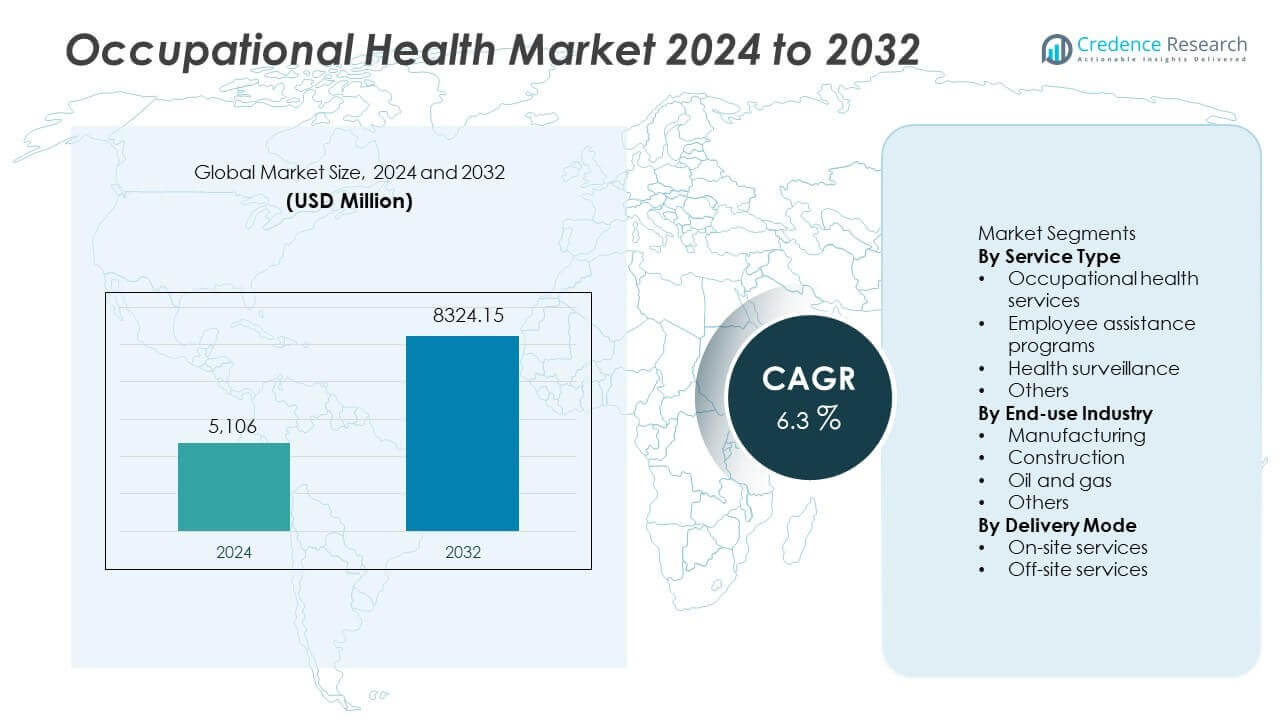
The Occupational Health market size reached USD 5,106 million in 2024 and is projected to reach USD 8,324.15 million by 2032, growing at a CAGR of 6.3% during the forecast period.
| REPORT ATTRIBUTE | DETAILS |
|---|---|
| Historical Period | 2020-2023 |
| Base Year | 2024 |
| Forecast Period | 2025-2032 |
| Occupational Health Market Size 2024 | USD 5,106 million |
| Occupational Health Market, CAGR | 6.3% |
| Occupational Health Market Size 2032 | USD 8,324.15 million |
The Occupational Health market features strong participation from leading players such as Concentra Group, Optum, International SOS, Bupa Group, Premise Health, Medigold Health, AXA Group, Cority Software Inc., UnitedHealth Group, and Siemens Healthineers. These companies compete through integrated service offerings, regulatory expertise, and digital health capabilities. Large players focus on multi-site enterprise contracts and customized industry solutions. Strategic partnerships and technology adoption strengthen market positioning. Regionally, North America leads the Occupational Health market with a 36% market share, driven by strict safety regulations, high employer awareness, and advanced healthcare infrastructure. The region’s strong compliance culture and widespread adoption of preventive health programs continue to support leadership.
Occupational Health Market Insights
- The Occupational Health market was valued at USD 5,106 million in 2024 and is projected to reach USD 8,324.15 million by 2032, registering a CAGR of 6.3% during the forecast period, supported by rising employer focus on workforce safety and preventive healthcare programs.
- Growth is driven by strict workplace safety regulations, increasing employer liability concerns, and rising demand for employee wellbeing programs, with occupational health services leading the service type segment and holding a 46% market share due to strong compliance and preventive care requirements.
- Market trends highlight digitalization, on-site service expansion, and integrated health platforms, while competitive intensity remains moderate, with leading players expanding service portfolios, strengthening compliance solutions, and adopting data-driven health monitoring tools.
- Market restraints include high implementation costs, limited skilled professionals, and affordability challenges for small enterprises, which restrict full-scale adoption despite growing awareness across industries.
- Regionally, North America leads with a 36% market share, followed by Europe at 28%, Asia Pacific at 22%, Latin America at 9%, and the Middle East and Africa at 5%, reflecting regulatory maturity, industrial growth, and workforce size differences.
Occupational Health Market Segmentation Analysis:
By Service Type
The by service type segment shows strong differentiation across preventive and support services. Occupational health services dominated this segment, holding 46% market share in 2024. Employers prioritize occupational health services to reduce workplace injuries and absenteeism. Regulatory compliance requirements also drive adoption across large enterprises. These services support pre-employment screening, fitness assessments, and injury management. Growing focus on preventive care strengthens demand for core occupational services. Employee assistance programs follow due to rising mental health awareness. Health surveillance gains steady traction from exposure monitoring needs. Cost efficiency and measurable outcomes keep occupational health services in a leading position.
- For instance, Premise Health operates more than 800 onsite and near-site clinics and delivered over 25 million employee health encounters in a single year, highlighting measurable service outcomes.
By End-use Industry
The by end-use industry segment reflects risk exposure and compliance intensity. Manufacturing led this segment with a 38% market share in 2024. High injury rates and machinery-related risks drive strong service demand. Manufacturers invest in health programs to maintain productivity and workforce stability. Strict labor safety regulations further support adoption. Construction follows due to on-site hazard exposure. Oil and gas relies on occupational health for remote workforce safety. Other industries show moderate uptake. Continuous industrial expansion and safety audits reinforce manufacturing dominance across the occupational health market.
- For instance, Siemens runs standardized occupational health systems across more than 300 manufacturing sites, supporting over 300,000 industrial employees with digital injury reporting and medical surveillance tools.
By Delivery Mode
The by delivery mode segment highlights operational preferences of employers. On-site services accounted for 57% market share in 2024, making this the dominant sub-segment. Large organizations prefer on-site models for immediate care access. On-site delivery reduces response time during workplace incidents. Employers also benefit from higher employee participation rates. Integration with daily operations improves preventive monitoring. Off-site services grow among small enterprises due to lower costs. However, on-site services remain preferred for high-risk industries. Workforce size, risk profile, and compliance needs continue to drive on-site service leadership.
Key Growth Drivers
Rising Workplace Safety Regulations
Governments continue strengthening workplace health and safety regulations across industries. Employers must comply with mandatory health screenings and risk assessments. Regulatory bodies enforce periodic audits and reporting standards. Non-compliance results in financial penalties and legal exposure. These factors push companies to adopt structured occupational health programs. Manufacturing, construction, and energy sectors show the strongest impact. Compliance-driven demand supports recurring service contracts. Organizations also seek expert partners to manage documentation. This driver creates stable revenue streams for service providers. Regulatory enforcement remains a key growth pillar across the occupational health market.
- For instance, International SOS supports regulatory compliance across its extensive network of medical and client sites, delivering medical and safety assistance cases through standardized audit and reporting systems.
Growing Focus on Employee Wellbeing and Productivity
Organizations increasingly link employee health with productivity outcomes. Healthy workers show lower absenteeism and improved engagement levels. Employers invest in preventive health programs to reduce long-term costs. Occupational health services support early risk detection. Wellness initiatives improve workforce morale and retention. Management teams prioritize mental and physical wellbeing strategies. Competitive labor markets intensify this focus. Companies aim to attract skilled talent through health benefits. This shift expands demand beyond compliance. Employee wellbeing initiatives continue driving sustained market growth.
- For instance, Optum delivers health and wellbeing services to more than 100 million individuals worldwide and processes over 1 billion clinical and administrative transactions annually, supporting large-scale workforce health management.
Expansion of High-Risk Industrial Activities
Industrial expansion increases exposure to workplace hazards. Manufacturing output continues rising in developing economies. Infrastructure projects drive construction workforce growth. Oil and gas operations expand into remote environments. These sectors face higher injury and exposure risks. Employers adopt occupational health solutions to mitigate liabilities. Health surveillance becomes essential for hazardous roles. Risk-intensive industries require continuous medical monitoring. Service providers tailor solutions for specific hazards. Industrial growth directly fuels occupational health market expansion.
Key Trends & Opportunities
Digitalization of Occupational Health Services
Technology adoption reshapes service delivery models. Digital health records improve data accuracy and access. Telehealth enables remote consultations and follow-ups. Wearable devices support real-time health monitoring. Analytics tools help identify risk patterns early. Digital platforms improve compliance tracking and reporting. Employers gain actionable insights from integrated systems. Service providers enhance efficiency through automation. Digital solutions create scalable service opportunities. Technology-led models strengthen long-term market competitiveness.
- For instance, Cority Software supports organizations globally and manages employee health records through its integrated EHS and occupational health platform, enabling real-time reporting and risk analytics.
Growing Adoption Among Small and Medium Enterprises
Small and medium enterprises increase investment in employee health services. Flexible service packages suit limited budgets. Off-site and subscription-based models support affordability. Awareness of regulatory obligations improves adoption. SMEs seek outsourced solutions to reduce internal burden. Market players design scalable offerings for smaller firms. Cloud-based tools simplify service access. This trend opens untapped demand pools. SME participation broadens the occupational health customer base.
- For instance, Medigold Health delivers occupational health services to more than 4,000 SME clients across the UK and processes over 250,000 management referrals and health assessments annually using centralized digital scheduling and reporting systems.
Key Challenges
High Cost of Comprehensive Occupational Health Programs
Cost remains a major adoption barrier for many organizations. Comprehensive programs require skilled professionals and equipment. Smaller firms struggle with ongoing service expenses. On-site models increase operational costs. Budget constraints delay full-scale implementation. Employers prioritize core compliance over advanced services. Cost sensitivity affects emerging markets more strongly. Providers face pricing pressure from competitive bidding. Balancing quality with affordability remains challenging. Cost concerns continue limiting market penetration.
Shortage of Skilled Occupational Health Professionals
The market faces limited availability of trained professionals. Occupational physicians and nurses remain in short supply. Training requirements restrict rapid workforce expansion. High workload leads to professional burnout. Rural and remote areas face stronger shortages. Service quality depends on experienced personnel. Talent gaps slow service scaling efforts. Providers invest in training and digital tools. Workforce constraints challenge consistent service delivery. Talent shortages remain a critical market challenge.
Regional Analysis
North America
North America led the Occupational Health market with a 36% market share in 2024, supported by strict workplace safety regulations and mature healthcare infrastructure. Employers across manufacturing, construction, and energy sectors invest heavily in preventive health programs. The United States drives regional demand through mandatory compliance standards and strong employer liability frameworks. High awareness of employee wellbeing strengthens service adoption. Advanced digital health platforms improve service efficiency. Large enterprises prefer on-site service models for rapid response. Continuous investment in worker safety programs sustains North America’s leadership position.
Europe
Europe accounted for a 28% market share in 2024, driven by strong labor protection laws and standardized occupational health policies. Countries such as Germany, the United Kingdom, and France enforce mandatory health monitoring. Employers emphasize long-term workforce sustainability and risk prevention. An aging workforce increases demand for periodic health assessments. Manufacturing and industrial sectors remain key contributors. Government safety initiatives support adoption. Digital compliance systems improve reporting accuracy. These factors position Europe as a stable and regulation-driven occupational health market.
Asia Pacific
Asia Pacific held a 22% market share in 2024, supported by rapid industrialization and workforce expansion. Manufacturing growth in China, India, and Southeast Asia raises occupational risk exposure. Governments strengthen labor safety frameworks to reduce incidents. Multinational companies apply global safety standards regionally. Employer awareness of employee health continues rising. Infrastructure and construction projects drive demand for surveillance services. Cost-effective delivery models aid adoption. Regulatory enforcement and industrial growth sustain regional market momentum.
Latin America
Latin America represented a 9% market share in 2024, driven by improving labor regulations and industrial growth. Brazil and Mexico lead demand due to expanding manufacturing activity. Governments focus on reducing workplace injuries. Employers adopt occupational health services to meet compliance needs. Mining, oil and gas, and construction sectors contribute strongly. Private healthcare partnerships support service access. Preventive care awareness shows steady improvement. Formal employment growth strengthens occupational health adoption across the region.
Middle East and Africa
The Middle East and Africa accounted for a 5% market share in 2024, supported by infrastructure expansion and energy sector activity. Gulf countries invest in workforce safety due to large migrant labor populations. Oil and gas operations drive strong health surveillance demand. Governments introduce stricter compliance requirements. Construction projects increase workplace risk exposure. Adoption remains lower in parts of Africa due to limited awareness. Global firms enforce international safety standards locally. Regulatory development supports long-term regional growth.
Occupational Health Market Segmentations:
By Service Type
- Occupational health services
- Employee assistance programs
- Health surveillance
- Others
By End-use Industry
- Manufacturing
- Construction
- Oil and gas
- Others
By Delivery Mode
- On-site services
- Off-site services
By Geography
- North America
- U.S.
- Canada
- Mexico
- Europe
- Germany
- France
- U.K.
- Italy
- Spain
- Rest of Europe
- Asia Pacific
- China
- Japan
- India
- South Korea
- South-east Asia
- Rest of Asia Pacific
- Latin America
- Brazil
- Argentina
- Rest of Latin America
- Middle East & Africa
- GCC Countries
- South Africa
- Rest of the Middle East and Africa
Competitive Landscape
Competitive landscape analysis highlights a moderately consolidated Occupational Health market led by Concentra Group, Optum, International SOS, Bupa Group, Premise Health, Medigold Health, AXA Group, Cority Software Inc., UnitedHealth Group, and Siemens Healthineers. Market leaders focus on integrated service portfolios covering preventive care, health surveillance, and compliance management. Companies expand geographic reach through partnerships and acquisitions. Digital platforms support remote monitoring and compliance reporting. Providers invest in data analytics to improve risk assessment accuracy. Custom service models address industry-specific requirements. Large enterprises prefer vendors offering end-to-end solutions. Competitive differentiation relies on service quality, response time, and regulatory expertise. Pricing strategies balance affordability with premium offerings. Continuous innovation and workforce expertise strengthen long-term competitive positioning across the occupational health market.
Key Player Analysis
- Concentra Group
- Optum, Inc.
- International SOS
- Medigold Health
- Bupa Group
- Cority Software Inc.
- Premise Health
- UnitedHealth Group
- AXA Group
- Siemens Healthineers
Recent Developments
- In March 2025, Optum, Inc. launched InterQual 2025, enhancing evidence-based clinical decision tools that support better health management workflows.
- In January 2025, Cority Software Inc. acquired Meddbase, adding a clinical software innovator to its occupational health and practice management platform.
- In 2025, Cority Software Inc. released insights on AI and data use, highlighting how predictive technology improves occupational health program planning.
Report Coverage
The research report offers an in-depth analysis based on Service Type, End-use Industry, Delivery Mode and Geography. It details leading market players, providing an overview of their business, product offerings, investments, revenue streams, and key applications. Additionally, the report includes insights into the competitive environment, SWOT analysis, current market trends, as well as the primary drivers and constraints. Furthermore, it discusses various factors that have driven market expansion in recent years. The report also explores market dynamics, regulatory scenarios, and technological advancements that are shaping the industry. It assesses the impact of external factors and global economic changes on market growth. Lastly, it provides strategic recommendations for new entrants and established companies to navigate the complexities of the market.
Future Outlook
- Employers will increase investment in preventive occupational health programs to reduce long-term workforce risks.
- Regulatory bodies will strengthen compliance requirements across high-risk industries.
- Digital health platforms will gain wider adoption for monitoring and reporting.
- On-site occupational health services will remain preferred by large enterprises.
- Demand for mental health and wellbeing services will continue rising.
- High-risk industries will drive sustained service demand growth.
- Service providers will expand integrated and customized offerings.
- Partnerships and acquisitions will support geographic expansion strategies.
- Workforce health analytics will improve risk prediction and decision-making.
- Emerging markets will contribute steadily to long-term market expansion.

Request a Free Sample
Fill in your details and we'll send you a free sample report.
- Sample data tables & charts
- Research methodology
Market Dynamics
Rising Workplace Safety Regulations
Governments are enforcing stricter workplace health and safety regulations, requiring employers to implement structured occupational health programs, conduct mandatory screenings, and maintain compliance documentation. This regulatory pressure is especially strong in high-risk industries, driving recurring demand for occupational health services.
Growing Focus on Employee Wellbeing and Productivity
Organizations increasingly recognize the link between employee health and productivity, investing in preventive health programs to reduce absenteeism and improve workforce engagement. This trend expands demand for occupational health services beyond compliance, as companies seek to attract and retain talent through comprehensive wellbeing initiatives.
Expansion of High-Risk Industrial Activities
Industrial growth in sectors such as manufacturing, construction, and oil and gas increases exposure to workplace hazards, prompting employers to adopt occupational health solutions for risk mitigation and regulatory compliance. The need for continuous health surveillance and injury management in these sectors directly fuels market expansion.
Digitalization of Occupational Health Services
Adoption of digital health platforms, telehealth, and real-time monitoring tools is transforming service delivery, enabling more efficient compliance tracking, risk analytics, and remote consultations. Technology-driven models enhance scalability and appeal to both large enterprises and SMEs, supporting broader market adoption.
Increasing Adoption Among Small and Medium Enterprises
SMEs are investing more in occupational health through flexible, affordable service models such as off-site and subscription-based offerings. Improved awareness of regulatory obligations and the availability of scalable digital solutions are driving uptake among smaller organizations, expanding the overall customer base.
Need a Custom Version of This Report?
Tailor the scope, geography, or segments to your exact requirements.
- Custom geography or segment scope
- Direct access to our analyst team
Frequently Asked Questions
What is the current market size for Occupational Health market, and what is its projected size in 2032?
At what Compound Annual Growth Rate is the Occupational Health market projected to grow between 2024 and 2032?
Which Occupational Health market segment held the largest share in 2024?
What are the primary factors fueling the growth of the Occupational Health market?
Who are the leading companies in the Occupational Health market?
Which region commanded the largest share of the Occupational Health market in 2024?
Table of Content
Chapter 1 Market Segmentation
- 1.1 Segmentation Framework
- 1.1.1 Product and Service Classification
- 1.1.2 Application and End-Use Classification
- 1.1.3 Technology and Solution Classification
- 1.1.4 Customer and Distribution Channel Classification
- 1.1.5 Geographic Segmentation
- 1.1.6 Market Segment Definitions and Boundaries
- 1.2 By Service Type
- 1.2.1 Occupational health services
- 1.2.2 Employee assistance programs
- 1.2.3 Health surveillance
- 1.2.4 Others
- 1.3 By Delivery Mode
- 1.3.1 On-site services
- 1.3.2 Off-site services
- 1.4 By End-use Industry
- 1.4.1 Manufacturing
- 1.4.2 Construction
- 1.4.3 Oil and gas
- 1.4.4 Others
Chapter 2 Introduction
- 2.1 Report Objectives and Scope
- 2.2 Product Definition and Industry Terminology
- 2.3 Market Inclusions and Exclusions
- 2.4 Research Process
- 2.4.1 Primary Research and Expert Interviews
- 2.4.2 Secondary Research and Source Review
- 2.4.3 Top-Down and Bottom-Up Estimation
- 2.4.4 Data Triangulation and Verification
- 2.5 Market Size Measurement Basis
- 2.5.1 2024: USD 5,106 million → 2032: USD 8,324.15 million
- 2.6 Historical and Forecast Reference Periods
- 2.6.1 Base Year: 2024
- 2.6.2 Forecast Period: 2024-2032
- 2.7 Research Assumptions and Limitations
Chapter 3 Executive Summary
- 3.1 Market Snapshot and Key Findings
- 3.2 Base-Year Market Size, 2024
- 3.3 Forecast Market Size, 2032
- 3.4 Revenue and Volume Growth Outlook
- 3.5 Key Demand and Supply Indicators
- 3.6 Leading Market Segments
- 3.7 Fastest-Growing Market Opportunities
- 3.8 Regional Performance Highlights
- 3.9 Technology and Industry Transformation
- 3.10 Competitive Landscape Summary
- 3.11 Analyst View and Strategic Implications
Chapter 4 Global Occupational Health Market Trends and Developments
- 4.1 Historical Industry Development
- 4.2 Recent Market Trends and Developments
- 4.3 Demand and Customer Behavior Trends
- 4.4 Technology and Product Innovation
- 4.5 Artificial Intelligence, Automation and Digitalization
- 4.6 Local Manufacturing and Supply Chain Realignment
- 4.7 Industry Partnerships, Mergers and Acquisitions
- 4.8 Sustainability and Circular Economy Developments
- 4.9 Government and Private Sector Investment Trends
- 4.10 Emerging Business Models and Commercialization
- 4.11 Industry Developments and Announcements
Chapter 5 Global Occupational Health Market Production, Supply and Demand Analysis
- 5.1 Demand Trend and Consumption Analysis
- 5.2 Demand Forecast, 2024-2032
- 5.3 Production and Output Trend
- 5.4 Production and Output Forecast, 2024-2032
- 5.5 Installed Capacity and Capacity Utilization
- 5.6 Company-Wise Production Plants and Statistics
- 5.6.1 Installed Production Capacity
- 5.6.2 Actual Production
- 5.6.3 Planned Capacity and Expansion Targets
- 5.7 Supply Chain Structure and Procurement Trends
- 5.8 Supply-Demand Gap and Bottlenecks
- 5.9 Import Dependence and Sourcing Structure
- 5.10 Contract Manufacturing and Outsourcing
- 5.11 Regional Supply and Demand Concentration
Chapter 6 Global Occupational Health Market Pricing Analysis
- 6.1 Pricing Structure and Measurement
- 6.2 Historical Pricing Trends
- 6.3 Pricing Outlook, 2024-2032
- 6.4 Average Selling Price and Unit Economics
- 6.5 Pricing by Product and Market Segment
- 6.6 Geographic Pricing Differences
- 6.7 Key Input, Energy, Labor and Logistics Costs
- 6.8 Contract Pricing and Purchasing Models
- 6.9 Pricing Sensitivity and Competitive Positioning
- 6.10 Price, Margin and Profitability Implications
Chapter 7 Global Occupational Health Market Dynamics
- 7.1 Market Growth Drivers
- 7.1.1 Demand-Side Drivers
- 7.1.2 Technology and Innovation Drivers
- 7.1.3 Infrastructure and Investment Drivers
- 7.1.4 Regulatory and Policy Drivers
- 7.2 Market Restraints
- 7.2.1 Cost and Affordability Constraints
- 7.2.2 Technology and Adoption Barriers
- 7.2.3 Supply Chain and Operational Constraints
- 7.3 Market Challenges
- 7.3.1 Competitive Pressure and Margin Erosion
- 7.3.2 Skills, Infrastructure and Implementation Gaps
- 7.4 Emerging Market Opportunities
- 7.5 Market Dynamics Impact and Time-Horizon Assessment
Chapter 8 Global Occupational Health Value Chain Analysis
- 8.1 Industry Value Chain Overview
- 8.2 Upstream Suppliers and Critical Inputs
- 8.3 Technology and Component Providers
- 8.4 Manufacturing or Service Delivery
- 8.5 Distribution, Channel Partners and Integrators
- 8.6 Downstream Applications and End Users
- 8.7 Value Addition and Profit Pools
- 8.8 Vertical Integration and Outsourcing
- 8.9 Supplier Concentration and Risk
- 8.10 Supply Chain Localization and Resilience
Chapter 9 Global Occupational Health Market Regulations and Policies
- 9.1 Relevant Laws, Standards and Compliance Frameworks
- 9.2 Product, Service, Safety and Quality Requirements
- 9.3 Government Policies, Incentives and Subsidies
- 9.4 Imports, Exports and Trade Barriers
- 9.5 Public Procurement and Local Content Requirements
- 9.6 Environmental and Sustainability Compliance
- 9.7 Upcoming Policy Changes and Market Implications
Chapter 10 Global Occupational Health Market Hotspots and Opportunities
- 10.1 Market Opportunity Mapping and Growth Hotspots
- 10.2 High-Growth Applications and Customer Groups
- 10.3 Underserved Markets and White-Space Opportunities
- 10.4 Emerging Technology and Product Opportunities
- 10.5 New Capacity and Investment Hotspots
- 10.6 Market Entry and Expansion Opportunities
- 10.7 Distribution and Partnership Opportunities
- 10.8 Near-Term and Long-Term Commercial Potential
- 10.9 Opportunity Attractiveness and Execution Risks
Chapter 11 Global Occupational Health Market Outlook, 2024-2032
- 11.1 Market Size and Analysis
- 11.1.1 Revenue (Market Measurement: 2024: USD 5,106 million → 2032: USD 8,324.15 million)
- 11.1.2 Market Volume and Quantity Sold
- 11.1.3 Historical Market Size
- 11.1.4 Base-Year Market Size, 2024
- 11.2 Market Forecast, 2024-2032
- 11.2.1 Revenue Forecast to 2032
- 11.2.2 Volume Forecast to 2032
- 11.2.3 CAGR and Year-on-Year Growth
- 11.2.4 Incremental Revenue Opportunity
- 11.3 Forecast Assumptions and Scenario Analysis
- 11.3.1 Base-Case Forecast
- 11.3.2 Optimistic and Conservative Scenarios
- 11.3.3 Technology, Pricing and Policy Sensitivities
- 11.4 Market Attractiveness and Growth Outlook
Chapter 12 Global Occupational Health Market Segmentation and Outlook
- 12.1 Segmentation Summary and Market Shares, 2024
- 12.2 Largest and Fastest-Growing Segments
- 12.3 By Service Type - Market Size and Forecast, 2024-2032
- 12.3.1 Segment Definition and Scope
- 12.3.2 Historical Market Size
- 12.3.3 Revenue Forecast, 2024-2032
- 12.3.4 Volume Forecast, 2024-2032
- 12.3.5 Base-Year Market Share, 2024
- 12.3.6 Segment CAGR and Growth Drivers
- 12.3.7 Subsegment Market Size and Forecast
- 12.3.7.1 Occupational health services
- 12.3.7.2 Employee assistance programs
- 12.3.7.3 Health surveillance
- 12.3.7.4 Others
- 12.3.8 Subsegment Pricing and Adoption Trends
- 12.3.9 Leading Suppliers and Competition
- 12.3.10 Regional Demand and Opportunities
- 12.4 By Delivery Mode - Market Size and Forecast, 2024-2032
- 12.4.1 Segment Definition and Scope
- 12.4.2 Historical Market Size
- 12.4.3 Revenue Forecast, 2024-2032
- 12.4.4 Volume Forecast, 2024-2032
- 12.4.5 Base-Year Market Share, 2024
- 12.4.6 Segment CAGR and Growth Drivers
- 12.4.7 Subsegment Market Size and Forecast
- 12.4.7.1 On-site services
- 12.4.7.2 Off-site services
- 12.4.8 Subsegment Pricing and Adoption Trends
- 12.4.9 Leading Suppliers and Competition
- 12.4.10 Regional Demand and Opportunities
- 12.5 By End-use Industry - Market Size and Forecast, 2024-2032
- 12.5.1 Segment Definition and Scope
- 12.5.2 Historical Market Size
- 12.5.3 Revenue Forecast, 2024-2032
- 12.5.4 Volume Forecast, 2024-2032
- 12.5.5 Base-Year Market Share, 2024
- 12.5.6 Segment CAGR and Growth Drivers
- 12.5.7 Subsegment Market Size and Forecast
- 12.5.7.1 Manufacturing
- 12.5.7.2 Construction
- 12.5.7.3 Oil and gas
- 12.5.7.4 Others
- 12.5.8 Subsegment Pricing and Adoption Trends
- 12.5.9 Leading Suppliers and Competition
- 12.5.10 Regional Demand and Opportunities
- 12.6 Segment Growth Comparison
- 12.7 Segment Attractiveness and Priority Matrix
Chapter 13 Global Occupational Health End-Use and Application Market Outlook
- 13.1 End-Use Industry and Customer Demand Structure
- 13.2 Leading Applications and Customer Groups
- 13.3 End-Use Market Size, Share and Forecast
- 13.4 Major End-Use Industry Deep Dives
- 13.4.1 Customer Requirements and Use Cases
- 13.4.2 Demand and Replacement Cycles
- 13.4.3 Technical and Regulatory Considerations
- 13.4.4 Purchasing and Procurement Models
- 13.4.5 Leading Vendors and Distribution Channels
- 13.4.6 Forecast and Commercial Opportunities
- 13.5 Emerging Applications and Cross-Segment Demand
- 13.6 End-Use Industry Investment Priorities
Chapter 14 Global Occupational Health Geographic Market Outlook, 2024-2032
- 14.1 Regional Market Size and Share, 2024
- 14.2 Regional Market Forecast, 2024-2032
- 14.3 Regional Pricing, Production and Demand Differences
- 14.4 North America
- 14.4.1 United States
- 14.4.2 Canada
- 14.4.3 Mexico
- 14.5 Europe
- 14.5.1 Germany
- 14.5.2 France
- 14.5.3 Italy
- 14.5.4 United Kingdom
- 14.5.5 Spain
- 14.5.6 Poland
- 14.5.7 Russia
- 14.5.8 Netherlands
- 14.5.9 Belgium
- 14.5.10 Sweden
- 14.5.11 Denmark
- 14.5.12 Norway
- 14.5.13 Rest of Europe
- 14.6 Asia Pacific
- 14.6.1 China
- 14.6.2 India
- 14.6.3 Japan
- 14.6.4 South Korea
- 14.6.5 Thailand
- 14.6.6 Indonesia
- 14.6.7 Vietnam
- 14.6.8 Malaysia
- 14.6.9 Australia
- 14.6.10 Rest of Asia Pacific
- 14.7 Latin America
- 14.7.1 Brazil
- 14.7.2 Argentina
- 14.7.3 Colombia
- 14.7.4 Chile
- 14.7.5 Rest of Latin America
- 14.8 Middle East
- 14.8.1 Saudi Arabia
- 14.8.2 United Arab Emirates
- 14.8.3 Turkey
- 14.8.4 Israel
- 14.8.5 Iran
- 14.8.6 Rest of the Middle East
- 14.9 Africa
- 14.9.1 South Africa
- 14.9.2 Egypt
- 14.9.3 Nigeria
- 14.9.4 Morocco
- 14.9.5 Rest of Africa
- 14.10 Regional Investment, Policy and Supply Chain Differences
- 14.11 Regional Competitive Landscape
- 14.12 Geographic Growth Hotspots
Chapter 15 Global Occupational Health Technology, Innovation and Sustainability Outlook
- 15.1 Technology Landscape and Maturity
- 15.2 Product, Process and Service Innovation
- 15.3 AI, Automation and Digital Tools in the Industry
- 15.4 Technology Adoption and Performance Benchmarking
- 15.5 Innovation Pipeline and R&D Investment
- 15.6 Patent and Intellectual Property Trends
- 15.7 Energy Efficiency and Resource Management
- 15.8 Sustainability, Recycling and Circularity
- 15.9 Technology Roadmap, 2024-2032
- 15.10 Risks of Obsolescence and Technology Substitution
Chapter 16 Global Occupational Health Market Key Strategic Imperatives
- 16.1 Growth and Market Entry Priorities
- 16.2 High-Return Products and Segments
- 16.3 Pricing, Profitability and Cost Optimization
- 16.4 Technology Investment and Product Differentiation
- 16.5 Supply Chain Localization and Resilience
- 16.6 Distribution and Customer Acquisition
- 16.7 Partnership, Acquisition and Capacity Strategy
- 16.8 Regional Expansion Priorities
- 16.9 Short-, Medium- and Long-Term Actions
Chapter 17 Competition Outlook
- 17.1 Industry Competition Characteristics
- 17.2 Market Structure and Concentration
- 17.3 Market Share and Competitive Positioning, 2024
- 17.4 Company-Wise Revenue and Product Benchmarking
- 17.5 Production and Service Capacity Benchmarking
- 17.6 Technology, Pricing and Differentiation
- 17.7 Regional Footprint and Distribution Strength
- 17.8 Mergers, Acquisitions and Strategic Alliances
- 17.9 New Entrants and Competitive Threats
- 17.10 Porter's Five Forces and Industry Attractiveness
- 17.11 Competitive Outlook, 2024-2032
Chapter 18 Company Profiles
- 18.1 Company Coverage and Selection Criteria
- 18.2 Concentra Group
- 18.2.1 Business Description
- 18.2.2 Company Ownership and Geographic Presence
- 18.2.3 Product and Service Portfolio
- 18.2.4 Manufacturing and Operating Footprint
- 18.2.5 Production Capacity and Expansion Plans
- 18.2.6 Financial Performance and Investment
- 18.2.7 Market Share and Competitive Position
- 18.2.8 Technology and Innovation Capabilities
- 18.2.9 Strategic Alliances or Partnerships
- 18.2.10 Recent Developments
- 18.2.11 Growth Strategy and Outlook
- 18.3 Optum, Inc.
- 18.4 International SOS
- 18.5 Bupa Group
- 18.6 Premise Health
- 18.7 Medigold Health
- 18.8 AXA Group
- 18.9 Cority Software Inc.
- 18.10 UnitedHealth Group
- 18.11 Siemens Healthineers
- 18.12 Other Relevant Market Participants
Note: Every listed company is profiled on the structure shown under the first company. The company list is preliminary and may change based on research findings, market developments, data availability and client requirements.
Chapter 19 Disclaimer
- 19.1 Research and Forecast Disclaimer
- 19.2 Data Source and Estimation Limitations
Note: The depth of individual sections depends on data availability for this market. Volume, capacity, trade and other unit-based metrics are included where applicable.