
| REPORT ATTRIBUTE | DETAILS |
|---|---|
| Historical Period | 2020-2023 |
| Base Year | 2024 |
| Forecast Period | 2025-2032 |
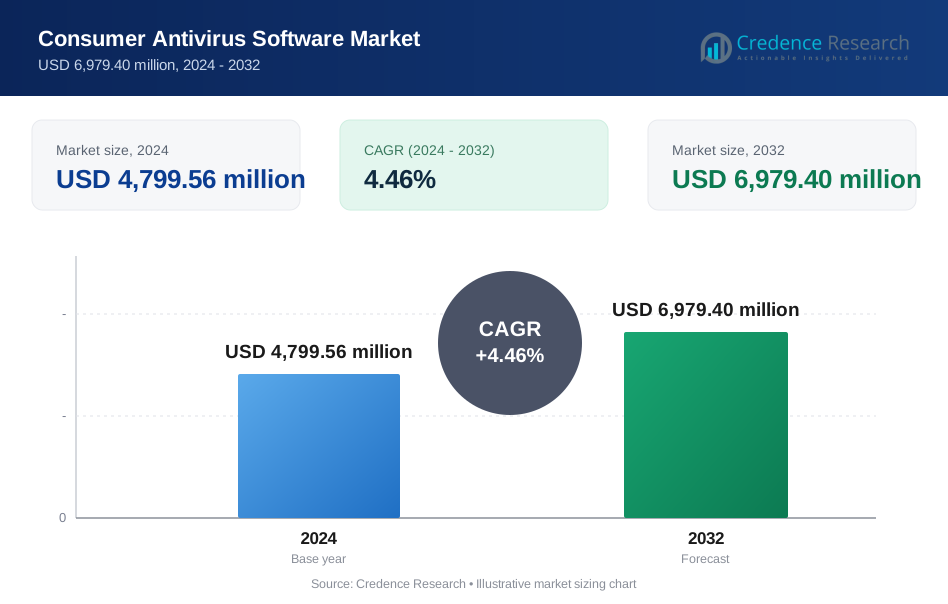
| Consumer Antivirus Software Market Size 2024 | USD 4,799.56 Million |
| Consumer Antivirus Software Market, CAGR | 4.46% |
| Consumer Antivirus Software Market Size 2032 | USD 6,979.40 Million |
Market Overview
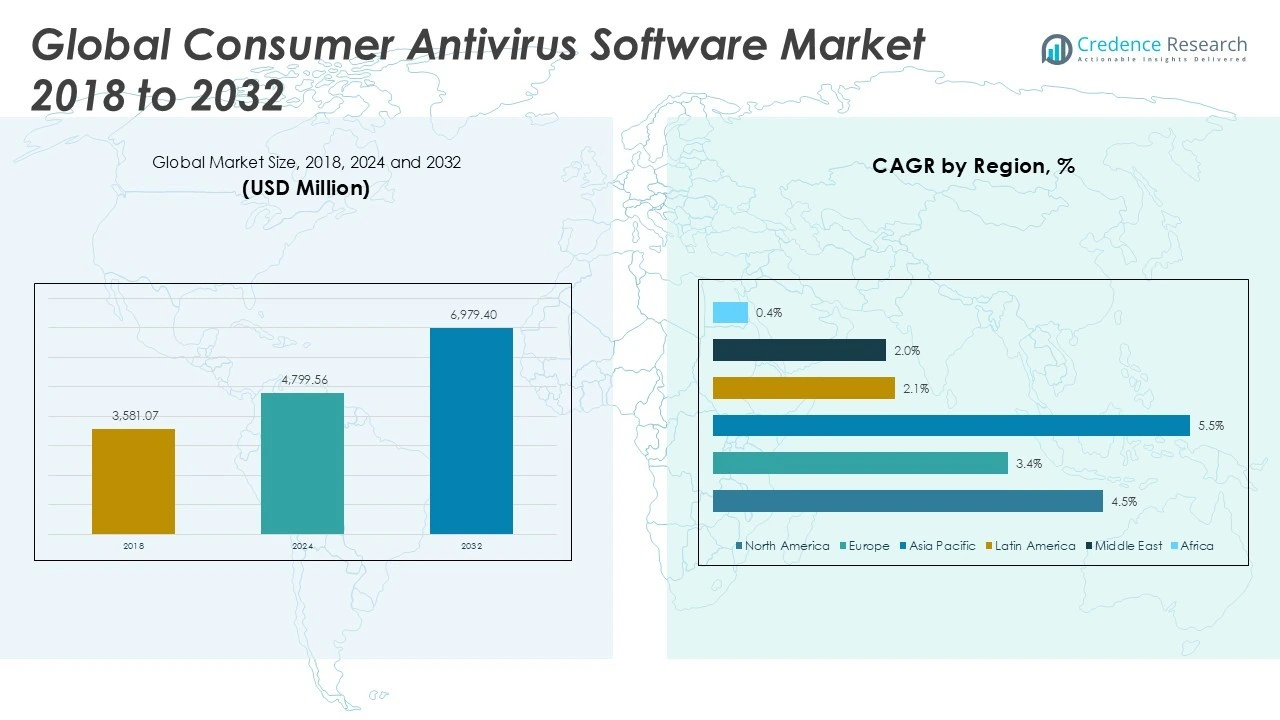
Consumer Antivirus Software Market size was valued at USD 3,581.07 million in 2018 to USD 4,799.56 million in 2024 and is anticipated to reach USD 6,979.40 million by 2032, at a CAGR of 4.46% during the forecast period.
Rising cyber threats, including malware, ransomware, and phishing attacks, are key drivers fueling demand for consumer antivirus software, as individuals seek reliable protection for personal data and devices. Expanding internet access, increasing adoption of smart devices, and the shift toward remote work have intensified the need for robust cybersecurity solutions in the home environment. Market growth is further supported by heightened consumer awareness about digital risks and privacy concerns, prompting investment in user-friendly and comprehensive antivirus products. Trends shaping the market include the integration of artificial intelligence and machine learning for real-time threat detection, the development of lightweight, cloud-based solutions, and the rise of multi-device subscription models that cater to families and individuals with multiple endpoints. The emergence of bundled security offerings combining antivirus, VPN, and identity protection reflects a shift toward holistic digital security, positioning vendors to address evolving consumer expectations and competitive pressures.
The geographical analysis of the Consumer Antivirus Software Market highlights the strong presence and growth potential across North America, Europe, and Asia Pacific, driven by high internet penetration, expanding digital device adoption, and increasing awareness of cyber threats. North America leads with robust consumer demand for advanced security solutions, while Europe emphasizes compliance and data privacy. Asia Pacific stands out for rapid digitalization, mobile-first consumers, and growing concerns about malware and phishing attacks. Latin America, the Middle East, and Africa are gradually increasing adoption rates as connectivity improves and digital awareness rises. Key players shaping the competitive landscape include NortonLifeLock Inc., McAfee Corp., and Kaspersky Lab, each known for their comprehensive security offerings and continual investment in product innovation. These companies compete on the basis of advanced threat detection, user-friendly features, and multi-device compatibility to address evolving consumer security needs worldwide.
Market Insights
- The Consumer Antivirus Software Market was valued at USD 4,799.56 million in 2024 and is projected to reach USD 6,979.40 million by 2032, reflecting a CAGR of 4.46%.
- Rising cyber threats, including malware and phishing attacks, drive consumer demand for robust antivirus solutions to protect personal data and digital devices.
- Key trends include the integration of artificial intelligence and machine learning for real-time threat detection, along with the adoption of cloud-based, lightweight security models.
- The market is highly competitive, with major players such as NortonLifeLock Inc., McAfee Corp., and Kaspersky Lab focusing on continuous innovation and expanding multi-device coverage.
- Intense competition from free and built-in antivirus solutions, consumer apathy toward paid offerings, and market saturation present key restraints for growth.
- North America leads the market in terms of consumer adoption and product innovation, while Asia Pacific shows strong growth potential due to rapid digitalization and mobile device proliferation.
- Vendors increasingly bundle antivirus software with value-added services, such as VPNs and identity protection, to differentiate offerings and retain customers across diverse regional markets.
Market Drivers
Rising Cybersecurity Threats and Increasing Consumer Vulnerabilities
The Consumer Antivirus Software Market is primarily driven by the escalating sophistication and frequency of cyberattacks targeting individuals. Phishing, malware, ransomware, and spyware continue to evolve, exposing consumers to significant risks of data loss, financial theft, and privacy breaches. Consumers recognize the potential consequences of compromised devices and are seeking reliable antivirus solutions to safeguard personal information. The rising use of digital platforms for banking, shopping, and communication amplifies vulnerabilities, making antivirus software an essential tool for everyday protection. Cybercriminals target not only computers but also smartphones and tablets, broadening the market’s scope. It responds with advanced threat detection technologies and continuous updates to mitigate emerging threats.
For instance, the FBI reported that cybercrime cost the American public $12.5 billion in 2024, highlighting the growing need for robust antivirus solutions.Proliferation of Internet-Enabled Devices and Expanding Digital Footprint
Rapid adoption of internet-enabled devices, including smartphones, laptops, tablets, and IoT products, supports the steady growth of the Consumer Antivirus Software Market. Increasing device connectivity extends users’ digital footprints, creating more potential entry points for cyber threats. Consumers seek comprehensive solutions that provide multi-device protection under a single subscription, aligning with modern usage patterns. It emphasizes seamless integration and compatibility across different operating systems to meet evolving consumer expectations. The shift to remote work and online learning environments accelerates demand for robust home cybersecurity solutions. Smart home devices, wearables, and connected entertainment systems further amplify the need for endpoint security.
For instance, the National Cybersecurity Center of Excellence estimated that over 75 billion IoT devices will be in use by the end of 2025, increasing cybersecurity risks.Growing Consumer Awareness and Emphasis on Digital Privacy
A heightened understanding of cyber risks and personal data privacy issues fuels adoption of antivirus software among consumers. The Consumer Antivirus Software Market benefits from widespread educational campaigns, regulatory guidelines, and frequent media coverage highlighting the importance of digital protection. Consumers are prioritizing privacy by choosing solutions that offer secure browsing, identity theft prevention, and real-time alerts for suspicious activities. It strengthens trust by providing transparency in data handling and compliance with privacy regulations. Security software vendors address consumer concerns through intuitive interfaces and easy-to-use features, encouraging adoption across diverse age groups. The emphasis on user experience increases customer retention and drives market growth.
Technological Advancements and Product Innovation Shaping Consumer Choices
Continuous advancements in artificial intelligence, machine learning, and cloud-based detection significantly shape the Consumer Antivirus Software Market’s development. Vendors leverage automation to deliver real-time threat analysis, reducing response times and enhancing accuracy in identifying malicious activity. It introduces lightweight solutions that minimize impact on device performance, aligning with consumer preferences for efficient, unobtrusive protection. Regular software updates and cloud-driven intelligence ensure evolving threats are countered proactively. The market also witnesses a trend toward bundled offerings, integrating antivirus with VPN, parental controls, and identity protection, delivering comprehensive security solutions. Competitive differentiation increasingly depends on technological leadership and value-added features that address the full spectrum of consumer needs.
Market Trends
Adoption of Artificial Intelligence and Machine Learning in Threat Detection
The Consumer Antivirus Software Market is witnessing a marked shift toward integrating artificial intelligence (AI) and machine learning (ML) in its core offerings. Vendors invest in advanced algorithms that enhance the detection and mitigation of both known and zero-day threats. AI-powered systems enable real-time behavioral analysis, which identifies suspicious patterns without relying solely on traditional signature-based approaches. It delivers adaptive protection that evolves with emerging cyberattack techniques. This technological evolution helps maintain relevance against increasingly sophisticated malware and phishing schemes. AI and ML capabilities are now standard features in leading antivirus products, reflecting the market’s focus on innovation and proactive security.
For instance, AI-driven antivirus solutions are improving threat detection accuracy by analyzing behavioral patterns and identifying zero-day vulnerabilities.Emergence of Cloud-Based and Lightweight Security Solutions
A significant trend shaping the Consumer Antivirus Software Market is the rising demand for cloud-based and lightweight security solutions. Consumers prefer antivirus products that offer seamless updates, remote management, and minimal impact on device performance. The shift toward cloud infrastructure enables faster threat intelligence sharing and reduces the burden of manual updates. It aligns with the lifestyle of users who value efficiency and uninterrupted digital experiences. These solutions facilitate easy deployment across multiple devices, meeting the needs of households with diverse digital ecosystems. Cloud-based antivirus models set new benchmarks for scalability and responsiveness in the market.
For instance, cloud-based antivirus solutions are improving workflow efficiency by enabling real-time threat intelligence sharing and seamless updates.Expansion of Multi-Device and Cross-Platform Protection Models
The trend of multi-device ownership drives demand for cross-platform protection within the Consumer Antivirus Software Market. Consumers expect a unified security solution that safeguards desktops, laptops, smartphones, and tablets under a single license. Vendors focus on compatibility and seamless user experiences across different operating systems. It reflects a response to modern digital habits, where work, entertainment, and personal interactions span multiple devices. Cross-platform support is now a key differentiator among leading antivirus brands. This approach addresses consumer convenience while ensuring comprehensive cybersecurity coverage.
Bundling of Comprehensive Digital Security Features and Value-Added Services
Vendors in the Consumer Antivirus Software Market increasingly bundle antivirus protection with complementary digital security features. Packages now commonly include VPN services, identity theft monitoring, parental controls, and secure browsing tools. It provides users with an all-in-one solution that addresses a broader spectrum of online risks. The market witnesses strong consumer interest in value-added services that extend beyond malware prevention. This bundling strategy fosters brand loyalty, increases subscription renewals, and helps vendors capture a larger share of household security spending. The trend toward integrated digital protection will continue shaping product development and market competition.
Market Challenges Analysis
Rising Sophistication of Cyber Threats and Evasion Techniques
The Consumer Antivirus Software Market faces significant challenges from the rapid evolution of cyber threats and advanced evasion tactics. Cybercriminals continuously develop new malware strains and deploy sophisticated attack vectors that circumvent traditional detection methods. It struggles to maintain pace with zero-day vulnerabilities and polymorphic viruses that adapt to avoid signature-based identification. Attackers exploit unpatched software, social engineering, and encrypted channels, creating new security gaps for consumers. The complexity and scale of threats require ongoing research and innovation, placing pressure on vendors to deliver timely updates and proactive defenses. This escalating threat landscape tests the resilience and adaptability of antivirus solutions.
For instance, hackers are increasingly using polymorphic malware that adapts to avoid signature-based detection, making traditional antivirus solutions less effective.Market Saturation, Consumer Apathy, and Free Alternatives
Intense competition and market saturation pose another set of challenges for the Consumer Antivirus Software Market. A wide array of free and bundled security solutions reduces the willingness of consumers to pay for premium antivirus products. It encounters consumer apathy fueled by misconceptions about device vulnerability and overreliance on built-in operating system defenses. Low product differentiation and aggressive pricing make it difficult for vendors to retain and attract customers in a crowded market. The prevalence of freemium models leads to revenue pressures, impacting investments in R&D and customer support. Addressing these barriers requires renewed focus on consumer education, value creation, and product innovation.
Market Opportunities
Expansion in Emerging Digital Ecosystems and Device Categories
The Consumer Antivirus Software Market presents strong opportunities for growth in emerging digital ecosystems and expanding device categories. Rapid digital adoption in developing economies creates a sizable new user base seeking reliable cybersecurity solutions. It can capitalize on the increasing penetration of smartphones, smart TVs, and IoT devices, all of which require dedicated security measures. The trend toward connected homes and remote work environments enhances the need for multi-device, cross-platform protection. Vendors who offer tailored, affordable, and easy-to-deploy solutions stand to gain market share in these fast-growing segments. Partnering with device manufacturers and telecom providers can further strengthen distribution and reach.
Integration of Value-Added Services and Advanced Security Features
Opportunities for the Consumer Antivirus Software Market also lie in integrating value-added services and advanced security features into core offerings. Consumers demonstrate growing interest in comprehensive solutions that combine antivirus protection with VPNs, identity theft monitoring, secure browsing, and parental controls. It can boost engagement and customer retention by bundling these services in flexible, subscription-based packages. Leveraging artificial intelligence and real-time analytics enhances threat detection and sets new industry standards for protection. Delivering intuitive user experiences and clear privacy assurances addresses evolving consumer preferences and regulatory expectations, opening new avenues for brand differentiation and revenue growth.
Market Segmentation Analysis:
By Type:
The Consumer Antivirus Software Market segments by type into free antivirus and paid antivirus solutions, each catering to distinct consumer needs and value perceptions. Free antivirus software appeals to a broad user base seeking basic protection without financial commitment, often relying on advertising revenue or encouraging upgrades to premium versions. It serves price-sensitive segments and first-time users but offers limited advanced features. Paid antivirus solutions target consumers who prioritize comprehensive protection, advanced functionalities, and dedicated customer support. This segment captures users willing to invest in proactive digital security, often benefiting from bundled services such as VPNs, parental controls, and identity theft protection. Vendors focus on differentiating paid offerings with real-time threat intelligence and enhanced usability.
By Device:
The Consumer Antivirus Software Market covers desktops, laptops, smartphones, tablets, and servers, reflecting the diversity of digital environments in households and personal use. Desktops and laptops continue to account for a significant market share due to their central role in productivity and entertainment. It delivers tailored antivirus solutions to address the unique vulnerabilities and usage patterns of each device category. The rapid growth in smartphone and tablet adoption intensifies demand for mobile security, driving innovation in lightweight, resource-efficient applications. Servers, while less prominent in consumer settings, require robust protection for home offices and small businesses integrating networked storage and cloud services.
By Operating System:
Segmentation by operating system highlights the Consumer Antivirus Software Market’s focus on compatibility and cross-platform coverage. Windows remains the dominant operating system, supporting the largest installed base and drawing significant attention from cybercriminals. Antivirus vendors invest in advanced detection technologies to address the frequent targeting of Windows devices. macOS, historically perceived as less vulnerable, now receives specialized solutions as malware threats targeting Apple platforms increase. Android/iOS/Linux comprise a growing segment driven by mobile device usage and the proliferation of alternative operating systems in smart homes. It emphasizes multi-platform licensing and seamless user experience, allowing consumers to protect multiple devices through a unified interface. This segment approach enables vendors to address evolving consumer requirements and optimize their market positioning.
Segments:
Based on Type:
- Free Antivirus
- Paid Antivirus
Based on Device:
- Desktops
- Laptops
- Smartphones
- Tablets
- Servers
Based on Operating System:
- Windows
- macOS
- Android/iOS/Linux
Based on End User:
- Individual Consumers
- Enterprises
- Government Entities
Based on the Geography:
- North America
- U.S.
- Canada
- Mexico
- Europe
- UK
- France
- Germany
- Italy
- Spain
- Russia
- Belgium
- Netherlands
- Austria
- Sweden
- Poland
- Denmark
- Switzerland
- Rest of Europe
- Asia Pacific
- China
- Japan
- South Korea
- India
- Australia
- Thailand
- Indonesia
- Vietnam
- Malaysia
- Philippines
- Taiwan
- Rest of Asia Pacific
- Latin America
- Brazil
- Argentina
- Peru
- Chile
- Colombia
- Rest of Latin America
- Middle East
- UAE
- KSA
- Israel
- Turkey
- Iran
- Rest of Middle East
- Africa
- Egypt
- Nigeria
- Algeria
- Morocco
- Rest of Africa
Regional Analysis
North America Consumer Antivirus Software Market
North America Consumer Antivirus Software Market grew from USD 1,387.58 million in 2018 to USD 1,837.96 million in 2024 and is projected to reach USD 2,681.09 million by 2032, reflecting a compound annual growth rate (CAGR) of 4.5%. North America is holding a 38% market share. The United States and Canada remain at the forefront due to high internet penetration, widespread use of digital devices, and strong consumer awareness of cybersecurity threats. The region benefits from the presence of major antivirus software providers and continuous product innovation. Rapid adoption of cloud-based security solutions and demand for multi-device coverage support sustained market growth. Regulatory focus on privacy and data protection creates a robust environment for premium antivirus offerings.
Europe Consumer Antivirus Software Market
Europe Consumer Antivirus Software Market grew from USD 741.38 million in 2018 to USD 944.55 million in 2024 and is expected to reach USD 1,261.87 million by 2032, at a CAGR of 3.4%. Europe accounts for a 18% market share. Key countries driving the market include Germany, the United Kingdom, and France. The region experiences steady demand for antivirus solutions driven by strict data privacy regulations, digital transformation in households, and growing cyberthreats. It shows increased adoption of subscription-based and bundled security services. Vendors focus on compliance and localization to address diverse consumer preferences.
Asia Pacific Consumer Antivirus Software Market
Asia Pacific Consumer Antivirus Software Market grew from USD 1,198.04 million in 2018 to USD 1,683.12 million in 2024 and is set to reach USD 2,640.46 million by 2032, registering a CAGR of 5.5%. Asia Pacific captures a 38% market share. China, Japan, India, and South Korea lead the region with large and growing digital populations. The rise in internet connectivity, proliferation of smartphones, and increasing cybercrime incidents fuel strong demand for advanced consumer antivirus solutions. It is witnessing rapid adoption of mobile security and cross-platform protection products. Market players prioritize affordable, user-friendly offerings to penetrate emerging economies.
Latin America Consumer Antivirus Software Market
Latin America Consumer Antivirus Software Market grew from USD 120.40 million in 2018 to USD 158.55 million in 2024 and will reach USD 193.15 million by 2032, with a CAGR of 2.1%. Latin America maintains a 3% market share. Brazil and Mexico represent key markets, reflecting increased awareness of cyber threats and digital privacy. Economic challenges and variable internet infrastructure affect adoption rates. The region shows growing interest in affordable, lightweight antivirus solutions and free offerings. It is also seeing demand for solutions that secure mobile and low-cost devices.
Middle East Consumer Antivirus Software Market
Middle East Consumer Antivirus Software Market grew from USD 92.52 million in 2018 to USD 112.46 million in 2024 and is forecasted to reach USD 135.61 million by 2032, at a CAGR of 2.0%. The Middle East holds a 2% market share. Key countries include Saudi Arabia, the United Arab Emirates, and Israel, where digital transformation and remote work trends spur demand for antivirus software. Market growth is tempered by varied consumer awareness and differences in technology adoption. It focuses on delivering scalable solutions suited to both urban and rural digital environments.
Africa Consumer Antivirus Software Market
Africa Consumer Antivirus Software Market grew from USD 41.15 million in 2018 to USD 62.93 million in 2024 and is projected to reach USD 67.22 million by 2032, reflecting a CAGR of 0.4%. Africa claims a 1% market share. South Africa, Nigeria, and Egypt drive market activity, supported by gradual digitalization and mobile device adoption. Limited internet access and lower consumer purchasing power constrain premium product adoption. It sees rising demand for free antivirus solutions and security apps optimized for basic smartphones. Vendors focus on awareness campaigns and partnerships to expand market presence.
Key Player Analysis
- NortonLifeLock Inc.
- McAfee Corp.
- Bitdefender
- Trend Micro Incorporated
- Kaspersky Lab
- ESET
- Sophos Ltd.
- Avast Software s.r.o.
- Avira Operations GmbH & Co. KG
- F-Secure
Competitive Analysis
The competitive landscape of the Consumer Antivirus Software Market is shaped by leading players such as NortonLifeLock Inc., McAfee Corp., Kaspersky Lab, Bitdefender, Trend Micro Incorporated, and ESET. These companies dominate the market through strong global brand recognition, extensive research and development, and a commitment to advancing cybersecurity technologies. Each invests in the integration of artificial intelligence and machine learning for enhanced threat detection, ensuring rapid response to evolving cyber risks. Their product portfolios address a range of consumer needs, offering solutions for desktops, laptops, smartphones, and tablets with seamless multi-device compatibility. Vendors differentiate themselves by providing intuitive user interfaces, robust customer support, and added services such as VPN, identity theft protection, and parental controls. Subscription-based models, frequent product updates, and cloud-based security solutions help maintain customer engagement and retention. The intense rivalry encourages continuous innovation, with market leaders focusing on proactive threat intelligence and bundled offerings. Price competition from free antivirus alternatives and built-in operating system security intensifies the need for value-driven features and strong after-sales service. These leading players maintain their positions by adapting to technological trends, responding to regional consumer demands, and building strategic partnerships to expand their market reach.
Recent Developments
- In January 2024, in a survey conducted by McAfee of owners and IT decision makers at small businesses across 6 countries regarding their perceptions and practices in engaging with cyber security, McAfee Corp that too is stated as a global leader in the provision of protection over the internet has today made public the results from its Global Small Business Study.
- In 2023, Software company Bitdefender offered a new version of their antivirus software called Bitdefender 2024, which integrated an enhanced ransomware mitigation tool alongside a better anti-phishing module.
- In June 2023, new trends in cyber security are emerging, which was established by Trend Micro Incorporated, according to them, this technology shifts the way organizations enhance their security and how they respond to threats to a new level. The new release of Trend Vision One shows an enormous step into the future of enterprise cyber security, which integrates complete attack surface risk management, Unified protection across hybrid environments and next-generation XDR, which has also been improved through the introduction of the generative AI technology.
- In November 2022, Fortinet unveiled the availability of FortiGate Cloud-Native Firewall (FortiGate CNF), an enterprise-grade, managed next-generation firewall service specially created for AWS environments. For real-time detection and defense against malicious external and internal threats, FortiGate CNF integrated FortiGuard artificial intelligence (AI)-powered security services.
- In May 2022, Trend Micro, a cybersecurity firm based in Japan, introduced Trend Micro One, a cybersecurity and attack surface management platform. A platform is an online tool that gives users visibility and control over internal and external attack surfaces. Utilizing 250 million sensors, Trend Micro One continuously detects dynamic attack surfaces, assesses risk, and responds with the appropriate security at the appropriate moment.
Market Concentration & Characteristics
The Consumer Antivirus Software Market demonstrates moderate to high market concentration, with a few global players accounting for a substantial share of total revenues. It features established brands with strong reputations, broad product portfolios, and significant R&D investments, allowing them to set industry standards and influence innovation trends. The market is characterized by rapid technological advancements, frequent product updates, and a growing shift toward cloud-based, multi-device security solutions. Vendors emphasize user-friendly interfaces, integrated value-added services, and flexible subscription models to attract and retain consumers. The landscape is competitive yet stable, with barriers to entry created by brand loyalty, technical expertise, and the need for continuous threat intelligence. The presence of both paid and free antivirus options caters to diverse consumer segments, making it essential for leading companies to differentiate through advanced features and trusted customer support.
Report Coverage
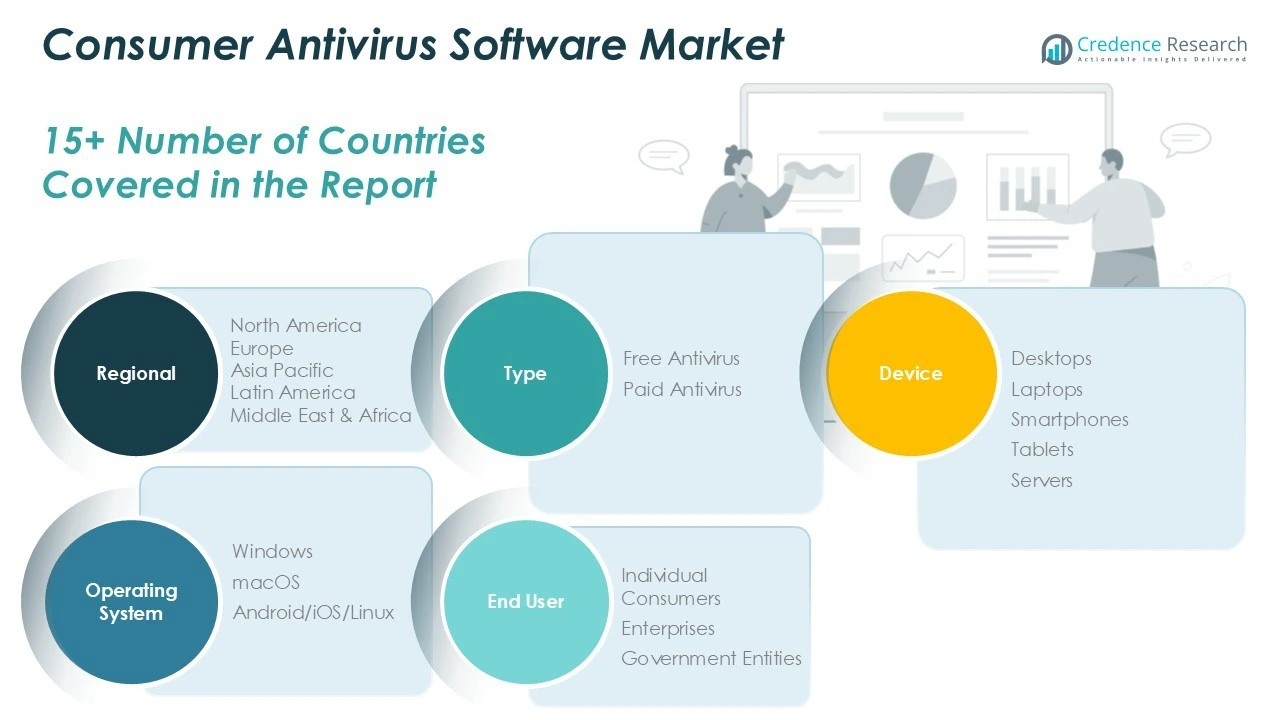
The research report offers an in-depth analysis based on Type, Device, Operating System, End User and Geography. It details leading market players, providing an overview of their business, product offerings, investments, revenue streams, and key applications. Additionally, the report includes insights into the competitive environment, SWOT analysis, current market trends, as well as the primary drivers and constraints. Furthermore, it discusses various factors that have driven market expansion in recent years. The report also explores market dynamics, regulatory scenarios, and technological advancements that are shaping the industry. It assesses the impact of external factors and global economic changes on market growth. Lastly, it provides strategic recommendations for new entrants and established companies to navigate the complexities of the market.
Future Outlook
- The market will continue shifting towards cloud-based antivirus solutions due to increased demand for real-time protection and remote accessibility.
- AI and machine learning integration will become more prevalent to detect sophisticated and evolving cyber threats.
- Vendors will focus on offering comprehensive security suites that combine antivirus with VPN, firewall, and identity protection features.
- Subscription-based models will dominate, with flexible plans targeting individuals, families, and small businesses.
- Consumer demand for cross-platform compatibility will drive development of antivirus solutions for all major operating systems and smart devices.
- Increased cyber awareness among consumers will lead to higher adoption of paid antivirus solutions over free versions.
- Data privacy regulations and compliance requirements will influence software features and update cycles.
- Companies will invest more in threat intelligence and real-time response capabilities to stay ahead of advanced cyber attacks.
- Partnerships with device manufacturers and telecom providers will expand distribution channels and market reach.
- Emerging markets will present new growth opportunities due to rising internet penetration and digital device usage.
Request a Free Sample
Fill in your details and we'll send you a free sample report.
- Sample data tables & charts
- Research methodology
Need a Custom Version of This Report?
Tailor the scope, geography, or segments to your exact requirements.
- Custom geography or segment scope
- Direct access to our analyst team
Frequently Asked Questions
What is the current size of the Consumer Antivirus Software Market?
What factors are driving the growth of the Consumer Antivirus Software Market?
What are the key segments within the Consumer Antivirus Software Market?
What are some challenges faced by the Consumer Antivirus Software Market?
Who are the major players in the Consumer Antivirus Software Market?
Table of Content
Chapter 1 Market Segmentation
- 1.1 Segmentation Framework
- 1.1.1 Product and Service Classification
- 1.1.2 Application and End-Use Classification
- 1.1.3 Technology and Solution Classification
- 1.1.4 Customer and Distribution Channel Classification
- 1.1.5 Geographic Segmentation
- 1.1.6 Market Segment Definitions and Boundaries
Chapter 2 Introduction
- 2.1 Report Objectives and Scope
- 2.2 Product Definition and Industry Terminology
- 2.3 Market Inclusions and Exclusions
- 2.4 Research Process
- 2.4.1 Primary Research and Expert Interviews
- 2.4.2 Secondary Research and Source Review
- 2.4.3 Top-Down and Bottom-Up Estimation
- 2.4.4 Data Triangulation and Verification
- 2.5 Market Size Measurement Basis
- 2.5.1 2024: USD 4,799.56 million → 2032: USD 6,979.40 million
- 2.6 Historical and Forecast Reference Periods
- 2.6.1 Base Year: 2024
- 2.6.2 Forecast Period: 2024-2032
- 2.7 Research Assumptions and Limitations
Chapter 3 Executive Summary
- 3.1 Market Snapshot and Key Findings
- 3.2 Base-Year Market Size, 2024
- 3.3 Forecast Market Size, 2032
- 3.4 Revenue and Volume Growth Outlook
- 3.5 Key Demand and Supply Indicators
- 3.6 Leading Market Segments
- 3.7 Fastest-Growing Market Opportunities
- 3.8 Regional Performance Highlights
- 3.9 Technology and Industry Transformation
- 3.10 Competitive Landscape Summary
- 3.11 Analyst View and Strategic Implications
Chapter 4 Global Consumer Antivirus Software Market Trends and Developments
- 4.1 Historical Industry Development
- 4.2 Recent Market Trends and Developments
- 4.3 Demand and Customer Behavior Trends
- 4.4 Technology and Product Innovation
- 4.5 Artificial Intelligence, Automation and Digitalization
- 4.6 Local Manufacturing and Supply Chain Realignment
- 4.7 Industry Partnerships, Mergers and Acquisitions
- 4.8 Sustainability and Circular Economy Developments
- 4.9 Government and Private Sector Investment Trends
- 4.10 Emerging Business Models and Commercialization
- 4.11 Industry Developments and Announcements
Chapter 5 Global Consumer Antivirus Software Market Supply and Demand Analysis
- 5.1 Demand Trend and Consumption Analysis
- 5.2 Demand Forecast, 2024-2032
- 5.3 Supply Chain Structure and Procurement Trends
- 5.4 Supply-Demand Gap and Bottlenecks
- 5.5 Import Dependence and Sourcing Structure
- 5.6 Regional Supply and Demand Concentration
Chapter 6 Global Consumer Antivirus Software Market Pricing Analysis
- 6.1 Pricing Structure and Measurement
- 6.2 Historical Pricing Trends
- 6.3 Pricing Outlook, 2024-2032
- 6.4 Pricing by Product and Market Segment
- 6.5 Geographic Pricing Differences
- 6.6 Key Input, Energy, Labor and Logistics Costs
- 6.7 Contract Pricing and Purchasing Models
- 6.8 Pricing Sensitivity and Competitive Positioning
- 6.9 Price, Margin and Profitability Implications
Chapter 7 Global Consumer Antivirus Software Market Dynamics
- 7.1 Market Growth Drivers
- 7.1.1 Demand-Side Drivers
- 7.1.2 Technology and Innovation Drivers
- 7.1.3 Infrastructure and Investment Drivers
- 7.1.4 Regulatory and Policy Drivers
- 7.2 Market Restraints
- 7.2.1 Cost and Affordability Constraints
- 7.2.2 Technology and Adoption Barriers
- 7.2.3 Supply Chain and Operational Constraints
- 7.3 Market Challenges
- 7.3.1 Competitive Pressure and Margin Erosion
- 7.3.2 Skills, Infrastructure and Implementation Gaps
- 7.4 Emerging Market Opportunities
- 7.5 Market Dynamics Impact and Time-Horizon Assessment
Chapter 8 Global Consumer Antivirus Software Value Chain Analysis
- 8.1 Industry Value Chain Overview
- 8.2 Upstream Suppliers and Critical Inputs
- 8.3 Technology and Component Providers
- 8.4 Manufacturing or Service Delivery
- 8.5 Distribution, Channel Partners and Integrators
- 8.6 Downstream Applications and End Users
- 8.7 Value Addition and Profit Pools
- 8.8 Vertical Integration and Outsourcing
- 8.9 Supplier Concentration and Risk
- 8.10 Supply Chain Localization and Resilience
Chapter 9 Global Consumer Antivirus Software Market Regulations and Policies
- 9.1 Relevant Laws, Standards and Compliance Frameworks
- 9.2 Product, Service, Safety and Quality Requirements
- 9.3 Government Policies, Incentives and Subsidies
- 9.4 Imports, Exports and Trade Barriers
- 9.5 Public Procurement and Local Content Requirements
- 9.6 Data Protection, AI and Cybersecurity Compliance
- 9.7 Upcoming Policy Changes and Market Implications
Chapter 10 Global Consumer Antivirus Software Market Hotspots and Opportunities
- 10.1 Market Opportunity Mapping and Growth Hotspots
- 10.2 High-Growth Applications and Customer Groups
- 10.3 Underserved Markets and White-Space Opportunities
- 10.4 Emerging Technology and Product Opportunities
- 10.5 New Capacity and Investment Hotspots
- 10.6 Market Entry and Expansion Opportunities
- 10.7 Distribution and Partnership Opportunities
- 10.8 Near-Term and Long-Term Commercial Potential
- 10.9 Opportunity Attractiveness and Execution Risks
Chapter 11 Global Consumer Antivirus Software Market Outlook, 2024-2032
- 11.1 Market Size and Analysis
- 11.1.1 Revenue (Market Measurement: 2024: USD 4,799.56 million → 2032: USD 6,979.40 million)
- 11.1.2 Historical Market Size
- 11.1.3 Base-Year Market Size, 2024
- 11.2 Market Forecast, 2024-2032
- 11.2.1 Revenue Forecast to 2032
- 11.2.2 CAGR and Year-on-Year Growth
- 11.2.3 Incremental Revenue Opportunity
- 11.3 Forecast Assumptions and Scenario Analysis
- 11.3.1 Base-Case Forecast
- 11.3.2 Optimistic and Conservative Scenarios
- 11.3.3 Technology, Pricing and Policy Sensitivities
- 11.4 Market Attractiveness and Growth Outlook
Chapter 12 Global Consumer Antivirus Software Market Segmentation and Outlook
- 12.1 Segmentation Summary and Market Shares, 2024
- 12.2 Largest and Fastest-Growing Segments
- 12.3 Segment Growth Comparison
- 12.4 Segment Attractiveness and Priority Matrix
Chapter 13 Global Consumer Antivirus Software Geographic Market Outlook, 2024-2032
- 13.1 Regional Market Size and Share, 2024
- 13.2 Regional Market Forecast, 2024-2032
- 13.3 Regional Pricing, Production and Demand Differences
- 13.4 North America
- 13.4.1 United States
- 13.4.2 Canada
- 13.4.3 Mexico
- 13.5 Europe
- 13.5.1 Germany
- 13.5.2 France
- 13.5.3 Italy
- 13.5.4 United Kingdom
- 13.5.5 Spain
- 13.5.6 Poland
- 13.5.7 Russia
- 13.5.8 Netherlands
- 13.5.9 Belgium
- 13.5.10 Sweden
- 13.5.11 Denmark
- 13.5.12 Norway
- 13.5.13 Rest of Europe
- 13.6 Asia Pacific
- 13.6.1 China
- 13.6.2 India
- 13.6.3 Japan
- 13.6.4 South Korea
- 13.6.5 Thailand
- 13.6.6 Indonesia
- 13.6.7 Vietnam
- 13.6.8 Malaysia
- 13.6.9 Australia
- 13.6.10 Rest of Asia Pacific
- 13.7 Latin America
- 13.7.1 Brazil
- 13.7.2 Argentina
- 13.7.3 Colombia
- 13.7.4 Chile
- 13.7.5 Rest of Latin America
- 13.8 Middle East
- 13.8.1 Saudi Arabia
- 13.8.2 United Arab Emirates
- 13.8.3 Turkey
- 13.8.4 Israel
- 13.8.5 Iran
- 13.8.6 Rest of the Middle East
- 13.9 Africa
- 13.9.1 South Africa
- 13.9.2 Egypt
- 13.9.3 Nigeria
- 13.9.4 Morocco
- 13.9.5 Rest of Africa
- 13.10 Regional Investment, Policy and Supply Chain Differences
- 13.11 Regional Competitive Landscape
- 13.12 Geographic Growth Hotspots
Chapter 14 Global Consumer Antivirus Software Technology, Innovation and Sustainability Outlook
- 14.1 Technology Landscape and Maturity
- 14.2 Product, Process and Service Innovation
- 14.3 AI, Automation and Digital Tools in the Industry
- 14.4 Technology Adoption and Performance Benchmarking
- 14.5 Innovation Pipeline and R&D Investment
- 14.6 Patent and Intellectual Property Trends
- 14.7 Energy Efficiency and Resource Management
- 14.8 Sustainability, Recycling and Circularity
- 14.9 Technology Roadmap, 2024-2032
- 14.10 Risks of Obsolescence and Technology Substitution
Chapter 15 Global Consumer Antivirus Software Market Key Strategic Imperatives
- 15.1 Growth and Market Entry Priorities
- 15.2 High-Return Products and Segments
- 15.3 Pricing, Profitability and Cost Optimization
- 15.4 Technology Investment and Product Differentiation
- 15.5 Supply Chain Localization and Resilience
- 15.6 Distribution and Customer Acquisition
- 15.7 Partnership, Acquisition and Capacity Strategy
- 15.8 Regional Expansion Priorities
- 15.9 Short-, Medium- and Long-Term Actions
Chapter 16 Competition Outlook
- 16.1 Industry Competition Characteristics
- 16.2 Market Structure and Concentration
- 16.3 Market Share and Competitive Positioning, 2024
- 16.4 Company-Wise Revenue and Product Benchmarking
- 16.5 Production and Service Capacity Benchmarking
- 16.6 Technology, Pricing and Differentiation
- 16.7 Regional Footprint and Distribution Strength
- 16.8 Mergers, Acquisitions and Strategic Alliances
- 16.9 New Entrants and Competitive Threats
- 16.10 Porter's Five Forces and Industry Attractiveness
- 16.11 Competitive Outlook, 2024-2032
Chapter 17 Company Profiles
- 17.1 Company Coverage and Selection Criteria
- 17.2 Leading Market Participants – Standard Profile Structure
- 17.2.1 Business Description
- 17.2.2 Company Ownership and Geographic Presence
- 17.2.3 Product and Service Portfolio
- 17.2.4 Manufacturing and Operating Footprint
- 17.2.5 Financial Performance and Investment
- 17.2.6 Market Share and Competitive Position
- 17.2.7 Technology and Innovation Capabilities
- 17.2.8 Strategic Alliances or Partnerships
- 17.2.9 Recent Developments
- 17.2.10 Growth Strategy and Outlook
- 17.3 Other Relevant Market Participants
Note: Every listed company is profiled on the structure shown under the first company. The company list is preliminary and may change based on research findings, market developments, data availability and client requirements.
Chapter 18 Disclaimer
- 18.1 Research and Forecast Disclaimer
- 18.2 Data Source and Estimation Limitations
Note: The depth of individual sections depends on data availability for this market. Volume, capacity, trade and other unit-based metrics are included where applicable.
