
Deep Sea Mining Market Overview:
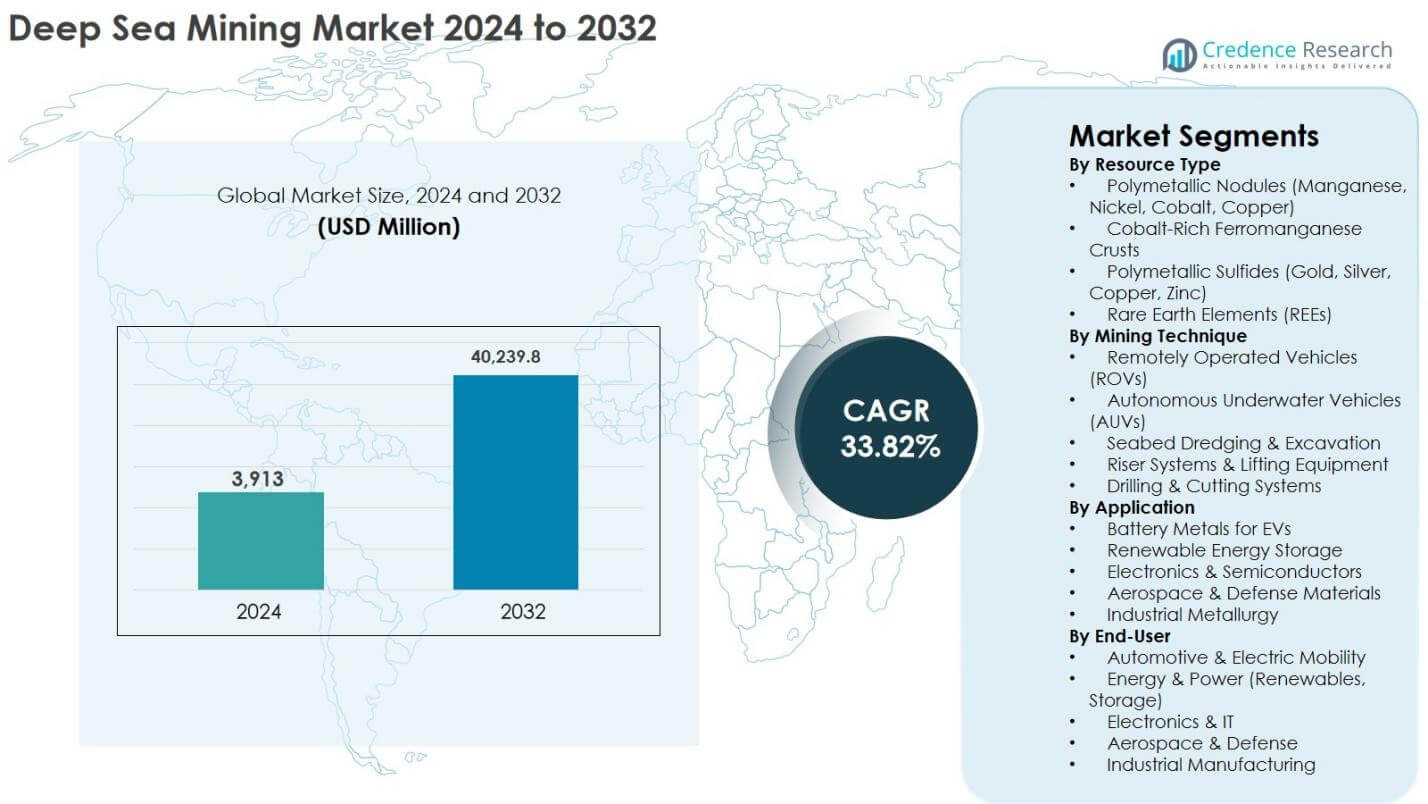
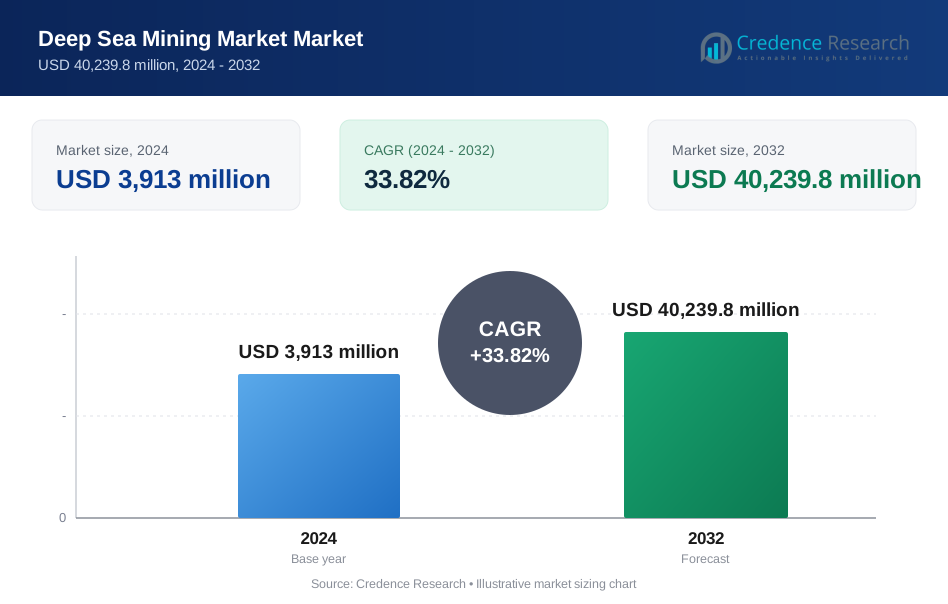
The Deep Sea Mining market size was valued at USD 3,913 million in 2024 and is anticipated to reach USD 40,239.8 million by 2032, growing at a CAGR of 33.82% during the forecast period.
| REPORT ATTRIBUTE | DETAILS |
|---|---|
| Historical Period | 2020-2023 |
| Base Year | 2024 |
| Forecast Period | 2025-2032 |
| Deep Sea Mining Market Size 2024 | USD 44704 million |
| Deep Sea Mining Market, CAGR | 33.82% |
| Deep Sea Mining Market Size 2032 | USD 40,239.8 million |
Deep Sea Mining Market Insights
- Market growth is driven by rising demand for critical minerals such as nickel, cobalt, copper, and manganese for EV batteries, renewable energy storage, and grid infrastructure, with polymetallic nodules dominating the resource segment at 48.6% share due to high metal concentration and wide seabed availability.
- Technological progress in subsea robotics and sensing systems is a key trend, with remotely operated vehicles accounting for 41.3% segment share, enabling precise mineral collection, improved safety, and real-time environmental monitoring at ultra-deep ocean depths.
- Competitive activity remains concentrated among a limited number of players focusing on proprietary mining systems, environmental compliance readiness, and long-term exploration licenses, while high capital intensity and evolving international regulations act as major restraints.
- Regionally, North America led the market with 32.8% share in 2024, followed by Asia Pacific at 29.1% driven by battery metals demand, Europe at 26.4% supported by sustainability-led policies, with Latin America and Middle East & Africa collectively accounting for 11.7%.
Deep Sea Mining Market Segmentation Analysis:
By Resource Type
The Deep Sea Mining market by resource type is led by polymetallic nodules, which accounted for 48.6% market share in 2024, driven by their high concentration of manganese, nickel, cobalt, and copper in a single deposit. These nodules are widely distributed across abyssal plains, enabling relatively lower extraction complexity compared to other resources. Rising demand for battery-grade nickel and cobalt for electric vehicles and energy storage systems remains the primary growth driver. Additionally, secure access to critical minerals and reduced reliance on terrestrial mining support continued dominance of polymetallic nodules over sulfides, crusts, and rare earth elements.
- For instance, The Metals Company reported in 2023 that nodules in its NORI-D area of the Clarion-Clipperton Zone contain an average of about 1.4% nickel, 0.2% cobalt, 29% manganese, and 1.2% copper, underscoring their multi-metal potential.
By Mining Technique
By mining technique, remotely operated vehicles (ROVs) dominated the Deep Sea Mining market with a 41.3% share in 2024, supported by their precision control, operational safety, and ability to function at extreme depths. ROVs enable accurate resource collection while minimizing equipment loss and operational risk in harsh subsea environments. Key growth drivers include advancements in underwater robotics, real-time monitoring capabilities, and increased investment in deep-sea exploration technologies. Compared to dredging or riser-based systems, ROVs offer greater adaptability across varying seabed conditions, making them the preferred solution for early-stage and commercial-scale mining projects.
- For instance, Oceaneering International’s Magnum and Millennium work‑class ROVs have been used in complex subsea construction and inspection campaigns worldwide, providing a proven platform of high‑power tooling, real‑time data links, and high‑definition imaging that can be adapted for deep‑sea mineral extraction tasks.
By Application
In terms of application, battery metals for EVs held the largest share of 44.9% in 2024, reflecting the accelerating global transition toward electric mobility. Deep sea resources provide critical inputs such as nickel, cobalt, and manganese essential for high-energy-density lithium-ion batteries. Growth is driven by rapid EV production expansion, government mandates for electrification, and long-term supply constraints in land-based mining. The segment also benefits from rising investments in sustainable battery supply chains and strategic stockpiling of critical minerals, positioning battery metals as the primary demand driver over electronics, aerospace, and industrial metallurgy applications.
Key Growth Drivers
Rising Demand for Critical Minerals for Energy Transition
The Deep Sea Mining market is strongly driven by surging global demand for critical minerals such as nickel, cobalt, copper, manganese, and rare earth elements, which are essential for electric vehicles, renewable energy storage, and grid infrastructure. Rapid electrification of transportation, expansion of lithium-ion battery manufacturing, and large-scale deployment of wind and solar power systems are placing pressure on existing terrestrial mineral supplies. Deep sea resources offer high-grade concentrations and long-term availability, supporting supply security for clean energy technologies. Governments and industrial players are increasingly prioritizing diversified mineral sourcing to reduce geopolitical risks and dependence on limited land-based reserves, accelerating interest in deep sea mining development.
- For instance, the European Commission’s 2023 Critical Raw Materials Act highlights cobalt, nickel, rare earths, and manganese as strategic inputs for batteries and renewables, and calls for diversified, resilient supply chains beyond traditional terrestrial sources.
Depletion and Environmental Constraints of Terrestrial Mining
Declining ore grades, rising extraction costs, and stricter environmental regulations are limiting the scalability of traditional mining operations, creating a strong growth driver for the Deep Sea Mining market. Many onshore mines face land acquisition challenges, water scarcity, community opposition, and higher carbon footprints. In contrast, deep sea mineral deposits remain largely untapped and offer significantly higher metal concentrations per ton of ore. The potential to reduce deforestation, overburden removal, and surface-level ecological disruption is encouraging governments and mining companies to explore offshore alternatives as a strategic supplement to terrestrial mining operations.
- For instance, the International Energy Agency has documented a steady decline in average copper ore grades in major producing regions over recent decades, contributing to higher energy use and emissions per unit of metal produced on land.
Advancements in Deep-Sea Exploration and Mining Technologies
Technological progress in underwater robotics, sensing systems, and subsea processing equipment is accelerating the feasibility of deep sea mining projects. Innovations in remotely operated vehicles, autonomous underwater vehicles, riser systems, and real-time seabed mapping have improved operational accuracy, safety, and cost efficiency at extreme depths. Enhanced monitoring and data analytics enable better resource assessment and environmental management, reducing operational uncertainty. Increased investment in pilot projects and prototype testing is supporting faster commercialization, making advanced subsea technologies a critical driver for market expansion.
Key Trends & Opportunities
Strategic Government and Institutional Support for Critical Minerals
A major trend shaping the Deep Sea Mining market is growing government involvement in securing critical mineral supply chains. National strategies focused on battery materials, defense readiness, and energy independence are encouraging funding, licensing frameworks, and international collaborations for seabed exploration. Public-private partnerships and multilateral initiatives are emerging to balance resource development with environmental oversight. This trend creates significant opportunities for technology providers, exploration firms, and service companies to participate in early-stage projects backed by long-term policy support and strategic mineral stockpiling programs.
- For instance, Norway’s Parliament approved in 2024 the opening of parts of its continental shelf for exploration of seabed minerals, positioning these resources as a potential contributor to European critical mineral security under a state‑regulated licensing regime
Integration of Sustainable and Low-Impact Mining Practices
Sustainability-focused innovation is emerging as a key opportunity within the Deep Sea Mining market. Companies are investing in low-impact collection systems, sediment control technologies, and continuous environmental monitoring to address ecological concerns. The adoption of responsible mining frameworks and transparent data reporting is becoming a differentiator for project approvals and investor confidence. This trend opens opportunities for advanced environmental technology providers and positions deep sea mining as a potentially lower-carbon alternative to conventional mining when aligned with strict sustainability standards.
- For instance, the International Seabed Authority’s evolving Mining Code framework requires contractors to implement environmental management and monitoring plans, spurring demand for specialized sensing, data analytics, and marine baseline assessment technologies from environmental service providers.
Key Challenges
Environmental and Ecological Uncertainty
Environmental impact remains one of the most significant challenges for the Deep Sea Mining market. Limited scientific understanding of deep-sea ecosystems raises concerns about biodiversity loss, habitat destruction, and long-term ecological disruption. Sediment plumes, noise pollution, and disturbance of slow-growing marine species present regulatory and reputational risks. Ongoing debates among environmental groups, policymakers, and scientists are delaying approvals and increasing scrutiny, which can slow project timelines and raise compliance costs for market participants.
Regulatory Complexity and High Capital Requirements
The market faces challenges related to evolving international regulations and high upfront capital investment. Deep sea mining activities are governed by complex international frameworks that continue to evolve, creating uncertainty around licensing, environmental standards, and operational compliance. Additionally, the capital-intensive nature of subsea equipment, vessels, and long development cycles limits participation to well-funded organizations. These factors can constrain market entry, delay commercialization, and increase financial risk, particularly for early-stage projects.
Regional Analysis
North America
North America accounted for 32.8% of the Deep Sea Mining market in 2024, supported by strong government-backed research programs, advanced offshore engineering capabilities, and strategic focus on critical mineral security. The region benefits from robust investments in subsea robotics, exploration technologies, and pilot-scale mining initiatives aimed at supporting EV batteries, defense systems, and renewable energy infrastructure. Policy emphasis on reducing dependence on foreign mineral imports further strengthens regional activity. Collaboration between technology developers, research institutions, and mining companies positions North America as a leading hub for early-stage commercialization and technological innovation in deep sea mining.
Europe
Europe held a 26.4% share of the Deep Sea Mining market in 2024, driven by strong regulatory frameworks, sustainability-led mineral strategies, and active participation in international seabed exploration programs. European countries emphasize responsible sourcing of battery metals and rare earth elements to support electric mobility, renewable energy expansion, and industrial decarbonization goals. The region benefits from advanced maritime engineering, subsea equipment manufacturing, and public-private partnerships focused on environmental monitoring. Europe’s leadership in ESG compliance and low-impact mining technologies continues to influence global standards while supporting steady regional market growth.
Asia Pacific
Asia Pacific represented 29.1% of the Deep Sea Mining market in 2024, making it one of the fastest-growing regions globally. Strong demand for battery metals from EV manufacturing, electronics production, and renewable energy storage is a key growth driver. Countries in the region are actively investing in deep-sea exploration to secure long-term access to nickel, cobalt, and rare earth elements. Expanding industrial capacity, government-backed mineral security initiatives, and increasing offshore technological capabilities support regional dominance. Asia Pacific’s large-scale manufacturing base significantly accelerates demand for deep sea–sourced minerals.
Latin America
Latin America captured 6.7% of the Deep Sea Mining market in 2024, supported by growing interest in offshore mineral exploration as a complement to traditional land-based mining. The region’s extensive maritime zones and proximity to mineral-rich seabeds create long-term growth potential. Governments are gradually exploring regulatory frameworks to attract foreign investment while balancing environmental considerations. Rising participation in global clean energy supply chains and battery material exports is encouraging deeper engagement in subsea resource development. Although still emerging, Latin America presents attractive opportunities for exploration partnerships and technology deployment.
Middle East & Africa
The Middle East & Africa region accounted for 5.0% of the Deep Sea Mining market in 2024, reflecting early-stage development but growing strategic interest. Coastal nations are evaluating seabed mineral potential to diversify economies beyond hydrocarbons and strengthen access to critical raw materials. Investments in offshore infrastructure, marine research, and international collaborations are gradually increasing. The region’s long-term opportunity lies in leveraging deep sea mining to support energy transition initiatives, industrial diversification, and export-oriented mineral strategies. Regulatory development and technology access will be key to accelerating future market participation.
Deep Sea Mining Market Segmentations:
By Resource Type
- Polymetallic Nodules (Manganese, Nickel, Cobalt, Copper)
- Cobalt-Rich Ferromanganese Crusts
- Polymetallic Sulfides (Gold, Silver, Copper, Zinc)
- Rare Earth Elements (REEs)
By Mining Technique
- Remotely Operated Vehicles (ROVs)
- Autonomous Underwater Vehicles (AUVs)
- Seabed Dredging & Excavation
- Riser Systems & Lifting Equipment
- Drilling & Cutting Systems
By Application
- Battery Metals for EVs
- Renewable Energy Storage
- Electronics & Semiconductors
- Aerospace & Defense Materials
- Industrial Metallurgy
By End-User
- Automotive & Electric Mobility
- Energy & Power (Renewables, Storage)
- Electronics & IT
- Aerospace & Defense
- Industrial Manufacturing
By Geography
- North America
- U.S.
- Canada
- Mexico
- Europe
- Germany
- France
- U.K.
- Italy
- Spain
- Rest of Europe
- Asia Pacific
- China
- Japan
- India
- South Korea
- South-east Asia
- Rest of Asia Pacific
- Latin America
- Brazil
- Argentina
- Rest of Latin America
- Middle East & Africa
- GCC Countries
- South Africa
- Rest of the Middle East and Africa
Competitive Landscape
Competitive landscape of the Deep Sea Mining market is characterized by a small group of technologically advanced players focused on seabed exploration, subsea robotics, and mineral recovery systems, with operations largely driven by long-term strategic positioning rather than near-term volume production. Key players include Lockheed Martin Corporation, Global Sea Mineral Resources NV, Kongsberg Gruppen, Royal IHC, Odyssey Marine Exploration, Inc., China Minmetals Corporation, and Japan Oil, Gas and Metals National Corporation. These companies emphasize proprietary mining technologies, seabed mapping, and environmental monitoring capabilities to secure exploration contracts and future production rights. Strategic collaborations with governments, research institutions, and offshore engineering firms are common, while competitive positioning increasingly depends on compliance readiness, technological reliability, and access to capital for large-scale pilot and commercial projects.
Key Player Analysis
- Japan Oil, Gas and Metals National Corporation
- Royal IHC
- Lockheed Martin Corporation
- Deep Reach Technology, Inc.
- China Minmetals Corporation
- Kongsberg Gruppen
- Odyssey Marine Exploration, Inc.
- Global Sea Mineral Resources NV (GSR, DEME Group)
- Soil Machine Dynamics Ltd.
- Keppel Corporation Limited
Recent Developments
- In July 2025, American Resources Corporation along with ReElement Technologies Corporation and Impossible Metals, Inc. signed an MOU collaboration to investigate and develop a sustainable U.S. supply chain for refining rare earth and critical minerals from deep-sea nodules.
- In June 2025, The Metals Company (TMC) received an $85.2 million investment from Korea Zinc aimed at accelerating the development of deep-seabed critical mineral extraction capabilities in the United States
- In May 2025, The Metals Company (TMC) announced a $37 million strategic investment financing round led by Michael Hess and SAF Growth to advance its deep-sea mineral development operations and support potential commercial recovery permit efforts.
Report Coverage
The research report offers an in-depth analysis based on Resource Type, Mining Technique, Application, End-User and Geography. It details leading market players, providing an overview of their business, product offerings, investments, revenue streams, and key applications. Additionally, the report includes insights into the competitive environment, SWOT analysis, current market trends, as well as the primary drivers and constraints. Furthermore, it discusses various factors that have driven market expansion in recent years. The report also explores market dynamics, regulatory scenarios, and technological advancements that are shaping the industry. It assesses the impact of external factors and global economic changes on market growth. Lastly, it provides strategic recommendations for new entrants and established companies to navigate the complexities of the market.
Future Outlook
- Deep sea mining activities are expected to accelerate as demand for critical minerals supporting electrification and energy transition continues to rise globally.
- Advancements in subsea robotics, autonomous systems, and real-time monitoring will improve operational efficiency and safety at greater ocean depths.
- Regulatory frameworks governing seabed mining are likely to become clearer, enabling more pilot projects to transition into commercial-scale operations.
- Strategic government involvement will increase to secure long-term access to battery metals and reduce dependence on limited terrestrial mineral sources.
- Environmental monitoring and low-impact mining technologies will play a central role in gaining approvals and investor confidence.
- Partnerships between mining companies, technology providers, and research institutions will strengthen innovation and risk-sharing.
- Asia Pacific is expected to witness the fastest growth due to expanding EV manufacturing and electronics production capacity.
- Cost optimization and modular mining system designs will improve project viability over the forecast period.
- Competition will intensify as new entrants focus on niche technologies and environmentally responsible mining solutions.
- Deep sea mining is likely to emerge as a strategic complement to land-based mining rather than a complete replacement
Request a Free Sample
Fill in your details and we'll send you a free sample report.
- Sample data tables & charts
- Research methodology
Need a Custom Version of This Report?
Tailor the scope, geography, or segments to your exact requirements.
- Custom geography or segment scope
- Direct access to our analyst team
Frequently Asked Questions
What is the current market size for the Deep Sea Mining market, and what is its projected size in 2032?
At what Compound Annual Growth Rate is the Deep Sea Mining market projected to grow between 2024 and 2032?
Which Deep Sea Mining market segment held the largest share in 2024?
What are the primary factors fueling the growth of the Deep Sea Mining market?
Who are the leading companies in the Deep Sea Mining market?
Which region commanded the largest share of the Deep Sea Mining market in 2024?
Table of Content
Chapter 1. Report Introduction
- 1.1 Report Description & Purpose
- 1.1.1 Report Title & Market Definition
- 1.1.2 Unique Selling Propositions (USP) & Key Differentiators
- 1.1.3 Value Proposition for Stakeholders
- 1.2 Research Objectives
- 1.2.1 Market Sizing Objectives (Volume & Revenue) (Volume Where Applicable)
- 1.2.2 Segmentation Objectives
- 1.2.3 Competitive Intelligence Objectives
- 1.2.4 Forecast & Scenario Objectives
- 1.3 Report Scope
- 1.3.1 Deep Sea Mining Market Scope – Segments & Subsegments Covered
- 1.3.2 Geographic Scope – Regions & Countries Covered
- 1.3.3 Historical Period, Base Year & Forecast Period (2024; forecast to 2032)
- 1.3.4 Inclusions & Exclusions
- 1.4 Industry Classification & Applicable Codes
- 1.5 Currency, Measurement Units & Valuation Basis
- 1.6 Target Stakeholders
- 1.7 Limitations & Assumptions
Chapter 2. Executive Summary
- 2.1 Global Deep Sea Mining Market Market Snapshot
- 2.1.1 Market Size – Historical (2024) & Forecast (2024-2032) (2024: USD 3,913 million → 2032: USD 40,239.8 million)
- 2.1.2 Volume & Revenue – Global Totals (Volume Where Applicable)
- 2.1.3 Key Market Highlights – Top Five Facts
- 2.2 Deep Sea Mining Market Market Segmentation Snapshot
- 2.2.1 Market Split by Region – 2024 vs. 2032
- 2.3 Competitive Snapshot
- 2.3.1 Top 10 Players by Revenue Share – 2024
- 2.3.2 Top 10 Players by Volume Share – 2024 (Volume Where Applicable)
- 2.3.3 Recent Strategic Developments (18-Month Summary)
- 2.4 Key Investment Highlights & Strategic Conclusions
Chapter 3. Deep Sea Mining Market Market Dynamics & Industry Analysis
- 3.1 Market Overview & Context
- 3.1.1 Deep Sea Mining Market Market Position in the Broader Industry Value Chain
- 3.1.2 Demand Structure & Purchasing Dynamics
- 3.1.3 Market Maturity & Development Stage by Region
- 3.2 Deep Sea Mining Market Market Drivers
- 3.3 Deep Sea Mining Market Market Restraints & Challenges
- 3.4 Deep Sea Mining Market Market Opportunities
- 3.5 Porter's Five Forces Analysis
- 3.5.1 Threat of New Entrants
- 3.5.2 Bargaining Power of Suppliers
- 3.5.3 Bargaining Power of Buyers
- 3.5.4 Threat of Substitutes
- 3.5.5 Competitive Rivalry – Intensity Assessment
- 3.6 Deep Sea Mining Market Value Chain Analysis
- 3.6.1 Upstream – Key Inputs, Resources & Suppliers
- 3.6.1.1 Key Input/Resource 1
- 3.6.1.2 Key Input/Resource 2
- 3.6.1.3 Key Input/Resource 3
- 3.6.2 Midstream – Core Operations & Value Creation
- 3.6.2.1 Operating Model & Process Overview
- 3.6.2.2 Key Operating Locations & Capabilities by Company
- 3.6.3 Downstream – Market Channels & End Users
- 3.6.3.1 Direct Sales & Customer Engagement Channels
- 3.6.3.2 Indirect Sales, Intermediaries & Partner Channels
- 3.6.4 Value Chain Profitability Analysis
- 3.6.1 Upstream – Key Inputs, Resources & Suppliers
- 3.7 PESTEL Analysis
- 3.7.1 Political Factors
- 3.7.2 Economic Factors
- 3.7.3 Social Factors
- 3.7.4 Technological Factors
- 3.7.5 Environmental Factors
- 3.7.6 Legal Factors
- 3.8 Deep Sea Mining Market Supply Chain Analysis
- 3.8.1 Critical Input & Resource Availability Risk Assessment
- 3.8.2 Supplier & Operational Concentration Risk (Geographic Exposure)
- 3.8.3 Supply & Service Disruption Impact Analysis
- 3.9 Regulatory & Policy Landscape
Note: The regulatory and policy landscape section covers regulations based on their applicability to the market, Deep Sea Mining Market category, geography, and scope of the study. Only regulatory frameworks with a material impact on operations, compliance, trade, sustainability, or market access are analyzed in detail.
Chapter 4. Key Investment Pockets & Opportunity Analysis
- 4.1 Deep Sea Mining Market Market Attractiveness Analysis
- 4.1.1 By Region – Investment Attractiveness Matrix (Market Size × CAGR)
- 4.2 Absolute Revenue Growth Opportunity
- 4.2.1 By Region – Absolute Revenue Growth Through 2032
- 4.3 Incremental Demand Opportunity
- 4.3.1 By Region – Incremental Demand Through 2032
- 4.3.2 Segment – Incremental Demand
- 4.4 Emerging Submarket Opportunity Deep Dive (Subject to Applicability)
- 4.5 Priority Market Opportunity Scorecards
- 4.5.1 United States
- 4.5.2 Europe
- 4.5.3 Asia
- 4.5.4 Middle East & Africa
Note: Priority market opportunity scorecards reflect the geographic scope and strategic relevance of the study. Listed markets are indicative and may be adapted to the industry.
Chapter 5. Deep Sea Mining Market Cross-Border Trade & Market Access Analysis
- 5.1 International Trade & Cross-Border Activity Overview
- 5.1.1 Global Export Value by Country (2024)
- 5.1.2 Global Export Volume by Country (2024) (Volume Where Applicable)
- 5.1.3 Global Import Value by Country (2024)
- 5.1.4 Global Import Volume by Country (2024) (Volume Where Applicable)
- 5.1.5 Net Trade Balance by Country (2024)
- 5.2 Export Analysis – Segment
- 5.2.1 Category 1 (Applicable Classification Code)
- 5.2.2 Category 2 (Applicable Classification Code)
- 5.2.3 Category 3 (Applicable Classification Code)
- 5.2.4 Category 4 (Applicable Classification Code)
- 5.2.5 Category 5 (Applicable Classification Code)
- 5.3 Import Analysis – Segment
- 5.3.1 Category 1 (Applicable Classification Code)
- 5.3.2 Category 2 (Applicable Classification Code)
- 5.3.3 Category 3 (Applicable Classification Code)
- 5.3.4 Category 4 (Applicable Classification Code)
- 5.3.5 Category 5 (Applicable Classification Code)
- 5.4 Cross-Border Pricing & Transaction Benchmarks
- 5.4.1 Export Pricing – Segment & Country
- 5.4.2 Import Pricing – Segment & Source Country
- 5.4.3 Price Trends (2024)
- 5.5 Key Cross-Border Trade & Delivery Routes
- 5.5.1 Cross-Border Trade/Delivery Route 1
- 5.5.2 Cross-Border Trade/Delivery Route 2
- 5.5.3 Cross-Border Trade/Delivery Route 3
- 5.5.4 Cross-Border Trade/Delivery Route 4
- 5.5.5 Cross-Border Trade/Delivery Route 5
- 5.6 Trade Policy & Market Access Impact Assessment
- 5.6.1 Tariff & Non-Tariff Barriers
- 5.6.2 Regional Trade & Economic Integration Frameworks
- 5.6.3 Bilateral & Multilateral Trade Agreements
- 5.6.4 Cross-Border Operating, Licensing & Localization Requirements
Note: This chapter applies where cross-border trade or delivery is relevant to Deep Sea Mining Market. Goods, services, and digital offerings are assessed using applicable classifications and transaction measures. Import-export volumes, trade balances, and route analyses are included only where meaningful to the market.
Chapter 6. Competitive Landscape & Company Benchmarking
- 6.1 Deep Sea Mining Market Market Concentration & Structure
- 6.1.1 Herfindahl-Hirschman Index (HHI) – the historical period vs. 2024
- 6.1.2 Leading, Mid-Sized & Emerging Player Structure
- 6.1.3 Global, Regional & Local Player Dynamics
- 6.2 Deep Sea Mining Market Market Share Analysis – 2024
- 6.2.1 Global Revenue Share by Company
- 6.2.2 Global Volume Share by Company (Volume Where Applicable)
- 6.2.3 Regional Revenue Share
- 6.2.4 Market Share Evolution (the historical period vs. 2024)
- 6.2.5 Company Market Share by Key Segment
- 6.2.6 Company Market Share by Customer Group
- 6.3 Operating Scale, Capacity & Infrastructure Analysis
- 6.3.1 Global Operating Scale & Supply Capacity
- 6.3.2 Resource Utilization & Operating Efficiency
- 6.3.3 Output, Service Delivery & Activity Metrics
- 6.3.4 Operating Footprint & Infrastructure Map
- 6.3.5 Planned Operational & Capacity Expansion
- 6.4 Deep Sea Mining Market Competitive Benchmarking Matrix
- 6.4.1 Revenue, Growth, Profitability & Operating Metric Comparison
- 6.4.2 Channel Revenue Mix
- 6.4.3 Geographic Revenue Exposure
- 6.4.4 R&D Intensity
- 6.4.5 Sustainability Maturity
- 6.5 Strategic Developments in Deep Sea Mining Market (Last 24 Months)
- 6.5.1 Mergers, Acquisitions & Divestments
- 6.5.2 New Products, Services & Solutions in Deep Sea Mining Market
- 6.5.3 Operational & Infrastructure Expansions
- 6.5.4 Strategic Alliances, Joint Ventures & Partnerships
- 6.5.5 Distribution Expansion & Market Entry
- 6.5.6 Sustainability & ESG Initiatives
- 6.6 Competitive Strategy Mapping
- 6.6.1 Leader, Challenger, Follower & Niche Classification
- 6.6.2 Pricing Strategy Comparison
- 6.6.3 Channel Strategy Matrix
Note: Strategic developments are included based on their materiality and the availability of reliable information.
Chapter 7. Global Deep Sea Mining Market Market – By Sales & Delivery Channel
- 7.1 Segment Overview
- 7.1.1 Volume & Revenue Split by Channel (2024 & 2032) (Volume Where Applicable)
- 7.1.2 Channel Mix Evolution (2024-2032)
Chapter 8. Regional Market Analysis – Global Overview
- 8.1 Global Regional Overview
- 8.1.1 Regional Volume Share (Volume Where Applicable)
- 8.1.2 Regional Revenue Share
- 8.1.3 Regional Volume by Region (Volume Where Applicable)
- 8.1.4 Regional Revenue by Region
- 8.1.5 Regional Forecast Through 2032
- 8.2 Cross-Regional Segment Analysis
- 8.2.1 By Sales & Delivery Channel
- 8.2.2 By Competitive Positioning & Price Tier
Chapter 9. North America Deep Sea Mining Market Market
- 9.1 United States
- 9.2 Canada
- 9.3 Mexico
Chapter 10. Europe Deep Sea Mining Market Market
- 10.1 Germany
- 10.2 France
- 10.3 Italy
- 10.4 United Kingdom
- 10.5 Spain
- 10.6 Poland
- 10.7 Russia
- 10.8 Netherlands
- 10.9 Belgium
- 10.10 Sweden
- 10.11 Denmark
- 10.12 Norway
- 10.13 Rest of Europe
Chapter 11. Asia Pacific Deep Sea Mining Market Market
- 11.1 China
- 11.2 India
- 11.3 Japan
- 11.4 South Korea
- 11.5 Thailand
- 11.6 Indonesia
- 11.7 Vietnam
- 11.8 Malaysia
- 11.9 Australia
- 11.10 Rest of Asia Pacific
Chapter 12. Latin America Deep Sea Mining Market Market
- 12.1 Brazil
- 12.2 Argentina
- 12.3 Colombia
- 12.4 Chile
- 12.5 Rest of Latin America
Chapter 13. Middle East Deep Sea Mining Market Market
- 13.1 Saudi Arabia
- 13.2 United Arab Emirates
- 13.3 Turkey
- 13.4 Israel
- 13.5 Iran
- 13.6 Rest of the Middle East
Chapter 14. Africa Deep Sea Mining Market Market
- 14.1 South Africa
- 14.2 Egypt
- 14.3 Nigeria
- 14.4 Morocco
- 14.5 Rest of Africa
Chapter 15. Deep Sea Mining Market Company Profiles
- 15.1 [Company 01]
- 15.1.1 Company Overview
- 15.1.2 Key Management Personnel
- 15.1.3 Products & Services Portfolio
- 15.1.4 Financial Performance
- 15.1.5 Key Market Focus & Geographic Presence
- 15.1.6 Recent Developments & Strategic Initiatives
Note: The company profile list is preliminary and may change based on research findings, market developments, data availability, and client requirements.
Chapter 16. Appendices
- Appendix A – List of Abbreviations & Acronyms
- Appendix B – Industry Classification Code Reference – Full Series
- Appendix C – Supply, Output & Operating Capacity Data Tables
- Appendix D – End-Use & Demand Base Tables
- Appendix E – Demand, Adoption & Usage Assumptions
- Appendix F – Pricing & Revenue Metric Reference Tables
- Appendix G – Company Operations & Infrastructure Database
- Appendix H – Cross-Border Trade & Activity Data Tables (Where Applicable)
- Appendix I – Regulatory Summary Tables
- Appendix J – Primary Research Participant List (Anonymized)
- Appendix K – Primary Research Questionnaire Framework
- Appendix L – Data Sources & Bibliography
- Appendix M – Market Size Divergence & Source Comparison
Chapter 17. Research Methodology
- 17.1 Research Framework & Philosophy
- 17.2 Secondary Research – Sources, Hierarchy & Data Extraction
- 17.3 Data Modeling – Bottom-Up & Top-Down Market Sizing
- 17.4 Primary Research – Stakeholder Framework, LOI & Sample Sizes
- 17.5 Forecast Methodology – Regression, Scenario & Sensitivity Analysis
- 17.6 Quality Control – Four-Layer Validation Framework
- 17.7 Limitations & Standard Assumptions
- 17.8 Disclaimer
