Cupuacu Butter Market Overview:
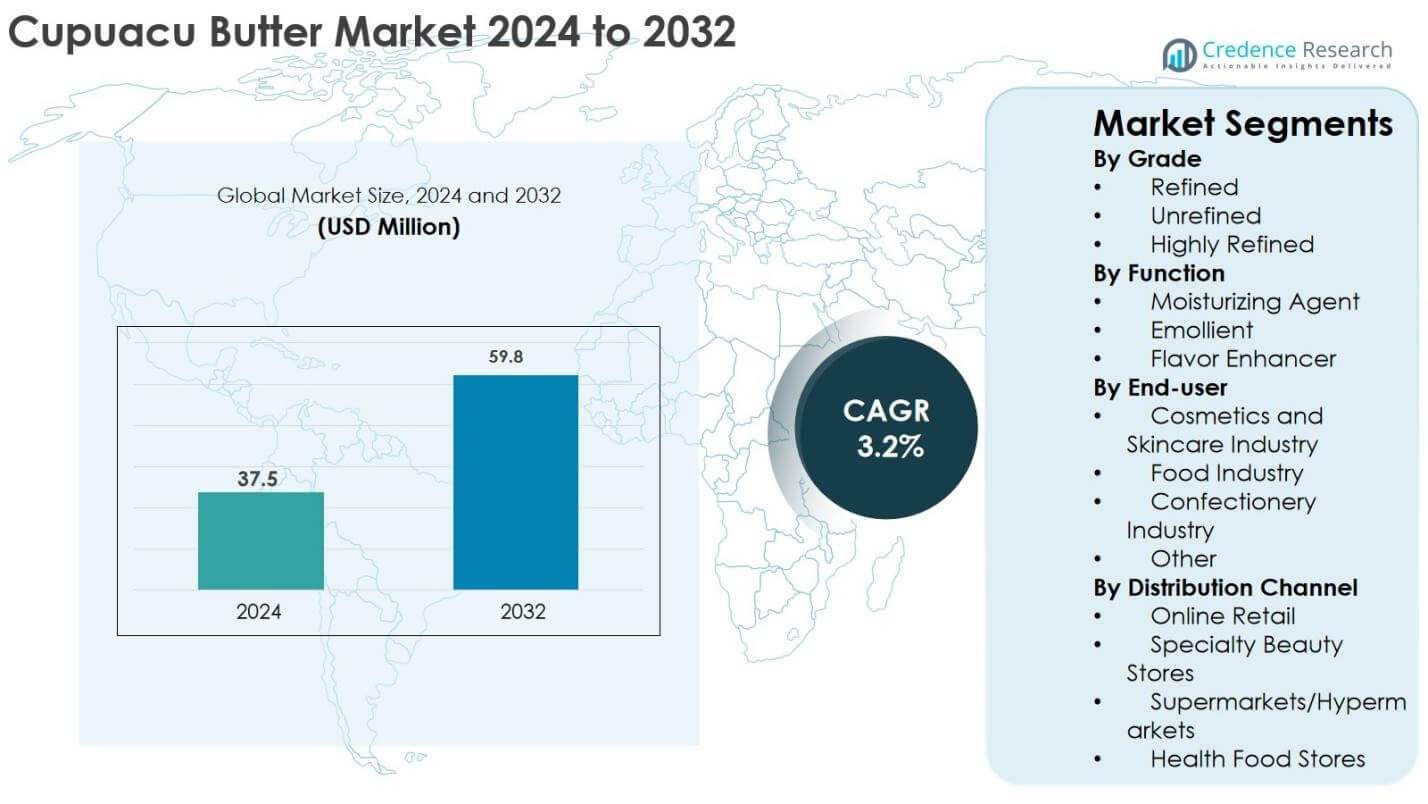
The Cupuacu Butter market size was valued at USD 37.5 million in 2024 and is anticipated to reach USD 59.8 million by 2032, growing at a CAGR of 6% during the forecast period.
| REPORT ATTRIBUTE | DETAILS |
|---|---|
| Historical Period | 2020-2023 |
| Base Year | 2024 |
| Forecast Period | 2025-2032 |
| Cupuacu Butter Market Size 2024 | USD 37.5 million |
| Cupuacu Butter Market, CAGR | 6% |
| Cupuacu Butter Market Size 2032 | USD 59.8 million |
Cupuacu Butter Market Insights
- Market growth is primarily driven by rising demand for natural, plant-based, and sustainably sourced ingredients, with the cosmetics and skincare end-user segment dominating at 56.8% market share in 2024 due to extensive use in moisturizers, body butters, and haircare formulations.
- Key market trends include increasing adoption of multifunctional butters and premium formulations, while refined grade cupuacu butter leads the grade segment with 48.6% share, supported by consistent quality and large-scale manufacturing compatibility.
- The competitive environment features global ingredient suppliers and specialty brands focusing on ethical sourcing, traceability, and formulation expertise, while competition from shea and cocoa butter acts as a restraint on pricing and adoption.
- Regionally, North America led the market with 32.4% share in 2024, followed by Europe at 28.1% and Asia Pacific at 22.6%, driven by strong personal care manufacturing, clean-label demand, and growing consumer awareness.
Cupuacu Butter Market Segmentation Analysis:
By Grade
The cupuacu butter market by grade shows strong preference for refined variants, which accounted for 48.6% market share in 2024, driven by their consistent quality, neutral odor, and extended shelf life. Refined cupuacu butter is widely adopted across large-scale cosmetics and personal care manufacturing, where formulation stability and regulatory compliance are critical. Unrefined butter follows due to rising demand for clean-label and organic skincare products, while highly refined grades gain traction in premium formulations requiring ultra-low impurity levels. Growth in this segment is supported by expanding global skincare production and increasing exports of standardized cosmetic ingredients.
- For instance, several established cosmetic ingredient suppliers offer refined cupuacu butter grades specifically standardized for oxidative stability and low peroxide values to support long production cycles in skin and hair care lines.
By Function
By function, the emollient segment dominated the cupuacu butter market with a 44.2% share in 2024, supported by the ingredient’s superior water-binding capacity and lipid composition. Cupuacu butter is extensively used as an emollient to restore skin elasticity and enhance barrier protection in creams, lotions, and hair conditioners. The moisturizing agent segment also recorded strong adoption due to rising demand for deep-hydration products, while flavor enhancer usage remains niche, primarily within specialty food formulations. Growing consumer preference for multifunctional, plant-based ingredients continues to drive functional diversification across end-use applications.
- For instance, cupuacu butter is described in cosmetic ingredient catalogs (e.g., from suppliers such as Hallstar and Natural Plant Products) as a plant-based emollient that offers high water absorption and improved skin feel in emulsions.
By End-user
The cosmetics and skincare industry emerged as the dominant end-user segment, holding a 56.8% market share in 2024, driven by increasing demand for natural butters in premium and dermatologically tested formulations. Cupuacu butter is widely used in moisturizers, lip balms, body butters, and hair masks due to its high absorption and nourishing properties. The food and confectionery industries represent smaller but growing segments, supported by clean-label trends and specialty product innovation. Expansion of natural cosmetic brands and rising consumer awareness of Amazonian botanicals remain key growth drivers for end-user demand.
Key Growth Drivers
Rising Demand for Natural and Plant-Based Cosmetic Ingredients
The Cupuacu Butter market is experiencing strong growth due to rising demand for natural, plant-based, and sustainably sourced cosmetic ingredients. Consumers increasingly prefer clean-label skincare and haircare products formulated without synthetic additives, driving manufacturers to adopt botanical butters with proven functional benefits. Cupuacu butter offers superior moisturizing, emollient, and barrier-repair properties compared to conventional alternatives, making it highly attractive for premium personal care formulations. Its natural origin and compatibility with organic and vegan product lines further strengthen adoption. In addition, growing awareness of skin health, anti-aging solutions, and long-lasting hydration has accelerated its inclusion in creams, lotions, balms, and hair treatments, supporting consistent demand growth across global cosmetic markets.
- For instance, Lush has incorporated cupuacu butter into products like body conditioners and hair treatments, highlighting its rich, hydrating profile and rainforest origin on product descriptions.
Expansion of Premium and Specialty Skincare Products
The rapid expansion of premium, dermatologically tested, and specialty skincare products is a major growth driver for the Cupuacu Butter market. High-end beauty brands increasingly focus on ingredient differentiation, performance efficacy, and exotic sourcing stories to attract value-conscious consumers. Cupuacu butter’s high water-absorption capacity, smooth texture, and non-greasy feel make it suitable for luxury moisturizers and therapeutic formulations. Its use in sensitive-skin, baby-care, and anti-aging products further broadens application scope. As consumers show willingness to pay higher prices for premium formulations with functional and ethical benefits, manufacturers are scaling procurement of cupuacu butter, reinforcing its role as a key value-added ingredient.
- For instance, Clariant (through its Beraca portfolio) promotes cupuacu butter as a high-performance, sustainably sourced Amazonian lipid for sophisticated skincare and haircare systems in its technical brochures.
Growing Awareness of Amazonian and Sustainable Ingredients
Increasing awareness of Amazonian biodiversity and ethically sourced ingredients is significantly driving the Cupuacu Butter market. Consumers are becoming more conscious of ingredient origin, environmental impact, and community-based sourcing practices. Cupuacu butter, derived from Amazonian fruit seeds, aligns well with sustainability narratives and fair-trade initiatives. Brands highlighting traceability, eco-friendly harvesting, and support for indigenous communities gain stronger consumer trust and brand loyalty. Regulatory encouragement toward sustainable raw materials and corporate commitments to ESG goals further support market expansion. This growing emphasis on responsible sourcing and biodiversity preservation is translating into long-term demand stability for cupuacu butter across cosmetic and personal care industries.
Key Trends & Opportunities
Integration into Multifunctional Personal Care Formulations
A key trend in the Cupuacu Butter market is its increasing integration into multifunctional personal care formulations. Manufacturers are developing products that combine moisturizing, conditioning, anti-aging, and protective properties in a single formulation. Cupuacu butter’s unique fatty acid profile allows it to function simultaneously as an emollient, humectant, and texture enhancer. This multifunctionality supports its use in all-in-one creams, hybrid skincare products, and premium hair masks. The trend aligns with consumer demand for simplified beauty routines and high-performance formulations, creating strong opportunities for ingredient suppliers to position cupuacu butter as a versatile, value-enhancing component.
- For instance, cosmetic ingredient catalogs from specialty suppliers highlight cupuacu butter in prototype formulations labeled as “multi-functional” or “all-in-one” butters, body creams, and hair masks, underlining its role in reducing the number of separate ingredients needed in a formula.
Growth Opportunities in Food and Confectionery Applications
The food and confectionery industries present emerging opportunities for the Cupuacu Butter market. Although currently smaller than cosmetics, demand is rising due to interest in novel, plant-based fats with clean-label appeal. Cupuacu butter offers a mild flavor profile and functional fat properties suitable for specialty chocolates, spreads, and gourmet confectionery products. Innovation in functional foods and premium desserts is encouraging experimentation with alternative cocoa-butter substitutes. As manufacturers seek differentiation and sustainability-driven ingredients, cupuacu butter is gaining attention as a niche but high-value ingredient, supporting diversification of end-use applications beyond personal care.
- For instance, product development articles and R&D presentations from Brazilian ingredient suppliers have showcased cupuacu derivatives in confectionery prototypes such as spreads and gourmet fillings, underlining its potential in premium food concepts.
Key Challenges
Supply Chain Constraints and Raw Material Availability
One of the primary challenges facing the Cupuacu Butter market is supply chain constraint linked to raw material availability. Cupuacu trees are geographically concentrated in the Amazon region, making production dependent on seasonal harvests and local environmental conditions. Limited cultivation scale, logistical challenges, and inconsistent yield volumes can affect supply stability and pricing. Additionally, reliance on smallholder farming communities introduces variability in processing quality and output. These factors can restrict large-scale adoption by multinational manufacturers seeking consistent and uninterrupted supply, posing a challenge to market scalability and long-term planning.
Price Volatility and Competition from Substitute Ingredients
Price volatility and competition from substitute natural butters present another key challenge for the Cupuacu Butter market. Ingredients such as shea butter, cocoa butter, and mango butter are more widely available and often priced more competitively. Fluctuations in harvesting costs, transportation expenses, and export regulations can increase cupuacu butter prices, limiting adoption in cost-sensitive formulations. Smaller manufacturers may hesitate to incorporate cupuacu butter due to margin pressures. Overcoming this challenge requires improved supply chain efficiency, expanded cultivation, and clear communication of functional advantages to justify premium pricing in end-use applications.
Regional Analysis
North America
North America accounted for 32.4% of the Cupuacu Butter market share in 2024, driven by strong demand for natural and plant-based cosmetic ingredients across the United States and Canada. The region benefits from a well-established personal care industry, high consumer awareness of clean-label formulations, and rapid adoption of premium skincare products. Manufacturers actively incorporate cupuacu butter into moisturizers, lip care, and hair conditioning products due to its superior hydration properties. Growth is further supported by rising demand for vegan and cruelty-free beauty products, along with strong retail penetration through specialty stores and online distribution channels.
Europe
Europe held a 28.1% market share in 2024, supported by stringent regulations favoring natural and sustainable cosmetic ingredients. Countries such as France, Germany, and the United Kingdom show strong demand for ethically sourced botanical butters in skincare and personal care formulations. European consumers prioritize ingredient transparency, sustainability, and product efficacy, which aligns well with cupuacu butter’s functional and environmental attributes. The region also benefits from the presence of premium cosmetic brands and increasing investment in organic product lines. Expanding demand for dermatologically tested and sensitive-skin products continues to strengthen regional market growth.
Asia Pacific
Asia Pacific captured 22.6% of the Cupuacu Butter market share in 2024, driven by expanding cosmetics manufacturing in countries such as China, Japan, South Korea, and India. Rapid urbanization, rising disposable incomes, and growing awareness of natural skincare ingredients are key growth drivers. The region shows increasing adoption of cupuacu butter in haircare, body care, and multifunctional beauty products. Demand is further supported by the popularity of K-beauty and J-beauty trends emphasizing hydration and skin barrier protection. Expansion of e-commerce platforms and local cosmetic brands accelerates market penetration across Asia Pacific.
Latin America
Latin America accounted for 11.3% of the Cupuacu Butter market share in 2024, supported by regional availability of raw materials and growing domestic consumption. Brazil plays a central role due to its proximity to cupuacu cultivation and strong cosmetics industry. Regional brands increasingly highlight Amazonian and sustainably sourced ingredients to strengthen product differentiation. Demand is also rising in personal care and niche food applications. Government initiatives supporting sustainable harvesting and biodiversity conservation further encourage market development. However, limited processing infrastructure and export challenges slightly constrain faster growth across the region.
Middle East & Africa
The Middle East & Africa held a 5.6% market share in 2024, reflecting gradual but steady adoption of cupuacu butter in premium skincare and haircare products. Growth is driven by increasing consumer spending on personal care, particularly in Gulf countries, along with rising demand for natural and moisturizing ingredients suited to dry climates. The region relies largely on imports, which influences pricing and availability. Expanding retail distribution and growing awareness of botanical ingredients support demand growth. While the market remains smaller, increasing interest in luxury and natural cosmetics presents long-term opportunities.
Cupuacu Butter Market Segmentations:
By Grade
- Refined
- Unrefined
- Highly Refined
By Function
- Moisturizing Agent
- Emollient
- Flavor Enhancer
By End-user
- Cosmetics and Skincare Industry
- Food Industry
- Confectionery Industry
- Other
By Distribution Channel
- Online Retail
- Specialty Beauty Stores
- Supermarkets/Hypermarkets
- Health Food Stores
By Geography
- North America
- U.S.
- Canada
- Mexico
- Europe
- Germany
- France
- U.K.
- Italy
- Spain
- Rest of Europe
- Asia Pacific
- China
- Japan
- India
- South Korea
- South-east Asia
- Rest of Asia Pacific
- Latin America
- Brazil
- Argentina
- Rest of Latin America
- Middle East & Africa
- GCC Countries
- South Africa
- Rest of the Middle East and Africa
Competitive Landscape
The Cupuacu Butter market is characterized by the presence of a mix of global ingredient suppliers, specialty natural product companies, and niche organic skincare brands competing on quality, sourcing transparency, and application expertise. Leading players such as Croda International Plc, Natura & Co Holding S.A., Beraca Ingredientes Naturais S/A, and The Body Shop International Limited leverage strong supply chains and sustainability-focused sourcing from the Amazon region to maintain competitive advantage. Companies including Lush Ltd, Mountain Rose Herbs, and Essential Wholesale & Labs focus on organic, clean-label positioning to address growing demand from indie and premium beauty brands. Smaller players such as Rainforest Chica, Artisan Bath & Body, and Aromaaz International strengthen competition through customization, ethical sourcing narratives, and flexible product offerings.
Key Player Analysis
- Croda International Plc
- Rainforest Chica
- Beraca Ingredientes Naturais S/A
- Artisan Bath & Body
- Natura & Co Holding S.A
- Mountain Rose Herbs
- Lush Ltd
- Essential Wholesale & Labs
- Aromaaz International
- The Body Shop International Limited
Recent Developments
- In April 2024, Sol de Janeiro launched a new cupuacu butter-infused SPF50 body lotion, expanding the use of Cupuacu butter beyond traditional moisturizers into sun-care formulations
Report Coverage
The research report offers an in-depth analysis based on Grade, Function, End-User, Distribution Channel and Geography. It details leading market players, providing an overview of their business, product offerings, investments, revenue streams, and key applications. Additionally, the report includes insights into the competitive environment, SWOT analysis, current market trends, as well as the primary drivers and constraints. Furthermore, it discusses various factors that have driven market expansion in recent years. The report also explores market dynamics, regulatory scenarios, and technological advancements that are shaping the industry. It assesses the impact of external factors and global economic changes on market growth. Lastly, it provides strategic recommendations for new entrants and established companies to navigate the complexities of the market.
Future Outlook
- Demand for cupuacu butter will increase steadily due to rising preference for natural and plant-based cosmetic ingredients.
- Cosmetic and skincare applications will remain the primary revenue contributors, supported by premium and clean-label product launches.
- Adoption of cupuacu butter in multifunctional formulations will expand across skincare and haircare segments.
- Sustainable sourcing and ethical supply chain practices will become critical factors influencing supplier selection.
- Growing awareness of Amazonian biodiversity will strengthen brand positioning and consumer trust.
- Asia Pacific will witness faster growth due to expanding cosmetics manufacturing and rising disposable incomes.
- Food and confectionery applications will gain gradual traction through specialty and clean-label product innovation.
- Product standardization and quality consistency will improve with advancements in processing technologies.
- Competition from substitute natural butters will encourage differentiation based on functionality and sustainability.
- Strategic partnerships with local producers will support long-term supply stability and market expansion.

Request a Free Sample
Fill in your details and we'll send you a free sample report.
- Sample data tables & charts
- Research methodology
Need a Custom Version of This Report?
Tailor the scope, geography, or segments to your exact requirements.
- Custom geography or segment scope
- Direct access to our analyst team
Frequently Asked Questions
What is the current market size for the Cupuacu Butter market, and what is its projected size in 2032?
At what Compound Annual Growth Rate is the Cupuacu Butter market projected to grow between 2024 and 2032?
Which Cupuacu Butter market segment held the largest share in 2024?
What are the primary factors fueling the growth of the Cupuacu Butter market?
Who are the leading companies in the Cupuacu Butter market?
Which region commanded the largest share of the Cupuacu Butter market in 2024?
Table of Content
Chapter 1 Market Segmentation
- 1.1 Segmentation Framework
- 1.1.1 Product and Service Classification
- 1.1.2 Application and End-Use Classification
- 1.1.3 Technology and Solution Classification
- 1.1.4 Customer and Distribution Channel Classification
- 1.1.5 Geographic Segmentation
- 1.1.6 Market Segment Definitions and Boundaries
Chapter 2 Introduction
- 2.1 Report Objectives and Scope
- 2.2 Product Definition and Industry Terminology
- 2.3 Market Inclusions and Exclusions
- 2.4 Research Process
- 2.4.1 Primary Research and Expert Interviews
- 2.4.2 Secondary Research and Source Review
- 2.4.3 Top-Down and Bottom-Up Estimation
- 2.4.4 Data Triangulation and Verification
- 2.5 Market Size Measurement Basis
- 2.5.1 2024: USD 37.5 million → 2032: USD 59.8 million
- 2.6 Historical and Forecast Reference Periods
- 2.6.1 Base Year: 2024
- 2.6.2 Forecast Period: 2024-2032
- 2.7 Research Assumptions and Limitations
Chapter 3 Executive Summary
- 3.1 Market Snapshot and Key Findings
- 3.2 Base-Year Market Size, 2024
- 3.3 Forecast Market Size, 2032
- 3.4 Revenue and Volume Growth Outlook
- 3.5 Key Demand and Supply Indicators
- 3.6 Leading Market Segments
- 3.7 Fastest-Growing Market Opportunities
- 3.8 Regional Performance Highlights
- 3.9 Technology and Industry Transformation
- 3.10 Competitive Landscape Summary
- 3.11 Analyst View and Strategic Implications
Chapter 4 Global Cupuacu Butter Market Trends and Developments
- 4.1 Historical Industry Development
- 4.2 Recent Market Trends and Developments
- 4.3 Demand and Customer Behavior Trends
- 4.4 Technology and Product Innovation
- 4.5 Artificial Intelligence, Automation and Digitalization
- 4.6 Local Manufacturing and Supply Chain Realignment
- 4.7 Industry Partnerships, Mergers and Acquisitions
- 4.8 Sustainability and Circular Economy Developments
- 4.9 Government and Private Sector Investment Trends
- 4.10 Emerging Business Models and Commercialization
- 4.11 Industry Developments and Announcements
Chapter 5 Global Cupuacu Butter Market Production, Supply and Demand Analysis
- 5.1 Demand Trend and Consumption Analysis
- 5.2 Demand Forecast, 2024-2032
- 5.3 Production and Output Trend
- 5.4 Production and Output Forecast, 2024-2032
- 5.5 Installed Capacity and Capacity Utilization
- 5.6 Company-Wise Production Plants and Statistics
- 5.6.1 Installed Production Capacity
- 5.6.2 Actual Production
- 5.6.3 Planned Capacity and Expansion Targets
- 5.7 Supply Chain Structure and Procurement Trends
- 5.8 Supply-Demand Gap and Bottlenecks
- 5.9 Import Dependence and Sourcing Structure
- 5.10 Contract Manufacturing and Outsourcing
- 5.11 Regional Supply and Demand Concentration
Chapter 6 Global Cupuacu Butter Market Pricing Analysis
- 6.1 Pricing Structure and Measurement
- 6.2 Historical Pricing Trends
- 6.3 Pricing Outlook, 2024-2032
- 6.4 Average Selling Price and Unit Economics
- 6.5 Pricing by Product and Market Segment
- 6.6 Geographic Pricing Differences
- 6.7 Key Input, Energy, Labor and Logistics Costs
- 6.8 Contract Pricing and Purchasing Models
- 6.9 Pricing Sensitivity and Competitive Positioning
- 6.10 Price, Margin and Profitability Implications
Chapter 7 Global Cupuacu Butter Market Dynamics
- 7.1 Market Growth Drivers
- 7.1.1 Demand-Side Drivers
- 7.1.2 Technology and Innovation Drivers
- 7.1.3 Infrastructure and Investment Drivers
- 7.1.4 Regulatory and Policy Drivers
- 7.2 Market Restraints
- 7.2.1 Cost and Affordability Constraints
- 7.2.2 Technology and Adoption Barriers
- 7.2.3 Supply Chain and Operational Constraints
- 7.3 Market Challenges
- 7.3.1 Competitive Pressure and Margin Erosion
- 7.3.2 Skills, Infrastructure and Implementation Gaps
- 7.4 Emerging Market Opportunities
- 7.5 Market Dynamics Impact and Time-Horizon Assessment
Chapter 8 Global Cupuacu Butter Value Chain Analysis
- 8.1 Industry Value Chain Overview
- 8.2 Upstream Suppliers and Critical Inputs
- 8.3 Technology and Component Providers
- 8.4 Manufacturing or Service Delivery
- 8.5 Distribution, Channel Partners and Integrators
- 8.6 Downstream Applications and End Users
- 8.7 Value Addition and Profit Pools
- 8.8 Vertical Integration and Outsourcing
- 8.9 Supplier Concentration and Risk
- 8.10 Supply Chain Localization and Resilience
Chapter 9 Global Cupuacu Butter Market Regulations and Policies
- 9.1 Relevant Laws, Standards and Compliance Frameworks
- 9.2 Product, Service, Safety and Quality Requirements
- 9.3 Government Policies, Incentives and Subsidies
- 9.4 Imports, Exports and Trade Barriers
- 9.5 Public Procurement and Local Content Requirements
- 9.6 Environmental and Sustainability Compliance
- 9.7 Upcoming Policy Changes and Market Implications
Chapter 10 Global Cupuacu Butter Market Hotspots and Opportunities
- 10.1 Market Opportunity Mapping and Growth Hotspots
- 10.2 High-Growth Applications and Customer Groups
- 10.3 Underserved Markets and White-Space Opportunities
- 10.4 Emerging Technology and Product Opportunities
- 10.5 New Capacity and Investment Hotspots
- 10.6 Market Entry and Expansion Opportunities
- 10.7 Distribution and Partnership Opportunities
- 10.8 Near-Term and Long-Term Commercial Potential
- 10.9 Opportunity Attractiveness and Execution Risks
Chapter 11 Global Cupuacu Butter Market Outlook, 2024-2032
- 11.1 Market Size and Analysis
- 11.1.1 Revenue (Market Measurement: 2024: USD 37.5 million → 2032: USD 59.8 million)
- 11.1.2 Market Volume and Quantity Sold
- 11.1.3 Historical Market Size
- 11.1.4 Base-Year Market Size, 2024
- 11.2 Market Forecast, 2024-2032
- 11.2.1 Revenue Forecast to 2032
- 11.2.2 Volume Forecast to 2032
- 11.2.3 CAGR and Year-on-Year Growth
- 11.2.4 Incremental Revenue Opportunity
- 11.3 Forecast Assumptions and Scenario Analysis
- 11.3.1 Base-Case Forecast
- 11.3.2 Optimistic and Conservative Scenarios
- 11.3.3 Technology, Pricing and Policy Sensitivities
- 11.4 Market Attractiveness and Growth Outlook
Chapter 12 Global Cupuacu Butter Market Segmentation and Outlook
- 12.1 Segmentation Summary and Market Shares, 2024
- 12.2 Largest and Fastest-Growing Segments
- 12.3 Segment Growth Comparison
- 12.4 Segment Attractiveness and Priority Matrix
Chapter 13 Global Cupuacu Butter Geographic Market Outlook, 2024-2032
- 13.1 Regional Market Size and Share, 2024
- 13.2 Regional Market Forecast, 2024-2032
- 13.3 Regional Pricing, Production and Demand Differences
- 13.4 North America
- 13.4.1 United States
- 13.4.2 Canada
- 13.4.3 Mexico
- 13.5 Europe
- 13.5.1 Germany
- 13.5.2 France
- 13.5.3 Italy
- 13.5.4 United Kingdom
- 13.5.5 Spain
- 13.5.6 Poland
- 13.5.7 Russia
- 13.5.8 Netherlands
- 13.5.9 Belgium
- 13.5.10 Sweden
- 13.5.11 Denmark
- 13.5.12 Norway
- 13.5.13 Rest of Europe
- 13.6 Asia Pacific
- 13.6.1 China
- 13.6.2 India
- 13.6.3 Japan
- 13.6.4 South Korea
- 13.6.5 Thailand
- 13.6.6 Indonesia
- 13.6.7 Vietnam
- 13.6.8 Malaysia
- 13.6.9 Australia
- 13.6.10 Rest of Asia Pacific
- 13.7 Latin America
- 13.7.1 Brazil
- 13.7.2 Argentina
- 13.7.3 Colombia
- 13.7.4 Chile
- 13.7.5 Rest of Latin America
- 13.8 Middle East
- 13.8.1 Saudi Arabia
- 13.8.2 United Arab Emirates
- 13.8.3 Turkey
- 13.8.4 Israel
- 13.8.5 Iran
- 13.8.6 Rest of the Middle East
- 13.9 Africa
- 13.9.1 South Africa
- 13.9.2 Egypt
- 13.9.3 Nigeria
- 13.9.4 Morocco
- 13.9.5 Rest of Africa
- 13.10 Regional Investment, Policy and Supply Chain Differences
- 13.11 Regional Competitive Landscape
- 13.12 Geographic Growth Hotspots
Chapter 14 Global Cupuacu Butter Technology, Innovation and Sustainability Outlook
- 14.1 Technology Landscape and Maturity
- 14.2 Product, Process and Service Innovation
- 14.3 AI, Automation and Digital Tools in the Industry
- 14.4 Technology Adoption and Performance Benchmarking
- 14.5 Innovation Pipeline and R&D Investment
- 14.6 Patent and Intellectual Property Trends
- 14.7 Energy Efficiency and Resource Management
- 14.8 Sustainability, Recycling and Circularity
- 14.9 Technology Roadmap, 2024-2032
- 14.10 Risks of Obsolescence and Technology Substitution
Chapter 15 Global Cupuacu Butter Market Key Strategic Imperatives
- 15.1 Growth and Market Entry Priorities
- 15.2 High-Return Products and Segments
- 15.3 Pricing, Profitability and Cost Optimization
- 15.4 Technology Investment and Product Differentiation
- 15.5 Supply Chain Localization and Resilience
- 15.6 Distribution and Customer Acquisition
- 15.7 Partnership, Acquisition and Capacity Strategy
- 15.8 Regional Expansion Priorities
- 15.9 Short-, Medium- and Long-Term Actions
Chapter 16 Competition Outlook
- 16.1 Industry Competition Characteristics
- 16.2 Market Structure and Concentration
- 16.3 Market Share and Competitive Positioning, 2024
- 16.4 Company-Wise Revenue and Product Benchmarking
- 16.5 Production and Service Capacity Benchmarking
- 16.6 Technology, Pricing and Differentiation
- 16.7 Regional Footprint and Distribution Strength
- 16.8 Mergers, Acquisitions and Strategic Alliances
- 16.9 New Entrants and Competitive Threats
- 16.10 Porter's Five Forces and Industry Attractiveness
- 16.11 Competitive Outlook, 2024-2032
Chapter 17 Company Profiles
- 17.1 Company Coverage and Selection Criteria
- 17.2 Leading Market Participants – Standard Profile Structure
- 17.2.1 Business Description
- 17.2.2 Company Ownership and Geographic Presence
- 17.2.3 Product and Service Portfolio
- 17.2.4 Manufacturing and Operating Footprint
- 17.2.5 Production Capacity and Expansion Plans
- 17.2.6 Financial Performance and Investment
- 17.2.7 Market Share and Competitive Position
- 17.2.8 Technology and Innovation Capabilities
- 17.2.9 Strategic Alliances or Partnerships
- 17.2.10 Recent Developments
- 17.2.11 Growth Strategy and Outlook
- 17.3 Other Relevant Market Participants
Note: Every listed company is profiled on the structure shown under the first company. The company list is preliminary and may change based on research findings, market developments, data availability and client requirements.
Chapter 18 Disclaimer
- 18.1 Research and Forecast Disclaimer
- 18.2 Data Source and Estimation Limitations
Note: The depth of individual sections depends on data availability for this market. Volume, capacity, trade and other unit-based metrics are included where applicable.