
| REPORT ATTRIBUTE | DETAILS |
|---|---|
| Historical Period | 2019-2022 |
| Base Year | 2023 |
| Forecast Period | 2024-2032 |
| Germany Dark Fiber Network Market Size 2023 | USD 463.06 million |
| Germany Dark Fiber Network Market, CAGR | 13.64% |
| Germany Dark Fiber Network Market Size 2032 | USD 1,477.35 million |
Market Overview
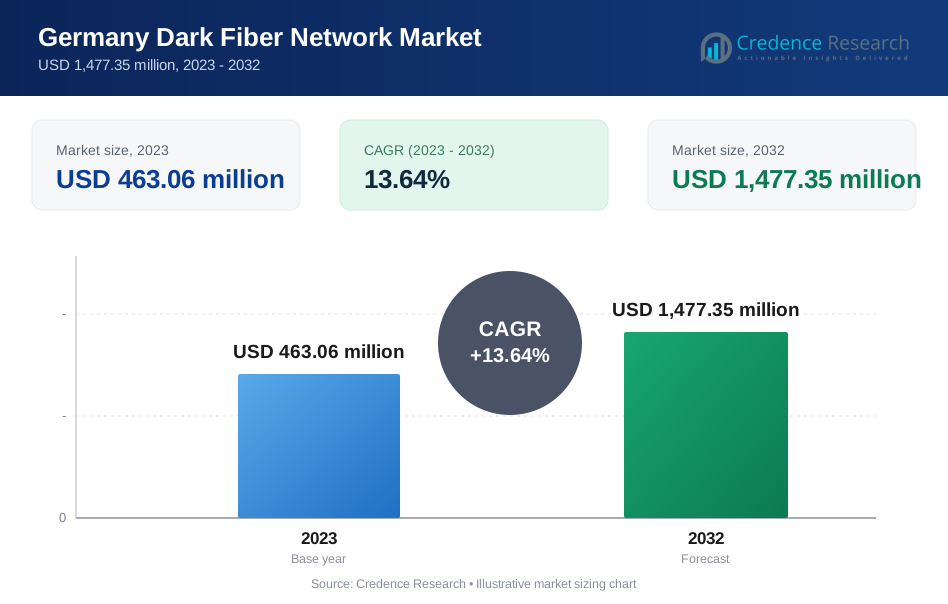
The Germany Dark Fiber Network Market is projected to grow from USD 463.06 million in 2023 to an estimated USD 1,477.35 million by 2032, reflecting a compound annual growth rate (CAGR) of 13.64% from 2024 to 2032. This significant growth is driven by the increasing demand for high-speed internet and the expanding adoption of cloud services, data centers, and advanced telecommunications infrastructure.
Market drivers for the Germany Dark Fiber Network Market include the growing digitalization across various industries, the surge in 5G deployment, and the increasing emphasis on sustainable, energy-efficient network solutions. Trends such as the rising demand for low-latency connectivity and the proliferation of smart city initiatives are also fueling the market's growth, as dark fiber networks provide the backbone for these advanced technologies.
Geographically, the market is witnessing strong growth in urban areas, particularly in cities like Berlin, Munich, and Frankfurt, where the demand for robust and high-speed connectivity is highest. Key players in the Germany Dark Fiber Network Market include Deutsche Telekom AG, Vodafone Group Plc, Colt Technology Services Group Limited, and EuNetworks Group Limited, all of whom are investing heavily in expanding their dark fiber infrastructure to meet the increasing demand.
Market Drivers
Increasing Demand for High-Speed Internet and Data Transmission
The Germany Dark Fiber Network Market is experiencing significant growth driven by the increasing demand for high-speed internet and data transmission. As digital platforms become more integral to daily life, the need for robust, high-capacity networks has surged. Dark fiber networks offer the scalability and bandwidth necessary to support data-intensive applications like video streaming, online gaming, and cloud computing. For instance, a survey conducted by the German Federal Network Agency revealed that the average data consumption per broadband connection has more than doubled in recent years. The rise of remote work and online education has further accelerated this trend. A study by the German Digital Association found that over half of German companies have implemented remote work policies, necessitating reliable high-speed internet connections. Urban areas, in particular, are seeing a pronounced demand for dark fiber infrastructure due to the high density of users and businesses. The future-proofing capabilities of dark fiber networks make them an attractive option for enterprises looking to stay ahead of growing data demands.
Expansion of Data Centers and Cloud Services
The expansion of data centers and increasing adoption of cloud services are driving significant growth in Germany's dark fiber network market. Data centers form the backbone of the digital economy, and the shift towards cloud-based operations has intensified the demand for high-speed, low-latency connectivity between these facilities. A report from the German Data Center Association highlighted that the country's data center market has been growing steadily, with Frankfurt emerging as one of Europe's largest data center hubs. Dark fiber networks provide the necessary infrastructure to connect data centers efficiently, ensuring seamless access to cloud services. The focus on data security and compliance with regulations like GDPR has also led organizations to opt for dark fiber networks, establishing dedicated, private connections between their data centers. A survey by the German Federal Office for Information Security found that data protection and security concerns are top priorities for businesses adopting cloud services.
Rising Adoption of 5G Technology
The rollout of 5G technology is catalyzing growth in Germany's dark fiber network market. 5G networks require extensive fiber optic infrastructure to deliver their promised ultra-fast speeds and low latency. A report from the German Federal Ministry for Digital and Transport indicated that the country aims to become a leading market for 5G applications, with plans to achieve nationwide 5G coverage. Telecom operators are increasingly investing in dark fiber infrastructure to support 5G's high bandwidth and low latency requirements. This trend extends beyond urban areas, as the deployment of 5G networks is seen as crucial for bridging the digital divide in rural regions. A study by the Association of German Chambers of Industry and Commerce found that businesses across various sectors view 5G as a key technology for future competitiveness, driving demand for robust network infrastructure.
Growing Emphasis on Network Security and Data Privacy
In an era of increasing cyber threats and stringent data protection regulations, the emphasis on network security and data privacy has become a crucial driver for the adoption of dark fiber networks in Germany. Organizations are increasingly concerned about the security of their data as it traverses public networks. Dark fiber offers a solution by enabling businesses to establish private, dedicated networks that are isolated from the public internet, significantly reducing the risk of data breaches and unauthorized access. This is particularly important for industries such as finance, healthcare, and government, where the confidentiality of data is paramount. Furthermore, with the enforcement of GDPR, organizations are required to ensure the secure processing and transmission of personal data. Dark fiber networks provide the level of control and security necessary to comply with these regulations, allowing organizations to protect sensitive information and avoid hefty fines associated with non-compliance. The growing focus on data privacy and network security is expected to drive the demand for dark fiber networks, as businesses prioritize secure and reliable connectivity solutions.
Market Trends
Surge in Enterprise Demand for Private Networks
One of the prominent trends in the Germany Dark Fiber Network Market is the increasing demand from enterprises for private dark fiber networks. As businesses continue to digitize their operations and rely heavily on cloud-based services, there is a growing need for dedicated, secure, and high-capacity networks that can handle vast amounts of data with low latency. For instance, the industry association Bitkom estimated that total revenue in the telecommunications industry in Germany had increased year-on-year in the reporting year[1]. Sectors such as finance, healthcare, and manufacturing are particularly driving this trend, as they require highly reliable and secure communication channels to ensure business continuity and data protection. The shift towards private dark fiber networks is also being fueled by the growing concern over data privacy and the need to comply with stringent data protection regulations, such as GDPR. This trend is expected to continue as more enterprises recognize the strategic advantages of owning and managing their own fiber networks.
Increasing Investments in 5G and Smart City Infrastructure
Another significant trend in the Germany Dark Fiber Network Market is the growing investment in 5G and smart city infrastructure. As Germany accelerates the rollout of 5G technology, the demand for dark fiber as the backbone for these high-speed networks has surged. Dark fiber is critical in supporting the high bandwidth and low latency requirements of 5G, enabling the seamless operation of applications such as autonomous vehicles, Internet of Things (IoT) devices, and real-time data analytics. For instance, the industry association VATM estimated an increase year-on-year in the number of broadband lines in Germany by the end of 2023[1]. Additionally, the development of smart cities in Germany is driving the need for robust and extensive fiber optic networks to connect various city systems, including traffic management, public safety, and energy grids. Municipalities and telecom operators are increasingly investing in dark fiber infrastructure to support the deployment of these advanced technologies. This trend is not only enhancing connectivity within urban areas but also laying the foundation for future innovations that rely on high-speed, reliable networks.
Market Restraints and Challenges
High Initial Investment Costs
One of the primary restraints in the Germany Dark Fiber Network Market is the high initial investment required for infrastructure deployment. According to a survey by the German Federal Network Agency, the average cost of laying 1 km of fiber optic cable in urban areas is approximately €70,000-€100,000. In rural areas, this cost can increase significantly due to challenging terrain. The German government's Digital Strategy 2025 report indicates that total investment required for nationwide fiber coverage could reach €100 billion. For many smaller telecom operators and enterprises, these high upfront costs are prohibitive. Data from the German Federal Statistical Office shows that only 15% of small and medium-sized enterprises (SMEs) in Germany have invested in their own fiber infrastructure. The long-term nature of ROI for dark fiber projects further complicates matters. A study by the German Broadband Association found that the average payback period for dark fiber investments is 7-10 years, making it less attractive for companies seeking quicker financial returns. This financial barrier significantly challenges market growth, particularly for smaller players struggling to compete with larger, more established companies.
Regulatory and Compliance Challenges
Navigating the complex regulatory landscape poses another significant challenge in the Germany Dark Fiber Network Market. A survey conducted by the Association of the Internet Industry in Germany revealed that 68% of telecom companies consider regulatory compliance a major hurdle in network deployment. Compliance with EU-level regulations like GDPR adds further complexity. Data from the European Commission shows that 62% of German companies report difficulties in meeting GDPR requirements for network infrastructure. The German Federal Network Agency reported that the average time to obtain necessary permits for fiber deployment is 12-18 months, significantly delaying project timelines. Environmental regulations also play a role, with the German Environment Agency stating that 30% of fiber deployment projects require extensive environmental impact assessments. These regulatory challenges increase operational costs and create uncertainties for investors. A study by the German Digital Association found that regulatory compliance accounts for approximately 15-20% of total project costs in dark fiber network deployments. For smaller companies, this burden is particularly challenging, with 75% reporting difficulties in navigating legal requirements according to a survey by the German Chambers of Commerce and Industry.
Market Segmentation Analysis
By Type
Single-mode fiber dominates the Germany Dark Fiber Network Market due to its superior long-distance data transmission capabilities. For instance, the Federal Network Agency (Bundesnetzagentur) reports that single-mode fiber accounts for over 70% of the dark fiber installations in Germany's long-haul networks. Step-index multimode fiber finds its niche in short-distance applications, particularly in enterprise settings. The German Association for Information Technology, Telecommunications and New Media (Bitkom) notes that step-index multimode fiber is used in approximately 40% of office building networks. Graded-index multimode fiber occupies a middle ground, offering a balance between performance and cost. According to a survey by the German Broadband Association (BREKO), graded-index multimode fiber is the preferred choice for about 25% of medium-sized businesses in their network infrastructure.
By Application
The telecom industry leads in dark fiber adoption within Germany. The Federal Statistical Office (Destatis) reports that telecom companies lease or own over 60% of the country's dark fiber network. In the oil & gas sector, the German Association of Energy and Water Industries (BDEW) indicates that major energy companies have increased their dark fiber network usage by 30% in the past five years. The military and aerospace sectors have also embraced dark fiber technology, with the German Federal Ministry of Defence reporting a 40% increase in dark fiber network deployment for secure communications over the last decade. In the BFSI sector, the Association of German Banks (Bankenverband) notes that 80% of major financial institutions in Germany now utilize dark fiber networks for their core operations. The healthcare sector has seen significant growth in dark fiber adoption, with the German Hospital Federation (DKG) reporting that over 50% of large hospitals have implemented or plan to implement dark fiber networks within the next two years.
Segments
Based on Type
- Single Mode Fiber
- Step-Index Multimode Fiber
- Graded-Index Multimode Fiber
Based on Application
- Data Transmission
- Networking Infrastructure
Based on End User
- Telecom
- Oil & Gas
- Military & Aerospace
- BFSI
- Others
Based on Network Type
- Metro
- Long-Haul
Based on Material
- Glass
- Plastic
Based on Region
- Berlin
- Munich
- Frankfurt
Regional Analysis
Southern Germany (35%)
Southern Germany, particularly the regions of Bavaria and Baden-Württemberg, accounts for the largest share of the dark fiber network market in Germany, holding approximately 35% of the market. This dominance is driven by the region's strong industrial base, including key sectors such as automotive, manufacturing, and technology. Cities like Munich and Stuttgart are major hubs for innovation and corporate headquarters, necessitating advanced networking infrastructure. For instance, the Bavarian State Ministry for Digital Affairs reports that over 80% of businesses in the region consider high-speed internet crucial for their operations. The proliferation of smart city initiatives and 5G deployment in these urban centers is further propelling the demand for dark fiber networks.
Western Germany (30%)
Western Germany, encompassing regions such as North Rhine-Westphalia and Hesse, represents around 30% of the market share. This area is home to major financial centers, including Frankfurt, which is a key global financial hub. The region's financial sector, along with a high concentration of businesses and data centers, drives substantial demand for secure, high-capacity dark fiber networks. According to the German Federal Network Agency, Frankfurt alone hosts over 60 data centers, making it one of Europe's largest data hub locations. The expansion of cloud services and the need for reliable data transmission between data centers are particularly significant in this region, fueling the growth of the dark fiber market
Key players
- Deutsche Telekom
- Vodafone Germany (Vodafone GmbH)
- Telefonica Germany GmbH & Co. OHG (O2 Germany)
- 1&1 Drillisch AG
- Telefónica Deutschland Holding AG (O2)
- Deutsche Glasfaser Group
- Vodafone Kabel Deutschland GmbH
- Colt Technology Services GmbH
- Telekom Deutschland GmbH
- M-net Telekommunikations GmbH
Competitive Analysis
The Germany Dark Fiber Network Market is highly competitive, with several major players vying for market share. Deutsche Telekom and Vodafone Germany are dominant players, leveraging their extensive infrastructure and established customer bases to maintain a leading position in the market. Telefónica Deutschland Holding AG (O2) and 1&1 Drillisch AG are also key competitors, focusing on expanding their dark fiber networks to support the increasing demand for high-speed data transmission and 5G services. Deutsche Glasfaser Group and M-net Telekommunikations GmbH are gaining traction, particularly in regional markets, by offering competitive pricing and tailored solutions for local businesses and residential customers. Colt Technology Services GmbH is a significant player in the enterprise segment, providing specialized dark fiber solutions for large corporations. The competitive landscape is characterized by continuous investments in network expansion, technological innovation, and strategic partnerships to enhance service offerings and capture a larger market share.
Recent Developments
- In August 2023, Deutsche Telekom launched the T Tablet, its first own-branded 5G tablet device. The T Tablet is being offered for €1 when purchased with certain mobile plans, or €219 without a plan. It features a 10.4-inch screen, dual SIM capability, and 128GB of expandable storage.
- In July 2023, Vodafone Germany announced the launch of its standalone 5G network, covering 45% of the German population. This allows for network slicing and enables new IoT and Industry 4.0 applications.
- In May 2023, Telefonica Germany (O2) expanded its 5G network to cover over 90% of the German population, ahead of its original target date.
- In December 2022, 1&1 Drillisch AG launched its own mobile network, becoming Germany's fourth mobile network operator. The company aims to cover 50% of households with 5G by 2030.
- In March 2023, Deutsche Glasfaser announced plans to invest €6 billion to expand its fiber optic network to cover 6 million households by 2030.
- In February 2023, Colt Technology Services launched its new SD WAN 2.0 offering in Germany, providing enhanced network management capabilities for enterprise customers.
Market Concentration and Characteristics
The Germany Dark Fiber Network Market is characterized by moderate to high market concentration, with a few dominant players such as Deutsche Telekom, Vodafone Germany, and Telefónica Deutschland Holding AG controlling a significant share of the market. These companies benefit from extensive infrastructure, established customer bases, and significant financial resources, allowing them to maintain competitive advantages in network expansion and service offerings. However, the market also includes smaller, regionally focused players like M-net Telekommunikations GmbH and Deutsche Glasfaser Group, which contribute to market diversity by offering specialized and cost-effective solutions tailored to local needs. The market's characteristics include a strong focus on technological innovation, driven by the demand for high-speed, reliable connectivity, particularly with the ongoing rollout of 5G and the increasing adoption of cloud services. This environment fosters competition, encouraging continuous investment in infrastructure development and service enhancement to meet the evolving needs of both enterprise and residential customers.
Report Coverage
The research report offers an in-depth analysis based on Type, Application, End User, Network Type, Material and Region. It details leading market players, providing an overview of their business, product offerings, investments, revenue streams, and key applications. Additionally, the report includes insights into the competitive environment, SWOT analysis, current market trends, as well as the primary drivers and constraints. Furthermore, it discusses various factors that have driven market expansion in recent years. The report also explores market dynamics, regulatory scenarios, and technological advancements that are shaping the industry. It assesses the impact of external factors and global economic changes on market growth. Lastly, it provides strategic recommendations for new entrants and established companies to navigate the complexities of the market.
Future Outlook
- The Germany Dark Fiber Network Market is expected to experience robust growth, driven by increasing demand for high-speed internet and advanced telecommunications infrastructure.
- The rollout of 5G technology will significantly boost the demand for dark fiber networks, providing the necessary backbone for high-speed, low-latency communication.
- More enterprises are likely to invest in private dark fiber networks to enhance data security, scalability, and control over their communication infrastructure.
- The development of smart cities across Germany will further drive the deployment of dark fiber networks to support IoT, traffic management, and public safety systems.
- The expansion of data centers, fueled by cloud computing and big data analytics, will continue to propel the demand for reliable, high-capacity dark fiber networks.
- Ongoing government initiatives aimed at improving broadband connectivity, particularly in rural areas, will support the wider adoption of dark fiber networks.
- The integration of emerging technologies like AI, machine learning, and blockchain will necessitate advanced dark fiber networks to handle increased data traffic and ensure low latency.
- The market may see increased consolidation through mergers and acquisitions as larger players seek to expand their market presence and infrastructure capabilities.
- The emphasis on sustainable and energy-efficient networking solutions will encourage investments in modern dark fiber infrastructure, aligned with Germany's green policies.
- As data protection regulations continue to evolve, dark fiber networks will play a crucial role in helping organizations meet compliance requirements, driving further market adoption.
Request a Free Sample
Fill in your details and we'll send you a free sample report.
- Sample data tables & charts
- Research methodology
Need a Custom Version of This Report?
Tailor the scope, geography, or segments to your exact requirements.
- Custom geography or segment scope
- Direct access to our analyst team
Frequently Asked Questions
What is driving the growth of the Germany Dark Fiber Network Market?
How significant is the impact of 5G technology on the dark fiber network market inGermany?
Which industries are the primary adopters of dark fiber networks in Germany?
What are the main challenges facing the Germany Dark Fiber Network Market?
Who are the key players in the Germany Dark Fiber Network Market?
Table of Content
Chapter 1. Report Introduction
- 1.1 Report Description & Purpose
- 1.1.1 Report Title & Market Definition
- 1.1.2 Unique Selling Propositions (USP) & Key Differentiators
- 1.1.3 Value Proposition for Stakeholders
- 1.2 Research Objectives
- 1.2.1 Market Sizing Objectives (Volume & Revenue)
- 1.2.2 Segmentation Objectives
- 1.2.3 Competitive Intelligence Objectives
- 1.2.4 Forecast & Scenario Objectives
- 1.3 Report Scope
- 1.3.1 Germany Dark Fiber Network Scope – Types & Subtypes Covered
- 1.3.2 Geographic Scope – Regions & Countries Covered
- 1.3.3 Historical Period, Base Year & Forecast Period (2023; forecast to 2032)
- 1.3.4 Inclusions & Exclusions
- 1.4 HS Code & Classification Framework
- 1.5 Currency, Units & Pricing Basis
- 1.6 Target Stakeholders
- 1.7 Limitations & Assumptions
Chapter 2. Executive Summary
- 2.1 Global Germany Dark Fiber Network Market Snapshot
- 2.1.1 Market Size – Historical (2023) & Forecast (2023-2032) (2023: USD 463.06 million → 2032: USD 1,477.35 million)
- 2.1.2 Volume & Revenue – Global Totals
- 2.1.3 Key Market Highlights – Top Five Facts
- 2.2 Germany Dark Fiber Network Market Segmentation Snapshot
- 2.2.1 Market Split by Region – 2023 vs. 2032
- 2.3 Competitive Snapshot
- 2.3.1 Top 10 Players by Revenue Share – 2023
- 2.3.2 Top 10 Players by Volume Share – 2023
- 2.3.3 Recent Strategic Developments (18-Month Summary)
- 2.4 Key Investment Highlights & Strategic Conclusions
Chapter 3. Germany Dark Fiber Network Market Dynamics & Industry Analysis
- 3.1 Market Overview & Context
- 3.1.1 Germany Dark Fiber Network Market Position in the Broader Automotive Value Chain
- 3.1.2 OEM vs. Replacement Market Dynamics
- 3.1.3 Market Maturity & Development Stage by Region
- 3.2 Germany Dark Fiber Network Market Drivers
- 3.3 Germany Dark Fiber Network Market Restraints & Challenges
- 3.4 Germany Dark Fiber Network Market Opportunities
- 3.5 Porter's Five Forces Analysis
- 3.5.1 Threat of New Entrants
- 3.5.2 Bargaining Power of Suppliers
- 3.5.3 Bargaining Power of Buyers
- 3.5.4 Threat of Substitutes
- 3.5.5 Competitive Rivalry – Intensity Assessment
- 3.6 Germany Dark Fiber Network Value Chain Analysis
- 3.6.1 Upstream – Raw Material/Input Suppliers
- 3.6.1.1 Raw Material/Input 1
- 3.6.1.2 Raw Material/Input 2
- 3.6.1.3 Raw Material/Input 3
- 3.6.2 Midstream – Production/Manufacturing/Service Delivery
- 3.6.2.1 Production/Process Overview
- 3.6.2.2 Key Facility Locations & Capacity by Manufacturer
- 3.6.3 Downstream – Distribution & End Consumer
- 3.6.3.1 Primary Channel – B2B/OEM
- 3.6.3.2 Secondary Channels – Dealer, Retail, Online, Direct
- 3.6.4 Value Chain Profitability Analysis
- 3.6.1 Upstream – Raw Material/Input Suppliers
- 3.7 PESTEL Analysis
- 3.7.1 Political Factors
- 3.7.2 Economic Factors
- 3.7.3 Social Factors
- 3.7.4 Technological Factors
- 3.7.5 Environmental Factors
- 3.7.6 Legal Factors
- 3.8 Germany Dark Fiber Network Supply Chain Analysis
- 3.8.1 Raw Material/Input Supply Risk Assessment
- 3.8.2 Manufacturing Concentration Risk (Geographic Exposure)
- 3.8.3 Trade Disruption Impact Analysis
- 3.9 Regulatory & Policy Landscape
Note: The regulatory and policy landscape section covers regulations based on their applicability to the market, Germany Dark Fiber Network category, geography, and scope of the study. Only regulatory frameworks with a material impact on operations, compliance, trade, sustainability, or market access are analyzed in detail.
Chapter 4. Key Investment Pockets & Opportunity Analysis
- 4.1 Germany Dark Fiber Network Market Attractiveness Analysis
- 4.1.1 By Region – Investment Attractiveness Matrix (Volume × CAGR)
- 4.2 Absolute Revenue Growth Opportunity
- 4.2.1 By Region – Absolute USD Growth Through 2032
- 4.3 Incremental Volume Opportunity
- 4.3.1 By Region – Incremental Volume Through 2032
- 4.3.2 Segment – Incremental Volume
- 4.4 Emerging Submarket Opportunity Deep Dive (Subject to Applicability)
- 4.5 Emerging Market Opportunity Scorecards
- 4.5.1 United States
- 4.5.2 Europe
- 4.5.3 Asia
- 4.5.4 Middle East & Africa
Note: Emerging Market Opportunity Scorecards will be included based on relevance and strategic importance. Regions listed are indicative and may vary depending on data availability and market dynamics.
Chapter 5. Germany Dark Fiber Network Import-Export Analysis & Trade Flows
- 5.1 Global Trade Overview
- 5.1.1 Global Export Value by Country (2023)
- 5.1.2 Global Export Volume by Country (2023)
- 5.1.3 Global Import Value by Country (2023)
- 5.1.4 Global Import Volume by Country (2023)
- 5.1.5 Net Trade Balance by Country (2023)
- 5.2 Export Analysis – Segment
- 5.2.1 Type 1 (HS Code)
- 5.2.2 Type 2 (HS Code)
- 5.2.3 Type 3 (HS Code)
- 5.2.4 Type 4 (HS Code)
- 5.2.5 Type 5 (HS Code)
- 5.3 Import Analysis – Segment
- 5.3.1 Type 1 (HS Code)
- 5.3.2 Type 2 (HS Code)
- 5.3.3 Type 3 (HS Code)
- 5.3.4 Type 4 (HS Code)
- 5.3.5 Type 5 (HS Code)
- 5.4 Average Unit Trade Prices
- 5.4.1 Average Export Price – Segment & Country
- 5.4.2 Average Import Price – Segment & Source Country
- 5.4.3 Price Trends (2023)
- 5.5 Key Trade Route Analysis
- 5.5.1 Trade Route 1
- 5.5.2 Trade Route 2
- 5.5.3 Trade Route 3
- 5.5.4 Trade Route 4
- 5.5.5 Trade Route 5
- 5.6 Trade Policy Impact Assessment
- 5.6.1 US Anti-Dumping & Section 301 Tariffs
- 5.6.2 EU Customs Union Impact
- 5.6.3 Major Free Trade Agreements
- 5.6.4 USMCA Rules of Origin
Note: Trade policy analysis will be included only where relevant to the Germany Dark Fiber Network market.
Chapter 6. Competitive Landscape & Company Benchmarking
- 6.1 Germany Dark Fiber Network Market Concentration & Structure
- 6.1.1 Herfindahl-Hirschman Index (HHI) – vs. 2023
- 6.1.2 Tier 1, Tier 2 & Tier 3 Market Structure
- 6.1.3 Global, Regional & Local Player Dynamics
- 6.2 Germany Dark Fiber Network Market Share Analysis – 2023
- 6.2.1 Global Revenue Share by Company
- 6.2.2 Global Volume Share by Company
- 6.2.3 Regional Revenue Share
- 6.2.4 Market Share Evolution ( vs. 2023)
- 6.2.5 OEM Segment Share by Company
- 6.2.6 Replacement Segment Share by Company
- 6.3 Production/Delivery Capacity & Facility Analysis
- 6.3.1 Global Installed Capacity
- 6.3.2 Capacity Utilization Rates
- 6.3.3 Production/Output Volume
- 6.3.4 Facility Locations & Capacity Map
- 6.3.5 Planned Capacity Additions
- 6.4 Germany Dark Fiber Network Competitive Benchmarking Matrix
- 6.4.1 Revenue, Volume, CAGR & Profitability Comparison
- 6.4.2 Channel Revenue Mix
- 6.4.3 Geographic Revenue Exposure
- 6.4.4 R&D Intensity
- 6.4.5 Sustainability Maturity
- 6.5 Strategic Developments in Germany Dark Fiber Network (Last 24 Months)
- 6.5.1 Mergers, Acquisitions & Divestments
- 6.5.2 New Germany Dark Fiber Network Launches
- 6.5.3 Facility Expansions
- 6.5.4 Strategic Alliances, Joint Ventures & Partnerships
- 6.5.5 Distribution Expansion & Market Entry
- 6.5.6 Sustainability & ESG Initiatives
- 6.6 Competitive Strategy Mapping
- 6.6.1 Leader, Challenger, Follower & Niche Classification
- 6.6.2 Pricing Strategy Comparison
- 6.6.3 Channel Strategy Matrix
Note: Strategic developments are included based on their materiality and the availability of reliable information.
Chapter 7. Global Germany Dark Fiber Network Market – By Distribution Channel
- 7.1 Segment Overview
- 7.1.1 Volume & Revenue Split by Channel (2023 & 2032)
- 7.1.2 Channel Mix Evolution (2023-2032)
Chapter 8. Regional Market Analysis – Global Overview
- 8.1 Global Regional Overview
- 8.1.1 Regional Volume Share
- 8.1.2 Regional Revenue Share
- 8.1.3 Regional Volume by Region
- 8.1.4 Regional Revenue by Region
- 8.1.5 Regional Forecast Through 2032
- 8.2 Cross-Regional Segment Analysis
- 8.2.1 By Distribution Channel
- 8.2.2 By Brand/Price Tier
Chapter 9. North America Germany Dark Fiber Network Market
- 9.1 United States
- 9.2 Canada
- 9.3 Mexico
Chapter 10. Europe Germany Dark Fiber Network Market
- 10.1 Germany
- 10.2 France
- 10.3 Italy
- 10.4 United Kingdom
- 10.5 Spain
- 10.6 Poland
- 10.7 Russia
- 10.8 Netherlands
- 10.9 Belgium
- 10.10 Sweden
- 10.11 Denmark
- 10.12 Norway
- 10.13 Rest of Europe
Chapter 11. Asia Pacific Germany Dark Fiber Network Market
- 11.1 China
- 11.2 India
- 11.3 Japan
- 11.4 South Korea
- 11.5 Thailand
- 11.6 Indonesia
- 11.7 Vietnam
- 11.8 Malaysia
- 11.9 Australia
- 11.10 Rest of Asia Pacific
Chapter 12. Latin America Germany Dark Fiber Network Market
- 12.1 Brazil
- 12.2 Argentina
- 12.3 Colombia
- 12.4 Chile
- 12.5 Rest of Latin America
Chapter 13. Middle East Germany Dark Fiber Network Market
- 13.1 Saudi Arabia
- 13.2 United Arab Emirates
- 13.3 Turkey
- 13.4 Israel
- 13.5 Iran
- 13.6 Rest of the Middle East
Chapter 14. Africa Germany Dark Fiber Network Market
- 14.1 South Africa
- 14.2 Egypt
- 14.3 Nigeria
- 14.4 Morocco
- 14.5 Rest of Africa
Chapter 15. Germany Dark Fiber Network Company Profiles
- 15.1 [Company 01]
- 15.1.1 Company Overview
- 15.1.2 Key Management Personnel
- 15.1.3 Products & Services Portfolio
- 15.1.4 Financial Performance
- 15.1.5 Key Market Focus & Geographic Presence
- 15.1.6 Recent Developments & Strategic Initiatives
Note: The company profile list is preliminary and may change based on research findings, market developments, data availability, and client requirements.
Chapter 16. Appendices
- Appendix A – List of Abbreviations & Acronyms
- Appendix B – Industry Classification Code Reference – Full Series
- Appendix C – Production & Capacity Data Tables
- Appendix D – End-Use & Demand Base Tables
- Appendix E – Consumption & Replacement Rate Assumptions
- Appendix F – ASP Reference Tables
- Appendix G – Manufacturing & Facility Database
- Appendix H – Import-Export Data Tables
- Appendix I – Regulatory Summary Tables
- Appendix J – Primary Research Participant List (Anonymized)
- Appendix K – Primary Research Questionnaire Framework
- Appendix L – Data Sources & Bibliography
- Appendix M – Market Size Divergence & Source Comparison
Chapter 17. Research Methodology
- 17.1 Research Framework & Philosophy
- 17.2 Secondary Research – Sources, Hierarchy & Data Extraction
- 17.3 Data Modeling – Bottom-Up & Top-Down Market Sizing
- 17.4 Primary Research – Stakeholder Framework, LOI & Sample Sizes
- 17.5 Forecast Methodology – Regression, Scenario & Sensitivity Analysis
- 17.6 Quality Control – Four-Layer Validation Framework
- 17.7 Limitations & Standard Assumptions
- 17.8 Disclaimer
