
Online Program Management Market Overview:
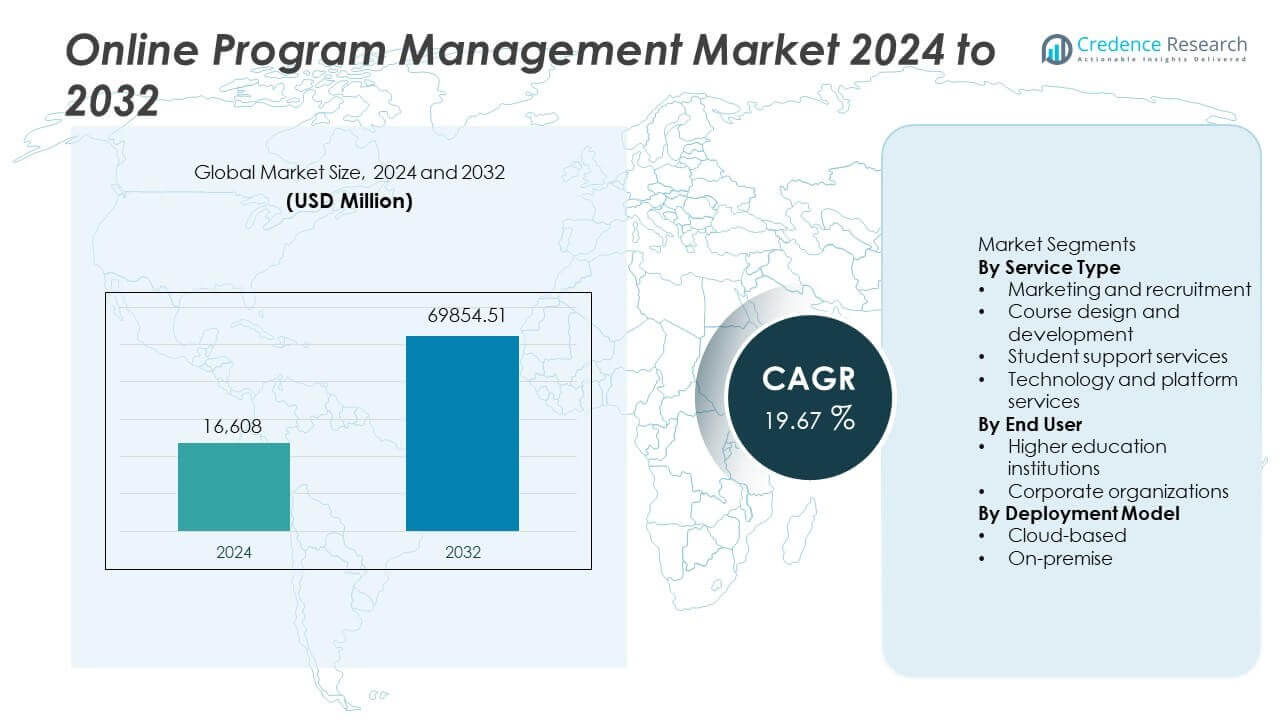
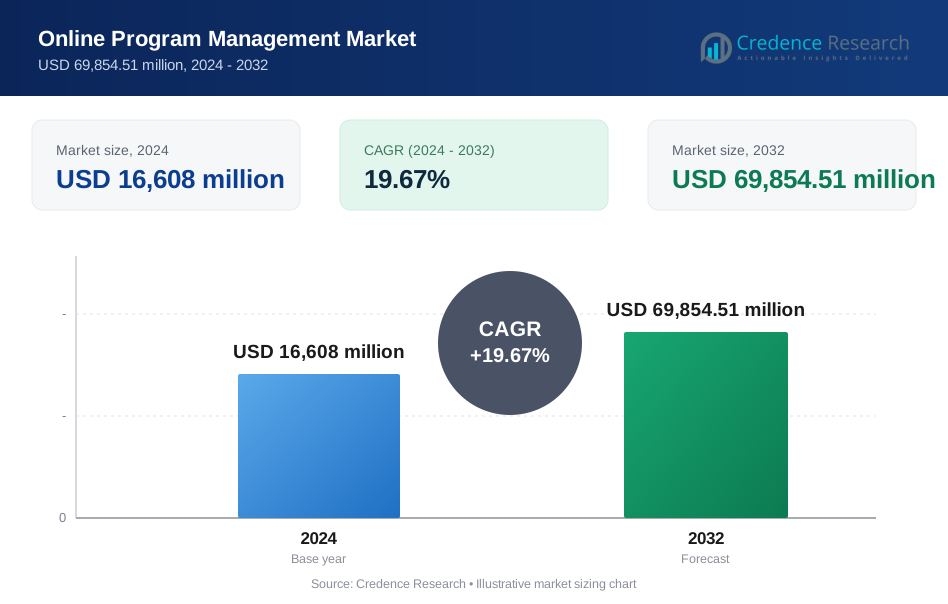
The Online Program Management market size was valued at USD 16,608 million in 2024 and is anticipated to reach USD 69,854.51 million by 2032, growing at a CAGR of 19.67% during the forecast period.
| REPORT ATTRIBUTE | DETAILS |
|---|---|
| Historical Period | 2020-2023 |
| Base Year | 2024 |
| Forecast Period | 2025-2032 |
| Online Program Management Market Size 2024 | USD 16,608 million |
| Online Program Management Market, CAGR | 19.67% |
| Online Program Management Market Size 2032 | USD 69,854.51 million |
The Online Program Management market is driven by leading players such as 2U, Inc., Coursera, Inc., edX, Pearson plc, Wiley Education Services, Emeritus, UpGrad, InStride, Academic Partnerships, and Noodle Partners. These companies compete by offering integrated services across marketing, technology platforms, and student support. Strategic partnerships with universities enable rapid program scaling and global reach. Providers also invest in analytics and cloud-based platforms to improve enrollment and retention. Regionally, North America leads the Online Program Management market with a 41% market share, supported by advanced digital infrastructure, high online enrollment acceptance, and strong institutional investment in online education.
Online Program Management Market Insights
- The Online Program Management market was valued at USD 16,608 million in 2024 and is projected to reach USD 69,854.51 million by 2032, growing at a CAGR of 19.67%, driven by rapid digital education adoption.
- Market growth is fueled by rising online enrollment, workforce upskilling demand, and limited in-house digital capabilities of institutions, with higher education institutions leading end users at a 72% market share.
- Key trends include cloud-based delivery, data-driven recruitment, and advanced learning technologies, while competition intensifies as providers expand global partnerships and integrated service offerings.
- Market restraints include high revenue-sharing costs, long-term contract risks, and regulatory and data privacy challenges that impact institutional decision-making.
- Regionally, North America leads with a 41% market share, followed by Europe at 24%, Asia Pacific at 23%, Latin America at 7%, and the Middle East and Africa at 5%, reflecting differences in digital maturity and education investment levels.
Online Program Management Market Segmentation Analysis:
By Service Type
The by service type segment reflects the core operational needs of online program delivery. Marketing and recruitment dominated this segment, holding a 38% market share in 2024. Institutions rely on these services to attract and enroll online learners at scale. Digital marketing expertise improves lead generation and conversion rates. Rising competition among online programs increases dependence on specialized recruitment partners. Course design and development follows, driven by demand for high-quality digital content. Student support services gain importance for retention. However, marketing and recruitment remain dominant due to direct revenue impact and enrollment-driven growth strategies.
- For instance, 2U supported enrollment operations for more than 240 online degree programs and managed digital learner acquisition campaigns across over 60 countries using centralized analytics platforms.
By End User
The by end user segment highlights institutional demand patterns. Higher education institutions accounted for a 72% market share in 2024, making them the dominant sub-segment. Universities adopt OPM solutions to expand online offerings quickly. Limited internal digital expertise drives outsourcing decisions. Online degree and certification programs support long-term revenue diversification. Public and private institutions both increase adoption. Corporate organizations show steady growth for workforce upskilling programs. However, higher education institutions lead due to large student bases and sustained online enrollment growth across undergraduate and postgraduate programs.
- For instance, Pearson Online Learning Services partnered with numerous universities and supported the delivery of fully online degree pathways across the globe.
By Deployment Model The by deployment model segment shows a clear shift toward scalable infrastructure. Cloud-based deployment led the segment with a 67% market share in 2024. Institutions prefer cloud solutions for flexibility and lower upfront costs. Cloud platforms support rapid content updates and analytics integration. Remote access improves collaboration among faculty and students. Scalability supports enrollment fluctuations. On-premise deployment remains limited to institutions with strict data control needs. However, cloud-based models dominate due to cost efficiency, faster implementation, and strong alignment with digital learning ecosystems.
Key Growth Drivers
Rapid Expansion of Online and Hybrid Education
The shift toward online and hybrid education strongly drives the Online Program Management market. Universities expand digital programs to reach wider student bases. Working professionals prefer flexible learning formats. Institutions seek faster program launches without heavy internal investment. OPM providers offer end-to-end delivery support. Enrollment growth supports long-term revenue models. Global access increases international student participation. Pandemic-led behavior changes remain permanent. Demand spans undergraduate, postgraduate, and certificate programs. This structural shift continues accelerating OPM adoption across education systems.
- For instance, Coursera for Campus enabled universities to deliver over 5,400 online courses, supporting large-scale hybrid learning models.
Rising Demand for Workforce Upskilling and Reskilling
Employers increasingly prioritize continuous learning and digital skills. Rapid technology change creates skill gaps across industries. Universities partner with OPM providers to launch job-focused programs. Short-term certificates and executive education gain traction. Corporate learners prefer flexible online formats. OPM platforms support scalable content delivery. Industry-aligned curricula improve employability outcomes. Government-backed skilling initiatives support demand. Lifelong learning becomes a strategic priority. Workforce transformation needs continue driving OPM market growth.
- For instance, Emeritus collaborates with numerous top-tier universities to deliver a wide range of professional education programs focused on leadership, data, and technology skills.
Limited In-House Digital Capabilities of Institutions
Many institutions lack expertise in digital marketing and technology. Online program delivery requires specialized skills and tools. OPM providers reduce operational complexity. Outsourcing lowers time-to-market for new programs. Institutions focus on academic quality while partners handle execution. Marketing and recruitment support improves enrollment efficiency. Analytics improve student acquisition and retention. Smaller institutions benefit significantly from external support. Capability gaps remain a key driver of OPM adoption.
Key Trends & Opportunities
Integration of Advanced Learning Technologies
OPM platforms adopt AI, analytics, and adaptive learning tools. Data-driven insights improve student engagement and outcomes. Personalization enhances course effectiveness. Learning analytics support retention strategies. Automation reduces administrative workload. Cloud-based platforms enable rapid innovation. Institutions value technology-enabled differentiation. Virtual labs and immersive content gain adoption. Technology integration creates new service opportunities. Innovation strengthens the competitive positioning of OPM providers.
- For instance, Pearson Online Learning Services deploys AI-based learner analytics that track more than 1,000 engagement signals per student across supported programs, enabling targeted academic interventions.
Growth of Global and Cross-Border Online Programs
Institutions increasingly target international students through online delivery. Cross-border programs reduce physical infrastructure needs. OPM partners manage localization and compliance. Multilingual content expands reach. Global credentials attract diverse learners. International collaboration improves brand visibility. Time-zone flexibility supports participation. Emerging markets show rising demand for global education. Cross-border expansion opens new revenue streams. This trend creates strong long-term growth opportunities.
- For instance, edX supports learners from over 190 countries through its online degree and micro-credential platforms, enabling universities to scale global access.
Key Challenges
High Cost and Revenue-Sharing Concerns
OPM contracts often involve long-term revenue sharing. Institutions face margin pressure on popular programs. High dependency on external partners raises financial risk. Contract renegotiation remains complex. Smaller institutions struggle with cost commitments. Transparency in pricing becomes critical. Budget scrutiny slows decision-making. Value realization varies across programs. Cost concerns remain a key adoption barrier.
Regulatory and Data Privacy Challenges
Education regulations vary across regions and countries. Compliance increases operational complexity for OPM providers. Data privacy laws require strict controls. Cross-border data handling raises legal risks. Accreditation requirements affect program design. Regulatory delays slow program launches. Institutions demand compliance assurance from partners. Policy changes add uncertainty. Regulatory complexity continues challenging market scalability.
Regional Analysis
North America
North America led the Online Program Management market with a 41% market share in 2024, supported by advanced digital education infrastructure and strong online enrollment demand. Universities in the United States and Canada widely partner with OPM providers to scale degree and certificate programs. High acceptance of online learning among working professionals strengthens adoption. Institutions focus on revenue diversification through online programs. Strong marketing capabilities and data-driven recruitment models improve enrollment outcomes. Mature cloud infrastructure supports platform scalability. Continuous innovation and strong institutional budgets sustain North America’s leadership in the Online Program Management market.
Europe
Europe accounted for a 24% market share in 2024, driven by growing adoption of blended and online education models. The United Kingdom, Germany, and France lead regional demand due to strong higher education systems. Universities expand online programs to attract international students. Regulatory support for digital learning improves adoption. Multilingual content delivery increases accessibility. Institutions emphasize academic quality and compliance. Public universities increasingly outsource non-core functions. OPM partnerships support faster digital transformation. Stable policy frameworks and rising digital skills demand continue supporting market growth across Europe.
Asia Pacific
Asia Pacific held a 23% market share in 2024, fueled by rapid expansion of higher education and digital learning adoption. China, India, and Australia drive regional growth through large student populations. Rising internet access supports online program delivery. Institutions partner with OPM providers to scale programs efficiently. Demand for professional and skill-based courses remains strong. Government initiatives promote digital education. Cost-effective cloud solutions improve accessibility. Growing middle-class populations increase enrollment demand. Asia Pacific remains a high-growth region for Online Program Management services.
Latin America
Latin America represented a 7% market share in 2024, supported by improving digital infrastructure and education reforms. Brazil and Mexico lead regional adoption due to expanding private universities. Institutions seek OPM partnerships to overcome resource constraints. Online programs improve access for working professionals. Demand for affordable education supports digital delivery. Internet penetration continues rising across urban areas. Universities focus on enrollment growth and retention. OPM providers offer scalable solutions. Gradual digital transformation supports steady growth in the Latin American market.
Middle East and Africa
The Middle East and Africa accounted for a 5% market share in 2024, reflecting early-stage but growing adoption. Gulf countries lead regional demand due to strong investment in education technology. Universities expand online offerings to reach diverse learners. Government-led digital education initiatives support growth. Africa shows rising interest driven by mobile connectivity. OPM providers focus on localized content and platforms. Infrastructure gaps remain a challenge. Cross-border partnerships support program delivery. Long-term education investments support gradual market expansion in this region.
Online Program Management Market Segmentations:
By Service Type
- Marketing and recruitment
- Course design and development
- Student support services
- Technology and platform services
By End User
- Higher education institutions
- Corporate organizations
By Deployment Model
- Cloud-based
- On-premise
By Geography
- North America
- U.S.
- Canada
- Mexico
- Europe
- Germany
- France
- U.K.
- Italy
- Spain
- Rest of Europe
- Asia Pacific
- China
- Japan
- India
- South Korea
- South-east Asia
- Rest of Asia Pacific
- Latin America
- Brazil
- Argentina
- Rest of Latin America
- Middle East & Africa
- GCC Countries
- South Africa
- Rest of the Middle East and Africa
Competitive Landscape
Competitive landscape analysis highlights a rapidly evolving Online Program Management market led by 2U, Inc., Coursera, Inc., edX, Pearson plc, Wiley Education Services, Emeritus, UpGrad, InStride, Academic Partnerships, and Noodle Partners. Market leaders focus on end-to-end service delivery covering marketing, technology, and student support. Companies invest in advanced learning platforms and analytics to improve enrollment and retention outcomes. Strategic partnerships with universities strengthen program portfolios. Providers expand globally to capture cross-border demand. Flexible contract structures gain importance as institutions seek cost efficiency. Competitive differentiation centers on technology capabilities, recruitment performance, and regulatory compliance. Continuous platform innovation and scalable cloud infrastructure support market positioning. As competition intensifies, providers emphasize value creation, outcome measurement, and long-term institutional partnerships to sustain growth.
Key Player Analysis
- 2U, Inc.
- Coursera, Inc.
- edX (2U, Inc.)
- Pearson plc
- Wiley Education Services
- Emeritus
- UpGrad
- InStride
- Academic Partnerships
- Noodle Partners
Recent Developments
- In July 2025, 2U, Inc. expanded its partnership with Oxford Saïd Business School by adding multiple online executive education programs. The expansion strengthened edX’s presence in global management education.
- In July 2025, Coursera, Inc. received recognition from TIME as one of the world’s most influential companies. The recognition highlighted Coursera’s impact on large-scale online degree and certificate delivery, specifically for democratizing access to Generative AI education and facilitating white-collar upskilling.
- In October 2023, edX (2U, Inc.) partnered with Verizon to expand access to digital and technology-focused online programs. The initiative focused on improving career readiness through online education.
Report Coverage
The research report offers an in-depth analysis based on Service Type, End User, Deployment Model and Geography. It details leading market players, providing an overview of their business, product offerings, investments, revenue streams, and key applications. Additionally, the report includes insights into the competitive environment, SWOT analysis, current market trends, as well as the primary drivers and constraints. Furthermore, it discusses various factors that have driven market expansion in recent years. The report also explores market dynamics, regulatory scenarios, and technological advancements that are shaping the industry. It assesses the impact of external factors and global economic changes on market growth. Lastly, it provides strategic recommendations for new entrants and established companies to navigate the complexities of the market.
Future Outlook
- Institutions will expand online and hybrid program offerings.
- Demand for workforce-focused and short-term programs will rise.
- Cloud-based platforms will remain the preferred deployment model.
- Data analytics will improve enrollment and retention outcomes.
- Partnerships between universities and OPM providers will increase.
- Global and cross-border online programs will gain traction.
- Flexible contract and pricing models will grow in importance.
- Advanced learning technologies will enhance student engagement.
- Regulatory compliance will shape service design and delivery.
- Emerging regions will contribute steadily to long-term market growth.
Request a Free Sample
Fill in your details and we'll send you a free sample report.
- Sample data tables & charts
- Research methodology
Need a Custom Version of This Report?
Tailor the scope, geography, or segments to your exact requirements.
- Custom geography or segment scope
- Direct access to our analyst team
Frequently Asked Questions
What is the current market size for Online Program Management market, and what is its projected size in 2032?
At what Compound Annual Growth Rate is the Online Program Management market projected to grow between 2024 and 2032?
Which Online Program Management market segment held the largest share in 2024?
What are the primary factors fueling the growth of the Online Program Management market?
Who are the leading companies in the Online Program Management market?
Which region commanded the largest share of the Online Program Management market in 2024?
Table of Content
Chapter 1. Report Introduction
- 1.1 Report Description & Purpose
- 1.1.1 Report Title & Market Definition
- 1.1.2 Unique Selling Propositions (USP) & Key Differentiators
- 1.1.3 Value Proposition for Stakeholders
- 1.2 Research Objectives
- 1.2.1 Market Sizing Objectives (Volume & Revenue)
- 1.2.2 Segmentation Objectives
- 1.2.3 Competitive Intelligence Objectives
- 1.2.4 Forecast & Scenario Objectives
- 1.3 Report Scope
- 1.3.1 Online Program Management Scope – Types & Subtypes Covered
- 1.3.2 Geographic Scope – Regions & Countries Covered
- 1.3.3 Historical Period, Base Year & Forecast Period (2024; forecast to 2032)
- 1.3.4 Inclusions & Exclusions
- 1.4 HS Code & Classification Framework
- 1.5 Currency, Units & Pricing Basis
- 1.6 Target Stakeholders
- 1.7 Limitations & Assumptions
Chapter 2. Executive Summary
- 2.1 Global Online Program Management Market Snapshot
- 2.1.1 Market Size – Historical (2024) & Forecast (2024-2032) (2024: USD 16,608 million → 2032: USD 69,854.51 million)
- 2.1.2 Volume & Revenue – Global Totals
- 2.1.3 Key Market Highlights – Top Five Facts
- 2.2 Online Program Management Market Segmentation Snapshot
- 2.2.1 Market Split by Region – 2024 vs. 2032
- 2.3 Competitive Snapshot
- 2.3.1 Top 10 Players by Revenue Share – 2024
- 2.3.2 Top 10 Players by Volume Share – 2024
- 2.3.3 Recent Strategic Developments (18-Month Summary)
- 2.4 Key Investment Highlights & Strategic Conclusions
Chapter 3. Online Program Management Market Dynamics & Industry Analysis
- 3.1 Market Overview & Context
- 3.1.1 Online Program Management Market Position in the Broader Automotive Value Chain
- 3.1.2 OEM vs. Replacement Market Dynamics
- 3.1.3 Market Maturity & Development Stage by Region
- 3.2 Online Program Management Market Drivers
- 3.3 Online Program Management Market Restraints & Challenges
- 3.4 Online Program Management Market Opportunities
- 3.5 Porter's Five Forces Analysis
- 3.5.1 Threat of New Entrants
- 3.5.2 Bargaining Power of Suppliers
- 3.5.3 Bargaining Power of Buyers
- 3.5.4 Threat of Substitutes
- 3.5.5 Competitive Rivalry – Intensity Assessment
- 3.6 Online Program Management Value Chain Analysis
- 3.6.1 Upstream – Raw Material/Input Suppliers
- 3.6.1.1 Raw Material/Input 1
- 3.6.1.2 Raw Material/Input 2
- 3.6.1.3 Raw Material/Input 3
- 3.6.2 Midstream – Production/Manufacturing/Service Delivery
- 3.6.2.1 Production/Process Overview
- 3.6.2.2 Key Facility Locations & Capacity by Manufacturer
- 3.6.3 Downstream – Distribution & End Consumer
- 3.6.3.1 Primary Channel – B2B/OEM
- 3.6.3.2 Secondary Channels – Dealer, Retail, Online, Direct
- 3.6.4 Value Chain Profitability Analysis
- 3.6.1 Upstream – Raw Material/Input Suppliers
- 3.7 PESTEL Analysis
- 3.7.1 Political Factors
- 3.7.2 Economic Factors
- 3.7.3 Social Factors
- 3.7.4 Technological Factors
- 3.7.5 Environmental Factors
- 3.7.6 Legal Factors
- 3.8 Online Program Management Supply Chain Analysis
- 3.8.1 Raw Material/Input Supply Risk Assessment
- 3.8.2 Manufacturing Concentration Risk (Geographic Exposure)
- 3.8.3 Trade Disruption Impact Analysis
- 3.9 Regulatory & Policy Landscape
Note: The regulatory and policy landscape section covers regulations based on their applicability to the market, Online Program Management category, geography, and scope of the study. Only regulatory frameworks with a material impact on operations, compliance, trade, sustainability, or market access are analyzed in detail.
Chapter 4. Key Investment Pockets & Opportunity Analysis
- 4.1 Online Program Management Market Attractiveness Analysis
- 4.1.1 By Region – Investment Attractiveness Matrix (Volume × CAGR)
- 4.2 Absolute Revenue Growth Opportunity
- 4.2.1 By Region – Absolute USD Growth Through 2032
- 4.3 Incremental Volume Opportunity
- 4.3.1 By Region – Incremental Volume Through 2032
- 4.3.2 Segment – Incremental Volume
- 4.4 Emerging Submarket Opportunity Deep Dive (Subject to Applicability)
- 4.5 Emerging Market Opportunity Scorecards
- 4.5.1 United States
- 4.5.2 Europe
- 4.5.3 Asia
- 4.5.4 Middle East & Africa
Note: Emerging Market Opportunity Scorecards will be included based on relevance and strategic importance. Regions listed are indicative and may vary depending on data availability and market dynamics.
Chapter 5. Online Program Management Import-Export Analysis & Trade Flows
- 5.1 Global Trade Overview
- 5.1.1 Global Export Value by Country (2024)
- 5.1.2 Global Export Volume by Country (2024)
- 5.1.3 Global Import Value by Country (2024)
- 5.1.4 Global Import Volume by Country (2024)
- 5.1.5 Net Trade Balance by Country (2024)
- 5.2 Export Analysis – Segment
- 5.2.1 Type 1 (HS Code)
- 5.2.2 Type 2 (HS Code)
- 5.2.3 Type 3 (HS Code)
- 5.2.4 Type 4 (HS Code)
- 5.2.5 Type 5 (HS Code)
- 5.3 Import Analysis – Segment
- 5.3.1 Type 1 (HS Code)
- 5.3.2 Type 2 (HS Code)
- 5.3.3 Type 3 (HS Code)
- 5.3.4 Type 4 (HS Code)
- 5.3.5 Type 5 (HS Code)
- 5.4 Average Unit Trade Prices
- 5.4.1 Average Export Price – Segment & Country
- 5.4.2 Average Import Price – Segment & Source Country
- 5.4.3 Price Trends (2024)
- 5.5 Key Trade Route Analysis
- 5.5.1 Trade Route 1
- 5.5.2 Trade Route 2
- 5.5.3 Trade Route 3
- 5.5.4 Trade Route 4
- 5.5.5 Trade Route 5
- 5.6 Trade Policy Impact Assessment
- 5.6.1 US Anti-Dumping & Section 301 Tariffs
- 5.6.2 EU Customs Union Impact
- 5.6.3 Major Free Trade Agreements
- 5.6.4 USMCA Rules of Origin
Note: Trade policy analysis will be included only where relevant to the Online Program Management market.
Chapter 6. Competitive Landscape & Company Benchmarking
- 6.1 Online Program Management Market Concentration & Structure
- 6.1.1 Herfindahl-Hirschman Index (HHI) – vs. 2024
- 6.1.2 Tier 1, Tier 2 & Tier 3 Market Structure
- 6.1.3 Global, Regional & Local Player Dynamics
- 6.2 Online Program Management Market Share Analysis – 2024
- 6.2.1 Global Revenue Share by Company
- 6.2.2 Global Volume Share by Company
- 6.2.3 Regional Revenue Share
- 6.2.4 Market Share Evolution ( vs. 2024)
- 6.2.5 OEM Segment Share by Company
- 6.2.6 Replacement Segment Share by Company
- 6.3 Production/Delivery Capacity & Facility Analysis
- 6.3.1 Global Installed Capacity
- 6.3.2 Capacity Utilization Rates
- 6.3.3 Production/Output Volume
- 6.3.4 Facility Locations & Capacity Map
- 6.3.5 Planned Capacity Additions
- 6.4 Online Program Management Competitive Benchmarking Matrix
- 6.4.1 Revenue, Volume, CAGR & Profitability Comparison
- 6.4.2 Channel Revenue Mix
- 6.4.3 Geographic Revenue Exposure
- 6.4.4 R&D Intensity
- 6.4.5 Sustainability Maturity
- 6.5 Strategic Developments in Online Program Management (Last 24 Months)
- 6.5.1 Mergers, Acquisitions & Divestments
- 6.5.2 New Online Program Management Launches
- 6.5.3 Facility Expansions
- 6.5.4 Strategic Alliances, Joint Ventures & Partnerships
- 6.5.5 Distribution Expansion & Market Entry
- 6.5.6 Sustainability & ESG Initiatives
- 6.6 Competitive Strategy Mapping
- 6.6.1 Leader, Challenger, Follower & Niche Classification
- 6.6.2 Pricing Strategy Comparison
- 6.6.3 Channel Strategy Matrix
Note: Strategic developments are included based on their materiality and the availability of reliable information.
Chapter 7. Global Online Program Management Market – By Distribution Channel
- 7.1 Segment Overview
- 7.1.1 Volume & Revenue Split by Channel (2024 & 2032)
- 7.1.2 Channel Mix Evolution (2024-2032)
Chapter 8. Regional Market Analysis – Global Overview
- 8.1 Global Regional Overview
- 8.1.1 Regional Volume Share
- 8.1.2 Regional Revenue Share
- 8.1.3 Regional Volume by Region
- 8.1.4 Regional Revenue by Region
- 8.1.5 Regional Forecast Through 2032
- 8.2 Cross-Regional Segment Analysis
- 8.2.1 By Distribution Channel
- 8.2.2 By Brand/Price Tier
Chapter 9. North America Online Program Management Market
- 9.1 United States
- 9.2 Canada
- 9.3 Mexico
Chapter 10. Europe Online Program Management Market
- 10.1 Germany
- 10.2 France
- 10.3 Italy
- 10.4 United Kingdom
- 10.5 Spain
- 10.6 Poland
- 10.7 Russia
- 10.8 Netherlands
- 10.9 Belgium
- 10.10 Sweden
- 10.11 Denmark
- 10.12 Norway
- 10.13 Rest of Europe
Chapter 11. Asia Pacific Online Program Management Market
- 11.1 China
- 11.2 India
- 11.3 Japan
- 11.4 South Korea
- 11.5 Thailand
- 11.6 Indonesia
- 11.7 Vietnam
- 11.8 Malaysia
- 11.9 Australia
- 11.10 Rest of Asia Pacific
Chapter 12. Latin America Online Program Management Market
- 12.1 Brazil
- 12.2 Argentina
- 12.3 Colombia
- 12.4 Chile
- 12.5 Rest of Latin America
Chapter 13. Middle East Online Program Management Market
- 13.1 Saudi Arabia
- 13.2 United Arab Emirates
- 13.3 Turkey
- 13.4 Israel
- 13.5 Iran
- 13.6 Rest of the Middle East
Chapter 14. Africa Online Program Management Market
- 14.1 South Africa
- 14.2 Egypt
- 14.3 Nigeria
- 14.4 Morocco
- 14.5 Rest of Africa
Chapter 15. Online Program Management Company Profiles
- 15.1 [Company 01]
- 15.1.1 Company Overview
- 15.1.2 Key Management Personnel
- 15.1.3 Products & Services Portfolio
- 15.1.4 Financial Performance
- 15.1.5 Key Market Focus & Geographic Presence
- 15.1.6 Recent Developments & Strategic Initiatives
Note: The company profile list is preliminary and may change based on research findings, market developments, data availability, and client requirements.
Chapter 16. Appendices
- Appendix A – List of Abbreviations & Acronyms
- Appendix B – Industry Classification Code Reference – Full Series
- Appendix C – Production & Capacity Data Tables
- Appendix D – End-Use & Demand Base Tables
- Appendix E – Consumption & Replacement Rate Assumptions
- Appendix F – ASP Reference Tables
- Appendix G – Manufacturing & Facility Database
- Appendix H – Import-Export Data Tables
- Appendix I – Regulatory Summary Tables
- Appendix J – Primary Research Participant List (Anonymized)
- Appendix K – Primary Research Questionnaire Framework
- Appendix L – Data Sources & Bibliography
- Appendix M – Market Size Divergence & Source Comparison
Chapter 17. Research Methodology
- 17.1 Research Framework & Philosophy
- 17.2 Secondary Research – Sources, Hierarchy & Data Extraction
- 17.3 Data Modeling – Bottom-Up & Top-Down Market Sizing
- 17.4 Primary Research – Stakeholder Framework, LOI & Sample Sizes
- 17.5 Forecast Methodology – Regression, Scenario & Sensitivity Analysis
- 17.6 Quality Control – Four-Layer Validation Framework
- 17.7 Limitations & Standard Assumptions
- 17.8 Disclaimer
