
Market Overview:
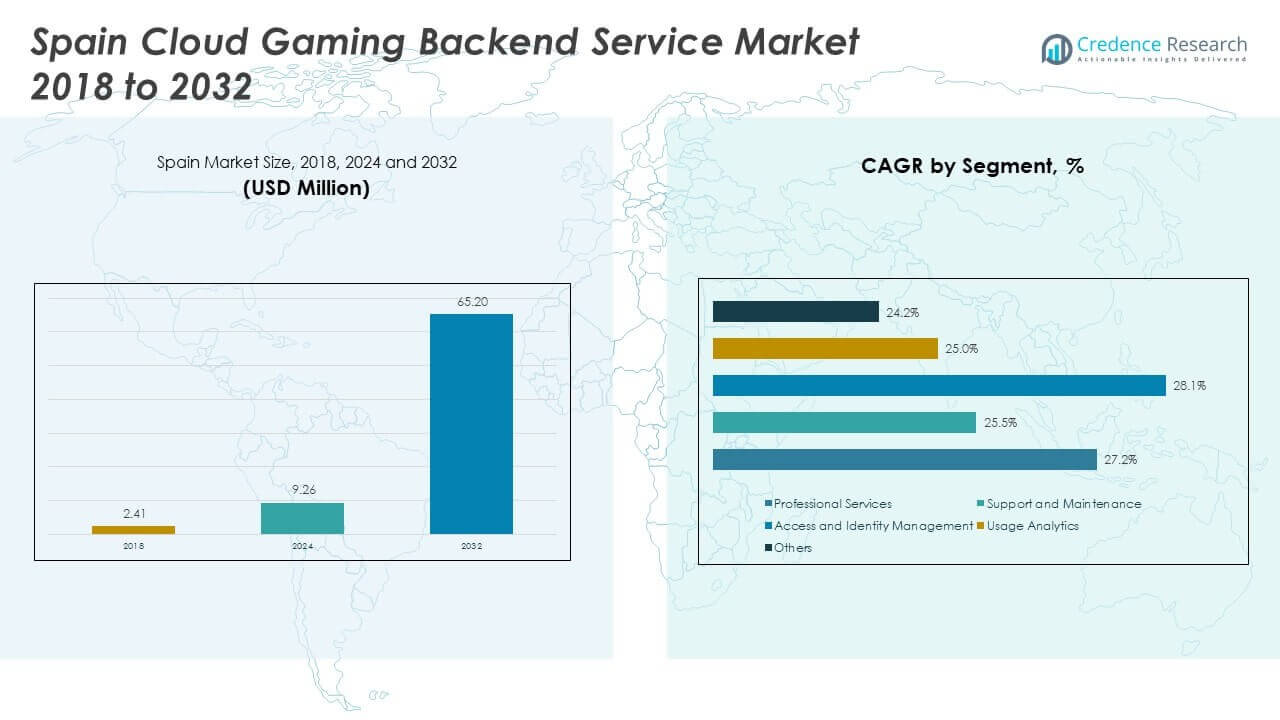
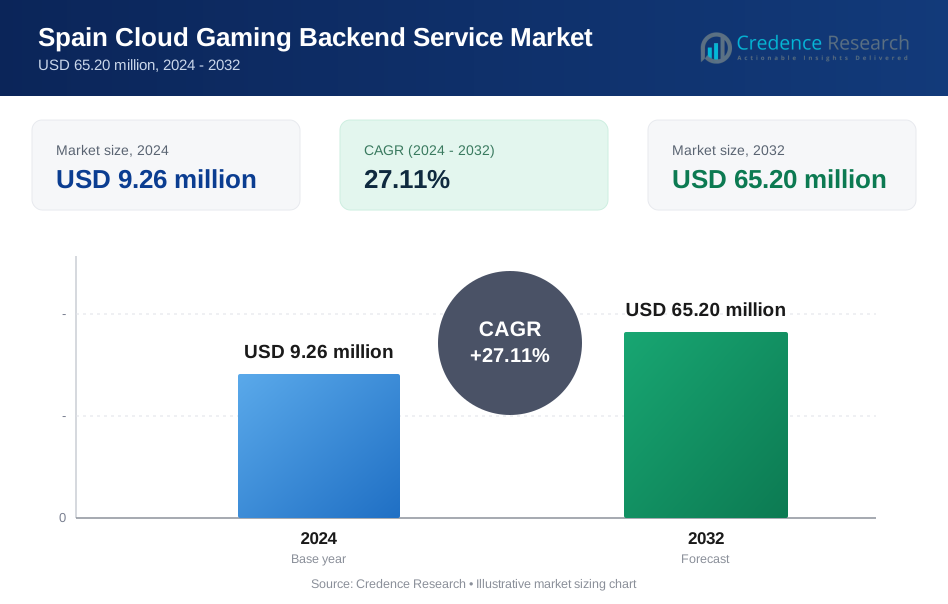
The Spain Cloud Gaming Backend Service Market size was valued at USD 2.41 million in 2018 to USD 9.26 million in 2024 and is anticipated to reach USD 65.20 million by 2032, at a CAGR of 27.11% during the forecast period.
| REPORT ATTRIBUTE | DETAILS |
|---|---|
| Historical Period | 2020-2023 |
| Base Year | 2024 |
| Forecast Period | 2025-2032 |
| Spain Cloud Gaming Backend Service Market Size 2024 | USD 9.26 Million |
| Spain Cloud Gaming Backend Service Market, CAGR | 27.11% |
| Spain Cloud Gaming Backend Service Market Size 2032 | USD 65.20 Million |
The Spain Cloud Gaming Backend Service Market is driven by increasing internet penetration and rising demand for immersive gaming experiences. Cloud platforms enable players to access high-quality games without high-end hardware, attracting both casual and professional gamers. Telecom operators are expanding 5G coverage, which enhances streaming performance and minimizes latency. Furthermore, strong adoption of subscription-based gaming models and growing investment by technology firms strengthen the market outlook. Strategic partnerships between gaming developers and cloud service providers also play a key role in expanding user engagement.
Regionally, Spain’s market benefits from its position in Southern Europe, with strong ties to Western and Central European gaming hubs. Countries like Germany, France, and the UK lead due to advanced infrastructure and high consumer spending on digital content. Emerging markets in Eastern Europe are gaining momentum, driven by improving connectivity and growing demand for affordable gaming solutions. Spain serves as a bridge, leveraging regional partnerships and cross-border collaborations to enhance growth prospects within the European gaming ecosystem.
Market Insights
- The Spain Cloud Gaming Backend Service Market was valued at USD 2.41 million in 2018, reached USD 9.26 million in 2024, and is projected to hit USD 65.20 million by 2032, at a CAGR of 27.11%.
- The Global Cloud Gaming Backend Service Market size was valued at USD 93.44 million in 2018 to USD 525.00 million in 2024 and is anticipated to reach USD 3,129.24 million by 2032, at a CAGR of 25.00% during the forecast period.
- Southern Spain held 38% share in 2024, supported by strong 5G coverage; Central Spain followed with 34% due to Madrid’s technology hub; Northern Spain secured 28%, driven by cultural gaming acceptance and regional investments.
- Northern Spain is the fastest-growing subregion with 28% share, fueled by rising adoption among younger demographics and expansion of telecom infrastructure.
- Professional Services accounted for 35% of the Spain Cloud Gaming Backend Service Market in 2024, reflecting enterprise reliance on integration expertise.
- Usage Analytics captured 22% share in 2024, highlighting rising demand for data-driven insights and performance optimization across platforms.
Market Drivers
Growing Impact of 5G Expansion and High-Speed Connectivity in Driving Market Demand
The expansion of 5G networks in Spain is transforming the gaming experience by ensuring low latency and seamless performance. Faster and more stable connections are making cloud gaming more attractive to a wide range of players. Telecom providers are heavily investing in infrastructure, enabling high-quality graphics and smoother gameplay. The Spain Cloud Gaming Backend Service Market benefits directly from these improvements. It encourages both casual and professional gamers to adopt streaming platforms over traditional consoles. Cloud providers are also using enhanced connectivity to promote multiplayer experiences. Improved coverage across urban and semi-urban regions helps increase the addressable market. Strong partnerships between telecom firms and gaming service providers further accelerate adoption.
- For example, Telefónica’s Movistar deployed 8 ,178 active 5G base stations in the 3.5 GHz band across Spain by July 2025, according to official data from the Spanish Ministry for Digital Transformation. This expansion supports the operator’s broad reach and network performance.
Rising Popularity of Subscription-Based Models as a Driver for Consistent Revenue Streams
Subscription models are rapidly gaining traction as gamers prefer affordable access to a broad library. These models allow customers to explore new games without upfront costs of physical consoles or downloads. The Spain Cloud Gaming Backend Service Market is increasingly shaped by this shift. It enables service providers to create recurring revenue and predict growth more accurately. Developers benefit from a wider distribution channel that enhances visibility. Consumers enjoy flexibility, which keeps engagement levels high and reduces barriers to entry. The appeal of bundled packages with added services also strengthens demand. This model supports market stability by aligning with broader digital consumption habits in Spain.
Increased Penetration of Smart Devices Enhancing Accessibility Across Wider Consumer Segments
The rise in smart devices, including smartphones, tablets, and smart TVs, is critical for accessibility. Growing affordability and higher adoption of these devices are creating new user groups. The Spain Cloud Gaming Backend Service Market thrives on this trend as it broadens its consumer reach. It becomes easier for people without high-end hardware to enjoy premium experiences. Cross-platform compatibility ensures continuity for players switching between devices. Developers are adapting their offerings to match diverse screen sizes and performance capabilities. Device manufacturers are also supporting gaming features, boosting integration across ecosystems. This development ensures inclusivity and long-term growth in the country.
- For instance, smart device and mobile broadband penetration in Spain reached 46.2 million internet users and 56.1 million cellular mobile connections as of January 2025, indicating an internet penetration rate of 96.4% and mobile broadband connectivity equivalent to 117% of the population.
Expanding Role of Partnerships Between Gaming Firms and Cloud Service Providers
Collaborations between cloud providers and gaming companies are significantly increasing service availability. These partnerships enhance content quality and strengthen backend infrastructure. The Spain Cloud Gaming Backend Service Market is witnessing steady growth from such alliances. It ensures that both large studios and smaller developers benefit from cloud ecosystems. Content libraries expand rapidly, offering consumers more diverse and engaging options. The integration of backend solutions into global gaming platforms raises market competitiveness. Service providers also improve scalability, which enhances user experience during peak demand. Such collaborations are fostering innovation, driving investment, and supporting the wider gaming ecosystem.
Market Trends
Emergence of Artificial Intelligence and Machine Learning in Enhancing User Experience
Artificial intelligence and machine learning are becoming vital in shaping gaming backend services. AI helps optimize server allocation, predict demand, and manage resource distribution effectively. The Spain Cloud Gaming Backend Service Market integrates these technologies to personalize user experience. It creates dynamic recommendations and adapts content to gamer preferences. AI-driven analytics are also helping service providers optimize pricing models. Game developers are experimenting with intelligent features that improve player engagement. These innovations make the overall experience more immersive and interactive. As AI evolves, its integration with cloud gaming platforms will remain a dominant trend.
- For example, Microsoft launched its "Spain Central" Azure cloud region in June 2024, located in the Community of Madrid, providing advanced cloud and AI services, including generative AI capabilities, to Spanish businesses and public entities. The region supports data residency to comply with European regulations and offers scalability through three Availability Zones. More information is available on Microsoft's news site
Shift Toward Edge Computing to Improve Performance and Reduce Latency
Edge computing is emerging as a transformative trend, bringing servers closer to users. This approach reduces latency and enhances responsiveness in cloud gaming services. The Spain Cloud Gaming Backend Service Market gains momentum through this adoption. It allows gamers to experience high-quality streaming without interruptions. Edge computing also supports scalability, handling heavy demand during peak times. Telecom operators and cloud providers are focusing on expanding local data centers. This infrastructure investment is improving access for urban and rural players. The reliance on edge capabilities will continue to shape market strategies in Spain.
Integration of Cloud Gaming With Social and Esports Ecosystems Driving Engagement
Cloud gaming is increasingly connected with social platforms and esports communities. Gamers are seeking interactive experiences that combine play with social engagement. The Spain Cloud Gaming Backend Service Market is benefiting from this growing convergence. It allows seamless streaming of gameplay across multiple platforms. Esports events are using cloud-based services for broader participation. These integrations strengthen community engagement and improve visibility for developers. Cloud platforms also enable real-time collaboration, expanding multiplayer opportunities. This trend supports the cultural shift of gaming into mainstream entertainment.
- For example, NVIDIA’s GeForce NOW cloud gaming platform is officially available in Spain, supporting integration with accounts from Steam, Epic Games Store, Ubisoft, and others. The service allows Spanish gamers to stream across PCs, Macs, smartphones, and smart TVs. By late 2024, GeForce NOW offered a library of more than 2,500 games, reinforcing its position as one of the most extensive cloud gaming platforms globally.
Sustainability and Green Data Centers Emerging as a Significant Market Influence
Sustainability is becoming an important factor for cloud gaming backend operations. Providers are focusing on renewable energy and green data centers. The Spain Cloud Gaming Backend Service Market aligns with this shift toward eco-friendly practices. Companies are exploring energy-efficient cooling and server technologies. These actions help reduce operational costs while improving brand perception. Environmental concerns among consumers are influencing provider strategies. Partnerships with renewable energy suppliers are also gaining attention. Sustainability will continue to be a differentiator in shaping the industry landscape.
Market Challenges Analysis
Persistent Latency Issues and Limited Infrastructure in Certain Areas of Spain
One of the major challenges remains latency, which directly affects gaming quality. Although 5G and fiber networks are expanding, rural regions face gaps in access. The Spain Cloud Gaming Backend Service Market must address these issues to ensure inclusivity. It is difficult for service providers to maintain seamless performance without consistent infrastructure. Players in underserved areas face interruptions that affect adoption. Maintaining consistent server availability is costly for providers managing wide networks. Service providers need significant investment to bridge these gaps. Addressing latency challenges remains a top priority for long-term stability.
High Operational Costs and Competitive Pressure on Service Providers
Cloud gaming requires heavy investment in backend systems, servers, and data centers. The Spain Cloud Gaming Backend Service Market faces pressure from both global and local competitors. It is challenging to balance affordability for consumers with profitability for providers. Companies must maintain strong security, scalability, and performance while controlling expenses. Rising energy costs and infrastructure maintenance strain financial sustainability. Competition from established platforms creates pricing pressure across the market. Smaller firms may find it difficult to maintain parity with larger providers. These operational and financial pressures limit growth for many industry participants.
Market Opportunities
Expanding Gaming Audience and New Demographics Creating Strong Growth Potential
The growing interest in gaming across different demographics offers strong opportunities. Young players, casual users, and older age groups are exploring gaming ecosystems. The Spain Cloud Gaming Backend Service Market can capture this demand through targeted strategies. It is creating inclusive platforms that meet diverse preferences and budgets. Cross-platform compatibility supports greater engagement among varied users. Providers can leverage content libraries that cater to local tastes. Social integrations also expand outreach, increasing brand visibility. The expansion of new demographics strengthens growth opportunities significantly.
Adoption of Innovative Technologies and Partnerships With Local Ecosystem Players
Emerging technologies such as AR, VR, and blockchain create untapped opportunities. The Spain Cloud Gaming Backend Service Market is adapting to these innovations quickly. It is enabling developers to launch immersive and secure gaming experiences. Collaborations with local telecom and technology firms enhance deployment success. Providers can introduce value-added services to build competitive differentiation. Opportunities also lie in customizing services for regional preferences. Investments in innovation improve consumer loyalty and long-term stability. Such technological and collaborative strategies open new growth pathways.
Market Segmentation Analysis
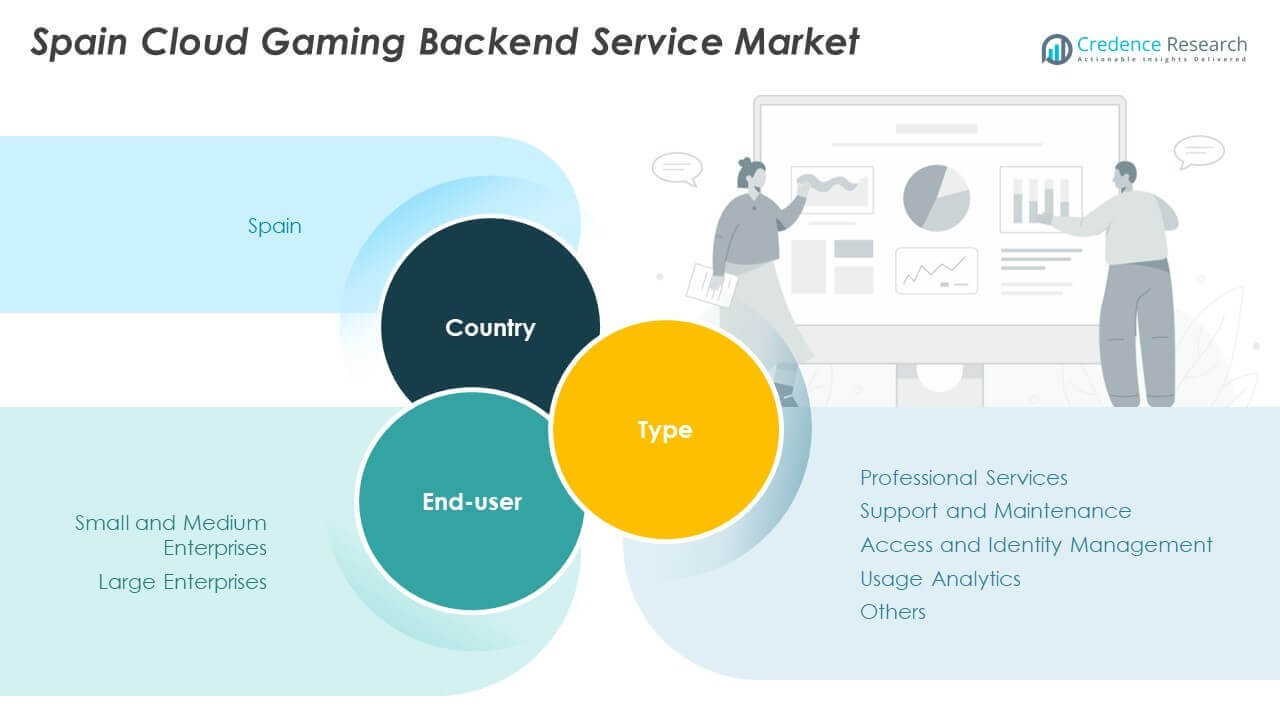
The Spain Cloud Gaming Backend Service Market is structured
By type into professional services, support and maintenance, access and identity management, usage analytics, and others. Professional services represent the largest share, driven by enterprises seeking expertise for seamless integration and management of backend systems. Support and maintenance are vital for ensuring reliable operations and minimizing downtime. Access and identity management solutions are expanding with the rise of secure authentication requirements. Usage analytics is gaining traction as service providers emphasize data-driven insights to improve performance. Other service categories contribute by addressing niche requirements in the ecosystem.
- For example, Sony’s PlayStation cloud streaming (now part of PlayStation Plus Premium) and Microsoft’s Xbox Cloud Gaming are both available in Spain, offering subscription-based access to a wide catalog of games. By 2025, these services support cross-device compatibility across consoles, PCs, smartphones, and smart TVs, enabling Spanish players to stream games through local ISPs with stable broadband and 5G connections.
By end-user, the Spain Cloud Gaming Backend Service Market is divided into small and medium enterprises and large enterprises. Large enterprises dominate adoption due to significant investments in advanced cloud infrastructure and the ability to leverage backend solutions for large-scale deployments. Small and medium enterprises are emerging as a promising segment, supported by scalable service models and subscription-based offerings that reduce upfront costs. It creates opportunities for cloud providers to expand reach across diverse business sizes. This segmentation highlights a balanced demand from both enterprise levels, with strong growth expected from SMEs in the coming years.
- For example, Telefónica has expanded its 5G network across Spain and partnered with Microsoft Azure to enhance cloud and edge services. This collaboration supports high-volume digital applications, including cloud gaming, by leveraging low-latency connectivity and scalable infrastructure.
Segmentation
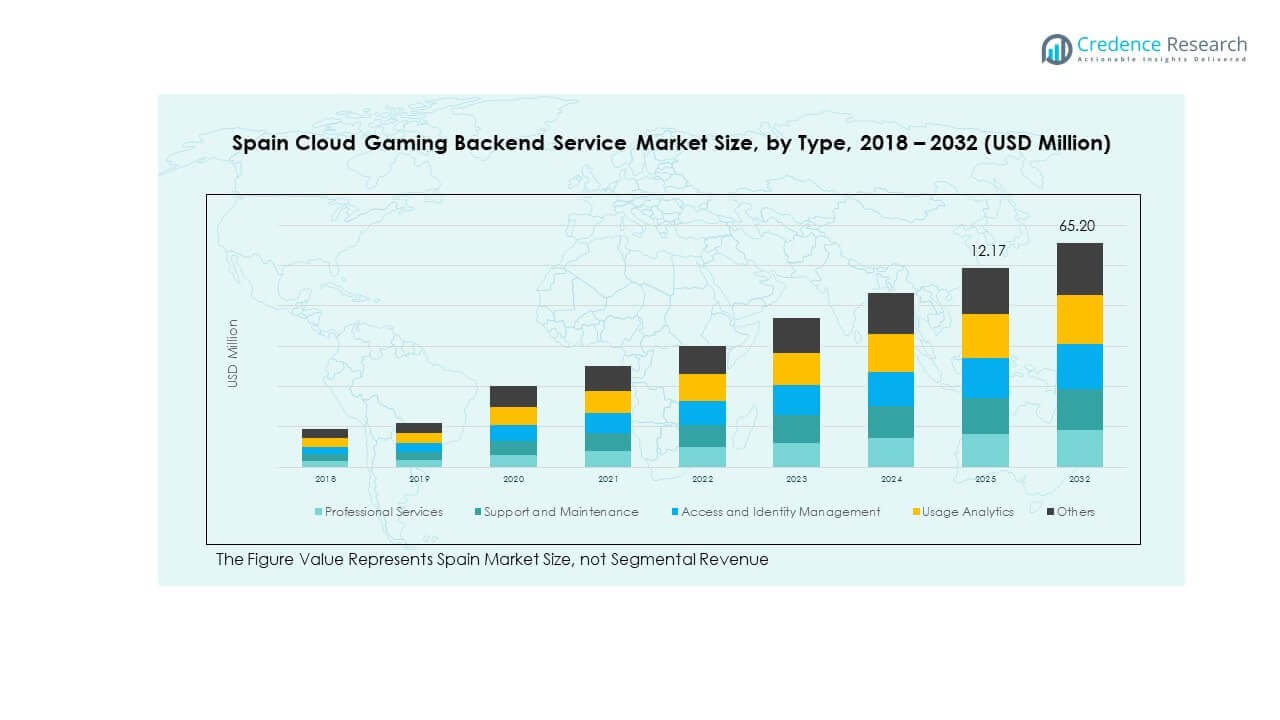
By Type
- Professional Services
- Support and Maintenance
- Access and Identity Management
- Usage Analytics
- Others
By End-User
- Small and Medium Enterprises
- Large Enterprises
Regional Analysis
Southern Spain holds 38% share of the Spain Cloud Gaming Backend Service Market, supported by strong adoption in cities like Seville and Malaga. High internet penetration and increasing 5G deployment strengthen user demand. Service providers are focusing on delivering scalable infrastructure to support gaming hubs in this subregion. It plays a vital role in connecting local developers with international platforms. Growing collaboration between telecom operators and cloud providers enhances accessibility for consumers. This concentration of investment ensures steady market growth in Southern Spain.
Central Spain accounts for 34% of the market share, driven by Madrid’s position as a technology and business hub. Cloud providers and global gaming firms are investing heavily in the capital’s infrastructure. The Spain Cloud Gaming Backend Service Market benefits from Madrid’s innovation ecosystem and government support for digitalization. It strengthens links between cloud gaming firms and local enterprises. The presence of multinational technology companies creates opportunities for partnerships and expansions. Demand from both enterprises and individual gamers continues to grow in this subregion.
Northern Spain holds 28% share, supported by emerging adoption in regions like Catalonia and the Basque Country. It is witnessing steady growth from younger demographics and increased investment in telecom networks. Local gaming studios are contributing to the development of new platforms. The Spain Cloud Gaming Backend Service Market leverages this demand to expand coverage. It benefits from higher disposable incomes and cultural acceptance of gaming in these regions. Northern Spain is positioning itself as an emerging contributor to the market’s overall performance.
Key Player Analysis
- NVIDIA GeForce Now
- Blacknut
- Shadow (Blade SAS)
- Ubitus
- Google Cloud Platform
- Amazon Web Services (AWS)
- Microsoft Azure
- IBM Cloud
- Scaleway
- GameSparks
Competitive Analysis
The Spain Cloud Gaming Backend Service Market is highly competitive, with global and regional players shaping the landscape. It is led by major providers such as NVIDIA GeForce Now, Google Cloud Platform, Amazon Web Services, and Microsoft Azure, who dominate through strong infrastructure, partnerships, and scalable ecosystems. Local firms like Blacknut, Shadow (Blade SAS), and Scaleway strengthen competition by offering tailored services. The market is defined by innovation, subscription models, and rapid deployment of advanced backend technologies. Service providers focus on improving latency, enhancing user experience, and integrating AI-driven features to remain competitive. Mergers, acquisitions, and product launches remain key strategies for expansion. The Spain Cloud Gaming Backend Service Market thrives on collaborations between telecom companies and gaming developers, which improve reach and adoption. It continues to attract investment due to rising demand, but competition pressures providers to maintain affordability while ensuring high-quality services. This balance shapes long-term positioning and growth strategies.
Recent Developments
- In September 2025, NVIDIA launched the Blackwell RTX upgrade for GeForce NOW, bringing RTX 5080-class power streaming to the cloud. This update enables higher gaming resolutions and frame rates, new competitive high-performance modes, and access to over 2,200 titles, further solidifying NVIDIA's presence in the North American cloud gaming backend service market.
- In March 2025, Xsolla and AWS entered into a key partnership designed to empower game developers with the latest advancements in cloud gaming and LiveOps solutions. The collaboration leverages AWS’s cloud infrastructure and Xsolla’s developer platform to create scalable, flexible backend solutions, further strengthening their positions in the expanding global cloud gaming backend service sector.
- In July 2024, Xsolla announced the acquisition of LF.Group to enhance gaming connectivity and commerce, empower creators, and improve user engagement across multiple platforms. This strategic move aims to give Xsolla a stronger foothold in the global cloud gaming backend service market by integrating LF.Group's technology stack and community features into its existing offerings, driving forward innovation in backend solutions for cloud gaming environments.
- In January 2025, Blacknut formed a strategic partnership with Titan OS, a Barcelona-based technology company, to bring the Blacknut cloud gaming experience to millions of gamers across Europe, including Spain. The Blacknut app became available on Philips smart TVs powered by Titan OS, with plans to expand to other brands like JVC. This allows users to access a vast library of over 500 cloud-based games directly from their TVs without consoles or downloads, enhancing the home gaming experience.
Report Coverage
The research report offers an in-depth analysis based on type and end-user. It details leading market players, providing an overview of their business, product offerings, investments, revenue streams, and key applications. Additionally, the report includes insights into the competitive environment, SWOT analysis, current market trends, as well as the primary drivers and constraints. Furthermore, it discusses various factors that have driven market expansion in recent years. The report also explores market dynamics, regulatory scenarios, and technological advancements that are shaping the industry. It assesses the impact of external factors and global economic changes on market growth. Lastly, it provides strategic recommendations for new entrants and established companies to navigate the complexities of the market.
Future Outlook
- The Spain Cloud Gaming Backend Service Market will expand with wider 5G adoption and stable connectivity.
- Subscription-based models will gain traction, supporting steady consumer engagement across demographics.
- Cloud-native innovations will transform backend efficiency, creating scalable and flexible deployment options.
- Partnerships between telecom operators and gaming developers will accelerate ecosystem integration.
- AI and analytics will enhance personalization, offering improved gamer experiences and retention.
- Edge computing will reduce latency, boosting real-time gaming performance for urban and rural users.
- Rising investment in data centers will strengthen national infrastructure for backend services.
- Cross-platform compatibility will drive growth by appealing to diverse device users.
- Sustainability initiatives and green data centers will influence provider strategies and consumer choices.
- Competitive intensity will increase, pushing companies to innovate, expand, and differentiate services.
Request a Free Sample
Fill in your details and we'll send you a free sample report.
- Sample data tables & charts
- Research methodology
Need a Custom Version of This Report?
Tailor the scope, geography, or segments to your exact requirements.
- Custom geography or segment scope
- Direct access to our analyst team
Frequently Asked Questions
What is the current market size for Spain Cloud Gaming Backend Service Market, and what is its projected size in 2032?
At what Compound Annual Growth Rate is the Spain Cloud Gaming Backend Service Market projected to grow between 2024 and 2032?
Which Spain Cloud Gaming Backend Service Market segment held the largest share in 2024?
What are the primary factors fueling the growth of the Spain Cloud Gaming Backend Service Market?
Who are the leading companies in the Spain Cloud Gaming Backend Service Market?
Which region commanded the largest share of the Spain Cloud Gaming Backend Service Market in 2024?
Table of Content
Chapter 1. Report Introduction
- 1.1 Report Description & Purpose
- 1.1.1 Report Title & Market Definition
- 1.1.2 Unique Selling Propositions (USP) & Key Differentiators
- 1.1.3 Value Proposition for Stakeholders
- 1.2 Research Objectives
- 1.2.1 Market Sizing Objectives (Volume & Revenue)
- 1.2.2 Segmentation Objectives
- 1.2.3 Competitive Intelligence Objectives
- 1.2.4 Forecast & Scenario Objectives
- 1.3 Report Scope
- 1.3.1 Spain Cloud Gaming Backend Service Scope – Types & Subtypes Covered
- 1.3.2 Geographic Scope – Regions & Countries Covered
- 1.3.3 Historical Period, Base Year & Forecast Period (2024; forecast to 2032)
- 1.3.4 Inclusions & Exclusions
- 1.4 HS Code & Classification Framework
- 1.5 Currency, Units & Pricing Basis
- 1.6 Target Stakeholders
- 1.7 Limitations & Assumptions
Chapter 2. Executive Summary
- 2.1 Global Spain Cloud Gaming Backend Service Market Snapshot
- 2.1.1 Market Size – Historical (2024) & Forecast (2024-2032) (2024: USD 9.26 million → 2032: USD 65.20 million)
- 2.1.2 Volume & Revenue – Global Totals
- 2.1.3 Key Market Highlights – Top Five Facts
- 2.2 Spain Cloud Gaming Backend Service Market Segmentation Snapshot
- 2.2.1 Market Split by Region – 2024 vs. 2032
- 2.3 Competitive Snapshot
- 2.3.1 Top 10 Players by Revenue Share – 2024
- 2.3.2 Top 10 Players by Volume Share – 2024
- 2.3.3 Recent Strategic Developments (18-Month Summary)
- 2.4 Key Investment Highlights & Strategic Conclusions
Chapter 3. Spain Cloud Gaming Backend Service Market Dynamics & Industry Analysis
- 3.1 Market Overview & Context
- 3.1.1 Spain Cloud Gaming Backend Service Market Position in the Broader Automotive Value Chain
- 3.1.2 OEM vs. Replacement Market Dynamics
- 3.1.3 Market Maturity & Development Stage by Region
- 3.2 Spain Cloud Gaming Backend Service Market Drivers
- 3.3 Spain Cloud Gaming Backend Service Market Restraints & Challenges
- 3.4 Spain Cloud Gaming Backend Service Market Opportunities
- 3.5 Porter's Five Forces Analysis
- 3.5.1 Threat of New Entrants
- 3.5.2 Bargaining Power of Suppliers
- 3.5.3 Bargaining Power of Buyers
- 3.5.4 Threat of Substitutes
- 3.5.5 Competitive Rivalry – Intensity Assessment
- 3.6 Spain Cloud Gaming Backend Service Value Chain Analysis
- 3.6.1 Upstream – Raw Material/Input Suppliers
- 3.6.1.1 Raw Material/Input 1
- 3.6.1.2 Raw Material/Input 2
- 3.6.1.3 Raw Material/Input 3
- 3.6.2 Midstream – Production/Manufacturing/Service Delivery
- 3.6.2.1 Production/Process Overview
- 3.6.2.2 Key Facility Locations & Capacity by Manufacturer
- 3.6.3 Downstream – Distribution & End Consumer
- 3.6.3.1 Primary Channel – B2B/OEM
- 3.6.3.2 Secondary Channels – Dealer, Retail, Online, Direct
- 3.6.4 Value Chain Profitability Analysis
- 3.6.1 Upstream – Raw Material/Input Suppliers
- 3.7 PESTEL Analysis
- 3.7.1 Political Factors
- 3.7.2 Economic Factors
- 3.7.3 Social Factors
- 3.7.4 Technological Factors
- 3.7.5 Environmental Factors
- 3.7.6 Legal Factors
- 3.8 Spain Cloud Gaming Backend Service Supply Chain Analysis
- 3.8.1 Raw Material/Input Supply Risk Assessment
- 3.8.2 Manufacturing Concentration Risk (Geographic Exposure)
- 3.8.3 Trade Disruption Impact Analysis
- 3.9 Regulatory & Policy Landscape
Note: The regulatory and policy landscape section covers regulations based on their applicability to the market, Spain Cloud Gaming Backend Service category, geography, and scope of the study. Only regulatory frameworks with a material impact on operations, compliance, trade, sustainability, or market access are analyzed in detail.
Chapter 4. Key Investment Pockets & Opportunity Analysis
- 4.1 Spain Cloud Gaming Backend Service Market Attractiveness Analysis
- 4.1.1 By Region – Investment Attractiveness Matrix (Volume × CAGR)
- 4.2 Absolute Revenue Growth Opportunity
- 4.2.1 By Region – Absolute USD Growth Through 2032
- 4.3 Incremental Volume Opportunity
- 4.3.1 By Region – Incremental Volume Through 2032
- 4.3.2 Segment – Incremental Volume
- 4.4 Emerging Submarket Opportunity Deep Dive (Subject to Applicability)
- 4.5 Emerging Market Opportunity Scorecards
- 4.5.1 United States
- 4.5.2 Europe
- 4.5.3 Asia
- 4.5.4 Middle East & Africa
Note: Emerging Market Opportunity Scorecards will be included based on relevance and strategic importance. Regions listed are indicative and may vary depending on data availability and market dynamics.
Chapter 5. Spain Cloud Gaming Backend Service Import-Export Analysis & Trade Flows
- 5.1 Global Trade Overview
- 5.1.1 Global Export Value by Country (2024)
- 5.1.2 Global Export Volume by Country (2024)
- 5.1.3 Global Import Value by Country (2024)
- 5.1.4 Global Import Volume by Country (2024)
- 5.1.5 Net Trade Balance by Country (2024)
- 5.2 Export Analysis – Segment
- 5.2.1 Type 1 (HS Code)
- 5.2.2 Type 2 (HS Code)
- 5.2.3 Type 3 (HS Code)
- 5.2.4 Type 4 (HS Code)
- 5.2.5 Type 5 (HS Code)
- 5.3 Import Analysis – Segment
- 5.3.1 Type 1 (HS Code)
- 5.3.2 Type 2 (HS Code)
- 5.3.3 Type 3 (HS Code)
- 5.3.4 Type 4 (HS Code)
- 5.3.5 Type 5 (HS Code)
- 5.4 Average Unit Trade Prices
- 5.4.1 Average Export Price – Segment & Country
- 5.4.2 Average Import Price – Segment & Source Country
- 5.4.3 Price Trends (2024)
- 5.5 Key Trade Route Analysis
- 5.5.1 Trade Route 1
- 5.5.2 Trade Route 2
- 5.5.3 Trade Route 3
- 5.5.4 Trade Route 4
- 5.5.5 Trade Route 5
- 5.6 Trade Policy Impact Assessment
- 5.6.1 US Anti-Dumping & Section 301 Tariffs
- 5.6.2 EU Customs Union Impact
- 5.6.3 Major Free Trade Agreements
- 5.6.4 USMCA Rules of Origin
Note: Trade policy analysis will be included only where relevant to the Spain Cloud Gaming Backend Service market.
Chapter 6. Competitive Landscape & Company Benchmarking
- 6.1 Spain Cloud Gaming Backend Service Market Concentration & Structure
- 6.1.1 Herfindahl-Hirschman Index (HHI) – vs. 2024
- 6.1.2 Tier 1, Tier 2 & Tier 3 Market Structure
- 6.1.3 Global, Regional & Local Player Dynamics
- 6.2 Spain Cloud Gaming Backend Service Market Share Analysis – 2024
- 6.2.1 Global Revenue Share by Company
- 6.2.2 Global Volume Share by Company
- 6.2.3 Regional Revenue Share
- 6.2.4 Market Share Evolution ( vs. 2024)
- 6.2.5 OEM Segment Share by Company
- 6.2.6 Replacement Segment Share by Company
- 6.3 Production/Delivery Capacity & Facility Analysis
- 6.3.1 Global Installed Capacity
- 6.3.2 Capacity Utilization Rates
- 6.3.3 Production/Output Volume
- 6.3.4 Facility Locations & Capacity Map
- 6.3.5 Planned Capacity Additions
- 6.4 Spain Cloud Gaming Backend Service Competitive Benchmarking Matrix
- 6.4.1 Revenue, Volume, CAGR & Profitability Comparison
- 6.4.2 Channel Revenue Mix
- 6.4.3 Geographic Revenue Exposure
- 6.4.4 R&D Intensity
- 6.4.5 Sustainability Maturity
- 6.5 Strategic Developments in Spain Cloud Gaming Backend Service (Last 24 Months)
- 6.5.1 Mergers, Acquisitions & Divestments
- 6.5.2 New Spain Cloud Gaming Backend Service Launches
- 6.5.3 Facility Expansions
- 6.5.4 Strategic Alliances, Joint Ventures & Partnerships
- 6.5.5 Distribution Expansion & Market Entry
- 6.5.6 Sustainability & ESG Initiatives
- 6.6 Competitive Strategy Mapping
- 6.6.1 Leader, Challenger, Follower & Niche Classification
- 6.6.2 Pricing Strategy Comparison
- 6.6.3 Channel Strategy Matrix
Note: Strategic developments are included based on their materiality and the availability of reliable information.
Chapter 7. Global Spain Cloud Gaming Backend Service Market – By Distribution Channel
- 7.1 Segment Overview
- 7.1.1 Volume & Revenue Split by Channel (2024 & 2032)
- 7.1.2 Channel Mix Evolution (2024-2032)
Chapter 8. Regional Market Analysis – Global Overview
- 8.1 Global Regional Overview
- 8.1.1 Regional Volume Share
- 8.1.2 Regional Revenue Share
- 8.1.3 Regional Volume by Region
- 8.1.4 Regional Revenue by Region
- 8.1.5 Regional Forecast Through 2032
- 8.2 Cross-Regional Segment Analysis
- 8.2.1 By Distribution Channel
- 8.2.2 By Brand/Price Tier
Chapter 9. North America Spain Cloud Gaming Backend Service Market
- 9.1 United States
- 9.2 Canada
- 9.3 Mexico
Chapter 10. Europe Spain Cloud Gaming Backend Service Market
- 10.1 Germany
- 10.2 France
- 10.3 Italy
- 10.4 United Kingdom
- 10.5 Spain
- 10.6 Poland
- 10.7 Russia
- 10.8 Netherlands
- 10.9 Belgium
- 10.10 Sweden
- 10.11 Denmark
- 10.12 Norway
- 10.13 Rest of Europe
Chapter 11. Asia Pacific Spain Cloud Gaming Backend Service Market
- 11.1 China
- 11.2 India
- 11.3 Japan
- 11.4 South Korea
- 11.5 Thailand
- 11.6 Indonesia
- 11.7 Vietnam
- 11.8 Malaysia
- 11.9 Australia
- 11.10 Rest of Asia Pacific
Chapter 12. Latin America Spain Cloud Gaming Backend Service Market
- 12.1 Brazil
- 12.2 Argentina
- 12.3 Colombia
- 12.4 Chile
- 12.5 Rest of Latin America
Chapter 13. Middle East Spain Cloud Gaming Backend Service Market
- 13.1 Saudi Arabia
- 13.2 United Arab Emirates
- 13.3 Turkey
- 13.4 Israel
- 13.5 Iran
- 13.6 Rest of the Middle East
Chapter 14. Africa Spain Cloud Gaming Backend Service Market
- 14.1 South Africa
- 14.2 Egypt
- 14.3 Nigeria
- 14.4 Morocco
- 14.5 Rest of Africa
Chapter 15. Spain Cloud Gaming Backend Service Company Profiles
- 15.1 [Company 01]
- 15.1.1 Company Overview
- 15.1.2 Key Management Personnel
- 15.1.3 Products & Services Portfolio
- 15.1.4 Financial Performance
- 15.1.5 Key Market Focus & Geographic Presence
- 15.1.6 Recent Developments & Strategic Initiatives
Note: The company profile list is preliminary and may change based on research findings, market developments, data availability, and client requirements.
Chapter 16. Appendices
- Appendix A – List of Abbreviations & Acronyms
- Appendix B – Industry Classification Code Reference – Full Series
- Appendix C – Production & Capacity Data Tables
- Appendix D – End-Use & Demand Base Tables
- Appendix E – Consumption & Replacement Rate Assumptions
- Appendix F – ASP Reference Tables
- Appendix G – Manufacturing & Facility Database
- Appendix H – Import-Export Data Tables
- Appendix I – Regulatory Summary Tables
- Appendix J – Primary Research Participant List (Anonymized)
- Appendix K – Primary Research Questionnaire Framework
- Appendix L – Data Sources & Bibliography
- Appendix M – Market Size Divergence & Source Comparison
Chapter 17. Research Methodology
- 17.1 Research Framework & Philosophy
- 17.2 Secondary Research – Sources, Hierarchy & Data Extraction
- 17.3 Data Modeling – Bottom-Up & Top-Down Market Sizing
- 17.4 Primary Research – Stakeholder Framework, LOI & Sample Sizes
- 17.5 Forecast Methodology – Regression, Scenario & Sensitivity Analysis
- 17.6 Quality Control – Four-Layer Validation Framework
- 17.7 Limitations & Standard Assumptions
- 17.8 Disclaimer
