
Africa Orphan Drugs Market Overview:
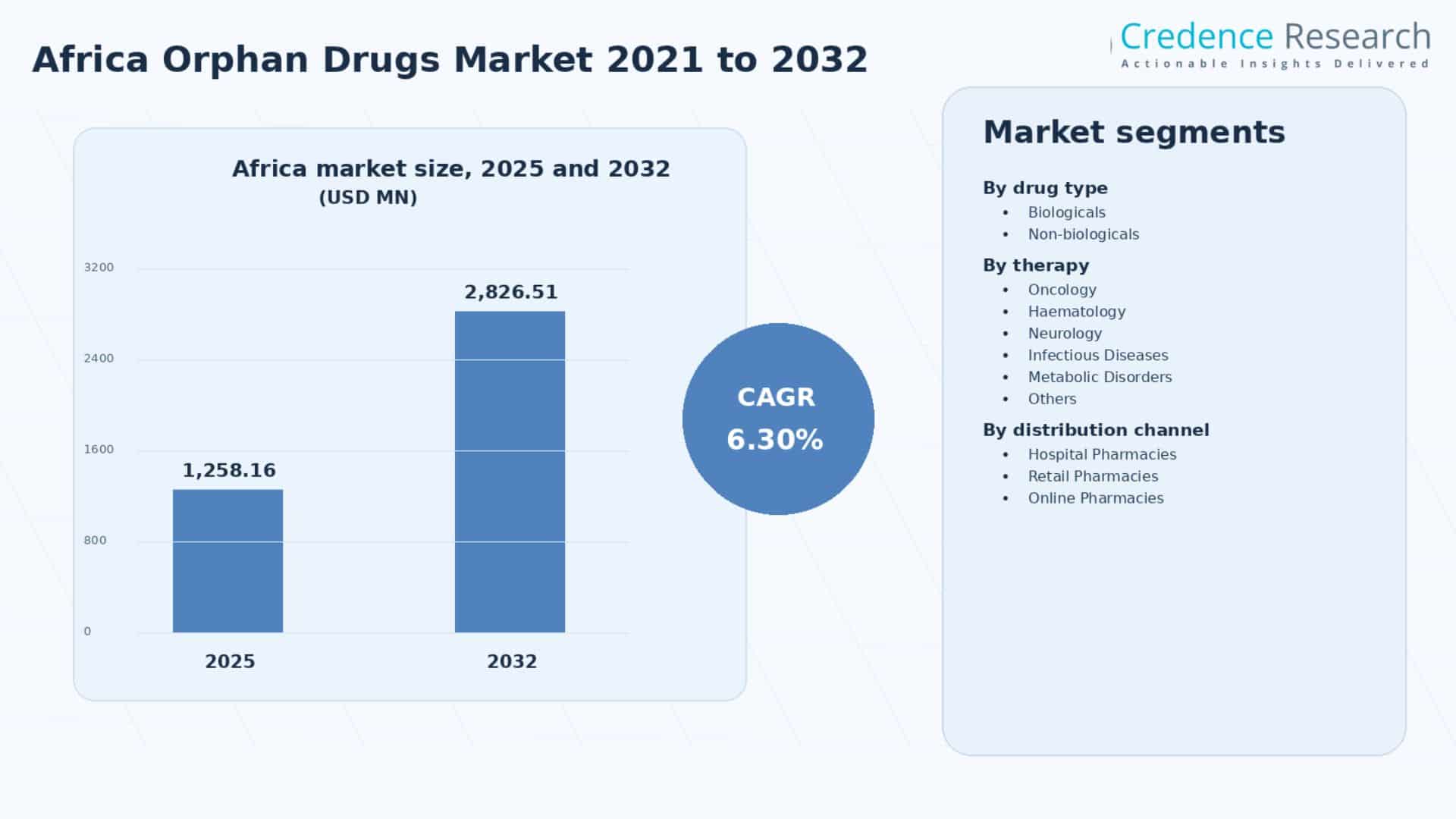
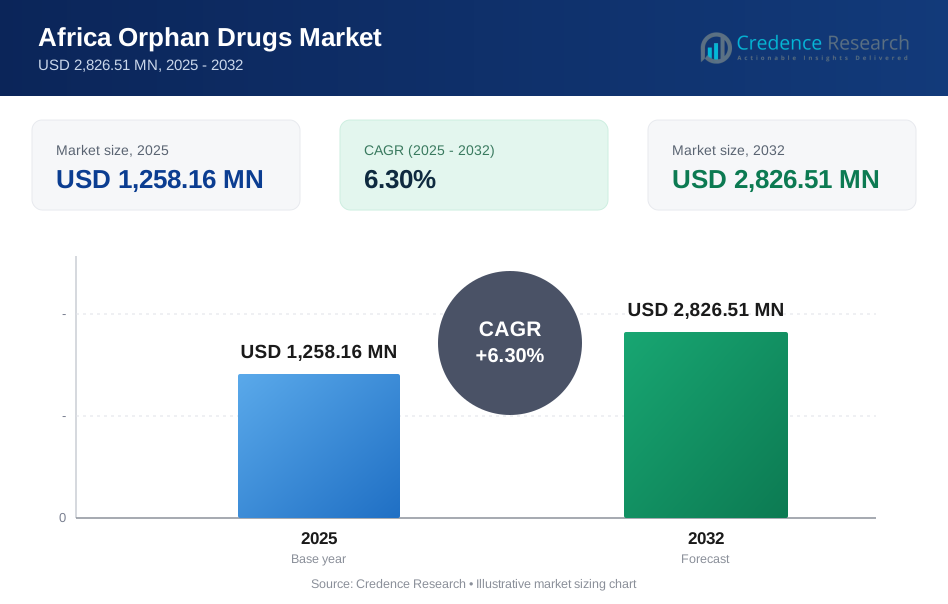
The Africa Orphan Drugs Market size was valued at USD 792.75 MN in 2021 and reached USD 1,258.16 MN in 2025. It is anticipated to reach USD 2,826.51 MN by 2032, growing at a CAGR of 6.30% during the forecast period.
| REPORT ATTRIBUTE | DETAILS |
|---|---|
| Historical Period | 2021-2024 |
| Base Year | 2025 |
| Forecast Period | 2026-2032 |
| Africa Orphan Drugs Market Size 2025 | USD 1,258.16 million |
| Africa Orphan Drugs Market, CAGR | 6.30% |
| Africa Orphan Drugs Market Size 2032 | USD 2,826.51 million |
Africa Orphan Drugs Market Insights
- Market growth is supported by unmet rare disease needs, oncology and haematology treatment demand, rising biologic adoption, improved regulatory coordination and gradual expansion of hospital pharmacy access.
- Biologicals hold a strong position because many orphan therapies for oncology, haematology, neurology and metabolic disorders use monoclonal antibodies, enzyme replacement therapies, recombinant proteins or gene-based mechanisms.
- Oncology remains a leading therapy area because rare cancers, hematologic malignancies and targeted cancer therapies drive specialist prescribing and hospital-based access.
- Hospital Pharmacies remain the leading distribution channel because orphan drugs often require specialist diagnosis, cold-chain management, prior authorization, monitoring and controlled administration.
Africa Orphan Drugs Market Segment Insights
By drug type
By drug type, Biologicals held the strongest position in 2025 because orphan disease treatment increasingly relies on biologic and advanced therapies. Biologicals include monoclonal antibodies, recombinant proteins, enzyme replacement therapies, plasma-derived products and gene-based therapies used across Oncology, Haematology, Neurology and Metabolic Disorders. Non-biologicals remain important because several orphan conditions are treated through small molecules, supportive therapies, antivirals, metabolic drugs and targeted oral medicines. Biologicals will continue to gain value as advanced rare disease therapies expand, but Non-biologicals will remain essential where affordability, oral access and simpler distribution make them more practical across African health systems.
By therapy
By therapy, Oncology held a strong position in 2025 because rare cancers and hematologic malignancies often require high-value orphan therapies. Haematology also contributes strong demand due to sickle-cell disease, hemophilia, rare anemia conditions and clotting disorders. Neurology is gaining relevance as spinal muscular atrophy, neuromuscular disorders, lysosomal storage diseases and genetic neurological diseases gain greater diagnostic visibility. Infectious Diseases include rare infection-related complications and specialized therapies. Metabolic Disorders include enzyme replacement and substrate reduction therapies for inherited metabolic diseases. Others include immunology, renal, ophthalmology and rare pediatric conditions. Therapy growth will depend on diagnosis, specialist access, reimbursement and donor-supported access programs.
By distribution channel
By distribution channel, Hospital Pharmacies held the strongest position in 2025 because orphan drugs are typically prescribed by specialists and require hospital-led diagnosis, monitoring and procurement. Hospital Pharmacies also manage biologics, injectable therapies, oncology drugs, hematology products and complex cold-chain handling. Retail Pharmacies support selected Non-biologicals, chronic oral therapies and refill-based treatment where products are approved and affordable. Online Pharmacies remain small because orphan drugs require specialist prescription validation, safe handling and strong regulatory oversight. Distribution growth will favor hospitals and specialty pharmacy models with product traceability, payer documentation and patient support capacity.
Key Market Drivers
Rare disease burden and unmet treatment need
Rare disease burden and unmet treatment need represent major growth drivers for the Africa Orphan Drugs Market. Many rare conditions remain underdiagnosed across the region, but greater awareness, genetic testing access and specialist care are improving identification of patients who may benefit from orphan therapies.
WHO says sickle-cell disease affected an estimated 7.74 million people globally in 2021, with 515,000 new births, primarily in sub-Saharan Africa, which accounts for nearly 80% of global cases. WHO also reported 81,100 deaths in children younger than 5 in 2021 linked to sickle-cell disease. This burden supports demand for Haematology therapies, Biologicals and Hospital Pharmacies. Market expansion will depend on newborn screening, diagnostic pathways, national rare disease policies and access programs.
Oncology orphan therapy demand
Oncology orphan therapy demand supports strong market growth because rare cancers and hematologic malignancies often require targeted orphan drugs, biologics and hospital-based treatment. Africa’s cancer burden creates a larger patient pool for advanced oncology medicines, including orphan-designated cancer therapies where access improves.
WHO’s Regional Office for Africa reported that the African Region recorded more than 900,000 new cancer cases and over 580,000 deaths in 2022. Oncology orphan drugs will gain relevance as cancer diagnosis, pathology capacity and specialist oncology centers expand. Growth will remain concentrated in countries with stronger cancer programs, public procurement, private insurance and hospital pharmacy infrastructure.
Biological therapy innovation and rare disease portfolios
Biological therapy innovation and rare disease portfolios are strengthening market value as leading pharmaceutical companies invest in high-value orphan therapies. Biologicals dominate many rare disease treatment pathways because they can address genetic, inflammatory, hematologic and enzyme-related disease mechanisms.
Takeda reported Rare Diseases revenue of 380.5 billion yen in the first half of fiscal 2025, while Novartis reported full-year 2025 Zolgensma Group sales of USD 1.232 billion. Sanofi’s 2025 Form 20-F also described rare disease pipeline assets and reported Fabrazyme sales of €1.019 billion and Rezurock sales of €490 million in 2025. This company investment supports long-term availability of orphan therapies for Haematology, Neurology and Metabolic Disorders.
Regulatory strengthening and access coordination
Regulatory strengthening and access coordination support market growth by improving the pathway for safe, effective and quality-assured medicines across Africa. Orphan drugs require strong regulatory systems because clinical populations are small, therapies are complex and product safety monitoring is critical.
WHO and the African Medicines Agency launched a Framework Agreement for Collaboration in 2026 to strengthen regulatory systems and improve access to safe, effective and quality-assured health products across Africa. WHO Africa also identifies regulatory system strengthening, supply system strengthening and health products policy as strategic priorities for essential medicines access. These initiatives support future orphan drug registration, harmonized review and access planning.
Key Trends and Opportunities
Hospital access programs expand
Hospital access programs are expanding as orphan drugs require specialist diagnosis, structured treatment pathways and careful monitoring. Oncology centers, hematology clinics, pediatric hospitals and rare disease referral units are expected to become key access points. Hospital Pharmacies will remain central because many Biologicals require infusion, injection, cold-chain storage or multidisciplinary monitoring. Access programs can help bridge affordability gaps by combining manufacturer support, donor participation, public procurement and specialist education. This trend supports Biologicals, Oncology, Haematology and Metabolic Disorders. Companies with patient assistance programs and country-level medical education will strengthen adoption.
Rare hematology therapies gain momentum
Rare hematology therapies are gaining momentum because sickle-cell disease, hemophilia, rare anemia and clotting disorders create substantial unmet need across Africa. FDA approved Sanofi’s Qfitlia in March 2025 for routine prophylaxis to prevent or reduce bleeding episodes in patients aged 12 and older with hemophilia A or B with or without inhibitors, showing continued innovation in rare blood disorders. FDA also approved expanded use of Takeda’s Vonvendi in September 2025 for von Willebrand disease, including routine prophylaxis in adults and selected pediatric uses. These global approvals support future treatment expectations in Haematology, although African access will depend on pricing, registration and reimbursement.
Regulatory harmonization improves launch potential
Regulatory harmonization is improving launch potential for orphan drugs because fragmented approval systems can delay access in smaller markets. The African Medicines Agency builds on regulatory harmonization efforts and covers selected medical products, including complex molecules for priority diseases and conditions. A stronger continental regulatory model can help rare disease companies plan submissions, reduce duplication and improve pharmacovigilance. This opportunity is especially relevant for Biologicals, oncology orphan drugs and advanced therapies. Adoption will depend on national implementation, technical capacity, review timelines and funding for regulatory systems.
Key Market Challenges
High therapy cost and limited reimbursement
High therapy cost and limited reimbursement remain the most significant challenges for the Africa Orphan Drugs Market. Orphan drugs often carry premium prices because they serve small patient populations and require complex development. Many African markets have limited insurance coverage, constrained public budgets and high out-of-pocket spending. This limits use even when diagnosis is confirmed. Biologicals, enzyme replacement therapies and advanced hematology treatments face the greatest affordability barriers. Manufacturers must support access programs, tiered pricing, public-private partnerships and real-world evidence to improve payer acceptance.
Diagnostic gaps and delayed treatment
Diagnostic gaps and delayed treatment limit market growth because many rare diseases are difficult to identify without genetic testing, specialist referral and laboratory infrastructure. Patients may spend years without a confirmed diagnosis, which reduces treatment eligibility and delays therapy initiation. Newborn screening remains limited in many markets, while neurologic and metabolic rare diseases often require specialized evaluation. Haematology and Oncology benefit from stronger diagnostic pathways in urban hospitals, but rural access remains weak. Expanding genetic testing, clinician training and referral networks will be critical for long-term market development.
Small patient populations and supply complexity
Small patient populations and supply complexity create commercial and operational barriers. Orphan drugs require accurate forecasting, cold-chain capacity, import coordination, trained pharmacists and post-treatment monitoring. Low patient numbers can make national tenders difficult and reduce manufacturer incentive to launch products in smaller countries. Supply interruptions can disrupt therapy, especially for chronic Biologicals and metabolic disorder treatments. Online Pharmacies face additional constraints due to specialist prescription requirements and product handling needs. Hospital-based specialty pharmacy models will remain essential for safe distribution and adherence support.
Regional Analysis
South Africa
South Africa leads the Africa Orphan Drugs Market due to stronger regulatory capacity, advanced hospital infrastructure, private insurance access and specialist care availability. Hospital Pharmacies dominate orphan drug distribution because oncology, haematology, metabolic and neurologic rare disease therapies require specialist oversight. South Africa is also positioned to benefit from regulatory strengthening because SAHPRA and continental harmonization initiatives support quality, safety and access objectives. Biologicals and oncology orphan drugs are expected to remain key growth areas. Market expansion will depend on reimbursement, private payer decisions, public procurement and rare disease advocacy.
Egypt
Egypt represents a strong growth market supported by large patient volume, expanding specialist hospitals and growing pharmaceutical infrastructure. Oncology, Haematology and Metabolic Disorders support orphan drug demand, particularly in tertiary hospitals and private care settings. Hospital Pharmacies remain the main channel for Biologicals and high-cost therapies, while Retail Pharmacies support selected Non-biologicals where availability and affordability improve. Egypt’s broader role in regional pharmaceutical production may support future access to selected rare disease therapies. Growth will depend on regulatory approval, reimbursement, diagnostic capacity and supplier partnerships.
Nigeria
Nigeria offers long-term potential due to its large population, sickle-cell disease burden and rising demand for specialist treatment. Haematology is a major opportunity, while Oncology, Neurology and Metabolic Disorders remain underpenetrated due to diagnostic and affordability constraints. Hospital Pharmacies will remain the main distribution channel for orphan drugs, especially in major urban hospitals. Retail Pharmacies may support selected chronic Non-biologicals, but access to high-cost Biologicals remains limited. Growth will depend on newborn screening, insurance expansion, donor-backed programs, specialist training and stronger hospital procurement systems.
Kenya
Kenya is an emerging market supported by growing private health care, regional hospital networks and increasing attention to rare disease diagnosis. Haematology, Oncology and Metabolic Disorders create demand for orphan drugs, but affordability remains a major barrier. Hospital Pharmacies dominate access because rare disease therapies require clinical supervision and reliable handling. Kenya can serve as a regional access point for East Africa if regulatory confidence, cold-chain logistics and specialty care capacity improve. Growth will depend on insurance coverage, public procurement, physician awareness and manufacturer access programs.
Rest of Africa
Rest of Africa includes markets at different stages of rare disease recognition and orphan drug access. Countries with stronger tertiary hospitals and insurance systems are likely to adopt therapies faster, while lower-resource markets will prioritize diagnosis, essential medicines access and public health infrastructure. Haematology and Oncology will remain the largest near-term opportunities due to higher visibility and specialist treatment pathways. Neurology and Metabolic Disorders will expand gradually as genetic testing and newborn screening improve. Long-term growth will depend on policy development, regional procurement, donor support and regulatory harmonization.
Report Attribute Details
| Report Attribute | Details |
| Historical Period | 2021–2024 |
| Base Year | 2025 |
| Forecast Period | 2025–2032 |
| Market Size in 2021 | USD 792.75 MN |
| Market Size in 2025 | USD 1,258.16 MN |
| Market Size in 2032 | USD 2,826.51 MN |
| CAGR | 6.30% |
| Segments Covered | Drug Type, Therapy, Distribution Channel and Geography |
| Key Companies Covered | F. Hoffmann-La Roche Ltd., Celgene Corporation, Merk & Co., Inc., Novartis AG, Sanofi, Takeda Pharmaceutical Company Limited, AstraZeneca, Alexion Pharmaceuticals Inc., Eli Lilly and Company and Amgen Inc. |
Africa Orphan Drugs Market Segmentations
By Drug Type
- Biologicals
- Non-biologicals
By Therapy
- Oncology
- Haematology
- Neurology
- Infectious Diseases
- Metabolic Disorders
- Others
By Distribution Channel
- Hospital Pharmacies
- Retail Pharmacies
- Online Pharmacies
Key Players
- F. Hoffmann-La Roche Ltd.
- Celgene Corporation
- Merk & Co., Inc.
- Novartis AG
- Sanofi
- Takeda Pharmaceutical Company Limited
- AstraZeneca
- Alexion Pharmaceuticals Inc.
- Eli Lilly and Company
- Amgen Inc.
Recent Developments
- In May 2026, WHO and the African Medicines Agency launched a Framework Agreement for Collaboration to strengthen regulatory systems and improve access to safe, effective and quality-assured health products across Africa.
- In November 2025, FDA’s CBER orphan approvals listed Novartis’ ITVISMA for spinal muscular atrophy in adult and pediatric patients 2 years of age and older with confirmed SMN1 mutation.
- In September 2025, FDA approved expanded use of Takeda’s Vonvendi for von Willebrand disease, including routine prophylaxis in adults and selected pediatric bleeding and perioperative uses.
- In March 2025, FDA approved Sanofi’s Qfitlia as a therapy for routine prophylaxis to prevent or reduce bleeding episodes in patients aged 12 and older with hemophilia A or B with or without factor VIII or IX inhibitors.
Report Coverage
The research report offers an in-depth analysis based on drug type, therapy, distribution channel and geography. It details leading market players, providing an overview of their business positioning, orphan drug portfolios, biologic platforms, rare disease therapies, oncology and haematology exposure, access programs, regulatory activity and strategic relevance in the Africa Orphan Drugs Market. The report includes insights into the competitive environment, market trends, growth drivers, restraints and opportunities. It also examines rare disease burden, sickle-cell disease, oncology treatment demand, biologic innovation, regulatory strengthening, hospital pharmacy access and patient assistance models as major factors shaping market development. The report assesses the impact of high therapy cost, limited reimbursement, diagnostic gaps, small patient populations, supply complexity and cold-chain requirements on market growth. It provides strategic recommendations for orphan drug manufacturers, hospital systems, retail pharmacy networks, online pharmacies, distributors, payers, rare disease organizations, investors and new entrants seeking to navigate Africa’s orphan drugs ecosystem.
Future Outlook
- Demand for orphan drugs will continue to rise as rare disease diagnosis, specialist awareness and hospital access improve across Africa.
- Biologicals will remain the leading drug type because many advanced orphan therapies use biologic, recombinant or gene-based mechanisms.
- Non-biologicals will remain important where oral access, lower cost and simpler distribution support broader use.
- Oncology will remain a major therapy area due to rare cancers, hematologic malignancies and targeted orphan therapies.
- Haematology will gain importance due to sickle-cell disease, hemophilia, rare anemia conditions and clotting disorders.
- Neurology will expand as diagnosis improves for spinal muscular atrophy, neuromuscular disease and inherited neurologic disorders.
- Metabolic Disorders will grow gradually as newborn screening and enzyme replacement therapy access improve.
- Hospital Pharmacies will remain the leading distribution channel because orphan drugs require specialist prescribing and clinical monitoring.
- Retail Pharmacies will support selected chronic Non-biologicals and refill-based therapies where product access improves.
- Competition will increase as companies compete on access programs, biologic innovation, diagnostic partnerships, regulatory approval, affordability and hospital supply reliability.
Request a Free Sample
Fill in your details and we'll send you a free sample report.
- Sample data tables & charts
- Research methodology
Need a Custom Version of This Report?
Tailor the scope, geography, or segments to your exact requirements.
- Custom geography or segment scope
- Direct access to our analyst team
Frequently Asked Questions
What is the current market size for the Africa Orphan Drugs Market and what is its projected size in 2032?
At what CAGR is the Africa Orphan Drugs Market projected to grow?
Which drug type segment is expected to lead the market?
Which therapy area supports strong market demand?
Which distribution channel leads the market?
Who are the leading companies in the market?
Which country leads the Africa market?
Table of Content
Chapter 1. Report Introduction
- 1.1 Report Description & Purpose
- 1.1.1 Report Title & Market Definition
- 1.1.2 Unique Selling Propositions (USP) & Key Differentiators
- 1.1.3 Value Proposition for Stakeholders
- 1.2 Research Objectives
- 1.2.1 Market Sizing Objectives (Volume & Revenue)
- 1.2.2 Segmentation Objectives
- 1.2.3 Competitive Intelligence Objectives
- 1.2.4 Forecast & Scenario Objectives
- 1.3 Report Scope
- 1.3.1 Africa Orphan Drugs Scope – Types & Subtypes Covered
- 1.3.2 Geographic Scope – Regions & Countries Covered
- 1.3.3 Historical Period, Base Year & Forecast Period (2025; forecast to 2032)
- 1.3.4 Inclusions & Exclusions
- 1.4 HS Code & Classification Framework
- 1.5 Currency, Units & Pricing Basis
- 1.6 Target Stakeholders
- 1.7 Limitations & Assumptions
Chapter 2. Executive Summary
- 2.1 Global Africa Orphan Drugs Market Snapshot
- 2.1.1 Market Size – Historical (2025) & Forecast (2025-2032) (2025: USD 1,258.16 MN → 2032: USD 2,826.51 MN)
- 2.1.2 Volume & Revenue – Global Totals
- 2.1.3 Key Market Highlights – Top Five Facts
- 2.2 Africa Orphan Drugs Market Segmentation Snapshot
- 2.2.1 Market Split by Region – 2025 vs. 2032
- 2.3 Competitive Snapshot
- 2.3.1 Top 10 Players by Revenue Share – 2025
- 2.3.2 Top 10 Players by Volume Share – 2025
- 2.3.3 Recent Strategic Developments (18-Month Summary)
- 2.4 Key Investment Highlights & Strategic Conclusions
Chapter 3. Africa Orphan Drugs Market Dynamics & Industry Analysis
- 3.1 Market Overview & Context
- 3.1.1 Africa Orphan Drugs Market Position in the Broader Automotive Value Chain
- 3.1.2 OEM vs. Replacement Market Dynamics
- 3.1.3 Market Maturity & Development Stage by Region
- 3.2 Africa Orphan Drugs Market Drivers
- 3.3 Africa Orphan Drugs Market Restraints & Challenges
- 3.4 Africa Orphan Drugs Market Opportunities
- 3.5 Porter's Five Forces Analysis
- 3.5.1 Threat of New Entrants
- 3.5.2 Bargaining Power of Suppliers
- 3.5.3 Bargaining Power of Buyers
- 3.5.4 Threat of Substitutes
- 3.5.5 Competitive Rivalry – Intensity Assessment
- 3.6 Africa Orphan Drugs Value Chain Analysis
- 3.6.1 Upstream – Raw Material/Input Suppliers
- 3.6.1.1 Raw Material/Input 1
- 3.6.1.2 Raw Material/Input 2
- 3.6.1.3 Raw Material/Input 3
- 3.6.2 Midstream – Production/Manufacturing/Service Delivery
- 3.6.2.1 Production/Process Overview
- 3.6.2.2 Key Facility Locations & Capacity by Manufacturer
- 3.6.3 Downstream – Distribution & End Consumer
- 3.6.3.1 Primary Channel – B2B/OEM
- 3.6.3.2 Secondary Channels – Dealer, Retail, Online, Direct
- 3.6.4 Value Chain Profitability Analysis
- 3.6.1 Upstream – Raw Material/Input Suppliers
- 3.7 PESTEL Analysis
- 3.7.1 Political Factors
- 3.7.2 Economic Factors
- 3.7.3 Social Factors
- 3.7.4 Technological Factors
- 3.7.5 Environmental Factors
- 3.7.6 Legal Factors
- 3.8 Africa Orphan Drugs Supply Chain Analysis
- 3.8.1 Raw Material/Input Supply Risk Assessment
- 3.8.2 Manufacturing Concentration Risk (Geographic Exposure)
- 3.8.3 Trade Disruption Impact Analysis
- 3.9 Regulatory & Policy Landscape
Note: The regulatory and policy landscape section covers regulations based on their applicability to the market, Africa Orphan Drugs category, geography, and scope of the study. Only regulatory frameworks with a material impact on operations, compliance, trade, sustainability, or market access are analyzed in detail.
Chapter 4. Key Investment Pockets & Opportunity Analysis
- 4.1 Africa Orphan Drugs Market Attractiveness Analysis
- 4.1.1 By Region – Investment Attractiveness Matrix (Volume × CAGR)
- 4.2 Absolute Revenue Growth Opportunity
- 4.2.1 By Region – Absolute USD Growth Through 2032
- 4.3 Incremental Volume Opportunity
- 4.3.1 By Region – Incremental Volume Through 2032
- 4.3.2 Segment – Incremental Volume
- 4.4 Emerging Submarket Opportunity Deep Dive (Subject to Applicability)
- 4.5 Emerging Market Opportunity Scorecards
- 4.5.1 United States
- 4.5.2 Europe
- 4.5.3 Asia
- 4.5.4 Middle East & Africa
Note: Emerging Market Opportunity Scorecards will be included based on relevance and strategic importance. Regions listed are indicative and may vary depending on data availability and market dynamics.
Chapter 5. Africa Orphan Drugs Import-Export Analysis & Trade Flows
- 5.1 Global Trade Overview
- 5.1.1 Global Export Value by Country (2025)
- 5.1.2 Global Export Volume by Country (2025)
- 5.1.3 Global Import Value by Country (2025)
- 5.1.4 Global Import Volume by Country (2025)
- 5.1.5 Net Trade Balance by Country (2025)
- 5.2 Export Analysis – Segment
- 5.2.1 Type 1 (HS Code)
- 5.2.2 Type 2 (HS Code)
- 5.2.3 Type 3 (HS Code)
- 5.2.4 Type 4 (HS Code)
- 5.2.5 Type 5 (HS Code)
- 5.3 Import Analysis – Segment
- 5.3.1 Type 1 (HS Code)
- 5.3.2 Type 2 (HS Code)
- 5.3.3 Type 3 (HS Code)
- 5.3.4 Type 4 (HS Code)
- 5.3.5 Type 5 (HS Code)
- 5.4 Average Unit Trade Prices
- 5.4.1 Average Export Price – Segment & Country
- 5.4.2 Average Import Price – Segment & Source Country
- 5.4.3 Price Trends (2025)
- 5.5 Key Trade Route Analysis
- 5.5.1 Trade Route 1
- 5.5.2 Trade Route 2
- 5.5.3 Trade Route 3
- 5.5.4 Trade Route 4
- 5.5.5 Trade Route 5
- 5.6 Trade Policy Impact Assessment
- 5.6.1 US Anti-Dumping & Section 301 Tariffs
- 5.6.2 EU Customs Union Impact
- 5.6.3 Major Free Trade Agreements
- 5.6.4 USMCA Rules of Origin
Note: Trade policy analysis will be included only where relevant to the Africa Orphan Drugs market.
Chapter 6. Competitive Landscape & Company Benchmarking
- 6.1 Africa Orphan Drugs Market Concentration & Structure
- 6.1.1 Herfindahl-Hirschman Index (HHI) – vs. 2025
- 6.1.2 Tier 1, Tier 2 & Tier 3 Market Structure
- 6.1.3 Global, Regional & Local Player Dynamics
- 6.2 Africa Orphan Drugs Market Share Analysis – 2025
- 6.2.1 Global Revenue Share by Company
- 6.2.2 Global Volume Share by Company
- 6.2.3 Regional Revenue Share
- 6.2.4 Market Share Evolution ( vs. 2025)
- 6.2.5 OEM Segment Share by Company
- 6.2.6 Replacement Segment Share by Company
- 6.3 Production/Delivery Capacity & Facility Analysis
- 6.3.1 Global Installed Capacity
- 6.3.2 Capacity Utilization Rates
- 6.3.3 Production/Output Volume
- 6.3.4 Facility Locations & Capacity Map
- 6.3.5 Planned Capacity Additions
- 6.4 Africa Orphan Drugs Competitive Benchmarking Matrix
- 6.4.1 Revenue, Volume, CAGR & Profitability Comparison
- 6.4.2 Channel Revenue Mix
- 6.4.3 Geographic Revenue Exposure
- 6.4.4 R&D Intensity
- 6.4.5 Sustainability Maturity
- 6.5 Strategic Developments in Africa Orphan Drugs (Last 24 Months)
- 6.5.1 Mergers, Acquisitions & Divestments
- 6.5.2 New Africa Orphan Drugs Launches
- 6.5.3 Facility Expansions
- 6.5.4 Strategic Alliances, Joint Ventures & Partnerships
- 6.5.5 Distribution Expansion & Market Entry
- 6.5.6 Sustainability & ESG Initiatives
- 6.6 Competitive Strategy Mapping
- 6.6.1 Leader, Challenger, Follower & Niche Classification
- 6.6.2 Pricing Strategy Comparison
- 6.6.3 Channel Strategy Matrix
Note: Strategic developments are included based on their materiality and the availability of reliable information.
Chapter 7. Global Africa Orphan Drugs Market – By Distribution Channel
- 7.1 Segment Overview
- 7.1.1 Volume & Revenue Split by Channel (2025 & 2032)
- 7.1.2 Channel Mix Evolution (2025-2032)
Chapter 8. Regional Market Analysis – Global Overview
- 8.1 Global Regional Overview
- 8.1.1 Regional Volume Share
- 8.1.2 Regional Revenue Share
- 8.1.3 Regional Volume by Region
- 8.1.4 Regional Revenue by Region
- 8.1.5 Regional Forecast Through 2032
- 8.2 Cross-Regional Segment Analysis
- 8.2.1 By Distribution Channel
- 8.2.2 By Brand/Price Tier
Chapter 9. North America Africa Orphan Drugs Market
- 9.1 United States
- 9.2 Canada
- 9.3 Mexico
Chapter 10. Europe Africa Orphan Drugs Market
- 10.1 Germany
- 10.2 France
- 10.3 Italy
- 10.4 United Kingdom
- 10.5 Spain
- 10.6 Poland
- 10.7 Russia
- 10.8 Netherlands
- 10.9 Belgium
- 10.10 Sweden
- 10.11 Denmark
- 10.12 Norway
- 10.13 Rest of Europe
Chapter 11. Asia Pacific Africa Orphan Drugs Market
- 11.1 China
- 11.2 India
- 11.3 Japan
- 11.4 South Korea
- 11.5 Thailand
- 11.6 Indonesia
- 11.7 Vietnam
- 11.8 Malaysia
- 11.9 Australia
- 11.10 Rest of Asia Pacific
Chapter 12. Latin America Africa Orphan Drugs Market
- 12.1 Brazil
- 12.2 Argentina
- 12.3 Colombia
- 12.4 Chile
- 12.5 Rest of Latin America
Chapter 13. Middle East Africa Orphan Drugs Market
- 13.1 Saudi Arabia
- 13.2 United Arab Emirates
- 13.3 Turkey
- 13.4 Israel
- 13.5 Iran
- 13.6 Rest of the Middle East
Chapter 14. Africa Africa Orphan Drugs Market
- 14.1 South Africa
- 14.2 Egypt
- 14.3 Nigeria
- 14.4 Morocco
- 14.5 Rest of Africa
Chapter 15. Africa Orphan Drugs Company Profiles
- 15.1 [Company 01]
- 15.1.1 Company Overview
- 15.1.2 Key Management Personnel
- 15.1.3 Products & Services Portfolio
- 15.1.4 Financial Performance
- 15.1.5 Key Market Focus & Geographic Presence
- 15.1.6 Recent Developments & Strategic Initiatives
Note: The company profile list is preliminary and may change based on research findings, market developments, data availability, and client requirements.
Chapter 16. Appendices
- Appendix A – List of Abbreviations & Acronyms
- Appendix B – Industry Classification Code Reference – Full Series
- Appendix C – Production & Capacity Data Tables
- Appendix D – End-Use & Demand Base Tables
- Appendix E – Consumption & Replacement Rate Assumptions
- Appendix F – ASP Reference Tables
- Appendix G – Manufacturing & Facility Database
- Appendix H – Import-Export Data Tables
- Appendix I – Regulatory Summary Tables
- Appendix J – Primary Research Participant List (Anonymized)
- Appendix K – Primary Research Questionnaire Framework
- Appendix L – Data Sources & Bibliography
- Appendix M – Market Size Divergence & Source Comparison
Chapter 17. Research Methodology
- 17.1 Research Framework & Philosophy
- 17.2 Secondary Research – Sources, Hierarchy & Data Extraction
- 17.3 Data Modeling – Bottom-Up & Top-Down Market Sizing
- 17.4 Primary Research – Stakeholder Framework, LOI & Sample Sizes
- 17.5 Forecast Methodology – Regression, Scenario & Sensitivity Analysis
- 17.6 Quality Control – Four-Layer Validation Framework
- 17.7 Limitations & Standard Assumptions
- 17.8 Disclaimer
