
North America Specialty Pharmaceuticals Market Overview:
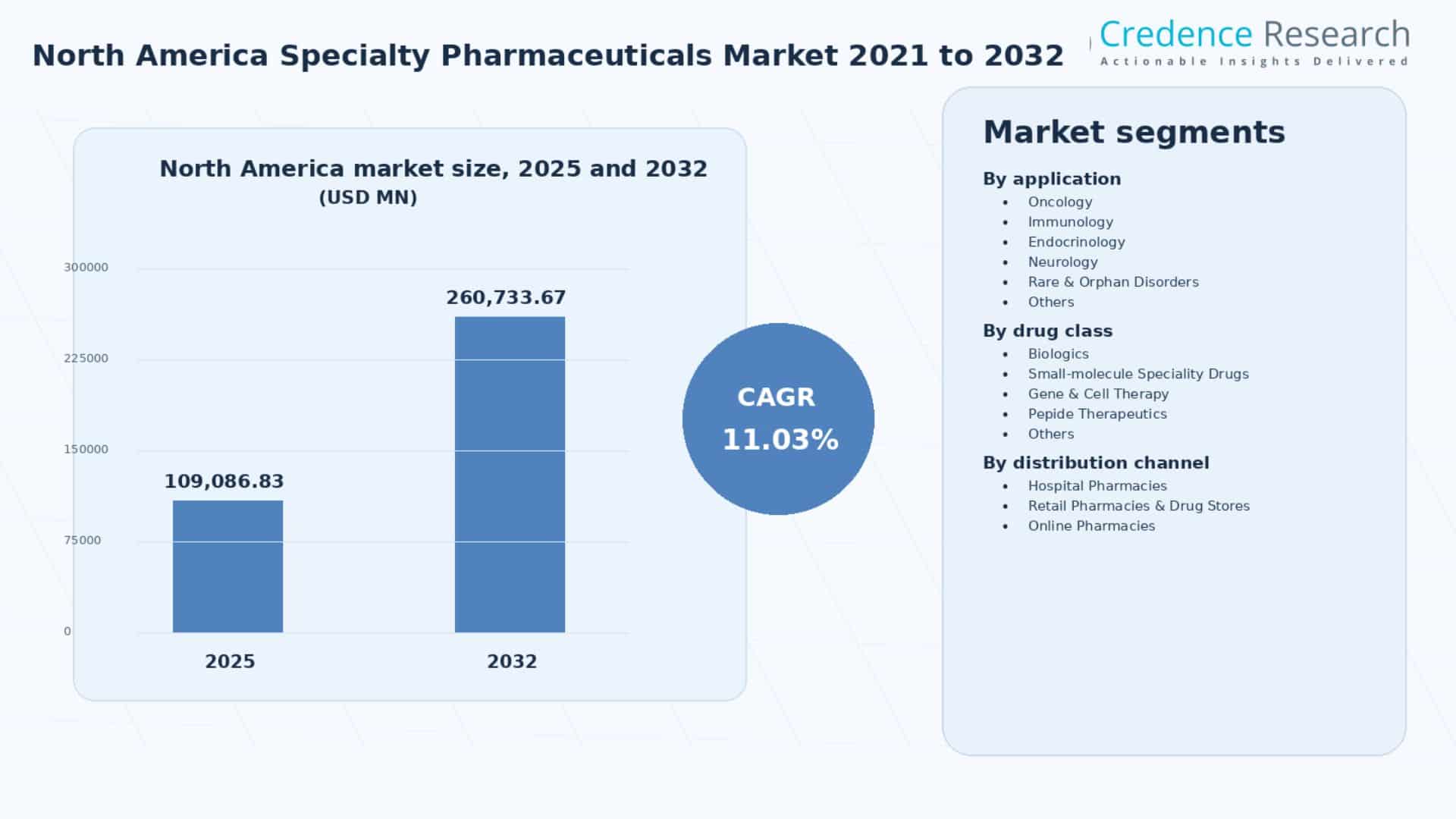
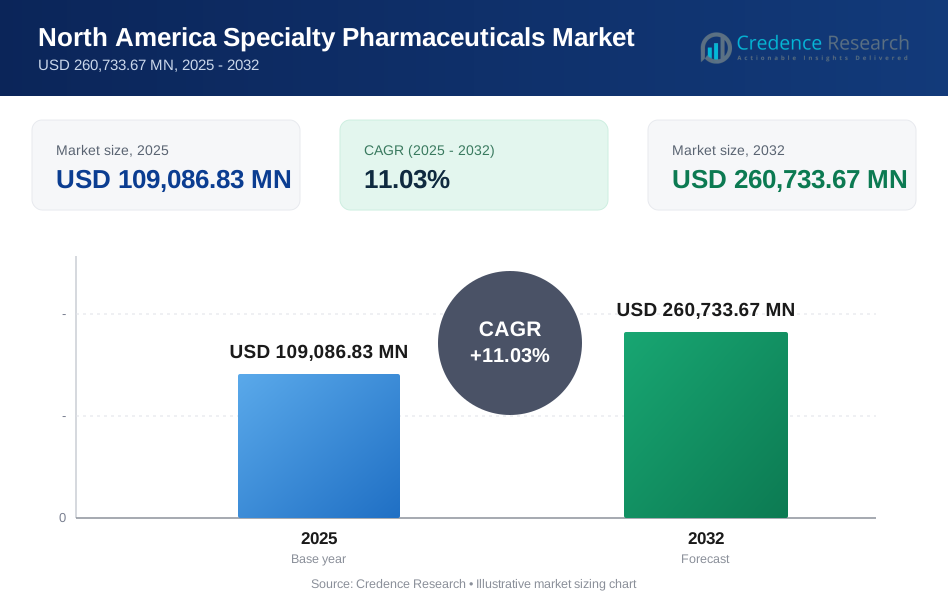
The North America Specialty Pharmaceuticals Market size was valued at USD 67,838.21 MN in 2021 and reached USD 109,086.83 MN in 2025. It is anticipated to reach USD 260,733.67 MN by 2032, growing at a CAGR of 11.03% during the forecast period.
| REPORT ATTRIBUTE | DETAILS |
|---|---|
| Historical Period | 2021-2024 |
| Base Year | 2025 |
| Forecast Period | 2025-2032 |
| North America Specialty Pharmaceuticals Market Size 2025 | USD 109,086.83 million |
| North America Specialty Pharmaceuticals Market, CAGR | 11.03% |
| North America Specialty Pharmaceuticals Market Size 2032 | USD 260,733.67 million |
North America Specialty Pharmaceuticals Market Insights
- Market growth is supported by oncology therapy demand, immunology biologic expansion, endocrine specialty drug uptake, rare disease approvals, gene and cell therapy adoption and specialty pharmacy distribution growth.
- Oncology holds a strong position because cancer care increasingly depends on biologics, targeted small-molecule specialty drugs, immunotherapies and gene and cell therapy innovations.
- Biologics remain a leading drug class due to strong use in oncology, immunology, endocrinology, rare diseases and inflammatory disease treatment.
- Hospital Pharmacies remain the leading distribution channel because specialty pharmaceuticals often require specialist diagnosis, prior authorization, cold-chain handling, infusion support and clinical monitoring.
North America Specialty Pharmaceuticals Market Segment Insights
By application
By application, Oncology held the strongest position in 2025 because cancer treatment increasingly uses biologics, targeted therapies, immunotherapies and advanced specialty drugs. Immunology also represents a major application due to biologic use in rheumatoid arthritis, psoriasis, inflammatory bowel disease and other immune-mediated disorders. Endocrinology is expanding rapidly through GLP-1 therapies, diabetes products and obesity-related specialty medicines. Neurology is gaining value due to rare neurologic disorders, multiple sclerosis, migraine, Alzheimer’s disease and neuromuscular therapies. Rare & Orphan Disorders support high-value treatment demand through biologics, gene therapies and precision medicines. Others include infectious disease, hematology, ophthalmology and transplant-related specialty care.
By drug class
By drug class, Biologics held the strongest position in 2025 because many high-value specialty pharmaceuticals are monoclonal antibodies, recombinant proteins, fusion proteins and plasma-derived products. Small-molecule Speciality Drugs remain important in oncology, rare disease, neurology and targeted therapy pathways. Gene & Cell Therapy is gaining momentum as FDA approvals expand for rare genetic diseases, hematologic malignancies and inherited disorders. Pepide Therapeutics are gaining relevance due to endocrine, metabolic and specialty chronic disease applications. Others include oligonucleotide drugs, enzyme replacement therapies, radiopharmaceuticals and advanced immunotherapies. Growth will depend on payer access, clinical outcomes, manufacturing scale and specialty distribution capabilities.
By distribution channel
By distribution channel, Hospital Pharmacies held the strongest position in 2025 because specialty pharmaceuticals often require hospital-led diagnosis, administration and monitoring. Oncology therapies, gene and cell therapies, infusions and rare disease treatments are concentrated in hospital systems and academic medical centers. Retail Pharmacies & Drug Stores remain important for self-administered biologics, endocrine therapies, oral oncology products and chronic specialty medicines. Online Pharmacies are gaining relevance through refill coordination, digital prior authorization, home delivery and patient support programs. Specialty pharmacy models will grow as payers require adherence monitoring, cold-chain control and outcome documentation.
Key Market Drivers
Rising oncology specialty drug demand
Rising oncology specialty drug demand represents a major growth driver for the North America Specialty Pharmaceuticals Market. Cancer care increasingly depends on high-value biologics, targeted small-molecule specialty drugs, immune checkpoint inhibitors, antibody-drug conjugates and cell therapies.
The CDC reported 1,851,238 new cancer cases in the United States in 2022, the latest year for incidence data, reinforcing the large treatment base for oncology specialty medicines. Bristol Myers Squibb reported 2025 worldwide Opdivo revenues of USD 10.0 billion, showing continued commercial strength for immuno-oncology specialty pharmaceuticals. This driver supports Oncology, Biologics, Small-molecule Speciality Drugs, Gene & Cell Therapy and Hospital Pharmacies.
Immunology biologic expansion
Immunology biologic expansion is strengthening specialty pharmaceutical demand across inflammatory bowel disease, psoriasis, rheumatoid arthritis and related immune-mediated disorders. Patients with moderate to severe disease frequently require biologics or advanced specialty therapies after inadequate response to conventional medicines.
AbbVie reported full-year 2025 global immunology portfolio net revenues of USD 30.406 billion, including Skyrizi net revenues of USD 17.562 billion, Rinvoq net revenues of USD 8.304 billion and Humira net revenues of USD 4.540 billion. This commercial momentum supports Immunology, Biologics, Small-molecule Speciality Drugs, Hospital Pharmacies and Retail Pharmacies & Drug Stores.
Endocrinology and GLP-1 specialty therapy growth
Endocrinology and GLP-1 specialty therapy growth is reshaping the market as obesity, diabetes and cardiometabolic treatment demand rises. High-value endocrine therapies require physician oversight, payer management, chronic adherence support and strong pharmacy distribution.
Eli Lilly’s 2025 Form 10-K said Mounjaro and Zepbound accounted for 56% of its total revenues in 2025 and that cardiometabolic health products are expected to remain a significant and growing portion of the company’s business. The driver supports Endocrinology, Pepide Therapeutics, Retail Pharmacies & Drug Stores and Online Pharmacies. Growth will depend on coverage expansion, supply availability, pricing and long-term outcomes data.
Rare disease and gene therapy approvals
Rare disease and gene therapy approvals are accelerating demand for high-value specialty pharmaceuticals. Gene & Cell Therapy products often target small patient populations with high unmet need, creating premium revenue opportunities despite complex manufacturing and distribution.
FDA approved Waskyra in December 2025 as the first cell-based gene therapy for Wiskott-Aldrich syndrome and described it as a patient-specific genetically corrected hematopoietic stem cell therapy. FDA also listed 2025 biological license approvals that included WASKYRA for pediatric and adult patients with Wiskott-Aldrich Syndrome who meet defined transplant-related criteria. This driver supports Rare & Orphan Disorders, Gene & Cell Therapy, Hospital Pharmacies and Specialty Centers.
Key Trends and Opportunities
Specialty pharmacy models expand
Specialty pharmacy models are expanding because complex medicines require prior authorization, adherence monitoring, cold-chain management, refill coordination and patient education. Hospital Pharmacies remain central for infusion and cell therapy, while Retail Pharmacies & Drug Stores and Online Pharmacies are gaining relevance for self-administered biologics, GLP-1 therapies, oral oncology products and chronic specialty medicines. CMS projects retail prescription drug spending to grow at an average annual rate of 5.7% from 2025 to 2034, making it the fastest-growing major national health expenditure category over that period. This trend supports pharmacy-led care coordination and payer-driven specialty distribution models.
Gene and cell therapy pipelines strengthen
Gene and cell therapy pipelines are strengthening as regulators approve more advanced products for rare diseases and severe conditions. FDA’s rare disease drug approvals page tracks recent rare disease approvals, including first-in-class and first-treatment categories, while its 2025 novel drug approval page lists new therapies across oncology, rare disease and specialty indications. These approvals create opportunities for manufacturers, hospitals and payers that can manage complex treatment delivery. Growth will favor institutions with cell processing capacity, reimbursement expertise, patient selection workflows and post-treatment monitoring systems.
Canada rare disease access improves
Canada rare disease access is improving through public policy support, creating opportunities for specialty pharmaceutical manufacturers. The Government of Canada’s National Strategy for Drugs for Rare Diseases aims to improve access to effective rare disease drugs and make them more affordable, with funding available between April 1, 2024 and March 31, 2027. Canada also announced up to CAD 1.5 billion over three years to support the strategy, including up to CAD 1.4 billion for bilateral agreements with provinces and territories. This trend supports Rare & Orphan Disorders, Biologics, Gene & Cell Therapy and hospital-linked specialty access.
Key Market Challenges
High drug cost and payer pressure
High drug cost and payer pressure remain major challenges for the North America Specialty Pharmaceuticals Market. Specialty drugs often carry premium prices because they require complex manufacturing, clinical evidence generation, patient support, temperature-controlled logistics and targeted prescribing. Payers frequently use prior authorization, step therapy, formulary exclusions and specialty pharmacy mandates to control spending. This can slow adoption in Oncology, Immunology, Endocrinology and Rare & Orphan Disorders. Manufacturers must demonstrate clear clinical value, real-world outcomes and budget impact evidence to support reimbursement.
Manufacturing and supply chain complexity
Manufacturing and supply chain complexity can restrict product availability and increase market risk. Biologics, Gene & Cell Therapy products and selected specialty drugs require advanced production platforms, batch controls, sterile processing, cold-chain logistics and regulatory oversight. Cell therapies add chain-of-identity requirements, specialized site certification and patient-specific scheduling. Supply disruptions can delay therapy initiation and affect treatment continuity. Companies need robust quality systems, redundant supply capacity, specialty distribution partners and strong product traceability to support growth.
Biosimilar and generic competition
Biosimilar and generic competition creates pricing pressure in mature specialty categories. Biologics in immunology and oncology face growing biosimilar substitution, payer tendering and rebate competition. Health Canada notes that biosimilar biologic drugs must meet rigorous authorization standards for quality, safety and efficacy, although authorization does not declare equivalence to the reference biologic. This environment can improve access but reduce originator revenue. Companies must defend share through new indications, lifecycle management, patient support, device improvements and clinical differentiation.
Regional Analysis
United States
The United States leads the North America Specialty Pharmaceuticals Market due to its large oncology burden, advanced biologics use, strong specialty pharmacy infrastructure, high payer involvement and rapid adoption of innovative therapies. Oncology, Immunology, Endocrinology and Rare & Orphan Disorders drive demand across Biologics, Small-molecule Speciality Drugs and Gene & Cell Therapy. FDA approvals for rare disease therapies and gene therapies support high-value market expansion, while CMS drug spending projections indicate continued prescription drug market growth. Hospital Pharmacies and specialty pharmacy networks will remain central to distribution through 2032.
Canada
Canada represents a mature specialty pharmaceuticals market supported by universal health care systems, provincial reimbursement frameworks, biologic regulation and rare disease policy initiatives. The National Strategy for Drugs for Rare Diseases supports access and affordability, while Health Canada’s biosimilar framework helps shape biologic competition and payer strategy. Oncology, Immunology, Rare & Orphan Disorders and Endocrinology remain key demand areas. Hospital Pharmacies support high-complexity therapies, while Retail Pharmacies & Drug Stores support chronic specialty drug dispensing. Growth will depend on price negotiations, provincial formularies, pan-Canadian Pharmaceutical Alliance outcomes and access agreements.
Mexico
Mexico is an emerging growth market within North America due to expanding private hospital capacity, rising demand for oncology and immunology therapies and increasing interest in advanced specialty drugs. Access remains more uneven than in the United States and Canada due to affordability, reimbursement variation and specialty care concentration in large urban centers. Hospital Pharmacies dominate high-cost specialty therapy access, while Retail Pharmacies & Drug Stores support selected endocrine, immunology and oral specialty medicines. Growth will depend on public procurement, private insurance coverage, multinational product launches, physician training and cold-chain distribution quality.
Report Attribute Details
| Report Attribute | Details |
| Historical Period | 2021–2024 |
| Base Year | 2025 |
| Forecast Period | 2025–2032 |
| Market Size in 2021 | USD 67,838.21 MN |
| Market Size in 2025 | USD 109,086.83 MN |
| Market Size in 2032 | USD 260,733.67 MN |
| CAGR | 11.03% |
| Segments Covered | Application, Drug Class, Distribution Channel and Geography |
| Key Companies Covered | AbbVie, Amgen, AstraZeneca, Bayer AG, Biogen, BioMarin, Boehringer Ingelheim, Bristol Myers Squibb, CSL Behring, Eli Lilly, Gilead Sciences and GSK plc |
North America Specialty Pharmaceuticals Market segmentations
By Application
- Oncology
- Immunology
- Endocrinology
- Neurology
- Rare & Orphan Disorders
- Others
By Drug Class
- Biologics
- Small-molecule Speciality Drugs
- Gene & Cell Therapy
- Pepide Therapeutics
- Others
By Distribution Channel
- Hospital Pharmacies
- Retail Pharmacies & Drug Stores
- Online Pharmacies
Key Players
- AbbVie
- Amgen
- AstraZeneca
- Bayer AG
- Biogen
- BioMarin
- Boehringer Ingelheim
- Bristol Myers Squibb
- CSL Behring
- Eli Lilly
- Gilead Sciences
- GSK plc
Recent Developments
- In February 2026, AbbVie reported full-year 2025 global immunology portfolio net revenues of USD 30.406 billion, supported by Skyrizi, Rinvoq and Humira.
- In February 2026, Eli Lilly reported that fourth-quarter 2025 revenue increased 43% to USD 19.3 billion, driven by volume growth from Mounjaro and Zepbound.
- In February 2026, Gilead Sciences reported full-year 2025 HIV product sales of USD 20.8 billion, up 6% from 2024, driven primarily by higher demand for HIV treatment and prevention.
- In December 2025, FDA approved Waskyra, the first cell-based gene therapy for Wiskott-Aldrich syndrome, strengthening the U.S. rare disease gene therapy landscape.
Report Coverage
The research report offers an in-depth analysis based on application, drug class, distribution channel and geography. It details leading market players, providing an overview of their business positioning, specialty drug portfolios, biologics exposure, oncology products, immunology platforms, endocrine therapies, rare disease assets, gene and cell therapy strategies and distribution relevance in the North America Specialty Pharmaceuticals Market. The report includes insights into the competitive environment, market trends, growth drivers, restraints and opportunities. It also examines oncology demand, immunology biologic expansion, endocrine specialty therapy growth, rare disease approvals, specialty pharmacy models, payer controls, biosimilar competition and hospital pharmacy infrastructure as major factors shaping market development. The report assesses the impact of high therapy cost, reimbursement pressure, supply chain complexity, manufacturing risk, cold-chain requirements and payer management on market growth. It provides strategic recommendations for pharmaceutical companies, hospital systems, specialty pharmacies, retail pharmacy networks, online pharmacies, payers, distributors, investors and new entrants seeking to navigate North America’s specialty pharmaceuticals ecosystem.
Future Outlook
- Demand for specialty pharmaceuticals will continue to rise as oncology, immunology, endocrinology, neurology and rare disease treatment expand across North America.
- Oncology will remain a leading application due to continued use of biologics, targeted small-molecule specialty drugs and advanced therapies.
- Immunology will grow through biologics and advanced specialty drugs for inflammatory and autoimmune diseases.
- Endocrinology will expand as GLP-1 therapies, diabetes products and obesity-related specialty drugs gain wider use.
- Rare & Orphan Disorders will gain share as gene therapy, enzyme replacement and targeted rare disease products expand.
- Biologics will remain the leading drug class due to broad adoption across cancer, immunology and rare disease care.
- Gene & Cell Therapy will grow as FDA approvals and hospital treatment infrastructure expand.
- Hospital Pharmacies will remain the leading channel for complex therapies, infusions, oncology drugs and gene therapies.
- Online Pharmacies will gain relevance through refill coordination, digital authorization and chronic specialty drug delivery.
- Competition will increase as companies compete on clinical differentiation, access programs, payer evidence, biosimilar defense, specialty distribution and product innovation.
Request a Free Sample
Fill in your details and we'll send you a free sample report.
- Sample data tables & charts
- Research methodology
Need a Custom Version of This Report?
Tailor the scope, geography, or segments to your exact requirements.
- Custom geography or segment scope
- Direct access to our analyst team
Frequently Asked Questions
What is the current market size for the North America Specialty Pharmaceuticals Market and what is its projected size in 2032?
At what CAGR is the North America Specialty Pharmaceuticals Market projected to grow?
Which application segment is expected to lead the market?
Which drug class holds the strongest position?
Which distribution channel leads the market?
Who are the leading companies in the market?
Which country leads the North America market?
Table of Content
Chapter 1. Report Introduction
- 1.1 Report Description & Purpose
- 1.1.1 Report Title & Market Definition
- 1.1.2 Unique Selling Propositions (USP) & Key Differentiators
- 1.1.3 Value Proposition for Stakeholders
- 1.2 Research Objectives
- 1.2.1 Market Sizing Objectives (Volume & Revenue)
- 1.2.2 Segmentation Objectives
- 1.2.3 Competitive Intelligence Objectives
- 1.2.4 Forecast & Scenario Objectives
- 1.3 Report Scope
- 1.3.1 North America Specialty Pharmaceuticals Scope – Types & Subtypes Covered
- 1.3.2 Geographic Scope – Regions & Countries Covered
- 1.3.3 Historical Period, Base Year & Forecast Period (2025; forecast to 2032)
- 1.3.4 Inclusions & Exclusions
- 1.4 HS Code & Classification Framework
- 1.5 Currency, Units & Pricing Basis
- 1.6 Target Stakeholders
- 1.7 Limitations & Assumptions
Chapter 2. Executive Summary
- 2.1 Global North America Specialty Pharmaceuticals Market Snapshot
- 2.1.1 Market Size – Historical (2025) & Forecast (2025-2032) (2025: USD 109,086.83 MN → 2032: USD 260,733.67 MN)
- 2.1.2 Volume & Revenue – Global Totals
- 2.1.3 Key Market Highlights – Top Five Facts
- 2.2 North America Specialty Pharmaceuticals Market Segmentation Snapshot
- 2.2.1 Market Split by Region – 2025 vs. 2032
- 2.3 Competitive Snapshot
- 2.3.1 Top 10 Players by Revenue Share – 2025
- 2.3.2 Top 10 Players by Volume Share – 2025
- 2.3.3 Recent Strategic Developments (18-Month Summary)
- 2.4 Key Investment Highlights & Strategic Conclusions
Chapter 3. North America Specialty Pharmaceuticals Market Dynamics & Industry Analysis
- 3.1 Market Overview & Context
- 3.1.1 North America Specialty Pharmaceuticals Market Position in the Broader Automotive Value Chain
- 3.1.2 OEM vs. Replacement Market Dynamics
- 3.1.3 Market Maturity & Development Stage by Region
- 3.2 North America Specialty Pharmaceuticals Market Drivers
- 3.3 North America Specialty Pharmaceuticals Market Restraints & Challenges
- 3.4 North America Specialty Pharmaceuticals Market Opportunities
- 3.5 Porter's Five Forces Analysis
- 3.5.1 Threat of New Entrants
- 3.5.2 Bargaining Power of Suppliers
- 3.5.3 Bargaining Power of Buyers
- 3.5.4 Threat of Substitutes
- 3.5.5 Competitive Rivalry – Intensity Assessment
- 3.6 North America Specialty Pharmaceuticals Value Chain Analysis
- 3.6.1 Upstream – Raw Material/Input Suppliers
- 3.6.1.1 Raw Material/Input 1
- 3.6.1.2 Raw Material/Input 2
- 3.6.1.3 Raw Material/Input 3
- 3.6.2 Midstream – Production/Manufacturing/Service Delivery
- 3.6.2.1 Production/Process Overview
- 3.6.2.2 Key Facility Locations & Capacity by Manufacturer
- 3.6.3 Downstream – Distribution & End Consumer
- 3.6.3.1 Primary Channel – B2B/OEM
- 3.6.3.2 Secondary Channels – Dealer, Retail, Online, Direct
- 3.6.4 Value Chain Profitability Analysis
- 3.6.1 Upstream – Raw Material/Input Suppliers
- 3.7 PESTEL Analysis
- 3.7.1 Political Factors
- 3.7.2 Economic Factors
- 3.7.3 Social Factors
- 3.7.4 Technological Factors
- 3.7.5 Environmental Factors
- 3.7.6 Legal Factors
- 3.8 North America Specialty Pharmaceuticals Supply Chain Analysis
- 3.8.1 Raw Material/Input Supply Risk Assessment
- 3.8.2 Manufacturing Concentration Risk (Geographic Exposure)
- 3.8.3 Trade Disruption Impact Analysis
- 3.9 Regulatory & Policy Landscape
Note: The regulatory and policy landscape section covers regulations based on their applicability to the market, North America Specialty Pharmaceuticals category, geography, and scope of the study. Only regulatory frameworks with a material impact on operations, compliance, trade, sustainability, or market access are analyzed in detail.
Chapter 4. Key Investment Pockets & Opportunity Analysis
- 4.1 North America Specialty Pharmaceuticals Market Attractiveness Analysis
- 4.1.1 By Region – Investment Attractiveness Matrix (Volume × CAGR)
- 4.2 Absolute Revenue Growth Opportunity
- 4.2.1 By Region – Absolute USD Growth Through 2032
- 4.3 Incremental Volume Opportunity
- 4.3.1 By Region – Incremental Volume Through 2032
- 4.3.2 Segment – Incremental Volume
- 4.4 Emerging Submarket Opportunity Deep Dive (Subject to Applicability)
- 4.5 Emerging Market Opportunity Scorecards
- 4.5.1 United States
- 4.5.2 Europe
- 4.5.3 Asia
- 4.5.4 Middle East & Africa
Note: Emerging Market Opportunity Scorecards will be included based on relevance and strategic importance. Regions listed are indicative and may vary depending on data availability and market dynamics.
Chapter 5. North America Specialty Pharmaceuticals Import-Export Analysis & Trade Flows
- 5.1 Global Trade Overview
- 5.1.1 Global Export Value by Country (2025)
- 5.1.2 Global Export Volume by Country (2025)
- 5.1.3 Global Import Value by Country (2025)
- 5.1.4 Global Import Volume by Country (2025)
- 5.1.5 Net Trade Balance by Country (2025)
- 5.2 Export Analysis – Segment
- 5.2.1 Type 1 (HS Code)
- 5.2.2 Type 2 (HS Code)
- 5.2.3 Type 3 (HS Code)
- 5.2.4 Type 4 (HS Code)
- 5.2.5 Type 5 (HS Code)
- 5.3 Import Analysis – Segment
- 5.3.1 Type 1 (HS Code)
- 5.3.2 Type 2 (HS Code)
- 5.3.3 Type 3 (HS Code)
- 5.3.4 Type 4 (HS Code)
- 5.3.5 Type 5 (HS Code)
- 5.4 Average Unit Trade Prices
- 5.4.1 Average Export Price – Segment & Country
- 5.4.2 Average Import Price – Segment & Source Country
- 5.4.3 Price Trends (2025)
- 5.5 Key Trade Route Analysis
- 5.5.1 Trade Route 1
- 5.5.2 Trade Route 2
- 5.5.3 Trade Route 3
- 5.5.4 Trade Route 4
- 5.5.5 Trade Route 5
- 5.6 Trade Policy Impact Assessment
- 5.6.1 US Anti-Dumping & Section 301 Tariffs
- 5.6.2 EU Customs Union Impact
- 5.6.3 Major Free Trade Agreements
- 5.6.4 USMCA Rules of Origin
Note: Trade policy analysis will be included only where relevant to the North America Specialty Pharmaceuticals market.
Chapter 6. Competitive Landscape & Company Benchmarking
- 6.1 North America Specialty Pharmaceuticals Market Concentration & Structure
- 6.1.1 Herfindahl-Hirschman Index (HHI) – vs. 2025
- 6.1.2 Tier 1, Tier 2 & Tier 3 Market Structure
- 6.1.3 Global, Regional & Local Player Dynamics
- 6.2 North America Specialty Pharmaceuticals Market Share Analysis – 2025
- 6.2.1 Global Revenue Share by Company
- 6.2.2 Global Volume Share by Company
- 6.2.3 Regional Revenue Share
- 6.2.4 Market Share Evolution ( vs. 2025)
- 6.2.5 OEM Segment Share by Company
- 6.2.6 Replacement Segment Share by Company
- 6.3 Production/Delivery Capacity & Facility Analysis
- 6.3.1 Global Installed Capacity
- 6.3.2 Capacity Utilization Rates
- 6.3.3 Production/Output Volume
- 6.3.4 Facility Locations & Capacity Map
- 6.3.5 Planned Capacity Additions
- 6.4 North America Specialty Pharmaceuticals Competitive Benchmarking Matrix
- 6.4.1 Revenue, Volume, CAGR & Profitability Comparison
- 6.4.2 Channel Revenue Mix
- 6.4.3 Geographic Revenue Exposure
- 6.4.4 R&D Intensity
- 6.4.5 Sustainability Maturity
- 6.5 Strategic Developments in North America Specialty Pharmaceuticals (Last 24 Months)
- 6.5.1 Mergers, Acquisitions & Divestments
- 6.5.2 New North America Specialty Pharmaceuticals Launches
- 6.5.3 Facility Expansions
- 6.5.4 Strategic Alliances, Joint Ventures & Partnerships
- 6.5.5 Distribution Expansion & Market Entry
- 6.5.6 Sustainability & ESG Initiatives
- 6.6 Competitive Strategy Mapping
- 6.6.1 Leader, Challenger, Follower & Niche Classification
- 6.6.2 Pricing Strategy Comparison
- 6.6.3 Channel Strategy Matrix
Note: Strategic developments are included based on their materiality and the availability of reliable information.
Chapter 7. Global North America Specialty Pharmaceuticals Market – By Distribution Channel
- 7.1 Segment Overview
- 7.1.1 Volume & Revenue Split by Channel (2025 & 2032)
- 7.1.2 Channel Mix Evolution (2025-2032)
Chapter 8. Regional Market Analysis – Global Overview
- 8.1 Global Regional Overview
- 8.1.1 Regional Volume Share
- 8.1.2 Regional Revenue Share
- 8.1.3 Regional Volume by Region
- 8.1.4 Regional Revenue by Region
- 8.1.5 Regional Forecast Through 2032
- 8.2 Cross-Regional Segment Analysis
- 8.2.1 By Distribution Channel
- 8.2.2 By Brand/Price Tier
Chapter 9. North America North America Specialty Pharmaceuticals Market
- 9.1 United States
- 9.2 Canada
- 9.3 Mexico
Chapter 10. Europe North America Specialty Pharmaceuticals Market
- 10.1 Germany
- 10.2 France
- 10.3 Italy
- 10.4 United Kingdom
- 10.5 Spain
- 10.6 Poland
- 10.7 Russia
- 10.8 Netherlands
- 10.9 Belgium
- 10.10 Sweden
- 10.11 Denmark
- 10.12 Norway
- 10.13 Rest of Europe
Chapter 11. Asia Pacific North America Specialty Pharmaceuticals Market
- 11.1 China
- 11.2 India
- 11.3 Japan
- 11.4 South Korea
- 11.5 Thailand
- 11.6 Indonesia
- 11.7 Vietnam
- 11.8 Malaysia
- 11.9 Australia
- 11.10 Rest of Asia Pacific
Chapter 12. Latin America North America Specialty Pharmaceuticals Market
- 12.1 Brazil
- 12.2 Argentina
- 12.3 Colombia
- 12.4 Chile
- 12.5 Rest of Latin America
Chapter 13. Middle East North America Specialty Pharmaceuticals Market
- 13.1 Saudi Arabia
- 13.2 United Arab Emirates
- 13.3 Turkey
- 13.4 Israel
- 13.5 Iran
- 13.6 Rest of the Middle East
Chapter 14. Africa North America Specialty Pharmaceuticals Market
- 14.1 South Africa
- 14.2 Egypt
- 14.3 Nigeria
- 14.4 Morocco
- 14.5 Rest of Africa
Chapter 15. North America Specialty Pharmaceuticals Company Profiles
- 15.1 [Company 01]
- 15.1.1 Company Overview
- 15.1.2 Key Management Personnel
- 15.1.3 Products & Services Portfolio
- 15.1.4 Financial Performance
- 15.1.5 Key Market Focus & Geographic Presence
- 15.1.6 Recent Developments & Strategic Initiatives
Note: The company profile list is preliminary and may change based on research findings, market developments, data availability, and client requirements.
Chapter 16. Appendices
- Appendix A – List of Abbreviations & Acronyms
- Appendix B – Industry Classification Code Reference – Full Series
- Appendix C – Production & Capacity Data Tables
- Appendix D – End-Use & Demand Base Tables
- Appendix E – Consumption & Replacement Rate Assumptions
- Appendix F – ASP Reference Tables
- Appendix G – Manufacturing & Facility Database
- Appendix H – Import-Export Data Tables
- Appendix I – Regulatory Summary Tables
- Appendix J – Primary Research Participant List (Anonymized)
- Appendix K – Primary Research Questionnaire Framework
- Appendix L – Data Sources & Bibliography
- Appendix M – Market Size Divergence & Source Comparison
Chapter 17. Research Methodology
- 17.1 Research Framework & Philosophy
- 17.2 Secondary Research – Sources, Hierarchy & Data Extraction
- 17.3 Data Modeling – Bottom-Up & Top-Down Market Sizing
- 17.4 Primary Research – Stakeholder Framework, LOI & Sample Sizes
- 17.5 Forecast Methodology – Regression, Scenario & Sensitivity Analysis
- 17.6 Quality Control – Four-Layer Validation Framework
- 17.7 Limitations & Standard Assumptions
- 17.8 Disclaimer
