
North America Over-the-Counter (OTC) Drugs Market Overview:
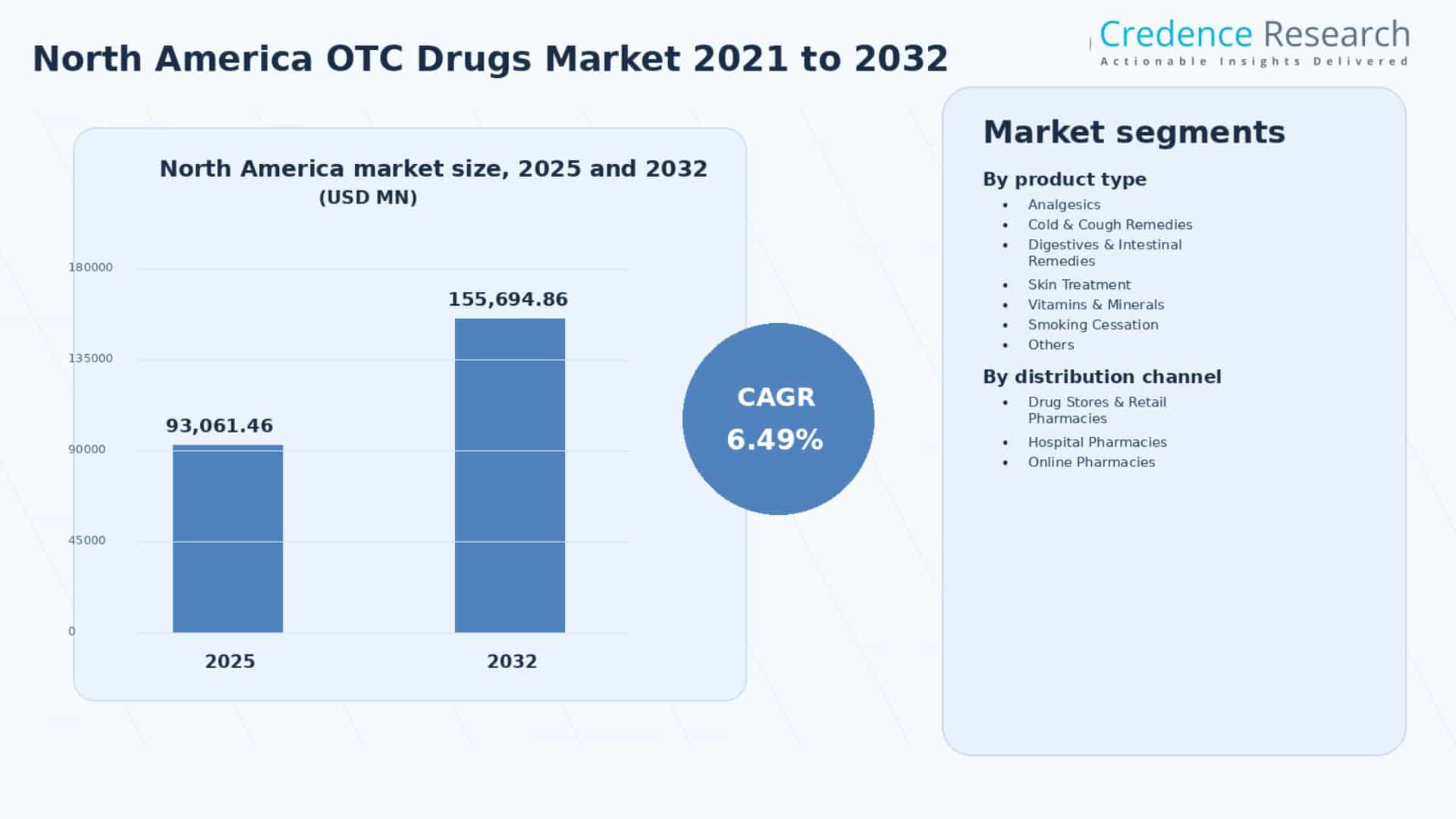
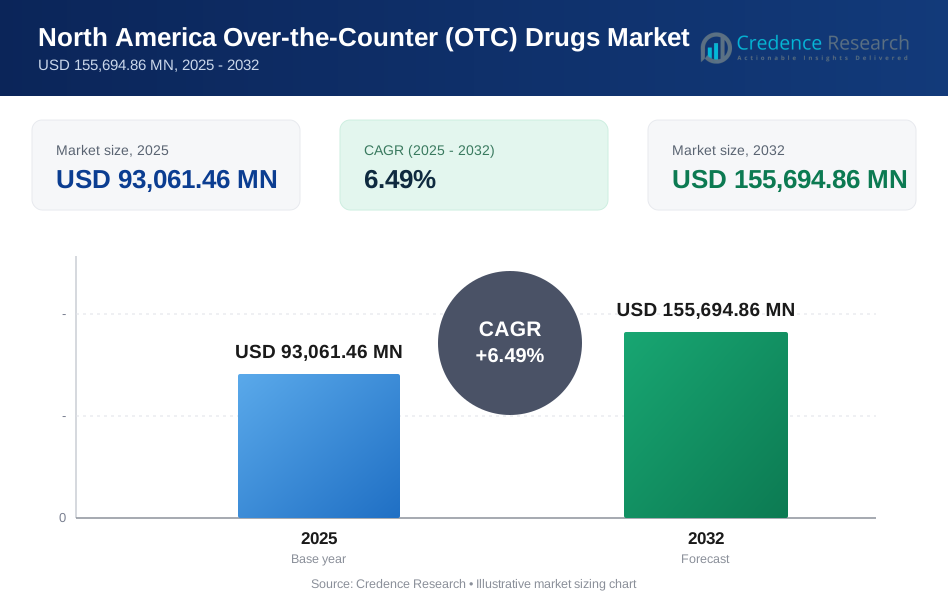
The North America Over-the-Counter (OTC) Drugs Market size was valued at USD 72,391.68 MN in 2021 and reached USD 93,061.46 MN in 2025. It is anticipated to reach USD 155,694.86 MN by 2032, growing at a CAGR of 6.49% during the forecast period.
| REPORT ATTRIBUTE | DETAILS |
|---|---|
| Historical Period | 2021-2024 |
| Base Year | 2025 |
| Forecast Period | 2025-2032 |
| North America Over-the-Counter (OTC) Drugs Market Size 2025 | USD 93,061.46 million |
| North America Over-the-Counter (OTC) Drugs Market, CAGR | 6.49% |
| North America Over-the-Counter (OTC) Drugs Market Size 2032 | USD 155,694.86 million |
North America Over-the-Counter (OTC) Drugs Market Insights
- Market growth is supported by high self-medication demand, chronic pain burden, seasonal cold and cough treatment, digestive health needs, smoking cessation products, vitamin and mineral use and wider online pharmacy access.
- Analgesics hold a strong position because consumers frequently use OTC pain relievers and fever reducers for headache, musculoskeletal pain, fever, minor injury pain and cold-related symptoms.
- Drug Stores & Retail Pharmacies remain the leading distribution channel because OTC drugs are highly dependent on immediate access, pharmacist guidance, private-label availability and repeat household purchasing.
- Online Pharmacies are gaining share through subscription refills, home delivery, price comparison, digital coupons and faster access to OTC products across chronic and seasonal categories.
North America Over-the-Counter (OTC) Drugs Market Segment Insights
By product type
By product type, Analgesics held the strongest position in 2025 because pain relief and fever management are among the most common self-care needs across North America. Demand is supported by acetaminophen, ibuprofen, aspirin and topical pain relief products used for headache, body pain, fever, minor injury pain and chronic symptom management. Cold & Cough Remedies remain a major seasonal category, although regulatory scrutiny around selected ingredients is reshaping formulations. Digestives & Intestinal Remedies support demand for antacids, laxatives, antidiarrheals and gas relief products. Skin Treatment includes acne, antifungal, anti-itch and minor wound care products. Vitamins & Minerals remain important for wellness routines, while Smoking Cessation includes OTC nicotine patches, gum and lozenges. Others include eye care, sleep aids, allergy care and women’s health products.
By distribution channel
By distribution channel, Drug Stores & Retail Pharmacies held the strongest position in 2025 because OTC drugs are frequently purchased during immediate need states such as pain, cough, cold, digestive discomfort and skin irritation. Retail pharmacies also offer pharmacist support, shelf visibility, private-label alternatives and broad product availability. Hospital Pharmacies remain smaller but important for discharge-linked OTC recommendations, institutional care, post-treatment symptom management and patient education. Online Pharmacies are expanding as consumers shift toward digital purchasing, home delivery and recurring self-care orders. Growth will favor omnichannel pharmacy models that combine pharmacist trust, competitive pricing, digital inventory, safe labeling and convenient fulfillment.
Key Market Drivers
High pain burden and analgesic self-care demand
High pain burden and analgesic self-care demand represent major growth drivers for the North America Over-the-Counter (OTC) Drugs Market. Analgesics remain a high-volume category because adults use OTC pain relievers for headache, fever, joint pain, muscle pain, minor injury pain and symptom relief linked to respiratory infections.
CDC reported that 24.3% of U.S. adults had chronic pain in 2023 and 8.5% had high-impact chronic pain that frequently limited life or work activities. Chronic pain also increased with age, reaching 36.0% among adults aged 65 and older. This burden supports demand for Analgesics, Drug Stores & Retail Pharmacies and Online Pharmacies. Market expansion will depend on safe use education, dosage clarity, product differentiation and availability of both branded and private-label products.
Seasonal respiratory illness and cold remedy use
Seasonal respiratory illness and cold remedy use support recurring OTC demand. Consumers rely on OTC remedies for symptom relief during common colds, cough, fever and sore throat episodes, especially when symptoms do not require prescription treatment.
CDC advises adults to ask health care providers or pharmacists about OTC medicines such as pain relievers and fever reducers for cold symptoms, while noting that these products may provide temporary symptom relief but do not cure illness. CDC also says OTC cough and cold medicines are not recommended for children younger than 6 years due to serious safety risks. This driver supports Cold & Cough Remedies, Analgesics, Drug Stores & Retail Pharmacies and pharmacist-guided purchasing. Demand will remain seasonal and sensitive to respiratory virus circulation, weather patterns and regulatory changes.
Smoking cessation and pharmacist-supported self-care
Smoking cessation and pharmacist-supported self-care support demand for nicotine replacement therapy and related OTC products. The segment benefits from public health programs, employer wellness initiatives, retail pharmacy counseling and repeated quit attempts.
Regulatory clarity for OTC monograph products
Regulatory clarity for OTC monograph products supports market stability and product innovation. OTC manufacturers operate within a defined regulatory framework that determines active ingredients, indications, doses, labeling and testing conditions for nonprescription use.
FDA says the CARES Act modernized the OTC drug review process and added section 505G to the Federal Food, Drug and Cosmetic Act. FDA also says OTC monograph drugs may be marketed without an approved drug application if they meet section 505G requirements and applicable monograph conditions. Health Canada says non-prescription drugs can be bought without a doctor’s prescription and require a valid Drug Identification Number to be sold in Canada, indicating that the product has met safety, quality and effectiveness requirements. This driver supports all product categories and legal market access across the United States and Canada.
Consumer health portfolio investment and private-label strength
Consumer health portfolio investment and private-label strength support market expansion across analgesics, digestives, skin treatment, vitamins and minerals and cold and cough categories.
Bayer reported Consumer Health sales of €5,802 million in 2025 and said the division registered gains in Digestive Health, Dermatology and Pain & Cardio, though Nutritionals and Allergy & Cold declined. Perrigo reported 2025 net sales of USD 4.25 billion and Consumer Self-Care Americas net sales of USD 2.59 billion, with store brand volume share gains and dollar share gains across key brands partly offsetting soft OTC category consumption. This driver supports branded OTC products, store brands, Drug Stores & Retail Pharmacies and Online Pharmacies.
Key Trends and Opportunities
Online pharmacy and omnichannel OTC access expand
Online pharmacy and omnichannel OTC access are expanding as consumers shift toward digital self-care purchasing, recurring household refills and delivery-based convenience. OTC drugs are well suited to online purchase because many products are standardized, frequently repurchased and easy to compare by price or brand. Online Pharmacies can gain share in Vitamins & Minerals, Digestives & Intestinal Remedies, Skin Treatment, Smoking Cessation and selected Analgesics. Retail pharmacy chains are expected to defend share by combining stores, mobile apps, digital coupons and same-day pickup. Growth will depend on fulfillment speed, product authenticity, pharmacist access, safe labeling and consumer trust.
Ingredient reformulation reshapes cold and cough remedies
Ingredient reformulation is reshaping Cold & Cough Remedies as regulators reassess selected OTC active ingredients. FDA proposed removing oral phenylephrine as an OTC monograph nasal decongestant ingredient after reviewing data and determining that oral phenylephrine is not effective for temporary nasal congestion relief. FDA said the proposed order is based on effectiveness concerns, not safety concerns, and only a final order would affect what products can be marketed. This trend creates opportunities for reformulated products, pharmacist-recommended alternatives and clearer consumer education. It also creates inventory, labeling and brand management challenges for companies with legacy cold and allergy portfolios.
Private-label OTC products gain shelf power
Private-label OTC products are gaining shelf power as retailers seek higher margins and consumers compare equivalent active ingredients. Store brands are particularly strong in analgesics, digestives, cough and cold products, skin treatment and vitamins. Perrigo’s 2025 results highlight the importance of store brand gains in the Consumer Self-Care Americas business despite soft OTC category consumption. This trend supports Drug Stores & Retail Pharmacies, Online Pharmacies and private-label manufacturers. Branded players must compete through trust, formulation differentiation, dosage convenience, packaging clarity and consumer loyalty.
Skin treatment and digestive health portfolios gain momentum
Skin treatment and digestive health portfolios are gaining momentum as consumers invest in self-care products for acne, fungal infections, itching, minor wounds, heartburn, constipation, diarrhea and digestive discomfort. Bayer reported gains in Digestive Health and Dermatology within its Consumer Health division in 2025, showing continued relevance for these OTC categories. Growth will be supported by higher awareness, pharmacist guidance, product innovation and recurring use. Companies with broad shelf presence, clinical claims, digital education and private-label defense strategies will gain stronger positioning.
Key Market Challenges
Regulatory scrutiny and active ingredient risk
Regulatory scrutiny and active ingredient risk remain key challenges for the North America Over-the-Counter (OTC) Drugs Market. Ingredient reassessment can force reformulation, relabeling, inventory changes and consumer communication. FDA’s proposed action on oral phenylephrine shows how evidence reviews can affect established product categories. Manufacturers must monitor monograph updates, safety communications, labeling requirements and post-market evidence. This challenge affects Cold & Cough Remedies, Analgesics, Skin Treatment and other monograph-regulated products. Companies with strong regulatory affairs teams and flexible manufacturing will reduce disruption.
Safety concerns and misuse risk
Safety concerns and misuse risk can limit growth and increase compliance burden. OTC medicines are accessible without a prescription, but improper dosing, duplicate active ingredient use, pediatric misuse and drug interactions can create safety issues. CDC advises consumers to always use OTC medicines as directed and to mention any other prescription or OTC medicines they are taking when seeking cold symptom guidance. This challenge affects Analgesics, Cold & Cough Remedies, Digestives & Intestinal Remedies and Smoking Cessation. Clear labeling, pharmacist counseling and consumer education remain essential.
Competitive pricing and margin pressure
Competitive pricing and margin pressure affect branded and private-label OTC products. Retailers use private labels to increase margins, while consumers compare price across drug stores, mass retailers and online platforms. Brands must defend pricing through trust, evidence, innovation, packaging, dosage forms and advertising. Perrigo’s 2025 results showed soft OTC category consumption and net price investments in Consumer Self-Care Americas, highlighting commercial pressure in the category. Margin risk is higher in mature categories such as analgesics, digestive remedies, cold and cough products and vitamins.
Seasonality and demand volatility
Seasonality and demand volatility affect inventory planning and category performance. Cold and cough demand varies with respiratory virus patterns, weather, school calendars and public health behavior. Bayer reported that the decline in Allergy & Cold sales in 2025 was primarily attributable to a soft allergy season in North America and lower cough and cold sales in Latin America. Retailers and manufacturers must balance seasonal stock, promotions, supply chain planning and expiration risk. Demand volatility can pressure revenue visibility and increase inventory write-down risk.
Regional Analysis
United States
The United States leads the North America Over-the-Counter (OTC) Drugs Market due to its large consumer base, broad pharmacy access, strong retail chains, high self-care culture and mature OTC regulatory framework. Analgesics, Cold & Cough Remedies, Digestives & Intestinal Remedies, Skin Treatment, Vitamins & Minerals and Smoking Cessation all benefit from wide shelf availability and online access. FDA’s OTC monograph framework supports a large nonprescription product base, while ingredient reassessments such as oral phenylephrine increase regulatory complexity. Drug Stores & Retail Pharmacies remain dominant, but Online Pharmacies continue to expand through convenience, subscriptions and home delivery.
Canada
Canada represents a mature OTC market supported by regulated non-prescription drug access, pharmacy counseling and strong consumer health product use. Health Canada says non-prescription drugs are products that can be bought without a doctor’s prescription and that a Drug Identification Number indicates safety, quality and effectiveness requirements have been met. Drug Stores & Retail Pharmacies remain central because pharmacist support influences product selection, especially for cold and cough remedies, analgesics, smoking cessation and digestive products. Online Pharmacies are gaining relevance, but provincial pharmacy rules, product classification and safe dispensing expectations influence channel growth.
Mexico
Mexico represents an expanding market within North America due to growing pharmacy chains, rising urban self-care demand, stronger retail availability and consumer preference for accessible symptom relief products. Analgesics, Cold & Cough Remedies, Digestives & Intestinal Remedies and Skin Treatment products are important categories due to high immediate-use demand. Drug Stores & Retail Pharmacies dominate distribution, while Online Pharmacies are developing gradually in urban markets. Growth will depend on pharmacy chain expansion, affordability, brand trust, regulatory enforcement, private-label development and digital commerce adoption. Mexico will remain more price-sensitive than the United States and Canada but offers long-term volume potential.
Report Attribute Details
| Report Attribute | Details |
| Historical Period | 2021–2024 |
| Base Year | 2025 |
| Forecast Period | 2025–2032 |
| Market Size in 2021 | USD 72,391.68 MN |
| Market Size in 2025 | USD 93,061.46 MN |
| Market Size in 2032 | USD 155,694.86 MN |
| CAGR | 6.49% |
| Segments Covered | Product Type, Distribution Channel and Geography |
| Key Companies Covered | Johnson & Johnson Services Inc., Bayer AG, Novartis AG, Sanofi S.A., Pfizer, GlaxoSmithKline Plc., Boehringer Ingelheim International GmbH, Reckitt Benckiser Group PLC, Takeda Pharmaceutical Company Ltd., Perrigo Company plc, Sun Pharmaceutical Limited and Cipla Limited |
North America Over-the-Counter (OTC) Drugs Market Segmentations
By Product Type
- Analgesics
- Cold & Cough Remedies
- Digestives & Intestinal Remedies
- Skin Treatment
- Vitamins & Minerals
- Smoking Cessation
- Others
By Distribution Channel
- Drug Stores & Retail Pharmacies
- Hospital Pharmacies
- Online Pharmacies
Key Players
- Johnson & Johnson Services Inc.
- Bayer AG
- Novartis AG
- Sanofi S.A.
- Pfizer
- GlaxoSmithKline Plc.
- Boehringer Ingelheim International GmbH
- Reckitt Benckiser Group PLC
- Takeda Pharmaceutical Company Ltd.
- Perrigo Company plc
- Sun Pharmaceutical Limited
- Cipla Limited
Recent Developments
- In November 2024, FDA proposed removing oral phenylephrine as an OTC monograph nasal decongestant ingredient after determining that oral phenylephrine is not effective for temporary nasal congestion relief.
- In 2025, Bayer reported Consumer Health sales of €5,802 million and gains in Digestive Health, Dermatology and Pain & Cardio, while Allergy & Cold declined due to a soft allergy season in North America and lower cough and cold product sales in Latin America.
- In February 2026, Perrigo reported 2025 net sales of USD 4.25 billion and Consumer Self-Care Americas net sales of USD 2.59 billion, with store brand volume share gains partly offsetting soft OTC category consumption.
- In 2025, Reckitt reported 5.0% like-for-like net revenue growth and 24.9% adjusted operating margin, reflecting continued scale across consumer health and household product categories.
Report Coverage
The research report offers an in-depth analysis based on product type, distribution channel and geography. It details leading market players, providing an overview of their business positioning, OTC portfolios, analgesics exposure, cold and cough product strategies, digestive health brands, skin treatment products, smoking cessation offerings, private-label competition, pharmacy channel reach and strategic relevance in the North America Over-the-Counter (OTC) Drugs Market. The report includes insights into the competitive environment, market trends, growth drivers, restraints and opportunities. It also examines pain relief demand, respiratory symptom management, smoking cessation support, regulatory modernization, ingredient reassessment, private-label expansion, online pharmacy growth and consumer self-care behavior as major factors shaping market development. The report assesses the impact of regulatory scrutiny, misuse risk, pricing pressure, private-label competition, seasonal demand volatility and channel disruption on market growth. It provides strategic recommendations for OTC drug manufacturers, pharmacy chains, online pharmacies, distributors, consumer health companies, private-label suppliers, investors and new entrants seeking to navigate North America’s OTC drugs ecosystem.
Future Outlook
- Demand for OTC drugs will continue to rise as consumers prioritize convenient self-care, symptom relief and pharmacy-based product access.
- Analgesics will remain a leading product type due to recurring use in pain relief, fever management and minor injury treatment.
- Cold & Cough Remedies will remain seasonal but important, with reformulation and ingredient scrutiny shaping product portfolios.
- Digestives & Intestinal Remedies will grow as consumers seek immediate relief for heartburn, constipation, diarrhea and digestive discomfort.
- Skin Treatment will gain momentum through acne, antifungal, anti-itch and minor wound care demand.
- Vitamins & Minerals will remain important within wellness-driven consumer self-care routines.
- Smoking Cessation will expand through OTC nicotine patches, gum, lozenges and pharmacist-supported quit programs.
- Drug Stores & Retail Pharmacies will remain the leading channel due to immediate access and pharmacist guidance.
- Online Pharmacies will gain share through subscriptions, home delivery and price transparency.
- Competition will increase as companies compete on brand trust, private-label pricing, regulatory compliance, product innovation, digital visibility and pharmacy partnerships.
Request a Free Sample
Fill in your details and we'll send you a free sample report.
- Sample data tables & charts
- Research methodology
Need a Custom Version of This Report?
Tailor the scope, geography, or segments to your exact requirements.
- Custom geography or segment scope
- Direct access to our analyst team
Frequently Asked Questions
What is the current market size for the North America Over-the-Counter (OTC) Drugs Market and what is its projected size in 2032?
At what CAGR is the North America Over-the-Counter (OTC) Drugs Market projected to grow?
Which product type segment is expected to lead the market?
Which distribution channel leads the market?
Which product categories offer strong growth opportunities?
Who are the leading companies in the market?
Which country leads the North America market?
Table of Content
Chapter 1. Report Introduction
- 1.1 Report Description & Purpose
- 1.1.1 Report Title & Market Definition
- 1.1.2 Unique Selling Propositions (USP) & Key Differentiators
- 1.1.3 Value Proposition for Stakeholders
- 1.2 Research Objectives
- 1.2.1 Market Sizing Objectives (Volume & Revenue)
- 1.2.2 Segmentation Objectives
- 1.2.3 Competitive Intelligence Objectives
- 1.2.4 Forecast & Scenario Objectives
- 1.3 Report Scope
- 1.3.1 North America Over-the-Counter (OTC) Drugs Scope – Types & Subtypes Covered
- 1.3.2 Geographic Scope – Regions & Countries Covered
- 1.3.3 Historical Period, Base Year & Forecast Period (2025; forecast to 2032)
- 1.3.4 Inclusions & Exclusions
- 1.4 HS Code & Classification Framework
- 1.5 Currency, Units & Pricing Basis
- 1.6 Target Stakeholders
- 1.7 Limitations & Assumptions
Chapter 2. Executive Summary
- 2.1 Global North America Over-the-Counter (OTC) Drugs Market Snapshot
- 2.1.1 Market Size – Historical (2025) & Forecast (2025-2032) (2025: USD 93,061.46 MN → 2032: USD 155,694.86 MN)
- 2.1.2 Volume & Revenue – Global Totals
- 2.1.3 Key Market Highlights – Top Five Facts
- 2.2 North America Over-the-Counter (OTC) Drugs Market Segmentation Snapshot
- 2.2.1 Market Split by Region – 2025 vs. 2032
- 2.3 Competitive Snapshot
- 2.3.1 Top 10 Players by Revenue Share – 2025
- 2.3.2 Top 10 Players by Volume Share – 2025
- 2.3.3 Recent Strategic Developments (18-Month Summary)
- 2.4 Key Investment Highlights & Strategic Conclusions
Chapter 3. North America Over-the-Counter (OTC) Drugs Market Dynamics & Industry Analysis
- 3.1 Market Overview & Context
- 3.1.1 North America Over-the-Counter (OTC) Drugs Market Position in the Broader Automotive Value Chain
- 3.1.2 OEM vs. Replacement Market Dynamics
- 3.1.3 Market Maturity & Development Stage by Region
- 3.2 North America Over-the-Counter (OTC) Drugs Market Drivers
- 3.3 North America Over-the-Counter (OTC) Drugs Market Restraints & Challenges
- 3.4 North America Over-the-Counter (OTC) Drugs Market Opportunities
- 3.5 Porter's Five Forces Analysis
- 3.5.1 Threat of New Entrants
- 3.5.2 Bargaining Power of Suppliers
- 3.5.3 Bargaining Power of Buyers
- 3.5.4 Threat of Substitutes
- 3.5.5 Competitive Rivalry – Intensity Assessment
- 3.6 North America Over-the-Counter (OTC) Drugs Value Chain Analysis
- 3.6.1 Upstream – Raw Material/Input Suppliers
- 3.6.1.1 Raw Material/Input 1
- 3.6.1.2 Raw Material/Input 2
- 3.6.1.3 Raw Material/Input 3
- 3.6.2 Midstream – Production/Manufacturing/Service Delivery
- 3.6.2.1 Production/Process Overview
- 3.6.2.2 Key Facility Locations & Capacity by Manufacturer
- 3.6.3 Downstream – Distribution & End Consumer
- 3.6.3.1 Primary Channel – B2B/OEM
- 3.6.3.2 Secondary Channels – Dealer, Retail, Online, Direct
- 3.6.4 Value Chain Profitability Analysis
- 3.6.1 Upstream – Raw Material/Input Suppliers
- 3.7 PESTEL Analysis
- 3.7.1 Political Factors
- 3.7.2 Economic Factors
- 3.7.3 Social Factors
- 3.7.4 Technological Factors
- 3.7.5 Environmental Factors
- 3.7.6 Legal Factors
- 3.8 North America Over-the-Counter (OTC) Drugs Supply Chain Analysis
- 3.8.1 Raw Material/Input Supply Risk Assessment
- 3.8.2 Manufacturing Concentration Risk (Geographic Exposure)
- 3.8.3 Trade Disruption Impact Analysis
- 3.9 Regulatory & Policy Landscape
Note: The regulatory and policy landscape section covers regulations based on their applicability to the market, North America Over-the-Counter (OTC) Drugs category, geography, and scope of the study. Only regulatory frameworks with a material impact on operations, compliance, trade, sustainability, or market access are analyzed in detail.
Chapter 4. Key Investment Pockets & Opportunity Analysis
- 4.1 North America Over-the-Counter (OTC) Drugs Market Attractiveness Analysis
- 4.1.1 By Region – Investment Attractiveness Matrix (Volume × CAGR)
- 4.2 Absolute Revenue Growth Opportunity
- 4.2.1 By Region – Absolute USD Growth Through 2032
- 4.3 Incremental Volume Opportunity
- 4.3.1 By Region – Incremental Volume Through 2032
- 4.3.2 Segment – Incremental Volume
- 4.4 Emerging Submarket Opportunity Deep Dive (Subject to Applicability)
- 4.5 Emerging Market Opportunity Scorecards
- 4.5.1 United States
- 4.5.2 Europe
- 4.5.3 Asia
- 4.5.4 Middle East & Africa
Note: Emerging Market Opportunity Scorecards will be included based on relevance and strategic importance. Regions listed are indicative and may vary depending on data availability and market dynamics.
Chapter 5. North America Over-the-Counter (OTC) Drugs Import-Export Analysis & Trade Flows
- 5.1 Global Trade Overview
- 5.1.1 Global Export Value by Country (2025)
- 5.1.2 Global Export Volume by Country (2025)
- 5.1.3 Global Import Value by Country (2025)
- 5.1.4 Global Import Volume by Country (2025)
- 5.1.5 Net Trade Balance by Country (2025)
- 5.2 Export Analysis – Segment
- 5.2.1 Type 1 (HS Code)
- 5.2.2 Type 2 (HS Code)
- 5.2.3 Type 3 (HS Code)
- 5.2.4 Type 4 (HS Code)
- 5.2.5 Type 5 (HS Code)
- 5.3 Import Analysis – Segment
- 5.3.1 Type 1 (HS Code)
- 5.3.2 Type 2 (HS Code)
- 5.3.3 Type 3 (HS Code)
- 5.3.4 Type 4 (HS Code)
- 5.3.5 Type 5 (HS Code)
- 5.4 Average Unit Trade Prices
- 5.4.1 Average Export Price – Segment & Country
- 5.4.2 Average Import Price – Segment & Source Country
- 5.4.3 Price Trends (2025)
- 5.5 Key Trade Route Analysis
- 5.5.1 Trade Route 1
- 5.5.2 Trade Route 2
- 5.5.3 Trade Route 3
- 5.5.4 Trade Route 4
- 5.5.5 Trade Route 5
- 5.6 Trade Policy Impact Assessment
- 5.6.1 US Anti-Dumping & Section 301 Tariffs
- 5.6.2 EU Customs Union Impact
- 5.6.3 Major Free Trade Agreements
- 5.6.4 USMCA Rules of Origin
Note: Trade policy analysis will be included only where relevant to the North America Over-the-Counter (OTC) Drugs market.
Chapter 6. Competitive Landscape & Company Benchmarking
- 6.1 North America Over-the-Counter (OTC) Drugs Market Concentration & Structure
- 6.1.1 Herfindahl-Hirschman Index (HHI) – vs. 2025
- 6.1.2 Tier 1, Tier 2 & Tier 3 Market Structure
- 6.1.3 Global, Regional & Local Player Dynamics
- 6.2 North America Over-the-Counter (OTC) Drugs Market Share Analysis – 2025
- 6.2.1 Global Revenue Share by Company
- 6.2.2 Global Volume Share by Company
- 6.2.3 Regional Revenue Share
- 6.2.4 Market Share Evolution ( vs. 2025)
- 6.2.5 OEM Segment Share by Company
- 6.2.6 Replacement Segment Share by Company
- 6.3 Production/Delivery Capacity & Facility Analysis
- 6.3.1 Global Installed Capacity
- 6.3.2 Capacity Utilization Rates
- 6.3.3 Production/Output Volume
- 6.3.4 Facility Locations & Capacity Map
- 6.3.5 Planned Capacity Additions
- 6.4 North America Over-the-Counter (OTC) Drugs Competitive Benchmarking Matrix
- 6.4.1 Revenue, Volume, CAGR & Profitability Comparison
- 6.4.2 Channel Revenue Mix
- 6.4.3 Geographic Revenue Exposure
- 6.4.4 R&D Intensity
- 6.4.5 Sustainability Maturity
- 6.5 Strategic Developments in North America Over-the-Counter (OTC) Drugs (Last 24 Months)
- 6.5.1 Mergers, Acquisitions & Divestments
- 6.5.2 New North America Over-the-Counter (OTC) Drugs Launches
- 6.5.3 Facility Expansions
- 6.5.4 Strategic Alliances, Joint Ventures & Partnerships
- 6.5.5 Distribution Expansion & Market Entry
- 6.5.6 Sustainability & ESG Initiatives
- 6.6 Competitive Strategy Mapping
- 6.6.1 Leader, Challenger, Follower & Niche Classification
- 6.6.2 Pricing Strategy Comparison
- 6.6.3 Channel Strategy Matrix
Note: Strategic developments are included based on their materiality and the availability of reliable information.
Chapter 7. Global North America Over-the-Counter (OTC) Drugs Market – By Distribution Channel
- 7.1 Segment Overview
- 7.1.1 Volume & Revenue Split by Channel (2025 & 2032)
- 7.1.2 Channel Mix Evolution (2025-2032)
Chapter 8. Regional Market Analysis – Global Overview
- 8.1 Global Regional Overview
- 8.1.1 Regional Volume Share
- 8.1.2 Regional Revenue Share
- 8.1.3 Regional Volume by Region
- 8.1.4 Regional Revenue by Region
- 8.1.5 Regional Forecast Through 2032
- 8.2 Cross-Regional Segment Analysis
- 8.2.1 By Distribution Channel
- 8.2.2 By Brand/Price Tier
Chapter 9. North America North America Over-the-Counter (OTC) Drugs Market
- 9.1 United States
- 9.2 Canada
- 9.3 Mexico
Chapter 10. Europe North America Over-the-Counter (OTC) Drugs Market
- 10.1 Germany
- 10.2 France
- 10.3 Italy
- 10.4 United Kingdom
- 10.5 Spain
- 10.6 Poland
- 10.7 Russia
- 10.8 Netherlands
- 10.9 Belgium
- 10.10 Sweden
- 10.11 Denmark
- 10.12 Norway
- 10.13 Rest of Europe
Chapter 11. Asia Pacific North America Over-the-Counter (OTC) Drugs Market
- 11.1 China
- 11.2 India
- 11.3 Japan
- 11.4 South Korea
- 11.5 Thailand
- 11.6 Indonesia
- 11.7 Vietnam
- 11.8 Malaysia
- 11.9 Australia
- 11.10 Rest of Asia Pacific
Chapter 12. Latin America North America Over-the-Counter (OTC) Drugs Market
- 12.1 Brazil
- 12.2 Argentina
- 12.3 Colombia
- 12.4 Chile
- 12.5 Rest of Latin America
Chapter 13. Middle East North America Over-the-Counter (OTC) Drugs Market
- 13.1 Saudi Arabia
- 13.2 United Arab Emirates
- 13.3 Turkey
- 13.4 Israel
- 13.5 Iran
- 13.6 Rest of the Middle East
Chapter 14. Africa North America Over-the-Counter (OTC) Drugs Market
- 14.1 South Africa
- 14.2 Egypt
- 14.3 Nigeria
- 14.4 Morocco
- 14.5 Rest of Africa
Chapter 15. North America Over-the-Counter (OTC) Drugs Company Profiles
- 15.1 [Company 01]
- 15.1.1 Company Overview
- 15.1.2 Key Management Personnel
- 15.1.3 Products & Services Portfolio
- 15.1.4 Financial Performance
- 15.1.5 Key Market Focus & Geographic Presence
- 15.1.6 Recent Developments & Strategic Initiatives
Note: The company profile list is preliminary and may change based on research findings, market developments, data availability, and client requirements.
Chapter 16. Appendices
- Appendix A – List of Abbreviations & Acronyms
- Appendix B – Industry Classification Code Reference – Full Series
- Appendix C – Production & Capacity Data Tables
- Appendix D – End-Use & Demand Base Tables
- Appendix E – Consumption & Replacement Rate Assumptions
- Appendix F – ASP Reference Tables
- Appendix G – Manufacturing & Facility Database
- Appendix H – Import-Export Data Tables
- Appendix I – Regulatory Summary Tables
- Appendix J – Primary Research Participant List (Anonymized)
- Appendix K – Primary Research Questionnaire Framework
- Appendix L – Data Sources & Bibliography
- Appendix M – Market Size Divergence & Source Comparison
Chapter 17. Research Methodology
- 17.1 Research Framework & Philosophy
- 17.2 Secondary Research – Sources, Hierarchy & Data Extraction
- 17.3 Data Modeling – Bottom-Up & Top-Down Market Sizing
- 17.4 Primary Research – Stakeholder Framework, LOI & Sample Sizes
- 17.5 Forecast Methodology – Regression, Scenario & Sensitivity Analysis
- 17.6 Quality Control – Four-Layer Validation Framework
- 17.7 Limitations & Standard Assumptions
- 17.8 Disclaimer
