Aluminum Profiles and Accessories Market Overview:
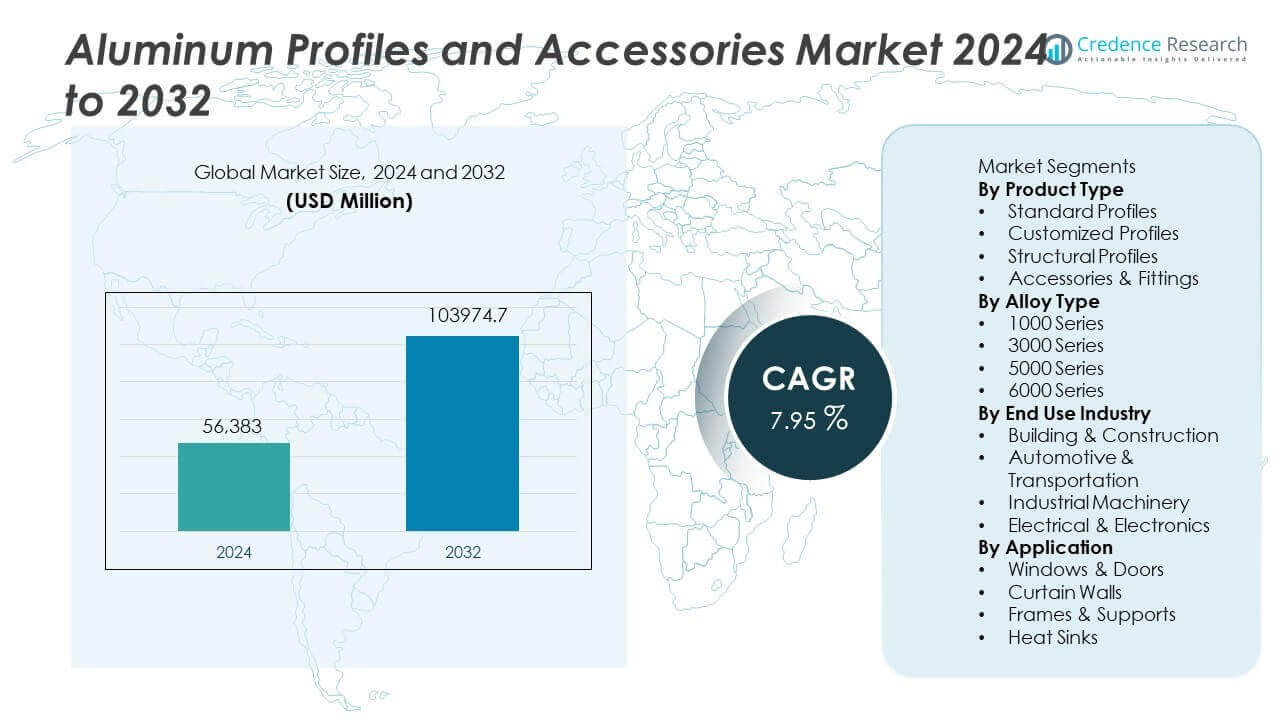
The Aluminum Profiles and Accessories market size stood at USD 56,383 million in 2024, and the value is projected to reach USD 103,974.7 million by 2032, reflecting a CAGR of 7.95% during the forecast period.
| REPORT ATTRIBUTE | DETAILS |
|---|---|
| Historical Period | 2020-2023 |
| Base Year | 2024 |
| Forecast Period | 2025-2032 |
| Aluminum Profiles and Accessories Market Size 2024 | USD 56,383 million |
| Aluminum Profiles and Accessories Market, CAGR | 7.95% |
| Aluminum Profiles and Accessories Market Size 2032 | USD 103,974.7 million |
Aluminum Profiles and Accessories Market Insights
- Growing construction activity and rising use in windows, doors, and façades drive demand, led by standard profiles with 44% share in 2024 due to versatility and cost efficiency.
- Market trends highlight rising adoption of customized profiles, improved finishing technologies, and wider use in EV platforms and industrial automation, supporting stronger value opportunities.
- Competitive activity remains steady as key players expand extrusion capacity, enhance alloy performance, and strengthen supply networks to secure large-scale contracts across core sectors.
- North America leads with 34% share in 2024, followed by Europe at 31% and Asia Pacific at 28%, supported by strong building projects, transport growth, and machinery upgrades across these regions.
Aluminum Profiles and Accessories Market Segmentation Analysis:
By Product Type
Standard profiles lead this segment with 44% share in 2024, supported by wide use in windows, frames, partitions, railings, and commercial structures. Users prefer these profiles for strength, corrosion resistance, and low weight. Customized profiles grow due to demand for project-specific shapes in machinery and transport. Structural profiles expand in factories, solar plants, and modular buildings. Accessories and fittings rise with higher installation activity and renovation cycles. Standard profiles remain in lead as construction firms prioritize cost control, large-scale supply, and simplified assembly.
- For instance, Hydro Aluminium operates extrusion presses with a combined annual output of 1,400,000 tons that supply profiles for door and frame systems.
By Alloy Type
The 6000 series holds 57% share in 2024, driven by strong mechanical properties, formability, and surface finish. These alloys support high-volume extrusion, machining, and anodizing across building and transport uses. The 5000 series follows due to growing marine and automotive demand. The 3000 series finds use in heat sinks and electrical components. The 1000 series remains in niche roles that require high conductivity and corrosion resistance. The 6000 series stays dominant as OEMs seek strength-to-weight balance, consistent performance, and long-term durability.
- For instance, UACJ Corporation processes 6000-series billets with tensile strength values reaching 310 MPa for automotive frames.
By End Use Industry
Building and construction leads with 62% share in 2024 due to heavy use in doors, windows, curtain walls, and façade systems. Lightweight profiles improve energy performance, installation speed, and design flexibility. Automotive and transportation expand as EV platforms and body parts shift to aluminum for improved efficiency. Industrial machinery adopts profiles for frames, conveyors, and assembly lines. Electrical and electronics grow with heat sinks and enclosures. Building and construction remains dominant as urban projects rise and users favor strong, recyclable, and corrosion-resistant aluminum systems.
Key Growth Drivers
Expansion in Building and Construction Activity
Urban development, commercial expansions, and renovation cycles drive high use of aluminum profiles in doors, windows, façades, and structural frameworks. The material supports energy-efficient buildings through thermal performance, corrosion resistance, and long service life. Contractors value faster installation, lower maintenance, and design flexibility. Growth in residential towers, industrial parks, and civic projects further accelerates demand. Manufacturers invest in powder coating, anodizing, and modular systems to meet durability and style needs. This driver will remain strong as governments fund infrastructure upgrades and sustainable building standards rise across major regions, strengthening long-term market momentum.
- For instance, Jindal Aluminium operates extrusion presses capable of producing profiles up to 360 mm width that reduce installation time in high-rise window wall systems.
Rising Demand in Automotive and Transportation
Automakers and transport fleets increase use of aluminum profiles to reduce vehicle weight, improve durability, and support fuel and energy savings. EV platforms use extruded profiles in battery housings, body frames, and crash structures, helping enhance safety and range. Lightweight materials play a key role in meeting global emission rules and efficiency goals. Manufacturers develop complex, high-strength shapes for new vehicle models and transport systems. This driver will continue to gain traction as electric mobility expands and commercial fleets adopt advanced materials to reduce cost and improve performance across long-distance operations.
- For instance, Constellium supplies crash management systems using 6000-series extrusions with yield strength values over 280 MPa for electric SUVs.
Strong Use in Industrial Machinery and Automation
Industrial sites adopt aluminum profiles for machine frames, conveyors, guards, enclosures, and workstations, supporting flexible layouts and fast assembly. The material offers strength, low weight, and better corrosion resistance than steel in many indoor settings. Modular systems reduce downtime and support quick changeovers in automated lines. As factories expand automation, robotics, and lean production, demand for reliable structural components increases. Manufacturers enhance accuracy and surface finish to support heavier loads and precise alignment. This driver will stay strong as industrial growth accelerates across packaging, electronics, food processing, and logistics applications, shaping consistent long-term demand.
Key Trends and Opportunities
Growth of Customized and High-Precision Profiles
Advanced extrusion, machining, and finishing methods support complex profiles with tight tolerances and improved dimensional stability. Custom shapes help meet project-specific needs for strength, alignment, and weight reduction in machinery, transport, and building systems. Digital modeling and rapid prototyping improve design accuracy, reduce waste, and shorten production cycles. These advancements open opportunities for premium products and specialized supply agreements. As end users demand stronger performance and tailored dimensions, producers expand engineering support and invest in automated inspection, positioning customization as a key route to value growth and competitive advantage.
- For instance, Bonnell Aluminum uses 3D modeling platforms to validate profile geometries and supports machining accuracy within ±0.05 mm for industrial parts.
Sustainability and Recycling Focus
Demand increases for aluminum profiles with higher recycled content and lower carbon impact. Users emphasize lifecycle gains, reduced emissions, and material recovery as part of sustainability goals. Producers enhance scrap sorting and remelting systems to improve efficiency and reduce energy use. Green building codes and EV supply chains support wider acceptance of recycled alloys. This trend encourages investment in circular supply models and carbon footprint tracking. As regulations tighten and buyers prioritize eco-friendly solutions, sustainable profiles gain strong traction across construction, transportation, and industrial sectors, creating new revenue paths and long-term growth potential.
- For instance, Constellium operates recycling centers that process over 100,000 tons of aluminum scrap per year for closed-loop supply programs.
Key Challenges
Raw Material Price Volatility
Fluctuating aluminum prices create uncertainty for producers and end users, impacting project planning and cost management. Sudden increases in raw material cost squeeze margins and elevate pricing pressure in competitive markets. Buyers delay purchase decisions or adjust designs to manage budgets. Producers explore cost control measures including recycling, long-term contracts, and alloy optimization. This challenge influences inventory strategies and pricing models, requiring careful balancing between efficiency and service reliability. Continued volatility may slow adoption in cost-sensitive sectors while pushing industry players toward more resilient sourcing and financial planning strategies.
Supply Chain and Lead Time Pressure
Complex global supply networks and capacity constraints create delivery delays across extrusion, machining, and finishing stages. Large projects face extended lead times, forcing users to adjust schedules or seek alternative suppliers. Logistics challenges, labor gaps, and transport bottlenecks add to the pressure. Buyers increasingly favor regional production and dependable distribution models to mitigate risk. Producers respond by expanding facilities, improving forecasting, and adopting digital planning tools. Persistent supply challenges may limit market responsiveness, reinforcing the need for flexible capacity and diversified sourcing as demand grows across key end-use industries.
Regional Analysis
North America
North America holds 34% share in 2024, driven by strong construction output, infrastructure upgrades, and steady demand from commercial buildings. Window frames, curtain walls, and structural profiles remain key uses. Automotive production and EV growth add further momentum as OEMs adopt lightweight profiles for body structures and battery modules. Industrial machinery users increase intake for modular frames and assembly lines. Local producers expand extrusion and finishing capacity to meet rising project timelines. Long-term growth remains positive as sustainability goals, urban expansion, and industrial automation support continued use of aluminum profiles and accessories.
Europe
Europe accounts for 31% share in 2024, supported by stringent energy standards and strong renovation activity. Builders value aluminum profiles for insulation performance, corrosion resistance, and durable finishes. EV adoption grows, driving demand for light structural parts and battery frames. Manufacturing upgrades increase use in industrial systems and automation lines. OEMs invest in advanced alloys and precision shapes to improve building design and transport efficiency. Regional climate targets and recycling focus reinforce aluminum use. This region maintains steady long-term demand driven by regulatory frameworks and higher expectations for building and transport sustainability.
Asia Pacific
Asia Pacific holds 28% share in 2024, led by major activity in China, India, Japan, and Southeast Asia. Large-scale urban development and industrial expansion fuel demand for windows, doors, façades, and modular construction systems. Automotive growth and continued shift toward EVs increase intake of lightweight profiles. Machinery production and ongoing automation trends support uses in frames, conveyors, and enclosures. Producers expand extrusion lines and supply chains to serve high-volume orders. Strong investment in public infrastructure and transport networks sustains long-term momentum as the region continues to dominate global production and end-user uptake.
Latin America
Latin America captures 4% share in 2024, supported by rising commercial construction, industrial activity, and transport upgrades. Builders adopt aluminum profiles for lightweight structures and corrosion resistance, helping improve project timelines and durability. Automotive and machinery uses grow as local manufacturing expands and imported components increase. Currency volatility and slower investment cycles limit faster scaling, yet ongoing infrastructure work and housing demand provide stability. Producers and distributors widen regional channels to improve availability and shorten lead times. Gradual market growth is expected as economic conditions improve and public projects accelerate.
Middle East & Africa
Middle East & Africa represent 3% share in 2024, shaped by ongoing commercial and civic development across Gulf states and parts of Africa. Large construction projects, airports, and mixed-use buildings boost demand for façades, windows, and lightweight framing systems. Industrial and transport applications show early progress as manufacturing and logistics expand. Limited local production capacity increases reliance on imports, yet investment in extrusion and fabrication facilities continues. Regional focus on energy-efficient design and modern infrastructure strengthens outlook. Long-term growth links to economic diversification, urbanization, and rising interest in sustainable building solutions.
Aluminum Profiles and Accessories Market Segmentations:
By Product Type
- Standard Profiles
- Customized Profiles
- Structural Profiles
- Accessories & Fittings
By Alloy Type
- 1000 Series
- 3000 Series
- 5000 Series
- 6000 Series
By End Use Industry
- Building & Construction
- Automotive & Transportation
- Industrial Machinery
- Electrical & Electronics
By Application
- Windows & Doors
- Curtain Walls
- Frames & Supports
- Heat Sinks
By Geography
- North America
- U.S.
- Canada
- Mexico
- Europe
- Germany
- France
- U.K.
- Italy
- Spain
- Rest of Europe
- Asia Pacific
- China
- Japan
- India
- South Korea
- South-east Asia
- Rest of Asia Pacific
- Latin America
- Brazil
- Argentina
- Rest of Latin America
- Middle East & Africa
- GCC Countries
- South Africa
- Rest of the Middle East and Africa
Competitive Landscape
Competitive landscape features major companies including Hydro Aluminium, Alcoa Corporation, Constellium SE, Arconic Corporation, Nanshan Aluminum, China Zhongwang Holdings Limited, UACJ Corporation, Jindal Aluminium Limited, Gulf Extrusions Co. LLC, and Bonnell Aluminum. These companies focus on expanding extrusion capacity, improving alloy performance, and offering value-added accessories to meet rising demand across construction, automotive, industrial, and electrical applications. Many invest in precision finishing, anodizing, powder coating, and machining to enhance durability, corrosion resistance, and design flexibility. Partnerships with OEMs and builders support long-term supply agreements and custom product development. Competitive activity includes automation upgrades, recycled alloy integration, and downstream service expansion to reduce lead time. Market players continue to strengthen regional networks and R&D capability, using lightweight and high-strength solutions to capture growth across emerging and established sectors worldwide.
Key Player Analysis
- Hydro Aluminium
- Alcoa Corporation
- Constellium SE
- Arconic Corporation
- Nanshan Aluminum
- China Zhongwang Holdings Limited
- UACJ Corporation
- Jindal Aluminium Limited
- Gulf Extrusions Co. LLC
- Bonnell Aluminum
Recent Developments
- In November 2025, Hydro Aluminium (Norsk Hydro ASA) announced plans to close five extrusion plants in Europe as part of a consolidation strategy to improve capacity use and cut costs.
- In October 2025, Hydro Aluminium reported solid third-quarter 2025 results, with stronger extrusions segment EBITDA driven by volume and cost efforts.
- In May 2025, Alcoa Corporation officially reported the sale of its low-carbon EcoLum® aluminum billet to Keymark Corporation in North America.
Report Coverage
The research report offers an in-depth analysis based on Product Type, Alloy Type, End Use Industry, Application and Geography. It details leading market players, providing an overview of their business, product offerings, investments, revenue streams, and key applications. Additionally, the report includes insights into the competitive environment, SWOT analysis, current market trends, as well as the primary drivers and constraints. Furthermore, it discusses various factors that have driven market expansion in recent years. The report also explores market dynamics, regulatory scenarios, and technological advancements that are shaping the industry. It assesses the impact of external factors and global economic changes on market growth. Lastly, it provides strategic recommendations for new entrants and established companies to navigate the complexities of the market.
Future Outlook
- Demand will rise as construction and renovation activity expands worldwide.
- EV platforms will increase adoption of lightweight aluminum profiles.
- Industrial automation will support wider use in modular machinery frames.
- Customized profiles will gain traction due to project-specific needs.
- Recycled aluminum content will grow as sustainability targets progress.
- Advanced finishes will improve durability and design flexibility.
- Regional manufacturing capacity will expand to shorten delivery times.
- Digital design tools will improve accuracy and reduce production waste.
- Alloy innovation will enhance strength, corrosion resistance, and lifespan.
- Long-term contracts with OEMs and builders will strengthen market stability.

Request a Free Sample
Fill in your details and we'll send you a free sample report.
- Sample data tables & charts
- Research methodology
Need a Custom Version of This Report?
Tailor the scope, geography, or segments to your exact requirements.
- Custom geography or segment scope
- Direct access to our analyst team
Frequently Asked Questions
What is the current market size for Aluminum Profiles and Accessories market, and what is its projected size in 2032?
At what Compound Annual Growth Rate is the Aluminum Profiles and Accessories market projected to grow between 2024 and 2032?
Which Aluminum Profiles and Accessories market segment held the largest share in 2024?
What are the primary factors fueling the growth of the Aluminum Profiles and Accessories market?
Who are the leading companies in the Aluminum Profiles and Accessories market?
Which region commanded the largest share of the Aluminum Profiles and Accessories market in 2024?
Table of Content
Chapter 1 Market Segmentation
- 1.1 Segmentation Framework
- 1.1.1 Product and Service Classification
- 1.1.2 Application and End-Use Classification
- 1.1.3 Technology and Solution Classification
- 1.1.4 Customer and Distribution Channel Classification
- 1.1.5 Geographic Segmentation
- 1.1.6 Market Segment Definitions and Boundaries
Chapter 2 Introduction
- 2.1 Report Objectives and Scope
- 2.2 Product Definition and Industry Terminology
- 2.3 Market Inclusions and Exclusions
- 2.4 Research Process
- 2.4.1 Primary Research and Expert Interviews
- 2.4.2 Secondary Research and Source Review
- 2.4.3 Top-Down and Bottom-Up Estimation
- 2.4.4 Data Triangulation and Verification
- 2.5 Market Size Measurement Basis
- 2.5.1 2024: USD 56,383 million → 2032: USD 103,974.7 million
- 2.6 Historical and Forecast Reference Periods
- 2.6.1 Base Year: 2024
- 2.6.2 Forecast Period: 2024-2032
- 2.7 Research Assumptions and Limitations
Chapter 3 Executive Summary
- 3.1 Market Snapshot and Key Findings
- 3.2 Base-Year Market Size, 2024
- 3.3 Forecast Market Size, 2032
- 3.4 Revenue and Volume Growth Outlook
- 3.5 Key Demand and Supply Indicators
- 3.6 Leading Market Segments
- 3.7 Fastest-Growing Market Opportunities
- 3.8 Regional Performance Highlights
- 3.9 Technology and Industry Transformation
- 3.10 Competitive Landscape Summary
- 3.11 Analyst View and Strategic Implications
Chapter 4 Global Aluminum Profiles and Accessories Market Trends and Developments
- 4.1 Historical Industry Development
- 4.2 Recent Market Trends and Developments
- 4.3 Demand and Customer Behavior Trends
- 4.4 Technology and Product Innovation
- 4.5 Artificial Intelligence, Automation and Digitalization
- 4.6 Local Manufacturing and Supply Chain Realignment
- 4.7 Industry Partnerships, Mergers and Acquisitions
- 4.8 Sustainability and Circular Economy Developments
- 4.9 Government and Private Sector Investment Trends
- 4.10 Emerging Business Models and Commercialization
- 4.11 Industry Developments and Announcements
Chapter 5 Global Aluminum Profiles and Accessories Market Production, Supply and Demand Analysis
- 5.1 Demand Trend and Consumption Analysis
- 5.2 Demand Forecast, 2024-2032
- 5.3 Production and Output Trend
- 5.4 Production and Output Forecast, 2024-2032
- 5.5 Installed Capacity and Capacity Utilization
- 5.6 Company-Wise Production Plants and Statistics
- 5.6.1 Installed Production Capacity
- 5.6.2 Actual Production
- 5.6.3 Planned Capacity and Expansion Targets
- 5.7 Supply Chain Structure and Procurement Trends
- 5.8 Supply-Demand Gap and Bottlenecks
- 5.9 Import Dependence and Sourcing Structure
- 5.10 Contract Manufacturing and Outsourcing
- 5.11 Regional Supply and Demand Concentration
Chapter 6 Global Aluminum Profiles and Accessories Market Pricing Analysis
- 6.1 Pricing Structure and Measurement
- 6.2 Historical Pricing Trends
- 6.3 Pricing Outlook, 2024-2032
- 6.4 Average Selling Price and Unit Economics
- 6.5 Pricing by Product and Market Segment
- 6.6 Geographic Pricing Differences
- 6.7 Key Input, Energy, Labor and Logistics Costs
- 6.8 Contract Pricing and Purchasing Models
- 6.9 Pricing Sensitivity and Competitive Positioning
- 6.10 Price, Margin and Profitability Implications
Chapter 7 Global Aluminum Profiles and Accessories Market Dynamics
- 7.1 Market Growth Drivers
- 7.1.1 Demand-Side Drivers
- 7.1.2 Technology and Innovation Drivers
- 7.1.3 Infrastructure and Investment Drivers
- 7.1.4 Regulatory and Policy Drivers
- 7.2 Market Restraints
- 7.2.1 Cost and Affordability Constraints
- 7.2.2 Technology and Adoption Barriers
- 7.2.3 Supply Chain and Operational Constraints
- 7.3 Market Challenges
- 7.3.1 Competitive Pressure and Margin Erosion
- 7.3.2 Skills, Infrastructure and Implementation Gaps
- 7.4 Emerging Market Opportunities
- 7.5 Market Dynamics Impact and Time-Horizon Assessment
Chapter 8 Global Aluminum Profiles and Accessories Value Chain Analysis
- 8.1 Industry Value Chain Overview
- 8.2 Upstream Suppliers and Critical Inputs
- 8.3 Technology and Component Providers
- 8.4 Manufacturing or Service Delivery
- 8.5 Distribution, Channel Partners and Integrators
- 8.6 Downstream Applications and End Users
- 8.7 Value Addition and Profit Pools
- 8.8 Vertical Integration and Outsourcing
- 8.9 Supplier Concentration and Risk
- 8.10 Supply Chain Localization and Resilience
Chapter 9 Global Aluminum Profiles and Accessories Market Regulations and Policies
- 9.1 Relevant Laws, Standards and Compliance Frameworks
- 9.2 Product, Service, Safety and Quality Requirements
- 9.3 Government Policies, Incentives and Subsidies
- 9.4 Imports, Exports and Trade Barriers
- 9.5 Public Procurement and Local Content Requirements
- 9.6 Environmental and Sustainability Compliance
- 9.7 Upcoming Policy Changes and Market Implications
Chapter 10 Global Aluminum Profiles and Accessories Market Hotspots and Opportunities
- 10.1 Market Opportunity Mapping and Growth Hotspots
- 10.2 High-Growth Applications and Customer Groups
- 10.3 Underserved Markets and White-Space Opportunities
- 10.4 Emerging Technology and Product Opportunities
- 10.5 New Capacity and Investment Hotspots
- 10.6 Market Entry and Expansion Opportunities
- 10.7 Distribution and Partnership Opportunities
- 10.8 Near-Term and Long-Term Commercial Potential
- 10.9 Opportunity Attractiveness and Execution Risks
Chapter 11 Global Aluminum Profiles and Accessories Market Outlook, 2024-2032
- 11.1 Market Size and Analysis
- 11.1.1 Revenue (Market Measurement: 2024: USD 56,383 million → 2032: USD 103,974.7 million)
- 11.1.2 Market Volume and Quantity Sold
- 11.1.3 Historical Market Size
- 11.1.4 Base-Year Market Size, 2024
- 11.2 Market Forecast, 2024-2032
- 11.2.1 Revenue Forecast to 2032
- 11.2.2 Volume Forecast to 2032
- 11.2.3 CAGR and Year-on-Year Growth
- 11.2.4 Incremental Revenue Opportunity
- 11.3 Forecast Assumptions and Scenario Analysis
- 11.3.1 Base-Case Forecast
- 11.3.2 Optimistic and Conservative Scenarios
- 11.3.3 Technology, Pricing and Policy Sensitivities
- 11.4 Market Attractiveness and Growth Outlook
Chapter 12 Global Aluminum Profiles and Accessories Market Segmentation and Outlook
- 12.1 Segmentation Summary and Market Shares, 2024
- 12.2 Largest and Fastest-Growing Segments
- 12.3 Segment Growth Comparison
- 12.4 Segment Attractiveness and Priority Matrix
Chapter 13 Global Aluminum Profiles and Accessories Geographic Market Outlook, 2024-2032
- 13.1 Regional Market Size and Share, 2024
- 13.2 Regional Market Forecast, 2024-2032
- 13.3 Regional Pricing, Production and Demand Differences
- 13.4 North America
- 13.4.1 United States
- 13.4.2 Canada
- 13.4.3 Mexico
- 13.5 Europe
- 13.5.1 Germany
- 13.5.2 France
- 13.5.3 Italy
- 13.5.4 United Kingdom
- 13.5.5 Spain
- 13.5.6 Poland
- 13.5.7 Russia
- 13.5.8 Netherlands
- 13.5.9 Belgium
- 13.5.10 Sweden
- 13.5.11 Denmark
- 13.5.12 Norway
- 13.5.13 Rest of Europe
- 13.6 Asia Pacific
- 13.6.1 China
- 13.6.2 India
- 13.6.3 Japan
- 13.6.4 South Korea
- 13.6.5 Thailand
- 13.6.6 Indonesia
- 13.6.7 Vietnam
- 13.6.8 Malaysia
- 13.6.9 Australia
- 13.6.10 Rest of Asia Pacific
- 13.7 Latin America
- 13.7.1 Brazil
- 13.7.2 Argentina
- 13.7.3 Colombia
- 13.7.4 Chile
- 13.7.5 Rest of Latin America
- 13.8 Middle East
- 13.8.1 Saudi Arabia
- 13.8.2 United Arab Emirates
- 13.8.3 Turkey
- 13.8.4 Israel
- 13.8.5 Iran
- 13.8.6 Rest of the Middle East
- 13.9 Africa
- 13.9.1 South Africa
- 13.9.2 Egypt
- 13.9.3 Nigeria
- 13.9.4 Morocco
- 13.9.5 Rest of Africa
- 13.10 Regional Investment, Policy and Supply Chain Differences
- 13.11 Regional Competitive Landscape
- 13.12 Geographic Growth Hotspots
Chapter 14 Global Aluminum Profiles and Accessories Technology, Innovation and Sustainability Outlook
- 14.1 Technology Landscape and Maturity
- 14.2 Product, Process and Service Innovation
- 14.3 AI, Automation and Digital Tools in the Industry
- 14.4 Technology Adoption and Performance Benchmarking
- 14.5 Innovation Pipeline and R&D Investment
- 14.6 Patent and Intellectual Property Trends
- 14.7 Energy Efficiency and Resource Management
- 14.8 Sustainability, Recycling and Circularity
- 14.9 Technology Roadmap, 2024-2032
- 14.10 Risks of Obsolescence and Technology Substitution
Chapter 15 Global Aluminum Profiles and Accessories Market Key Strategic Imperatives
- 15.1 Growth and Market Entry Priorities
- 15.2 High-Return Products and Segments
- 15.3 Pricing, Profitability and Cost Optimization
- 15.4 Technology Investment and Product Differentiation
- 15.5 Supply Chain Localization and Resilience
- 15.6 Distribution and Customer Acquisition
- 15.7 Partnership, Acquisition and Capacity Strategy
- 15.8 Regional Expansion Priorities
- 15.9 Short-, Medium- and Long-Term Actions
Chapter 16 Competition Outlook
- 16.1 Industry Competition Characteristics
- 16.2 Market Structure and Concentration
- 16.3 Market Share and Competitive Positioning, 2024
- 16.4 Company-Wise Revenue and Product Benchmarking
- 16.5 Production and Service Capacity Benchmarking
- 16.6 Technology, Pricing and Differentiation
- 16.7 Regional Footprint and Distribution Strength
- 16.8 Mergers, Acquisitions and Strategic Alliances
- 16.9 New Entrants and Competitive Threats
- 16.10 Porter's Five Forces and Industry Attractiveness
- 16.11 Competitive Outlook, 2024-2032
Chapter 17 Company Profiles
- 17.1 Company Coverage and Selection Criteria
- 17.2 Leading Market Participants – Standard Profile Structure
- 17.2.1 Business Description
- 17.2.2 Company Ownership and Geographic Presence
- 17.2.3 Product and Service Portfolio
- 17.2.4 Manufacturing and Operating Footprint
- 17.2.5 Production Capacity and Expansion Plans
- 17.2.6 Financial Performance and Investment
- 17.2.7 Market Share and Competitive Position
- 17.2.8 Technology and Innovation Capabilities
- 17.2.9 Strategic Alliances or Partnerships
- 17.2.10 Recent Developments
- 17.2.11 Growth Strategy and Outlook
- 17.3 Other Relevant Market Participants
Note: Every listed company is profiled on the structure shown under the first company. The company list is preliminary and may change based on research findings, market developments, data availability and client requirements.
Chapter 18 Disclaimer
- 18.1 Research and Forecast Disclaimer
- 18.2 Data Source and Estimation Limitations
Note: The depth of individual sections depends on data availability for this market. Volume, capacity, trade and other unit-based metrics are included where applicable.