
| REPORT ATTRIBUTE | DETAILS |
|---|---|
| Historical Period | 2020-2023 |
| Base Year | 2024 |
| Forecast Period | 2025-2032 |
| Autonomous Checkout Market Size 2024 | USD 5,550 million |
| Autonomous Checkout Market, CAGR | 10.3% |
| Autonomous Checkout Market Size 2032 | USD 12,159 million |
Market Overview
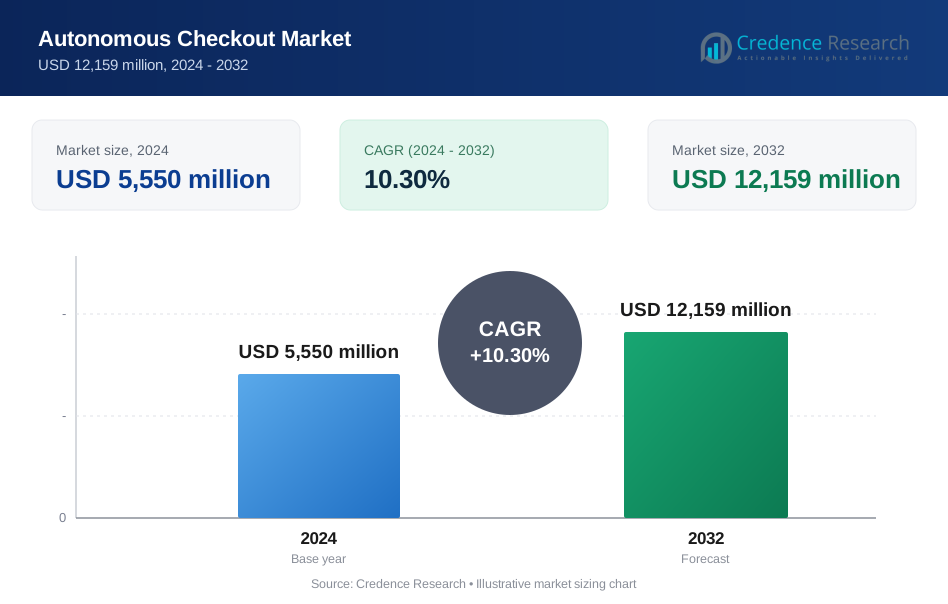
Autonomous Checkout Market size was valued at USD 5,550 million in 2024 and is anticipated to reach USD 12,159 million by 2032, at a CAGR of 10.3% during the forecast period.
The Autonomous Checkout Market is driven by rapid advancements in artificial intelligence, machine learning, and sensor technologies, which enable seamless and efficient checkout experiences for both retailers and consumers. Growing demand for contactless shopping, heightened by the pandemic, and rising consumer preference for convenience are accelerating the adoption of autonomous checkout solutions across supermarkets, convenience stores, and specialty retail outlets. Retailers are increasingly investing in these technologies to streamline operations, reduce labor costs, and enhance customer satisfaction. Market trends indicate a surge in partnerships between technology providers and retail chains to pilot and deploy cashierless store formats. Additionally, the integration of mobile payment platforms, computer vision, and IoT devices is fostering real-time inventory tracking and personalized shopping experiences. As competition intensifies, vendors are focusing on scalability and interoperability, further propelling market growth and shaping the future landscape of retail automation.
The Autonomous Checkout Market is experiencing significant growth across various regions, driven by the increasing demand for seamless shopping experiences and advancements in AI and sensor technologies. Europe follows closely, with countries like the UK and Germany embracing cashierless technologies in response to labor shortages and changing consumer preferences. Asia-Pacific is emerging as a rapidly growing market, particularly in countries such as China, Japan, and India, where urbanization and digital payment adoption are accelerating the shift towards automated retail solutions. Key players driving innovation in the Autonomous Checkout Market include NCR Corporation, a leader in self-checkout solutions; Fujitsu Limited, known for its advanced retail technologies; Toshiba Global Commerce Solutions, offering comprehensive point-of-sale systems; and AiFi Inc., specializing in AI-powered, checkout-free retail experiences. These companies are at the forefront of developing and deploying technologies that enable retailers to offer frictionless and efficient shopping experiences, thereby shaping the future of the retail industry.
Market Insights
- The Autonomous Checkout Market is projected to grow from USD 5,550 million in 2024 to USD 12,159 million by 2032, registering a CAGR of 10.3%.
- Rapid advancements in artificial intelligence, sensor technology, and machine learning are fueling the adoption of autonomous checkout solutions in retail environments.
- Retailers are focusing on integrating advanced computer vision and real-time analytics to provide seamless, contactless, and frictionless checkout experiences for customers.
- Increasing strategic partnerships between retailers and technology firms are accelerating the development and deployment of cashierless stores globally.
- High implementation costs, integration challenges with legacy systems, and data privacy concerns remain key restraints, especially for small and mid-sized retailers.
- North America leads the Autonomous Checkout Market, followed by Europe and Asia-Pacific, with each region demonstrating unique growth dynamics and adoption patterns.
- Key players such as Fujitsu Limited, NCR Corporation, AiFi Inc., Zippin, Trigo, Toshiba Corporation, and Standard Cognition are driving competition and innovation, introducing scalable and reliable autonomous solutions tailored to diverse retail formats.
Market Drivers
Technological Advancements in Artificial Intelligence and Sensor Integration
The Autonomous Checkout Market is experiencing rapid growth due to significant advancements in artificial intelligence, machine learning, and sensor integration. These technologies allow retailers to offer seamless, frictionless checkout experiences, minimizing manual intervention and improving operational efficiency. Computer vision, RFID, and advanced data analytics work together to track products, identify shoppers, and facilitate automated payments. The integration of these systems leads to reduced errors and faster transactions. Retailers adopting these solutions see improvements in customer satisfaction and store throughput. Companies in the market continue to invest in R&D to further enhance accuracy and reliability. This focus on innovation positions autonomous checkout as a key enabler in the digital transformation of retail.
- For instance, India’s AI Revolution initiative has allocated ₹10,300 crore over five years to strengthen AI capabilities, supporting innovations in autonomous retail technologies.
Rising Consumer Demand for Convenience and Contactless Experiences
Evolving consumer expectations are shaping the Autonomous Checkout Market, with a clear preference for speed, convenience, and safety. Shoppers increasingly seek out retail experiences that minimize waiting times and eliminate the need for physical interaction at checkout counters. The pandemic has accelerated this trend, making contactless technologies not only desirable but often essential. Retailers respond by implementing autonomous solutions that deliver streamlined and efficient service. Mobile payment integration and app-based checkout features offer further value by aligning with digital-first consumer habits. These developments foster customer loyalty and support repeat business. Consumer adoption drives continuous refinement of autonomous systems in various retail settings.
- For instance, British supermarket giant Tesco piloted scan-free kiosks to enhance customer convenience and reduce checkout times.
Retailer Focus on Operational Efficiency and Cost Reduction
Retailers view the Autonomous Checkout Market as a means to achieve greater efficiency and lower costs. Automating the checkout process reduces dependence on human labor, addresses staffing challenges, and optimizes resource allocation. It also limits shrinkage and theft through real-time product tracking and surveillance. Operational savings achieved through automation free up resources for investment in other areas of business. Retailers implementing these solutions often realize higher store productivity and improved profit margins. This focus on cost control makes autonomous checkout a compelling choice in a competitive landscape. It aligns with the broader strategy to modernize retail infrastructure.
Industry Collaboration and Ecosystem Expansion Fueling Adoption
Industry partnerships and ecosystem development are essential drivers in the Autonomous Checkout Market. Retailers collaborate with technology providers, payment companies, and IoT vendors to deploy scalable and interoperable solutions. These alliances accelerate product innovation and facilitate broader market reach. Companies working together address integration challenges and ensure seamless operation across diverse retail environments. Successful pilots and rollouts create positive momentum, prompting additional retailers to explore autonomous checkout technologies. Industry collaboration supports standardization, further lowering barriers to entry. The expanding ecosystem continues to unlock new opportunities and accelerates market adoption.
Market Trends
Integration of Advanced AI and Computer Vision Technology Reshapes Checkout Experiences
Autonomous Checkout Market players are focusing on deploying sophisticated artificial intelligence and computer vision solutions to revolutionize the shopping journey. Retailers implement these technologies to accurately identify products, track customer movement, and process transactions without human intervention. AI-driven analytics provide actionable insights into shopper behavior, allowing retailers to personalize experiences and refine store layouts. Computer vision enables real-time monitoring of shelves, helping maintain stock levels and improve inventory management. These advancements minimize checkout friction, reduce operational costs, and deliver a seamless experience for customers. The market demonstrates robust adoption of these solutions in grocery, convenience, and specialty stores, reflecting a strong shift toward automation.
Focus on Data Security, Privacy, and Compliance Strengthens Consumer Trust
With the expansion of autonomous checkout technologies, retailers prioritize robust data security and privacy measures. Regulatory requirements regarding consumer data collection and processing have become more stringent, prompting companies to adopt advanced encryption and compliance protocols. It implements regular audits, transparent data usage policies, and secure transaction processes to mitigate risks. Ensuring data integrity and safeguarding customer information build trust and protect brand reputation. Retailers in the Autonomous Checkout Market recognize the importance of compliance to sustain long-term growth. This proactive stance on security reassures both customers and stakeholders, strengthening the market’s credibility.
- For instance, autonomous checkout systems are implementing advanced encryption protocols and anonymizing customer information to ensure compliance with stringent privacy standards.
Contactless and Frictionless Shopping Drives Consumer Engagement and Loyalty \
Consumers increasingly seek convenience and speed, prompting retailers to adopt contactless autonomous checkout systems. The pandemic has heightened awareness around safety and hygiene, driving demand for touch-free shopping environments. It reduces wait times and eliminates traditional checkout bottlenecks, which leads to higher customer satisfaction and retention. Retailers leverage mobile payment platforms and self-scanning applications to streamline the entire process. The Autonomous Checkout Market benefits from these preferences by attracting both tech-savvy and time-conscious shoppers. Retailers that implement frictionless solutions often report increased foot traffic and improved loyalty rates. This trend sets new benchmarks for in-store experiences across the retail sector.
- For instance, frictionless checkout experiences are becoming a key differentiator for retailers, with biometric payment technologies being piloted in multiple regions.
Strategic Collaborations and Ecosystem Expansion Fuel Market Momentum
Major retailers and technology firms are forming partnerships to accelerate the rollout of autonomous checkout solutions. Collaborations enable seamless integration of hardware, software, and payment systems, ensuring efficient deployment across multiple locations. It facilitates the development of scalable and interoperable solutions that cater to diverse retail formats. Companies invest in pilot programs and co-development initiatives to test new features and gather real-world feedback. These efforts encourage standardization and drive down adoption costs for smaller retailers. The Autonomous Checkout Market benefits from this collaborative ecosystem, which enhances innovation and accelerates mainstream acceptance.
Market Challenges Analysis
High Implementation Costs and Integration Complexities Hinder Widespread Adoption
The Autonomous Checkout Market faces significant challenges related to high upfront investment and technical integration. It requires retailers to allocate substantial capital for hardware, software, and infrastructure upgrades, which can deter small and mid-sized businesses. Integration with legacy point-of-sale systems and existing store layouts often proves complex and time-consuming. Retailers may experience operational disruptions during the transition phase, leading to concerns about potential revenue loss. The need for ongoing maintenance and technical support further increases the total cost of ownership. Market participants must address these barriers to facilitate broader adoption and ensure a smooth, scalable deployment process.
- For instance, a CB Insights report highlights that autonomous checkout solutions have raised over $900M in total funding, yet slow adoption persists due to hardware implementation challenges and capital costs.
Data Privacy Concerns and Regulatory Compliance Present Ongoing Risks
Retailers operating in the Autonomous Checkout Market must navigate a complex landscape of data privacy regulations and compliance requirements. It collects and processes large volumes of sensitive consumer information, making data protection a top priority. Failure to implement robust security protocols can result in breaches that damage brand reputation and erode consumer trust. Navigating evolving regulations across multiple jurisdictions creates additional challenges for multinational retailers. Clear communication about data usage and strong compliance measures are essential to maintaining customer confidence. Addressing these concerns is vital for sustainable growth and long-term market acceptance.
Market Opportunities
Expansion into New Retail Formats and Geographic Regions Presents Strong Growth Potential
The Autonomous Checkout Market holds significant opportunity through expansion into a wider range of retail formats and emerging markets. It enables retailers to implement automated solutions not only in supermarkets and convenience stores but also in specialty shops, airports, and hospitality venues. Rapid urbanization and a growing middle-class population in regions such as Asia-Pacific, Latin America, and the Middle East create favorable conditions for adoption. Retailers who move quickly to deploy these solutions can establish a competitive edge, capturing early market share and enhancing brand loyalty. Partnerships with local technology providers and integration with regional payment systems can accelerate market entry. The demand for scalable, cost-effective autonomous checkout systems continues to increase, making geographic and vertical diversification a compelling opportunity.
Integration of Personalized Services and Advanced Analytics Drives Enhanced Customer Experiences
Retailers can leverage the Autonomous Checkout Market to deliver highly personalized services and data-driven insights that improve customer engagement. It allows seamless integration of loyalty programs, tailored promotions, and real-time product recommendations into the checkout process. Advanced analytics enable retailers to understand consumer preferences, optimize inventory management, and respond quickly to market trends. Collaboration with fintech and artificial intelligence firms supports the development of innovative features that differentiate the in-store experience. Retailers who invest in these capabilities can build deeper relationships with customers and drive repeat business. The ability to merge automation with personalization positions the market for sustained growth and transformation.
Market Segmentation Analysis:
By Type:
The Autonomous Checkout Market demonstrates strong differentiation across its primary segments, enabling retailers to select solutions tailored to their operational requirements. By type, RFID technology plays a crucial role in automating product identification and enhancing inventory management. It ensures rapid and accurate item tracking, supporting seamless customer experiences. Computer visual tracking devices and advanced cameras and sensors further expand automation capabilities by enabling real-time monitoring of shopper movements and product selections. These technologies work in tandem to minimize errors and support fully automated checkout processes. The “Others” segment, which includes emerging and hybrid technologies, continues to evolve as vendors innovate new solutions to address niche retail demands.
By Components:
The market divides into hardware and software segments. Hardware forms the foundation of autonomous systems, with devices such as sensors, cameras, and RFID readers ensuring accurate data capture and real-time environment awareness. Software serves as the intelligence layer, integrating machine learning, artificial intelligence, and analytics platforms to interpret data, automate transactions, and deliver actionable insights to retailers. The synergy between robust hardware and intelligent software enables retailers to realize the full potential of autonomous checkout systems and respond swiftly to evolving business needs.
By Application:
The Autonomous Checkout Market finds adoption in a variety of retail settings. Retail stores utilize these solutions to streamline customer flows and reduce checkout queues, improving overall service quality. Grocery stores and supermarkets benefit from automated systems by optimizing high-frequency transactions and enhancing inventory control, addressing sector-specific challenges such as perishables management. Departmental stores leverage autonomous checkout to elevate the shopping experience and cater to diverse product categories under one roof. Vending machines equipped with autonomous checkout components present opportunities for unattended retail and 24/7 service, catering to the demand for convenience-driven experiences. Each application segment highlights the flexibility and scalability of autonomous checkout technology, making it a strategic investment for retailers aiming to enhance efficiency, customer satisfaction, and competitive advantage.
Segments:
Based on Type:
- RFID
- Computer Visual Tracking Device
- Cameras & Sensors
- Others
Based on Components
- Hardware
- Software
Based on Application
- Retail Stores
- Grocery Stores & Supermarkets
- Departmental Stores
- Vending Machine
Based on the Geography:
- North America
- U.S.
- Canada
- Mexico
- Europe
- UK
- France
- Germany
- Italy
- Spain
- Russia
- Belgium
- Netherlands
- Austria
- Sweden
- Poland
- Denmark
- Switzerland
- Rest of Europe
- Asia Pacific
- China
- Japan
- South Korea
- India
- Australia
- Thailand
- Indonesia
- Vietnam
- Malaysia
- Philippines
- Taiwan
- Rest of Asia Pacific
- Latin America
- Brazil
- Argentina
- Peru
- Chile
- Colombia
- Rest of Latin America
- Middle East
- UAE
- KSA
- Israel
- Turkey
- Iran
- Rest of Middle East
- Africa
- Egypt
- Nigeria
- Algeria
- Morocco
- Rest of Africa
Regional Analysis
North America
North America holds the largest share of the Autonomous Checkout Market, accounting for over 40% in 2024. This dominance stems from early adoption, robust technological infrastructure, and significant investments by major retailers and tech companies. The United States, in particular, has been at the forefront, with companies like Amazon pioneering cashierless store formats such as Amazon Go and Amazon Fresh. Retailers across the region are increasingly implementing autonomous checkout solutions to enhance customer experience and reduce operational costs. The presence of key market players and a consumer base receptive to technological advancements further solidify North America's leading position in this market.
Europe
Europe is experiencing significant growth in the Autonomous Checkout Market, with a market share of approximately 30% in 2024. Countries like the United Kingdom, Germany, and France are leading the charge, supported by favorable regulations and a strong emphasis on innovation. Retailers are adopting autonomous checkout technologies to streamline operations and meet the growing demand for contactless shopping experiences. The integration of advanced technologies, such as computer vision and AI, into retail environments is becoming increasingly common. Consumer acceptance of these technologies is high, contributing to the region's robust market growth.
Asia-Pacific
The Asia-Pacific region is the fastest-growing market for autonomous checkout solutions, holding a market share of around 20% in 2024. Rapid urbanization, increasing disposable incomes, and a strong inclination towards technological adoption are key factors driving this growth. Countries like China, Japan, and South Korea are leading in implementing autonomous checkout technologies, with numerous pilot projects and full-scale deployments. Retailers in the region are leveraging AI and IoT to enhance customer experiences and operational efficiency. The region's dynamic retail landscape and consumer readiness to embrace new technologies position it as a critical area for market expansion.
Latin America
Latin America holds a smaller share of the Autonomous Checkout Market, estimated at around 5% in 2024, but exhibits significant potential for growth. The region is undergoing a digital transformation, with increasing adoption of e-commerce and digital payment systems. Countries like Brazil and Mexico are witnessing a surge in retail automation initiatives, driven by the need to improve customer service and operational efficiency. While infrastructural challenges exist, the growing middle class and urbanization trends are creating a conducive environment for the adoption of autonomous checkout technologies. Collaborations between international tech firms and local retailers are expected to accelerate market penetration in the coming years.
Middle East and Africa
The Middle East and Africa region accounts for approximately 5% of the Autonomous Checkout Market in 2024, with gradual adoption observed across various countries. The United Arab Emirates and South Africa are leading in the implementation of autonomous checkout technologies, driven by initiatives to modernize retail infrastructure and enhance customer experiences. Retailers in these countries are exploring innovative solutions to meet the evolving demands of tech-savvy consumers. While the market is still in its nascent stages, increasing investments in digital infrastructure and a focus on improving retail efficiency are expected to drive growth in this region.
Key Player Analysis
- Fujitsu Limited
- NCR Corporation
- Zippin
- Standard Cognition
- Mashgin, Inc.
- FOCAL SYSTEMS INC.
- AiFi Inc.
- Accel Robotics Corporation
- Toshiba Corporation
- Trigo
- Zippin
Competitive Analysis
The Autonomous Checkout Market is characterized by intense competition among leading players, each striving to deliver advanced, scalable, and cost-effective solutions to retailers. Key players include Fujitsu Limited, NCR Corporation, AiFi Inc., Zippin, Trigo, Toshiba Corporation, Accel Robotics Corporation, Standard Cognition, Mashgin, Inc., and FOCAL SYSTEMS INC. These companies focus on continuous innovation in artificial intelligence, computer vision, and sensor technologies to differentiate their offerings. They actively pursue strategic partnerships with retail chains, payment solution providers, and technology integrators to expand their market reach and accelerate product deployment. Market leaders invest heavily in research and development, aiming to improve system accuracy, enhance user experience, and address integration challenges with legacy retail infrastructures. Many also provide modular, customizable platforms that adapt to a wide variety of store layouts and business models. Security and data privacy are high priorities, with companies implementing advanced protocols to ensure compliance with regional regulations. Competitive dynamics drive players to refine pricing strategies and offer value-added services, such as predictive analytics and inventory optimization, which strengthen their relationships with clients. This focus on innovation, collaboration, and tailored solutions ensures that leading players remain at the forefront of the Autonomous Checkout Market’s ongoing evolution.
Recent Developments
- In September 2024, CCL TECH, a provider of innovative self-checkout solutions, announced its participation in Gitex Technology Week 2024, which will be held at the Dubai World Trade Centre. The company would showcase its latest products and services at Stand H4A-13.
- In January 2024, NCR Voyix Corporation, the largest self-checkout vendor, launched its Next Generation Self-Checkout Solution, driven by the NCR Voyix Commerce Platform. This advanced solution enhances the retail checkout experience, adapts to evolving shopper behaviors, supports diverse demographics and payment methods, and features a modern SaaS technology stack with flexible hardware design.
- In January 2024, ITAB Group entered into an agreement with a major European grocery chain to supply 7,200 self-checkouts for its stores across multiple countries. The implementation has commenced and is expected to be completed by February 2025. The total value of the contract is estimated at approximately USD 16.63 million in 2024.
- In February 2023, AiFi, the leading AI provider helping retailers worldwide to extend autonomous shopping solutions with 100% computer vision, welcomed Joe Jorczak as its Head of Global Revenue to support the company's global expansion. The 100th checkout-free store has opened.
Market Concentration & Characteristics
The Autonomous Checkout Market exhibits a moderately concentrated landscape, with a handful of technology-driven firms commanding a significant share of the industry. It features leading players that invest heavily in research, innovation, and strategic partnerships to maintain a competitive edge. The market is marked by a high degree of technological advancement, with rapid developments in artificial intelligence, computer vision, and IoT integration shaping solution offerings. Barriers to entry remain substantial due to the complexity of the required infrastructure and the need for robust data security and compliance measures. The Autonomous Checkout Market stands out for its focus on operational efficiency, customer convenience, and adaptability across diverse retail environments. It continues to evolve as vendors develop scalable, flexible systems that address unique retailer needs while ensuring seamless customer experiences and reliable performance.
Report Coverage
The research report offers an in-depth analysis based on Type, Components, Application and Geography. It details leading market players, providing an overview of their business, product offerings, investments, revenue streams, and key applications. Additionally, the report includes insights into the competitive environment, SWOT analysis, current market trends, as well as the primary drivers and constraints. Furthermore, it discusses various factors that have driven market expansion in recent years. The report also explores market dynamics, regulatory scenarios, and technological advancements that are shaping the industry. It assesses the impact of external factors and global economic changes on market growth. Lastly, it provides strategic recommendations for new entrants and established companies to navigate the complexities of the market.
Future Outlook
- Retailers will expand autonomous checkout solutions to a wider range of store formats and geographic regions.
- Continuous advancements in artificial intelligence and sensor technology will enhance system reliability and accuracy.
- Integration with loyalty programs and mobile payment platforms will improve personalization and drive customer engagement.
- Retailers will prioritize scalable and flexible solutions to meet diverse operational needs and adapt to changing consumer behavior.
- Growing consumer demand for seamless and frictionless shopping experiences will fuel accelerated adoption.
- Market participants will focus on reducing implementation costs and simplifying integration with legacy retail systems.
- Strong emphasis on data security and regulatory compliance will remain critical to building consumer trust.
- Partnerships between technology vendors and retail chains will shape product innovation and accelerate global deployment.
- Real-time data analytics and inventory management will become standard features, helping retailers optimize operations.
- Competition among leading providers will intensify, driving continuous improvement and broader accessibility of autonomous checkout systems.
Request a Free Sample
Fill in your details and we'll send you a free sample report.
- Sample data tables & charts
- Research methodology
Need a Custom Version of This Report?
Tailor the scope, geography, or segments to your exact requirements.
- Custom geography or segment scope
- Direct access to our analyst team
Frequently Asked Questions
What is the current size of the Autonomous Checkout Market?
What factors are driving the growth of the Autonomous Checkout Market?
What are some challenges faced by the Autonomous Checkout Market?
Who are the major players in the Autonomous Checkout Market?
Table of Content
Chapter 1. Report Introduction
- 1.1 Report Description & Purpose
- 1.1.1 Report Title & Market Definition
- 1.1.2 Unique Selling Propositions (USP) & Key Differentiators
- 1.1.3 Value Proposition for Stakeholders
- 1.2 Research Objectives
- 1.2.1 Market Sizing Objectives (Volume & Revenue) (Volume Where Applicable)
- 1.2.2 Segmentation Objectives
- 1.2.3 Competitive Intelligence Objectives
- 1.2.4 Forecast & Scenario Objectives
- 1.3 Report Scope
- 1.3.1 Autonomous Checkout Scope – Segments & Subsegments Covered
- 1.3.2 Geographic Scope – Regions & Countries Covered
- 1.3.3 Historical Period, Base Year & Forecast Period (2024; forecast to 2032)
- 1.3.4 Inclusions & Exclusions
- 1.4 Industry Classification & Applicable Codes
- 1.5 Currency, Measurement Units & Valuation Basis
- 1.6 Target Stakeholders
- 1.7 Limitations & Assumptions
Chapter 2. Executive Summary
- 2.1 Global Autonomous Checkout Market Snapshot
- 2.1.1 Market Size – Historical (2024) & Forecast (2024-2032) (2024: USD 5,550 million → 2032: USD 12,159 million)
- 2.1.2 Volume & Revenue – Global Totals (Volume Where Applicable)
- 2.1.3 Key Market Highlights – Top Five Facts
- 2.2 Autonomous Checkout Market Segmentation Snapshot
- 2.2.1 Market Split by Region – 2024 vs. 2032
- 2.3 Competitive Snapshot
- 2.3.1 Top 10 Players by Revenue Share – 2024
- 2.3.2 Top 10 Players by Volume Share – 2024 (Volume Where Applicable)
- 2.3.3 Recent Strategic Developments (18-Month Summary)
- 2.4 Key Investment Highlights & Strategic Conclusions
Chapter 3. Autonomous Checkout Market Dynamics & Industry Analysis
- 3.1 Market Overview & Context
- 3.1.1 Autonomous Checkout Market Position in the Broader Industry Value Chain
- 3.1.2 Demand Structure & Purchasing Dynamics
- 3.1.3 Market Maturity & Development Stage by Region
- 3.2 Autonomous Checkout Market Drivers
- 3.3 Autonomous Checkout Market Restraints & Challenges
- 3.4 Autonomous Checkout Market Opportunities
- 3.5 Porter's Five Forces Analysis
- 3.5.1 Threat of New Entrants
- 3.5.2 Bargaining Power of Suppliers
- 3.5.3 Bargaining Power of Buyers
- 3.5.4 Threat of Substitutes
- 3.5.5 Competitive Rivalry – Intensity Assessment
- 3.6 Autonomous Checkout Value Chain Analysis
- 3.6.1 Upstream – Key Inputs, Resources & Suppliers
- 3.6.1.1 Key Input/Resource 1
- 3.6.1.2 Key Input/Resource 2
- 3.6.1.3 Key Input/Resource 3
- 3.6.2 Midstream – Core Operations & Value Creation
- 3.6.2.1 Operating Model & Process Overview
- 3.6.2.2 Key Operating Locations & Capabilities by Company
- 3.6.3 Downstream – Market Channels & End Users
- 3.6.3.1 Direct Sales & Customer Engagement Channels
- 3.6.3.2 Indirect Sales, Intermediaries & Partner Channels
- 3.6.4 Value Chain Profitability Analysis
- 3.6.1 Upstream – Key Inputs, Resources & Suppliers
- 3.7 PESTEL Analysis
- 3.7.1 Political Factors
- 3.7.2 Economic Factors
- 3.7.3 Social Factors
- 3.7.4 Technological Factors
- 3.7.5 Environmental Factors
- 3.7.6 Legal Factors
- 3.8 Autonomous Checkout Supply Chain Analysis
- 3.8.1 Critical Input & Resource Availability Risk Assessment
- 3.8.2 Supplier & Operational Concentration Risk (Geographic Exposure)
- 3.8.3 Supply & Service Disruption Impact Analysis
- 3.9 Regulatory & Policy Landscape
Note: The regulatory and policy landscape section covers regulations based on their applicability to the market, Autonomous Checkout category, geography, and scope of the study. Only regulatory frameworks with a material impact on operations, compliance, trade, sustainability, or market access are analyzed in detail.
Chapter 4. Key Investment Pockets & Opportunity Analysis
- 4.1 Autonomous Checkout Market Attractiveness Analysis
- 4.1.1 By Region – Investment Attractiveness Matrix (Market Size × CAGR)
- 4.2 Absolute Revenue Growth Opportunity
- 4.2.1 By Region – Absolute Revenue Growth Through 2032
- 4.3 Incremental Demand Opportunity
- 4.3.1 By Region – Incremental Demand Through 2032
- 4.3.2 Segment – Incremental Demand
- 4.4 Emerging Submarket Opportunity Deep Dive (Subject to Applicability)
- 4.5 Priority Market Opportunity Scorecards
- 4.5.1 United States
- 4.5.2 Europe
- 4.5.3 Asia
- 4.5.4 Middle East & Africa
Note: Priority market opportunity scorecards reflect the geographic scope and strategic relevance of the study. Listed markets are indicative and may be adapted to the industry.
Chapter 5. Autonomous Checkout Cross-Border Trade & Market Access Analysis
- 5.1 International Trade & Cross-Border Activity Overview
- 5.1.1 Global Export Value by Country (2024)
- 5.1.2 Global Export Volume by Country (2024) (Volume Where Applicable)
- 5.1.3 Global Import Value by Country (2024)
- 5.1.4 Global Import Volume by Country (2024) (Volume Where Applicable)
- 5.1.5 Net Trade Balance by Country (2024)
- 5.2 Export Analysis – Segment
- 5.2.1 Category 1 (Applicable Classification Code)
- 5.2.2 Category 2 (Applicable Classification Code)
- 5.2.3 Category 3 (Applicable Classification Code)
- 5.2.4 Category 4 (Applicable Classification Code)
- 5.2.5 Category 5 (Applicable Classification Code)
- 5.3 Import Analysis – Segment
- 5.3.1 Category 1 (Applicable Classification Code)
- 5.3.2 Category 2 (Applicable Classification Code)
- 5.3.3 Category 3 (Applicable Classification Code)
- 5.3.4 Category 4 (Applicable Classification Code)
- 5.3.5 Category 5 (Applicable Classification Code)
- 5.4 Cross-Border Pricing & Transaction Benchmarks
- 5.4.1 Export Pricing – Segment & Country
- 5.4.2 Import Pricing – Segment & Source Country
- 5.4.3 Price Trends (2024)
- 5.5 Key Cross-Border Trade & Delivery Routes
- 5.5.1 Cross-Border Trade/Delivery Route 1
- 5.5.2 Cross-Border Trade/Delivery Route 2
- 5.5.3 Cross-Border Trade/Delivery Route 3
- 5.5.4 Cross-Border Trade/Delivery Route 4
- 5.5.5 Cross-Border Trade/Delivery Route 5
- 5.6 Trade Policy & Market Access Impact Assessment
- 5.6.1 Tariff & Non-Tariff Barriers
- 5.6.2 Regional Trade & Economic Integration Frameworks
- 5.6.3 Bilateral & Multilateral Trade Agreements
- 5.6.4 Cross-Border Operating, Licensing & Localization Requirements
Note: This chapter applies where cross-border trade or delivery is relevant to Autonomous Checkout. Goods, services, and digital offerings are assessed using applicable classifications and transaction measures. Import-export volumes, trade balances, and route analyses are included only where meaningful to the market.
Chapter 6. Competitive Landscape & Company Benchmarking
- 6.1 Autonomous Checkout Market Concentration & Structure
- 6.1.1 Herfindahl-Hirschman Index (HHI) – vs. 2024
- 6.1.2 Leading, Mid-Sized & Emerging Player Structure
- 6.1.3 Global, Regional & Local Player Dynamics
- 6.2 Autonomous Checkout Market Share Analysis – 2024
- 6.2.1 Global Revenue Share by Company
- 6.2.2 Global Volume Share by Company (Volume Where Applicable)
- 6.2.3 Regional Revenue Share
- 6.2.4 Market Share Evolution ( vs. 2024)
- 6.2.5 Company Market Share by Key Segment
- 6.2.6 Company Market Share by Customer Group
- 6.3 Operating Scale, Capacity & Infrastructure Analysis
- 6.3.1 Global Operating Scale & Supply Capacity
- 6.3.2 Resource Utilization & Operating Efficiency
- 6.3.3 Output, Service Delivery & Activity Metrics
- 6.3.4 Operating Footprint & Infrastructure Map
- 6.3.5 Planned Operational & Capacity Expansion
- 6.4 Autonomous Checkout Competitive Benchmarking Matrix
- 6.4.1 Revenue, Growth, Profitability & Operating Metric Comparison
- 6.4.2 Channel Revenue Mix
- 6.4.3 Geographic Revenue Exposure
- 6.4.4 R&D Intensity
- 6.4.5 Sustainability Maturity
- 6.5 Strategic Developments in Autonomous Checkout (Last 24 Months)
- 6.5.1 Mergers, Acquisitions & Divestments
- 6.5.2 New Products, Services & Solutions in Autonomous Checkout
- 6.5.3 Operational & Infrastructure Expansions
- 6.5.4 Strategic Alliances, Joint Ventures & Partnerships
- 6.5.5 Distribution Expansion & Market Entry
- 6.5.6 Sustainability & ESG Initiatives
- 6.6 Competitive Strategy Mapping
- 6.6.1 Leader, Challenger, Follower & Niche Classification
- 6.6.2 Pricing Strategy Comparison
- 6.6.3 Channel Strategy Matrix
Note: Strategic developments are included based on their materiality and the availability of reliable information.
Chapter 7. Global Autonomous Checkout Market – By Sales & Delivery Channel
- 7.1 Segment Overview
- 7.1.1 Volume & Revenue Split by Channel (2024 & 2032) (Volume Where Applicable)
- 7.1.2 Channel Mix Evolution (2024-2032)
Chapter 8. Regional Market Analysis – Global Overview
- 8.1 Global Regional Overview
- 8.1.1 Regional Volume Share (Volume Where Applicable)
- 8.1.2 Regional Revenue Share
- 8.1.3 Regional Volume by Region (Volume Where Applicable)
- 8.1.4 Regional Revenue by Region
- 8.1.5 Regional Forecast Through 2032
- 8.2 Cross-Regional Segment Analysis
- 8.2.1 By Sales & Delivery Channel
- 8.2.2 By Competitive Positioning & Price Tier
Chapter 9. North America Autonomous Checkout Market
- 9.1 United States
- 9.2 Canada
- 9.3 Mexico
Chapter 10. Europe Autonomous Checkout Market
- 10.1 Germany
- 10.2 France
- 10.3 Italy
- 10.4 United Kingdom
- 10.5 Spain
- 10.6 Poland
- 10.7 Russia
- 10.8 Netherlands
- 10.9 Belgium
- 10.10 Sweden
- 10.11 Denmark
- 10.12 Norway
- 10.13 Rest of Europe
Chapter 11. Asia Pacific Autonomous Checkout Market
- 11.1 China
- 11.2 India
- 11.3 Japan
- 11.4 South Korea
- 11.5 Thailand
- 11.6 Indonesia
- 11.7 Vietnam
- 11.8 Malaysia
- 11.9 Australia
- 11.10 Rest of Asia Pacific
Chapter 12. Latin America Autonomous Checkout Market
- 12.1 Brazil
- 12.2 Argentina
- 12.3 Colombia
- 12.4 Chile
- 12.5 Rest of Latin America
Chapter 13. Middle East Autonomous Checkout Market
- 13.1 Saudi Arabia
- 13.2 United Arab Emirates
- 13.3 Turkey
- 13.4 Israel
- 13.5 Iran
- 13.6 Rest of the Middle East
Chapter 14. Africa Autonomous Checkout Market
- 14.1 South Africa
- 14.2 Egypt
- 14.3 Nigeria
- 14.4 Morocco
- 14.5 Rest of Africa
Chapter 15. Autonomous Checkout Company Profiles
- 15.1 [Company 01]
- 15.1.1 Company Overview
- 15.1.2 Key Management Personnel
- 15.1.3 Products & Services Portfolio
- 15.1.4 Financial Performance
- 15.1.5 Key Market Focus & Geographic Presence
- 15.1.6 Recent Developments & Strategic Initiatives
Note: The company profile list is preliminary and may change based on research findings, market developments, data availability, and client requirements.
Chapter 16. Appendices
- Appendix A – List of Abbreviations & Acronyms
- Appendix B – Industry Classification Code Reference – Full Series
- Appendix C – Supply, Output & Operating Capacity Data Tables
- Appendix D – End-Use & Demand Base Tables
- Appendix E – Demand, Adoption & Usage Assumptions
- Appendix F – Pricing & Revenue Metric Reference Tables
- Appendix G – Company Operations & Infrastructure Database
- Appendix H – Cross-Border Trade & Activity Data Tables (Where Applicable)
- Appendix I – Regulatory Summary Tables
- Appendix J – Primary Research Participant List (Anonymized)
- Appendix K – Primary Research Questionnaire Framework
- Appendix L – Data Sources & Bibliography
- Appendix M – Market Size Divergence & Source Comparison
Chapter 17. Research Methodology
- 17.1 Research Framework & Philosophy
- 17.2 Secondary Research – Sources, Hierarchy & Data Extraction
- 17.3 Data Modeling – Bottom-Up & Top-Down Market Sizing
- 17.4 Primary Research – Stakeholder Framework, LOI & Sample Sizes
- 17.5 Forecast Methodology – Regression, Scenario & Sensitivity Analysis
- 17.6 Quality Control – Four-Layer Validation Framework
- 17.7 Limitations & Standard Assumptions
- 17.8 Disclaimer
